
IRS Payment Plans
Pay Off Your IRS Payment Plan Early: What You Save and How to Do It (2026)
The short answer: you can pay off an IRS payment plan early at any time. There is no prepayment penalty. Interest compounds daily and a 0.25% monthly failure-to-pay penalty runs until the balance hits zero, so early payoff directly cuts your total cost. Pull your exact payoff figure from your IRS online account first.
What this guide covers: why paying off an IRS installment agreement early saves money, what riding out the full term costs, three ways to clear the balance faster with the math on each, how to send the payoff without tripping a default, and the few cases where paying early is a mistake.
The plan has been running fine. The debit hits on schedule and the balance creeps down. Now a raise, a bonus, or a chunk of savings has you doing math at the kitchen table: is it worth wiping this thing out early? Almost always, and the mechanics take about ten minutes online. The traps sit in the details, like paying from a stale notice figure, canceling the debit too soon, or skipping penalty relief that could have shrunk the payoff before you sent it.
⏱ The real clock: there's no payoff deadline. The cost is daily compounding. On a $23,800 balance, combined interest and the reduced failure-to-pay penalty add roughly $190 to $200 every month you stay on the plan (illustrative at a 7% interest rate; the actual IRS rate resets quarterly).
Why does paying off an IRS payment plan early always save money?
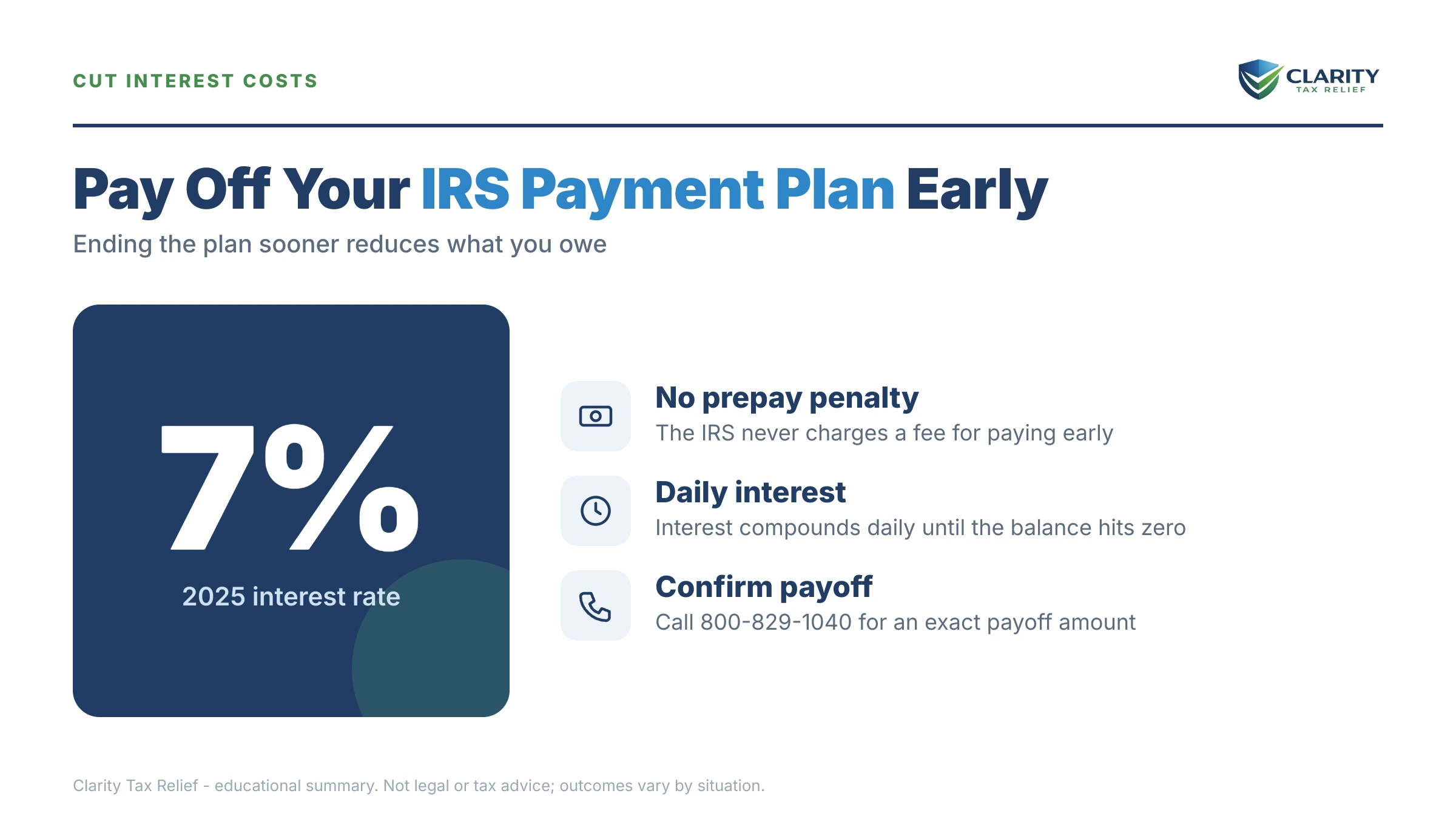
The IRS charges no prepayment penalty on installment agreements. You can pay any amount, at any time, and stop daily-compounding interest cold. Think of the plan as a running meter instead of a fixed-cost loan. Interest accrues at the federal short-term rate plus 3 percentage points, compounds daily, and resets every quarter.
On top of interest, the failure-to-pay penalty keeps posting. Normally it's 0.5% of the unpaid tax per month. The rate is cut in half to 0.25% per month while an installment agreement is in effect, which is one of the quiet benefits of being on a plan. That's still 3% a year layered on top of interest, and both charges run on whatever is unpaid, every single day, until the balance is zero.
Two more things the plan paperwork never spells out. Your setup fee is a sunk cost. Paying off early doesn't refund it, and it doesn't add anything either. (One exception: low-income taxpayers who qualified for the reduced fee on a direct-debit agreement may have that fee reimbursed when the agreement completes.) And the minimum payment the IRS quoted you was built to stretch the debt across the full term, which maximizes the months the meter runs. Every dollar above the minimum comes straight off the compounding base. You can estimate what your own balance is accruing with our Penalty & Interest Calculator, and see the rate mechanics in our guide to the installment agreement interest rate.
If you're reading this before you've even set the plan up, start with our walkthrough of how to set up an IRS payment plan online. This article assumes the plan already exists and you want out faster.
“Pay your balance in full to stop underpayment interest from accumulating daily.”
— Interest (IRS.gov)
What does staying on the plan full-term cost you?
Riding out a 72-month plan on $23,800 adds roughly $7,900 in interest and penalties by the final payment, at recent rates. The cost repeats in a cycle that runs as long as the balance exists:
- Every day: interest compounds on the unpaid balance at the federal short-term rate plus 3%.
- Every month: the 0.25% failure-to-pay penalty posts, and a CP521 notice arrives reminding you of the payment due.
- Every quarter: the interest rate can reset, and in a rising-rate quarter your carrying cost goes up mid-plan with no new paperwork.
- Every filing season: any federal refund you're owed is seized and applied to the balance, even though you're current. Details in will the IRS take your refund on a payment plan.
- Any slip: a missed IRS payment plan payment or a new unpaid balance on a fresh return opens a cure window. Miss that and you're looking at a CP523 and a defaulted installment agreement, which restores the full 0.5% monthly penalty and reopens the levy path you escaped by getting on the plan.
That last item is the underrated argument for early payoff. Every month the plan stays open is another month something can go wrong with it. A changed bank account, a payroll hiccup, or a surprise balance on next year's return can unravel a plan that was six payments from done.
About that refund offset. You usually don't get a choice, since the refund is applied automatically while you owe. It works as a free extra payment. The smarter move is to fix your W-4 withholding so you stop over-paying during the year, then put that cash toward the plan monthly instead.
Want out of your payment plan faster?
Before you send the payoff, let an experienced tax professional check one thing for free: whether penalty abatement can shrink your balance first. On multi-year plans, that review regularly changes the payoff figure. Call (888) 825-7779 or use the 2-minute form.
What are your options to pay off an IRS payment plan early?
Three ways to clear the balance faster
You have three realistic ways to pay off an IRS payment plan early: bigger monthly payments, a partial or full lump sum, or shrinking the balance itself through penalty relief before you pay. Extra payments are always allowed. Keep making your regular scheduled payment, because an extra payment doesn't replace it, and designate the extra payment to a specific tax year so it lands where you want it.
Here's what each looks like on a real-shaped scenario. Say you owe $23,800, as a single W-2 employee whose withholding came up short two years running. Assume, purely for illustration, 7% annual interest (the real rate is the federal short-term rate plus 3%, reset quarterly) plus the 0.25% monthly penalty, for a combined carrying cost of roughly 10% a year:
- Ride out the full 72 months. Retiring $23,800 with accruals takes a payment of about $441/month. Total paid: roughly $31,700, about $7,900 of it interest and penalty.
- Add $260 a month. At $700/month, the balance dies in about 40 months instead of 72. Total paid: roughly $28,000. You save about $3,700 and nearly three years of exposure.
- Lump-sum payoff at month 12. After a year of $441 payments, the payoff balance sits near $20,750. Pay it off then and your all-in total is about $26,000, saving roughly $5,700 versus the full term.
- Abate penalties first, then pay off. If your prior three years are clean, first-time penalty abatement can strip the failure-to-pay penalty and the interest charged on it before you send the payoff. Starting summer 2026, the new Automatic Exemption from Penalty (AEP) begins applying some of this relief automatically, with no request needed. Order matters. Relief granted before payoff lowers the check you write, and relief requested after means chasing a refund.
| Strategy | Monthly payment | Time to zero | Approx. total paid |
|---|---|---|---|
| Minimum payment, full term | ~$441 | 72 months | ~$31,700 |
| Add $260/month | $700 | ~40 months | ~$28,000 |
| Lump-sum payoff at month 12 | $441, then ~$20,750 once | 12 months | ~$26,000 |
| Penalty abatement first, then payoff | Varies | Varies | Lowest, if you qualify |
These figures are illustrative. Your actual rate, posting dates, and penalty history will move the numbers. The shape of the result never changes: the earlier a dollar lands, the more compounding it kills.
How to pay off your IRS payment plan early, step by step
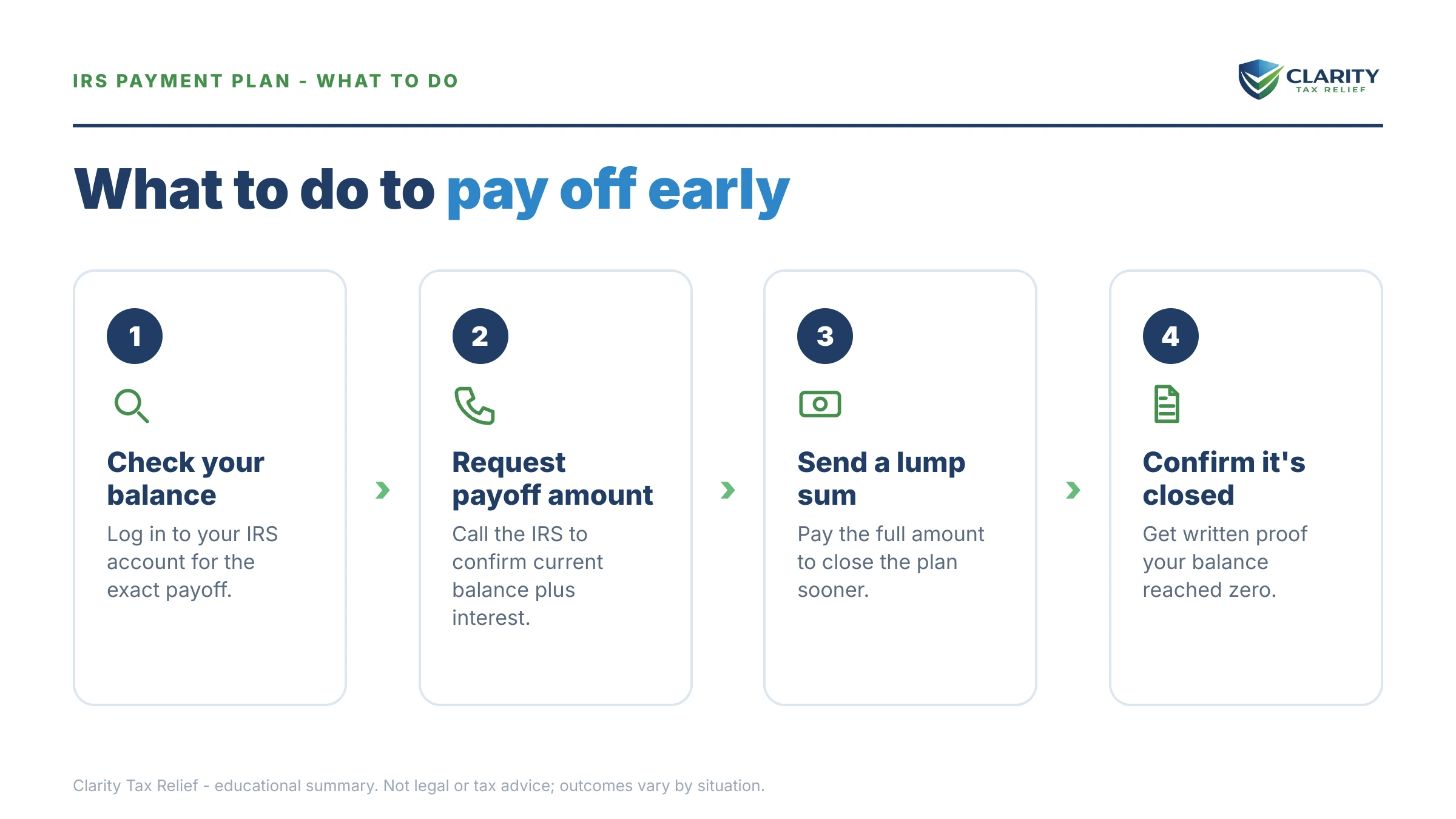
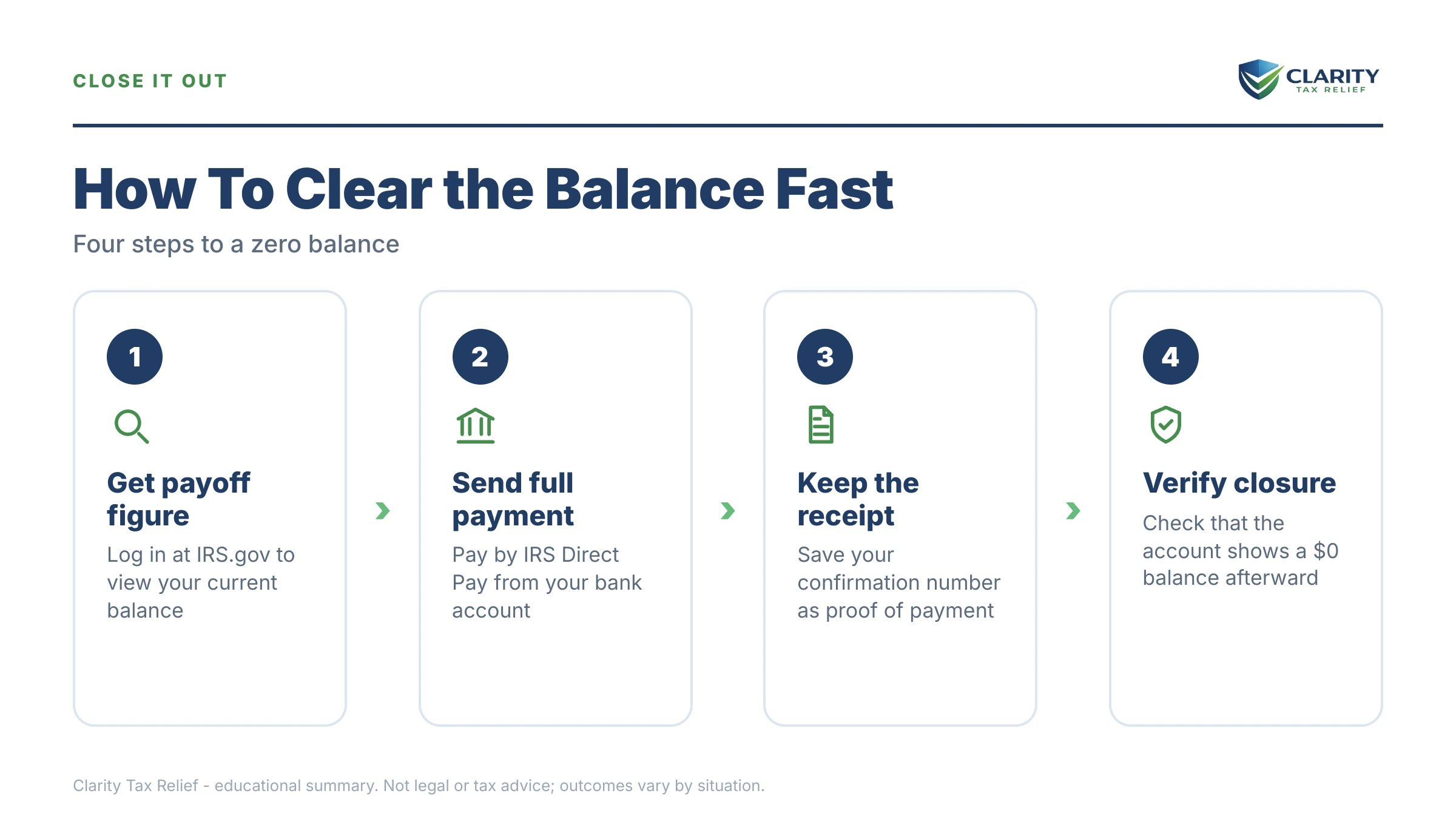
Paying off an IRS payment plan early takes five steps, and most of it happens inside your IRS online account:
- Pull your exact payoff balance. Log into your IRS online account. The balance shown includes interest accrued through the current date, broken out by tax year. A CP521 shows the balance only as of its print date, so never pay off from the notice.
- Request penalty relief before you pay. If your compliance history is clean for the prior three years, first-time penalty abatement can remove the failure-to-pay penalty, and the interest charged on it, shrinking the payoff before you send a dime. Starting summer 2026, Automatic Exemption from Penalty (AEP) applies some of this relief with no request needed.
- Send the payoff as a designated payment. Use Direct Pay or your online account, select the correct tax year, and choose installment agreement as the payment reason. Paying from a bank account costs nothing.
- Keep your scheduled monthly payment running. Don't cancel the direct debit until the balance reads zero. A skipped payment while your payoff posts can start default processing on a plan you've nearly finished.
- Verify the zero balance and close the loop. Check your online account two to four weeks later for residual interest, and if a lien was filed, confirm the IRS releases it within 30 days of full payment.
On that last step, look for a zero balance on every tax year the plan covered. A few dollars of residual interest can accrue between your payoff quote and the day the payment posts, and that scrap can generate a new bill if you ignore it. Once every year reads zero, the CP521 reminders stop and the agreement closes automatically. A lien release means the lien is satisfied. If you want it pulled from the public record entirely, for example before a mortgage application, you can request a lien withdrawal on Form 12277 after payment.
On step 3, the method you pick changes nothing about the payoff itself. It only changes what it costs to send and how fast it posts. All of these run through IRS.gov/payments:
| Payment method | Cost | What to know |
|---|---|---|
| IRS online account | $0 (bank account) | Best option. You see the live payoff balance and pay against it in one session |
| IRS Direct Pay | $0 | No login needed; select the tax year and installment agreement as the reason |
| EFTPS | $0 | Requires enrollment in advance; useful if you already use it for estimated taxes |
| Debit / credit card | Processor convenience fee | Third-party processors charge a fee; on a four- or five-figure payoff it adds up fast |
| Check or money order | $0 plus postage | Slowest to post; interest keeps accruing until it does. Include SSN, tax year, and form number |
And here is what the mail means during and after the payoff. The notices around a payment plan confuse more people than the payoff itself:
| Notice / document | When it arrives | What it means for your payoff |
|---|---|---|
| CP521 | Monthly, while the plan is open | Routine payment reminder. Its balance figure is stale the day it prints; use your online account instead |
| CP71 / CP71C | Annually, while a balance exists | Required yearly statement of what you still owe, not an escalation, but proof the meter is running |
| CP523 | Only if the plan defaults | Intent to terminate the agreement. Act inside the cure window or the plan (and its protections) ends |
| Certificate of Release of Federal Tax Lien | Within 30 days of full payment | If a lien was filed, this document shows it's satisfied. Confirm it issues; don't assume |
When is paying off early the wrong move?
Paying off early is the wrong move in at least four situations, and the biggest is a partial-pay agreement. If you're on a partial payment installment agreement, the IRS has already accepted that your payments won't cover the full debt before the 10-year collection statute runs out. Whatever remains at the CSED becomes uncollectible, though appeals, an OIC, or bankruptcy can pause and extend that date. Voluntarily accelerating a PPIA can hand the IRS money it was never going to collect. Get your CSED dates verified before you send anything extra.
The same logic applies on a regular plan covering multiple years when the oldest year's statute is close to expiring. Because you can designate voluntary payments to a specific year, pointing extra money at the newest year and letting the oldest ride toward its expiration date can be worth thousands. This is transcript work. Guessing won't do.
Third, don't drain the safety net. The plan's whole value is that it keeps enforced collection off your back for as little as the minimum payment. Emptying your emergency fund to kill a ~10%-a-year balance, then defaulting on rent or a 22% credit card two months later, is a losing trade. If you carry high-interest consumer debt, the arithmetic usually says attack the card first and keep the IRS at the minimum.
Fourth, never pull retirement money to do it. An early distribution creates new taxable income, plus a 10% additional tax if you're under 59½, and plenty of people who do this land right back on a payment plan for the following year. The full trap is laid out in our guide to the 401(k) withdrawal tax bill.
One situation cuts the other way: buying a home. Lenders treat an open IRS balance, especially one with a filed lien, as a live problem in underwriting, and paying the plan off (then confirming the lien release) is often the cleanest fix. See buying a house while owing the IRS for how underwriters look at it, and how long the IRS takes to release a tax lien once you've paid.
Married filing jointly? A joint balance is joint liability. The payoff clears both spouses at once, and any refund-protection maneuvering you were doing (like filing separately) stops being necessary the day the balance reads zero.
Can you handle this yourself?
Doing it yourself versus hiring help
Most people can pay off an IRS payment plan early with no professional help at all. If the plan covers one or two years, you agree with the balance, and there's no lien on record, the whole job is an online-account login and a bank payment. A professional adds nothing to that transaction.
Experienced help changes the outcome in narrower situations. Multiple years where payment designation and CSED timing decide which dollars to send where. Penalty histories where abatement before payoff could cut the balance meaningfully. A filed lien that needs to release, or be withdrawn, on a mortgage lender's timeline. A PPIA where paying extra may be actively against your interest. Or a business IRS installment agreement, where payroll-tax rules and trust-fund exposure make the payoff order consequential. In those cases you're paying for strategy.
Not sure which camp you're in? A free transcript-level review will tell you whether abatement or CSED timing should change your payoff. Start with the 2-minute form or call (888) 825-7779.
Terms on your payment plan, decoded
- Payoff amount: your balance including interest and penalty accrued through the day you actually pay, not the figure printed on last month's notice.
- Failure-to-pay penalty: normally 0.5% of the unpaid tax per month; reduced to 0.25% per month while an installment agreement is in effect.
- CP521: the monthly reminder statement the IRS sends while your plan is open; it stops once the balance is zero.
- Direct-debit installment agreement: a plan paid automatically from your bank account, typically confirmed on Form 433-D. The debit must keep running until payoff posts.
- CSED: the Collection Statute Expiration Date, 10 years from assessment, after which the IRS can no longer collect, though appeals, an OIC, or bankruptcy can pause the clock.
- Certificate of release: the document showing a filed federal tax lien is satisfied. The IRS must issue it within 30 days of full payment.
Common questions
Is there a prepayment penalty for paying off an IRS installment agreement early?
No. The IRS charges no prepayment penalty on installment agreements. You can double a payment, send a lump sum, or pay the whole balance the day after the plan starts. The only effect is that daily interest and the 0.25% monthly failure-to-pay penalty stop sooner. The setup fee you already paid is not refunded, but nothing new is charged for finishing early.
How do I find my exact IRS payoff amount?
Your IRS online account shows your current balance, including interest accrued through today, broken out by tax year. That is your payoff figure. A CP521 or CP71 notice shows the balance only as of its print date, so it understates what you owe now. If you can't use the online account, call the number on your notice and ask for the payoff amount as of a specific date.
Can I pay off just one year of a multi-year payment plan?
Yes. A voluntary payment can be designated to a specific tax year (select the year in Direct Pay or tell the IRS where you want it applied). People often target the newest year first when an older year's collection statute is close to expiring, or clear a single year to simplify a mortgage file. Undesignated payments get applied in the order the IRS chooses, typically the oldest liability first.
If you want the IRS's own reference on plan terms, fees, and modifications, it lives at the IRS payment plans and installment agreements page.
Bottom line
There's no prepayment penalty, and every dollar you send early stops interest and penalty from compounding on it. Pull the live balance, ask for penalty relief first, and keep the debit running until the account reads zero. The one group that should slow down is anyone on a partial-pay plan or near a CSED, where paying more can hand the IRS money it would never have collected.
Your next 24 hours
- Log into your IRS online account and write down the current balance for every tax year on the plan. That live figure, not your last CP521, is your real payoff number.
- Gather your plan paperwork: the original agreement terms (or Form 433-D), your most recent CP521, and a note of any penalties on your account. That's everything needed to check whether abatement can shrink the payoff.
- Get a free payoff review before you send the money. Interest and penalty accrue every day the balance stands, and on multi-year plans the order you pay things in changes the total. Call (888) 825-7779 or use the 2-minute form at the top of this page.
This guide is general information, not tax or legal advice for your specific situation. Eligibility for IRS programs depends on individual facts and circumstances; no outcome is guaranteed.