
IRS Payment Plans
Non-Streamlined Installment Agreement: The IRS Payment Plan Over $50,000 (2026)
The short answer: a non streamlined installment agreement is the IRS monthly payment plan for people who owe more than $50,000 or need terms beyond the streamlined limits. Unlike streamlined plans, the IRS usually requires a financial statement (Form 433-F), negotiates your payment based on ability to pay, and a federal tax lien becomes likely.
What this guide covers: what pushes an IRS payment plan out of streamlined rules, what changes above $50,000, the options you have once you're over the line, and how to set up a non-streamlined agreement without overpaying.
You added up the notices from two Schedule C years, logged into your IRS account, and there it was: a balance north of $50,000, and the online payment-plan tool that works for everyone else won't offer you terms. That wall has a name, and it has rules. This page maps them, including the paydown move that can get you around the wall entirely.
⏱ Your real clock: there's no printed deadline on this decision. The clock is accrual. Without an agreement, the failure-to-pay penalty adds 0.5% of your balance every month on top of daily compounding interest, and once your balance reaches $66,000 (the 2026 threshold), the IRS can certify your debt to the State Department and block your passport.
What makes an installment agreement "non-streamlined"?
An installment agreement becomes "non-streamlined" the moment your case falls outside the limits the IRS's computers can approve automatically. The most common trigger is an assessed balance over $50,000. Below the line, streamlined rules apply: no financial statement, terms up to 72 months, approval that's close to automatic. Above it, a human being at the IRS reviews your finances and negotiates your payment. You set it up by phone or mail, since the online tool won't take it.
These situations push you into non-streamlined territory:
- You owe more than $50,000 in combined tax, penalties and interest for individual income tax. This is the classic trigger.
- You owe less than $50,000 but can't full-pay within 72 months. If even the maximum streamlined term doesn't clear the debt, the IRS has to test your case individually.
- Your history disqualifies the shortcut. A recently defaulted agreement or certain business balances can force a manual review even at lower dollar amounts.
If you're not sure which side of the line you're on, our streamlined installment agreement guide covers the under-$50,000 rules. The general setup process lives in our walkthrough of how to set up an IRS payment plan online. This article assumes you've hit the ceiling, because what happens above it works differently.
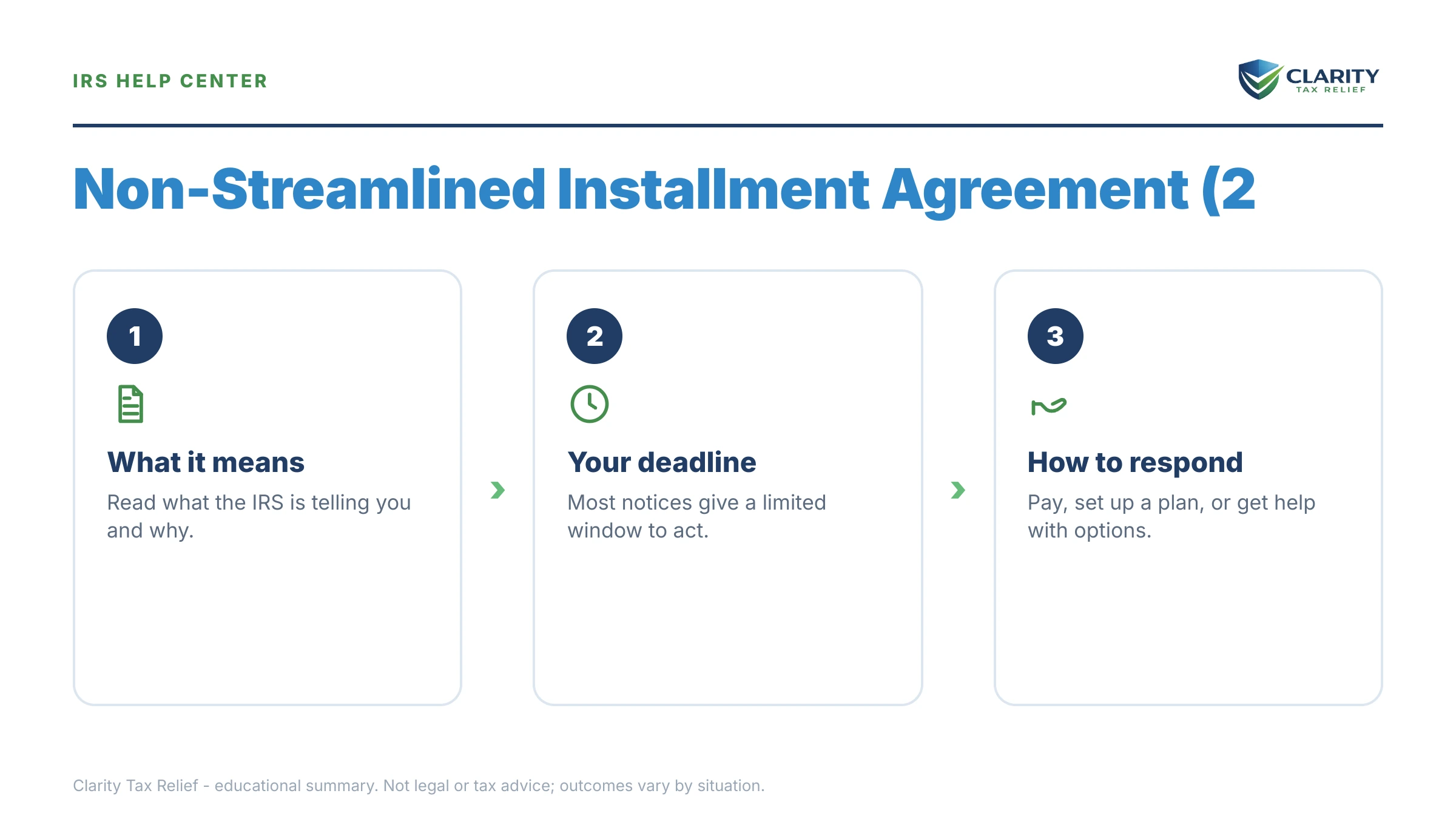
“A payment plan is an agreement with the IRS to pay the taxes you owe within an extended timeframe. You should request a payment plan if you believe you will be able to pay your taxes in full within the extended time frame.”
— Payment plans; installment agreements (IRS.gov)
What changes at the $50,000 line?
$50,000 is the point where the IRS stops taking your word for what you can pay and starts asking for proof. The differences change your paperwork, your privacy, your credit on public record, and how your monthly payment gets decided.
| Question | Streamlined (≤ $50,000) | Non-streamlined (over $50,000) |
|---|---|---|
| Financial disclosure | None | Usually Form 433-F (433-A if a revenue officer is assigned) |
| How you apply | Online in minutes | Phone or mail; possibly Form 9465 with attachments |
| Who sets the payment | You pick, up to 72 months | The IRS, based on your ability to pay and the statute |
| Federal tax lien | Generally not filed | A lien determination is required; filing is likely |
| Maximum length | 72 months | Up to the remaining 10-year collection statute |
| Direct debit | Required above $25,000 | Strongly expected; improves lien outcome |
Two rows matter most. The first is the lien determination. Non-streamlined approval requires the IRS to decide whether to file a Notice of Federal Tax Lien, a public record that attaches to everything you own and complicates refinancing or selling property. A filing isn't automatic in every case. Agreements set up with direct debit that full-pay the balance within the statute are the setups most likely to avoid one, and if a lien has already been filed, paying the agreement as promised is the main path toward withdrawal or release later.
The second is disclosure. Form 433-F opens your bank accounts, business receipts, assets and monthly expenses to IRS review, and the IRS measures your expenses against its own standards instead of your actual spending. Our Form 433-F walkthrough shows what each section asks and how the allowable-expense math works before you commit numbers to paper.
What happens if you set nothing up?
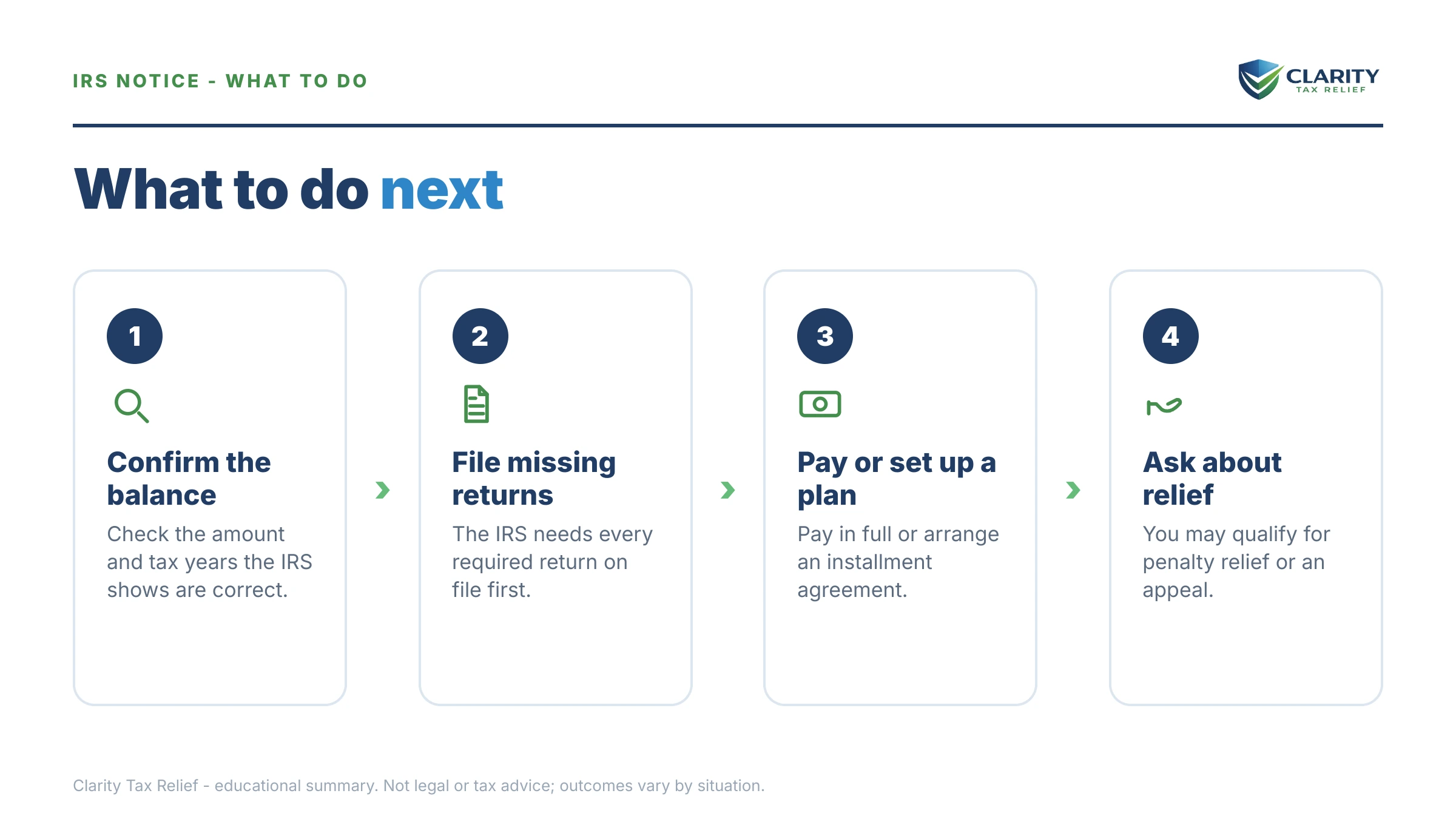
A balance over $50,000 with no agreement attached moves through the IRS collection sequence automatically. No human decides to escalate you. The system does it on schedule, in this order:
- CP14 and reminder notices (CP501/CP503): bills, each one arriving with a bigger balance as penalties and interest post.
- CP504, Notice of Intent to Levy: the IRS can now seize your state tax refund, and lien filing moves from possible to probable.
- Notice of Federal Tax Lien: at this balance level, a public lien filing is a near-certainty once collection escalates. It attaches to your home, your business assets and, if you invoice clients, your accounts receivable.
- LT11 / Letter 1058, Final Notice of Intent to Levy: this starts a 30-day clock and your Collection Due Process rights. After it passes, levies are authorized.
- Levy: bank accounts get a 21-day hold before funds leave, and a wage levy is continuous until released. For a sole proprietor, the IRS can also levy the payments your customers owe you, which cuts off cash flow at the source.
- Passport certification: once your balance reaches $66,000 (the 2026 threshold), the IRS can certify you to the State Department, which can deny or revoke your passport for tax debt.
One 2026 reality makes this sharper. The IRS workforce shrank roughly 27% in 2025, so reaching a human to negotiate takes longer than it used to, while the notice stream, lien filings and levies are automated and never slowed down. The machine escalates on time even when nobody answers the phone. Start the process early. Panic won't help.
Owe more than $50,000 and staring at the non-streamlined wall?
Get your balance and options reviewed free before another month of penalties and interest posts — an experienced tax professional will price out the paydown route, the negotiated route, and everything in between. No pressure, no obligation.
What are your options above the streamlined limit?
Above $50,000 you have five realistic paths: pay the balance down into streamlined range, negotiate a full-pay non-streamlined agreement, request a partial-pay agreement, seek hardship status, or pursue an offer in compromise. Which one fits depends on one number, what the IRS's expense standards say you can pay each month.
| Option | What it takes | Cost & timeline |
|---|---|---|
| Pay down to $50,000, then go streamlined | A lump payment that drops the assessed balance to $50,000 or less; direct debit required above $25,000 | Set up online, often same day; no financial statement; up to 72 months |
| Full-pay non-streamlined agreement | A payment that clears the debt within the collection statute; usually Form 433-F, sometimes not required up to $250,000 (ask) | Phone or mail setup; setup fee applies (lowest with direct debit, waivable for low-income taxpayers); runs until paid |
| Partial payment installment agreement (PPIA) | Verified financials proving you can't full-pay by the statute deadline; asset review | Pays less than the full debt over the remaining statute; IRS re-reviews roughly every two years |
| Currently Not Collectible (CNC) | Financials showing any payment creates hardship | Collection pauses; balance keeps accruing; lien likely; periodic income checks |
| Offer in Compromise (OIC) | Proof that assets plus future income can't cover the debt; $205 fee (waivable for low income) | Months-long review; the IRS accepted roughly 1 in 5 offers in FY2024 — a real option only when the math works |
A few details the comparison table can't hold:
Do you always need a financial statement?
Usually, yes. Balances above the streamlined limit typically require Form 433-F (or Form 433-A if a revenue officer holds your case) plus proof of income and expenses. In recent years, though, the IRS has allowed some non-streamlined agreements on balances up to $250,000 to be approved without a full financial statement, when the proposed payment full-pays the debt within the collection statute and the case is still in automated collections (no revenue officer assigned). Availability depends on your case's posture, so ask specifically when you call, before volunteering a 433-F you might not need. If your balance is in six figures, our guide to an IRS payment plan over $100k covers the revenue-officer dynamics that kick in higher up.
How long can a non-streamlined agreement last?
As long as the time remaining on the 10-year collection statute for each tax year. That is the real ceiling on any IRS payment plan. Streamlined plans cap at 72 months, and a non-streamlined plan can run longer if your statute has more time left. If even a statute-length payment won't full-pay the debt, the IRS shifts you to a partial-pay agreement instead. A standard non-streamlined agreement full-pays your balance before the statute expires. A PPIA is what the IRS grants when your verified ability to pay can't do that in the time left. PPIAs always require financials, and the IRS re-reviews them roughly every two years and can raise the payment if your income grows.
What happens to the setup fee, penalty and interest?
Every long-term agreement carries a setup fee. It's lowest when you apply with direct debit, and waived or reimbursed for low-income taxpayers (details in our IRS payment plan setup fee breakdown). Once any installment agreement is in effect, the failure-to-pay penalty drops from 0.5% to 0.25% per month, so the agreement itself cuts your monthly penalty in half. Interest keeps compounding daily on the unpaid balance for the life of the plan, at the federal short-term rate plus 3%, adjusted quarterly. Paying more than the required minimum whenever you can shortens the plan and reduces total interest.
What happens to your refunds?
While any agreement is active, the IRS keeps your tax refunds and applies them to the balance. They don't count as your monthly payment. See will the IRS take my refund on a payment plan before you plan around a refund you won't receive.
| Balance owed | Agreement type | Financial statement? |
|---|---|---|
| $10,000 or less | Guaranteed installment agreement — approval is required by statute if you full-pay within 3 years and meet compliance rules | No |
| $10,001 – $25,000 | Streamlined — online, up to 72 months, any payment method | No |
| $25,001 – $50,000 | Streamlined — online, up to 72 months, direct debit required | No |
| $50,001 – $250,000 | Non-streamlined — this article; phone/mail setup, lien determination, negotiated payment | Usually (full-pay-within-statute exception may apply) |
| Over $250,000 | Revenue-officer managed — full Form 433-A financials, asset review, active case management | Yes, always |
What does $61,200 look like for a self-employed sole proprietor?
Say you owe $61,200 across two years of Schedule C income where the quarterlies never quite got paid. Here's how the main routes price out, all figures hypothetical:
Route A, pay down to streamlined. $61,200 − $50,000 = $11,200 of paydown (in practice, pay $11,201 so the assessed balance sits at $49,999 with margin). Now you qualify for a streamlined direct-debit agreement online: $49,999 ÷ 72 months ≈ $695/month, no financial statement, no negotiation, and generally no lien filing. That paydown is often the cheapest move, the difference between disclosure and negotiation on one side and a largely automatic approval on the other. If you have savings, a credit line, or a slow-season equipment sale that can raise $11,200, this route trades one lump payment for privacy and speed. Weigh where the lump comes from, since draining an emergency fund to zero can set up next April's failure.
Route B, full-pay non-streamlined. Suppose the collection statute on your two years has about 8 years (96 months) of life left on average. $61,200 ÷ 96 ≈ $638/month is the bare arithmetic minimum. Expect the IRS to set the actual payment higher so the plan covers interest that accrues along the way, and to want full payment well before the statute's final month.
Route C, Form 433-F ability to pay. Say your Schedule C nets $6,800/month and the IRS allowable living expense standards permit $5,750 of monthly expenses for your household. Your ability to pay is $6,800 − $5,750 = $1,050/month, and that's what the IRS will ask for, even though Route B's arithmetic said $638. This is the counterintuitive core of non-streamlined negotiation: disclosure can raise your payment. The IRS tests your proposal against your 433-F, so if the standards say you can pay $1,100 a month, a $500 offer will usually be countered or rejected. A rejected installment agreement proposal carries appeal rights, and the IRS generally cannot levy while a proposed agreement is pending. If your real ability to pay is high, paying down to streamlined (Route A) may cost less per month than showing the IRS your books.
Whatever route you take, the meter matters. With no agreement, the failure-to-pay penalty alone runs 0.5% × $61,200 ≈ $306/month, before daily-compounding interest. With an agreement in place, that penalty falls to about $153/month. There's also a quiet danger at exactly this balance. You're only $4,800 below the $66,000 passport-certification threshold, and a year or so of drift in penalties and interest can push you across it. You can estimate how fast your own balance grows with our Penalty & Interest Calculator.
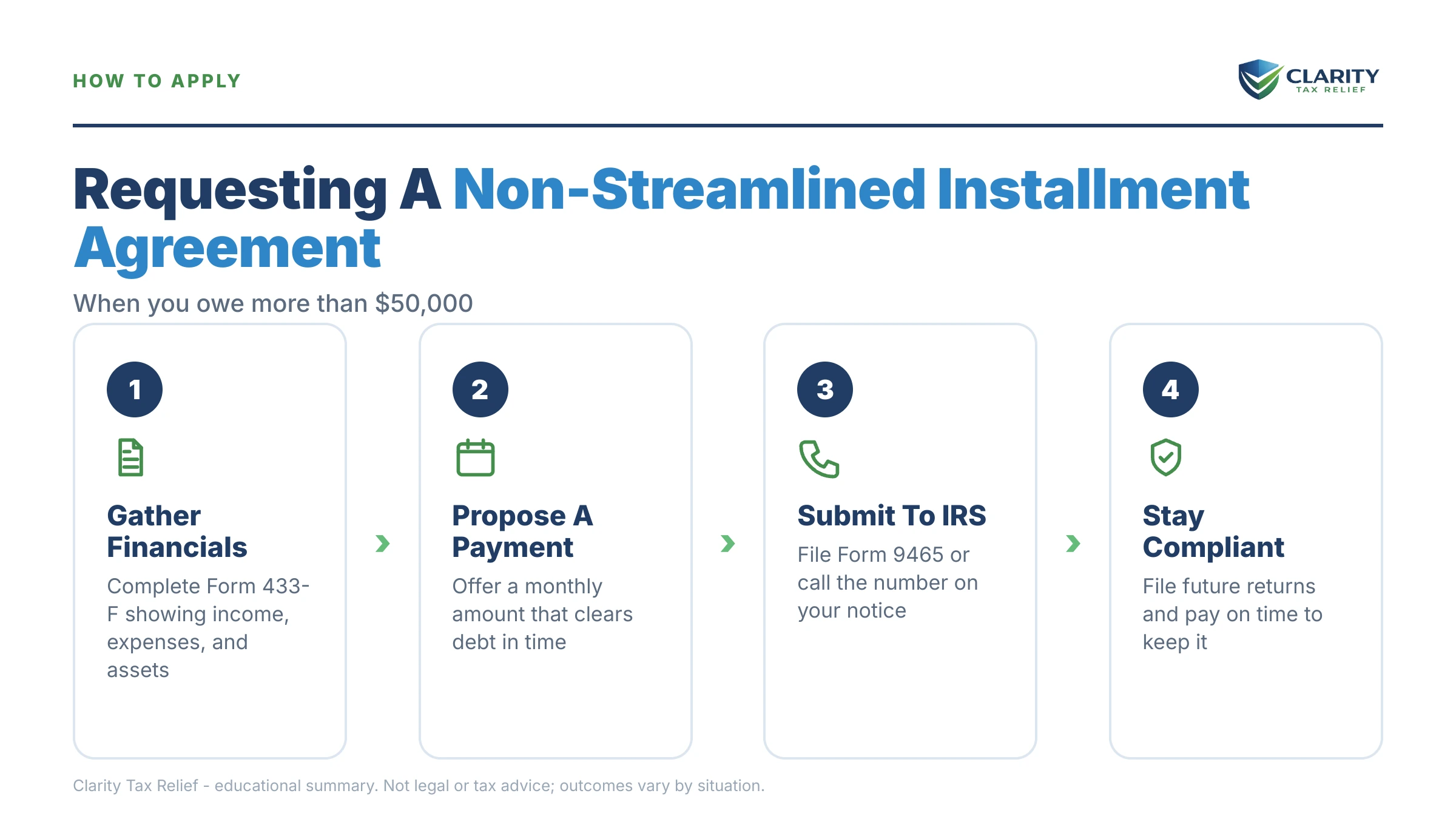
How to set up a non-streamlined installment agreement, step by step
- File every required return. The IRS will not approve any installment agreement while required returns are missing, and for most taxpayers that means the last six years. Unfiled years also block the paydown-to-streamlined route.
- Pull your exact balance and assessment dates. Log into your IRS online account and request account transcripts for each year you owe. The assessment dates drive the 10-year collection statute, which sets the ceiling on your plan length.
- Choose your route before you call. If you can pay the balance down to $50,000 or less, the streamlined path usually beats negotiating. If you can't, decide whether you'll full-pay within the statute or need a partial-pay agreement.
- Complete Form 433-F before contacting the IRS. Fill it out using the IRS allowable living expense standards instead of your actual lifestyle budget, so you know what payment the IRS math will produce before an agent runs it for you.
- Propose your payment and request direct debit. Offer an amount your 433-F supports that full-pays within the statute. Direct debit lowers the setup fee, reduces default risk, and is the setup most likely to keep a lien off the record.
- Confirm the terms on Form 433-D and stay current. Review the monthly amount and draft date before signing, then keep up with this year's estimated taxes. A new balance is the fastest way to default the agreement you just built.
Two of these steps have their own deep guides. Form 433-D is the confirmation document that locks in your terms. The choice between payment methods is covered in direct debit installment agreement, and it's worth reading before you pick, because the method affects your fee, your lien odds and your default risk all at once. If a revenue officer already holds your case, the financial statement changes too: see our Form 433-A instructions.
Self-employed? Your agreement lives or dies on this year's quarterlies
Why current-year quarterly taxes sink these agreements
Self-employed installment agreements most often default because of a new balance from the current year's unpaid estimated taxes. The monthly payment is rarely the problem. Every IRS agreement carries a compliance condition: you must stay current going forward. For a W-2 employee, withholding handles that automatically. For a sole proprietor, nothing is automatic. Skip this year's quarterlies while paying last year's plan, and next spring's return posts a new debt and terminates the agreement you worked to build.
So build the plan backwards. Set aside your quarterly estimate first, then propose a monthly payment from what's left. In the $61,200 example, offering the IRS $1,050/month while ignoring a $1,400/month quarterly obligation is a scheduled default. On your 433-F, this cuts in your favor too, because current-year estimated tax payments are a legitimate obligation in the ability-to-pay math, so document them.
If a payment does slip, act inside the cure window. One missed payment doesn't instantly kill the agreement. The IRS typically sends notice CP523, a notice of intent to terminate, and gives you a window to catch up before the agreement defaults. If it does default, the full balance becomes collectible again and levies can resume, and reinstating a defaulted non-streamlined agreement can mean fresh financial disclosure. Our guide to a missed IRS payment plan payment explains how much grace you have before that CP523 goes out.
One more sole-proprietor wrinkle. Your business and personal finances are legally the same, so a lien filed for this debt reaches business assets and receivables, and a levy can reach the invoices your customers owe you. Get the agreement in place before the LT11 stage.
Mistakes to avoid
- Filling out the 433-F with your real budget instead of the IRS standards.
- Volunteering a 433-F before asking whether the up-to-$250,000 exception applies.
- Skipping this year's quarterlies while paying last year's plan.
- Planning around a refund the IRS will apply to the balance.
- Letting penalties and interest push the balance past $66,000.
When can you handle this yourself, and when does help change the outcome?
Plenty of non-streamlined cases are DIY. If your balance is just over the line and you can pay it down below $50,000, you don't need anyone. Set up the streamlined plan online at the IRS payment plans page and you're done in an afternoon. If you agree with the balance, your finances are simple and the full-pay-within-statute math clearly works, a patient phone call (plus a completed Form 9465 if the IRS asks for one) can get it done without professional fees.
Experienced help earns its cost in a few situations:
- The 433-F math is contestable. Self-employment income is lumpy, and how business expenses, seasonal swings and required quarterlies get presented can move your payment by hundreds of dollars a month, every month, for years.
- A lien is on the table and you have a refinance, sale, or business credit line that a public filing would wreck. The sequencing of direct debit, full-pay terms and the lien determination matters.
- A levy is already in motion or a revenue officer is assigned. The negotiation posture is different and mistakes are expensive.
- The math says you can't full-pay. Then the real conversation is a partial payment installment agreement, hardship status, or an offer in compromise, and choosing wrong locks in years of overpayment.
If your case is stuck and the IRS is unresponsive, the Taxpayer Advocate Service is a free, independent avenue as well.
Maybe your 433-F draft looks worse than you expected, or you can't tell whether Route A, B or C is cheapest over the life of the debt. A free case review with an experienced tax professional at (888) 825-7779 can price all of them before you commit.
Terms in the non-streamlined process, decoded
- CSED (Collection Statute Expiration Date): the date, 10 years after each assessment, when the IRS's legal right to collect that year's debt ends. It's the true ceiling on any payment plan's length.
- Form 433-F: the short-form Collection Information Statement, the financial disclosure the IRS's automated collection unit uses to calculate what you can pay each month.
- ACS (Automated Collection System): the centralized phone-and-notice operation that handles most balances until a case is assigned to a local revenue officer.
- Notice of Federal Tax Lien: a public filing that attaches the government's claim to everything you own. Required to be considered (a "lien determination") before non-streamlined approval.
- Allowable living expenses: the IRS's national and local standards for housing, transportation, food and health costs, the caps used in ability-to-pay math instead of your actual budget.
- Full-pay vs. partial-pay: a full-pay agreement clears the debt before the CSED. A partial-pay agreement (PPIA) runs to the CSED knowing the balance won't be fully collected.
Common questions
What is a non-streamlined installment agreement?
A non-streamlined installment agreement is an IRS monthly payment plan for taxpayers who fall outside the streamlined limits, usually a balance over $50,000 or terms longer than 72 months. The IRS reviews your case individually instead of approving it almost automatically, typically asks for a financial statement on Form 433-F, and negotiates the monthly amount. You set it up by phone or mail, since the online tool won't take it.
Do I have to submit financial documents for a non-streamlined installment agreement?
Usually, yes. Balances above the streamlined limit typically require Form 433-F (or Form 433-A if a revenue officer holds your case) plus proof of income and expenses. In recent years the IRS has allowed some agreements on balances up to $250,000 to be set up without a financial statement when the payment full-pays the debt within the collection statute. Ask whether that applies to your case before you fill anything out.
Will the IRS file a tax lien if I owe more than $50,000?
A Notice of Federal Tax Lien becomes much more likely above $50,000, because non-streamlined cases require a lien determination before approval. It is not automatic in every case. Agreements set up with direct debit that full-pay the balance within the statute are the setups most likely to avoid a filing. If a lien has already been filed, paying the agreement as promised is the main path toward withdrawal or release later.
Bottom line
Above $50,000 the IRS wants proof of what you can pay, a lien determination, and a payment it sets itself. If a paydown can bring the balance to $50,000 or less, the streamlined route usually wins. If it can't, run your 433-F against the IRS standards before you call, protect this year's quarterlies, and get an agreement in place before the balance drifts toward $66,000.
Your next 24 hours
- Get your exact number. Log into your IRS online account and write down the total assessed balance and the assessment date for each year. That tells you how far you are from $50,000 (the paydown target) and from $66,000 (the passport line).
- Gather the 433-F inputs: your last filed return, three months of bank statements, your average monthly Schedule C net, and this year's quarterly estimates paid so far. Whichever route you choose, this is the file that decides your payment.
- Get the routes priced before you pick one. A free case review (the 2-minute form at claritytaxrelief.com/#consult or (888) 825-7779) compares the paydown, full-pay and ability-to-pay routes on your actual numbers, while the balance is still growing at hundreds of dollars a month in penalties and interest.
This guide is general information, not tax or legal advice for your specific situation. Eligibility for IRS programs depends on individual facts and circumstances; no outcome is guaranteed.