
Contacting the IRS
How the IRS Call Back Service Works in 2026 (Courtesy Callback)
The short answer: the IRS call back service — the agency calls it a "courtesy callback" — holds your place in the phone queue and rings you back when a live agent is free, so you don't wait on hold. It's offered automatically on select IRS lines when wait times run long, and it is completely free.
You dialed the IRS, sat through the menu, and a recording said the wait was over an hour, then offered to call you back instead of making you hold. Now you're staring at the phone wondering if that offer is real, whether you'll lose your spot, and whether the number that eventually rings will actually be the IRS or a scammer. It's a smart thing to pause on.
Here's the map. The IRS call back service is a real, free feature of the agency's toll-free lines, but it only exists when you requested it, and that distinction is exactly what tells a legitimate callback apart from a fraud call. The image below shows what the option looks like and where it appears in the phone flow, and the sections that follow walk through which lines offer it, how to use it, and how to stay safe when it rings.
⏱ The clock that matters: the phone queue has no deadline, but the balance or notice behind your call usually does. Penalties and interest keep accruing every day the issue sits unresolved, so even a callback that saves you a wasted afternoon does not pause what you owe. Reaching the IRS is a step, not a fix.
What the IRS call back service actually is
The courtesy callback is an automated queue feature that lets you hang up while keeping your position in line. When projected hold times are long, the phone system offers to ring you back at the number you provide instead of leaving you on hold. You get your afternoon back; the IRS calls when an agent reaches your spot.
Two things are worth being clear about. First, the callback is a place-holder, not a scheduled appointment. You don't pick a time, and the callback comes roughly within the estimated wait you were quoted. Second, the callback often opens with an automated recording ("please hold for the next available representative") before a real person comes on. That recorded start is normal and is not, by itself, a sign of a scam.
It's the opposite of the agency cold-calling you. If you're not sure whether the IRS ever initiates a phone call, read does the IRS call you — the short version is that unsolicited demand calls are almost always fraud, while a callback you requested is legitimate.
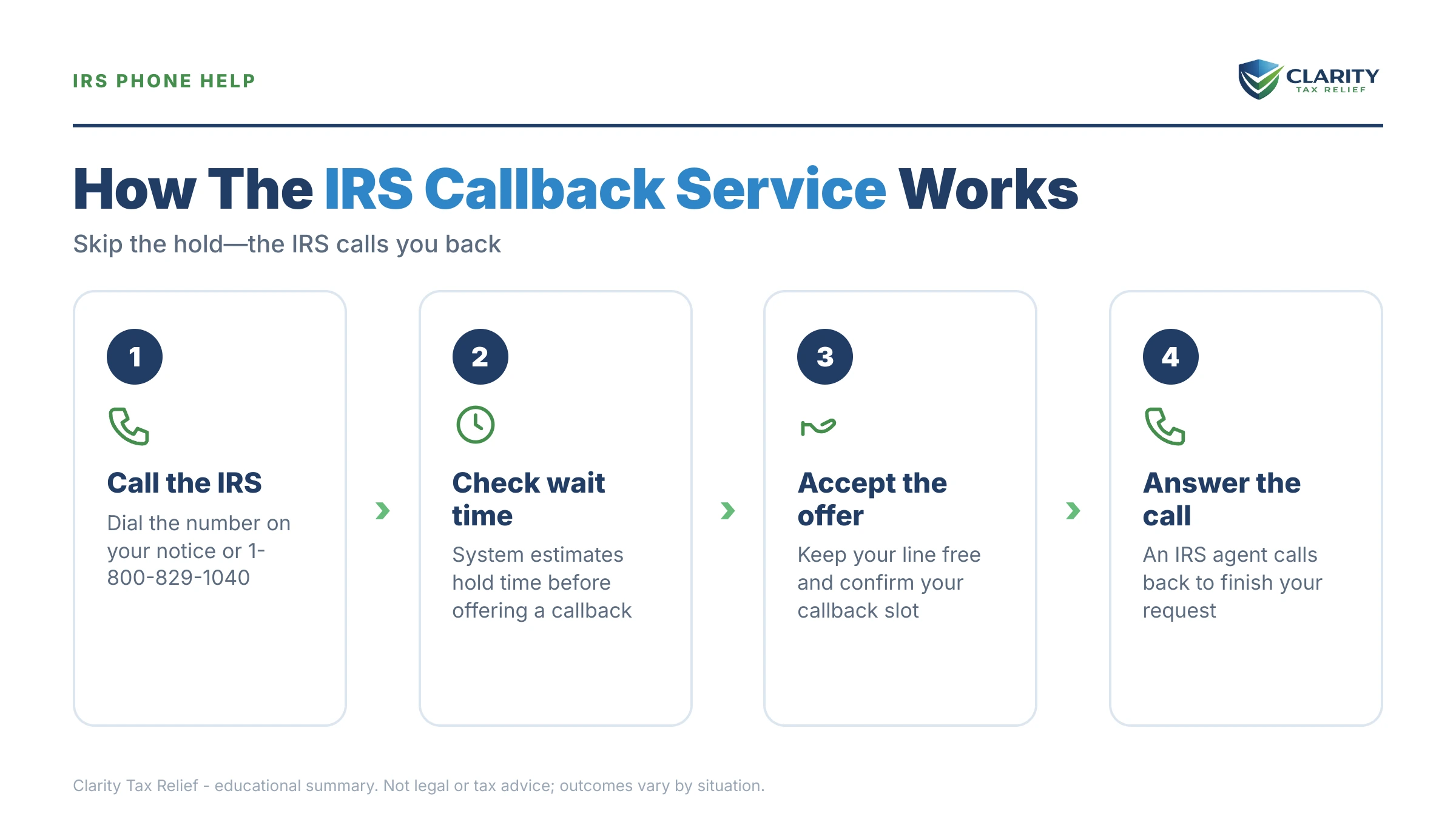
How to use the IRS call back service, step by step
Getting a callback is simple once you know the offer only appears when the line is busy. Follow the flow in order.
- Call the right line for your issue — the individual line at 800-829-1040 for a 1040 balance or notice, the business and specialty line at 800-829-4933 for a business account.
- Work through the automated menu so the system routes you toward a live-agent queue instead of dropping you at a recording.
- Listen for the callback offer — when wait times are long, the system quotes the estimated hold time and offers to call you back.
- Accept and confirm your number — choose the callback option, confirm the phone number, then hang up. Your place is held.
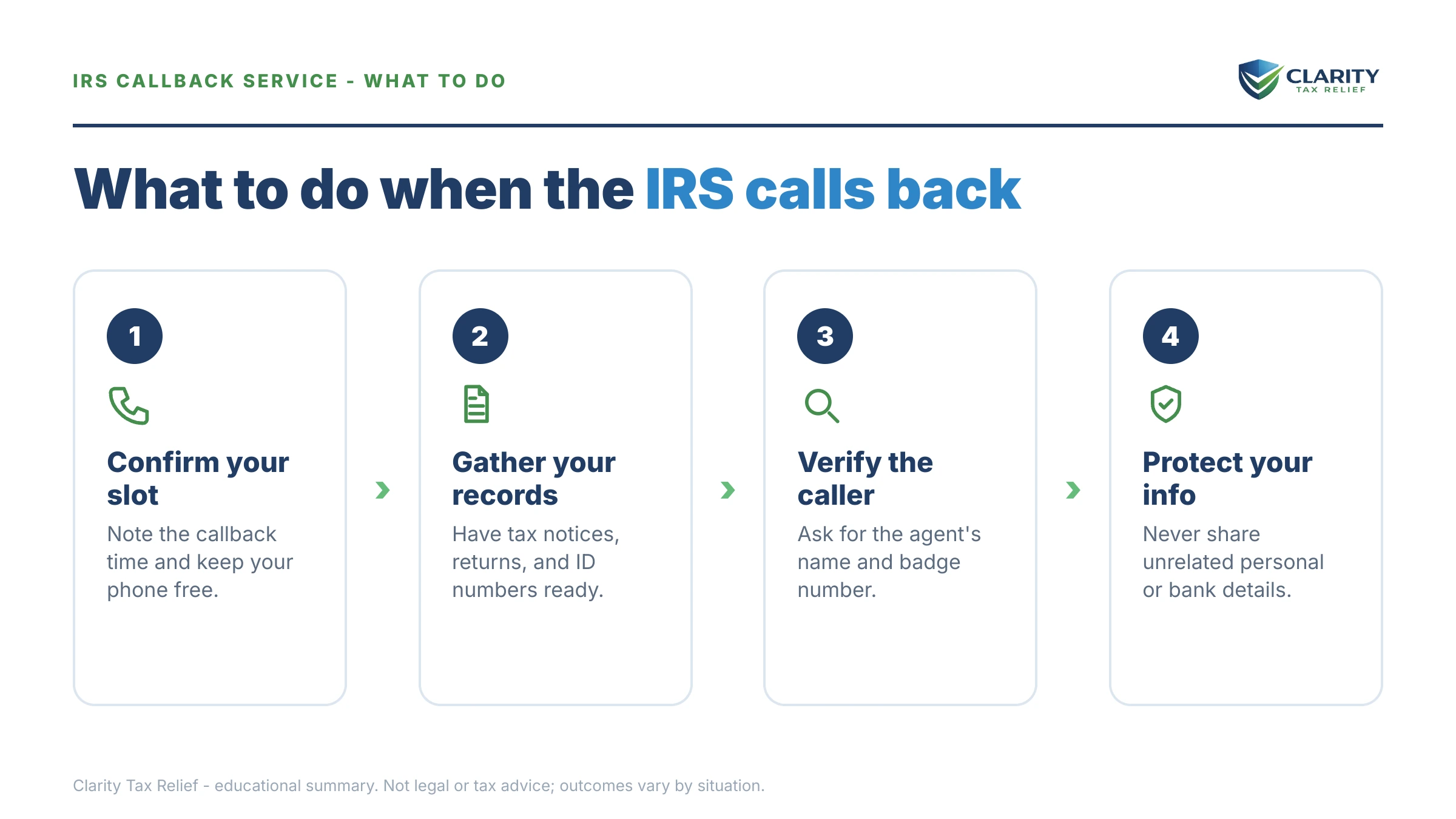
- Keep your phone and documents ready — turn off spam-blocking, keep the line free, and have your return, the notice. Your ID information in front of you.
- Answer and verify it's the IRS — a real agent confirms your identity but never demands gift cards, wires, or on-the-spot payment. If they do, hang up.
Which IRS phone lines offer a callback
The courtesy callback is offered on select live-agent lines only when projected waits are long enough to trigger it. You won't always hear it, and lines with no live agent never offer it. Use the table to reach the right number, then let the system decide whether a callback is available that day.
| Line | Number | Hours (local time) | Callback offered? |
|---|---|---|---|
| Individual (1040 balances, notices) | 800-829-1040 | Mon–Fri, roughly 7 a.m.–7 p.m. | Often, when busy |
| Business & Specialty Tax | 800-829-4933 | Mon–Fri, roughly 7 a.m.–7 p.m. | Often, when busy |
| Automated refund hotline | 800-829-1954 | 24/7 automated | No — no live agent to reach |
| Taxpayer Advocate Service | 877-777-4778 | Mon–Fri, business hours | Varies by office |
Timing changes everything. Early in the morning, mid-week (Tuesday through Thursday), and outside the January–April filing crush are your best odds of either a short wait or a working callback. If you keep hitting a wall, our guide on what to do when you can't reach the IRS on the phone covers the workarounds.
Real callback vs. scam call: how to tell the difference
The single reliable test is who started the call. A legitimate IRS callback happens only because you dialed the IRS and asked for one. A call you didn't request, that opens with threats or payment demands, is a scam — full stop. Scammers spoof caller ID, so the number on your screen proves nothing.
| Signal | Real IRS callback | Scam call |
|---|---|---|
| Who started it | You requested it on an IRS line | Out of the blue, you never called |
| Payment demand | Never asks for gift cards, wire, crypto, or apps | Demands immediate payment by those methods |
| Tone | Asks verification questions, calm | Threatens arrest, deportation, license loss "today" |
| How to verify | Hang up and call the published IRS number back | Refuses to let you verify independently |
If a call fails any of these, hang up and call the IRS back at a number you looked up yourself. For the full breakdown of how the agency does and doesn't contact you, including texts and emails, see does the IRS text you.
A hypothetical: what the callback saves you
Say you owe $8,400 on a CP14 notice and need to reach the IRS to set up a payment plan before the notice sequence escalates. You call the individual line at 10 a.m. and the recording quotes an 85-minute wait.
Option A: you hold. You burn an hour and a half, and there's a real risk the line ends in a "courtesy disconnect" before an agent answers — sending you back to square one tomorrow.
Option B: you accept the callback, hang up, and go back to work. The IRS rings you around 11:25 a.m., you set up a streamlined installment agreement, and enforcement pauses.
Either way, the math on the debt doesn't change: the failure-to-pay penalty runs at 0.5% per month — about $42 a month on $8,400 — plus interest. It keeps accruing until the balance is cleared. The callback saves your afternoon and your sanity; it does not save you a dime of penalty. That's why reaching the IRS is only step one.
What happens if you skip it (or lose the call)
If you don't use the callback or you miss it, you don't lose your tax rights. You just lose time, and time is money on an accruing balance. Here's the sequence when a phone attempt falls apart:
- You hold instead of accepting the callback — 60–120 minutes gone, and no guarantee an agent picks up.
- Courtesy disconnect — during high volume the system may say "we're unable to take your call" and hang up before any callback is offered. You've reached no one.
- You miss the callback — the automated system generally won't leave a live agent on voicemail or keep redialing, so you drop out of the queue and start over.
- Days slip by — meanwhile penalties and interest keep running, and any deadline on the notice you're calling about keeps ticking toward the next collection notice.
In 2026 that last point bites harder than it used to. IRS staffing was cut by roughly 27% during 2025, so live-agent capacity is thin. But the automated systems that mail notices and issue levies never slowed down. If you're wondering whether the cuts mean you can quietly wait things out, the honest answer is in IRS understaffed — do I still owe: the robot still collects even when the humans are gone.
Can't get the IRS on the phone, and a balance is growing?
Skip the queue entirely. A signed authorization lets an experienced tax professional call the IRS for you and read your account directly, while we figure out the fastest way to stop penalties and set up a plan. Free, confidential review.
Faster than the callback: your other options
The callback beats holding, but it's not always the fastest route to an answer. Many questions never require a live agent at all. Compare the ways to reach the IRS before you commit an afternoon to the phone.
| Method | Typical speed | Best for |
|---|---|---|
| Courtesy callback | Same day, within the quoted wait | Account questions that need a live agent |
| Holding on the line | 60–120+ minutes; may disconnect | When callback isn't offered |
| IRS online account | Immediate | Balance, payments, notices, transcripts, plan setup |
| Mailed response | Weeks | Disputing a notice with documents |
| Tax pro with Form 2848 | Often same day via priority line | Complex accounts, back taxes, plans, appeals |
Before you call at all, set up (or log into) your IRS online account. It shows your balance, posted payments, and notices instantly, and it lets you build a payment plan without ever speaking to a person. When you do need a live agent, going in with a plan matters. Our guide on what to say when calling the IRS about back taxes gives you the script.
When you can handle this yourself, and when help changes the outcome
Plenty of callers never need anyone's help. If you agree with a balance you can pay, want to confirm a payment posted, or need to set up a simple payment plan under $50,000, the callback plus your online account will get it done for free. There's no reason to hire out a five-minute task.
Where experienced help genuinely changes things is when the reason you're calling is bigger than the phone tree. Multiple unfiled years, a balance you can't pay, a levy or garnishment already in motion, business or payroll debt, or an Offer in Compromise where the math has to be built correctly. These are cases where a professional with a signed Form 2848 power of attorney calls the Practitioner Priority Service, a dedicated line with far shorter waits, and resolves the account directly. You skip the queue entirely. The order things get fixed in — returns, then penalties, then the balance — is handled to protect what you pay. If the wider context of 2026 cuts is on your mind, what IRS budget cuts mean for your case lays it out.
Terms on your call, decoded
Courtesy callback (customer callback): the free feature that holds your place in the phone queue and rings you back instead of making you hold.
Courtesy disconnect: when the IRS system hangs up during very high call volume before you reach an agent or a callback offer — you've reached no one and must call again.
Practitioner Priority Service (PPS): a dedicated IRS phone line for authorized tax professionals, generally with shorter waits than the public lines.
Form 2848: the power-of-attorney form that authorizes a professional to call the IRS and act on your account on your behalf.
IRS online account: your self-service portal at IRS.gov showing balance, payments, notices, and transcripts, often faster than any phone call.
IRS call back service questions, answered
Is the IRS call back service real or a scam?
It's real, but only when you requested it. The courtesy callback is an automated feature that rings you back after you asked the IRS phone system to hold your place in line. A callback you never requested — especially one demanding immediate payment by gift card, wire, or app — is a scam. The IRS does not cold-call to threaten arrest or seize accounts on the spot.
Does the IRS call you back the same day?
Usually yes — the callback is meant to reach you within roughly the estimated hold time you were quoted, on the same day you called. It only works during that line's operating hours, so a callback requested near closing may not connect. If you miss the call, the system typically will not keep trying, and you'll need to call again.
What number does the IRS call back from?
The callback usually shows an IRS or a generic/unfamiliar caller-ID number. It often starts with an automated recording before connecting you to an agent. Because scammers spoof caller ID, never judge legitimacy by the number alone. Verify by the substance: a real agent confirms your identity and never demands payment by gift card, wire transfer, or cryptocurrency.
Which IRS phone lines offer a callback?
The courtesy callback is offered on select lines — including the main individual line (800-829-1040) and the business and specialty line (800-829-4933) — and only when projected wait times are long enough to trigger it. Automated-only lines, such as the refund hotline, don't offer it because there's no live agent to reach. If you don't hear the offer, wait times were short enough to stay in queue.
What happens if I miss the IRS callback?
You lose your place in line and generally have to start over by calling again. The automated system does not usually leave a voicemail with a real agent or keep redialing. To avoid this, keep your phone free once you accept a callback, turn off any spam-blocking that might silence unknown numbers, and answer even if the caller ID looks unfamiliar.
Is the IRS callback service free?
Yes. The courtesy callback is a free feature of the IRS's toll-free phone lines. You are never charged to request or receive it. Anyone who asks you to pay a fee to "reserve a callback," "unlock" your account by phone, or "release" a refund is running a scam. Legitimate IRS phone help costs nothing.
Why can't I reach the IRS even with the callback option?
In 2026 the IRS workforce was cut by roughly 27% during 2025, so live-agent capacity is stretched and some calls end in a "courtesy disconnect" before any callback is offered. Calling early in the day, mid-week, and outside filing season improves your odds. When phones fail entirely, your IRS online account, mailed correspondence, or a tax professional with authorization can often do the same job.
Can a tax professional call the IRS for me?
Yes. With a signed Form 2848 Power of Attorney on file, an enrolled agent, CPA, or attorney can call the IRS on your behalf, often through the Practitioner Priority Service, a dedicated line with shorter waits than the public lines. That means you never wait on hold at all, and the professional can resolve balances, set up plans, and read your account directly.
Your next 24 hours
- Find your reason and the right line. Pull the notice you're calling about (note the tax year and any "respond by" date) and match it to the correct number — 800-829-1040 for individual, 800-829-4933 for business.
- Gather before you dial. Have your most recent return, the notice. Your Social Security number ready, and log into your IRS online account first. It may answer your question in seconds without a call at all.
- Get a free case review. If the balance is more than you can pay, you have unfiled years, or collection is already moving, let an experienced tax professional skip the queue for you — use the 2-minute form or call (888) 825-7779. Penalties and interest keep accruing every day, so the sooner it's handled, the less it costs.
This guide is general information, not tax or legal advice for your specific situation. Eligibility for IRS programs depends on individual facts and circumstances; no outcome is guaranteed.