
IRS Data Studies
How Often Does the IRS Seize Property? The 2026 Data (Just 50 Seizures vs. 339,137 Levies)
Read the transcript
Host: So you owe the IRS, the letters are getting sharper, and the thing keeping you up at two in the morning is the movie version. Agents at the door. Your car towed off to auction. That's the fear we're dealing with today.
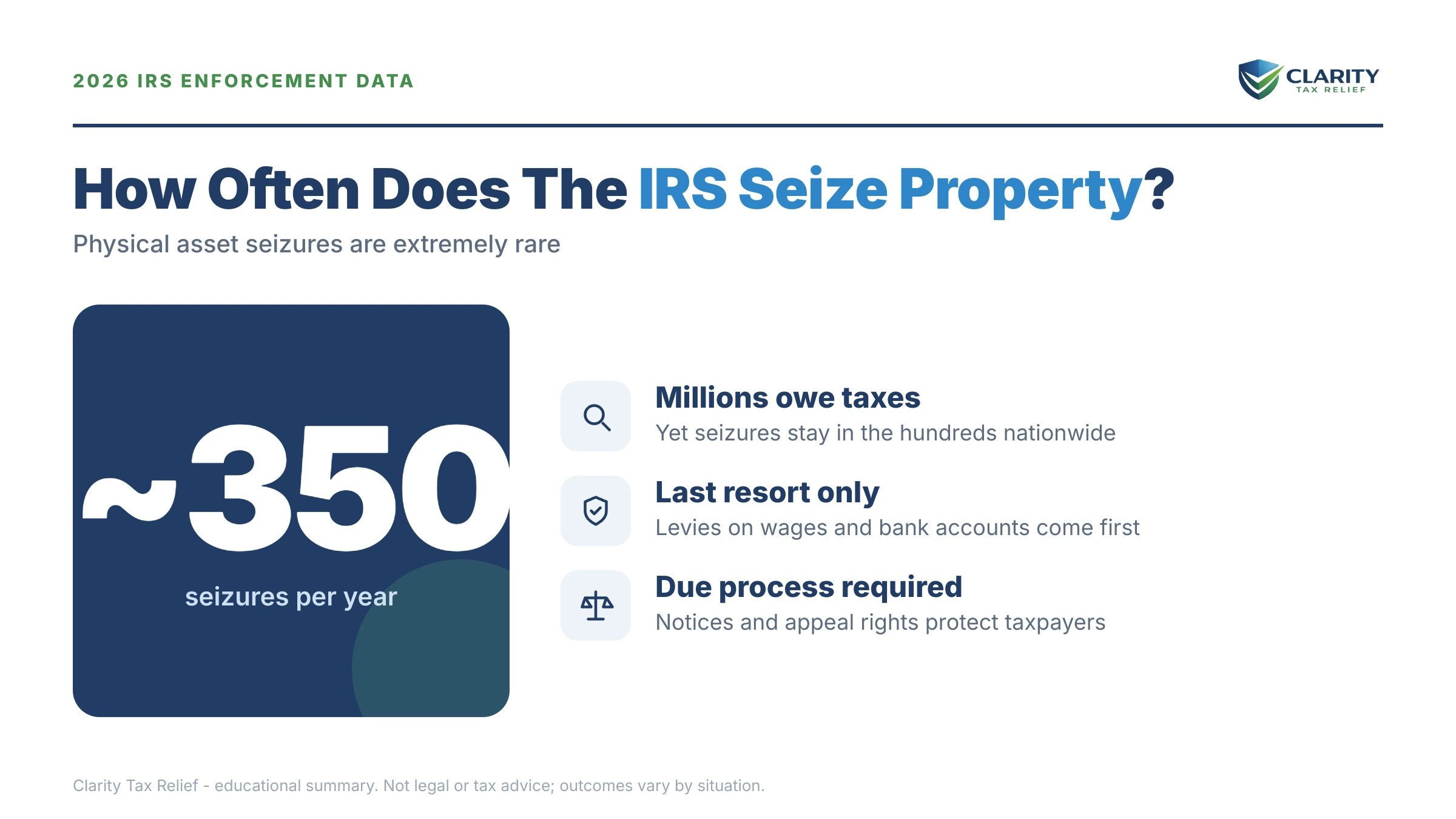
Tax specialist: And the IRS's own enforcement data says that picture is almost entirely wrong. Field Collection conducted 50 property seizures in all of FY2025. Fifty. Nationwide.
Host: Fifty. In a country of, what, three hundred forty million people.
Tax specialist: More than 340 million. And in the same year the IRS requested 339,137 notices of levy on third parties.
Host: Say that number again?
Tax specialist: 339,137 levy notices. Against 50 seizures. Run the ratio and it's roughly 6,783 levies for every one seizure.
Host: Okay, so — hold on. My instinct as a listener is to hear that and relax. Six thousand to one, they're never coming for my house, I can let this sit.
Tax specialist: That's exactly the wrong read, and it's the one people take. Rarity of seizure is not rarity of enforcement. Your house is probably not the target. Your paycheck and your bank account absolutely are.
Host: Right.
Tax specialist: Both of those numbers come from the same source, the IRS Data Book. Same agency, same year. One tool is almost never used. The other one is used hundreds of thousands of times.
Host: Why such a gap? Like structurally, why?
Tax specialist: Two reasons. First, who can do it. Seizures are conducted only by Field Collection. Those are human revenue officers working cases in person. Levies get requested by Field Collection and by the Automated Collection System, ACS, the computerized side. A computer can generate a levy notice. Only a person can padlock a building.
Host: Hm. Okay, that's the part people miss.
Tax specialist: Second reason is money. A seizure means a revenue officer has to locate the asset, verify your rights in it, get a manager to sign off, then secure it, store it, advertise it, auction it, often for a fraction of retail. A levy is a piece of mail that makes a bank hand over cash at full value. No storage, no appraiser.
Host: And there are legal guardrails on top of that, aren't there.
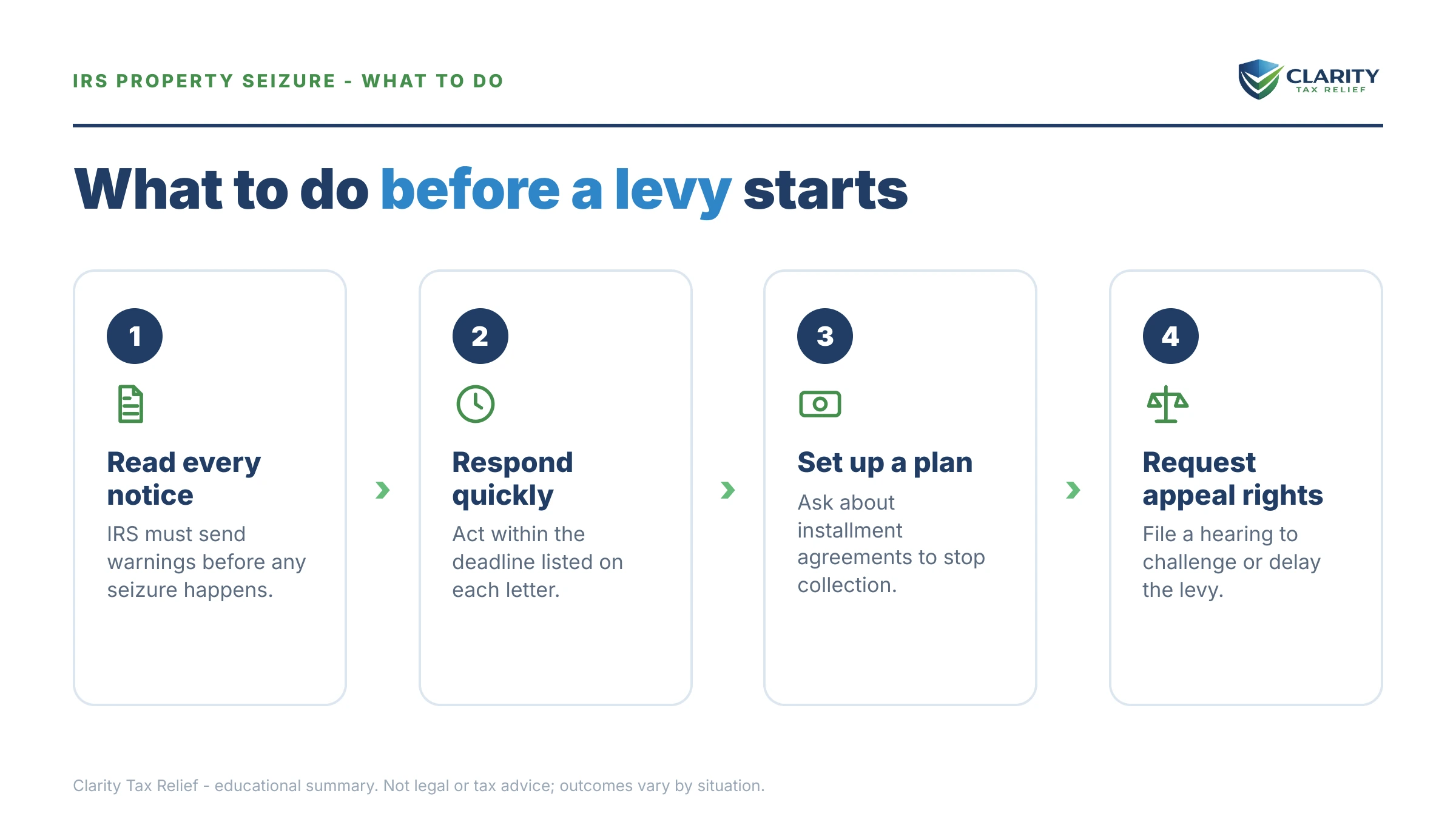
Tax specialist: Several. Before the IRS can levy or seize, it generally has to send a final notice and honor a 30-day window — we'll come back to that, it's the most important date in this whole conversation. A principal residence generally needs approval from a federal court, not just an IRS manager. And some property is exempt by statute — basic clothing, limited tools of a trade.
Host: There's also a staffing story in the numbers, right? The seizure count actually dropped.
Tax specialist: From 71 in FY2024 to 50 in FY2025. About a thirty percent drop in one year. The IRS workforce was cut roughly 27% in 2025, and Field Collection — again, the only program that seizes — shrank with it.
Host: 71 down to 50. But the automated side didn't shrink.
Tax specialist: No. The systems that issue notices and liens and levies kept running straight through the cuts. Nobody laid off the computer.
Host: So walk me through what actually reaches a person. In order of likelihood.
Tax specialist: Refund offsets first — cheapest collection there is, your federal refund gets applied to the debt automatically, and often your state one too. Then bank levies. A notice of levy freezes your account balance, and there's a 21-day hold before the money actually transfers.
Host: Twenty-one days. That's a real window.
Tax specialist: It's your last one. Then wage levies, and this is the difference that matters — a bank levy is a one-time grab of what's sitting there. A wage levy is continuous. It repeats every single paycheck until it's released.
Host: Every paycheck.
Tax specialist: Until released. Then Social Security levies — up to 15% of benefits under the Federal Payment Levy Program. And federal tax liens, which aren't a taking at all. It's a public claim that attaches to what you own and makes selling or refinancing complicated.
Host: Okay, let's do the ladder. Because I think the listener's real question is: where am I right now?
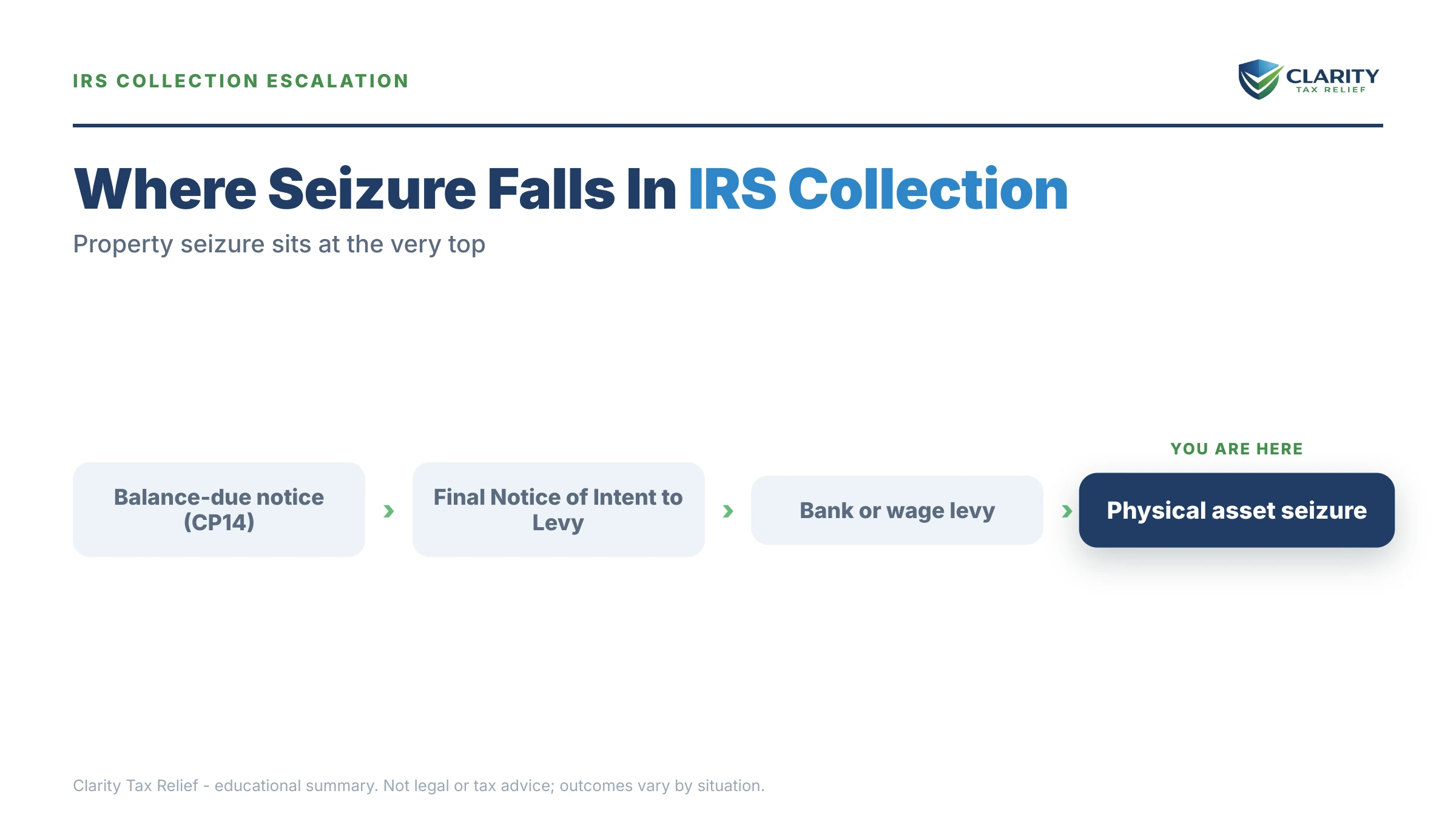
Tax specialist: The notice number in the top corner tells you. CP14 is the first bill, typically about 21 days to pay, no enforcement machinery yet. CP501 and CP503 are reminders — still just bills, but the balance grows with penalties and interest every month. Then CP504.
Host: And CP504 says intent to levy, which sounds like the end of the world.
Tax specialist: It sounds terrifying and it is not the final notice. CP504 is intent to levy your state tax refund. The true final notice is LT11 or Letter 1058.
Host: LT11 or Letter 1058. That's the one.
Tax specialist: That's the one. It starts a 30-day clock, and inside those 30 days you can request a Collection Due Process hearing on Form 12153. That request generally pauses levy action while your case is heard. Miss the 30 days and levies can begin, and on the automated side, no human has to review your file first.
Host: Wait, back up. Say the form again, simply.
Tax specialist: Form 12153. One two one five three. It's the Collection Due Process request, and it has to go in within 30 days of the date on that final notice.
Host: So what actually stops the escalation. What are the options.
Tax specialist: An active arrangement generally takes levy action off the table while it's in place. Short-term payment plan if you can pay in full within 180 days — no setup fee. There's the Guaranteed Installment Agreement, that's the statutory one under IRC 6159(c), for balances of ten thousand dollars or less with returns filed. There's the streamlined or online installment agreement — balances up to fifty thousand, up to 72 months, no detailed financial disclosure at that level.
Host: And if paying anything at all is impossible?
Tax specialist: Currently Not Collectible. No cost to request, but it requires real financial documentation showing that paying would cause hardship. Collection pauses. The debt and the interest stay. And then Offer in Compromise, where the question is whether your assets plus future income genuinely can't cover the debt. Two hundred five dollar fee plus twenty percent down on lump-sum offers, both waived with low-income certification.
Host: And I want to be careful here — you're not saying any of these are a given.
Tax specialist: Not even close. Eligibility depends entirely on your facts. On the Offer in Compromise, the article's own number is that roughly one in five offers were accepted in FY2024. That's the historical data, not a forecast about anyone's case. What you control is filing your returns, meeting the 30-day deadline, and producing accurate financials. That's it. That's the lever.
Host: There's a hypothetical in the article — thirty-one thousand two hundred dollars, W-2 earner. Is it worth walking?
Tax specialist: Briefly, and it's a hypothetical, not anybody's result. At $31,200 you're under the fifty thousand online threshold, so a 72-month plan works out to about $433 a month before interest. And the point of the example is the risk shape: that person's seizure exposure is effectively nil, because the seizure files are dominated by long-running, high-dollar, or deliberately evasive cases with a revenue officer already assigned. But their employer and their bank? Those are exactly the third parties those 339,137 notices go to.
Host: So when does someone really need help versus just doing it online.
Tax specialist: If you owe under fifty thousand, your returns are filed, and no revenue officer is involved. You can often handle that yourself online in under an hour. Where experience matters is narrower: a levy already moving inside its 21-day or 30-day window, multiple unfiled years, business or payroll tax debt, or a Field Collection case where an officer is asking for Form 433-A.
Host: Because that's the small pool.
Tax specialist: That's the pool where seizure is genuinely on the menu, yes.
Host: Okay. Next 24 hours. What do you do.
Tax specialist: Find your most recent notice and look at the number in the top corner. CP14 or CP501 means you're early. CP504 or LT11 means levy action is close. Then check your IRS online account and confirm the balance, the tax years, and whether any levy or lien activity already shows.
Host: And pull three things together.
Tax specialist: Your last filed return, every notice you've received, and a recent pay stub. That's enough to price your options. If you want a second set of eyes, call Clarity at (888) 825-7779 — our Enrolled Agents will map where you sit on that ladder. It's free and confidential.
Host: And the balance doesn't hold still while you think about it.
Tax specialist: Penalties and interest accrue every month it waits. That part's automatic too.
The short answer: how often does the IRS seize property? Almost never. IRS Field Collection conducted just 50 property seizures in all of FY2025 — versus 339,137 notices of levy on third parties. That's roughly 6,783 levies for every seizure. Your paycheck, bank account, and tax refund face far more risk than your house or car.
You owe the IRS, the letters keep getting sharper, and somewhere in the back of your mind is the picture from the movies — agents at the door, a padlock on the garage, your car towed to auction. The government's own enforcement data says that picture is almost entirely wrong. What the data also says: the IRS collects aggressively anyway — just not the way you fear.
This data study breaks down exactly how rare physical seizures are, what the IRS reaches for instead, and how to make sure a levy — the enforcement action that actually happens hundreds of thousands of times a year — never touches your money. The image below shows how lopsided the IRS's enforcement mix really is, and exactly where the real risk sits.
⏱ The clock that actually matters: there's no seizure countdown printed on any early notice, but before the IRS can levy or seize anything, it must send a final notice (LT11 or Letter 1058) and wait 30 days. That 30-day window is when you can request a Collection Due Process hearing and stop enforcement before it starts. Until you resolve the balance, penalties and interest keep accruing every month.

How often does the IRS seize property? The FY2025 numbers
The IRS physically seized property just 50 times in all of FY2025 — versus 339,137 levies — proving seizures are the rare exception, not the rule. Those figures come straight from the IRS's own annual Data Book. The gap between them is the single most misunderstood fact in tax collection.
The trend is downward, too. Field Collection conducted 71 seizures in FY2024 and 50 in FY2025 — a 30% drop in one year, across a country of more than 340 million people. Meanwhile, the IRS requested 339,137 notices of levy on third parties in FY2025 alone. Run the ratio and levies outnumber seizures by roughly 6,783 to 1.
| Enforcement action | FY2024 | FY2025 |
|---|---|---|
| Property seizures (conducted only by Field Collection) | 71 | 50 |
| Notices of levy requested on third parties (ACS + Field Collection) | — | 339,137 |
| Levies per seizure | — | ~6,783 to 1 |
One structural detail explains a lot of that gap. Seizures are conducted only by the Field Collection program — human revenue officers working cases in person. Levies, by contrast, are requested by both the Automated Collection System (ACS) and Field Collection. A computer can generate a levy notice; only a person can padlock a building. For the year-over-year enforcement picture across every IRS action, see our full IRS seizure statistics study and the companion IRS levy statistics breakdown.
“An IRS levy permits the legal seizure of your property to satisfy a tax debt. It can garnish wages, take money in your bank or other financial account, seize and sell your vehicle(s), real estate and other personal property.”
— Levy (IRS.gov)
Why IRS property seizures are so rare
Seizures are rare because they are the slowest, most expensive, most heavily supervised action the IRS can take. Every seizure requires a revenue officer to locate the asset, verify the taxpayer's rights in it, get managerial sign-off, then secure, store, advertise, and auction the property, often for a fraction of its retail value. A levy, by comparison, is a piece of mail that makes a bank hand over cash.
Several legal guardrails narrow the funnel further:
- Notice and hearing rights come first. The IRS must issue a final notice of intent to levy and honor the 30-day Collection Due Process window before enforcement — outside of rare jeopardy situations.
- Principal residences get extra protection. Seizing a primary home generally requires approval from a federal court, not just an IRS manager — one reason home seizures are a sliver of an already tiny number. Our guide to whether the IRS can take your house — can the IRS take my house — covers those protections in detail.
- Some property is exempt by statute. Federal law shields categories like basic clothing and limited tools of a trade from seizure.
- Levies simply pay better. Cash from a bank account or paycheck arrives at full value with no auction, no storage, and no appraiser.
The FY2024-to-FY2025 drop from 71 to 50 has a staffing story behind it: the IRS workforce was cut roughly 27% in 2025, and Field Collection, the only program that conducts seizures, shrank with it. The catch is that the automated side didn't slow down the same way. Notices, liens, and levies are generated by systems that never got laid off. If your case escalates to an IRS revenue officer, you've entered the small pool where seizure is genuinely on the menu, and where the deep-dive on IRS seize property rules becomes required reading.
What the IRS takes instead of physical property
The collection tools that reach your money
For every one seizure in FY2025, the IRS issued roughly 6,783 levies, and levies reach money, not furniture. If you owe and do nothing, these are the tools that will actually touch you, roughly in order of likelihood:
- Refund offsets. The cheapest collection there is: your federal (and often state) refund is applied to the debt automatically. The scale is documented in our treasury offset program refund seizure statistics study.
- Bank levies. A notice of levy freezes the balance in your account; there's a 21-day hold before the funds transfer to the IRS. Your last window to act. See IRS bank levy 21 days for exactly how that window works.
- Wage levies. Unlike a bank levy, a wage levy is continuous. It repeats every paycheck until released. You can estimate how much of your paycheck is exposed with our wage garnishment calculator.
- Social Security levies. Up to 15% of benefits can be taken through the Federal Payment Levy Program.
- Federal tax liens. Not a taking at all, but a public claim that attaches to everything you own and complicates selling or refinancing. The distinction matters — see IRS lien vs levy.
Read the data honestly and the message is double-edged: your house is almost certainly safe, and your money almost certainly isn't. Rarity of seizure is not rarity of enforcement.
What happens if you ignore the notices
Every one of the 339,137 FY2025 levies started the same way: a balance due and a sequence of unanswered letters. The ladder is automated, and each rung carries more power than the last:
- CP14 — the first bill. Typically about 21 days to pay before the sequence continues. No enforcement yet; the cheapest moment to fix anything.
- CP501 / CP503 — reminder notices. Still just bills, but the balance grows monthly with penalties and interest.
- CP504 — intent to levy your state tax refund under IRC §6331(d). Despite the alarming title, it is not the final notice — the CP504 notice guide explains what it can and can't do.
- LT11 / Letter 1058 — the true final notice of intent to levy. A 30-day clock starts, along with your Collection Due Process rights. Full breakdown in our LT11 notice guide.
- Levies begin — bank accounts (21-day hold), wages (continuous), Social Security (up to 15%), payments owed to you by clients or platforms.
- Field Collection assignment — larger, older, or business cases can be routed to a revenue officer. This is the only path that ends in one of those 50 seizures: vehicles, business assets, real estate, sold at auction.
The deadlines-and-rights view of that same ladder:
| Notice / stage | Your window | The right at stake |
|---|---|---|
| CP14 (first bill) | Typically 21 days | Resolve before any enforcement machinery starts |
| CP504 (intent to levy state refund) | Pay-by date on the notice | Keep your state tax refund out of the debt |
| LT11 / Letter 1058 (final notice) | 30 days | Collection Due Process hearing via Form 12153 — miss it and levies can begin |
| Bank levy issued | 21-day hold | Last chance to show hardship or error before funds transfer |
| Seizure (Field Collection only) | Before the sale date on the seizure notice | Pay or arrange a resolution to stop the auction |
Notices stacking up and not sure which rung you're on?
Seizure is rare. But the levy that hits your paycheck or bank account is not. The automated system doesn't wait for a human to review your file. Send us your latest notice and an experienced tax professional will map exactly where you stand and what stops the escalation — free, confidential, no pressure.
Your options before enforcement starts
Every resolution option below generally takes levies, and by extension seizure — off the table while it's active. The IRS enforcement data has a clear implication: taxpayers who get into any arrangement almost never appear in these statistics. If you want the full self-guided walkthrough of each program, our hub on how to settle tax debt yourself covers the mechanics. Here's the eligibility map:
| Option | Typical eligibility | Cost to set up | Enforcement effect |
|---|---|---|---|
| Short-term payment plan | Can pay in full within 180 days | $0 setup fee | Escalation stops while you pay; interest and penalties continue |
| Guaranteed installment agreement | Balance of $10,000 or less, returns filed | Standard setup fee | IRS must accept if criteria are met; levies generally off while active |
| Streamlined / online installment agreement | Balance up to $50,000; up to 72 months online | Setup fee (lower with direct debit) | No financial disclosure needed at streamlined levels; enforcement paused |
| Currently Not Collectible (CNC) | Financials show paying would cause hardship | $0, but requires financial documentation | Collection paused; debt and interest remain |
| Offer in Compromise (OIC) | Assets + future income genuinely can't cover the debt | $205 fee + 20% down for lump-sum offers (both waived with low-income certification) | Levy action generally held while the offer is pending; roughly 1 in 5 offers accepted in FY2024 |
A worked example: where a $31,200 balance actually sits on this map
Say you're a W-2 employee filing single and you owe the IRS $31,200 across two tax years. Here's what the enforcement data means for you, specifically:
- Seizure risk: effectively nil. A wage-earner with a filed-return balance in the low five figures is not one of the 50 FY2025 seizure cases. Those are dominated by long-running, high-dollar, or deliberately evasive files worked by revenue officers.
- Levy risk: very real if you stall. Your W-2 employer and your bank are exactly the third parties those 339,137 levy notices go to. Once an LT11's 30 days pass, ACS can reach your paycheck without a single human reviewing your file.
- The fix is routine. At $31,200 you're under the $50,000 online threshold, so a 72-month installment agreement is available without detailed financial disclosure: $31,200 ÷ 72 ≈ $433 a month before interest. Because interest and the 0.5%-per-month failure-to-pay penalty keep accruing on the shrinking balance, paying faster than the minimum saves real money.
- Side benefits: you're below the $66,000 passport-certification threshold for 2026, and an active agreement keeps you off the lien-and-levy track entirely.
This is a hypothetical, not a client result. But the math is the math: for most wage earners, one online payment plan converts "will they take my stuff?" into a fixed monthly bill.
How to respond, step by step
- Find your last IRS notice. The notice number in the top corner tells you where you are: CP14 or CP501 means you're early; CP504 or LT11 means levy action is close.
- Check your balance in your IRS online account. Confirm the amount, the tax years, and whether any levy or lien activity already shows before you choose a fix.
- Request a CDP hearing if an LT11 clock is running. File Form 12153 CDP hearing within 30 days of the final notice date. It generally pauses levy action while your case is heard.
- Set up a resolution before enforcement starts. A payment plan, Currently Not Collectible status, or a pending Offer in Compromise generally keeps levies, and seizure — off the table while it's active.
- Get an experienced review if a revenue officer is assigned. Field Collection handles every seizure the IRS conducts — if your case is there, experienced representation matters most.
When you can handle this yourself
If you owe under $50,000, your returns are filed, and no revenue officer is involved, you can usually resolve this online in under an hour. A short-term plan (180 days, no setup fee) or a streamlined installment agreement requires no negotiation and no financial disclosure, and either one keeps you out of every statistic in this study.
Experienced help changes outcomes in a narrower set of situations: a levy already in motion inside its 21-day or 30-day window, multiple years unfiled, business or payroll tax debt, a Field Collection case with a revenue officer asking for Form 433-A, or an Offer in Compromise where the asset-and-income math decides everything. Those are the cases where the difference between the right move and the almost-right move is measured in thousands of dollars, and occasionally in whether an auction happens at all.
Terms in this study, decoded
- Seizure — the IRS physically taking property (a vehicle, equipment, real estate) to sell at auction; 50 occurred in FY2025.
- Levy — a legal taking of money or rights to money, usually via a notice mailed to a bank, employer, or payer.
- Notice of levy on third parties — the levy document sent to someone who holds your money (bank, employer, client); 339,137 were requested in FY2025.
- Field Collection — the IRS program of in-person revenue officers; the only program that conducts seizures.
- Automated Collection System (ACS) — the IRS's computerized collection arm; it issues notices and levies by mail but cannot seize physical assets.
- Collection Due Process (CDP) — your right, after a final notice, to a hearing that generally pauses enforcement. Requested on Form 12153 within 30 days.
- CSED — the collection statute expiration date: the IRS generally has 10 years from assessment to collect, though appeals, offers, and bankruptcy can pause that clock.
IRS seizure questions, answered
How many properties does the IRS actually seize each year?
In FY2025, IRS Field Collection conducted just 50 property seizures nationwide, down from 71 seizures in FY2024. Compare that with 339,137 notices of levy on third parties in FY2025 — bank accounts, wages, and payments owed to you. Seizure is the rarest tool the IRS uses, reserved for cases where levies have failed or been deliberately dodged, almost always with a revenue officer already assigned.
Can the IRS really take my house?
Can the IRS take your home?
Legally yes, practically almost never. A principal residence can generally only be seized with federal court approval. The IRS must show the debt can't reasonably be collected another way. With only 50 seizures of all property types in FY2025, homes are a tiny slice. If you have equity, the more realistic risk is a federal tax lien attaching to the home and complicating a sale or refinance.
What is the difference between an IRS levy and a seizure?
A levy takes money or rights to money — a bank balance, part of your paycheck, a payment a client owes you — usually by mailing a notice to a third party. A seizure takes physical property, like a vehicle, equipment, or real estate, which the IRS then sells at auction. Levies are largely automated and common; seizures require a revenue officer and layers of approval, and happened only 50 times in FY2025.
Who at the IRS has the power to seize property?
Only the Field Collection program, revenue officers who work cases in person, conducts seizures. The Automated Collection System (ACS), which sends most collection notices and issues levies by mail, cannot seize physical assets. Both ACS and Field Collection request levies, which is a big part of why levies vastly outnumber seizures. If a revenue officer has been assigned to your case, you are in the small pool where seizure is genuinely possible.
How much warning do I get before the IRS levies or seizes anything?
A lot. You'll receive a series of notices — CP14, CP501/CP503, CP504 — and then a final notice, LT11 or Letter 1058, that starts a 30-day clock before levy action can begin. Within those 30 days you can request a Collection Due Process hearing on Form 12153, which generally pauses enforcement while your case is heard. Enforcement without that notice sequence is limited to rare jeopardy situations.
Why did IRS seizures drop from 71 to 50?
The IRS workforce shrank roughly 27% in 2025, and seizures are the most labor-intensive action the agency takes — each one needs a revenue officer to value, secure, advertise, and auction the property. Fewer field staff means fewer seizures. But automated levies did not slow the same way: the computer systems that issue notices of levy kept running straight through the staffing cuts.
If seizures are so rare, can I just ignore my tax debt?
No — rarity of seizure doesn't mean rarity of enforcement. The IRS issued 339,137 notices of levy on third parties in FY2025. It can also offset your tax refunds, take up to 15% of Social Security benefits, file a public federal tax lien, and certify your passport for revocation once your debt tops $66,000 in 2026. Penalties and interest compound monthly, so the debt gets more expensive, not forgotten.
Your next 24 hours
- Find your latest notice number and date. It's in the top corner of the most recent IRS letter. That one code tells you whether you're weeks or days from a levy window.
- Gather three things: your last filed return, every IRS notice you've received, and a recent pay stub. That's everything needed to price your options.
- Get a free case review. Call (888) 825-7779 or use the 2-minute form — an experienced tax professional will tell you exactly which arrangement keeps your paycheck and bank account off the levy list. The balance grows with penalties and interest every month it waits; the review costs nothing.
Source data: all seizure and levy figures in this study come from the IRS's annual IRS Data Book (Publication 55-B). Payment arrangement details are on the official IRS payment plans page, and independent help is available through the Taxpayer Advocate Service.
This guide is general information, not tax or legal advice for your specific situation. Eligibility for IRS programs depends on individual facts and circumstances; no outcome is guaranteed.