
IRS Data & Studies
IRS Refund Delays Statistics: 30 Million Suspended Returns and 3.6 Million Late Refunds (2026 Data Study)
What this episode covers
- What does it mean when the IRS suspends a tax return from normal processing?
- Why shouldn't I file a second tax return while my refund is still processing?
- What do IRS transcript codes 570, 810, and 971 mean?
- Does a frozen IRS refund stop IRS collection on a different tax year?
The short answer: the key IRS refund delays statistics for FY2025 — more than 30 million individual tax returns were pulled out of normal processing, and 3.6 million taxpayers waited past the IRS's normal timeframe for their refund, an average of seven weeks for e-filers and 14 weeks for paper filers.
You filed months ago. "Where's My Refund" hasn't changed, the money you budgeted for rent or the credit card is still sitting in a government account, and nobody will tell you why. The IRS refund delays statistics below explain what actually happened to your return, and the data shows you are anything but alone.
Every number in this study comes from the National Taxpayer Advocate's 2025 Annual Report to Congress and a companion Treasury report. The image below shows how those tens of millions of suspended returns stack up across the five categories the IRS tracks — one category dwarfs all the others.
⏱ The real clock: a delayed refund has no printed deadline, but if your return is held for identity verification, nothing moves until you verify. Every day you wait to answer an IRS letter is added to the back end of your wait. A frozen refund does not pause collection on any balance you owe for other years.

IRS refund delays statistics: the 2025 filing season at a glance
The IRS processed more than 165 million individual income tax returns in 2025, and roughly one in five of them left the normal automated pipeline at some point. About 94% of returns were e-filed and 6% (about 11 million) arrived on paper. Approximately 104 million taxpayers (63%) received refunds, with an average refund of $3,167 — a figure we break down further in our average tax refund data study.
| Measure | 2025 figure |
|---|---|
| Individual returns processed | More than 165 million |
| Filing method split | About 94% e-filed; 6% (about 11 million) on paper |
| Taxpayers receiving refunds | Approximately 104 million (63%) |
| Average refund | $3,167 |
| Returns suspended during processing | More than 30 million (33,544,912 across five categories) |
| Taxpayers refunded past normal timeframes | About 3.6 million |
| Average delay beyond normal processing | Seven weeks for e-filers; 14 weeks for paper filers |
| Interest paid on delayed refunds | More than $2.6 billion in 2025 (as of Nov 30, 2025), per a Treasury Department report |
Run the arithmetic and the odds come into focus: 3.6 million delayed refunds out of approximately 104 million issued is roughly 1 in 29 refund recipients — about 3.5%. For year-over-year trends in wait times themselves, see our broader irs refund delay statistics study. This page focuses on the mechanism behind the delays — suspended returns.
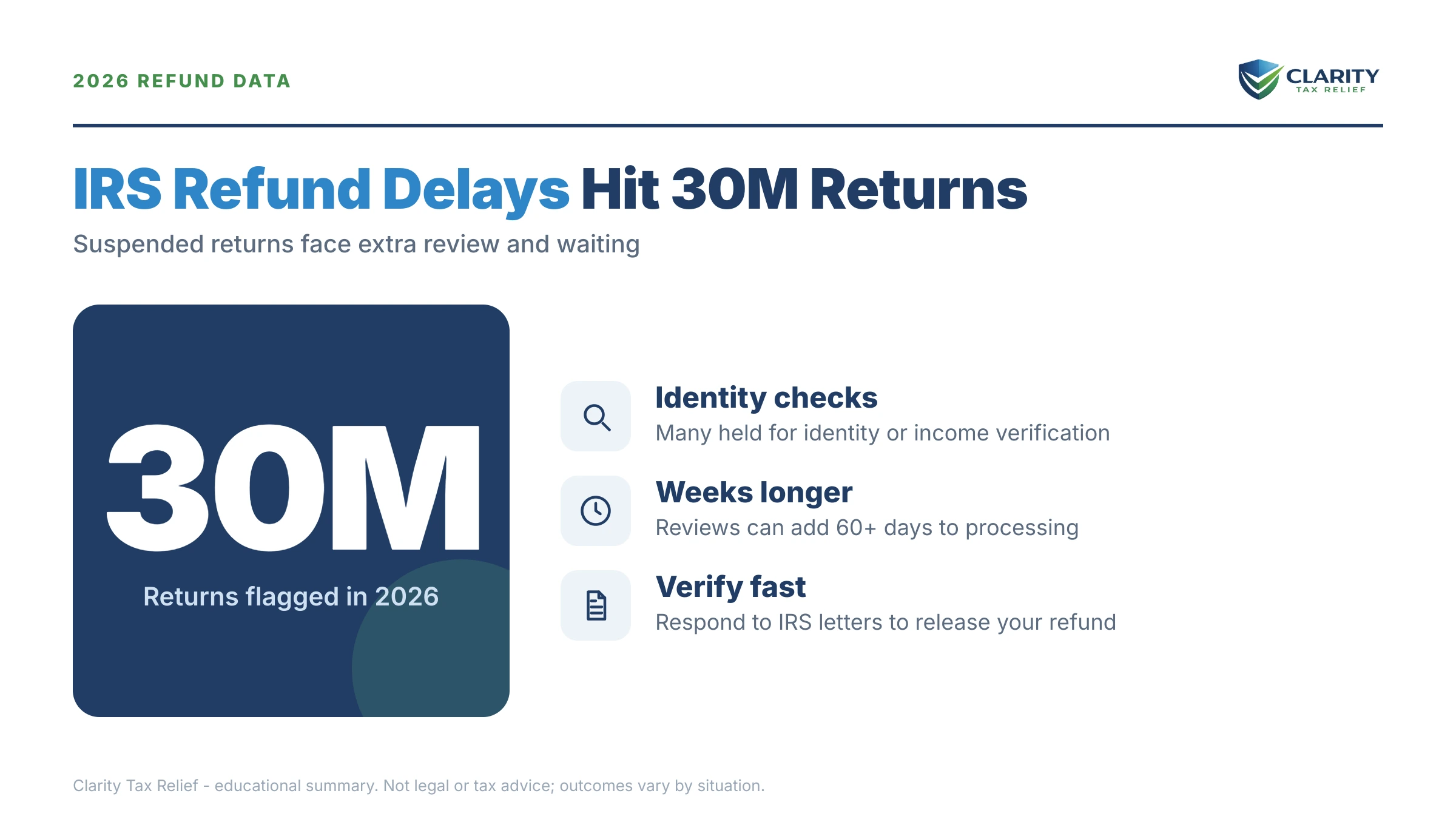
Why refunds were delayed: 33.5 million returns pulled from processing
More than 30 million individual income tax returns were suspended during processing in FY2025 — 33,544,912 in total across the five categories the National Taxpayer Advocate tracks in Figure 1.1.1 of its 2025 Annual Report. "Suspended" means the return hit a filter, left the automated pipeline, and sat waiting for extra handling, sometimes by a computer, often by a human who may not get to it for weeks.
| Suspense category | Returns suspended (FY2025) | What it means for your refund |
|---|---|---|
| Unpostables | 17,731,621 | The return couldn't post to your account, often a name/SSN mismatch, a duplicate filing, or a conflict with what's already on your account. |
| Error Resolution Cases | 9,045,056 | A math error, missing form, or inconsistency sent the return to the Error Resolution System for correction before the refund can release. |
| Suspected ID Theft Returns | 2,914,180 | An identity filter flagged the return; the refund is frozen until identity is confirmed, usually via a 5071C-type letter. |
| Processing Rejects | 2,828,923 | The return failed a validity check during intake and needs correction or a response from you before it can be processed. |
| Suspected Fraudulent Returns | 1,025,132 | A fraud filter froze the refund entirely pending review, often visible as a code 810 on your transcript. |
| Total | 33,544,912 | Every one of these returns left normal processing at least once in FY2025. |
Two of those categories deserve a closer look. Unpostables — 17,731,621 returns — are more than half of all suspensions. A meaningful share of them are self-inflicted: filing a second return because the first "seemed lost" creates a duplicate that can't post. And identity-theft holds carry the longest tail of all — the 2,914,180 suspected ID theft returns feed a resolution queue we measure separately in our study on how long the IRS takes to resolve identity theft cases.
Not every delay is a malfunction, either. Returns claiming the Earned Income Tax Credit or Additional Child Tax Credit face a statutory early-season hold under the PATH Act — a lawful, scheduled delay that our eitc refund hold path act data study covers in full.
“E-filed return - 3 weeks from the date you e-filed Mailed return - 6 or more weeks from the date we received your mailed return Refund delays can happen when a tax return needs corrections or further review.”
— Refunds (IRS.gov)
How long delayed refunds took, and what the IRS paid for the wait
About 3.6 million taxpayers received their refunds beyond the IRS's normal processing time in FY2025. The average wait for delayed refunds was seven weeks for e-filers and 14 weeks for paper filers — meaning the filing method you chose in February largely decided whether your money arrived in spring or in late summer.
The government doesn't hold that money for free. Per a Treasury Department report, the IRS paid more than $2.6 billion in interest on delayed refunds in 2025 (as of Nov 30, 2025). That interest is real, but it's also taxable income to you the following year. It doesn't pay the rent that was due in April.
A worked example (hypothetical): say you paper-filed in February expecting the average $3,167 refund, and your return landed in the Error Resolution queue. At the FY2025 average delay of 14 weeks beyond normal processing, that's your own money held back at roughly $226 for every week of delay ($3,167 ÷ 14 ≈ $226). The same delay for an e-filer averaged seven weeks — about $452 of your refund freed per week saved ($3,167 ÷ 7 ≈ $452). The single cheapest "fix" in this entire dataset is the filing method itself.
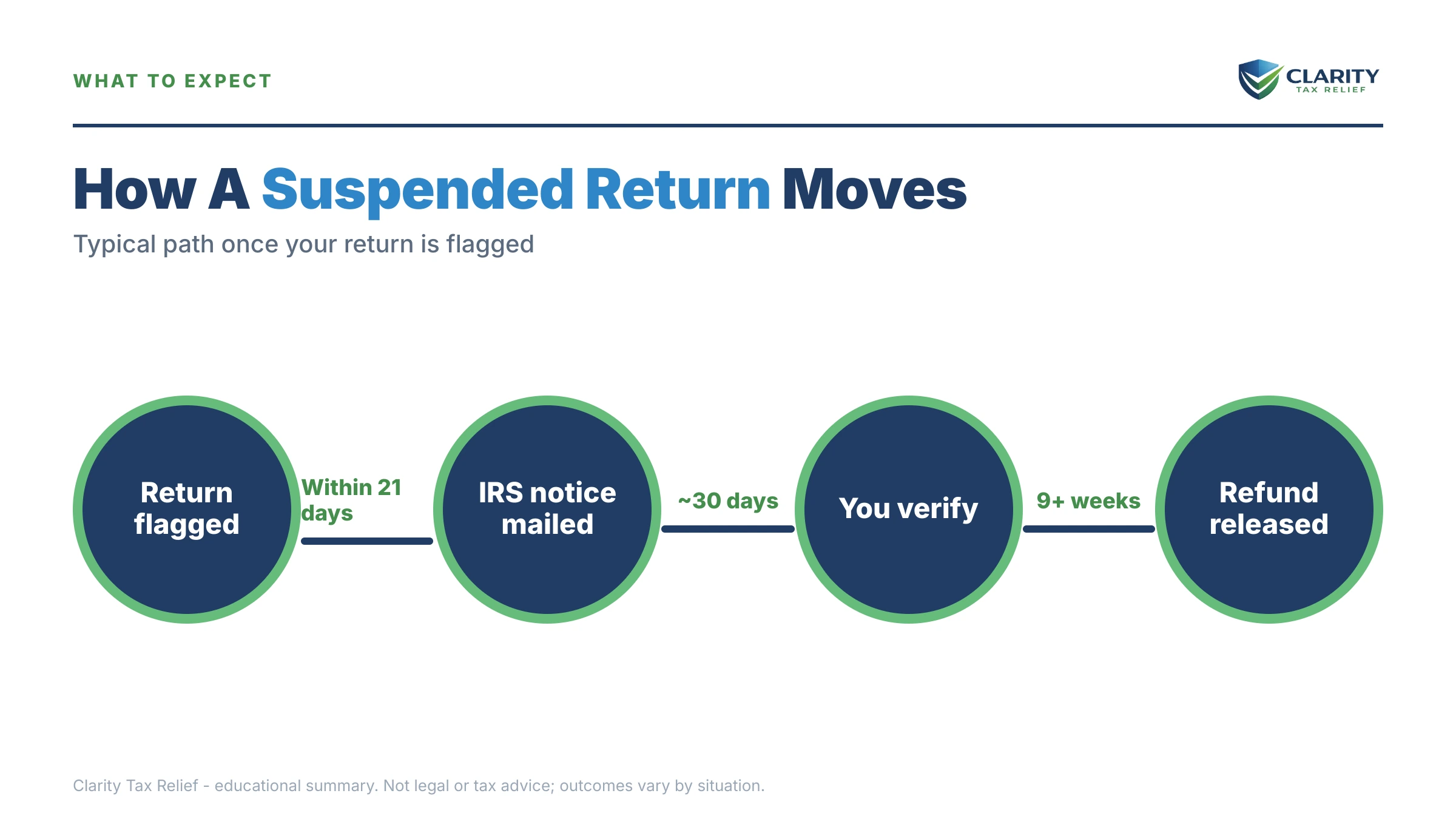
What happens if you do nothing about a suspended return
A suspended return does not resolve itself on any schedule you can count on — the sequence below is the order in which a stuck refund typically unfolds:
- Your return hits a filter and is suspended. It leaves automated processing. "Where's My Refund" often shows only "still processing" with no explanation.
- The IRS may send a letter, or may not. Identity holds usually generate a 5071c letter. Income-verification reviews a cp05 notice. Missing-document cases a Letter 12C. Unpostables are often worked internally with no letter at all.
- If a letter goes unanswered, the case sits. An identity-verification refund never releases without verification. There is no timeout that pays you anyway.
- Fraud-flagged refunds stay frozen indefinitely. A code 810 refund freeze holds the money until the review concludes or you prove the return is legitimate.
- Meanwhile, collections against you keep running. If you owe for another year, a frozen refund doesn't pause the notice stream — the IRS can escalate toward a levy on one year while it sits on your money for another.
Refund stuck while IRS letters keep coming?
A suspended return won't work itself — someone has to act on it. Send us what you're seeing (the letter, the transcript code, or just the "still processing" screen) and an experienced tax professional will map exactly where your refund is stuck and the fastest route out — free and confidential.
Your options when your refund is stuck in processing
Which fix works depends entirely on which of the five suspense categories caught your return. The signal you're seeing usually tells you which one it was.
| The signal you see | What's likely happening | Your fastest move |
|---|---|---|
| "Still processing" for weeks, no letter | Unpostable or error-resolution suspension being worked internally | Pull your account transcript; do NOT refile — duplicates create new unpostables |
| Letter 5071C, 4883C, or 5747C | One of the 2,914,180 suspected ID theft holds | Verify your identity the same day, online or by phone — the hold releases only after you do |
| CP05 notice | Income/withholding verification review | Usually nothing to send — wait, but calendar a follow-up and escalate if it drags |
| Letter 12C | Processing reject — a form or schedule is missing | Send exactly what's requested, by the method requested, with the letter's cover sheet |
| Transcript shows code 570 on irs transcript | A general hold on the refund pending review | Watch for the companion 971 (a letter is coming) and respond fast when it lands |
| Transcript shows code 810 | Fraud-filter freeze — one of 1,025,132 in FY2025 | These rarely self-resolve; verification and often professional follow-up are required |
| Refund arrived smaller, or not at all — with an offset notice | The refund was taken, not delayed | That's a different problem; see our treasury offset program refund seizure statistics study |
One scenario deserves its own sentence: if your refund is frozen for one year while you owe the IRS for another, the two problems must be worked together — the refund can often be applied against the balance. The full playbook for the debt side is in our guide on how to settle tax debt yourself.
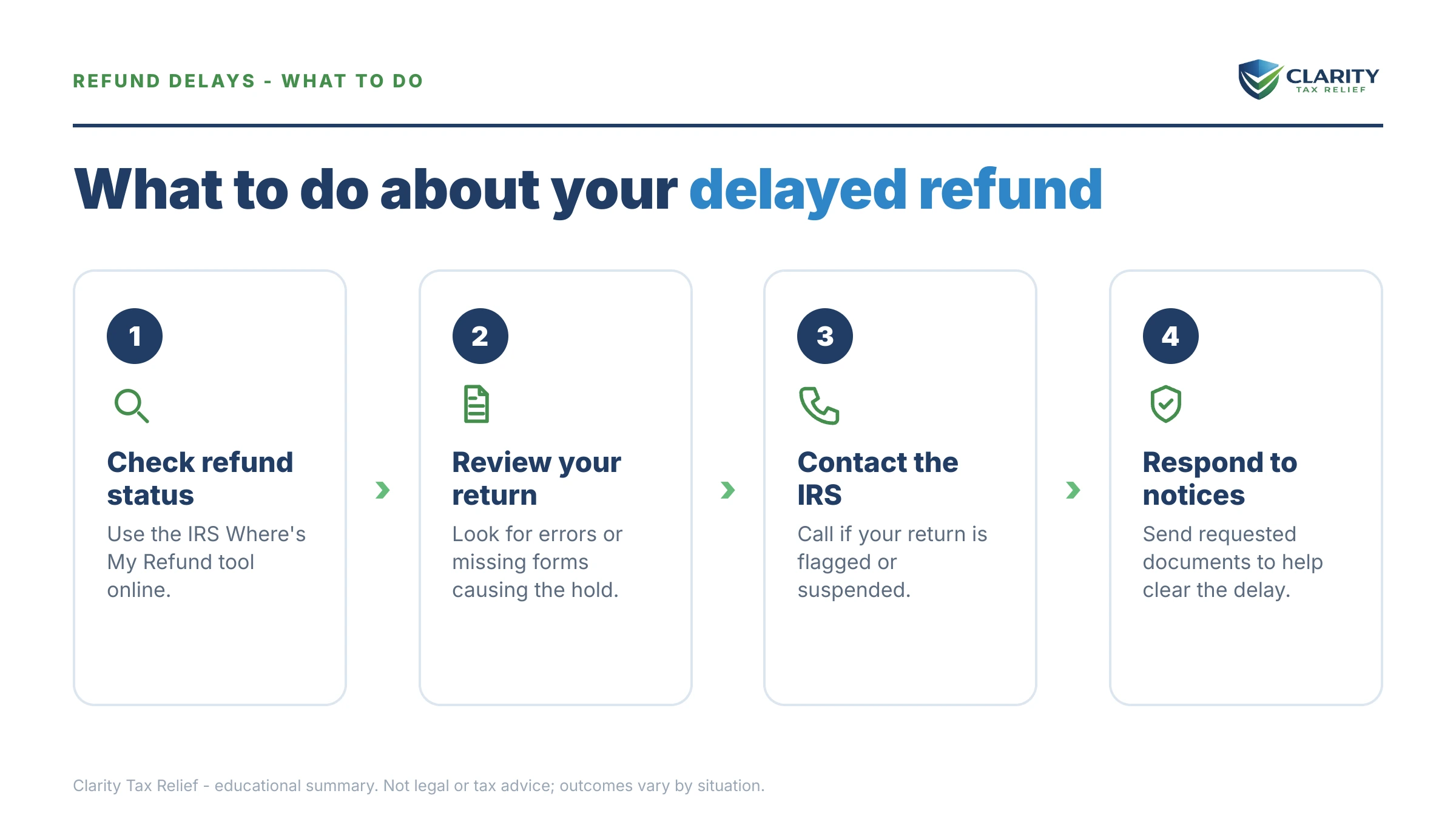
How to get a delayed refund moving, step by step
- Check Where's My Refund and your account transcript. Where's My Refund shows the official status. Your free IRS account transcript shows the hold codes behind it, such as 570 or 810.
- Read any IRS letter and respond exactly as it instructs. A 5071C wants identity verification online or by phone. A CP05 usually needs nothing from you. A 12C wants missing documents mailed or faxed back.
- Verify your identity the same day if asked. Identity-hold refunds do not move until you verify — the wait effectively restarts from your verification date, not your filing date.
- Do not file a second return. Duplicates typically post as unpostables, the largest suspense category in FY2025, and can add months to your wait.
- Escalate to the Taxpayer Advocate Service if the delay causes hardship. File Form 911 if you face eviction, utility shutoff, or can't cover basic living expenses; TAS can force a stalled case to be worked.
The hardship route matters more than most people realize: form 911 taxpayer advocate requests exist precisely for the renter whose delayed refund was the rent money, and TAS is free.
When you can handle this yourself, and when help changes the outcome
Most delayed refunds resolve without professional help. If your only signal is "still processing" with no letter, or you received a 5071C and can verify online, or a 12C asks for one missing form — do those things yourself and wait. Responding accurately and once is the entire game for most of the 33.5 million suspended returns.
Experienced help changes the outcome in a narrower set of cases: a code 810 fraud freeze that hasn't budged after verification. Identity theft spanning multiple tax years. A frozen refund colliding with active collection — levy warnings arriving for one year while your money sits trapped in another. Or a hardship case where a properly documented Form 911 needs to land the first time. In 2026 this matters more than usual: the IRS workforce was cut roughly 27% in 2025, so the humans who release suspended refunds are fewer, while the automated filters that suspend returns. The automated collection notices, never slowed down.
Terms in the data, decoded
- Unpostable: a return or transaction that can't record to your IRS account, usually a mismatch or duplicate, until a person or program fixes the conflict.
- Error Resolution System (ERS): the IRS unit that corrects math errors, missing forms, and inconsistencies before a return can finish processing.
- Processing reject: a return that failed a validity check at intake and needs correction, often with your input, before it can be processed at all.
- Refund freeze (code 810): a transcript code showing a fraud or compliance filter has stopped your refund entirely pending review.
- Suspense status: the general term for any return pulled out of normal automated processing to wait for additional handling.
- Taxpayer Advocate Service (TAS): the independent organization inside the IRS that intervenes in stalled or hardship cases — requested with Form 911.
IRS refund delay questions, answered
How many tax refunds were delayed in 2025?
About 3.6 million taxpayers received their refunds beyond the IRS's normal processing time in FY2025, according to the National Taxpayer Advocate. That's out of approximately 104 million taxpayers (63%) who received refunds, with an average refund of $3,167. Delayed e-filers waited an average of seven weeks past normal timeframes; delayed paper filers waited an average of 14 weeks.
How many tax returns did the IRS suspend in 2025?
More than 30 million individual income tax returns were suspended during processing in FY2025 — 33,544,912 across the five tracked categories. Unpostables were the largest group at 17,731,621, followed by Error Resolution Cases at 9,045,056. A suspension doesn't always mean a long delay, but every suspended return leaves the automated pipeline and waits for additional handling before a refund can go out.
Why is my refund taking longer than normal?
Most delayed refunds trace back to a return being pulled into one of five suspense categories: unpostables, error resolution, processing rejects, suspected identity theft, or suspected fraud. The IRS usually mails a letter when it needs something from you, and identity verification is the most common ask. Check your IRS online account and transcript — a code 570 or 810 shows a hold is in place.
Does the IRS pay interest on delayed refunds?
Yes. When a refund goes out late enough, the law requires the IRS to add interest. A Treasury Department report showed the IRS paid more than $2.6 billion in interest on delayed refunds in 2025 (as of Nov 30, 2025). The catch: that interest is taxable income to you the following year, and it does nothing for bills that are due while you wait.
Are paper returns more likely to be delayed?
Dramatically. Only about 6% of 2025 returns (about 11 million) were filed on paper, yet delayed paper filers waited an average of 14 weeks past normal processing — double the seven-week average for delayed e-filers. Paper returns must be transcribed by hand, which multiplies the chance of an error-resolution or unpostable suspension. If you can e-file, e-file.
Should I file my return again if my refund is late?
No. A duplicate return typically posts as an unpostable — the single largest suspense category, with 17,731,621 returns in FY2025 — and can add months to your wait instead of shortening it. The right sequence is to check Where's My Refund and your account transcript, respond to any IRS letter, and escalate to the Taxpayer Advocate Service if the delay is causing hardship.
Can the Taxpayer Advocate Service speed up my refund?
Often, yes. TAS is an independent organization inside the IRS that can intervene when a delay is causing financial hardship — a pending eviction or utility shutoff, for example — or when normal channels have failed. You request help with Form 911. TAS can't skip legally required steps like identity verification. But it can force a stalled case to be worked instead of sitting in a queue.
What are the odds my refund gets delayed?
Roughly 1 in 29 refund recipients waited past the normal timeframe in FY2025 — 3.6 million out of approximately 104 million refunds, or about 3.5%. But the risk isn't evenly spread: paper filing, refundable credit claims, W-2 or 1099 data that doesn't match IRS records, and prior identity-theft flags on your account all raise your odds substantially.
Your next 24 hours
- Find your signal. Check "Where's My Refund," then pull your free account transcript from your IRS online account and note any 570, 810, or 971 codes, and dig out any IRS letter you've set aside.
- Gather three things: a copy of the return you filed, the letter (if any). A government photo ID — everything an identity verification or document response will require.
- Get a free case review. If your refund is frozen, you're facing hardship, or collection letters for another year are arriving while your money sits — use the 2-minute form or call (888) 825-7779. Suspended returns don't resolve on their own timetable; they resolve when someone acts.
Sources: suspended-return and delay figures come from the National Taxpayer Advocate 2025 Annual Report to Congress, Executive Summary (Figure 1.1.1), published via the Taxpayer Advocate Service. The refund-interest figure comes from a Treasury Department report. Official refund status tools are at IRS.gov/refunds.
This guide is general information, not tax or legal advice for your specific situation. Eligibility for IRS programs depends on individual facts and circumstances; no outcome is guaranteed.