
IRS Transcripts
IRS Transcript Shows No Record of Return Filed: What It Means in 2026
The short answer: a "no record of return filed" transcript means the IRS has not yet posted a processed return for that year — most often because a recent return is still processing, was rejected at e-file, is held for identity verification, or was never actually filed. It describes the IRS's records, not always reality.
You pulled your transcript to check on a refund, satisfy a lender, or confirm an old return went through, and instead of numbers you got the line no record of return filed. That's unsettling, especially if you're certain you filed. Here's the reassuring part: in most cases this is a timing or processing issue, not a lost return, and every version of it has a clear next step.
What you can't do is guess. The same message can mean "wait two weeks" or "you have an unfiled year the IRS is about to act on", and those are very different situations. The tax year printed at the top of the transcript and the filing method you used together tell you which one you're in.
The image below shows where "no record of return filed" appears on a transcript and what a properly posted return looks like instead — the single line you're actually waiting to see.
⏱ The one real deadline here: if a refund is at stake, you generally have three years from the return's original due date to file and claim it. Miss that window and the refund is forfeited to the Treasury, even though you can still file the return itself.
What "no record of return filed" actually means
The message means the IRS Master File has no posted, processed return for your Social Security number and that specific tax year. The line you're waiting to see is Code 150 on an IRS transcript, "tax return filed", which is the entry that confirms your return has been assessed into the system. Until Code 150 posts, the transcript honestly shows nothing, because from the computer's point of view nothing has finished processing.
That's the key distinction: "no record" reflects processing status, not whether you personally mailed or e-filed something. A return can be sitting in a paper queue, stuck behind an identity check, or bounced at e-file and never accepted, and in every one of those cases the transcript reads the same. This is closely related to when a transcript says N/A or comes up blank; both describe a year the IRS hasn't recorded yet.
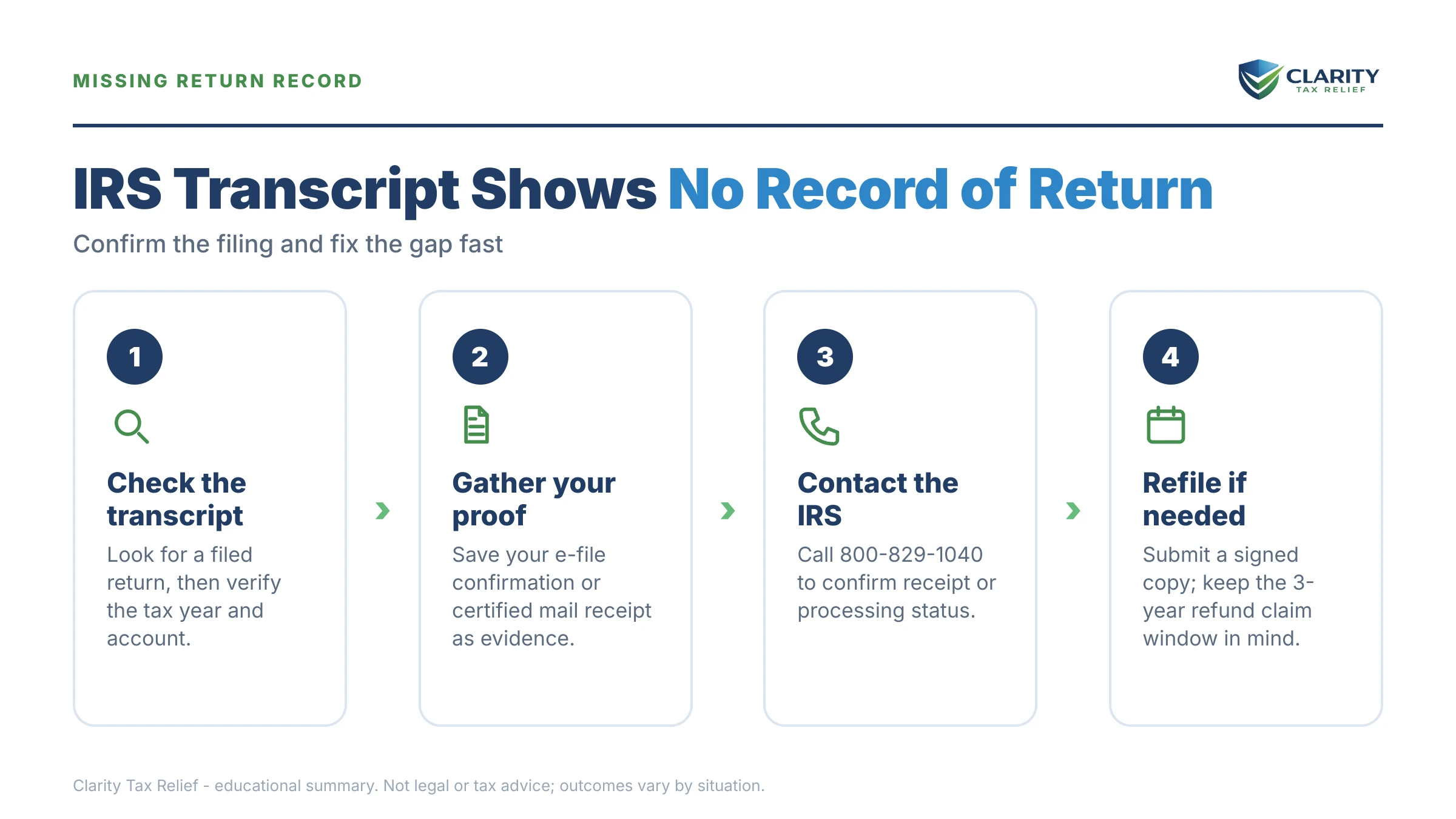
Why your transcript shows no record of return filed: the 7 causes
There are seven common reasons for a no-record transcript, and the fix is different for each. Find yours before you do anything else.
| What likely happened | How to confirm it | What to do |
|---|---|---|
| Recently filed, still processing | E-file accepted within the last few weeks | Wait for Code 150 to post; check weekly |
| Mailed a paper return | No online confirmation; sent by mail | Allow six weeks or more; keep proof of mailing |
| E-file was rejected, never accepted | Rejection notice from software; no accepted status | Fix the error and re-transmit. It was never filed |
| Held for identity verification | Got a 5071C, 4883C, or 5747C letter | Verify your identity so processing resumes |
| Filed to the wrong year or entity | Return posted under a different year/SSN | Check other years; contact the IRS to correct |
| Return genuinely never filed | No return prepared or submitted for that year | File the return as soon as possible |
| Wrong transcript or wrong year requested | Pulled the wrong type or an off-by-one year | Request the correct transcript and year |
Two of these deserve extra attention. If you were flagged for identity verification, processing simply stops until you respond — see our walkthrough of the 5071C identity verification letter. And if the return was never actually filed, this isn't a transcript glitch at all; it's an unfiled year, and the IRS treats those very differently.
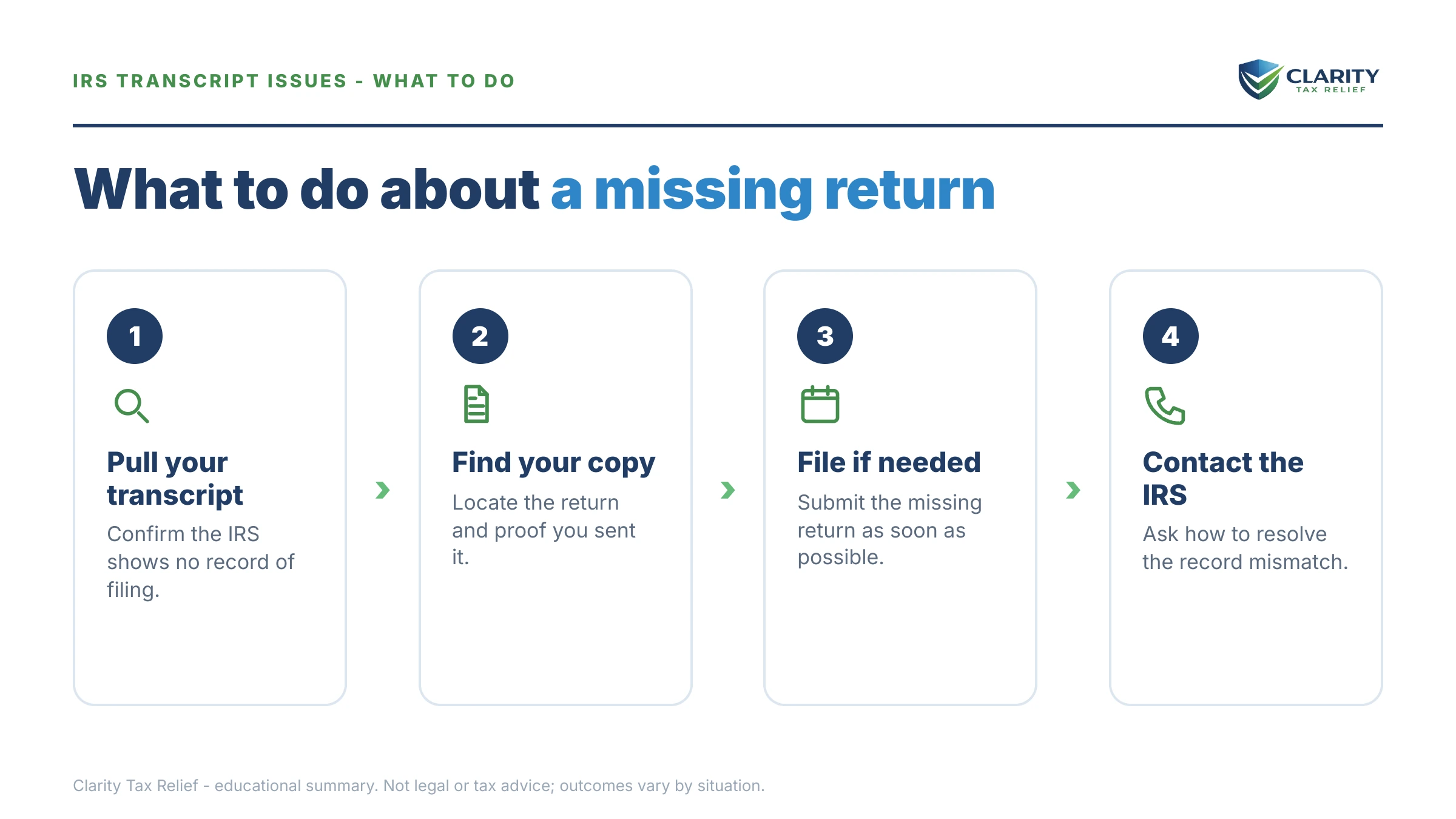
How long before a filed return shows on the transcript
An accepted e-filed return typically posts to your transcript within about two to three weeks. "Accepted" is not the same as "processed" — acceptance just means the IRS received the file. The transcript stays empty until the return works all the way through, at which point Code 150 appears. Knowing what day IRS transcripts update can save you from refreshing daily.
| Filing method | Typical time to appear | What "no record" means before then |
|---|---|---|
| E-file, accepted | About 2–3 weeks | Normal — return is still processing |
| Paper return, mailed | 6 weeks or more | Normal — expect a long, quiet wait |
| Amended return (1040-X) | Often 4+ months | Normal — check the amended-return tracker |
| Return under ID/accuracy review | Until the hold clears | Processing paused — action needed from you |
If your refund is what's really driving this, the transcript and the refund tool don't always move in step — that mismatch is common enough that we cover it in "Where's My Refund" stuck on still processing. No refund releases until the return posts and a Code 846 refund-issued line appears.
What happens if you do nothing
If the cause is timing, doing nothing is fine — the return posts on its own. But if the return was never filed, silence has consequences, because the IRS eventually notices a missing year and its automated non-filer process takes over. That sequence runs on its own track, whether or not a human ever reviews your file:
- No record / N/A on the transcript — the quiet stage. Nothing is wrong yet if you simply haven't filed and no one has flagged it.
- CP59 / CP80 — the IRS notices a missing return. A CP59 notice says no return is on file. A CP80 notice means a credit or payment is sitting on your account with no return to match it.
- CP516 / CP518 — follow-up demands for the overdue return, escalating in tone.
- CP2566 / Substitute for Return — the IRS prepares a return for you using only reported income, with no deductions or credits in your favor. Learn what that means in the IRS filed a substitute return for me.
- Balance due & collection — the SFR assessment becomes a bill, and the collection notices and levies that follow are automated.
In 2026 this matters more than usual: IRS staffing was cut sharply in 2025. But the non-filer and collection notices are generated by systems that never stopped running. A missing year won't stay invisible, and the earlier you file it yourself, the more control you keep over the numbers.
Transcript shows no record, and you're not sure why?
Send us the year and what your transcript shows. An experienced tax professional will tell you whether it's just processing or a genuinely unfiled year, and exactly what to do next, before any refund window or notice deadline closes. Free and confidential.
Your options, by situation
Match your fix to the reason. Guessing wrong costs weeks — and, for older years, can cost the refund entirely.
- Filed recently, e-file accepted: wait out the two-to-three-week window and re-pull the transcript. Confirm you weren't flagged for identity verification. Nothing else is needed.
- Mailed a paper return: patience plus proof. Keep your certified-mail or tracking receipt, and give it six weeks or more before treating the return as missing.
- E-file rejected: this is the trap — a rejected return was never filed. Log into your software, correct the reject reason (often a mismatched prior-year AGI or a duplicate dependent), and re-transmit.
- Held for identity verification: respond to the 5071C/4883C/5747C letter through the exact channel it names. Processing resumes only after you verify.
- Never filed, refund likely: file now. The three-year refund window is the only hard deadline in this whole topic — see can I still get a refund from 3 years ago.
- Never filed, multiple years behind: file the missing years in order and get ahead of the non-filer notices — start with haven't filed taxes in 3 years.
How to respond to a no-record transcript, step by step
- Confirm which transcript and year you pulled — re-check the tax year and request the correct type through getting your transcripts online.
- Check your filing proof — find your e-file acceptance email or paper-mailing receipt to confirm the return was actually submitted, not just prepared.
- Rule out a hold — look for any 5071C, 4883C, or 5747C identity letter, which quietly stops processing until you act.
- Wait the normal posting window — allow two to three weeks for e-file, six-plus for paper, before treating the return as missing.
- File or refile if there's genuinely no return — if it was rejected or never filed, submit it now, prioritizing any year with a refund at risk.
- Get help for multiple years or a near deadline — the order you file and resolve years in changes what you owe and what you keep.
When you can handle this yourself, and when help changes the outcome
Most no-record transcripts don't need a professional. If your e-file was accepted last week, the answer is simply "wait." If your software shows a rejection, you re-transmit yourself. If you got an identity letter, you verify and move on. And if you have a single unfiled year with a refund coming, filing it promptly is straightforward — reading how to read an IRS account transcript will let you confirm the fix landed once Code 150 posts.
Experienced help earns its keep when the "no record" is really a bigger problem in disguise: several unfiled years, a year where the IRS already prepared a substitute return, income records you no longer have, or a lender deadline colliding with a slow-processing year. In those cases the sequence matters — which year to file first, how to protect a refund on one year while limiting a balance on another, and how to unwind an SFR assessment. Getting that order wrong is what quietly costs people money.
Steer clear of any firm promising to make the IRS "erase" a missing year or guaranteeing a refund — no one can promise an outcome, and unfiled returns are resolved by filing, not by marketing.
A worked example: the old year with a refund at risk
Say you pull your 2022 transcript in 2026 to help with a mortgage and it reads no record of return filed, and you're fairly sure you were owed about $3,200 that year. You dig up your software and find the return was rejected for a prior-year AGI mismatch and never re-transmitted. From the IRS's point of view, 2022 was never filed.
Here's the math that matters: a 2022 return was originally due April 15, 2023, so the three-year refund window runs to roughly April 15, 2026. File before that date and the $3,200 is yours. File after it and the refund is gone for good, even though the IRS will still happily accept the return. Because there's a refund rather than a balance, there's no failure-to-file penalty to worry about here (penalties are calculated on tax owed. You owed nothing). The only cost of the delay is the refund itself — which is exactly why the deadline, not the balance, drives the urgency.
Flip the scenario — say 2022 showed a $3,200 balance due instead — and the calculus changes entirely: the failure-to-file penalty runs at 5% per month, ten times the failure-to-pay penalty, so filing immediately (even without paying) is the move.
Terms on your transcript, decoded
- Code 150 — "Tax return filed." The line whose absence produces the "no record" message. Once it posts, your return is officially in the system.
- Return transcript vs. account transcript — the return transcript shows line items as filed; the account transcript shows the activity and codes on your account. "No record" can appear on either when nothing has posted.
- RSED (Refund Statute Expiration Date) — the three-year deadline to file and claim a refund; miss it and the money is forfeited.
- Substitute for Return (SFR) — a return the IRS files for you when you don't, using only reported income and no deductions in your favor.
- Verification of Non-filing Letter — an official IRS letter stating no return is on file for a year. Lenders and aid programs sometimes request it directly.
No record of return filed transcript: FAQs
Why does my transcript say no record of return filed?
It means the IRS system has not yet posted a processed return for that Social Security number and tax year. The most common reason is timing — a recently filed return has not finished processing. But it can also mean the return was rejected at e-file, is held for identity verification, was mailed and is still in the paper backlog, or was never actually filed. The message describes the IRS's records, not necessarily reality.
How long does it take for a tax return to show up on my transcript?
An accepted e-filed return usually posts to your transcript within about two to three weeks, when Code 150 appears. A mailed paper return can take considerably longer, often six weeks or more before anything shows. Amended returns take the longest, frequently four months or more. Until the return finishes processing, the transcript can correctly read no record of return filed even though you did file.
Does no record of return mean the IRS lost my return?
Usually not. Far more often the return is simply still in the processing pipeline or was never fully accepted. The way to tell the difference is to check your e-file confirmation and your IRS online account. If you mailed the return, the message can persist for weeks. Only after the normal posting window has clearly passed with no movement should you treat it as lost and refile.
My e-file was accepted but the transcript shows no record — why?
"Accepted" only means the IRS received the file and cleared the initial checks — it is not the same as processed. Code 150 posts later, once the return works through the system, which can take a few weeks. If it has been well past three weeks and the transcript still shows no record, check whether the return was pulled for identity verification, such as a 5071C letter, which stops processing until you confirm who you are.
Will no record of return filed delay my refund?
Yes — no refund is released until the return actually posts and a Code 846 refund-issued line appears on the account transcript. If the transcript shows no record, the refund clock has effectively not started. The most common cause of a stuck refund alongside this message is a return still processing or one held for identity or accuracy review. Resolving the underlying hold is what frees the refund.
What's the difference between no record of return and N/A on a transcript?
They point to the same underlying fact from two different screens. "No record of return filed" typically appears on the return or account transcript for a specific year, while N/A shows in the transcript-availability grid when nothing has posted for that year yet. Both mean the IRS has not recorded a processed return. Neither one, by itself, tells you whether the cause is timing, a hold, or a genuine non-filing.
My mortgage lender says the IRS has no record of my return — what do I do?
Lenders pull a tax return transcript through income verification, and if the year hasn't posted it comes back empty. If you filed recently, the fix is time plus proof — give the lender your accepted e-file confirmation and a stamped copy of the return while it finishes processing. If you filed on paper, expect a longer wait. If you never filed that year, you'll need to file before the transcript can support the loan.
Can I still get my refund if an old return shows no record?
Only if you file within the refund window. You generally have three years from the original due date to file a return and claim its refund. Past that date the money is forfeited to the Treasury, even though the underlying return can still be filed. So if a transcript shows no record for an older year you were owed money in, filing quickly is the only way to protect that refund.
Your next 24 hours
- Find the year — confirm the exact tax year printed on the transcript and whether it's the return or account transcript. Off-by-one years are a surprisingly common cause of a false alarm.
- Gather your filing proof — your e-file acceptance email or paper-mailing receipt, a copy of the return, and any 5071C/4883C/5747C identity letter you received.
- Get a free case review — if it's an unfiled year, a refund at risk, or multiple years behind, use the 2-minute form or call (888) 825-7779. Every day matters when a three-year refund window or a non-filer notice is in play.
This guide is general information, not tax or legal advice for your specific situation. Eligibility for IRS programs depends on individual facts and circumstances; no outcome is guaranteed.
Authoritative sources: IRS — Get Transcript, IRS — Where's My Refund, and the Taxpayer Advocate Service.