
IRS Data Studies
Trust Fund Recovery Penalty Statistics: What IRS Data Shows in 2026
Read the transcript
Host: So the envelope came certified, and the letter says the IRS wants to collect the business's unpaid payroll taxes from you. Personally. Even if that company shut down years ago.
Tax specialist: Right. That's the Trust Fund Recovery Penalty, and it's the one civil penalty that ignores the wall between a business and the people who ran it.
Host: Okay, before the numbers — what exactly is it recovering? Because people assume it's the whole payroll tax bill.
Tax specialist: It isn't. Under IRC 6672 it's a hundred percent penalty on the trust fund portion only. That's the federal income tax you withheld from employees, plus the employees' share of Social Security and Medicare. The employer's matching share, the deposit penalties, the interest on the business account. Those stay with the business.
Host: Hm. So the personal number is smaller than what the business owes.
Tax specialist: Usually, yes. Which is also why step one is always verifying the math. If the proposed penalty includes the employer's matching share, somebody made an error and that's worth catching.
Host: Let's do the article's example, because it made it click for me.
Tax specialist: Sure. Hypothetical numbers. One quarter, $150,000 in wages. Withheld income tax, $18,000. Employees' Social Security and Medicare, $11,475. Employer's matching share, another $11,475. Total 941 liability for that quarter, $40,950.
Host: And the trust fund piece is the first two.
Tax specialist: $18,000 plus $11,475. $29,475. That's what can be pinned on each responsible person for that quarter.
Host: $29,475. Say that back — each responsible person? Each?
Tax specialist: Each. Stretch it to four quarters like that and the proposed penalty against you personally is four times $29,475 — $117,900. If a co-owner is also found responsible, you're each assessed $117,900 for the same dollars. The IRS collects those dollars once, and whatever the business or either of you pays gets cross-credited against the others.
Host: Which brings us to that big national number, and I want you to slow down on it, because I think it gets misread.
Tax specialist: It does. FY2025, the IRS credited $738,943,809 in trust fund recovery penalties. Call it $738.9 million. That's IRS Data Book, Table 4-2, footnote 13.
Host: $738.9 million. And it shows up in the abatement column?
Tax specialist: It does, and that's the trap. "Credited" is not forgiveness. Those are the cross-credits we just talked about — payments moving across the mirrored business and personal accounts as the balance gets paid down. So read it as the scale of real money running through personal trust fund accounts in a single year.
Host: Is there a count of people?
Tax specialist: No. The IRS doesn't publish a clean annual count of individuals assessed. The dollar figure is the best public yardstick we have.
Host: Okay. So who gets caught in this? Because the listener I'm picturing isn't a CEO, they're—
Tax specialist: They're often not. Two findings are required: responsible, meaning you had authority over which bills got paid, and willful, meaning you knew the taxes were unpaid and paid someone else first. Willful does not mean malicious. Keeping the lights on while the 941 balance grew is enough.
Host: That's the part people can't believe.
Tax specialist: And the net reaches officers, partners, CFOs, bookkeepers, outside check signers. It attaches to the quarters when you had that authority, so leaving the company afterward, or retiring, doesn't undo it.
Host: Walk me through the sequence, because the article's point is that each stage takes away options you had at the one before.
Tax specialist: Right. The business misses deposits, and deposit and failure-to-pay penalties stack on the business account. Then an investigation opens — a revenue officer is typically assigned, and you may get Letter 3164 telling you the IRS is contacting third parties. Then the Form 4180 interview.
Host: Stop there. What is that interview, in plain terms?
Tax specialist: It's the IRS asking who signed checks, who decided which bills got paid, who knew the taxes were unpaid. Your answers become the IRS's evidence on responsibility and willfulness. And you are allowed representation at that interview.
Host: Allowed representation. People don't know that.
Tax specialist: Statements made there are nearly impossible to walk back. That's the honest reason to prepare first.
Host: Then Letter 1153.
Tax specialist: Letter 1153 is the formal proposal to assess the penalty against you, and there's a protest deadline printed on it. A written protest filed by that date sends the case to IRS Appeals before anything hits your personal account. Appeals looks at responsibility, willfulness, and the math. Cost to file: zero.
Host: And if the deadline passes?
Tax specialist: Then it's assessed, and it's your personal debt. Liens, bank levies, refund offsets are on the table, and up to fifteen percent of Social Security benefits can be taken through the Federal Payment Levy Program. Interest compounds daily from there. The IRS has ten years from assessment, the CSED, to collect from you.
Host: And nobody's calling you first.
Tax specialist: The IRS workforce shrank roughly twenty-seven percent in 2025, per TIGTA reporting. But the assessments, liens and levies run on automated systems that never stopped. Waiting for a human isn't a plan.
Host: So what are the exits? And say the hard part out loud on each one.
Tax specialist: The Letter 1153 protest is the cheapest and earliest. If the business is still open, voluntary payments, not levied ones, can be designated to the trust fund portion first, which shrinks personal exposure. After assessment: a short-term plan gives up to 180 days, interest keeps running. A long-term installment agreement, balances up to $50,000 can be set up online for up to 72 months, and penalties and interest keep accruing. Currently Not Collectible pauses collection on proof of hardship — the debt stays, and the CSED keeps running. An Offer in Compromise, $205 fee plus twenty percent down on lump-sum offers, both waived with low-income certification, and it only works when the IRS's own math says you can't pay. Roughly one in five offers were accepted in FY2024. And after assessment there's a challenge or refund claim, typically Form 843.
Host: Wait — first-time abatement? Does that reach this?
Tax specialist: No. It does not reach the TFRP. The paths are the protest, the post-assessment challenge, and the resolution programs. That's it.
Host: Does the amount change which of those is realistic?
Tax specialist: Heavily. Under $10,000, it's pay in full or a Guaranteed Installment Agreement — minimal paperwork, no financial disclosure. Ten to twenty-five thousand, streamlined agreement territory. Above fifty thousand you're into the Form 433 series, full financial disclosure. And over $66,000 — that's the 2026 threshold where seriously delinquent tax debt can trigger passport certification.
Host: $66,000. Noted. And bankruptcy — people ask.
Tax specialist: Trust fund taxes are priority debts that generally survive personal bankruptcy, and the business closing doesn't erase a personal liability. That filing work sits outside what Clarity handles, so that's a conversation for your own counsel.
Host: When can somebody just do this themselves?
Tax specialist: When the amount is small, you agree you were the responsible person, one quarter is involved and the math checks out, or you can pay inside 180 days and just need the plan set up. The IRS's online tools handle that fine.
Host: And when does it get past DIY?
Tax specialist: A pending Form 4180 interview. Multiple people with check-signing authority and the IRS deciding who to assess. The business still operating, where designation matters. A proposed amount that includes non-trust-fund dollars. Or a fixed income, where a plan you can't sustain is worse than hardship status.
Host: So, next twenty-four hours.
Tax specialist: Find the letter, top right — Letter 3164, a Form 4180 request, Letter 1153, or a balance-due bill. Circle any response date. Pull the Forms 941 for those quarters, bank signature cards, payroll records, anything showing who controlled the checkbook. Then get it reviewed, 888-825-7779, before the date printed on that letter decides for you.
The short answer: the IRS credited $738.9 million in trust fund recovery penalties in FY2025 — exactly $738,943,809, per the IRS Data Book. The TFRP is a 100% penalty under IRC 6672: it shifts every dollar of withheld income and FICA tax a business failed to remit onto the individuals who ran it.
These trust fund recovery penalty statistics matter because the TFRP is the one civil penalty that ignores the wall between a business and its people. Maybe the company closed years ago. Maybe you're retired now, living on Social Security, and a certified envelope just told you the IRS wants to hold you personally responsible for payroll taxes the business never sent in.
That is exactly what this penalty was built to do, and the numbers below show how big the machine behind it really is. This is fixable, but the order you act in matters. The image below shows you exactly how the FY2025 trust fund figure fits inside the IRS's broader employment-tax penalty data, so you can see where your case sits in the system.
⏱ Your deadline: if you're holding Letter 1153, your protest deadline is printed on the letter. It is the last easy exit before the IRS assesses the full trust fund amount against you personally. If the TFRP is already assessed, the clock is interest: it compounds daily on the balance until the debt is resolved.

Trust fund recovery penalty statistics: the FY2025 headline number
The IRS credited $738,943,809 in trust fund recovery penalties in FY2025 — roughly $738.9 million flowing through the accounts of individuals held personally liable for their businesses' unpaid payroll taxes (IRS Data Book FY2025, Table 4-2, footnote 13).
That word "credited" needs decoding, because it hides how the TFRP actually works. The figure is included in the Data Book's abated total, but it is not forgiveness. When the IRS asserts a TFRP, it creates mirror-image liabilities: the business owes the full Form 941 balance, and each "responsible person" owes the trust fund portion personally.
The IRS can assess several people for the same dollars, but it only collects those dollars once. When the business, or one responsible person — pays, the same payment is credited against everyone else's parallel assessment. Those cross-credits are what land in the abatement column. So the $738.9 million is best read as the scale of real money moving through personal TFRP accounts in a single year.
One honest limitation of the data: the IRS does not publish a clean annual count of how many individuals it assesses with the TFRP. The dollar figure is the best public yardstick we have for how heavily the IRS leans on this tool, and $738.9 million says it leans hard.
Why the IRS aims this penalty at people, not just businesses
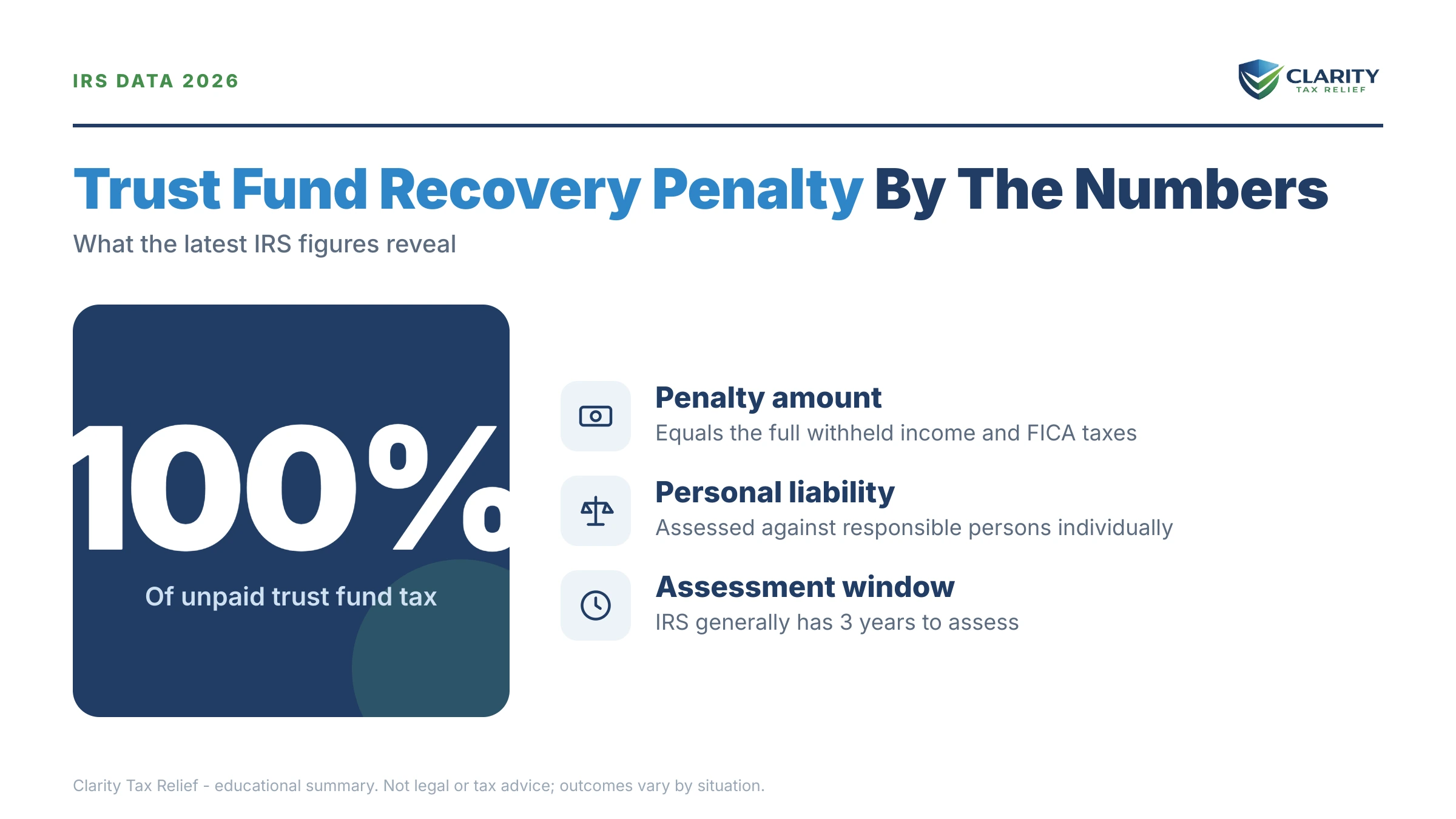
The TFRP is a 100% penalty — under IRC 6672, it recovers the full amount of withheld income and FICA (trust fund) taxes an employer failed to remit, dollar for dollar, from the individuals who could have paid it and didn't.
Here's the logic. When a business withholds federal income tax and the employees' Social Security and Medicare from paychecks, that money was never the company's. It is the employees' tax, held "in trust" for the government. When a struggling business spends that money on rent, vendors, or payroll instead, the IRS's leverage against the company itself is often weak: the business may be broke, closed, or dissolved.
The TFRP solves that problem by piercing through to individuals. Two findings are required: you were responsible (you had authority over which bills got paid) and you were willful (you knew the taxes were unpaid and paid someone else first). Willful does not mean malicious — keeping the lights on while the 941 balance grew is enough. Our full trust fund recovery penalty guide walks through the legal test in detail, and if you're wondering whether your old title or check-signing authority puts you in range, start with whether you're personally liable for payroll taxes.
The net catches more than owners. Officers, partners, CFOs, and even bookkeepers or outside signers have been assessed. And because the finding attaches to the quarters when you had authority, retiring or leaving the business afterward doesn't undo it.
How TFRP dollars compare to the rest of the employment-tax penalty system
In FY2023, the IRS assessed 4,665,429 employment-tax civil penalties worth $8.60 billion, and abated 868,297 of them worth $3.85 billion (IRS Data Book FY2023, Table 28).
The table below breaks that universe down. Two buckets dominate, and both land on the business — the TFRP is the escalation step that moves the debt onto a person.
| Employment-tax penalty measure | Count | Dollars |
|---|---|---|
| All employment-tax civil penalties assessed | 4,665,429 | $8.60 billion |
| All employment-tax civil penalties abated | 868,297 | $3.85 billion |
| Employer federal tax deposit penalties assessed | 1,209,310 | $5.19 billion |
| Employer failure-to-pay penalties assessed | 2,410,471 | $1.51 billion |
Read the pattern: the federal tax deposit penalty is the biggest bucket by dollars — 1,209,310 penalties worth $5.19 billion in FY2023 — because deposit penalties scale with how late the deposits are. Failure-to-pay is the biggest by count, with 2,410,471 penalties worth $1.51 billion. Our irs failure to pay penalty statistics study covers that penalty across all tax types.
Those business-side penalties are warnings. The TFRP is the consequence. By the time the IRS asserts it, the deposit and failure-to-pay penalties have usually been piling onto the business account for multiple quarters. For how penalties and interest stack in general, see the hub guide on how much are irs penalties on back taxes. This page stays focused on the trust fund numbers.
The abatement side is worth a beat too: $3.85 billion of the $8.60 billion assessed came back off in FY2023. Most of that relief flows through reasonable-cause and administrative channels available for deposit and payment penalties, not the TFRP itself, which has its own narrower exits (covered below). Our irs penalty abatement statistics study breaks down relief odds by penalty type.
What a 100% penalty actually costs: a worked example
A 100% penalty means the trust fund portion of every unpaid quarter transfers to you in full — here is the arithmetic, with clearly hypothetical numbers.
Say your company ran one quarter with $150,000 in wages and couldn't cover the payroll taxes:
- Federal income tax withheld from employees: $18,000
- Employees' Social Security and Medicare (7.65%): $11,475
- Employer's matching FICA share: $11,475
- Total 941 liability for the quarter: $40,950
The trust fund portion is the withheld income tax plus the employees' FICA: $18,000 + $11,475 = $29,475. That — not the full $40,950 — is what the TFRP can pin on each responsible person for that quarter. The employer's matching share, the deposit penalties, and the interest on the business account stay with the business.
Now stretch it the way these cases actually unfold. Four quarters like that and the business owes roughly $163,800 in tax plus penalties and interest, while the TFRP proposed against you personally is 4 × $29,475 = $117,900. If a co-owner is also found responsible, you're each assessed $117,900 for the same dollars. But the IRS collects the $117,900 only once, and every payment either of you (or the business) makes gets cross-credited. That cross-crediting is exactly what the $738.9 million FY2025 figure is measuring at national scale.
Once assessed, interest compounds on your personal balance daily. You can estimate how fast a balance grows with our Penalty & Interest Calculator — an estimate, not a quote. But it makes the cost of waiting concrete.
What happens if you ignore a TFRP investigation
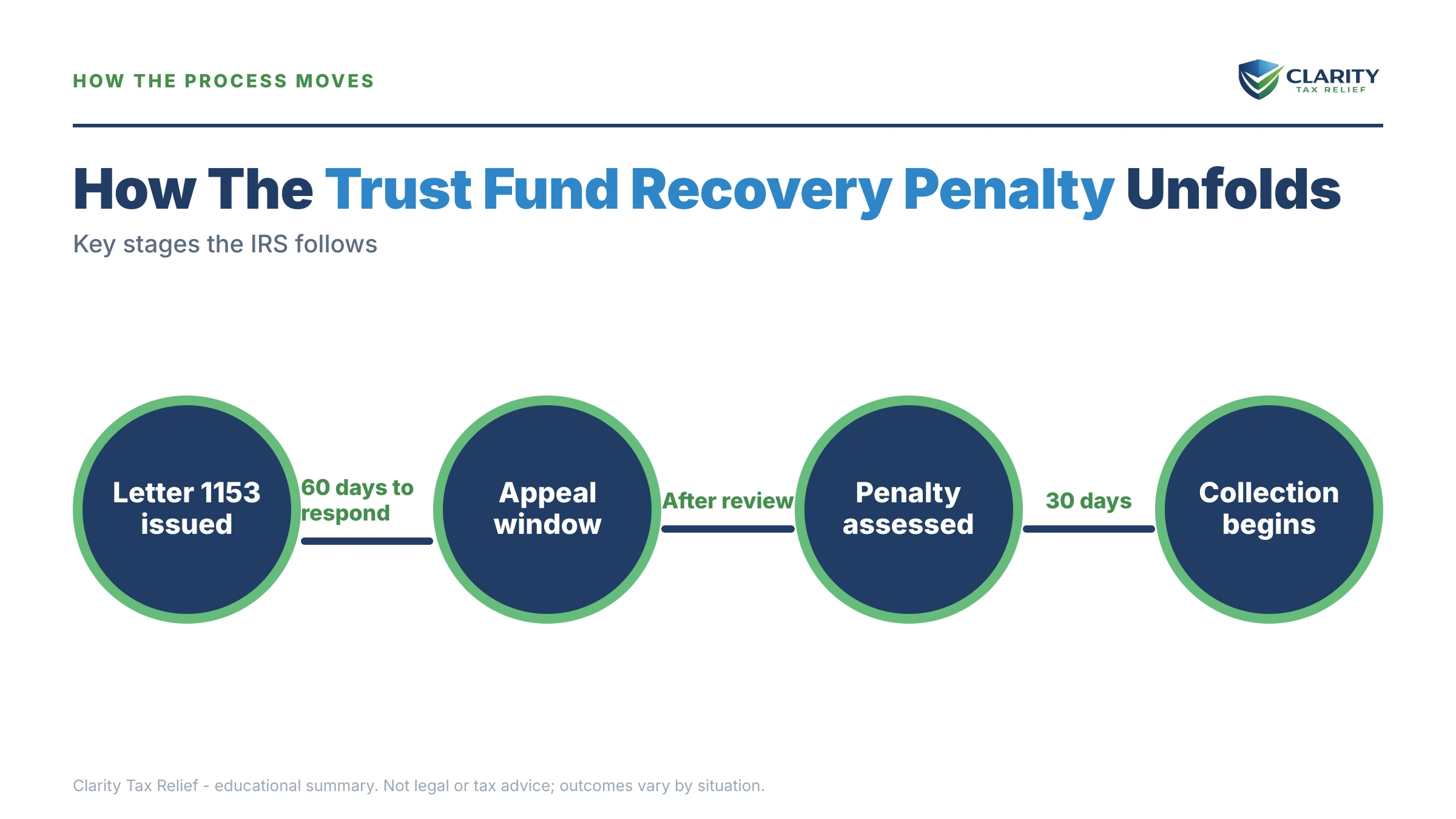
A TFRP case escalates in a fixed sequence, and each stage removes options you had at the one before.
- The business misses payroll deposits. Federal tax deposit and failure-to-pay penalties start stacking on the business account — the FY2023 data above is this stage, at national scale.
- The TFRP investigation opens. A revenue officer is typically assigned. You may receive Letter 3164 telling you the IRS is contacting third parties about your case.
- The Form 4180 interview. The IRS asks who signed checks, who decided which bills got paid, and who knew the taxes were unpaid. Your answers in the Form 4180 interview become the evidence for responsibility and willfulness.
- Letter 1153 arrives. This is the formal proposal to assess the TFRP against you, with a protest deadline printed on it. Letter 1153 is your best window to fight — a timely protest goes to IRS Appeals before anything hits your account.
- Assessment. Miss the protest window and the full trust fund amount becomes your personal debt. Federal tax liens, bank levies, and refund offsets are now on the table, and up to 15% of Social Security benefits can be taken through the Federal Payment Levy Program.
- The 10-year collection clock runs. The IRS has 10 years from assessment (the CSED) to collect from you personally — pausable by appeals, an Offer in Compromise, or bankruptcy.
In 2026 this sequence runs with less human contact than ever — the IRS workforce shrank roughly 27% in 2025, per TIGTA reporting, but assessments, liens, and levies are driven by automated systems that never stopped. Waiting for a person to call you is not a strategy.
Is the IRS building a TFRP case with your name on it?
Whether you're holding Letter 3164, a Form 4180 interview request, or Letter 1153, the stage you're in decides your options. Get your paperwork reviewed free, before the protest deadline printed on your letter passes.
Your options once the TFRP is proposed or assessed
Every stage of a TFRP case has an exit. But the cheap exits come early, and each one has a real cost and eligibility test.
| Option | Upfront cost | What it does |
|---|---|---|
| Letter 1153 protest (IRS Appeals) | $0 | Filed by the deadline printed on the letter; Appeals reviews responsibility, willfulness, and the math before assessment |
| Designated voluntary payments (business still open) | Payment amount | Voluntary (not levied) business payments can be designated to the trust fund portion first, shrinking your personal exposure |
| Short-term payment plan | $0 setup | Up to 180 days to pay an assessed balance in full; interest continues but enforcement stops |
| Long-term installment agreement | Setup fee varies | Balances up to $50,000 can be set up online for up to 72 months; interest and penalties keep accruing |
| Currently Not Collectible | $0 | Collection pauses on proof of hardship; the debt remains, and the 10-year CSED keeps running |
| Offer in Compromise | $205 fee + 20% down on lump-sum offers (both waived with low-income certification) | Settles for less than the balance only when the IRS's own math shows you can't pay; roughly 1 in 5 offers were accepted in FY2024 |
| Post-assessment abatement / refund claim (Form 843) | $0 | Challenges responsibility, willfulness, or the trust fund calculation after assessment |
Two TFRP-specific realities to keep in mind. First, first-time abatement does not reach the TFRP — the relief paths are the protest, the post-assessment challenge. The resolution programs above. The trust fund penalty abatement guide covers which arguments actually work. Second, if you plan to fight the responsibility or willfulness finding itself, the trust fund recovery penalty defense playbook matters more than any payment plan. You don't negotiate a debt you can defeat.
Which resolution is realistic depends heavily on the amount assessed against you personally:
| Amount assessed personally | Realistic options |
|---|---|
| Under $10,000 | Pay in full or a guaranteed installment agreement — minimal paperwork, no financial disclosure |
| $10,000 – $25,000 | Streamlined installment agreement; hardship status if income is fixed (Social Security, pension) |
| $25,001 – $50,000 | Streamlined plan with direct debit, or the 72-month online agreement; OIC if assets and income are genuinely thin |
| $50,001 – $66,000 | Full financial disclosure (Form 433 series); partial-pay agreements, CNC, or OIC depending on the numbers |
| Over $66,000 | All of the above, plus urgency: $66,000 is the 2026 threshold at which seriously delinquent tax debt can trigger passport certification |
If the business is closed or dissolving, the sequencing question — what the entity still owes versus what follows you — is its own topic. The 941 back taxes guide covers the business-side cleanup that runs parallel to your personal TFRP defense.
How to respond to a TFRP investigation, step by step
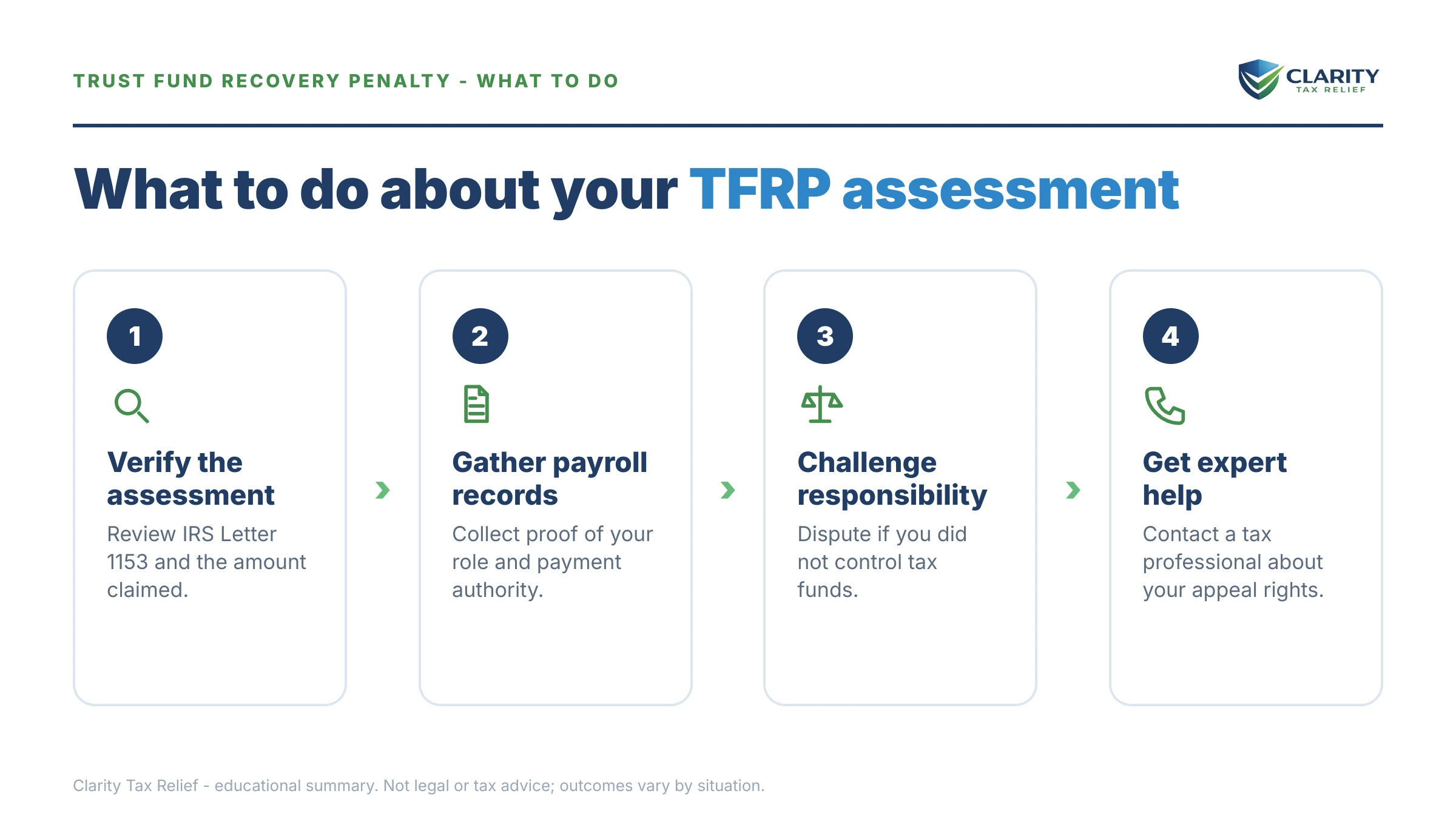
- Identify your stage. Find which document you're holding — Letter 3164 (investigation opened), a Form 4180 interview request, Letter 1153 (proposed penalty), or a bill on an already-assessed TFRP — because each stage has a different best move.
- Gather the business records. Pull the Forms 941, bank signature cards, payroll records, and any minutes or emails for the unpaid quarters before speaking with anyone. They define who was responsible and willful.
- Prepare before any Form 4180 interview. Your answers become the IRS's evidence on responsibility and willfulness, and you are allowed representation at the interview.
- Protest Letter 1153 by the deadline printed on it. A timely written protest sends the case to IRS Appeals before the penalty is assessed against you personally.
- Verify the trust fund math. Confirm the proposed penalty covers only withheld income tax and the employees' FICA share, not the employer's matching share, deposit penalties, or business interest.
- Set up a resolution on any assessed balance. Match a payment plan, hardship status, or Offer in Compromise to your actual finances before enforced collection starts.
When you can handle this yourself, and when help changes the outcome
Not every TFRP situation needs professional help, and pretending otherwise would be dishonest.
You can likely handle it yourself when: the assessed amount is small and you agree you were the responsible person. Only one quarter is involved and the trust fund math checks out. Or you can pay within 180 days and just need the short-term plan set up. The IRS's online payment tools work fine for that.
Experienced help tends to change outcomes when: a Form 4180 interview is pending, because statements made there are nearly impossible to walk back. Multiple people had check-signing authority and the IRS is deciding who to assess. The business is still operating and payment designation could shrink your personal exposure. The proposed amount includes non-trust-fund dollars. Or you're on a fixed income and the right answer is hardship status or an Offer rather than a payment plan you can't sustain. In those cases, the difference isn't paperwork speed — it's which liability finding and which dollar figure you end up living with for up to a decade.
Terms on your TFRP paperwork, decoded
- Trust fund taxes: the federal income tax withheld from employees plus the employees' share of Social Security and Medicare — money held in trust for the government, never the business's to spend.
- Responsible person: anyone with the authority and duty to collect, account for, or pay the taxes — defined by real control, not job title.
- Willfulness: knowing the taxes were unpaid and choosing to pay other creditors first; no bad intent is required.
- Letter 1153: the formal proposal to assess the TFRP against you, with your protest deadline printed on it.
- Credited vs. abated: in IRS data, TFRP "credits" are payments cross-applied across the mirrored business and personal assessments — dollars collected once, not forgiven.
- CSED: the Collection Statute Expiration Date — 10 years from assessment, the deadline for the IRS to collect from you, pausable by appeals, an OIC, or bankruptcy.
If those terms describe paperwork sitting on your kitchen table right now, a free review with an experienced tax professional at (888) 825-7779 can pinpoint which stage you're in and what your protest or resolution path looks like, before the deadline printed on your letter decides for you.
Trust fund recovery penalty statistics: FAQs
How much does the IRS collect in trust fund recovery penalties each year?
In FY2025, the IRS credited $738,943,809 in trust fund recovery penalties, roughly $738.9 million, per the IRS Data Book FY2025, Table 4-2, footnote 13. "Credited" largely means dollars moved across the mirrored business and personal TFRP accounts as they were paid down. The IRS does not publish a clean annual count of individuals assessed, so this dollar figure is the best public measure of the program's size.
What percentage of unpaid payroll tax is the trust fund recovery penalty?
The TFRP equals 100% of the trust fund portion of the unpaid payroll taxes — the federal income tax withheld from employees plus the employees' share of Social Security and Medicare. It does not include the employer's matching FICA share, the business's deposit penalties, or interest on the business account. That is why the TFRP against you personally is usually smaller than the total 941 balance the business owes.
Who can be held personally liable for the trust fund recovery penalty?
Anyone the IRS finds was both "responsible" for collecting or paying the taxes and "willful" in not paying them — owners, officers, partners, and sometimes bookkeepers or outside check signers. Titles matter less than authority: who signed checks, hired and fired, and decided which bills got paid. Being retired or out of the business now does not undo liability for the quarters when you held that authority.
How often does the IRS abate employment-tax penalties?
In FY2023, the IRS assessed 4,665,429 employment-tax civil penalties totaling $8.60 billion and abated 868,297 of them totaling $3.85 billion (IRS Data Book FY2023, Table 28). A meaningful share of assessed dollars does come back off, but mostly on penalties with reasonable-cause and first-time-abatement paths. The TFRP itself is harder to remove; the main routes are the Letter 1153 protest and proving you were not responsible or willful.
Can the trust fund recovery penalty be appealed or removed?
Yes, and the strongest window is the protest deadline printed on Letter 1153, before the penalty is ever assessed against you. After assessment, you can still pursue an abatement or refund claim (typically with Form 843) by showing you were not a responsible person, did not act willfully, or that the IRS's trust fund calculation is wrong. First-time abatement does not apply to the TFRP itself.
Does the TFRP go away if the business closed or filed bankruptcy?
No. The TFRP is a personal liability, separate from the business, so closing or dissolving the company does not erase it. Trust fund taxes are also priority debts that generally survive personal bankruptcy. Once assessed, the IRS has 10 years from the assessment date (the CSED) to collect from you personally. That clock can be paused by appeals, an Offer in Compromise, or bankruptcy.
Can the IRS take my Social Security to collect a TFRP?
Yes — through the Federal Payment Levy Program, the IRS can take up to 15% of your Social Security benefits for an assessed TFRP. If that levy would leave you unable to cover basic living expenses, you can request a hardship release or Currently Not Collectible status. Retirees on fixed incomes are often strong candidates for hardship-based resolutions because the IRS must weigh allowable living expenses.
What is the difference between the TFRP and the federal tax deposit penalty?
The federal tax deposit penalty punishes the business for late or missed payroll deposits — in FY2023 the IRS assessed 1,209,310 of them totaling $5.19 billion, the largest employment-tax penalty bucket by dollars. The TFRP is different: it moves the unpaid trust fund taxes themselves onto individual people. The deposit penalty stays with the business; the TFRP follows you home.
Your next 24 hours
- Find your letter number and its deadline. Look at the top right of the IRS letter — Letter 3164, a Form 4180 interview request, Letter 1153, or a balance-due bill — and circle any response date printed on it. That date defines everything.
- Gather the quarter's paper trail. Pull the Forms 941 for the unpaid quarters, bank signature cards, payroll records, and anything showing who actually controlled the checkbook.
- Get a free case review. Use the 2-minute form or call (888) 825-7779, before the protest deadline printed on your letter passes, or if the TFRP is already assessed, before interest compounds another month onto a balance that follows you for up to 10 years.
Sources: the FY2023 employment-tax penalty figures come from the IRS's civil penalties assessed and abated, IRS Data Book Table 28. The FY2025 credited figure comes from the IRS Data Book FY2025, Table 4-2, footnote 13. Payment-plan terms are current per the IRS payment plans page. If you can't afford representation and can't resolve your case through normal channels, the Taxpayer Advocate Service is an independent option within the IRS.
This guide is general information, not tax or legal advice for your specific situation. Eligibility for IRS programs depends on individual facts and circumstances; no outcome is guaranteed.