
IRS Statistics
How Many People File Tax Extensions? IRS Extension Statistics for 2026
Read the transcript
Host: So you filed the extension back in April, the return's still not done, and now there's this balance sitting there that you can't clear. And somewhere in the back of your head you're wondering if asking for more time put you on some kind of list.
Tax specialist: It didn't. That's actually the easiest part of this to answer. About 19 to 20 million people file Form 4868 every year.
Host: 19 to 20 million.
Tax specialist: Right. Out of roughly 160 to 165 million individual returns. So call it 12%, about one in eight filers. And a decade ago that number was closer to 13 million, so it's grown by about half.
Host: Hm. Why the jump?
Tax specialist: Mostly paperwork that shows up late, not procrastination. K-1s from partnerships and S corps, corrected 1099s from brokerages, multi-state documents. Those things land in March or later, sometimes after a preparer's cutoff. Plus self-employed folks still closing out their books, people going through a move or a death in the family or a divorce —
Host: Okay, but let me stop you, because I think the thing the listener's actually scared of is the audit question.
Tax specialist: Not a factor. The IRS has never identified filing an extension as an audit trigger. Returns get selected on what's in them, not when they arrive. If anything a rushed, error-filled April return is the riskier document.
Host: Fine. So what's the part people get wrong?
Tax specialist: The payment deadline. An extension moves exactly one thing. Your filing deadline, April 15 to October 15. Your payment was still due April 15. So the failure-to-pay penalty, 0.5% per month, plus daily-compounding interest, those started April 16 on whatever was unpaid.
Host: Wait. So it's been running since April and nobody told me.
Tax specialist: Quietly, yeah. No letter. That's the piece that catches people. The extension protects you from the filing penalty, the 5% a month one, and nothing else.
Host: 5% versus half a percent. That's ten times.
Tax specialist: Ten times. Which is why the article's whole argument for extensions is that gap. There's a hypothetical in there — a $12,000 balance, W-2 employee, bonus was under-withheld.
Host: Walk me through it.
Tax specialist: Scenario A, you file the 4868, pay nothing, then file and pay in October. Payment penalty is 0.5% of $12,000, so $60 a month, six months, $360. Interest at an illustrative 7% annual rate is roughly $420. So about $780 added — you're paying near $12,780.
Host: And if I'd just… ignored the whole thing?
Tax specialist: Scenario B. No extension, no return. Now both penalties run and the combined charge is 5% a month. Five months at 5% is 25% of $12,000, that's $3,000, then the filing penalty caps out and the payment penalty keeps going, another $60. So about $3,060 in penalties plus the same $420 of interest. You're near $15,500.
Host: So the extension itself saved — what, twenty-seven hundred?
Tax specialist: Roughly $2,700 on that balance. And then there's Scenario C, which is the one I want people to hear about even though it's a April thing.
Host: Go.
Tax specialist: The 90% safe harbor. If you pay at least 90% of your total tax by April 15 and the rest when you file by October 15, the IRS generally doesn't charge the failure-to-pay penalty. Interest still runs on the shortfall. In the example, paying $10,800 leaves $1,200, and interest on that is something like $42 over six months.
Host: Generally. You said generally twice.
Tax specialist: On purpose. It's a rule the IRS applies, not something I can promise for your file. And it depends on your total tax being what you thought it was, if the real number comes in higher, your 90% wasn't 90%.
Host: Okay. So say I'm past all that. Extension's filed, October's coming, and the money isn't there. What actually happens?
Tax specialist: There's a sequence. You file in October, the balance gets formally assessed — that's the word, assessment, the moment the IRS records the number. Then CP14 shows up, that's the first bill, typically about 21 days to pay. Then CP501 and CP503, reminders. Then CP504 —
Host: CP504 is the levy one?
Tax specialist: Notice of Intent to Levy. At that point they can take your state tax refund, and a federal tax lien becomes a live possibility. Then LT11, or Letter 1058, that's the final notice. Thirty days after that, wage garnishment and bank levies become legal, and that same notice carries your formal appeal rights.
Host: Say that last bit again, simpler.
Tax specialist: The letter that opens the door to garnishment is the same letter that opens your appeal window. So it's the one you never throw away.
Host: And the worst branch?
Tax specialist: You extend and then miss October 15 too. Then the 5% failure-to-file penalty applies retroactively from the original April due date, as if the extension never existed. Which is why the short version is file even if you can't pay. Filing is what stops that 5% clock.
Host: Even with nothing attached to it.
Tax specialist: Even with nothing attached to it.
Host: So what are the options for the balance itself?
Tax specialist: Ladder. Pay in full by October 15 if you can raise it — interest and the penalty stop the day payment posts. Next rung, a short-term plan up to 180 days, $0 setup fee. Penalties and interest keep running but the collection notices stop.
Host: And past 180 days?
Tax specialist: If you owe $10,000 or less there's the Guaranteed Installment Agreement — that's the statutory one, IRC 6159(c). If you meet every compliance condition, the IRS is obligated to accept it. The hard part is meeting all of them, and that's a question about your filing record, not something anyone can tell you over the phone in ten seconds.
Host: Right.
Tax specialist: Above that, a streamlined installment agreement up to $50,000, up to 72 months, set up online without full financial disclosure. There's a setup fee, and interest and penalties keep accruing. Currently Not Collectible if paying anything would cause genuine hardship — collection pauses, but the debt and the interest stay. And penalty relief if your prior three years are clean. That removes penalties, not tax and not interest.
Host: One more thing I want on the record — the IRS workforce.
Tax specialist: Down roughly 27% in 2025. Phone lines and manual processing are slower. But extensions are automatic and electronic, so those weren't affected, and the collection notices are automated too. Those never slowed down.
Host: So don't count on the mail being late.
Tax specialist: Don't count on it.
Host: Last thing. Who genuinely doesn't need us?
Tax specialist: Most of those 20 million. If you're due a refund, if you owe something you can clear by October 15 or on a 180-day plan, if your only problem is missing paperwork — handle it yourself. Where experience changes things is when the extension year is one of several unfiled or unpaid years, when the balance is big enough that plan structure and penalty relief and lien exposure all interact, when you're self-employed and this stacks on missed estimated payments, or when October 15 already passed and notices have started. In those, the order you fix things — returns first, then penalties, then the balance — can change the total.
Host: So, next 24 hours. Log into your IRS online account and find your real number, not a guess. Pull last year's return, this year's income documents, and any payments you've already made. And if the balance is bigger than you can clear by October 15, get it looked at — (888) 825-7779. Our people are Enrolled Agents, the review's free, and it's about fifteen minutes.
Tax specialist: And file. Whatever else you do or don't do, file.
How many people file tax extensions? About 19 to 20 million each year, based on IRS filing-season statistics — roughly 12% of all individual returns, or about one in eight. That's up from about 13 million a decade ago. The catch most filers miss: an extension moves the filing deadline, never the payment deadline.
Maybe you're the reason this page exists: your return is sitting unfinished, again, and you're half-wondering whether asking the IRS for more time puts you on some list of problem taxpayers. It doesn't — you'd be joining a crowd the size of New York State. The numbers below show exactly how normal an extension is, and the one rule that separates a harmless extension from an expensive one.
Form 4868 is a shorter form than most people expect — a single page where the payment estimate is the only line that takes any thought.
⏱ The clock that actually matters: a Form 4868 extension moves your filing deadline six months, to October 15, but your payment was still due April 15. The failure-to-pay penalty (0.5% per month) and daily-compounding interest run from April 15 on any unpaid balance, extension or not.

How many people file tax extensions each year? The IRS numbers
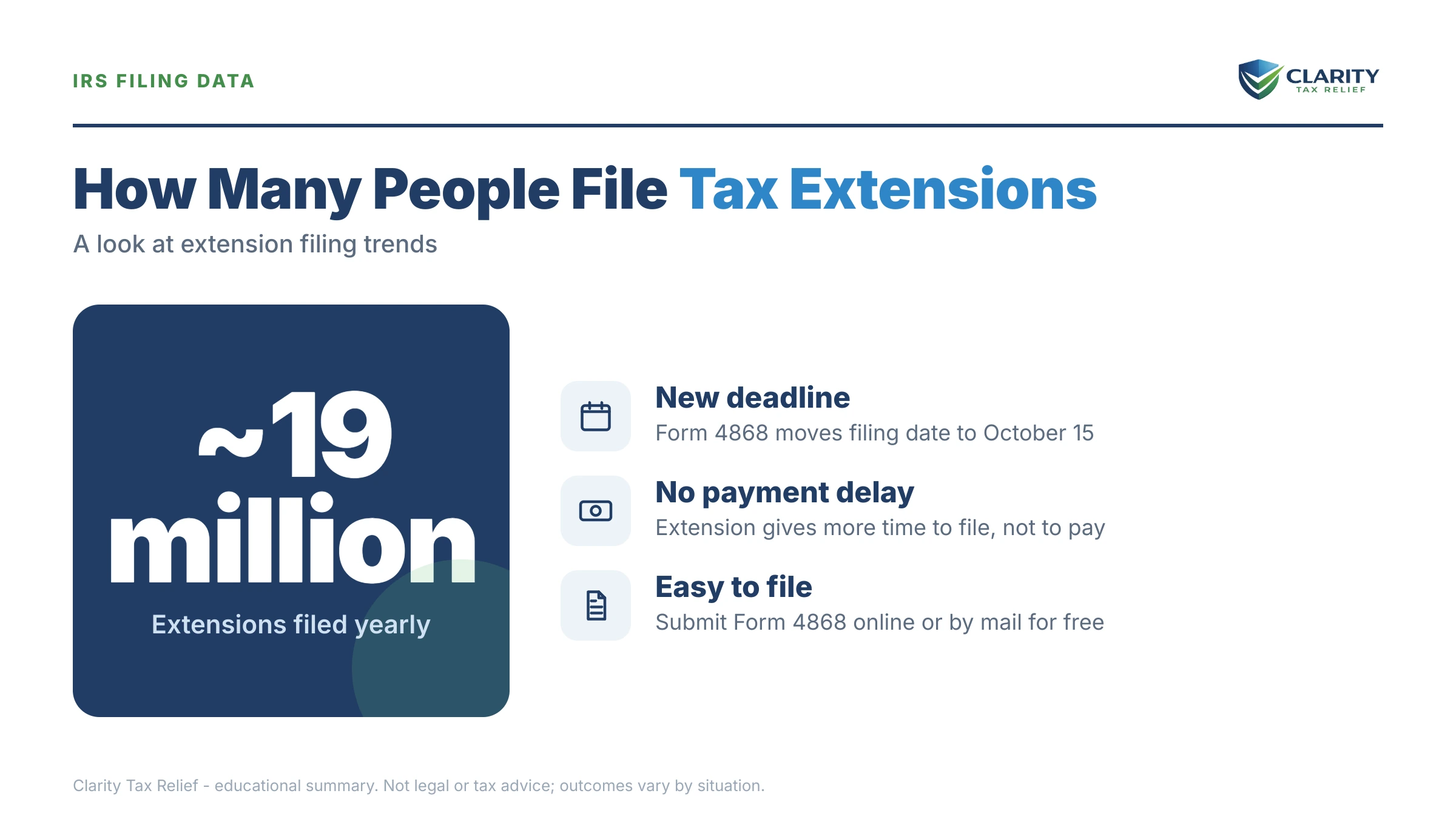
About 19 to 20 million taxpayers file tax extensions each year, according to IRS filing-season statistics and IRS projections. For context, the IRS receives roughly 160 to 165 million individual income tax returns annually, so extension filers now make up a bigger group than the population of most U.S. states.
The trend runs in one direction. Extension requests have grown by roughly half over the past decade, from about 13 million in the mid-2010s to about 20 million in recent filing seasons. Here's the shape of it, rounded from IRS filing-season data:
| Filing season (tax year) | Extension requests | Share of all individual returns |
|---|---|---|
| 2016 season (TY 2015) | About 13 million | About 9% |
| 2019 season (TY 2018) | About 15 million | About 10% |
| 2023 season (TY 2022) | About 19 million | About 12% |
| 2025 season (TY 2024) | About 20 million | About 12% |
A note on precision, because this is a numbers page: extension counts accumulate all the way through mid-October. The IRS publishes cumulative receipt figures and projections that get revised. That's why the honest phrasing is "about 19 to 20 million," not a false-precision decimal. The pandemic years also muddy comparisons — the 2020 deadline moved to July 15 and the 2021 deadline to May 17, which temporarily changed who needed an extension at all.
“A U.S. citizen or resident files this form to request an automatic extension of time to file a U.S. individual income tax return.”
— About Form 4868, Application for Automatic Extension of Time to File U.S. Individual Incom (IRS.gov)
Extensions as a share of all individual returns: the one-in-eight stat
Tax extensions now represent about 12% of all individual returns — roughly one in eight filers. Divide about 19.5 million extension requests by about 162 million individual returns and you land near 12%. A decade ago the same math produced closer to 9%.
That derived share is the most useful number on this page, because it reframes the question. An extension isn't a fringe behavior or a red flag — it's a mainstream filing strategy used by one in eight American taxpayers, and disproportionately by people with complex, professionally prepared returns.
One more piece of 2026 context: the IRS workforce shrank by roughly 27% in 2025, which slows phone lines and manual processing — our IRS workforce statistics page has the numbers. Extensions themselves are unaffected, because Form 4868 is automatic and electronic. But the collection notices that follow an unpaid extension balance are automated too, and those never slowed down.
Why so many taxpayers file extensions
The most common driver of the extension boom is late-arriving paperwork, not procrastination. The share of returns waiting on Schedule K-1s from partnerships and S corporations, corrected 1099s from brokerages, and multi-state documents has grown steadily. Those forms routinely land in March or later, after many preparers' cutoff dates.
The typical extension filers cluster into a few groups:
- Investors and business owners waiting on K-1s and corrected brokerage 1099s that arrive weeks before, or after — April 15.
- Self-employed filers who need time to finish books, and whose preparers are underwater in April.
- People hit by life events — a move, a death in the family, a divorce, a new business — where the return genuinely can't be finished accurately by April.
- W-2 procrastinators — no judgment; if a refund is coming, an extension costs literally nothing except the delay in getting your own money back.
- Automatic-extension groups — taxpayers in federally declared disaster areas get IRS-set later deadlines without filing anything (see our guide to the disaster extension tax deadline in 2026), and combat-zone service members and many Americans abroad get automatic extra time too.
Notice what's not on the list: audit avoidance or audit risk. Returns are selected for examination based on what's in them, not when they arrive.
What a tax extension does, and doesn't, do
A tax extension changes exactly one thing: your filing deadline moves from April 15 to October 15. Everything else people believe about extensions tends to be wrong. The most expensive myth is the payment one — covered in full in our guide does an extension give you more time to pay.
| The myth | The fact |
|---|---|
| "An extension gives me more time to pay." | It extends filing only. Payment was due April 15; the 0.5%-per-month failure-to-pay penalty plus interest run from April 16 on any unpaid balance. |
| "Filing an extension flags me for an audit." | The IRS has never identified extensions as an audit factor. Returns are selected on content — a rushed, error-filled April return is the riskier document. |
| "Extensions cost money or need IRS approval." | Form 4868 is free and automatic. No reason required, no approval issued — filing it (or making an extension-marked payment online) is the whole process. |
| "Once I extend, penalties stop." | Only the 5%-per-month failure-to-file penalty is avoided. The failure-to-pay penalty and interest continue on anything unpaid. |
| "I can extend again past October 15." | For most individuals, no second extension exists. Disaster-area and combat-zone extensions are automatic; certain taxpayers abroad can request more time (December 15 by letter, or Form 2350). |
| "My state deadline moves too." | Sometimes. States set their own rules — some honor Form 4868, some require their own form, and state payment deadlines almost always stay in April. |
The safe-harbor detail worth knowing: the IRS generally won't charge the failure-to-pay penalty on an extended return if you paid at least 90% of your total tax by April 15 and pay the remainder when you file by October 15. Interest still applies to the shortfall, but the penalty side goes quiet.
What happens if you extend but don't pay
If you extend but don't pay, the failure-to-pay penalty of 0.5% per month starts April 16 — the extension protects you from the filing penalty, never the payment clock. Here's the sequence, in order, for a taxpayer who extends, files in October, and lets the balance sit:
- April 15 — the payment deadline passes. The 0.5% monthly failure-to-pay penalty and daily-compounding interest begin on the unpaid balance. Quietly. No letter yet.
- October 15 — you file. The balance is formally assessed, and the IRS collection machine now has a number to pursue.
- CP14 notice — the first bill arrives, typically giving about 21 days to pay before the sequence escalates.
- CP501 and CP503 — reminder notices. Still just bills, but the balance grows every month they're ignored.
- CP504 — Notice of Intent to Levy. The IRS can now seize your state tax refund, and a federal tax lien becomes a live possibility.
- LT11 / Letter 1058 — the final notice. After 30 days, wage garnishment and bank levies become legal — along with your formal appeal rights.
And the worst-case branch: extend, then miss October 15 too. The failure-to-file penalty — 5% per month, ten times the payment penalty — applies retroactively from the original April due date, as if the extension never existed. If that's where you are, our guide to the missed October 15 tax deadline covers the recovery moves. The short version is file even if you can't pay, because filing is what stops the 5% clock.
Extended, but staring at a balance you can't pay?
Penalties and interest have been running since April 15, and October 15 turns that balance into a filed, collectible debt. Get your situation reviewed free — an experienced tax professional will map your cheapest path before the notice sequence starts.
The math on a $12,000 balance: extension vs. no extension
On a $12,000 balance, an extension saves roughly $2,700 in penalties over six months compared with not filing at all. Here's the arithmetic, using a clearly hypothetical scenario.
Say you owe $12,000 — you're a W-2 employee whose bonus was under-withheld, and April 15 arrives with the return unfinished and the cash unavailable.
- Scenario A — you file Form 4868, pay nothing, and file plus pay on October 15. Failure-to-pay penalty: 0.5% × $12,000 = $60 per month × 6 months = $360. Interest, at an illustrative 7% annual rate: roughly $12,000 × 7% × ½ year ≈ $420. Total added: about $780, for a payoff near $12,780.
- Scenario B — no extension, no return, same October resolution. When both penalties run, the combined charge is 5% per month (4.5% failure-to-file + 0.5% failure-to-pay). Five months at 5% is 25% of $12,000 — $3,000 — and the filing penalty then maxes out while the 0.5% payment penalty keeps running, adding another $60 in month six. Penalties come to about $3,060, plus the same ~$420 of interest — a payoff near $15,500.
- Scenario C — the smart play: pay 90% ($10,800) with the extension. The failure-to-pay penalty is generally waived under the 90% rule if you pay the rest when you file, and interest runs only on the $1,200 shortfall — roughly $42 over six months. Total cost of the extension: about the price of dinner.
That six-month gap between Scenario A and Scenario B — roughly $2,700 on this balance — is the entire argument for extensions. You can run your own balance through our IRS penalty and interest calculator to estimate what waiting is costing you. The full penalty comparison lives in failure-to-file penalty vs. failure-to-pay.
One more number for Scenario A: if $12,780 is still unpayable in October, a streamlined installment agreement spreads it over up to 72 months — a minimum of roughly $178 per month ($12,780 ÷ 72), though interest and the payment penalty keep accruing, so paying faster always costs less.
Owe when you extend? Your options, by amount and situation
The IRS offers a $0-setup short-term payment plan of up to 180 days for taxpayers who can't clear an extension balance at once, and that's just the first rung. Which option fits depends on the size of the balance and your finances:
| Option | Typical fit | Cost and key terms |
|---|---|---|
| Pay in full by October 15 | You can raise the cash within the extension window | Interest and the 0.5% monthly penalty stop the day payment posts; the 90% rule can erase the penalty entirely |
| Short-term payment plan | Balance you can clear within 180 days | $0 setup fee; penalties and interest continue, but collection notices stop |
| Guaranteed installment agreement | You owe $10,000 or less | The IRS must accept it if you meet the compliance conditions; details in our guaranteed installment agreement guide |
| Streamlined installment agreement | Balance up to $50,000 | Up to 72 months, set up online without full financial disclosure; setup fee applies, interest and penalties continue |
| Currently Not Collectible | Paying anything would cause genuine hardship | Collection pauses while your situation improves; the debt and interest remain |
| Penalty relief (FTA / AEP) | Clean compliance history the prior 3 years | Removes penalties, not tax or interest; first-time penalty abatement is being replaced by the automatic AEP penalty exemption starting summer 2026 |
For most extension filers with a manageable balance, the path is simple: set up an IRS payment plan online the same day you file. If April already came and went without a payment, start with can't pay taxes by April 15 — the sooner an arrangement exists, the less the escalation sequence above ever applies to you.
How to file a tax extension the right way, step by step
Filing Form 4868 takes about ten minutes and requires no explanation to the IRS. The form itself is a single page with a handful of lines, and the payment estimate is the only part that takes thought:
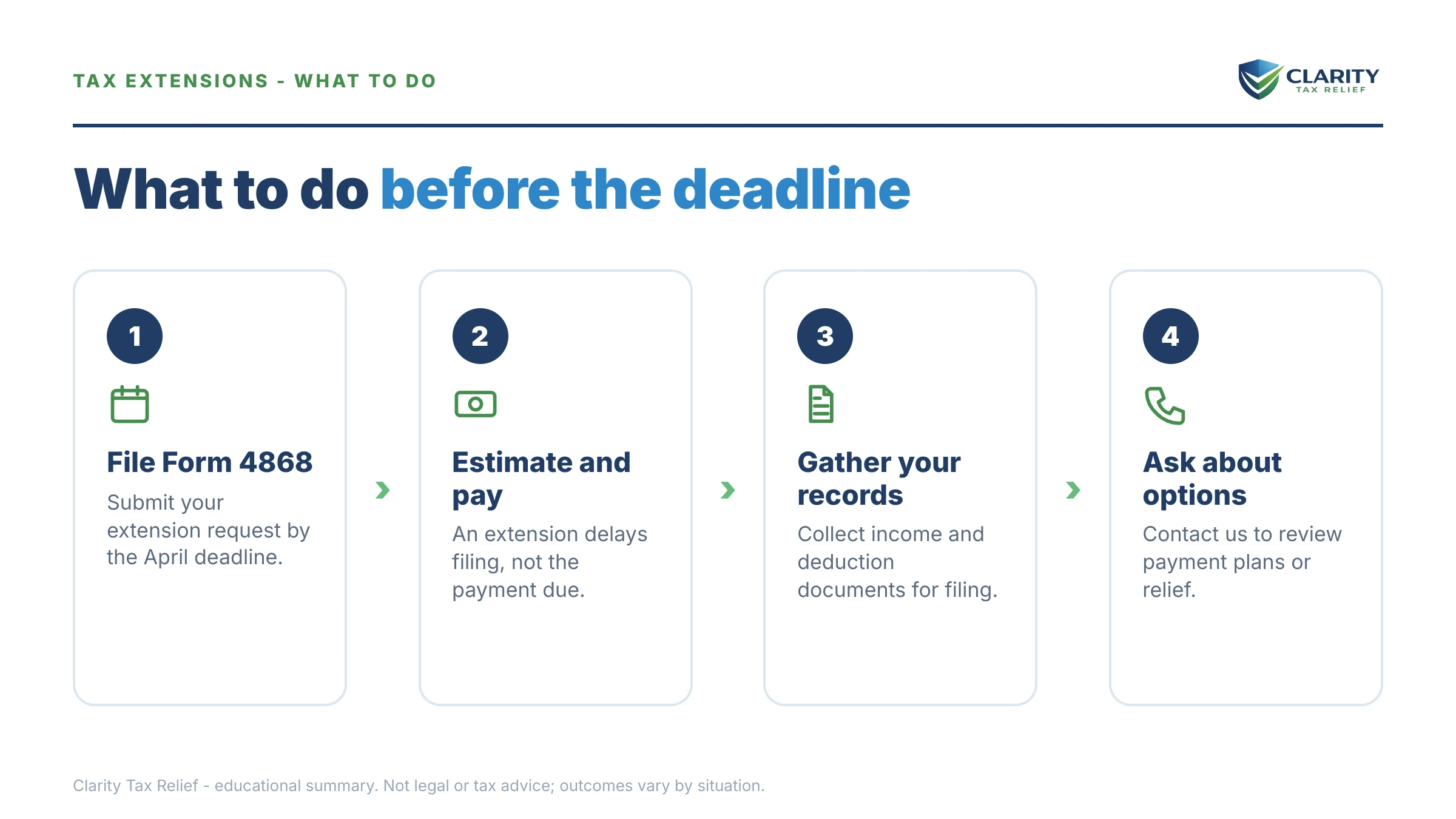
- Estimate your total tax. Use last year's return and your current W-2 or final paystub to project this year's tax before April 15 — the extension is valid even if the estimate is imperfect. But a good-faith number keeps penalties honest.
- Pay as much as you can with the extension. Penalties and interest run only on the unpaid balance, so every dollar sent by April 15 shrinks the meter. Paying at least 90% generally avoids the failure-to-pay penalty entirely.
- Submit Form 4868 by April 15. File it free through IRS Free File or tax software, or simply make an extension payment at IRS.gov and check the extension box — the payment itself files the extension.
- Calendar October 15 and file early. No second extension exists for most taxpayers, and filing in September beats the October crush. Filing on time protects you from the 5% monthly failure-to-file penalty.
- Set up a payment arrangement for any remaining balance. If you can't pay in full when you file, a short-term plan or installment agreement set up promptly stops the collection notice sequence before it starts.
When you can handle this yourself, and when help changes the outcome
Most of the roughly 20 million extension filers each year never need professional help, and shouldn't pay for it. You can confidently handle this alone if:
- You're due a refund — there's no penalty for filing late when the IRS owes you (though refunds have their own three-year claim window).
- You owe a balance you can pay by October 15 or within 180 days after — the extension plus a $0-fee short-term plan handles it end to end.
- Your only issue is missing paperwork — the extension exists precisely for you.
Experienced help genuinely changes outcomes in a narrower set of situations: the extension balance is one of several years of unpaid or unfiled taxes. The amount is large enough that plan structure, penalty relief, and lien exposure interact (see our IRS failure-to-pay penalty statistics for how fast those penalties compound across the population). You're self-employed and the balance stacks with missed estimated payments. Or October 15 already passed and collection notices have started. In those cases, the order you fix things in — returns first, then penalties, then the balance — often changes the total you pay.
Extension terms, decoded
- Form 4868 — the one-page "Application for Automatic Extension of Time to File" that moves an individual's filing deadline to October 15.
- Failure-to-file penalty — 5% of unpaid tax per month (capped at 25%) for not filing; this is the penalty an extension prevents.
- Failure-to-pay penalty — 0.5% of unpaid tax per month; this one runs from April 15 regardless of any extension.
- 90% safe harbor — pay at least 90% of your total tax by April 15 and the rest when you file by October 15. The failure-to-pay penalty is generally waived.
- Automatic extension — "automatic" means no approval or reason is required. It does not mean the IRS grants it without you filing the form or an extension payment.
- Assessment — the moment the IRS formally records your balance (when your extended return is processed), which starts the collection notice sequence on anything unpaid.
If your extension balance is turning into a debt you won't clear by October 15, a free case review or a call to (888) 825-7779 takes about 15 minutes and tells you which of the options above your finances actually support, before the first bill arrives.
Where these numbers come from
Every figure on this page traces to IRS publications: the agency's filing-season statistics and projections for extension request counts. The annual IRS Data Book for return volumes. You can verify the sources directly — the official Form 4868 page at IRS.gov for the extension rules, the IRS Tax Statistics portal for filing-season and Data Book figures, and IRS.gov/payments for extension payments and payment plans. Where the IRS reports cumulative or projected figures, we round and say "about" rather than manufacture precision.
Tax extension statistics: FAQs
How many people file tax extensions each year?
About 19 to 20 million people file tax extensions each year, based on IRS filing-season statistics. That is roughly one in eight of the approximately 160 to 165 million individual returns the IRS receives annually. The number has climbed steadily — a decade ago, extension requests ran closer to 13 million.
What percentage of tax returns are filed on extension?
Roughly 12% of individual tax returns involve a Form 4868 extension in recent filing seasons. That share has grown from about 9% in the mid-2010s as returns have become more complex and more filers receive late-arriving forms like K-1s and corrected 1099s. The percentage is an estimate because extension counts keep accumulating through mid-October.
Does filing a tax extension increase my chances of an audit?
No — the IRS has never identified filing an extension as an audit trigger, and returns are selected for exam based on their contents, not their timing. If anything, a rushed April return with errors or missing forms is more likely to draw a notice than an accurate October one. Extensions are routine; millions of professionally prepared returns go on extension every year.
Do I still have to pay by April 15 if I file an extension?
Yes. Form 4868 extends your time to file, not your time to pay — any unpaid balance starts accruing the 0.5% monthly failure-to-pay penalty plus interest on April 16. The IRS generally waives that penalty if you paid at least 90% of your total tax by April 15 and pay the rest when you file by October 15.
Is it bad to file a tax extension?
No. An extension is free, automatic, and used by about 19 to 20 million taxpayers a year, including many with professionally prepared returns. The only real downside appears when you owe and don't pay: penalties and interest run from April 15 regardless. If you're due a refund, an extension costs you nothing at all, though you're delaying your own money.
What happens if I miss the October 15 extended deadline?
The failure-to-file penalty — 5% of the unpaid tax per month, up to 25% — applies as if you never had an extension, calculated from the original April due date. File as fast as you can even if you can't pay, because filing stops that 5% clock. Disaster-area taxpayers and those in combat zones may have later deadlines.
How much does it cost to file a tax extension?
Nothing. Form 4868 is free to file through IRS Free File, commercial tax software, a tax professional, or by mail. You can even skip the form: make any payment at IRS.gov and mark it as an extension payment. The IRS records the extension automatically. Anyone charging a government fee for an extension is charging you for a free service.
Can I get a second tax extension after October 15?
For most taxpayers, no — October 15 is the final individual filing deadline, and the IRS generally does not grant second extensions. Disaster-area and combat-zone deadlines are extended automatically by the IRS, but certain taxpayers living abroad can request more time: a discretionary extension to December 15 by letter, or Form 2350 for those expecting to qualify for the foreign earned income exclusion. If October 15 is approaching and you owe, file with what you have and amend later if needed.
Does a federal extension cover my state taxes too?
Not automatically in every state. Some states honor the federal Form 4868, others grant their own automatic extension. A few require a separate state form or a payment by the state deadline to qualify. State payment deadlines almost always remain in April regardless. Check your state revenue agency's rules rather than assuming the federal extension carries over.
Your next 24 hours
- Pin down your real number. Log into your IRS online account (or pull last year's return and your latest paystub) and find what you actually owe — the estimate on your Form 4868 line, not a guess.
- Gather three things: last year's return, this year's income documents (W-2, 1099s, K-1s), and records of any payments you've already made toward the year.
- If the balance is more than you can clear by October 15, get it reviewed free — the 2-minute form or (888) 825-7779. Penalties and interest have been accruing since April 15, and every month of waiting adds to the number. Every month of a plan in place subtracts from the stress.
This guide is general information, not tax or legal advice for your specific situation. Eligibility for IRS programs depends on individual facts and circumstances; no outcome is guaranteed.