
IRS Forms
Form 5329 in 2026: When You Must File It, What Each Part Taxes, and How to Claim an Exception
The short answer: Form 5329 reports additional taxes on retirement and savings accounts — the 10% tax on early distributions, the 6% yearly tax on excess contributions to IRAs, HSAs, and similar accounts, and the excise tax on missed required minimum distributions. It files with your Form 1040, and it's the only place to claim an early-withdrawal exception.
What this guide covers: the three taxes Form 5329 reports, the exceptions that can cancel the 10% early-withdrawal tax, what a real cash-out costs, what happens if the form never gets filed, and how to fill it out and pay what's left.
The severance ran out, the 401(k) check kept the rent paid, and now a Form 1099-R is sitting on the table telling you that decision has a second bill attached. The math on Form 5329 is knowable. The exceptions are specific and written into the form itself, and the expensive outcomes mostly happen to people who never file it at all.
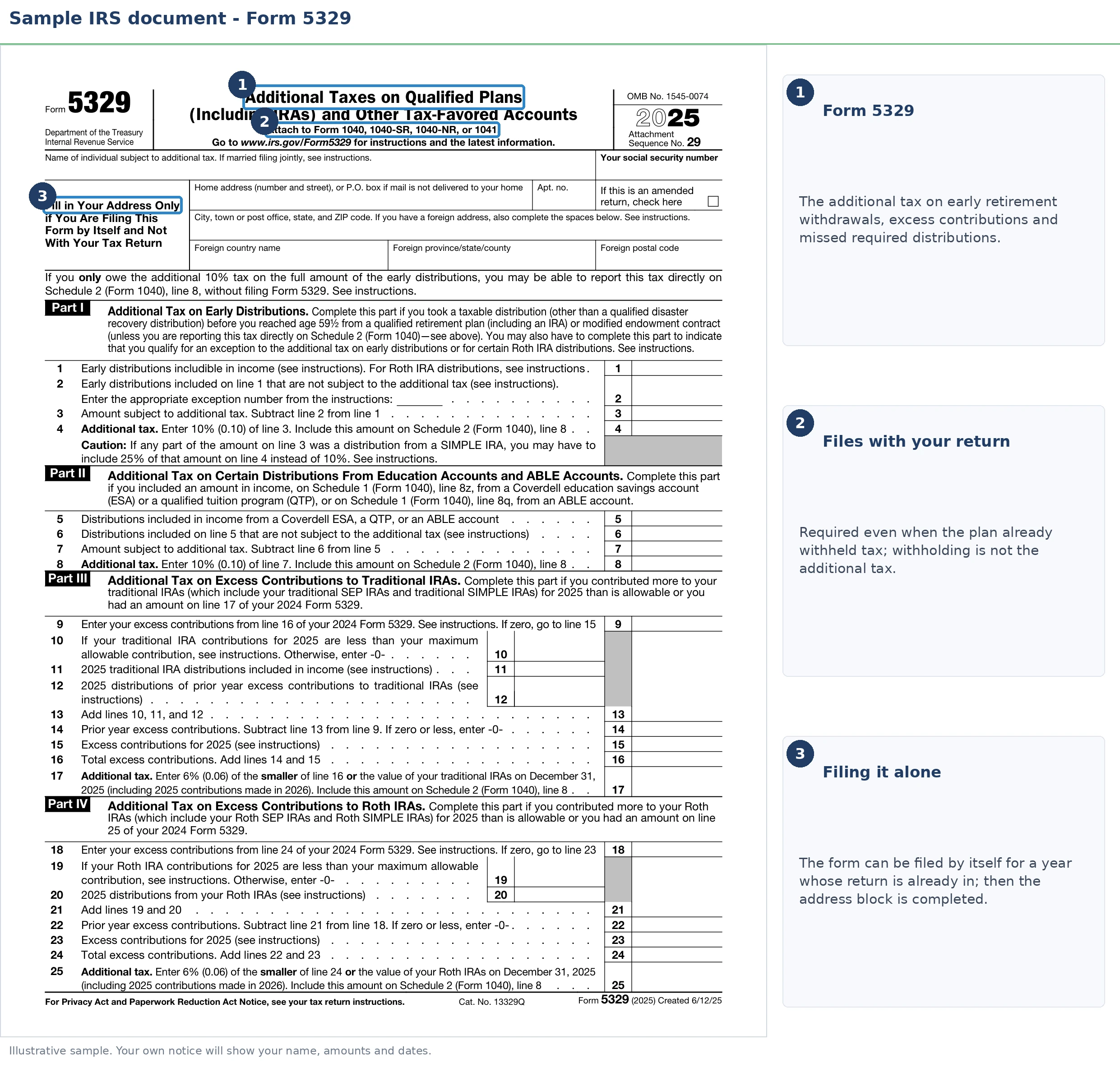
If you cashed out a retirement account early, most of what you need is in the first table, the exceptions list, and the worked example below. The image below shows what Form 5329 looks like and where each of the three taxes lands on it, so give it a glance before you touch the form.
⏱ Your deadline: Form 5329 has no due date of its own. It files with your Form 1040 by that year's regular filing deadline. Two clocks run without it, though: the 6% excess-contribution tax repeats every year the excess stays in the account, and once a balance is assessed, penalties and interest accrue monthly until it's paid.
Why are you filling out Form 5329?
Form 5329 exists because the IRS receives a copy of every Form 1099-R your plan issues. When your 401(k) administrator or IRA custodian paid you, it reported the gross amount, the taxable amount, and a distribution code straight to the IRS, before you filed anything. Form 5329 is where you tell your side: how much of that distribution owes the additional tax, and how much escapes it under an exception.
Here's the part that surprises almost everyone. The 20% your plan withheld does not cover the 10% additional tax. Mandatory withholding on a workplace-plan cash-out is a down payment on ordinary income tax only. The 10% is a separate charge, computed on Form 5329, and for most people in a real tax bracket the withholding doesn't even cover the income tax, let alone the extra 10%.
One more wrinkle to know early: you don't always need the form. If your 1099-R shows code 1 and you agree the full 10% applies, the tax can generally go straight onto Schedule 2. You must file Form 5329 when you're claiming an exception the payer didn't code, when the payer's code is wrong, or for excess contributions and missed RMDs, which are situations the 1099-R can't speak to.
What does Form 5329 cover?
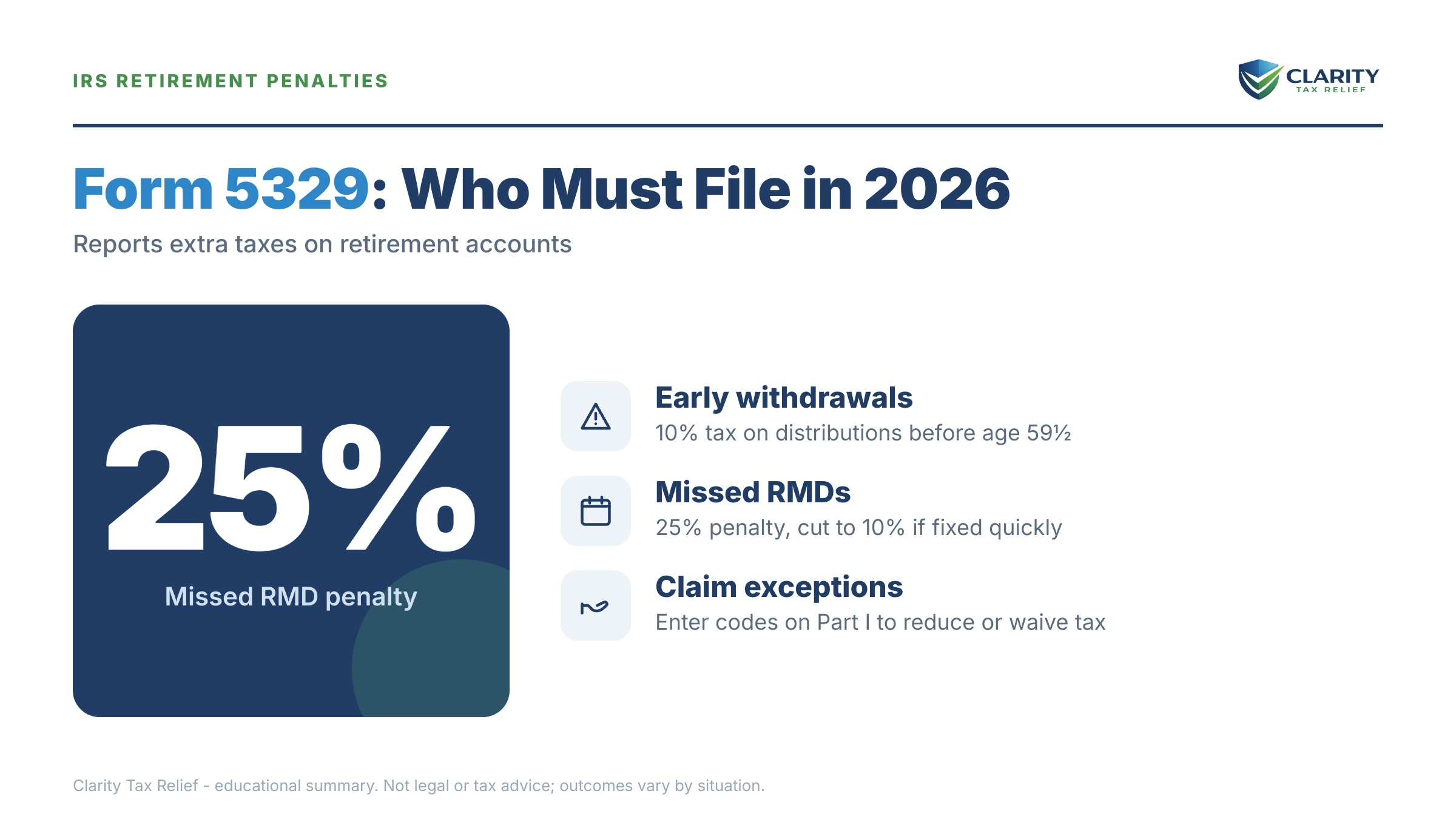
Form 5329 collects three distinct taxes: 10% on early distributions, 6% per year on excess contributions, and up to 25% on missed required minimum distributions. Each lives in its own section of the form, and each pulls its numbers from a different source. The image below shows the form's layout so you can see which section applies to you.
| What happened | Section of Form 5329 | The tax | Where the numbers come from |
|---|---|---|---|
| Took money out of an IRA, 401(k), or other qualified plan before age 59½ (also certain distributions from modified endowment contracts) | The early-distributions part (the first section of the form) | 10% of the taxable amount; 25% for certain SIMPLE IRA distributions in the first two years (per the Form 5329 instructions) | Form 1099-R: Box 1 (gross), Box 2a (taxable amount), Box 7 (distribution code) |
| Certain taxable distributions from Coverdell ESAs, QTPs (529 plans), or ABLE accounts | The education/ABLE distributions part | 10% additional tax on the taxable portion | Form 1099-Q and your own records; see Publication 970 |
| Contributed more than the limit to a traditional IRA, Roth IRA, Coverdell ESA, Archer MSA, or HSA | The excess-contribution parts, one per account type | 6% per year of the excess (capped at the account's year-end value), repeating until removed | Your contribution records, Form 5498, plus Form 8889 (HSA) or Form 8853 (Archer MSA) |
| Didn't take the full required minimum distribution from a retirement account | The excess-accumulation part (the last section of the form) | 25% of the shortfall; 10% if corrected within the correction window (per the instructions); waivable for reasonable cause | Your custodian's RMD statement and account balances; see Publication 590-B |
So a laid-off worker's 401(k) cash-out, a retiree's forgotten RMD, and an over-funded HSA all land on the same form, in completely different sections, at completely different rates. If your issue is HSA excess contributions, the mechanics interact with your regular HSA reporting on Form 8889. The 6% is capped at the account's year-end value and repeats every year the excess stays in. If it's a missed RMD, the waiver process has its own playbook. See our guide to the missed RMD penalty waiver.
Which exceptions can get you out of the 10%?
Several statutory exceptions on Form 5329 can erase the 10% early-distribution tax, and each has fine print about which accounts it covers. This matters most when your 1099-R shows code 1 (no known exception). The payer only reports what it knows, and it doesn't know about your medical bills or disability. Form 5329 is where you overrule the payer's code and claim the exception yourself, entering the exception number from the current instructions.
| Exception | Applies to | What to know |
|---|---|---|
| Total and permanent disability | IRAs and workplace plans | You must be unable to engage in substantial gainful activity; keep the medical determination |
| Death (distributions to a beneficiary) | IRAs and workplace plans | Inherited-account distributions escape the 10% regardless of the beneficiary's age, though income tax still applies (see our inherited IRA tax debt guide) |
| IRS levy on the account under section 6331 | IRAs and workplace plans | If the IRS itself seized the account, the forced distribution is exempt from the 10%. Details in can the IRS take your IRA |
| Unreimbursed medical expenses above the AGI floor (generally 7.5%; confirm in the current instructions) | IRAs and workplace plans | Only the portion of the distribution up to the expenses above the floor is exempt; no itemizing required |
| Separation from service at 55 or later (the "rule of 55") | Workplace plans only, never IRAs | You must leave the job in or after the calendar year you turn 55; rolling the money to an IRA forfeits it |
| Substantially equal periodic payments (72(t)) | IRAs and workplace plans (after separation) | A committed payment schedule based on life expectancy; breaking the schedule early triggers the tax retroactively |
| Qualified higher-education expenses | IRAs only | Tuition, fees, books, and certain room and board for you, a spouse, child, or grandchild |
| First-time home purchase (up to $10,000 lifetime) | IRAs only | "First-time" means no ownership interest in a main home in the prior two years |
| Qualified reservist distributions | IRAs and workplace plans | For reservists called to active duty for the required period |
Recent law added newer exceptions too, including limited emergency personal expense distributions and distributions for domestic-abuse victims under SECURE 2.0. The dollar caps are indexed and specific, so check the current Form 5329 instructions for the exact amounts and exception numbers before claiming one.
Two traps in this list catch laid-off workers constantly:
- The rule of 55 doesn't help you at 48. The age test is about the year you separated, whatever your need for the money. It applies only to workplace plans like 401(k)s and 403(b)s, and rolling a 401(k) into an IRA forfeits it.
- The health-insurance-while-unemployed exception you may have read about applies to IRAs only. It does nothing for a 401(k), and job loss by itself is no exception for a workplace-plan cash-out.
What does a $42,000 401(k) cash-out cost?
A $42,000 401(k) cash-out at 48 can cost roughly $13,440 in federal tax, about $5,040 more than the plan withheld. Here's the math, using a clearly hypothetical scenario.
Say you're 48, laid off in March, and you cashed out a $42,000 401(k) to cover rent. The plan withheld the mandatory 20% ($8,400) and deposited $33,600. It felt like the taxes were handled. Now run the actual numbers, assuming the distribution stacks on top of your severance and unemployment into the 22% bracket:
- Ordinary income tax: 22% × $42,000 = $9,240
- Additional tax on Form 5329: 10% × $42,000 = $4,200
- Total federal cost: $13,440
- Already withheld: $8,400
- Still owed at filing: roughly $5,040, before any state income tax and before any underpayment penalty
Now the exception check. Rule of 55? No, you were 48 when you separated. Unemployment alone? No, that exception is IRA-only. Suppose you paid $6,000 in unreimbursed medical bills that year and your AGI was $58,000. The amount above the 7.5% floor ($6,000 − $4,350 = $1,650) escapes the 10%, trimming the Form 5329 tax by $165. Small, but it's the kind of line item most self-preparers never claim, and it requires filing the form.
If this scenario is your scenario, the follow-on question, how to handle a 401(k) withdrawal tax bill you can't pay, has its own full guide.
What happens if you skip Form 5329 and ignore the 1099-R?
An unreported 1099-R doesn't disappear. The IRS's document-matching computers compare every payer form against your return, often a year or more after you file. When the match fails, a fixed sequence starts, and each stage costs more than the last:
- The mismatch is flagged. The Automated Underreporter program sees a 1099-R with no matching income or additional tax on your return. No human has looked at your file yet, and none needs to.
- CP2000 notice. The IRS proposes the extra income tax, the 10% additional tax, interest back to the original due date, and often an accuracy-related penalty. You typically get about 30 days to respond, and this is your best window to claim an exception you skipped.
- CP3219A, the statutory notice of deficiency. If you don't respond, this 90-day letter is your last chance to dispute the amount before assessment, by petitioning Tax Court.
- Assessment and the CP14 notice. The proposed tax becomes a legal debt and the first bill arrives, with roughly 21 days before the reminder sequence begins.
- The collection ladder. CP501 and CP503 reminders, then CP504 (the IRS can take your state refund), then LT11, the final notice that opens a 30-day window before wage garnishment and bank levies become legal, and your last chance to request a Collection Due Process hearing.
There's a quieter cost, too. For the excise taxes Form 5329 reports, the statute of limitations generally doesn't start until the form is filed. An unfiled 5329 can leave that year open to the IRS indefinitely. Filing it, even years late, is what starts the clock in your favor.
Cashed out a retirement account and the bill is bigger than the withholding covered?
Whether you're staring at a fresh 1099-R or a CP2000 for a withdrawal from two years ago, get it reviewed free before interest and penalties add another layer. An experienced tax professional will check every exception you can claim and map the cheapest way to handle the balance.
How do you file Form 5329, step by step?
- Gather your paperwork. Pull every Form 1099-R you received, a copy of your return, and any records that support an exception: medical bills, a disability determination, or the date you separated from the employer.
- Check Box 7 on each 1099-R. The distribution code tells you what the payer reported to the IRS. Code 1 means early distribution with no known exception, the code Form 5329 most often exists to correct.
- Complete the section that matches your situation. Early distributions go in the first part of the form; excess contributions each have their own account-type section; missed RMDs go in the final part.
- Attach the form to your return, or file it alone. Form 5329 rides with Form 1040 and its tax flows to Schedule 2. Form 5329 has its own signature block, so if you are not required to file a return, sign and file Form 5329 by itself. For a year you already filed, the usual route is Form 1040-X with Form 5329 attached. A missed-RMD waiver request is the common exception and can generally be filed on a standalone prior-year Form 5329 per the instructions.
- Fix the underlying problem. Withdraw an excess contribution (plus its earnings) so the 6% stops repeating, or take the missed RMD now and request a waiver on the form.
- Pay what you can and arrange the rest. Pay online at IRS.gov/payments, or set up a payment plan before the balance moves into the IRS collection notice stream.
What if you owe on Form 5329 and can't pay?
The IRS accepted roughly 1 in 5 Offers in Compromise in FY2024. Put plainly, most Form 5329 balances get resolved through payment arrangements, and settlements are the exception. Here's the realistic menu, from simplest to hardest:
- Pay in full by the return deadline. Cheapest option; stops the failure-to-pay penalty before it starts.
- Short-term payment plan. Up to 180 extra days, $0 setup fee. Interest and the 0.5%/month late-payment penalty continue, but collection doesn't start.
- Installment agreement. For balances up to $50,000, you can usually set up a plan online spread over as long as 72 months; balances of $10,000 or less generally qualify for a guaranteed installment agreement. Our guide to setting up an IRS payment plan online walks through it. On the hypothetical $5,040 shortfall above, even a modest monthly payment keeps the debt out of the levy pipeline entirely.
- Currently Not Collectible status. If you're still out of work and paying anything would leave you unable to cover basic living expenses, collection can be paused. The debt (and interest) remains, but levies stop. Start with our guide for people who lost a job and can't pay the IRS.
- Offer in Compromise. Settling for less than the full balance when your assets and income can't cover it. There's a $205 application fee and, for lump-sum offers, 20% down, both waived with low-income certification (AGI at or below 250% of the poverty level). Real, means-tested, and slow. Never a marketing promise.
- Penalty relief, with a big caveat. The 10% itself is an additional tax, so abatement can't touch it. The failure-to-file and failure-to-pay penalties stacked on an old unreported distribution are abatable, through first-time abatement now and through the new Automatic Exemption from Penalty rolling out starting summer 2026. You can estimate how much of your balance is penalties and interest versus tax with our IRS Penalty & Interest Calculator.
- Respond to the CP2000 instead of paying it blind. If the IRS already proposed the tax and you agree with the income but missed an exception, a corrected Form 5329 in your response can shrink the bill before it's assessed. If you agree with everything but can't pay, see CP2000: agree but can't pay.
When can you handle Form 5329 yourself?
Most straightforward Form 5329 situations are do-it-yourself. Handle it on your own when:
- Your 1099-R shows code 1, you agree the 10% applies, and you can pay the balance in full or within 180 days;
- You're claiming a single, well-documented exception (medical bills above the floor, a disability determination, a beneficiary distribution) and tax software will carry the numbers to Schedule 2;
- You caught an excess contribution early and just need to report one year of the 6% while the custodian processes the corrective withdrawal;
- You missed one RMD, took it as soon as you noticed, and are filing the waiver request with a short reasonable-cause statement.
Red flags that mean experienced help changes the outcome:
- A CP2000 already assessed for multiple years of unreported distributions.
- A cash-out you can't pay on top of other tax debt.
- A disputed exception where the payer's code contradicts your facts.
- A 72(t) payment schedule that broke.
- Excess contributions that compounded for several years across account types.
In those cases, the order you fix things in (exceptions first, then penalties, then the payment arrangement) often changes the total you pay more than any single form does.
What do the terms on Form 5329 and your 1099-R mean?
- Additional tax: the law's term for the 10%. It's a tax and no penalty, which is why penalty abatement can't remove it while statutory exceptions can.
- Distribution code (Box 7): the one- or two-character code your payer used to describe the withdrawal to the IRS; Form 5329 is how you correct or override it.
- Gross distribution vs. taxable amount: Box 1 is everything that left the account; Box 2a is the portion that counts as income, the number the additional tax is figured on.
- Excess contribution: money put into an IRA, HSA, or similar account beyond that year's legal limit; it draws the 6% excise every year it stays in.
- Required minimum distribution (RMD): the amount the law forces out of most retirement accounts each year past a certain age; the shortfall (and only the shortfall) is what gets taxed.
- Correction window: the period, defined in the Form 5329 instructions, during which fixing a missed RMD cuts the excise tax from 25% to 10%.
The bottom line on Form 5329
If a 1099-R shows an early withdrawal, the 10% is owed unless an exception applies, and Form 5329 is the only place to claim one. The 20% your plan withheld won't cover it. File the form with your return, fix any excess contribution or missed RMD so the tax stops repeating, and arrange payment before the CP2000 letters start.
Your next 24 hours
- Find three boxes on your 1099-R: Box 1 (gross distribution), Box 2a (taxable amount), and Box 7 (distribution code). Those three numbers determine everything Form 5329 will say.
- Gather your supporting records: last year's return, the 1099-R, and anything backing a possible exception, such as medical bills for the year, a disability determination, or your separation paperwork.
- Get a free case review. If the balance is more than you can pay, or a CP2000 already arrived, an experienced tax professional can check every exception and set up the right arrangement before interest and penalties add another layer. Use the 2-minute form or call (888) 825-7779.
Primary sources: the IRS's official page About Form 5329 hosts the current form and instructions, including the full exception-code list and correction-window rules, and Publication 590-B covers IRA distribution rules, including RMDs.
Common questions
Do I have to file Form 5329 if my 401(k) already withheld 20%?
Usually, yes. The 20% your plan withheld is a prepayment of ordinary income tax only. It does not include or satisfy the 10% additional tax on early distributions. If your 1099-R shows code 1 and no exception applies, you can often enter the 10% directly on Schedule 2 without the form, but you must file Form 5329 itself any time you claim an exception the payer did not code.
Is the 10% early-withdrawal tax a penalty the IRS can abate?
No. It is an additional tax under the law, so first-time abatement and reasonable-cause relief cannot remove it. Only the statutory exceptions on Form 5329 can. Abatement still matters, though: the failure-to-file and failure-to-pay penalties that stack on top of an unreported distribution are penalties, and those can often be reduced or removed.
What is the penalty for missing a required minimum distribution?
Under current law, the excise tax is 25% of the amount you should have withdrawn but didn't, and it drops to 10% if you correct the shortfall within the correction window described in the Form 5329 instructions. The IRS can also waive it entirely for reasonable cause. You request the waiver on Form 5329 itself with a brief explanation and proof you have since taken the distribution.
This guide is general information, not tax or legal advice for your specific situation. Eligibility for IRS programs depends on individual facts and circumstances; no outcome is guaranteed.