
State Tax Forms
Form 540: California's Personal Income Tax Return, Deadlines, and Late-Filing Fixes for 2026
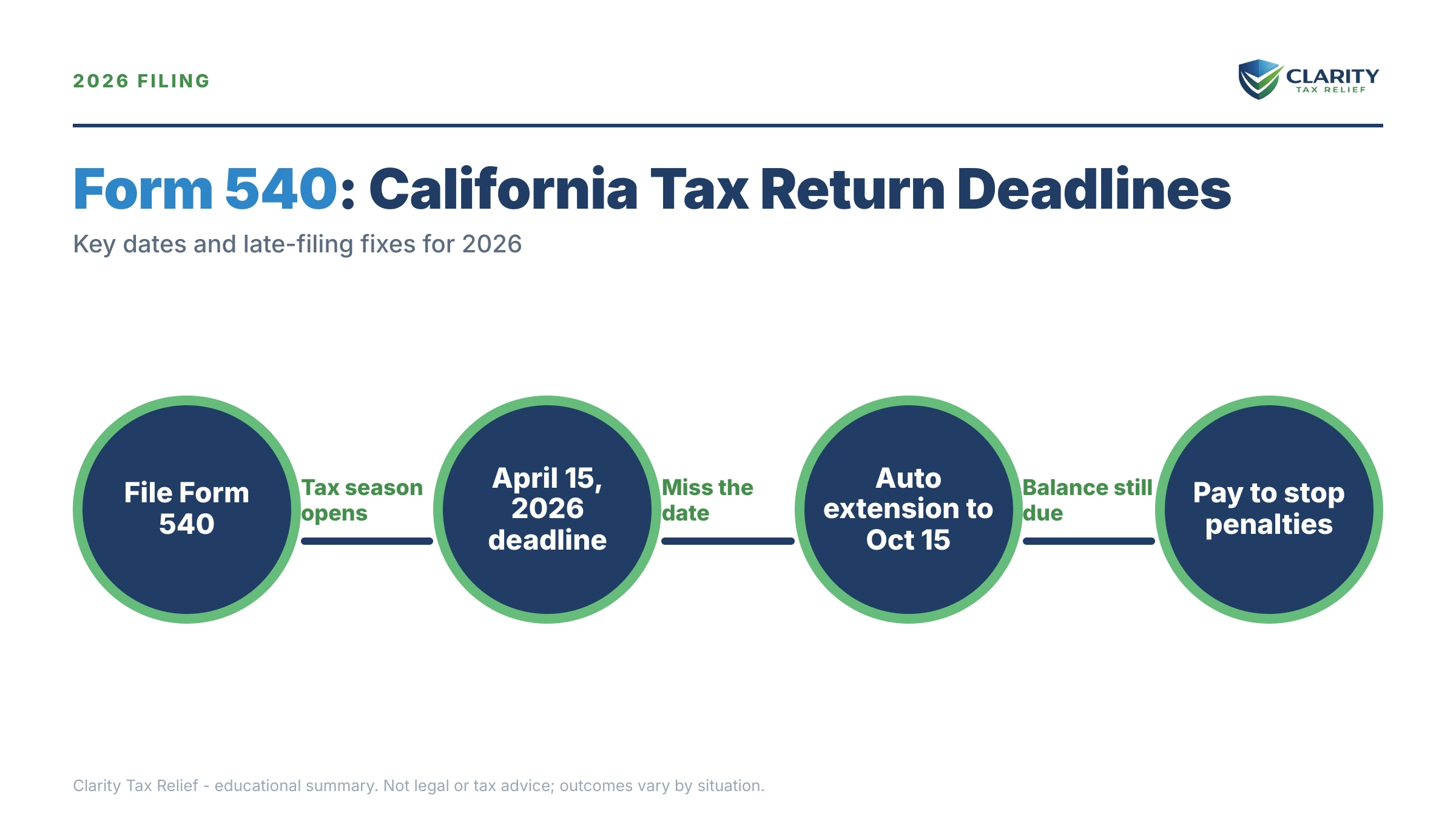
The short answer: Form 540 is California's Personal Income Tax return, filed with the Franchise Tax Board (FTB) — not the IRS. For the 2025 tax year, April 15, 2026 was the day to file and pay; October 15, 2026 is the last day to file without a late-filing penalty, though interest runs from April 15.
You filed your federal return in April, both years, right on time. The California return was the one that kept sliding — the software asked, you clicked "finish later," and later never came. Now there are two state years missing, and you're not entirely sure what the FTB knows.
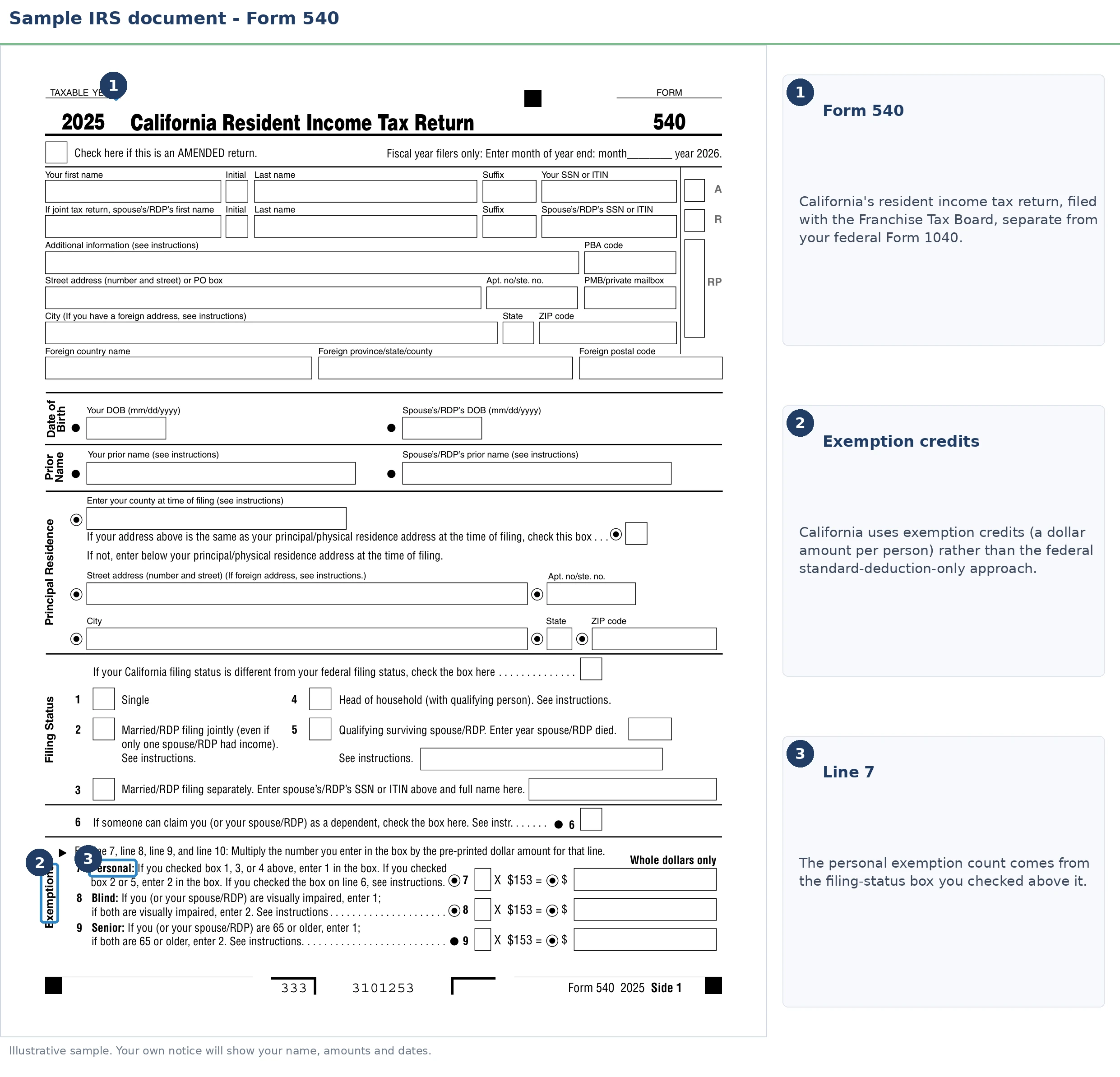
Here's the part that changes everything: because your federal returns are done, most of the numbers Form 540 needs already exist. The catch-up is mostly mechanical — and for the 2025 year, there's still a real deadline you can beat. The image below shows exactly what Form 540 looks like and where to look, so nothing on the form surprises you when you sit down with it.
⏱ The clock that matters right now: October 15, 2026 is the last day to file or e-file your 2025 Form 540 without a late-filing penalty. Interest on any unpaid balance still runs from the original April 15, 2026 due date — the automatic extension moves the filing deadline, never the payment deadline.
What Form 540 is and who must file it
Form 540 is the return every full-year California resident who meets the state's filing requirement sends to the Franchise Tax Board — a separate agency from the IRS, with its own deadlines, its own penalties, and a collection window twice as long as the IRS's.
Filing a federal Form 1040 does nothing to satisfy California. The two returns go to two different agencies, and the FTB receives IRS data — which is exactly how it spots people who filed federally from a California address but sent the state nothing.
Whether you must file depends on income thresholds that vary by filing status, age, and number of dependents. Those thresholds change each year and live in the FTB's Form 540 Personal Income Tax Booklet — check the current table there rather than an old blog post. Two practical notes:
- If California tax was withheld from your paychecks, filing is often how you get money back — refunds don't arrive on their own.
- The California Earned Income Tax Credit (CalEITC) is claimed through your state return. Skip the return, and you forfeit a credit that can be worth real money to lower-income workers.
If you're unsure whether the FTB shows a return on file for a given year, its automated phone line at 800-338-0505 can tell you, and your account at the FTB's website shows filed returns and balances.
Form 540 vs. 540 2EZ vs. 540NR: which California return you file
California uses three versions of its personal income tax return, and residency — not income level — is the first sorting question.
| Form | Who files it | The key thing to know |
|---|---|---|
| Form 540 | Full-year California residents | The standard, full-length return. It handles every resident situation, including anything the 2EZ excludes. |
| Form 540 2EZ | Full-year residents with simpler returns | A shortcut version with eligibility limits on income types and amounts — the current rules are in the 540 2EZ instructions. If you don't qualify, the regular 540 always works. |
| Form 540NR | Nonresidents and part-year residents | Used when you lived in California for only part of the year or earned California-source income while living elsewhere. |
The second sorting question is what changes between your federal and California numbers. Your federal and state taxable income are rarely the same, and these are the differences filers hit most:
- Social Security: California does not tax Social Security benefits, even when the federal return taxes part of them.
- HSAs: California does not conform to the federal HSA deduction — contributions deductible on your 1040 are added back for the state.
- Capital gains: California taxes capital gains as ordinary income. There is no preferential state rate for long-term gains.
- Unemployment: California does not tax unemployment compensation, even though the federal return does.
These adjustments are why "just copy the 1040" produces a wrong Form 540 — the state return exists precisely to reconcile the two systems.
Form 540 deadlines for the 2025 tax year
For the 2025 tax year, April 15, 2026 was the last day to both file Form 540 and pay the amount owed to avoid penalties and interest. California's extension to file is automatic — no request form needed to get more time to file — but a payment sent with that extension goes on form FTB 3519, because the money itself was still due in April.
| Date | What it is | What it means for you |
|---|---|---|
| April 15, 2026 | 2025 Form 540 filing and payment deadline | Last day to file and pay without penalties or interest. Payment with the automatic extension goes on form FTB 3519. |
| October 15, 2026 | Last day to file or e-file the 2025 return | Filing by this date avoids the late-filing penalty. Interest on any unpaid balance still runs from April 15, 2026. |
| April 15, 2026 | 1st 2026 estimated tax payment | For income without withholding (self-employment, investments, rentals). |
| June 15, 2026 | 2nd 2026 estimated tax payment | Note California's uneven schedule — this one arrives just two months after the first. |
| September 15, 2026 | 3rd 2026 estimated tax payment | If you missed it this week, pay as soon as possible — the shortfall doesn't wait for January. |
| January 15, 2027 | 4th 2026 estimated tax payment | Final installment for the 2026 tax year before that return is due in spring 2027. |
Do you even need estimated payments? Generally no, if your California withholding covers at least 90% of your required annual payment, or if withholding keeps what you'd owe with your return under $500 ($250 if married/RDP filing separately). Underpaying can trigger an FTB estimated tax penalty, computed under the Form 540-ES instructions.
What happens if you skip Form 540 — the FTB's escalation path
A missing Form 540 doesn't stay invisible, because the FTB cross-matches IRS filings, W-2s, and 1099s against its own records. Your on-time federal returns are the very data trail that flags the missing state years. The sequence runs in stages:
- Silent matching. The FTB compares federal and employer data against filed state returns. A California address on a 1040 with no matching 540 is the classic trigger.
- Demand to File. A formal FTB Demand to File notice gives you a window to file the missing return or explain why none is required. This is the cheapest moment to fix things after the deadline itself.
- Proposed assessment. If you don't respond, the FTB can propose a tax bill built from the income it sees — typically without your deductions, credits, or CalEITC — and add penalties and collection fees on top. Its number is almost always worse than yours.
- Collections. Once assessed and final, the balance moves to enforcement: bank levies, wage garnishment, and state tax liens. Use the FTB notice decoder to identify exactly which letter you're holding at this stage.
- A 20-year clock. Under R&TC §19255, the FTB can collect an assessed balance for 20 years — double the IRS's window. Details in our guide to the FTB statute of limitations on collections. Waiting it out is not a strategy in California.
The order matters: at stages one and two, you still control the numbers. From stage three on, the FTB writes them for you.
Two missing California returns? They won't file themselves.
Get both years reviewed free — before the October 15, 2026 e-file window closes on your 2025 Form 540 and before the FTB writes its own version of your older year. An experienced tax professional will map the fastest, cheapest path back into compliance.
Your options when you're behind on Form 540 and owe
Filing the missing returns yourself — before the FTB assesses for you — is almost always cheaper than any alternative, and it unlocks every relief option below.
- File and pay in full. Filing stops the late-filing exposure from growing; paying stops interest. If you can clear the balance, this ends it.
- File and pay over time. The FTB offers monthly payment arrangements — eligibility, terms, and setup are covered in our FTB payment plan guide. Interest continues while you pay.
- Penalty relief. The Form 540 booklet's Interest and Penalties section describes a one-time timeliness penalty abatement — California's version of a first-time break. How to request it, and what else may qualify, is in our FTB penalty abatement guide.
- Hardship and settlement paths. If paying anything would leave you unable to cover basics, the FTB has hardship and offer programs with their own rules — start with owe California state taxes and can't pay. These are means-tested; eligibility depends on your full financial picture.
For the wider picture — how FTB collections, liens, and relief programs fit together — the hub is our guide to California FTB back taxes. This page stays focused on the form and the filing fix.
A worked example: $8,900 across two missing years
Say you skipped tax years 2024 and 2025, and once both returns are prepared you owe $8,900 total — $5,150 for 2024 and $3,750 for 2025. (Hypothetical numbers, but a realistic shape for a W-2 earner whose withholding ran light two years straight.)
The two years are not in the same position, and that changes your move order:
- The 2025 year is still saveable. E-file it by October 15, 2026 and there is no late-filing penalty on the $3,750 — only interest running from April 15, 2026. That's why it files first, this week, not "when you do both."
- The 2024 year is already late. Filing it now stops the exposure from compounding and starts the clock on fixing it. Penalties and interest on that year are computed by the FTB under the booklet's Interest and Penalties rules — and this is where the one-time timeliness abatement can matter most.
- The remaining balance is a math problem, not a crisis. As pure arithmetic, $8,900 spread over 36 months is about $247 a month before ongoing interest ($8,900 ÷ 36 ≈ $247). Whether the FTB approves that structure depends on its payment-plan rules and your situation — but the point stands: this is a manageable monthly number, not a life-altering one.
Compare that with waiting: a proposed assessment built without your deductions, collection fees stacked on top, and a balance the FTB can pursue for 20 years. Filing first is the entire game.
How to file Form 540 late, step by step
- Pull your federal returns for every missing year. Your Form 1040 already holds most of the numbers Form 540 needs — income, filing status, dependents. Because you filed federal on time, the hard part is already done.
- Download each year's Form 540 from ftb.ca.gov. California returns are year-specific: a 2024 return goes on 2024 forms with 2024 instructions. Never file an old year on the current year's form.
- File the 2025 return before October 15, 2026. Filing or e-filing by that date means no late-filing penalty on the 2025 year — interest still runs from April 15, 2026, but the biggest penalty is off the table.
- Pay what you can with each return. Every dollar paid stops interest on that dollar. Partial payment with a filed return is always better than waiting until you can pay in full.
- Arrange the balance and request penalty relief. Set up an FTB payment plan for what remains, and ask about California's one-time timeliness penalty abatement, described in the Form 540 booklet's Interest and Penalties section.
When you can handle Form 540 yourself
A late Form 540 is one of the most DIY-friendly problems in state tax — when the facts are simple. You likely don't need professional help if:
- You're only late on the 2025 year and can file before October 15, 2026 — that's a normal extension-season filing, not a crisis.
- You're a W-2 earner whose returns mirror your 1040s, and you can pay the balance or set up a straightforward payment arrangement.
- You're owed refunds — filing to collect your own money needs no advocate.
Experienced help changes outcomes when the situation has moved past "late": a Demand to File or proposed assessment has already arrived, the FTB has started a levy or garnishment, there are more than two unfiled years, you have self-employment or business income the FTB may see differently than you reported federally, or part-year residency makes the 540-vs-540NR question genuinely contested. In those cases, the order you fix things in — returns, penalties, then the balance — often determines what you end up paying.
Terms on Form 540 paperwork, decoded
- Franchise Tax Board (FTB): California's income tax agency — the state counterpart to the IRS, with its own notices, penalties, and collection powers.
- FTB 3519: the payment voucher used to send money with California's automatic filing extension, since the extension never delays the payment itself.
- Form 540-ES: the vouchers and instructions for California estimated tax payments on income without withholding.
- Demand to File: the FTB's formal notice that it believes you owed a return and didn't file one — respond to it, or the FTB builds a bill for you.
- Notice of Proposed Assessment: the FTB's proposed tax bill, usually computed from raw income data without your deductions or credits, with a window to protest before it becomes final.
- CalEITC: the California Earned Income Tax Credit — a refundable state credit for lower-income workers, claimable only by filing a state return.
The authoritative source for everything on the form itself — thresholds, line instructions, penalty computations — is the 2025 Form 540 Personal Income Tax Booklet at the Franchise Tax Board's website, where you can also download prior-year forms at ftb.ca.gov.
Form 540 questions, answered
Is Form 540 a state or federal tax form?
Form 540 is a state form — California's Personal Income Tax return, administered by the Franchise Tax Board (FTB), not the IRS. Filing your federal Form 1040 does not file it for you; the two returns go to two different agencies with different deadlines and penalties. If you are not sure whether the FTB has a return on file for you, its automated phone line at 800-338-0505 can help, or check your account at ftb.ca.gov.
Do I have to file Form 540 if I already filed a federal 1040?
Usually yes, if you are a California resident who meets the state's filing requirement. The federal and state filings are completely separate, and the FTB receives IRS data — so a federal return with a California address and no matching state return is exactly the pattern that triggers a Demand to File notice. The income thresholds that require filing depend on filing status, age, and dependents; the current table is in the FTB's Form 540 booklet.
What is the difference between Form 540 and Form 540 2EZ?
Form 540 2EZ is a shorter, simplified version of Form 540 for full-year California residents with straightforward returns; the regular Form 540 is the full version that handles everything the 2EZ's eligibility rules exclude. If you were a nonresident or lived in California for only part of the year, you file Form 540NR instead. When in doubt, the regular Form 540 always works for a full-year resident — the 2EZ is a convenience, not a requirement.
What happens if I missed the April 15, 2026 deadline for my 2025 Form 540?
You can still avoid the late-filing penalty: California grants an automatic extension to file, and October 15, 2026 is the last day to file or e-file the 2025 return without one. Payment, however, was due April 15, 2026, so interest runs from that date on whatever you owe. Form FTB 3519 is the voucher for sending a payment with the automatic extension — the extension moves the filing deadline, never the payment deadline.
Do I need to make California estimated tax payments in 2026?
Generally not, if your California withholding covers at least 90% of your required annual payment, or if withholding keeps the amount you would owe with your return under $500 ($250 if married/RDP filing separately). If you do need them, the 2026 due dates are April 15, June 15, and September 15, 2026, and January 15, 2027. Underpaying can bring an underpayment of estimated tax penalty, computed per the Form 540-ES instructions.
What happens if I never file my California state return?
The FTB eventually fills the gap for you — on its terms. It matches IRS and employer data, sends a Demand to File notice, and if you do not respond, it can propose an assessment based on the income it sees, often without your deductions or credits, plus penalties and fees. Once a balance is assessed, the FTB can collect for 20 years under R&TC §19255 — twice the IRS's 10-year collection window.
Does California tax Social Security benefits on Form 540?
No — California does not tax Social Security benefits, even when your federal return taxes part of them; that is one of the adjustments made between the two returns. Other common differences run the other way: California does not recognize HSA deductions, it taxes capital gains as ordinary income with no preferential rate, and it does not tax unemployment compensation. Your federal and California taxable income are rarely the same number.
Your next 24 hours
- Confirm which years are missing. Check your records — or the FTB's automated line at 800-338-0505 — and write down exactly which tax years have no filed Form 540.
- Gather the raw material. Pull your federal 1040s for those years plus the W-2s and 1099s behind them. That stack is 90% of what each state return needs.
- Get a free case review before October 15, 2026. If the 2025 year is one of your gaps, that date is the difference between a late-filing penalty and none. Use the 2-minute form at /#consult or call (888) 825-7779 and an experienced tax professional will map both years today.
This guide is general information, not tax or legal advice for your specific situation. Eligibility for IRS programs depends on individual facts and circumstances; no outcome is guaranteed. California FTB programs have their own eligibility rules; the FTB's Form 540 booklet is the authoritative source for form-specific figures.