
California FTB
FTB Statute of Limitations on Collections: California's 20-Year Rule (2026)
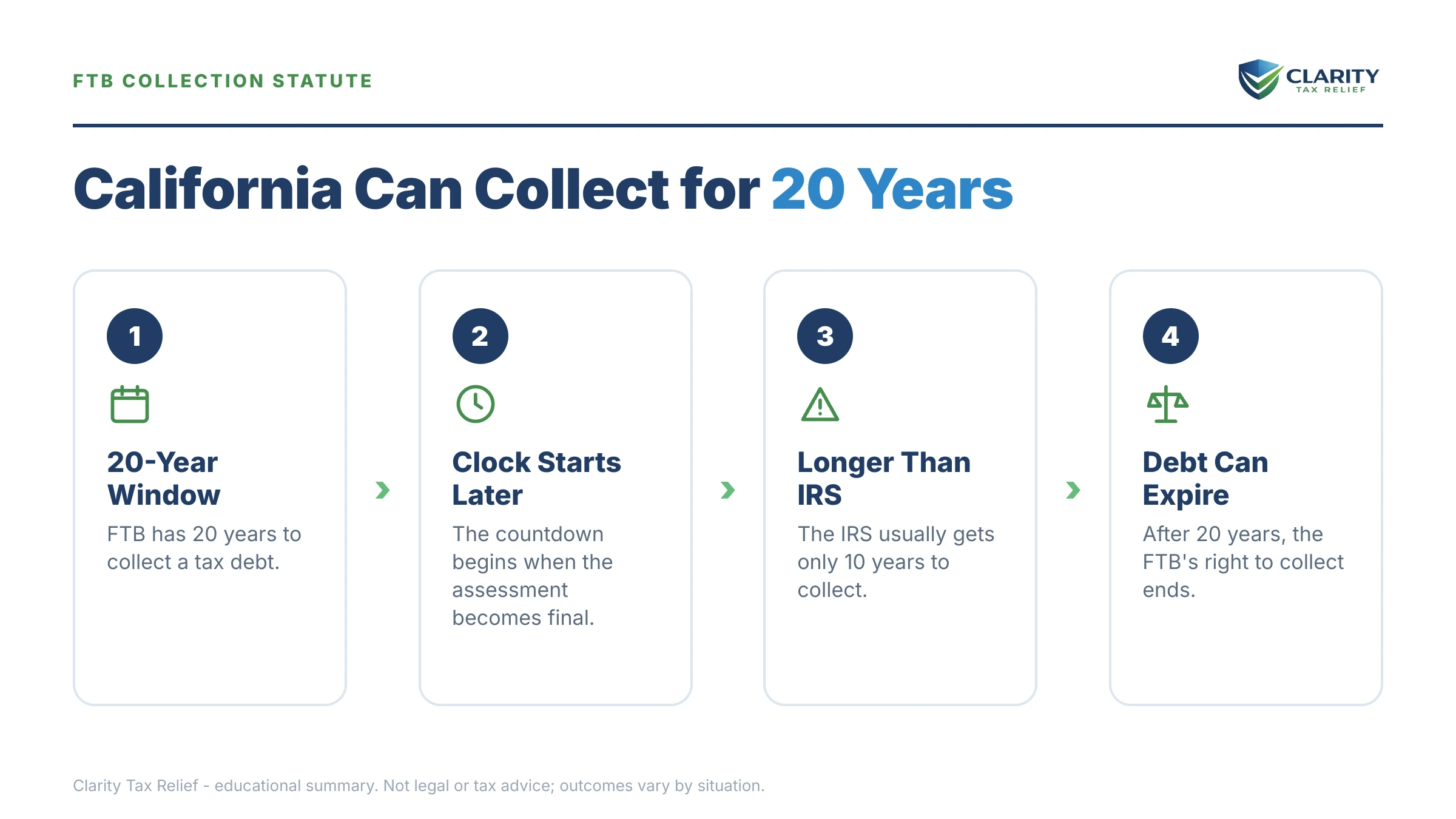
The short answer: the FTB statute of limitations on collections is 20 years — double the IRS's 10-year window. Under California Revenue & Taxation Code §19255, each clock starts when that liability becomes "due and payable," not in the tax year itself, and the balance is abated only after the 20 years run out.
You looked up whether California tax debt expires — probably hoping the answer was 10 years, like the federal rule you read about. It isn't. California wrote itself twice the collection runway, and the Franchisese Tax Board uses every year of it. The good news: once you know how the clock actually works, you can stop planning around a date two decades away and start shrinking the debt now.
The FTB statute of limitations on collections trips people up in three specific ways: the clock runs per assessment (not per tax year you remember owing for), unfiled years may have no clock running at all, and a later adjustment to the same year can move the expiration date. This guide covers all three, what 20 years of FTB enforcement actually looks like, and every realistic way out.
⏱ The real clock: the FTB has 20 years from the date each liability becomes due and payable to collect it, and interest and collection fees accrue the entire time. There is no short response window on this topic; the only clock working in your favor is the one you start by acting.
Why the FTB gets 20 years when the IRS gets 10
California Revenue & Taxation Code §19255 gives the Franchise Tax Board 20 years to collect an income or franchise tax liability — twice the federal collection statute. The IRS side, the 10-year collection statute (CSED), expires 10 years after assessment. The FTB's window runs from when each liability becomes "due and payable" and lasts two decades.
That difference isn't academic. A federal balance and a California balance from the same tax year live on completely different timelines: the IRS debt can expire while the FTB is still garnishing you for another ten years. The two systems also pause their clocks for different reasons — the federal rules are covered in what extends the IRS collection statute, and none of them automatically apply to California.
If you owe the IRS too, you can estimate your federal expiration date with our CSED Calculator, but keep the state and federal math in separate columns. Here's the side-by-side:
| Question | California FTB | IRS |
|---|---|---|
| How long can they collect? | 20 years (R&TC §19255) | 10 years (the CSED) |
| When does the clock start? | When each liability becomes "due and payable" — generally the assessment date | The date the tax is assessed |
| Unfiled years? | No clock until the FTB assesses the year (often via estimated assessment) | No clock until the IRS assesses (your return or a substitute return) |
| What happens at expiration? | The remaining balance is abated — unenforceable | The remaining balance is written off at the CSED |
| What can extend it? | A later assessment on the same year; a court judgment obtained before expiration; periods when collection is legally barred | Pending OIC, bankruptcy, CDP appeals, and other tolling events |
“When you request a payment plan (installment agreement), with certain exceptions, the IRS is generally prohibited from levying and the IRS’s time to collect is suspended or prolonged while an Installment Agreement (IA) is pending.”
— Payment plans; installment agreements (IRS.gov)
When the FTB statute of limitations on collections actually starts
The 20-year period runs from the date a liability becomes "due and payable" — which is tied to when the FTB records the assessment, not the tax year on the return. Owe for tax year 2018 but the FTB didn't assess it until 2024? The state can collect until roughly 2044.
Three details inside that rule change everything for planning:
Each assessment carries its own clock. A self-reported balance from a return you filed, an audit adjustment two years later. A penalty added after that can each have different due-and-payable dates. The statute looks at the latest liability for a year, so a new assessment on an old year can push that year's expiration date further out, not closer.
Unfiled years have no clock at all. If you never filed and the FTB hasn't assessed the year, there's nothing on the books to expire. What happens instead: the FTB matches 1099s, W-2s, mortgage interest, and licensing data, sends a FTB demand to file, and, if you don't respond, issues a Notice of Proposed Assessment built on estimated income with no deductions. That assessment then starts a fresh 20-year clock, usually for far more than you'd owe on a real return.
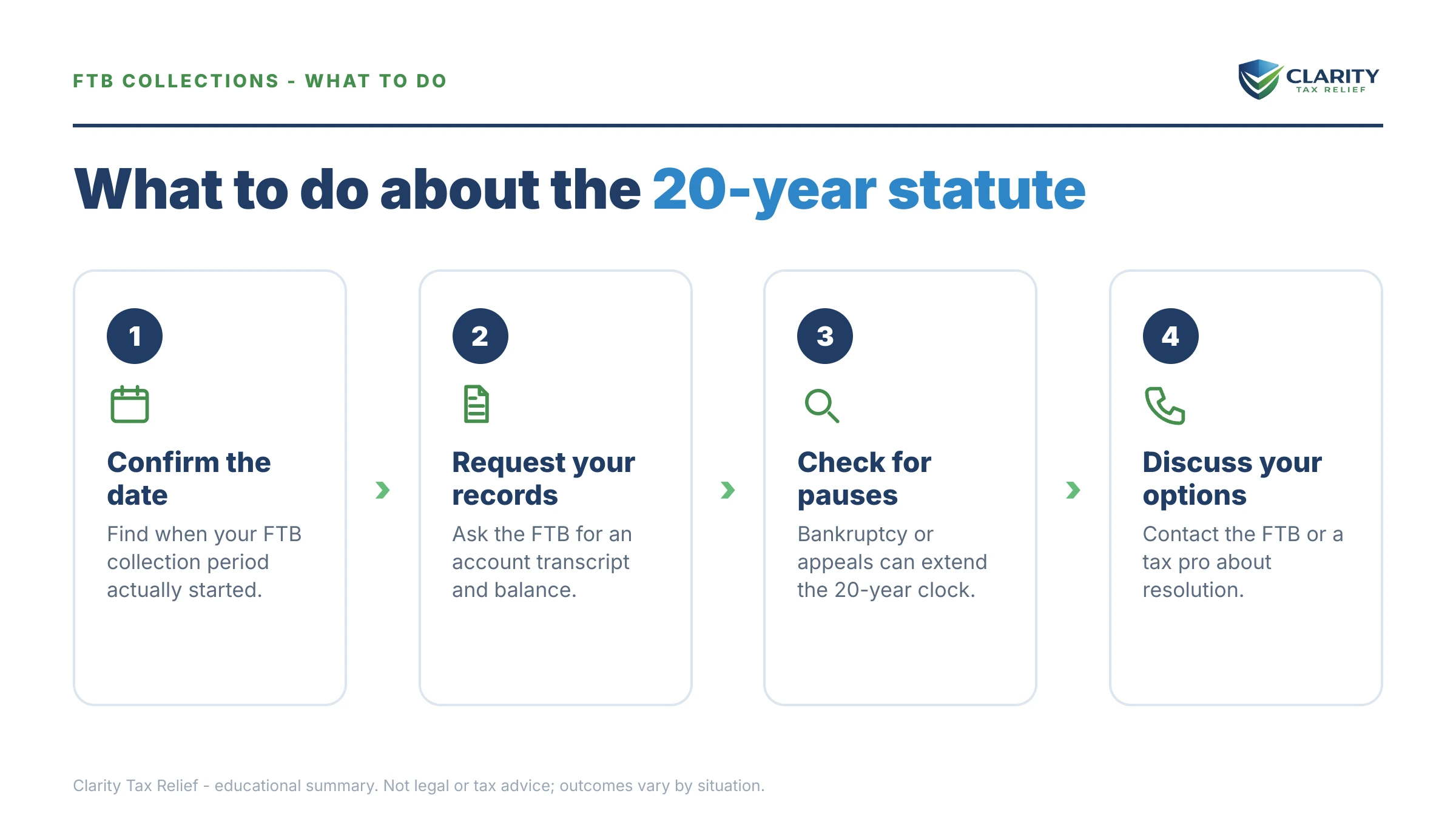
The date isn't printed anywhere obvious. Your notices show balances, not expiration dates. To map your real timeline, you need the assessment history for each year — from a MyFTB account, a written account statement request, or a professional pulling the record under a power of attorney.
What can extend or pause the 20-year clock
Twenty years is the floor of your exposure, not always the ceiling. Three things can stretch it:
- A new liability on the same year. An audit adjustment, a math-error correction, or an added penalty creates a later due-and-payable date. The statute measures from the latest one.
- A court judgment. If the FTB reduces the debt to a judgment before the 20 years expire, collection can continue under the judgment's own rules, past the original date.
- Periods when collection is legally barred. Time when the FTB is prohibited from collecting, a bankruptcy stay is the classic example, may not count against its 20 years. Don't assume a bankruptcy filing burned statute time.
One important carve-out runs the other way: the 20-year rule governs income and franchise tax. Debts the FTB collects for other agencies — traffic fines, court fees, victim restitution — fall under its separate FTB court-ordered debt collections program with different rules entirely. Check the top of your notice to see which program is writing to you.
Note what's not on the extension list: making a payment. Unlike some private debts, paying the FTB doesn't restart the statute, because the period is measured from assessment dates, not activity.
What happens if you try to wait out the FTB
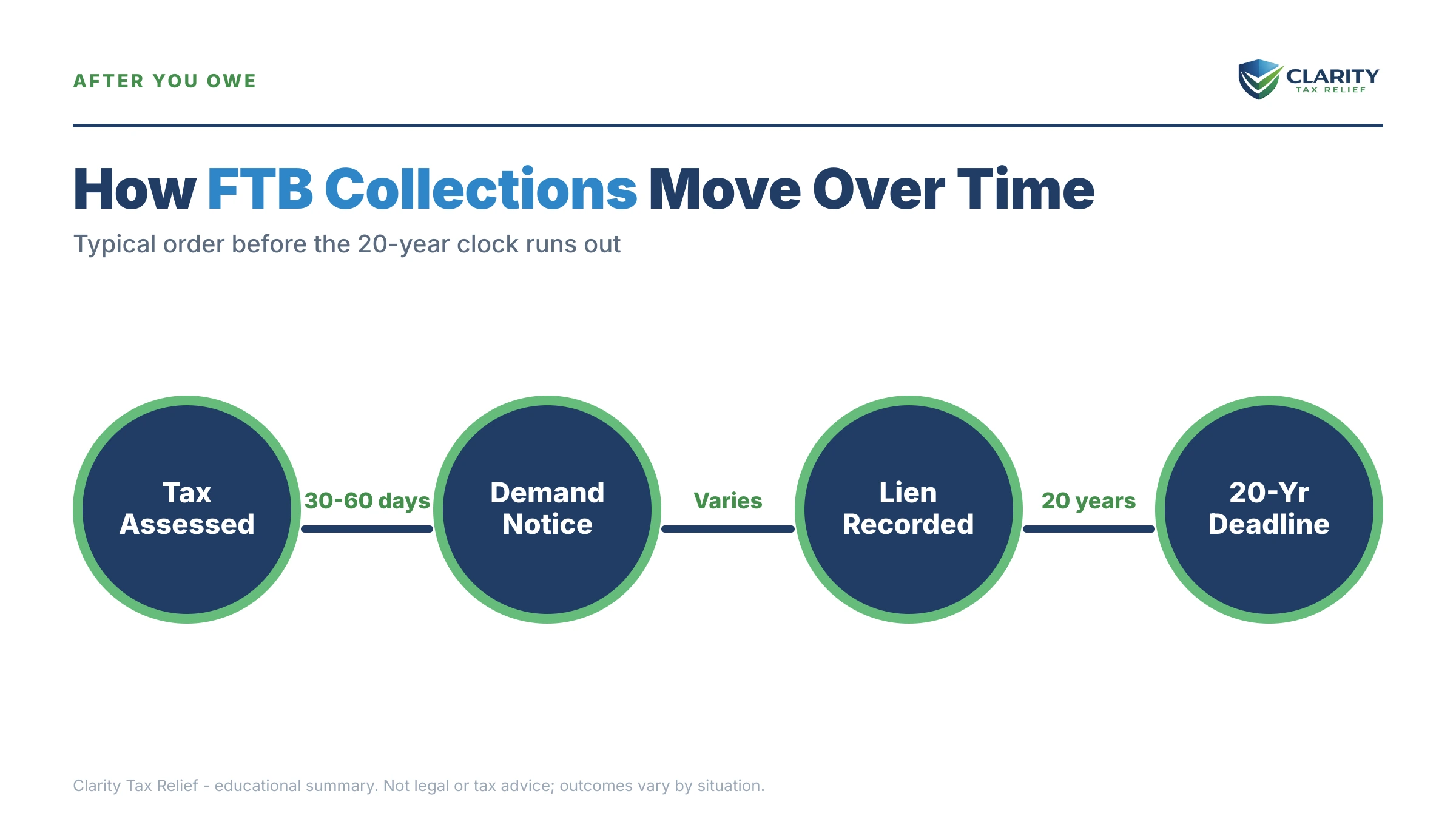
Waiting out a 20-year statute means volunteering for 20 years of enforcement by an agency that doesn't need a court order to take your money. The FTB's collection machine escalates in a predictable sequence, and unlike the IRS in 2026, short-staffed and slow to answer phones, the FTB's automated systems have never been the bottleneck:
- Billing and demand notices — the balance grows with interest (the FTB adjusts its rate periodically) plus added FTB collection fees once the account moves to collections.
- State tax lien recorded — an FTB tax lien attaches to your property as a public record, complicating any sale, refinance, or major purchase for as long as the debt exists.
- Bank levy (Order to Withhold) — the FTB takes funds directly from your accounts. It can issue new orders again and again as money reappears.
- Wage garnishment — an FTB wage garnishment (Earnings Withholding Order for Taxes) is continuous, staying on your paycheck until the debt is paid or the order is released.
- Refund intercepts, every year — every state refund you're ever due gets applied to the balance automatically.
- Large-debt consequences — owe over $100,000 and you risk the FTB Top 500 delinquent list, which carries public naming and suspension of professional and driver's licenses.
Now run the arithmetic on "waiting." A continuous garnishment plus periodic bank levies over two decades will usually extract far more than the original debt, while interest keeps the balance alive. The 20-year statute is a backstop, not a strategy. The realistic cases where debts actually expire involve people with no wages to garnish, no accounts to levy, and no property to lien for twenty straight years.
FTB collections already moving on you?
Whether it's a lien, a garnishment, or a stack of estimated assessments for years you never filed, an experienced tax professional will review your FTB account free and map the fastest path out — interest and collection fees are accruing either way. Confidential, no pressure.
Your options for resolving FTB debt before the clock matters
Every FTB resolution path requires one thing first: all your California returns filed. After that, which option fits is mostly a function of your balance and your finances. (For the general do-it-yourself framework that applies to any tax debt, see how to settle tax debt yourself — everything below is the California-specific version.)
| Option | Who generally qualifies | The trade-off |
|---|---|---|
| FTB payment plan | Balance of $25,000 or less, payable within 60 months, all returns filed | Interest keeps accruing; a missed payment can default the plan |
| Negotiated plan with financials | Balances above $25,000 or terms beyond 60 months — requires FTB Form 3561 | The FTB reviews your income and assets; a lien often stays in place |
| Hardship deferral | Income covers only basic living expenses, documented on Form 3561 | Collection pauses but the debt and interest remain; the FTB re-reviews periodically |
| FTB offer in compromise | You can't pay in full now or in the foreseeable future, and all returns are filed | Full financial disclosure; acceptance is means-tested and far from automatic |
| Penalty relief | California's one-time abatement for timeliness penalties, or reasonable cause for events beyond your control | Removes qualifying penalties only — the tax and interest remain |
How those options map to what you owe:
| Balance | What collection looks like | Realistic moves |
|---|---|---|
| Under $10,000 | Automated notices, refund intercepts, eventual levy | Pay or set up a payment plan online; request penalty relief if eligible |
| $10,000–$25,000 | Lien becomes likely; levy and garnishment follow non-response | 60-month plan without financial disclosure; stack penalty abatement to shrink the total |
| $25,000–$100,000 | Lien near-certain; active levy/garnishment enforcement | Form 3561 financials for a negotiated plan, hardship deferral, or an OIC if the numbers support one |
| Over $100,000 | All of the above, plus Top 500 exposure and license suspension risk | Professionally managed resolution — the disclosure you file shapes everything that follows |
Worked example: $48,300, three unfiled years, and a 20-year horizon
This is a hypothetical to show the math, not a client story. Say you drove for rideshare and delivery apps in 2021, 2022, and 2023 and never filed California returns. The FTB matched the 1099 data the apps reported, sent a Demand to File for each year, and when nothing came back, issued Notices of Proposed Assessment based on your gross app income — no mileage, no phone, no fees deducted. With the late-filing penalty, the 25% demand penalty, filing-enforcement fees, and interest, the combined balance now reads $48,300.
First, the clock: suppose those assessments became due and payable across 2025 and 2026. The FTB can collect on them until roughly 2045–2046. If you're 34 today, "waiting it out" means bank levies and intercepted refunds into your mid-50s while interest compounds the balance upward.
Now the better path. Those assessments were built on gross income; your real returns get to use actual expenses. Say your mileage logs and app records support deductions that drop the three years' corrected tax substantially, and penalties recalculate on the lower tax — suppose the corrected total lands at $19,400. That single move changed your category:
- At $48,300, you were above the $25,000 line — full Form 3561 financial disclosure, negotiated terms, likely lien.
- At $19,400, you qualify for a standard plan: $19,400 ÷ 60 months ≈ $324/month, while interest continues to accrue on the declining balance.
- If gig income has cratered and $324 isn't there, the same Form 3561 numbers that prove it can support a hardship deferral or an Offer in Compromise instead.
The sequence matters: file first, then resolve. Filing is what converts the FTB's worst-case numbers into your real ones, and nothing in the resolution column is available until the returns are in.
How to respond to FTB collections, step by step
- Pull your FTB account record — create a MyFTB account or request an account statement so you can see every year's balance, the assessment date, and what's penalty versus tax versus interest.
- File every unfiled California return — real returns replace the FTB's inflated estimated assessments and are required before any payment plan, hardship status, or Offer in Compromise will be considered.
- Map each year's 20-year expiration date — note the date each liability became due and payable and add 20 years. That's your worst-case horizon. It tells you which years the FTB will chase hardest.
- Choose the resolution that fits your balance — set up a payment plan if you owe $25,000 or less, prepare Form 3561 financials for larger balances or hardship, and evaluate an Offer in Compromise if you genuinely can't pay in full.
- Sequence the IRS side correctly if you owe both — decide which agency to resolve first based on who is closer to levying and which statute expires sooner. The two clocks run on completely different schedules.
- Get experienced help if enforcement is already moving — a recorded lien, an active garnishment, or a balance over $25,000 changes the math. Have an experienced tax professional review your account before you commit to a plan.
If you owe both the FTB and the IRS
Owing both agencies for the same years means running two different statutes, two sets of programs, and two enforcement machines at once. Three California-specific wrinkles:
The clocks diverge by a decade. A 2016 federal assessment may be approaching its CSED right now, while the matching California assessment has years of runway left. That can flip the usual priority, sometimes the smart play is minimal motion on a federal debt near expiration while actively resolving the state side. The trade-offs are covered in FTB vs IRS which first.
Community property widens the FTB's reach. California is a community property state, so a married taxpayer's debt can be collected from community income — including a spouse's wages. Married-filing-separately doesn't wall that off the way people assume.
Leaving California doesn't leave the debt. The FTB pursues former residents through recorded liens, levies on accounts at banks operating in California, and outside collection agencies — with the same 20 years to do it. If your California problem started before you moved, it moved with you.
For the broader picture of everything the FTB can do, and every program it offers — the hub guide to California FTB back taxes covers the full landscape.
When you can handle this yourself, and when help changes the outcome
Plenty of FTB situations don't need professional help. If all your returns are filed, you agree with the balance. You owe $25,000 or less that you can retire within 60 months, set up the payment plan yourself and be done — the FTB's process for that is straightforward. Same if your only issue is a timeliness penalty and you have a clean history: request the one-time abatement directly.
Experienced help earns its cost in specific situations: multiple unfiled years with estimated assessments (the filing strategy determines whether you owe $48,300 or $19,400, as the example above shows). An active garnishment or bank levy, where the release path depends on how fast a resolution gets in place; balances over $25,000, where the Form 3561 disclosure you submit becomes the FTB's roadmap to your assets. And overlapping IRS and FTB debt, where sequencing errors waste money on the wrong agency first. Honest rule of thumb: the simpler your facts, the less you need us.
If your situation is in that second list — estimated assessments for unfiled years, a levy in motion, or a five-figure balance — a free review of your FTB account with an experienced tax professional at (888) 825-7779 or through the 2-minute form will tell you exactly which category you're in before you commit to anything.
Terms on your FTB notices, decoded
- Due and payable — the date a liability legally lands on your account; it's the starting gun for that liability's 20-year collection clock.
- Abatement — the FTB wiping an amount off the books. It's what happens to whatever remains when the 20 years expire, and what penalty relief does early.
- Notice of Proposed Assessment (NPA) — the FTB's proposed tax for a year, often estimated from third-party data when you didn't file. It becomes final and collectible if you don't protest.
- Order to Withhold (OTW) — the FTB's bank levy: a one-time order that takes funds from your account, reissuable as often as the FTB likes.
- Earnings Withholding Order for Taxes (EWOT) — the FTB's continuous wage garnishment, which stays on your paycheck until released, paid, or expired.
- Tolling — time that doesn't count against a collection statute because collection was legally barred, such as during a bankruptcy stay.
FTB statute of limitations: your questions answered
Does California FTB tax debt expire after 20 years?
Yes — under Revenue and Taxation Code §19255, the FTB generally must stop collecting 20 years after a liability became due and payable. The remaining balance is abated. But the clock runs separately for each assessment, certain events can extend it. A debt reduced to a court judgment before expiration can survive past the 20-year mark. Expect two decades of liens, levies, and garnishment before that date ever arrives.
When does the FTB 20-year collection clock start?
It starts when a liability becomes "due and payable", generally when the FTB records the assessment, not in the tax year you owe for. A 2018 tax year assessed in 2024 can be collected until roughly 2044. Because the statute looks at the latest liability for a year, a later audit adjustment or added penalty on that same year can push the expiration date out even further.
Is the FTB statute of limitations the same as the IRS statute?
No. The IRS has 10 years from assessment (the CSED). The FTB has 20 years from the date each liability became due and payable, with its own extension rules. If you owe both agencies for the same year, the federal debt can expire roughly a decade before the California debt does. Never assume a rule from one agency applies to the other.
Can I just wait out my FTB tax debt?
Almost never realistically. Twenty years is long enough for the FTB to garnish wages continuously, levy bank accounts repeatedly, record liens against anything you buy, and intercept every state refund, while interest and collection fees grow the balance the whole time. For most people, resolving the debt through a payment plan, hardship status, or an Offer in Compromise costs far less than two decades of enforcement.
Does the 20-year clock run on years I never filed?
No. If you never filed and the FTB hasn't assessed the year, there is no liability on the books and no clock running at all. The FTB can issue a Demand to File and assess the year whenever its data shows you had California income. Its estimated assessments are usually far higher than what you'd owe on a real return. Filing is what starts the clock and lets you replace the inflated numbers.
Does making a payment restart the FTB collection statute?
No — the 20-year period is measured from the dates assessments became due and payable, not from your payment activity, so paying doesn't reset it. What can move the date is a new assessment on the same year, such as an audit adjustment or added penalty, or the FTB obtaining a court judgment before the period expires. A payment plan keeps enforcement off your back while the clock keeps running.
Does moving out of California stop FTB collections?
No. The FTB pursues former residents through recorded liens, levies on accounts at banks that operate in California, and outside collection agencies, and the 20-year clock keeps running wherever you live. Leaving the state changes the FTB's tactics, not its authority. If you left with an unresolved balance, resolving it is still cheaper than being found later with more interest attached.
Does the 20-year rule cover court-ordered debt the FTB collects?
No. Court-ordered debt and vehicle-registration collections are separate programs the FTB runs on behalf of courts and other agencies. They follow their own rules — §19255 governs income and franchise tax liabilities. If your FTB letters reference court fines, fees, or victim restitution, you're in a different system with a different playbook.
How do I find out when my FTB debt expires?
Create a MyFTB account or request an account statement from the FTB showing each tax year's balance and assessment dates — the 20-year period generally runs from each liability's due-and-payable date. Map every year separately, because each assessment carries its own expiration. An experienced tax professional can pull the same records with a power of attorney and confirm the dates for you.
Can the FTB garnish my wages for the whole 20 years?
Effectively yes — an Earnings Withholding Order for Taxes is continuous, staying on your paycheck until the debt is paid, the order is released, or the collection period expires. If you earn 1099 income instead of wages, the FTB targets your bank accounts and payers with Orders to Withhold. Setting up a payment plan or qualifying for hardship status is how garnishment ends before payoff.
Your next 24 hours
- Find your assessment dates. Log into (or create) a MyFTB account and note each tax year's balance and when it was assessed — that's what your 20-year timeline is actually built from, not the years on the returns.
- Gather your records. Every FTB notice you've received, your last filed state return, and income records (1099s, app summaries, bank statements) for any unfiled years.
- Get the free case review. An experienced tax professional will map your assessment dates, flag inflated estimated assessments, and lay out your options — the 2-minute form or (888) 825-7779. Interest and collection fees accrue every month the balance sits; the review costs nothing.
Primary sources: the text of Revenue & Taxation Code §19255 is searchable at the California Legislative Information site. The Franchise Tax Board's own payment and collection information lives at ftb.ca.gov.
This guide is general information, not tax or legal advice for your specific situation. Eligibility for IRS programs depends on individual facts and circumstances; no outcome is guaranteed.