
State Back Taxes
Illinois Back Taxes Payment Plan: How to Set It Up in 2026
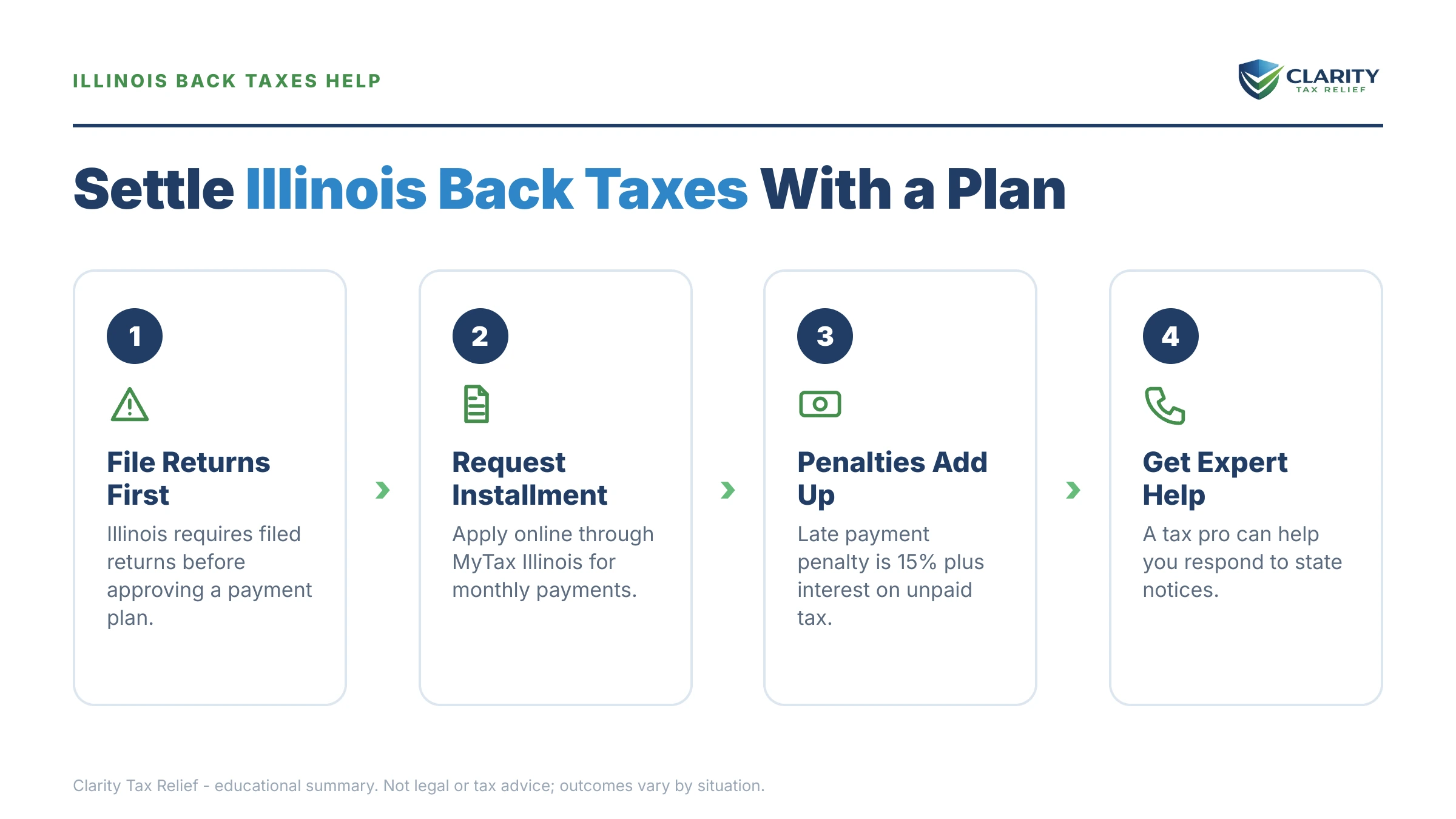
The short answer: you can set up an Illinois back taxes payment plan through your MyTax Illinois account or by filing Form CPP-1 with the Illinois Department of Revenue (IDOR). Interest and penalties keep accruing until the balance hits zero, so the shortest plan you can genuinely sustain is always the cheapest one.
Maybe you filed your IL-1040 and simply couldn't send the check — a year of 1099 income with nothing withheld will do that. Or maybe IDOR recalculated a year you thought was closed. Either way, the balance on that letter is real, it's growing, and Illinois will absolutely collect it. The good news: IDOR approves payment plans every day, and setting one up is more mechanical than scary.
If you're not sure which IDOR letter you're actually holding, the image below shows what the department's collection paperwork looks like and where to find the three things that matter — the balance, the tax years covered, and the respond-by date.
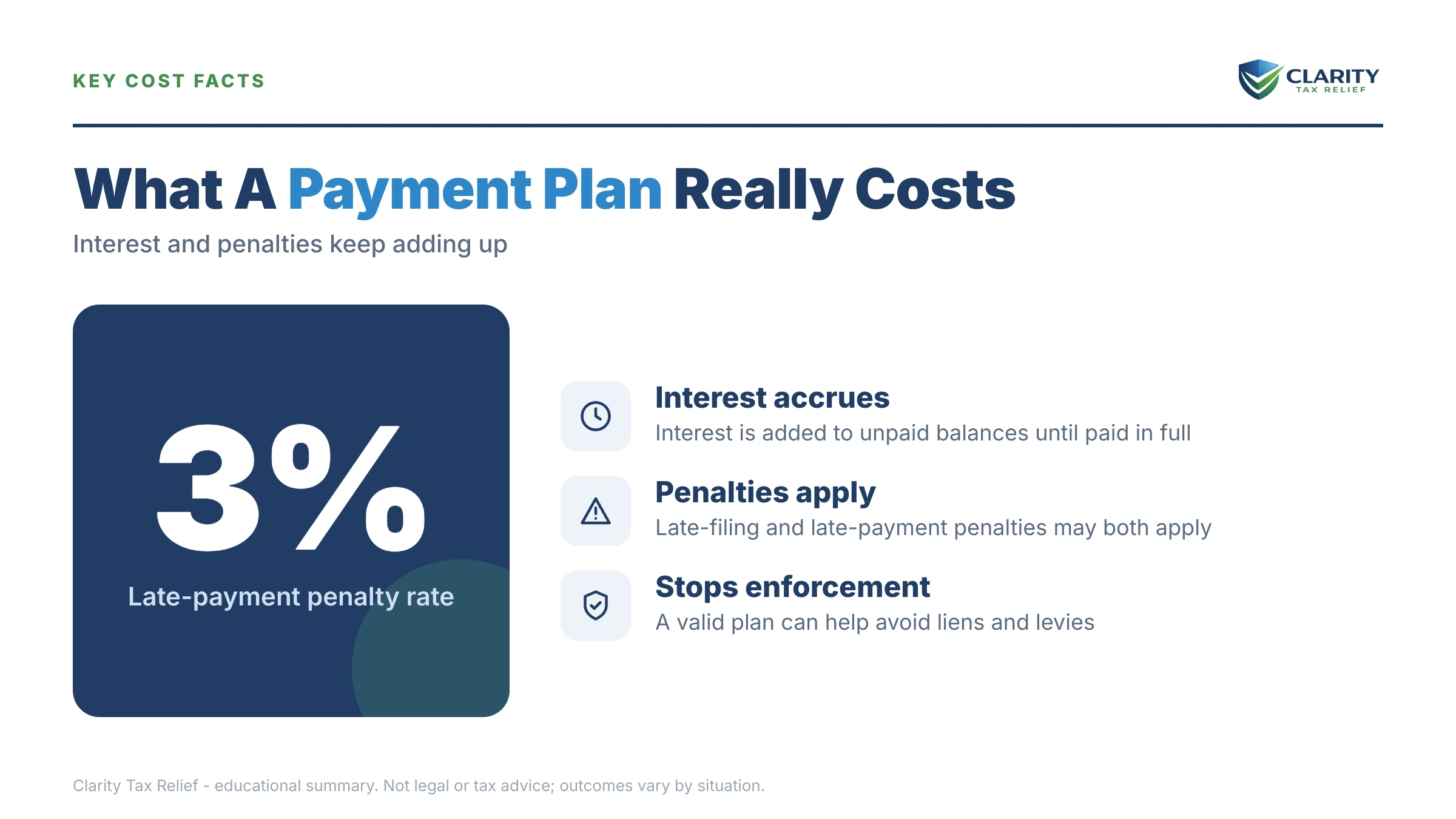
⏱ Your real clock: the respond-by date printed on your IDOR notice controls your next move. There is no fixed statewide deadline beyond it, but interest accrues on Illinois back taxes every day, and penalties keep stacking, until the balance is paid or a plan is in place. Every month of delay makes the same debt more expensive.
Why you owe Illinois back taxes in the first place
Illinois taxes individual income at a flat 4.95%, and nothing is withheld from 1099 pay — which is why contractors and self-employed workers dominate IDOR's collection files. Common paths to a balance:
- You filed but didn't pay. The IL-1040 was accurate; the money wasn't there in April. On $100,000 of net 1099 income, the Illinois tax alone is roughly $4,950 a year, and it was due quarterly, not at filing.
- You skipped Illinois estimated payments. Federal quarterlies get all the attention; the IL-1040-ES voucher gets forgotten. See how quarterly estimated taxes work to stop the cycle.
- A federal change flowed downhill. Illinois and the IRS exchange return data. When the IRS adjusts your federal return — a CP2000, an audit — a matching Illinois bill often follows months later, with its own penalties and interest attached.
- You didn't file at all. IDOR can assess tax based on the information it has, usually without the deductions a real return would claim. The late-filing penalty grows on top.
- You moved, but the income was Illinois-source. Leaving the state doesn't erase tax on money earned while you lived or worked there.
If this is your first year of contractor income and the bill blindsided you, the pattern is common enough that we wrote about it separately: first year self-employed and owe taxes.
“A payment plan is an agreement with the IRS to pay the taxes you owe within an extended timeframe. You should request a payment plan if you believe you will be able to pay your taxes in full within the extended time frame.”
— Payment plans; installment agreements (IRS.gov)
What happens if you ignore IDOR
Illinois collection escalates in stages, and states typically move from bill to lien to levy with fewer warning letters than the IRS sends. The sequence looks like this — the exact timing varies by case, and the date printed on each notice is the one that controls:
- Notice of tax due. The first bill. No enforcement yet, and the cheapest moment you will ever have to fix this. Any Illinois refunds you're owed start getting applied to the balance from here forward.
- Demand / final notice. IDOR tells you it intends to collect. This is the last routine stop before enforcement tools come out.
- State tax lien. IDOR records a lien that attaches to your property and becomes public record — a serious problem if you plan to sell, refinance, or borrow. Our Illinois tax lien guide covers how liens are filed and released.
- Levy and garnishment. IDOR can levy bank accounts and garnish wages. For a 1099 contractor, a levy can also reach payments your clients owe you — which threatens the income you'd use to pay the debt.
- Collection-agency referral. Accounts that stay unresolved can be handed to outside collection agencies, which can add collection costs on top of the tax, penalties, and interest.
None of this requires a human at IDOR to single you out. The system escalates on its own, and an approved payment plan is what switches it off.
Holding an IDOR bill you can't pay in full?
Send us a photo of the notice. An experienced tax professional will confirm exactly where your account sits in the Illinois collection sequence — before a lien or levy, ideally — and map the plan that fits your income. Free and confidential.
Your Illinois back taxes payment plan options
An Illinois back taxes payment plan is the default resolution for most people with steady income, but it isn't the only door IDOR has. Here's the full menu:
| Option | Best for | What IDOR requires | Cost while it runs |
|---|---|---|---|
| Pay in full | Balances you can clear within a billing cycle or two | Payment through MyTax Illinois or by the method on your notice | Stops all further penalties and interest — cheapest outcome |
| Installment payment plan | Steady income, can't pay all at once | All required returns filed; request via MyTax Illinois or Form CPP-1; Form EG-13-I financial statement for larger or longer plans | Interest and penalties keep accruing on the unpaid balance |
| Hardship / delayed collection | Paying anything would prevent basic living expenses | Documented financial hardship, typically via Form EG-13-I | Debt remains and keeps accruing; enforcement pauses |
| Board of Appeals petition (Form BOA-1) | Genuine inability to ever pay in full, or grounds for penalty/interest relief | Petition with full financial disclosure; relief is discretionary | No fee comparable to the IRS's; outcome not assured |
| Penalty abatement for reasonable cause | Illness, disaster, or circumstances beyond your control caused the lapse | Written explanation with documentation | Can shrink the balance the plan has to cover |
A few things the table can't fully capture. First, IDOR sets plan length case by case — Illinois doesn't publish a bright-line 72-month rule the way the IRS does. Short proposals sail through with the least scrutiny. Longer ones invite a request for Form EG-13-I, the financial statement IDOR uses to test whether you could actually pay faster.
Second, a plan is an enforcement pause, not a discount. Interest keeps running until the last dollar posts. Third, filing compliance comes first: IDOR expects every required IL-1040 filed before it finalizes an agreement. An unfiled year found later can unravel one that's already approved.
For the general background on how payment plans, hardship status, and settlement programs compare across agencies, and which debt to attack first when you owe more than one — see our hub on state tax debt vs IRS. This page stays focused on the Illinois mechanics.
How to set up an Illinois back taxes payment plan, step by step
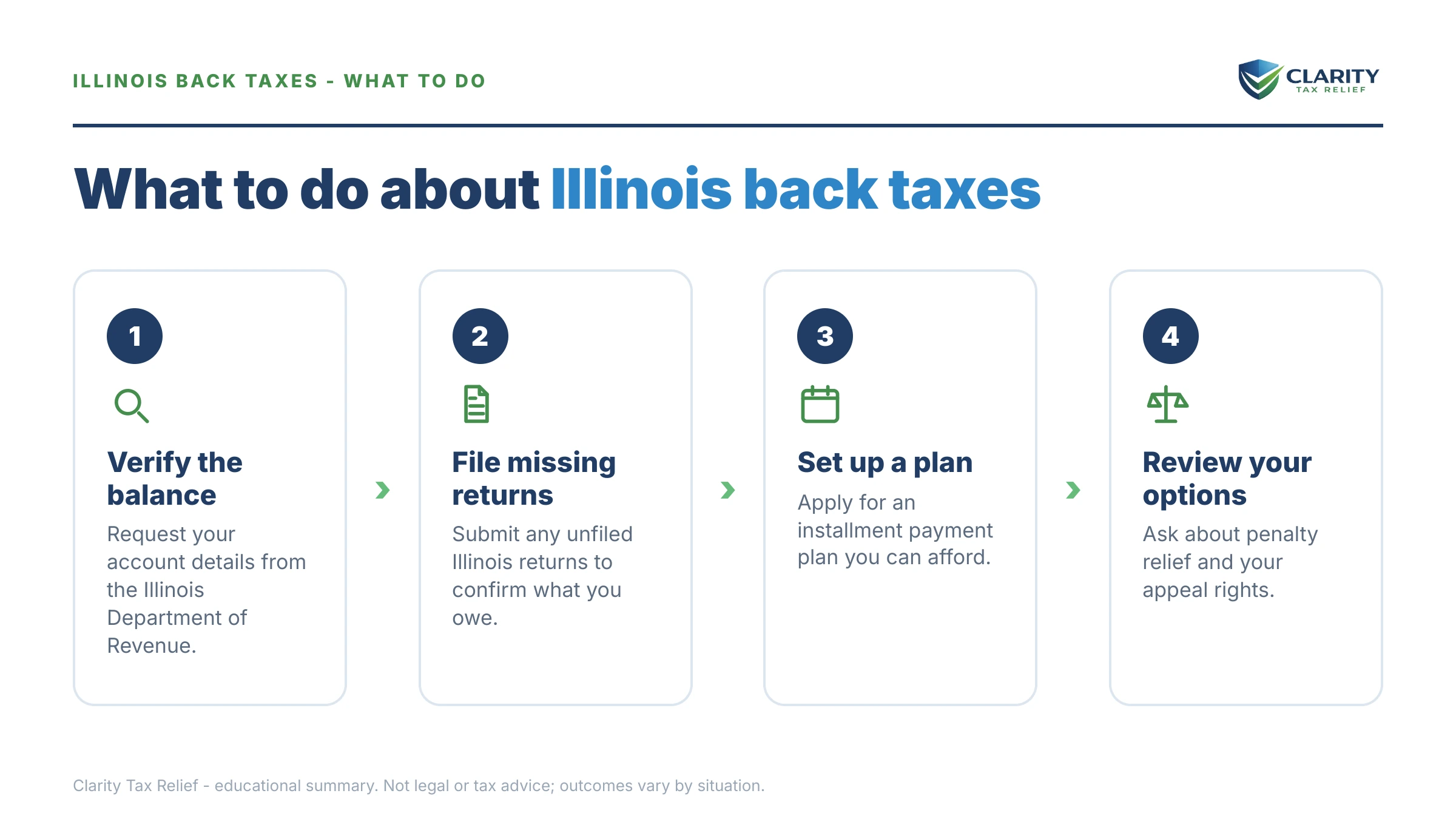
- Pull your exact balance. Log into MyTax Illinois or call the number on your notice to confirm what you owe for every tax year, not just the year on the letter in your hand.
- File any missing IL-1040s. IDOR won't finalize a payment plan around unfiled years, and each unfiled return keeps the much larger late-filing penalty growing. Reconstruct old income with your federal wage and income transcripts if records are missing.
- Pick a monthly number you can sustain. Budget for the plan payment plus your current-year quarterly estimated payments. A plan you default in six months is worse than a slightly longer one you finish.
- Submit the request. Request the plan through your MyTax Illinois account or mail Form CPP-1. If IDOR asks for Form EG-13-I, complete it accurately. It is the financial statement the department uses to judge your proposal.
- Set up automatic payments and stay current. Autopay prevents accidental default, and staying current on new taxes keeps the agreement alive. A fresh unpaid balance is the most common way Illinois payment plans fail.
What a plan on $41,800 actually looks like: a worked example
Most Illinois contractors with back taxes owe two agencies at once, so here's a realistic hypothetical with the math shown.
Say you're a 1099 contractor who owes $41,800 total — $8,600 to IDOR from two years of unpaid IL-1040 balances plus penalties and interest, and $33,200 to the IRS for the same years. Nothing was withheld from your pay; no quarterlies went out.
- The Illinois side: say IDOR accepts a 24-month proposal on the $8,600. That's about $360 per month ($8,600 ÷ 24 ≈ $358), with interest continuing to accrue, so the final payment adjusts upward slightly. Propose 12 months instead and it's roughly $717/month, but meaningfully less interest paid overall.
- The IRS side: $33,200 is under the $50,000 online threshold, so a streamlined installment agreement of up to 72 months is available without detailed financial disclosure — a minimum of roughly $461 per month ($33,200 ÷ 72). Stretching to the maximum term costs the most in accrued interest and penalties; a 36-month pace (~$922/month) cuts that substantially. You can set up the IRS payment plan online in one sitting, and estimate what the federal side is adding each month with our Penalty & Interest Calculator.
- Combined: at the minimums, that's roughly $820 per month across both agencies, before your 2026 quarterly estimates, which you must also keep current or both plans are at risk.
That last line is the part people miss. The plan payments cover the past; the quarterlies cover the present. If you skip 2026 estimates to afford the plans, next April creates a new balance that can default both agreements. If the combined number doesn't fit your income, that's not a dead end — it's the signal to look at hardship status, penalty relief, or restructuring the proposals, which is exactly what a case review sorts out.
Owe the IRS too? How the two debts interact
The IRS can seize your Illinois tax refund for federal debt through the State Income Tax Levy Program — the two systems talk to each other constantly. Here's how the machinery differs on each side:
| Feature | Illinois (IDOR) | IRS |
|---|---|---|
| Online portal | MyTax Illinois | IRS Online Account / Online Payment Agreement |
| Plan request form | Form CPP-1 | Form 9465 (or fully online) |
| Plan length | Case by case; longer terms need Form EG-13-I | Up to 180 days short-term ($0 setup); up to 72 months online for balances ≤ $50,000 |
| Financial disclosure | Form EG-13-I when IDOR asks | None for streamlined plans ≤ $50,000 |
| Settlement path | Board of Appeals petition (Form BOA-1), discretionary | Offer in Compromise (roughly 1 in 5 accepted in FY2024) |
| Refund treatment | State refunds applied to your IDOR balance | Federal refunds offset; IRS can also levy your state refund |
Sequencing matters. States often escalate to liens and levies faster than the IRS's long letter sequence, so an active Illinois enforcement threat usually jumps the queue even when the federal balance is bigger. But the IRS's tools (federal lien, bank levy, wage levy, refund offsets under the state income tax levy program) are heavier once they arrive. If a refund you were counting on vanished, see state refund taken for IRS debt. The full decision framework lives in the state tax debt vs IRS hub. The short version is: get both agencies onto agreements, and put your fastest dollars against whichever balance carries the higher combined penalty-and-interest rate or the nearer enforcement threat.
Deadlines and rights on your IDOR notice
Every IDOR notice prints its own respond-by date, and each stage you let pass closes a door you had at the stage before:
| Stage | What you can still do | What you lose if it passes |
|---|---|---|
| Assessment / proposed liability notice | Dispute the amount by the protest date printed on the notice | The easy path to challenge the number before it becomes final |
| Notice of tax due (first bill) | Pay, or set up a plan with minimal friction | The lowest-cost, lowest-scrutiny setup window |
| Demand / final notice | Arrange payment before enforcement begins | Your chance to prevent a lien from ever being recorded |
| State tax lien recorded | Still get a plan; work toward lien release at payoff | Clean title for selling, refinancing, or borrowing |
| Levy / garnishment / agency referral | Negotiate a plan or hardship status to stop the bleeding | Control of your bank account, paycheck, and client payments |
Two practical notes. If you disagree with the amount itself — IDOR taxed income that wasn't yours, or ignored withholding you actually had — dispute it by the date on the notice before agreeing to pay it in installments. A payment plan on a wrong number is still a wrong number. And if the amount stems from a federal change you also dispute, fix the federal side first, because Illinois generally follows it.
If your Illinois payment plan defaults
A defaulted Illinois plan puts the entire remaining balance back into active collection — the lien, levy, and referral tools all return. The usual triggers are a missed monthly payment, a bounced autopay, a new unpaid balance from the current year, or an unfiled return surfacing.
The fix ranks by speed: contact IDOR before a payment goes late if you see trouble coming — adjusting a live plan is routine, resurrecting a dead one is not. If it's already defaulted, be ready to propose new terms and, likely, to hand over a fresh Form EG-13-I. And if income has genuinely dropped — a contract ended, a client left — that's not just a default story. It may be a hardship case, which is a different and sometimes better conversation to have with the department.
If a plan you thought was fine just defaulted and IDOR is threatening enforcement, get the account reviewed free before the lien or levy stage arrives — the balance keeps accruing interest either way. But your options narrow at each step.
When you can handle this yourself
Plenty of Illinois back-tax cases don't need professional help. Handle it yourself when:
- You agree with the balance, it's one tax year. You can pay it off within a few months — MyTax Illinois will take you end to end in an evening.
- Your only issue is a first bill you simply couldn't pay at filing, and the monthly number fits your budget comfortably.
- You're just early in the notice sequence and want a straightforward CPP-1 plan.
Experienced help genuinely changes outcomes when:
- A levy or garnishment is already in motion, or a lien is about to block a home sale or refinance — sequencing and speed matter more than form-filling.
- You have multiple unfiled years, state and federal, and the order you file and resolve them changes what you ultimately pay.
- You owe both IDOR and the IRS and the combined monthly demand exceeds what your income supports — that's where hardship analysis, penalty relief, and Board of Appeals petitions come into play.
- The debt involves business or sales tax, where personal liability rules raise the stakes considerably.
Terms on your IDOR notice, decoded
- IDOR — the Illinois Department of Revenue, the state agency that assesses and collects Illinois taxes (not the IRS, and not affiliated with it).
- MyTax Illinois — IDOR's online account portal, where you can see balances, file returns, make payments, and request a payment plan.
- Form CPP-1 — the Installment Payment Plan Request, the paper route to proposing monthly payments to IDOR.
- Form EG-13-I — the Financial and Other Information Statement for Individuals; IDOR's version of a full financial disclosure, used to evaluate larger or longer plans and hardship claims.
- Lien vs. levy — a lien is a recorded legal claim against your property; a levy actually takes money or assets. Illinois can do both.
- Board of Appeals — the IDOR body that can grant discretionary relief, including for inability to pay, through a Form BOA-1 petition.
- Offset — a refund (state or federal) intercepted and applied to a tax debt instead of being paid to you.
Illinois back taxes payment plan FAQs
How do I set up a payment plan for Illinois back taxes?
Log into your MyTax Illinois account at mytax.illinois.gov and request a payment plan, or mail Form CPP-1 (Installment Payment Plan Request) to the Illinois Department of Revenue. You'll need all required IL-1040s filed first. For larger balances or longer terms, IDOR may ask for a financial statement, Form EG-13-I, before approving the plan.
How long can an Illinois state tax payment plan last?
IDOR sets plan length case by case rather than publishing a fixed maximum the way the IRS does with its 72-month online plans. Shorter proposals, paid within a year or two, are approved with the least friction. The longer the term you request, the more likely IDOR is to require a full financial statement (Form EG-13-I) proving you can't pay faster.
Does interest stop while I'm on an IDOR payment plan?
No. Interest and applicable penalties continue to accrue on the unpaid Illinois balance until it reaches zero — a payment plan stops enforcement, not the meter. That's why the cheapest plan is always the shortest one you can genuinely sustain, and why paying a plan off early saves real money. Your final payment is adjusted to cover what accrued along the way.
Can the Illinois Department of Revenue garnish my wages or bank account?
Yes. IDOR has levy power over bank accounts and wages, can record a state tax lien against your property, and applies your state refunds to the balance. It can also refer accounts to outside collection agencies, which can add collection costs. An approved payment plan is the standard way to keep those tools on the shelf — enforcement generally targets taxpayers who ignore notices, not those on active agreements.
Does Illinois have an offer in compromise program?
Illinois doesn't run a program identical to the IRS Offer in Compromise. But the Illinois Department of Revenue's Board of Appeals can consider relief — including relief based on genuine inability to pay — through a petition filed on Form BOA-1. Relief is discretionary and requires full financial disclosure. Most taxpayers with steady income are directed to a payment plan instead.
Will my tax refunds be taken while I owe Illinois back taxes?
Expect it. Illinois applies your state refunds to the balance, and if you also owe the IRS, the IRS can seize your Illinois refund through the State Income Tax Levy Program. Refund offsets typically continue even while you're on a payment plan — they're treated as extra payments, not replacements for your monthly amount, so keep paying your plan as agreed.
What happens if I miss a payment on my Illinois plan?
A missed payment can default the agreement, which puts the full remaining balance back into active collection — lien, levy, and collection-agency referral all come back on the table. If you know a payment will be late, contact IDOR before the due date. It is far easier to adjust an active plan than to reinstate a defaulted one. A new unpaid balance from a later tax year can also default an existing plan.
I owe both the IRS and Illinois — which should I pay first?
Run both plans if your budget allows; if you must prioritize, weigh which agency is escalating faster. States often move from bill to lien to levy with less warning than the IRS's long notice sequence, and both meters keep charging interest either way. See our full breakdown of state tax debt vs IRS priority — the right answer depends on which agency is closer to enforcement in your specific case.
Do I need to file all my returns before Illinois approves a payment plan?
Yes — plan on it. IDOR expects required IL-1040s (and business returns, if applicable) to be filed before it finalizes an installment plan. An unfiled year discovered later can unravel an approved agreement. Filing also stops the much larger late-filing penalty from growing. If you're missing records, your federal wage and income transcripts are the fastest way to reconstruct old years.
Your next 24 hours
- Find the three numbers on your IDOR notice — total balance, tax years covered. The respond-by date — then log into MyTax Illinois to confirm the balance matches for every year, not just the one on the letter.
- Gather your paperwork: the notice itself, your last filed IL-1040 and federal return, your 1099s, and a rough picture of monthly income and expenses. That's everything a plan proposal (or a hardship case) is built from.
- Get a free case review. Interest is accruing on the balance every day it sits, and each IDOR stage you pass closes an option the last one had. Call (888) 825-7779 or use the 2-minute form — an experienced tax professional will map the Illinois plan (and the IRS plan, if you owe both) that fits your actual income.
Official resources: the Illinois Department of Revenue's site at tax.illinois.gov covers forms and payment options. The federal side of a two-agency plan starts at the IRS payment plans page.
This guide is general information, not tax or legal advice for your specific situation. Eligibility for IRS programs depends on individual facts and circumstances; no outcome is guaranteed.