
State Back Taxes
Louisiana Back Taxes in 2026: How LDR Collections Work and Every Way to Resolve What You Owe
The short answer: Louisiana back taxes are collected by the Louisiana Department of Revenue (LDR), which can garnish wages without a court judgment, add a steep collection fee through the Office of Debt Recovery, and suspend your driver's license. Payment plans and settlement options exist, and a Notice of Assessment generally gives you 60 days to appeal.
Maybe it started with one envelope from Baton Rouge — an "estimated assessment" for a year you never filed, built from your 1099s with a number that looks nothing like what you actually cleared after gas and miles. Now there's a second envelope for another year, and an IRS letter underneath both. None of this is beyond fixing. But Louisiana's system runs on shorter fuses than the federal one, so the order you respond in matters.
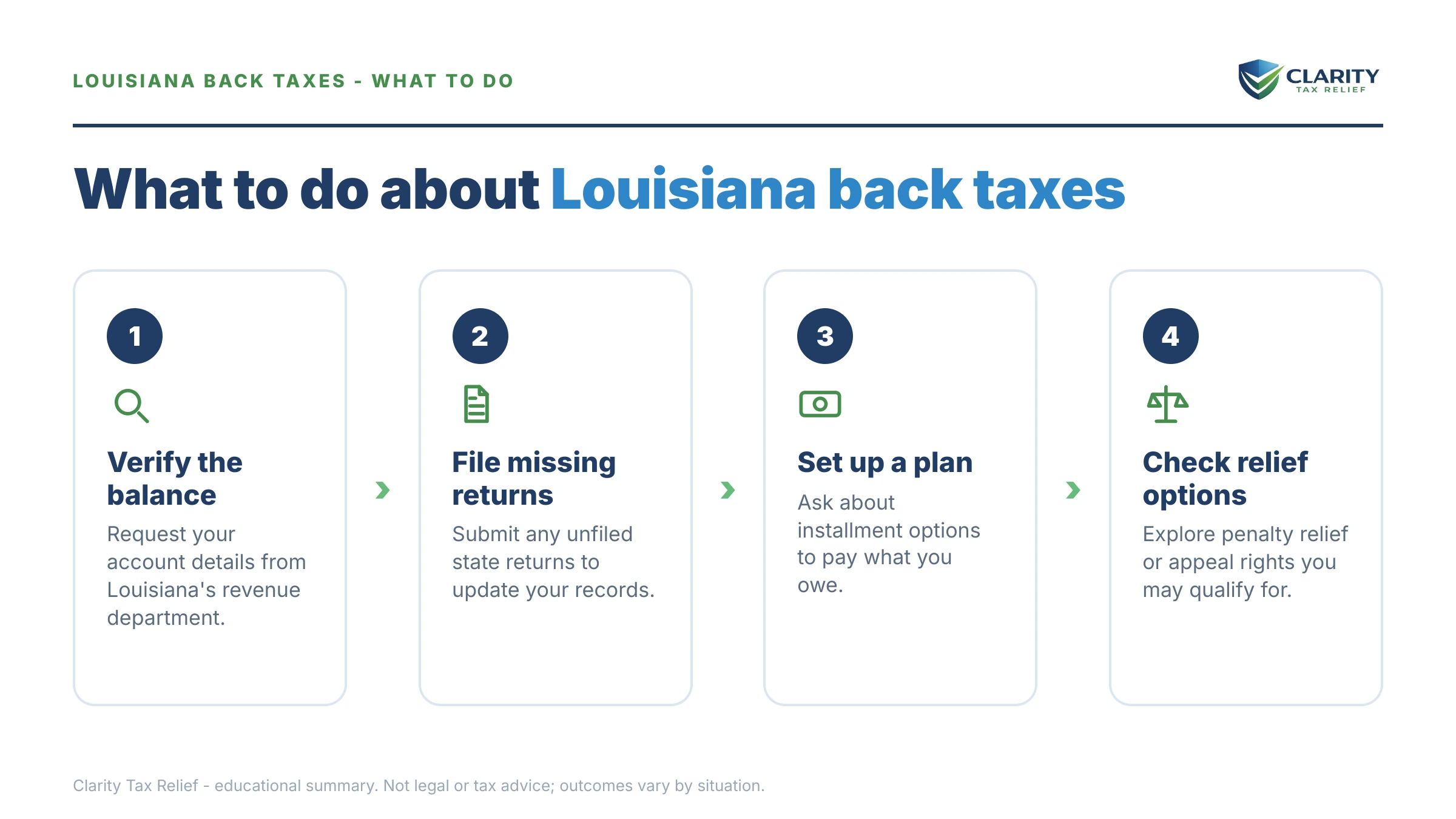
The image below shows how Louisiana's collection sequence unfolds and where the appeal window that protects your rights sits inside it — worth a look before you read the stages, because most people don't realize how early that window closes.
⏱ Your deadline: a Louisiana Notice of Assessment generally becomes final 60 calendar days after it's issued. Appeal to the Louisiana Board of Tax Appeals inside that window, or pay under protest, and you keep the right to fight the number before LDR can enforce it. The controlling date is printed on your notice; find it today.
Why you owe Louisiana back taxes, and why LDR's number may be wrong
LDR learns about your income the same way the IRS does: 1099-NEC and 1099-K data flows to the state whether or not you file. If Louisiana sees income but no Form IT-540, it can build an estimated assessment from your gross income, with zero deductions. No mileage, no phone, no platform fees. For a driver or courier, that routinely doubles or triples the real tax.
Gig income makes it worse because nothing was withheld. Louisiana moved to a flat 3% individual income tax starting with the 2025 tax year (earlier years used graduated rates topping out at 4.25%), and none of it comes out of app payouts automatically. Three years of that, stacked on the federal side, is exactly how a balance like $68,500 gets built. If you never sent in quarterly estimated taxes, the machine did the math without you.
Two other ways Louisianans land here: an audit or adjustment changed a return you did file, or a business fell behind on sales tax — which in Louisiana is split between LDR and parish-level collectors, a wrinkle covered in our state sales tax debt help guide. The rest of this article focuses on the most common case: individual income tax, often with unfiled years.
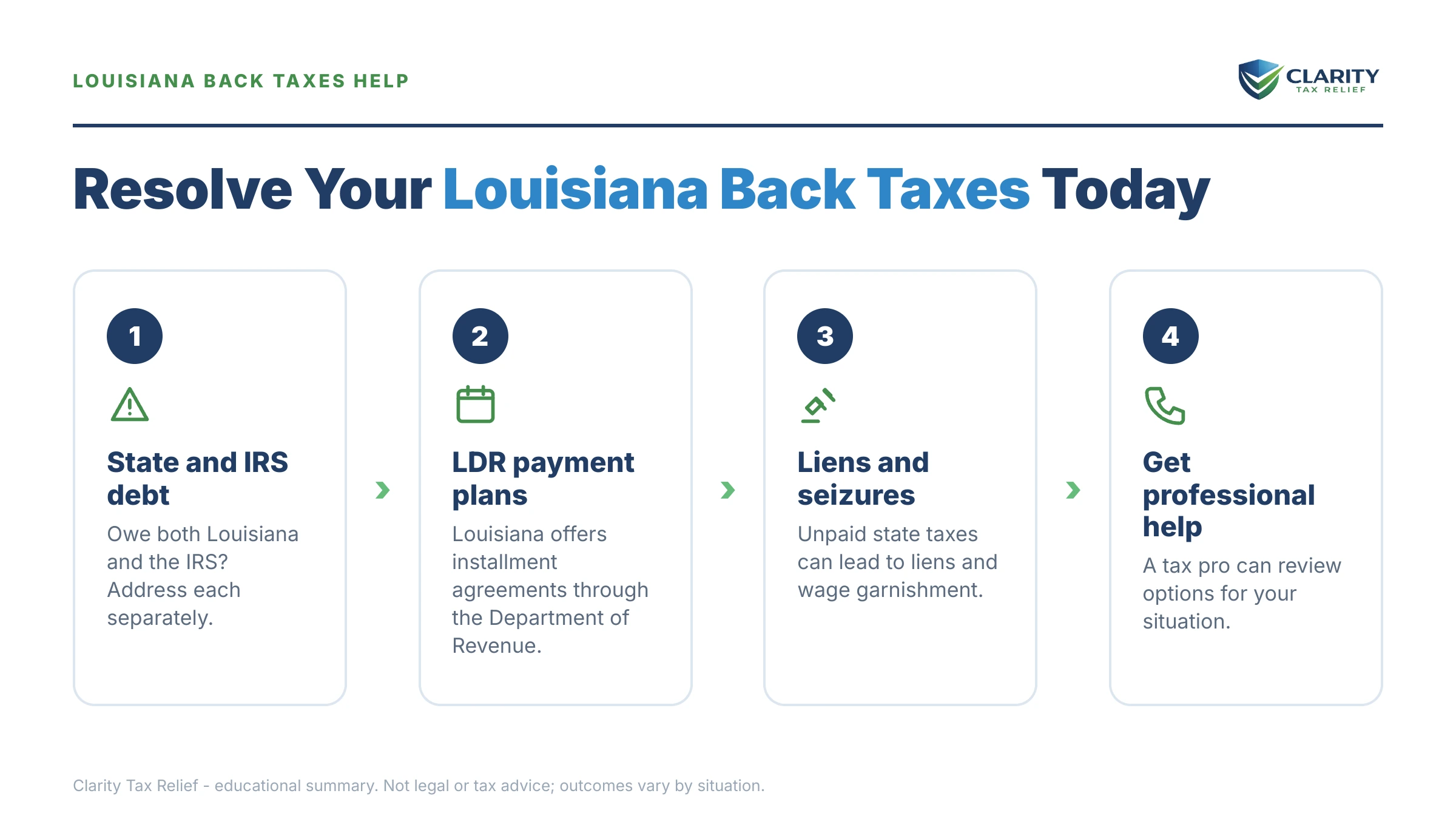
“An IRS levy permits the legal seizure of your property to satisfy a tax debt. It can garnish wages, take money in your bank or other financial account, seize and sell your vehicle(s), real estate and other personal property.”
— Levy (IRS.gov)
What happens if you ignore Louisiana back taxes
Once a Louisiana tax assessment becomes final, LDR can garnish your wages and levy your bank account without ever going to court. The sequence that gets you there is administrative and largely automated — each stage removes a right and adds a cost:
- Notice of Proposed Assessment. LDR's opening number — often an estimate built from gross 1099 income. You can protest it in writing within the window printed on the notice. This is the cheapest stage to fix anything.
- Notice of Assessment. The formal bill. You generally have 60 calendar days to appeal to the Louisiana Board of Tax Appeals or pay under protest. Do nothing and the assessment becomes final, and final means collectible.
- Enforced collection. With a final assessment, LDR can record a lien, garnish wages, and levy bank accounts through administrative process. No lawsuit, no judgment, no jury.
- Referral to the Office of Debt Recovery (ODR). Louisiana's centralized collector takes over final delinquent debts and adds its own collection fee — authorized up to 25% of the balance — on top of the tax, penalties, and interest you already owe.
- License suspension. Louisiana law authorizes suspending your driver's license over a final, unpaid individual income tax debt. It reaches hunting and fishing licenses too. For anyone who drives for a living, this is the stage that ends the income you'd use to pay.
- Ongoing offsets and accrual. Every future Louisiana refund is intercepted, interest keeps compounding, and unfiled years stay open forever — Louisiana's prescription clock never starts on a return that was never filed.
The federal track runs in parallel and doesn't pause for the state one. If your unfiled years triggered IRS substitute returns, that's its own escalation with its own deadlines — see what it means when the IRS filed a substitute return for you.
Your Louisiana deadlines and appeal rights, in one table
Every stage of an LDR case has a window, and each window that closes takes a right with it. This is the map:
| Notice or stage | Your window | The right at stake |
|---|---|---|
| Notice of Proposed Assessment (LDR) | Protest window printed on the notice — commonly 30 days | Informal protest before the number becomes a formal assessment |
| Notice of Assessment (LDR) | Generally 60 calendar days | Prepayment appeal to the Louisiana Board of Tax Appeals, or payment under protest |
| Final assessment | No further window — collection can begin | LDR may lien, garnish, and levy administratively; disputing gets far harder |
| ODR referral | Before referral is the moment to act | Avoiding the added collection fee (up to 25%) and license-suspension machinery |
| IRS LT11 / Letter 1058 (federal side) | 30 days | Collection Due Process hearing rights, requested via Form 12153 |
One honest caveat: south Louisiana lives with hurricanes, and disaster declarations sometimes extend filing and payment deadlines for affected parishes. Never assume an extension applies to your notice — the printed date on your letter controls unless LDR or the IRS says otherwise in writing.
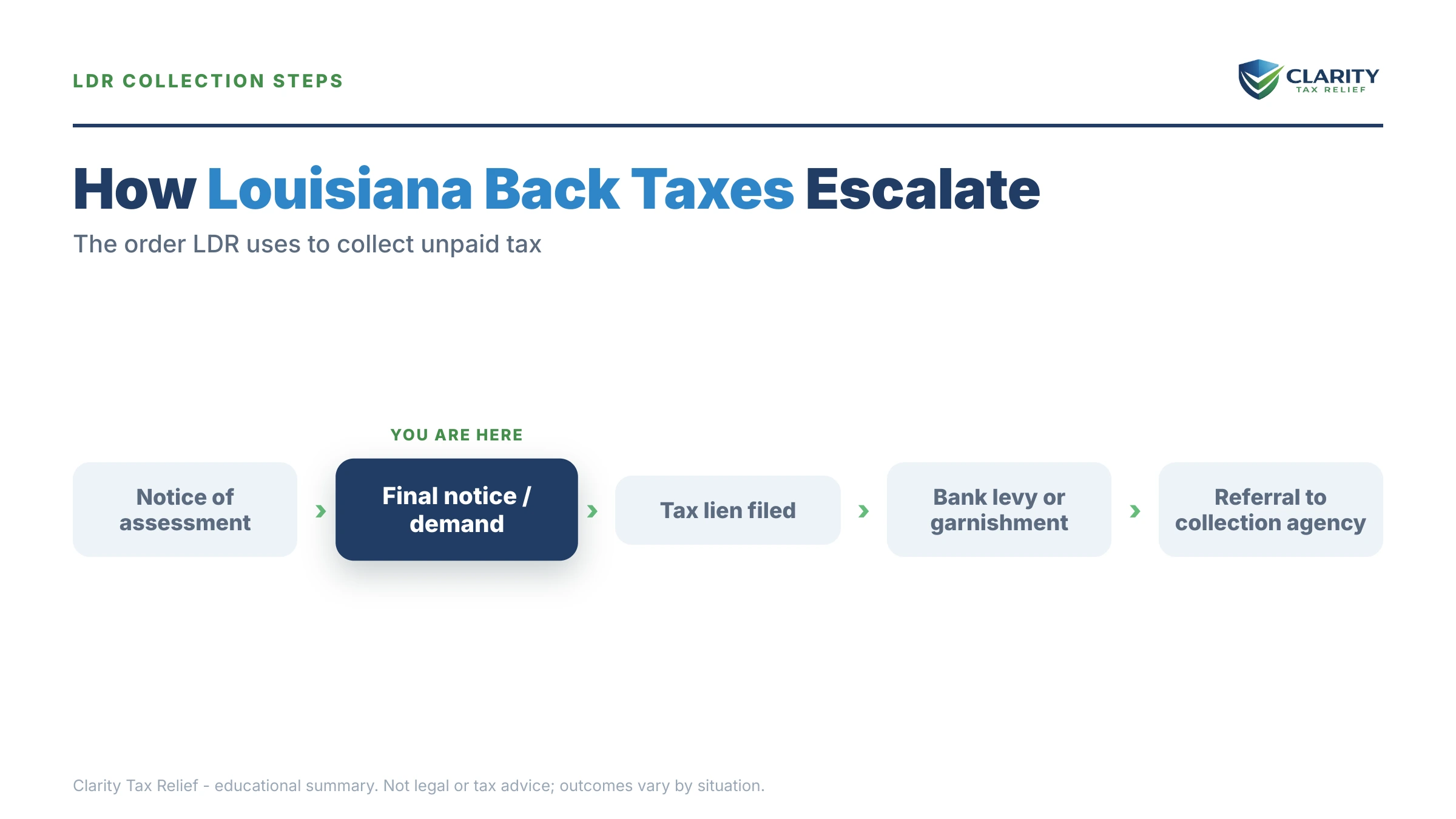
Holding a Louisiana Notice of Assessment right now?
The 60-day appeal window doesn't pause while you figure this out, and once the debt goes final, ODR's fee and license suspension come into play. Get your LDR and IRS notices reviewed free by an experienced tax professional before the window closes. Call (888) 825-7779 or take 2 minutes on the form.
Your options to resolve Louisiana back taxes
Louisiana offers fewer standardized programs than the IRS, but every real path is on this table. Which one fits depends on whether the number is right, whether you've filed, and what your budget can carry:
| Option | Best for | What to know |
|---|---|---|
| File the real returns | Anyone with unfiled years or estimated assessments | Actual IT-540s with deductions usually replace inflated estimates; the biggest dollar lever in most cases |
| Pay in full via LaTAP | Small balances you can clear now | Stops penalty and interest accrual and every enforcement stage immediately |
| LDR installment agreement | Steady income, can't pay at once | Requested through LaTAP or the collection division; terms set case by case and generally shorter than IRS plans; interest continues |
| Penalty waiver (reasonable cause) | Illness, disaster, records lost, events beyond your control | Must be documented; interest is rarely waived even when penalties are |
| Board of Tax Appeals appeal | Assessments you dispute, within the 60-day window | Louisiana's independent prepayment forum. You don't have to pay first to be heard |
| LDR compromise / settlement | Genuine inability to ever pay, or real doubt about the liability | Narrow legal authority, heavily documented, less standardized than the IRS offer in compromise — never assume approval |
| Voluntary disclosure | Unfiled years where LDR hasn't contacted you yet | Coming forward first typically brings penalty relief and a limited lookback; off the table once notices arrive |
Three of these deserve a closer word.
The installment agreement is the workhorse. LDR's LaTAP portal (Louisiana Taxpayer Access Point) lets you view your account and request a plan. Expect the state to want the debt cleared faster than the IRS would — Louisiana doesn't publish a 72-month equivalent — and expect penalties and interest to keep running until the balance hits zero. A plan that's in place and current, though, keeps garnishment, ODR referral, and license suspension off the table.
Compromise is real but rare. Louisiana law gives LDR authority to settle a final debt for less when there's genuine doubt it could ever collect the full amount, or genuine doubt you owe it. There's no Louisiana equivalent of a heavily marketed "fresh start" — anyone promising a guaranteed Louisiana settlement is selling, not advising. The general mechanics of settlement math are the same everywhere: the agency estimates what it could realistically collect from your assets and income, then compares your offer to that number.
Amnesty comes and goes. Louisiana ran amnesty programs in past years that waived penalties and some interest for taxpayers who paid up during the window. None is currently promised, and interest accrues at full speed while you wait for one that may never come. Treat amnesty as a bonus if it appears, never as a plan.
Say you owe $68,500 across three unfiled years: a worked example
Say you drove for delivery and rideshare apps in 2022, 2023, and 2024, grossing about $61,000 a year, and never filed federal or Louisiana returns. The IRS built substitute returns from your 1099s and LDR issued estimated assessments off the same data. Combined, the notices total $68,500 — roughly $59,400 federal and $9,100 Louisiana. Here's the hypothetical math on fixing it:
- Both agencies taxed your gross. No return means no deductions. But say you actually drove about 38,000 business miles a year — at a standard mileage rate of roughly 67 cents, that's about $25,500 a year in deductions, cutting your real net profit from $61,000 to about $35,500. (Reconstructing that log is doable even now — see didn't track miles and filing back taxes without records.)
- Federal, recomputed: on ~$35,500 of net profit, self-employment tax runs about $5,000 a year and income tax roughly $2,300 after the standard deduction — call it $7,300 a year, or about $21,900 of tax across three years. Add capped late-filing and late-paying penalties plus interest and the federal side lands somewhere around $31,000–$33,000 instead of $59,400. You can rough out your own accruals with our Penalty & Interest Calculator.
- Louisiana, recomputed: at the graduated rates in force for 2022–2024, state tax on the corrected income runs roughly $1,000–$1,100 a year — about $3,200 total. Louisiana's delinquent-filing penalty accrues at 5% of the tax per 30 days late (capped at 25%) and its delinquent-payment penalty at 0.5% per 30 days (also capped at 25%), so with interest the state side lands near $4,500–$5,000 instead of $9,100.
- The combined picture: filing three years of real returns hypothetically shrinks $68,500 to roughly $36,000–$38,000 before any relief request. The corrected federal balance also sits under the streamlined threshold — meaning a streamlined installment agreement of up to 72 months, roughly $450–$500 a month while interest continues, without a full financial disclosure. The Louisiana balance gets its own, shorter LDR plan.
- One more reason not to wait: at $59,400 and compounding, the federal side alone was drifting toward the $66,000 passport-certification threshold for 2026. Correcting the assessments defuses that entirely — see passport revoked for tax debt.
Every figure above is illustrative, not a promise — your miles, your rates, and your years will produce different numbers. The structure of the win is the same in almost every unfiled-gig-years case, though: replace the estimates first, then arrange payment on what's actually owed.
How to respond to Louisiana back taxes, step by step
- Sort every notice by agency and type. Separate LDR mail from IRS mail, then find each notice's date. A Louisiana Notice of Proposed Assessment, a Notice of Assessment. An ODR collection letter each carry different rights. The appeal window runs from the date printed on the notice, not the day you opened it.
- File the missing returns with real deductions. Actual Louisiana IT-540s and federal returns with your mileage and expenses almost always replace estimated assessments with smaller, correct balances. This is the single biggest dollar lever in most unfiled-years cases.
- Appeal anything you dispute before it goes final. If a Notice of Assessment is wrong and the 60-day window is still open, appeal to the Louisiana Board of Tax Appeals or pay the disputed amount under protest. Once the assessment is final, you lose the prepayment forum.
- Set up payment arrangements on both balances. Request an LDR installment agreement through LaTAP and, on the federal side, a payment plan through your IRS online account. Two separate debts need two separate agreements your budget can actually carry.
- Request penalty relief from both agencies. Ask LDR for a reasonable-cause penalty waiver with documentation, and check the IRS side for first-time abatement or the new automatic penalty exemption. Penalties are often the most reducible slice of the balance.
- Stay current so the agreements hold. Start making quarterly estimated payments on this year's gig income. A new balance defaults both plans and restarts collection on everything.
Louisiana back taxes vs. IRS back taxes: which do you tackle first?
Work the nearest hard deadline first, and in most Louisiana cases, that's the state side, because LDR's appeal window is shorter and its enforcement fuse is faster. The full decision framework lives in our guide to state tax debt vs IRS — which to resolve first. Here's how the two systems compare head to head:
| Feature | Louisiana (LDR) | IRS |
|---|---|---|
| Late-filing penalty | 5% per 30 days late, capped at 25% | 5% per month, capped at 25% |
| Late-payment penalty | 0.5% per 30 days, capped at 25% | 0.5% per month, capped at 25% |
| Payment plans | Case-by-case via LaTAP; generally shorter terms | Up to 180 days short-term ($0 setup); up to 72 months online for balances ≤ $50,000 |
| Settlement program | Narrow compromise authority, heavily documented | Offer in Compromise — roughly 1 in 5 offers accepted in FY2024 |
| Signature enforcement | ODR collection fee up to 25%; driver's, hunting, and fishing license suspension | Passport certification at $66,000 (2026); federal levies and liens |
| Collection clock | Prescription rules — the clock never starts on unfiled years | 10 years from assessment (CSED), pausable by appeals, offers, or bankruptcy |
Practically, most people with both debts stabilize Louisiana first — appeal or file within the window, get a plan in place — because the state balance is usually smaller and its consequences (license suspension, the ODR fee) hit livelihood fastest. Then they structure the larger federal balance into a longer plan; IRS terms and setup details are on the IRS payment plans page. Also know that the two systems talk to each other: the IRS can seize your Louisiana refund, and vice versa — see state refund taken for IRS debt.
When you can handle this yourself, and when help changes the outcome
Handling it yourself versus bringing in help
You do not need professional help for every Louisiana tax problem. Handle it yourself if: it's one year, you filed, you agree with the number. You can pay in full or carry a simple LaTAP payment plan. Same on the federal side — a single balance you agree with, under the online-plan thresholds, is a do-it-yourself job.
Experienced help changes outcomes in a different set of situations: multiple unfiled years at two agencies at once, where the sequencing (returns first, then appeals, then plans, then penalty relief) determines what you ultimately pay. Estimated assessments that need to be replaced before a window closes. A garnishment, ODR referral, or license suspension already in motion. Disputed liability headed to the Board of Tax Appeals. Or business debt involving payroll or parish sales tax, where personal liability rules get sharp. A three-year gap specifically has its own playbook — start with haven't filed in 3 years and how many years of back taxes you have to file.
If your case sits in that second group — unfiled years, two agencies, deadlines already running — a free case review with an experienced tax professional can map the sequence before anything goes final: request yours here or, if you're in the New Orleans area, see our tax relief in New Orleans guide.
Terms on your Louisiana notices, decoded
- Assessment — LDR's formal recording of tax you owe; once final, it's enforceable without any lawsuit.
- Prescription — Louisiana's word for a statute of limitations: the legal deadline for the state to assess or enforce a debt. It never starts running on a year you didn't file.
- Payment under protest — paying a disputed assessment while formally preserving your right to sue for the money back.
- Distraint — the state's administrative power to seize property, levy accounts, or garnish wages to collect a final tax debt.
- Office of Debt Recovery (ODR) — Louisiana's centralized collector for final delinquent government debts, which adds its own collection fee once a debt is referred.
- Board of Tax Appeals — Louisiana's independent tax tribunal, where you can contest an assessment without paying it first.
Louisiana back taxes: your questions, answered
Does Louisiana have a payment plan for back taxes?
Yes. The Louisiana Department of Revenue offers installment agreements, and you can request one through its LaTAP online portal or by contacting its collection division. Interest and penalties continue to accrue while you pay, and terms are set case by case — generally shorter than the IRS's 72-month plans. Missing payments can default the agreement and send the balance to the Office of Debt Recovery, where a collection fee is added.
Can Louisiana suspend your driver's license for unpaid taxes?
Yes. Louisiana law authorizes the suspension of your driver's license over a final, unpaid individual income tax debt, and state law also reaches hunting and fishing licenses. Suspension typically comes after the assessment is final and the debt has moved into enforced collection, so responding before that stage — with an appeal, a payment plan, or full payment — is how you keep it off the table.
Does Louisiana forgive back taxes?
There is no blanket forgiveness program. LDR has limited legal authority to compromise a final tax debt when there's genuine doubt you could ever pay it or doubt about the liability itself. It will waive penalties for documented reasonable cause. Louisiana has also run tax amnesty programs in past years, but none is guaranteed to return — waiting for one while interest accrues is a losing strategy.
How far back can Louisiana collect back taxes?
Louisiana's prescription rules generally give LDR three years from the end of the year a return was filed to assess additional tax. But that clock never starts on a year you didn't file, so unfiled years stay open indefinitely. Once a debt is assessed and final, LDR can enforce it for many years afterward. Don't assume the IRS's 10-year collection statute applies; Louisiana runs on its own rules.
What is the Louisiana Office of Debt Recovery?
The Office of Debt Recovery (ODR) is Louisiana's centralized collector for final, delinquent government debts, including state taxes LDR refers to it. Once your balance lands there, a collection fee, authorized up to 25% of the debt, is added on top of the tax, penalties, and interest, and ODR can pursue offsets, garnishments, and license suspensions. Resolving the debt before referral avoids that fee entirely.
Will Louisiana take my tax refund for back taxes?
Yes — any Louisiana state refund will be applied to your back-tax balance automatically before you see a dime. That continues every year until the debt is resolved. Refund offsets don't replace a payment plan, either: LDR treats an offset as an involuntary collection, not as you making payments. If you also owe the IRS, both agencies can intercept refunds independently.
Should I pay Louisiana or the IRS first?
Work the nearest hard deadline first, not the biggest balance. A Louisiana Notice of Assessment with days left on its appeal window, or a garnishment already in motion, outranks an IRS notice that's still early in the sequence. Because the state balance is usually smaller, many people resolve or set up the Louisiana side quickly, then structure the larger federal debt into a longer plan. Both debts accrue while you decide.
How many years of unfiled Louisiana returns do I have to file?
Plan on filing every year LDR has assessed or requested, plus any year you had Louisiana income above the filing threshold — unfiled years never prescribe, so there's no automatic cutoff. On the federal side, IRS policy generally looks back six years for non-filers. In practice, a three-year gap like most gig-work cases means filing all three, for both agencies.
Can LDR garnish my wages without a court order?
Yes. Once a Louisiana tax assessment is final, LDR can garnish wages, levy bank accounts, and seize property through administrative process — no separate lawsuit or judgment is required. That's why the appeal window on a Notice of Assessment matters so much: it is the main checkpoint between a number you dispute and enforced collection of it.
Your next 24 hours
- Find the notice type and date on every Louisiana letter. A Notice of Assessment starts a roughly 60-day appeal clock from its printed date. That date decides whether you still have a prepayment forum or not.
- Gather your records: the LDR and IRS notices, your 1099s, app earnings summaries, bank statements, and anything resembling a mileage log for each unfiled year. You can also register for a LaTAP account at the Louisiana Department of Revenue to see exactly what the state has on file.
- Get a free case review. An experienced tax professional can tell you whether your assessments are estimates worth replacing, whether your appeal window is still open, and what a two-agency payment structure looks like on your budget, before anything goes final. Call (888) 825-7779 or use the 2-minute form.
This guide is general information, not tax or legal advice for your specific situation. Eligibility for IRS programs depends on individual facts and circumstances; no outcome is guaranteed. Louisiana programs, thresholds, and deadlines are set by state law and can change — always confirm the dates and terms printed on your own notices.