
State Back Taxes
Missouri Back Taxes: How to Resolve What You Owe the DOR in 2026
The short answer: Missouri back taxes are collected by the Missouri Department of Revenue (DOR), not the IRS. The DOR can keep your refunds, file a tax lien in circuit court, and garnish wages, but it also offers payment plans and case-by-case settlements. Resolution starts with filing every missing return.
The envelope came from Jefferson City, not Kansas City's federal building, and the balance on it may be news to you even though the tax years aren't. If you're self-employed, there's a good chance this Missouri bill grew out of the same underpaid quarters that built your IRS balance, because Missouri's return starts from your federal numbers. The good news: the DOR negotiates, and the order you fix things in can change what you pay.
Missouri notices don't look like IRS notices, and the two dates that matter, the assessment date and the response deadline, sit in different places. The image below shows you exactly what a Missouri DOR balance-due notice looks like and where to look for both.
⏱ Two clocks are running. Any Missouri assessment notice gives you a protest window — the exact deadline is printed on the notice, and missing it makes the assessment final. Meanwhile, interest and additions to tax accrue on the balance every month you wait, on both the Missouri and federal sides.
Why you owe Missouri back taxes
Missouri back taxes almost always trace to one of four sources: an unpaid balance on a filed MO-1040, an IRS adjustment that flowed downhill to Missouri, unfiled state returns, or business taxes a sole proprietor fell behind on.
The downhill flow is the one that surprises people most. Your Missouri income tax return starts from your federal adjusted gross income, and the IRS and the DOR share information. When the IRS adjusts your federal return — a CP2000 underreporter notice, an audit, a substitute return — Missouri eventually recalculates your state tax from the new federal numbers and bills you too, sometimes a year or more later. One mistake, two bills.
Self-employment makes it worse, because nothing is withheld from a sole proprietor's income for either government. Miss your quarterly estimated payments and you fall behind with the IRS and Missouri in the same quarter — the self-employment tax shock hits federally. The state balance rides along quietly until the DOR notices.
If you never filed, the DOR can assess you based on the information it has — federal data, 1099s, prior-year figures — and those estimated assessments are usually higher than what a real return would show. Filing the actual return is often the single biggest reduction available.
One more layer unique to Missouri's two big metros: Kansas City and St. Louis each charge a 1% earnings tax, collected by the city itself, and it applies to self-employment profits, not just paychecks. If you live or work in either city, an unfiled or underpaid year usually means a third, smaller balance sitting with the city's revenue office.
“An offer in compromise allows you to settle your tax debt for less than the full amount you owe. It may be a legitimate option if you can't pay your full tax liability or doing so creates a financial hardship.”
— Offer in compromise (IRS.gov)
How Missouri collects back taxes if you ignore them
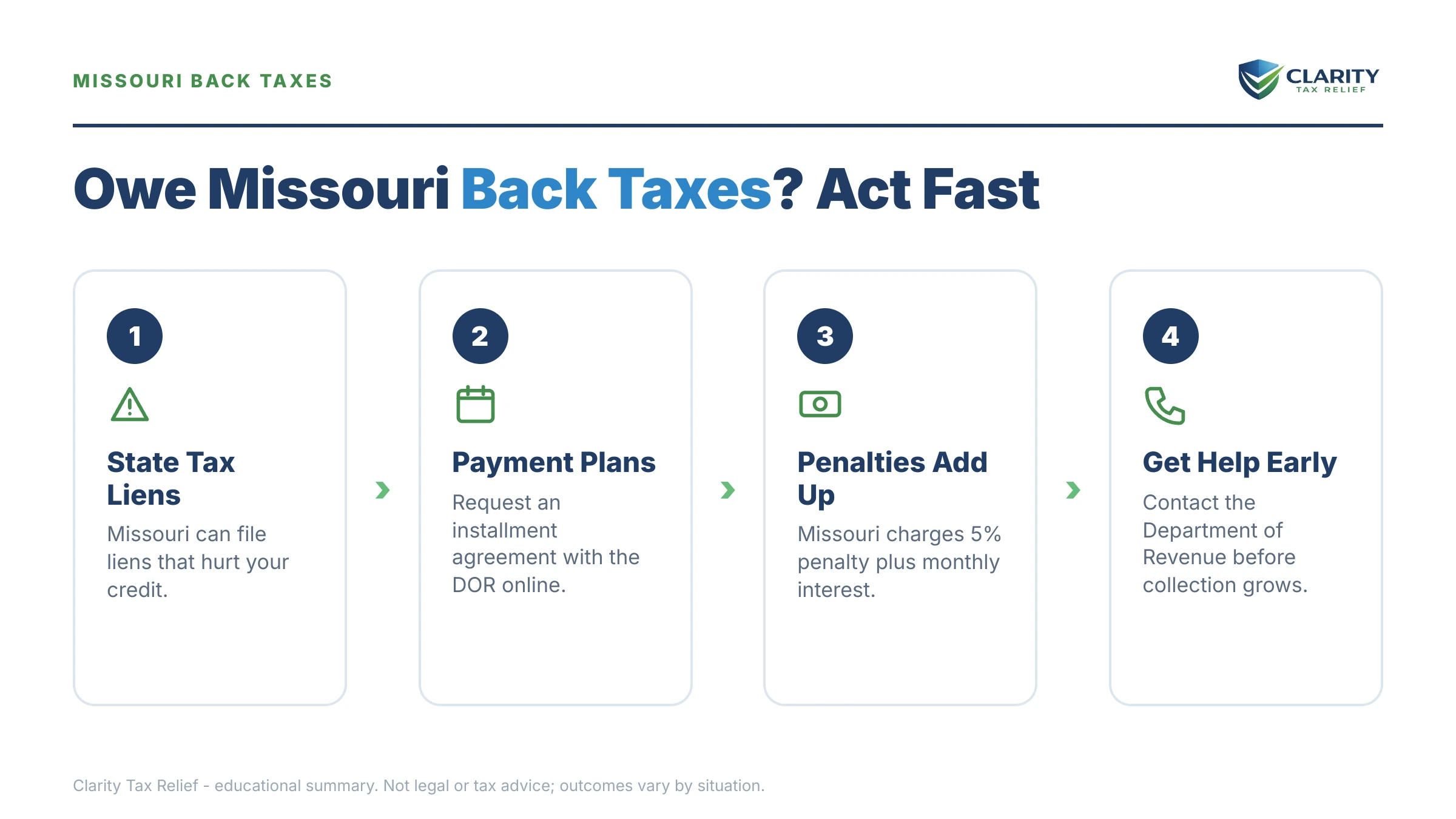
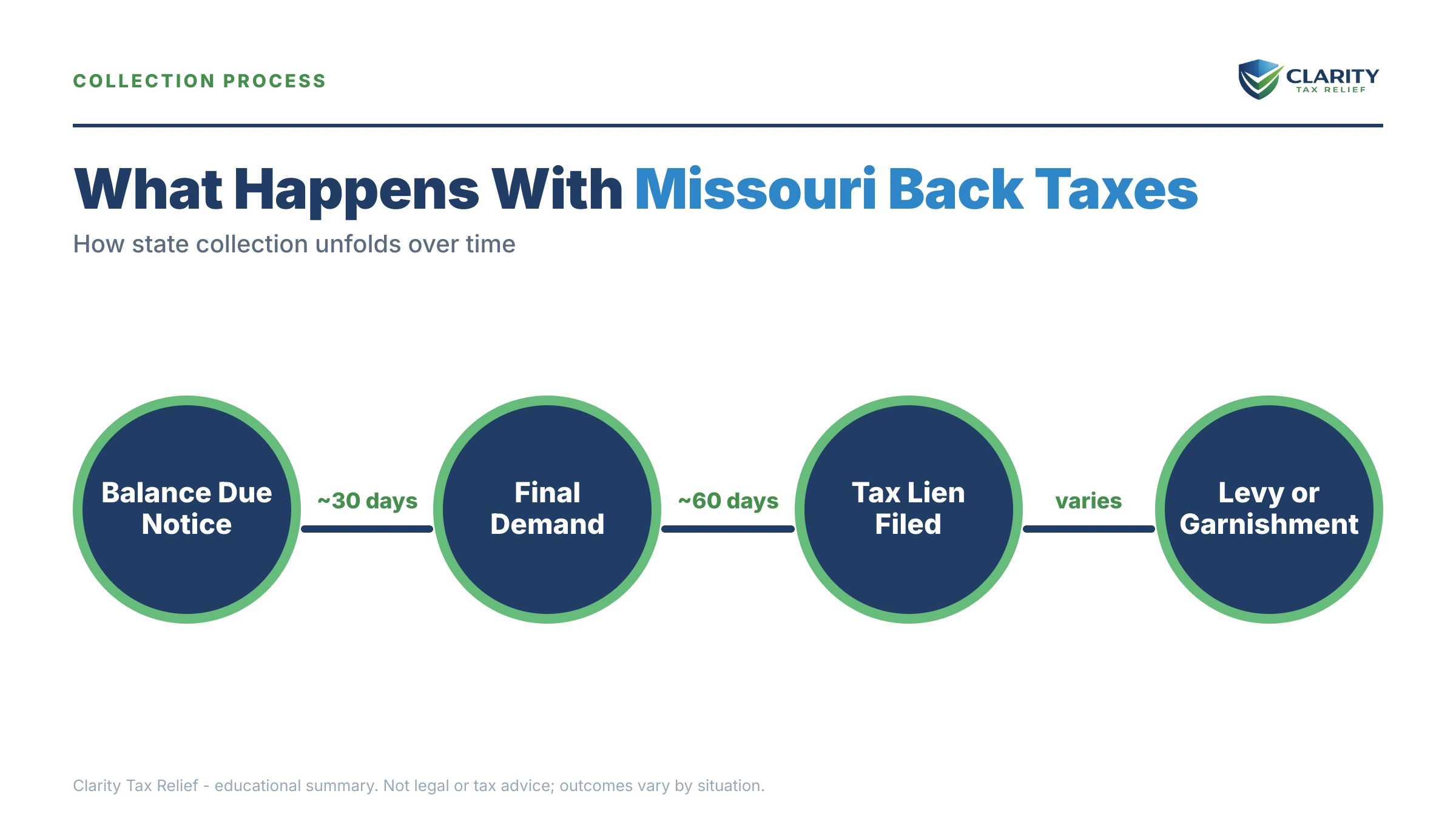
The Missouri DOR escalates from a mailed assessment to a circuit-court tax lien. The lien is what unlocks garnishment, bank levies, and public-record damage. The sequence is administrative and it does not require anyone to sue you first:
- Assessment notice. The DOR states what it says you owe for each year. A protest window is printed on the notice — respond inside it and you can dispute the numbers. Let it pass and the assessment becomes final.
- Billing and demand notices. The balance grows every month as Missouri's additions to tax and interest accrue — the state sets its own rates, separate from the IRS's.
- Certificate of tax lien. The DOR files a tax lien with the circuit court in your county. It becomes a public record, attaches to your real estate and other property, and gives the state judgment-style enforcement power.
- Enforced collection. With the lien in place, the DOR can pursue wage garnishment and bank levies. It also keeps any Missouri refund you're owed, and unpaid state income tax can reach your federal refund through the Treasury Offset Program — see how a state refund gets taken for tax debt in both directions.
- Business consequences. For a sole proprietor, this stage bites hardest: many Missouri cities and counties require a certificate of no tax due from the DOR before issuing or renewing a business license, and sales tax you collected from customers is trust money the state pursues personally. If sales tax is part of your balance, start with our guide to sales tax debt help — states treat it as their most serious category.
Remember that the federal side of a combined debt escalates on its own parallel track at the same time — the DOR pausing does nothing to stop an IRS levy notice, and vice versa. Neither agency waits for the other.
Owe Missouri and the IRS at the same time?
Interest and additions are accruing on both balances right now, and the DOR often files its lien before the IRS moves. Get both accounts reviewed free — an experienced tax professional will map which agency to resolve first and what each will actually accept. Call (888) 825-7779 or use the 2-minute form.
Your options for resolving Missouri back taxes in 2026
Payment plans, settlements and penalty relief options
Missouri offers fewer formal programs than the IRS, but every major resolution path exists in some form, and because most Missouri debts come paired with a federal balance, your real plan usually has two tracks.
| Option | Agency | Typically fits | Key catch |
|---|---|---|---|
| Pay in full | DOR / IRS | Balances you can cover within weeks | Cheapest option — stops accrual and prevents liens |
| DOR installment agreement | Missouri DOR | Income tax you can't pay at once | Must stay current on new taxes; interest and additions continue |
| IRS installment agreement | IRS | Up to $50,000 online, up to 72 months; above that, financial disclosure | Interest and penalties keep accruing during the plan |
| Missouri offer / settlement | Missouri DOR | Documented inability to ever pay in full | Case-by-case review; no advertised acceptance formula |
| IRS Offer in Compromise | IRS | Assets + future income can't cover the debt | $205 fee, 20% down on lump-sum offers (both waived for low-income); roughly 1 in 5 accepted in FY2024 |
| Hardship pause | DOR / IRS | Income covers only basic living expenses | Debt keeps growing; the agency re-reviews when finances improve |
| Penalty / additions relief | DOR / IRS | Clean compliance history or documented reasonable cause | Reduces penalties, not the underlying tax |
DOR payment plan. Missouri sets up installment agreements for individual income tax, and smaller balances can often be arranged online through the DOR's site. Terms are negotiated around your balance and budget. The plan generally requires every new return filed and paid on time — a missed 2026 estimated payment can default the agreement and restart enforcement.
Missouri offer or settlement. Missouri runs its own offer process, entirely separate from the federal program, for taxpayers who can document that full payment is genuinely out of reach. There is no published acceptance rate and no formula you can bank on — expect to hand over complete financials and support every number.
Replace estimated assessments. If the DOR assessed you without a return, file the real return. It usually replaces the estimated figure with the actual, often lower, amount, and it's a prerequisite for nearly every other option anyway. No records? Our guide to filing back taxes without records shows how to reconstruct income year by year.
Waiver of additions. Missouri can waive additions to tax when you show reasonable cause — a serious illness, disaster, or circumstances genuinely outside your control. Put the request in writing and attach proof; a bare apology doesn't move the needle.
Hardship. Missouri doesn't advertise an equivalent of the IRS's Currently Not Collectible status, but if paying anything would leave you unable to cover basics, collection holds can be negotiated case by case with documentation.
The federal track. For the IRS side of a combined debt: balances of $50,000 or less can go on an online plan of up to 72 months, while larger balances require Form 433-F financials — see the IRS payment plan over $50,000 rules. If your finances qualify, how an offer in compromise works explains the federal settlement math honestly. And if this is your first slip, first-time penalty abatement can strip federal penalties, with the IRS's new Automatic Exemption from Penalty (AEP) beginning to apply penalty relief automatically starting summer 2026.
How to respond to Missouri back taxes, step by step
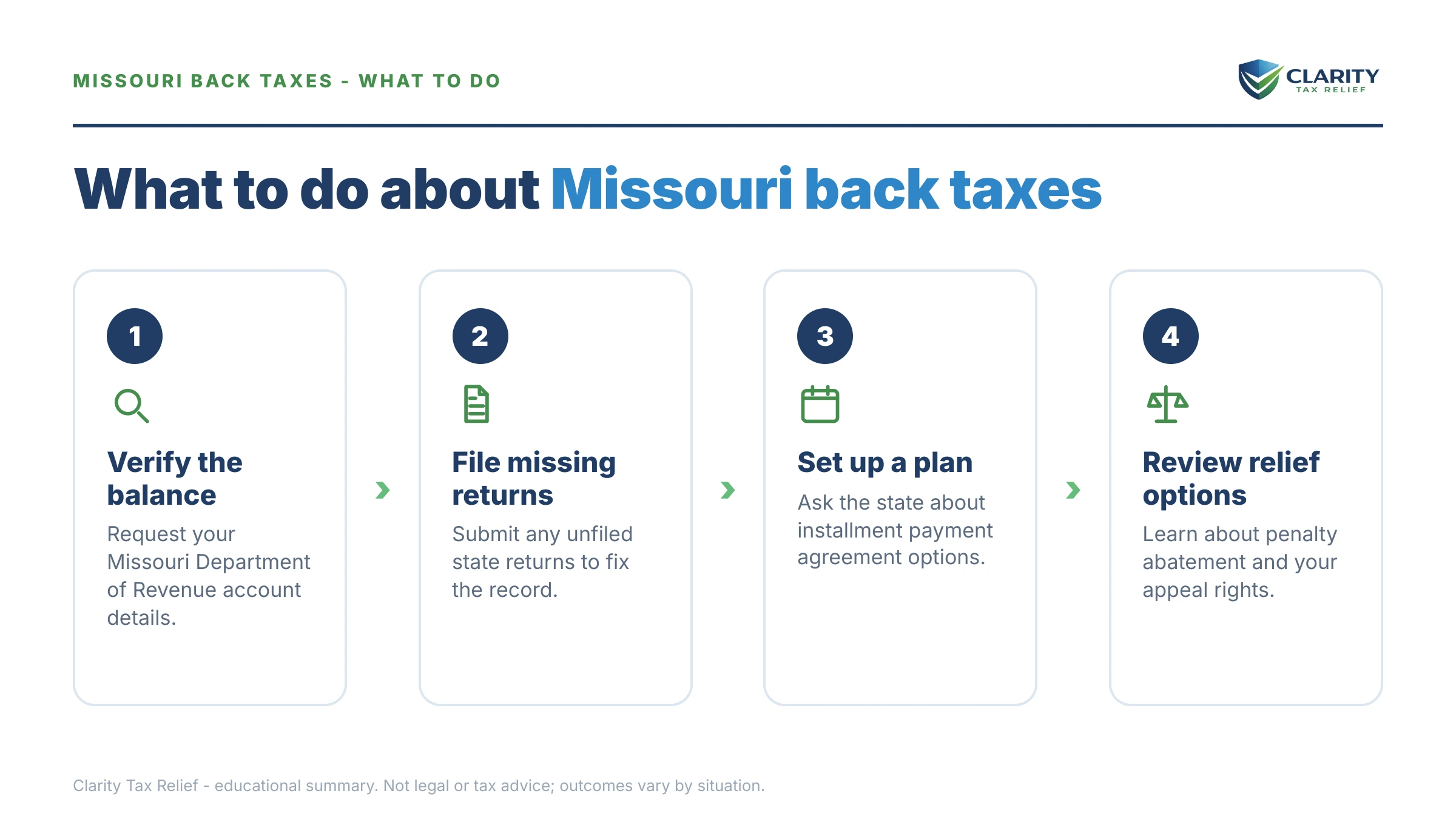
- Get the full picture. Pull your IRS account transcripts online and request your balance, assessment dates, and filing history from the Missouri DOR so you know exactly what each agency claims.
- File every missing return, federal first. The Missouri return starts from your federal AGI, so the federal return has to exist, and be right, before the Missouri one can be.
- Verify each assessment. Check the DOR's numbers against your records, and use the protest window printed on the notice if an amount is wrong or based on estimates.
- Choose a resolution track for each agency. Match a payment plan, settlement, or hardship request to your actual finances — the right answer for the IRS balance is often different from the right answer for the Missouri balance.
- Stay current on 2026 taxes. Make your quarterly estimated payments to both the IRS and Missouri going forward — a new balance is the fastest way to default every agreement you just set up.
What resolving $92,700 in Missouri and IRS back taxes looks like
A combined Missouri-and-federal debt is really three problems wearing one number, and each piece has its own cheapest fix. Say you're a self-employed sole proprietor in Kansas City who skipped quarterlies for three years and now owes $92,700 total: $71,400 to the IRS, $17,800 to the Missouri DOR, and $3,500 in Kansas City earnings tax. This is a hypothetical, but the math is real:
- The federal $71,400. It's over the $50,000 online-plan threshold, so you have two routes: submit Form 433-F financials for a non-streamlined agreement, or pay the balance down by $21,401 to $49,999 and set up a 72-month online plan — $49,999 ÷ 72 ≈ $695 a month, while interest and penalties keep accruing (so the real payoff runs longer or the payment adjusts). You can estimate how fast the federal balance grows with our IRS Penalty & Interest Calculator.
- The passport problem. At $71,400, the federal balance exceeds the $66,000 seriously-delinquent threshold for 2026, so passport revocation for tax debt is in play — getting into an installment agreement generally prevents or reverses the certification. Missouri has no passport power.
- The Missouri $17,800. A DOR installment agreement at, hypothetically, 36 months runs about $494 a month before Missouri's interest and additions. Resolving this piece early matters because the DOR's circuit-court lien would sit on your house and your business credit while you're still negotiating with the IRS.
- The city $3,500. Small enough to pay in full or on a short arrangement with Kansas City's revenue division — clearing the smallest collector first removes one set of notices entirely.
Total carrying cost in this scenario: roughly $1,190 a month across both plans, plus your 2026 quarterly estimates — which is exactly why the sequencing question (settle the state? pay down the federal first?) deserves real analysis before you commit. The framework in state tax debt vs IRS — which to resolve first walks through it.
Missouri DOR vs. the IRS: same playbook, different rules
The Missouri DOR and the IRS collect the same way on paper — bill, lien, levy — but the thresholds, timelines, and relief programs differ at every step, and mixing them up is how people miss deadlines.
| Question | IRS | Missouri DOR |
|---|---|---|
| Online payment plan | Up to $50,000, up to 72 months | Installment agreements available; terms negotiated, set up via dor.mo.gov |
| Settle for less | Offer in Compromise — $205 fee, 20% down on lump-sum (waived for low-income); ~1 in 5 accepted FY2024 | Own offer process; case-by-case, full financial documentation |
| Collection time limit | 10 years from assessment, pausable by appeals, OIC, bankruptcy | Set by Missouri law and different from the federal rule — confirm your dates with the DOR |
| Refund offsets | Can take your Missouri refund via the State Income Tax Levy Program | Keeps your Missouri refund; can reach your federal refund via the Treasury Offset Program |
| Passport action | Can certify federal debt of $66,000+ (2026) to the State Department | None |
| Lien mechanism | Notice of Federal Tax Lien | Certificate of tax lien filed in circuit court — judgment-style enforcement |
The refund-offset row deserves emphasis: the two systems feed each other. The IRS reaches state refunds through the State Income Tax Levy Program, and states reach federal refunds through the Treasury Offset Program, so as long as either balance exists, every refund you're ever owed is at risk. The federal clock itself is covered in our guide to the 10-year collection statute. Just don't assume Missouri mirrors it, because state law sets its own window.
One border note for Missouri's metro residents: if you commuted or did jobs across the state line, you may have filing obligations on the other side too — see Kansas back taxes for the KC metro and Illinois back taxes for the St. Louis metro. Multistate years are a common reason a "simple" Missouri cleanup turns into three or four returns per year.
When you can handle Missouri back taxes yourself
When to handle it yourself and when to get help
Plenty of Missouri back-tax situations don't need professional help, and knowing which is which saves you money. Handle it yourself when: you owe one year of Missouri income tax you agree with and can pay or plan within a few months. You're setting up a straightforward DOR installment agreement online. Or you're filing one or two missing returns with records in hand. The DOR's site at dor.mo.gov handles all of that directly. The IRS's own payment plans page covers the federal setup.
Experienced help changes outcomes when: a garnishment or bank levy is already in motion on either side. You have multiple unfiled years across both agencies. The federal balance exceeds $50,000 and the plan requires negotiated financial disclosure. Sales tax or withholding tax is part of the debt (personal, trust-fund-style liability). Or you're weighing settlement math with either agency. In those cases the order of operations — returns, protests, penalties, then the balances — determines what you actually pay, and it's easy to lock in a worse deal by moving in the wrong sequence. If the IRS is genuinely unresponsive on the federal side and a deadline or hardship is at stake, the Taxpayer Advocate Service is also a free federal escalation path.
If you'd rather have someone local-facing walk both accounts, start with our metro guides to tax relief in Kansas City and tax relief in St. Louis.
Terms on your Missouri notices, decoded
- Assessment — the DOR's formal determination that you owe a specific amount for a specific year. It becomes final if you don't respond within the protest window on the notice.
- Certificate of tax lien — the document the DOR files with your county's circuit court. It attaches to your property, appears in public records, and gives the state judgment-style collection power.
- Addition to tax — Missouri's term for its penalties for filing or paying late, charged on top of interest.
- Certificate of no tax due — a DOR document many Missouri cities and counties require before issuing or renewing a business license. Unresolved sales tax blocks it.
- Offset — one government keeping a refund another owes you and applying it to your debt; Missouri and the IRS offset each other's refunds in both directions.
- CSED — the federal Collection Statute Expiration Date, 10 years from IRS assessment. It applies only to the federal side of your debt, never to Missouri's.
If your Missouri balance is stacked on top of a five-figure IRS debt like the example above, a free review of both accounts — (888) 825-7779 — can map which agency to resolve first before either one files a lien.
Missouri back taxes: your questions answered
How long can Missouri collect back taxes?
Missouri's collection window is set by state law and is not the same as the IRS's 10-year statute, so don't build a plan around waiting the debt out. Once the DOR files a certificate of tax lien in circuit court, enforcement can continue far longer than most people expect. Confirm the assessment dates on your specific balances with the DOR, and remember that the federal side of a combined debt runs on its own 10-year clock.
Does Missouri offer a payment plan for back taxes?
Yes. The Missouri DOR sets up installment agreements for individual income tax, and smaller balances can often be arranged online through the DOR's website. Interest and additions to tax keep accruing while you pay. The agreement requires you to file and pay all new taxes on time — falling behind on a current-year payment can default the entire plan and restart enforcement.
Can I settle Missouri back taxes for less than I owe?
Sometimes, but it is strictly case-by-case. Missouri runs its own offer process, separate from the federal Offer in Compromise. It requires documented proof that you cannot pay the balance in full. Anyone quoting a settlement percentage before reviewing your finances is selling, not advising. On the federal side, the IRS accepted roughly 1 in 5 offers in FY2024 — real, but never automatic.
Will Missouri take my federal tax refund?
It can. States can intercept federal refunds through the Treasury Offset Program for unpaid state income tax, and Missouri will also keep any state refund you are owed and apply it to your balance. The street runs both ways: the IRS can take your Missouri refund through the State Income Tax Levy Program. An offset is not a resolution — enforcement continues until you set up an actual agreement.
Can the Missouri DOR garnish my wages or levy my bank account?
Yes. Once the DOR records a certificate of tax lien, it can pursue wage garnishment and bank levies. The lien itself becomes a public record that lenders and title companies see. If you are self-employed, the DOR can also reach business bank accounts. Getting into an agreement before the lien is filed is significantly cheaper than fighting enforced collection after it.
I owe both the IRS and Missouri — which do I pay first?
It depends on which agency is closer to enforcement. Many taxpayers resolve the state side first because state balances are usually smaller and the DOR often moves to a lien faster than the IRS moves to a levy. But if you are holding an IRS final notice of intent to levy (LT11), its 30-day deadline takes priority over everything else. Sequence matters — map both balances before committing to either plan.
What if I haven't filed Missouri returns for several years?
File the federal returns first — the Missouri return starts from your federal adjusted gross income, so the state numbers depend on the federal ones. If the DOR already assessed you based on estimated figures, filing your actual returns usually replaces those inflated assessments with the real amounts. Expect to provide the years the DOR specifically demands, and get the balances confirmed in writing once everything posts.
Does Missouri back-tax debt affect my passport?
No — passport certification is a federal-only tool. The IRS can certify seriously delinquent federal tax debt of $66,000 or more (the 2026 threshold) to the State Department; Missouri has no passport power. If your combined debt includes a federal balance over that line, the federal side is what threatens your passport, and getting into an IRS installment agreement generally prevents or reverses the certification.
Do I owe Kansas City or St. Louis earnings tax on top of Missouri back taxes?
If you live or work in either city, yes. Both Kansas City and St. Louis charge a 1% earnings tax, and it applies to self-employment profits, not just wages. The cities collect it themselves, separately from the Missouri DOR, so a full back-tax cleanup in either metro often means squaring up with three collectors: the IRS, the DOR. The city's revenue office.
Your next 24 hours
- Find the two dates on your DOR notice — the assessment date and the response deadline printed on it — and note the notice date on any IRS letters sitting in the same pile.
- Gather your paper trail: your last two years of federal and Missouri returns, every notice from every agency. A rough monthly income-and-expense picture from your business.
- Get a free case review of both balances — the form at the top of this page or (888) 825-7779. Interest and additions are accruing on every dollar of a Missouri-plus-IRS debt right now. The review maps which agency to resolve first before a lien makes everything harder.
This guide is general information, not tax or legal advice for your specific situation. Eligibility for IRS programs depends on individual facts and circumstances; no outcome is guaranteed.