
State Back Taxes
New Mexico Back Taxes: How to Resolve a TRD Balance in 2026
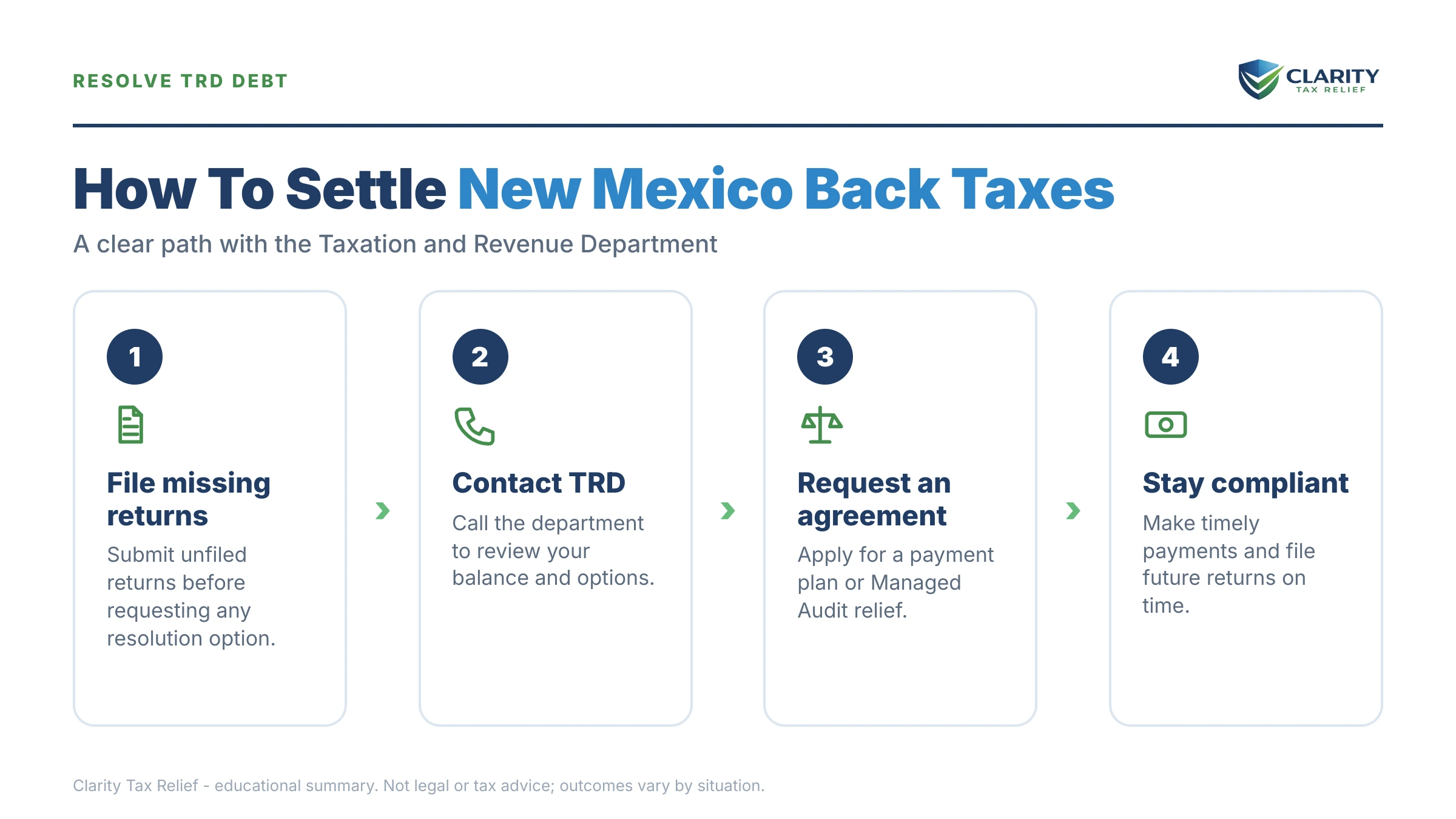
The short answer: New Mexico back taxes are collected by the Taxation and Revenue Department (TRD). After required notices, TRD can record a tax lien, garnish wages, and levy bank accounts. Your main fixes: pay in full through TAP, set up a TRD payment plan, or protest an incorrect assessment by the notice's printed deadline.
Maybe you found out the hard way — a lender pulled title for your refinance and a New Mexico state tax lien surfaced, one you half-remembered and hoped had faded away. Or a TRD envelope landed showing a balance you didn't know existed. Either way, this is fixable: TRD debts resolve on predictable rules, and every one of those rules works better for you the earlier you act.
New Mexico's system has quirks the IRS doesn't. There's no conventional sales tax — the state taxes a business's gross receipts, including services, and the business itself owes it. The federal 10-year collection rule doesn't apply here. And the agency is the Taxation and Revenue Department (TRD), not the IRS, so IRS programs and IRS deadlines are irrelevant to this debt.
If a TRD letter started all this, the image below shows exactly what a New Mexico assessment notice looks like and where to find the two things that matter most: the balance and the deadline.
⏱ Two clocks are running: the protest deadline printed on your TRD Notice of Assessment, miss it and the assessed amount becomes final, and monthly penalty and interest accrual, which never pauses while you decide what to do.
Why you owe New Mexico back taxes: TRD's four main triggers
New Mexico back taxes come from four main sources: unpaid personal income tax, unregistered or under-reported gross receipts tax, unremitted withholding, and assessments TRD builds from federal data when you don't file.
The simplest version: you filed a New Mexico return, owed a balance, and couldn't pay it that April. Penalties and interest have been compounding on it every month since. TRD's number today is bigger than the number you remember — sometimes much bigger.
The second version: TRD adjusted your return. New Mexico exchanges data with the IRS, so a federal change — a CP2000 notice, an audit adjustment, an amended 1040 — often triggers a matching state assessment months or years later. Readers are routinely blindsided by a state bill for a federal issue they thought was closed.
The third version is New Mexico's signature problem: gross receipts tax (GRT). New Mexico doesn't run a conventional sales tax. Instead, it taxes the gross receipts of anyone doing business in the state, and unlike most states' sales taxes, GRT reaches services, not just goods. The tax is legally imposed on the seller. A freelancer, consultant, or contractor who never registered can accumulate years of GRT liability without ever "collecting" a cent of tax from anyone. If that's you, the broader playbook in our sales tax debt help guide applies, with New Mexico's twist that the debt is yours by law, not just money you held for the state.
The fourth version: you never filed, and TRD assessed for you using federal data and estimates. Those estimates resolve every doubt in the state's favor. Filing the real returns — even for old years, even without complete records — usually replaces the estimate with a smaller, accurate number.
| Tax | Who owes it | Why back taxes happen |
|---|---|---|
| Personal income tax | New Mexico residents and anyone with New Mexico-source income | Filed without paying, TRD adjustments from IRS data, or unfiled years |
| Gross receipts tax (GRT) | The business or self-employed seller — including service providers | Never registered, under-reported receipts, or the wrong location rate |
| Withholding tax | Employers | Withheld from paychecks but not remitted — carries personal exposure |
| Compensating (use) tax | Buyers using untaxed goods or services in New Mexico | Out-of-state purchases nobody reported |
| Weight distance tax | Operators of heavy commercial vehicles | Missed filings by owner-operators and fleets |
One warning for business owners: withholding tax is money taken from employees' paychecks, and keeping it is the fastest way to turn a business debt into a personal one. If your business closed with unpaid trust-fund-type taxes, read closed business owe sales tax — the personal-liability logic is similar, and dissolving the entity does not dissolve the exposure.
“A lien is not a levy. A lien secures the government’s interest in your property when you don’t pay your tax debt. A levy actually takes the property to pay the tax debt.”
— Understanding a federal tax lien (IRS.gov)
What happens if you don't pay New Mexico back taxes
If you don't pay New Mexico back taxes, TRD moves from letters to a recorded lien, then to levies on wages and bank accounts, and every month in between adds penalty and interest to the balance.
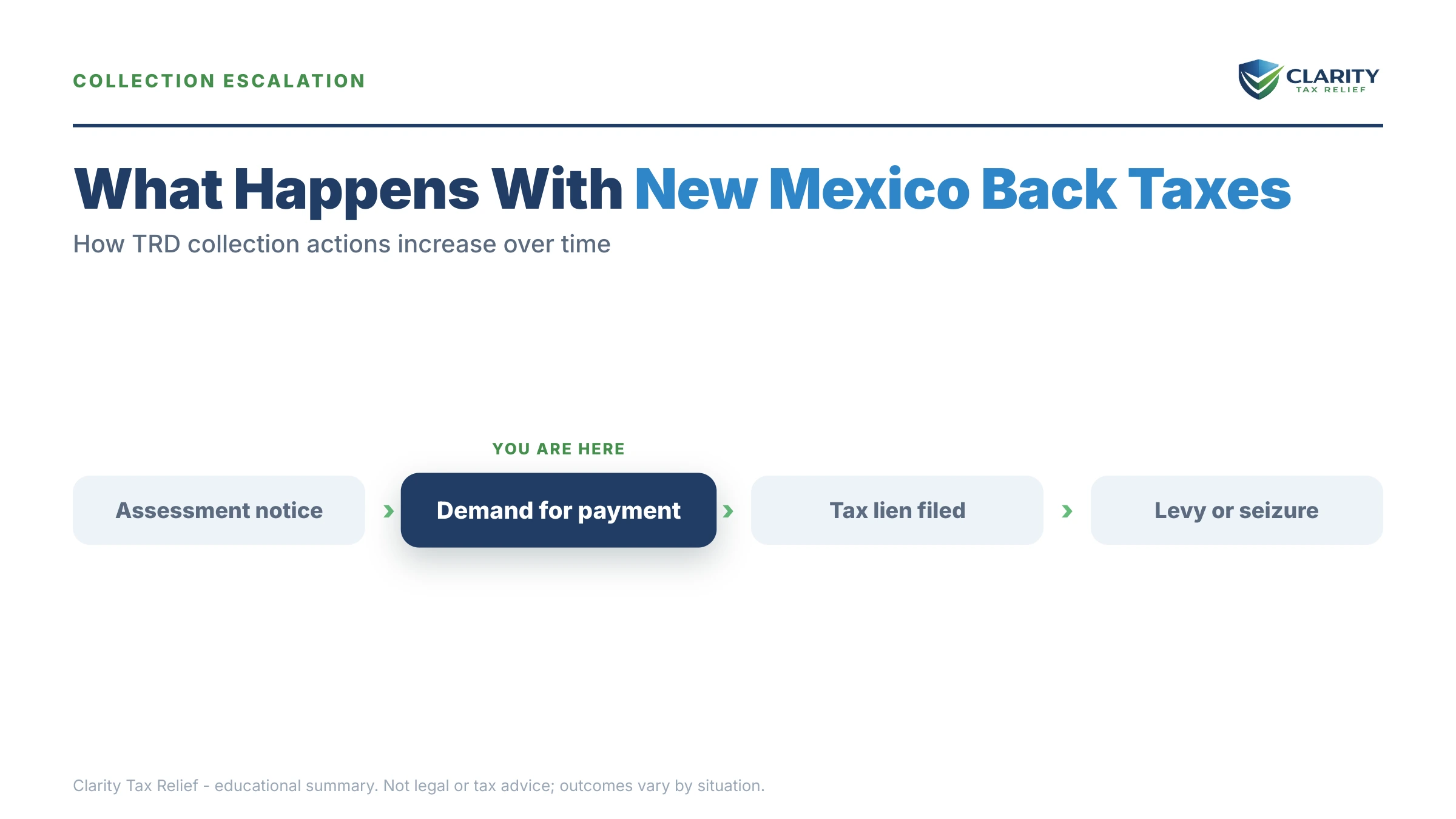
The sequence is not a bluff, and it doesn't require a human collector to decide anything. It runs in stages:
- Notice of Assessment and demand letters. TRD tells you what it says you owe, broken out by tax program and period. Penalties and interest are already accruing. You are probably here.
- The assessment becomes final. Your notice prints a protest deadline. Once it passes without a written protest, you generally lose the right to dispute the amount through the administrative process, even if the assessment was an estimate.
- A state tax lien is recorded. TRD files with the county clerk, making the debt public record. This is the stage that stalls refinances, home sales, and business credit — the lien surfaces in every title search from that day forward.
- Levy and garnishment. TRD can garnish wages and levy bank accounts administratively — no lawsuit required. A wage garnishment continues until the debt is resolved or released.
- Refund offsets, every year. Your New Mexico refund is applied to the balance until it's gone, and state tax debts can be referred for offset against federal payments through the Treasury Offset Program.
- Business escalation. For GRT and withholding debts, TRD can pursue the business's assets, and unpaid GRT can complicate or follow the sale of a business — get advice before selling or dissolving anything that owes.
Don't assume 2026's government staffing turmoil buys you time. State and federal collection systems alike run on automation — the letters, liens, and levies are generated by machines that never got smaller, even when the staff answering phones did.
| Stage | The clock | The right or leverage at stake |
|---|---|---|
| Notice of Assessment | Protest deadline printed on the notice | Your right to dispute the amount before it becomes final |
| Demand letters | Penalties and interest accrue monthly | Resolving now keeps the lien off public record and your title |
| Tax lien recorded | Immediate — public record at the county clerk | Clean title for refinancing or selling; lending consequences begin |
| Levy or garnishment | Immediate — continues until resolved | Your paycheck and bank balance; releases must now be negotiated |
| Refund offsets | Every filing season until paid | State, and potentially federal — refunds applied to the debt |
New Mexico tax debt threatening a lien, or a closing date?
Send us your TRD notice. An experienced tax professional will confirm what you actually owe, whether the protest window is still open. The fastest path to keep a lien off your title — free and confidential.
Your options for resolving New Mexico back taxes, compared
Most New Mexico back-tax cases end one of five ways: full payment, a TRD installment agreement, a successful protest, penalty relief, or, in narrow cases, bankruptcy discharge of older income tax.
| Option | Best for | The catch |
|---|---|---|
| Pay in full via TAP | Balances you agree with and can cover | Only finding the cash. This stops accrual and lien risk fastest |
| TRD installment agreement | Accurate balances you need months to pay | Interest continues; TRD may still record a lien; longer terms need financial disclosure |
| Protest the assessment | Amounts that are wrong or estimated | Must be filed in writing by the deadline printed on the notice |
| Penalty waiver request | Failures caused by circumstances beyond your control | Discretionary, and interest generally is not waived |
| Hardship pause | No ability to pay anything right now | No published program like IRS hardship status; requires documentation and persistence, and the debt keeps growing |
| Bankruptcy discharge | Older income tax meeting strict timing tests | GRT and withholding generally survive; get bankruptcy counsel first |
Payment plan. TRD negotiates installment agreements based on the balance and your finances, and smaller balances can often be set up through the Taxpayer Access Point (TAP) portal without a phone call. Two honest caveats: interest keeps accruing during the plan, and TRD may still record a lien to protect the state's position even while you're paying — ask about lien handling before you sign, especially if a refinance is coming.
Protest. If any part of the assessment is wrong — an estimated non-filer assessment, a GRT rate for the wrong location, income that isn't yours — you dispute it in writing by the deadline printed on the notice. This is the cheapest fix available when it applies, because it attacks the number itself rather than financing it.
Penalty waiver. TRD can waive penalties in limited circumstances when the failure wasn't due to negligence — serious illness, disaster, reliance on bad written advice. Request it in writing with documentation. Don't expect interest relief; build your budget assuming interest stays.
Settlement. New Mexico has no application-based equivalent of the IRS Offer in Compromise. TRD's authority to compromise is narrow. Any firm promising to settle a New Mexico debt "for a fraction" is selling you a federal program that doesn't exist at the state level.
Bankruptcy. Older state income taxes can sometimes be discharged under the same kind of timing tests that apply federally, see the discharge taxes in bankruptcy rules, but GRT and withholding debts generally survive. This is specialist territory; don't file anything on a hunch.
If you owe the IRS too, sequencing matters more than any single option — our hub on state tax debt vs IRS covers which collector to satisfy first and why the answer isn't always the bigger balance.
A worked example: $13,600 in New Mexico back taxes before a refinance
Say you owe TRD $13,600 — two years of underpaid income tax that started as roughly $9,800 and grew with penalties and interest — and you're three months from a refinance application. Here's how the math and the sequence play out. (This is a hypothetical illustration, not a client result.)
Scenario A — no lien recorded yet. You set up a TRD installment agreement now. At 24 months, that's $13,600 ÷ 24 ≈ $567/month before ongoing interest; at 36 months, roughly $378/month. Your lender will count that payment in your debt-to-income ratio. But an unrecorded state balance on a payment plan is a far smaller underwriting problem than a recorded lien in the title search. If your budget allows, paying it down faster before applying shrinks both the DTI hit and the interest cost.
Scenario B — the lien is already recorded. Now the debt sits in the county clerk's records, and the title company will flag it. Most lenders require it paid or released before or at closing. The workable path: request a payoff letter from TRD early, have the title company pay the $13,600 (plus accrued interest through the payoff date) from your closing proceeds or cash-out funds, then confirm TRD records the release. On a cash-out refinance, you're effectively converting a compounding tax debt into mortgage debt at a much lower rate — often the cheapest money available for this problem.
Scenario C — you dispute the number. If $4,000 of that $13,600 came from an estimated assessment for a year you actually had lower income, filing the real return or protesting by the notice deadline could cut the balance before you finance a penny of it. Never refinance a number you haven't verified.
The lesson across all three: the same $13,600 costs dramatically less resolved before the lien than after it — in time, in closing complications, and in what the debt does to your loan terms.
Refinancing or selling with a New Mexico tax lien
A recorded New Mexico tax lien must generally be paid or released before or at closing, because it attaches to your property and clouds the title your lender needs.
Steps to clear a lien before closing
The mechanics are routine when you start early. First, request a written payoff letter from TRD showing the exact balance good through a specific date — interest accrues daily, so the number moves. Second, give it to your title company; they'll pay TRD from closing funds and hold the transaction together. Third, follow up until the lien release is actually recorded with the county clerk — payment posts first, the release follows. You want written proof in your file.
Where deals slip: requesting the payoff letter the week of closing, discovering the balance includes a year you didn't know about, or finding a second lien for a different tax program. That's why step one of everything is pulling your complete TRD account, not just reading one letter. If you also carry a federal lien, the process differs — see can I refinance with an IRS lien, because the IRS has formal subordination and discharge procedures the state process doesn't mirror.
Owe both the IRS and New Mexico? Sequence them as one plan
When you owe both the IRS and New Mexico, resolve them together — each collector can take money the other plan was counting on.
Two intersections matter most. The IRS can seize your New Mexico refund through the State Income Tax Levy Program, and New Mexico's debt can reach federal payments through Treasury offset, so a refund you budgeted toward one debt can vanish into the other. And never transplant IRS rules onto the TRD side: the federal 10-year collection statute, IRS payment-plan thresholds. The Offer in Compromise all stop at the state line.
A common workable structure: put the IRS side on a formal IRS installment agreement, then size the TRD plan around what's left, while prioritizing whichever agency is closer to filing a lien or issuing a levy. To see how much of your federal balance is penalties and interest before you commit monthly cash to it, you can estimate it with our IRS penalty &. Interest calculator.
How to respond to New Mexico back taxes, step by step
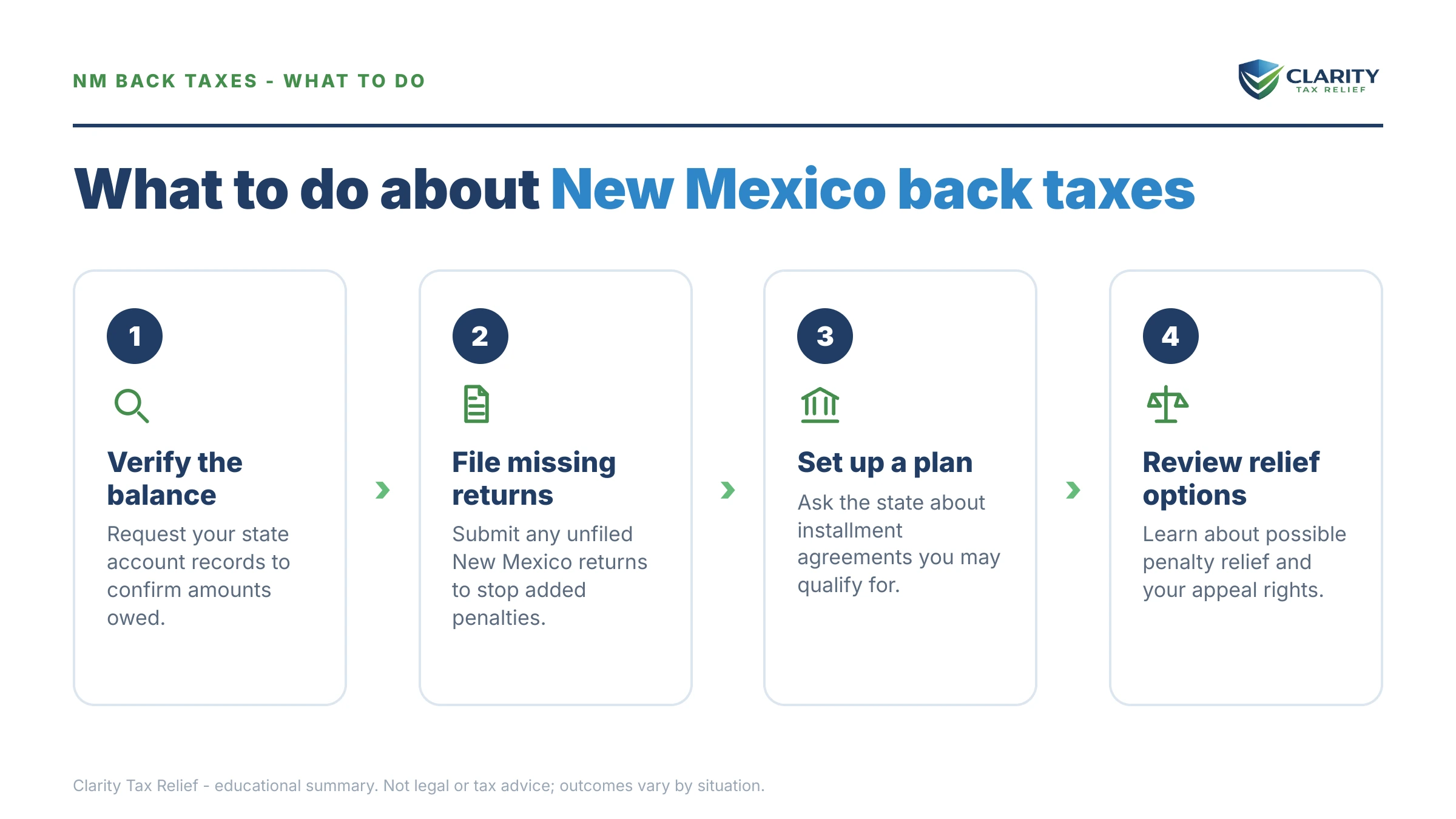
- Confirm the full balance. Log into TRD's Taxpayer Access Point (TAP) or call TRD to see every year, tax program, and amount the state has on file — the letter in your hand may not be the whole picture.
- Check the protest deadline. Find the protest deadline printed on your Notice of Assessment. If any part of the assessment is wrong, dispute it in writing before that date — silence makes it final.
- File any missing New Mexico returns. Replace TRD's estimated assessments with real numbers by filing the actual returns, even for old years — estimates almost always overstate what you owe.
- Choose your resolution before a lien is filed. Pay in full, set up a TRD installment agreement, or request a penalty waiver — arranging anything during the letter stage usually keeps the lien off your title.
- Get a free professional review for liens, levies, or business taxes. If a lien is already recorded, a levy is in motion, or gross receipts or withholding tax is involved, have an experienced tax professional map the sequence before you commit to anything.
When you can handle New Mexico back taxes yourself
You can usually handle this yourself when the balance is one year of income tax, you agree with the number. You can pay it in full or on a modest plan through TAP. Requesting a penalty waiver in writing for a well-documented one-time hardship is also very doable on your own. TRD's own site at tax.newmexico.gov is the right starting point for payments, TAP access, and forms.
Experienced help changes the outcome in a different set of situations: a lien already recorded with a closing date approaching, a GRT assessment against a business or freelancer covering multiple years, unremitted withholding with personal exposure, several unfiled years being estimated against you, or a garnishment already hitting your paycheck. In those cases the order of moves — file, protest, negotiate, pay — often matters more than any single move. A wrong first step can lock in a number you could have cut.
If your closing date is already on the calendar, a free case review can map the payoff-letter and release sequence before it costs you the rate lock — call (888) 825-7779 or use the 2-minute form.
Terms on your TRD notice, decoded
- Gross receipts tax (GRT): New Mexico's replacement for a sales tax — a tax on a business's total receipts, including services, legally owed by the seller.
- Compensating tax: New Mexico's use tax — owed on goods and services used in the state when no GRT was paid on the purchase.
- Notice of Assessment: TRD's formal statement of what it says you owe, with a printed deadline to protest before the amount becomes final.
- Protest: Your written dispute of an assessment, filed with TRD by the notice deadline, which opens the administrative review process.
- Lien vs. levy: a lien is a recorded public claim against your property. A levy is the actual taking — from a paycheck, a bank account, or other assets.
- TAP: the Taxpayer Access Point, TRD's online portal for viewing balances, filing, paying, and setting up smaller payment plans.
New Mexico back taxes: your questions, answered
Does New Mexico offer a payment plan for back taxes?
Yes. TRD sets up installment agreements for both individuals and businesses, and smaller balances can often be arranged through the Taxpayer Access Point (TAP) portal. Interest keeps accruing during the plan, and TRD may still record a tax lien to protect the state's position. Longer plans usually require financial disclosure, so have your income and expense figures ready before you ask.
How long can New Mexico collect back taxes?
New Mexico's collection window is set by state statute and is not the same as the IRS's 10-year rule — never assume a federal timeline applies to a TRD debt. Certain events, like a recorded lien or ongoing proceedings, can extend the state's reach. Before you plan around any expiration date, confirm the assessment date and current status directly with TRD or an experienced tax professional.
Can TRD garnish my wages or levy my bank account?
Yes. After the required notice and demand process, TRD can garnish wages and levy bank accounts administratively. It does not have to sue you in court first. A wage garnishment continues until the debt is resolved or released, which is why acting during the letter stage is so much cheaper than acting after enforcement starts.
Will New Mexico keep my state or federal refund?
Your New Mexico state refund will almost certainly be applied to a TRD balance until it is paid. State tax debts can also be referred for offset against federal payments through the Treasury Offset Program. If you are counting on a refund while you owe TRD, assume it will be intercepted and build your plan around that.
Does New Mexico have an offer in compromise like the IRS?
Not in the same form. New Mexico has no application-based settlement program equivalent to the IRS Offer in Compromise; TRD's authority to compromise a debt is limited and used in narrow circumstances. Be skeptical of any company promising to settle a New Mexico tax debt for a specific fraction — have the claim evaluated by an experienced tax professional before paying anyone.
Why do I owe gross receipts tax as a freelancer or service business?
Because New Mexico taxes gross receipts instead of running a conventional sales tax, and unlike most states, that tax reaches services, not just goods. The tax is legally imposed on you, the seller, whether or not you passed it on to clients. Freelancers, consultants, and contractors who never registered are TRD's most common surprise assessments.
Will a New Mexico tax lien stop my refinance or home sale?
It will show up in the title search, and most lenders require it paid or released before or at closing. The usual fix is a payoff letter from TRD, with the title company paying the balance from closing proceeds and TRD releasing the lien afterward. Start the payoff-letter request early — waiting until the week of closing is the most common way deals slip.
Can I go to jail for New Mexico back taxes?
Owing tax you cannot pay is a civil matter, not a crime — TRD collects with liens and levies, not arrests. Criminal exposure exists only for willful conduct, such as deliberately evading tax or collecting gross receipts tax or withholding from others and keeping it. If you are behind because money was tight, the answer is resolution, not fear.
What happens if I never filed New Mexico returns?
TRD can assess tax without your return, using federal data and estimates that resolve every doubt in the state's favor. Filing the actual returns usually replaces the estimated assessment with the real, lower number. Refund claims have time limits under state law, so file older refund years quickly rather than letting them expire.
Your next 24 hours
- Find the two numbers on your TRD notice — the total balance and the protest deadline printed near the assessment details. No notice handy? Log into TAP and pull your full account, every year and every tax program.
- Gather your paperwork: the notice, your last federal and New Mexico returns, current income figures, and if a refinance or sale is in motion, your closing timeline, because it dictates which resolution path fits.
- Get a free case review. Interest is compounding monthly whether or not you act, and a lien filing changes what everything costs. Call (888) 825-7779 or use the 2-minute form and an experienced tax professional will map your fastest path — free, confidential, no pressure.
This guide is general information, not tax or legal advice for your specific situation. Eligibility for IRS programs depends on individual facts and circumstances; no outcome is guaranteed.