
State Tax Debt
NYS Tax Warrant: What a Tax Warrant Is, Whether It's Criminal, and How to Pay It Off (2026)
The short answer: a NYS tax warrant is New York's civil judgment for unpaid state tax. In the Tax Department's words, "A tax warrant is equivalent to a civil judgment against you," filed with the Department of State and the county clerk, and it "creates a lien against your real and personal property." It is not an arrest warrant and nobody goes to jail over it. It lets New York garnish wages and levy accounts without a court hearing, and it is satisfied only when the warranted balance is paid in full; a payment plan stops collection but leaves the warrant on file.
Maybe you found the docket entry after a mortgage lender ran a title search. Maybe your employer's payroll department got the paperwork before you did. However a NYS tax warrant surfaced, New York has already converted a tax balance into a judgment against your name. This page explains what a tax warrant is, why it is not a criminal matter, what the state can do with it, and the exact process for paying it off and getting the satisfaction filed.
Two details on the filing control everything that follows: the county where the warrant is docketed and the docket date. The image below shows what a docketed New York tax warrant looks like and where those details appear, so you can read yours before you act.
⏱ The clock on a NYS tax warrant: there is no response window printed on a warrant. Once it is docketed, New York can issue an income execution or a bank levy at any time. The warrant is generally enforceable for 20 years, and penalties and interest keep accruing every month until the balance is resolved.
What is a tax warrant?
A tax warrant is the instrument New York State uses to turn an unpaid tax balance into a judgment. The Department of Taxation and Finance describes it this way: "A tax warrant is equivalent to a civil judgment against you and protects New York State's interests and priority in the collection of outstanding tax debt. We electronically file a tax warrant with the New York State Department of State as well as the county clerk's office listed on the warrant. It becomes a public record." The filing does two things at once. It dockets a money judgment against you, legally equivalent to losing a lawsuit, except no lawsuit was needed. And it "creates a lien against your real and personal property," which the state says may "allow us to seize and sell your real and personal property, allow us to garnish your wages or other income, or affect your ability to buy or sell property."
Other states use the phrase "state tax lien" or "judgment" for the same thing; New York's word is warrant. It is stronger than the federal version in two ways. An IRS lien secures the debt but the IRS must still issue separate levy notices with appeal rights before seizing anything, while New York's due process is complete when the warrant dockets. And the timelines diverge: the IRS generally has 10 years to collect, while a docketed New York warrant is enforceable for roughly twice that. Your Tax Department online account shows the balance and the tax years behind it. The Department of State's tax warrant search lists open warrants by name.
“A tax warrant is equivalent to a civil judgment against you and protects New York State's interests and priority in the collection of outstanding tax debt.”
— Tax warrants (New York State Department of Taxation and Finance)
Is a tax warrant an arrest warrant? Can you go to jail for a tax warrant?
No, and no. The word "warrant" is the confusing part. A tax warrant is a civil filing: a judgment and a lien that give the Tax Department the powers of a judgment creditor. It is not issued by a criminal court, no police agency acts on it, and nobody is arrested or jailed for having one. Owing tax and not being able to pay it is a civil matter in New York, however large the balance. Criminal tax cases exist. But they involve willful conduct such as fraud or evasion, are charged separately, and begin with an investigation rather than a docket entry at the county clerk. If the only paper you have is a warrant, a collection notice, or an income execution, you are in the civil collection process. The risks are financial: garnished wages, levied accounts, a lien on property, and, for balances of $10,000 or more, a suspended driver's license.
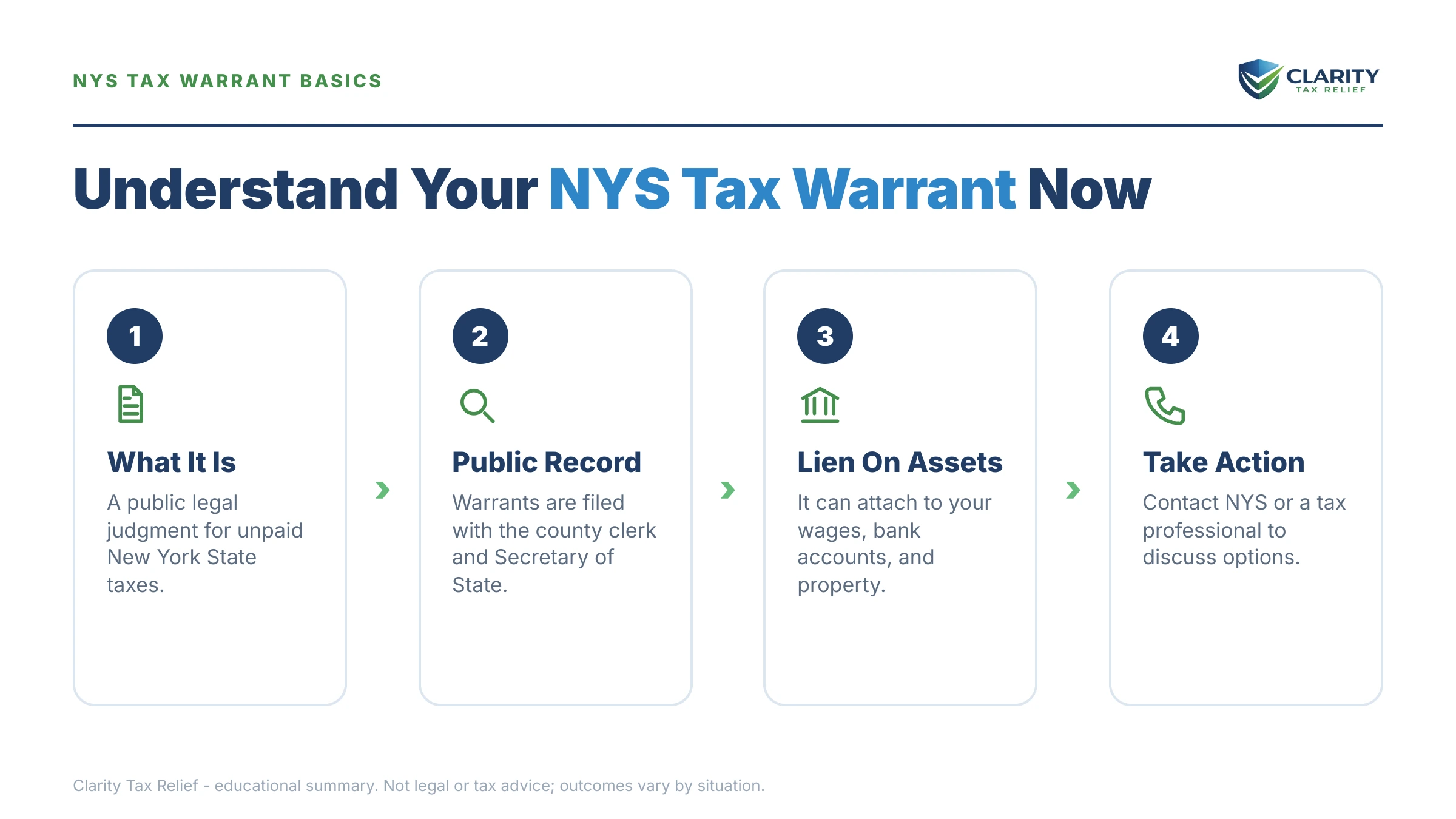
Why New York filed a warrant for unpaid taxes against you
The state files a warrant only after a tax has been assessed, billed and left unpaid. It is the judgment step, not the first letter. The Tax Department's own sequence: "If you fail to timely resolve your tax debt, your past due tax debt becomes fixed and final. We may file a tax warrant against you. Before we file a tax warrant, we will send you notice of the debt and give you an opportunity to resolve it. When we file a tax warrant, we send you a copy of the warrant." The assessment behind it came from a return you filed, an audit, or the state's own estimate for a year you never filed. The notices went to the address the state had on file. A warrant on a jointly filed year attaches to each spouse named on the return, no matter what a divorce decree says about who pays. The same principle behind why the IRS ignores the decree applies in Albany. One thing worth checking early: if the assessment itself is wrong, because the state estimated a year you never filed or disallowed something you can document, amending a return to lower a tax debt or filing the missing return can shrink the number behind the warrant before you resolve the rest.
What New York can do after a tax warrant is docketed
Because the judgment already exists, enforcement is administrative: the state does not ask a judge, it sends paperwork. The Tax Department says it "will file a tax warrant before we issue an income execution," and after that the tools are:
- Income execution. New York's wage garnishment. In the state's words, "We will ask you to voluntarily pay up to 10% of your gross wages each time you're paid. If you don't make voluntary payments, we'll have your employer automatically deduct up to 10% of your gross wages from your paycheck and send it to us." The notice comes to you first. You must "make the first payment within 20 days of receiving our notice" and remit "10% of your gross income, or 25% of your disposable earnings, each time you get paid." If you do not, the execution goes to your employer, who must comply. If two people share the debt, each can receive a separate income execution.
- Bank levy. The state can seize funds from your accounts under the warrant's authority. Do not assume New York follows the IRS's 21-day bank-hold rule; its procedures are its own.
- Driver's license suspension. New York can suspend the licenses of taxpayers owing $10,000 or more, a tool the IRS does not have. See NYS driver's-license suspension for tax debt.
- Refund offsets and property. State refunds are applied to the balance automatically. The warrant may "allow us to seize and sell your real and personal property," the rare last resort that the docketing makes legally possible.
None of these steps requires a new notice period the way federal levies do. The warrant is the end of the warning phase, not part of it.
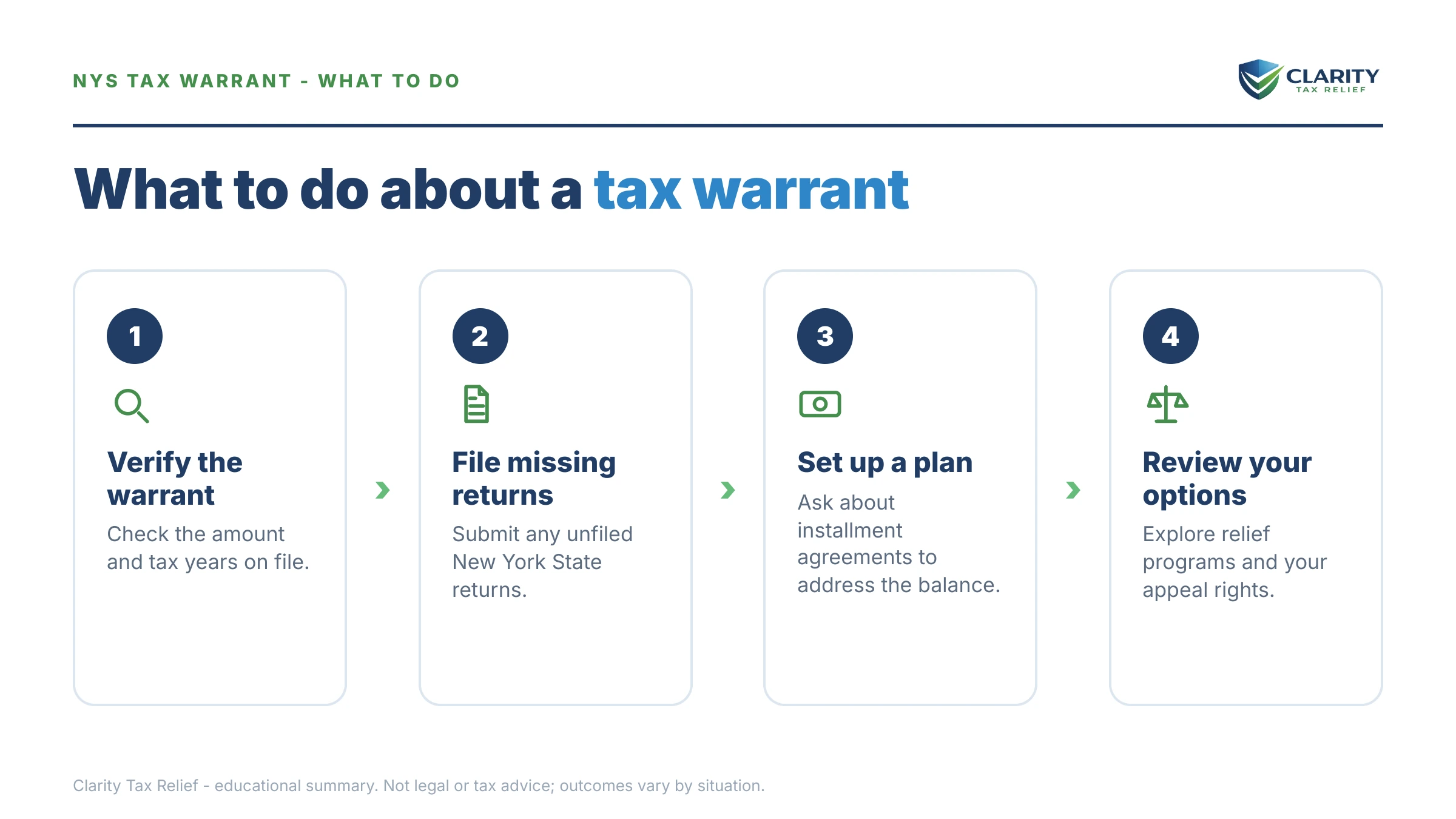
A tax warrant is already filed against you?
Once docketed, New York can serve an income execution or bank levy at any time; there is no waiting period left. Send us your warrant details and an experienced tax professional will map exactly what the state can take and which resolution stops it. Free and confidential.
How to pay a NYS tax warrant: the payoff request, the payment and the satisfaction
The Tax Department's rule is one sentence: "You must pay your total warranted balance in full to satisfy your tax warrant." The process, in order:
- Request the payoff figure. Call the Tax Department (have your taxpayer ID or collection case number ready) and ask for a warrant payoff letter. The state provides "an Outstanding Judgment Balance Due letter, which lists all outstanding warrants and the balance due projected to a specified date." That projected-date figure is the number to pay, because interest keeps accruing until the payment posts.
- Pay the warranted balance in full. Online from a bank account through Quick Pay or your Online Services account, by card for a fee, or by check or money order payable to Commissioner of Taxation and Finance. If a closing depends on it, pay in certified funds: certified check, bank check, wire or money order.
- Get the Satisfaction of Judgment. "Once you pay your total warranted balance, we will send the New York State Department of State and the applicable county clerk a Satisfaction of Judgment stating you have paid your warranted debt in full. Each will file the Satisfaction of Judgment, and we will send you a copy. You should retain this copy for your records." The state can give you a copy only after the Department of State has received and filed it.
- If you cannot wait for the filing, ask for a Notice of Pending Warrant Satisfaction. It "verifies we are in the process of satisfying your tax warrant," and the state says "Most title companies will accept this as proof a lien will be removed." Only you or your authorized representative can request it. It is issued when the state has received payment in full in certified funds, when you paid in full by credit card and the balance is zero, or when the payment has posted and you supply proof it cleared your account.
- Selling or refinancing without enough to pay in full? The state says you "may qualify for a release or subordination of lien" if you are borrowing against the property or selling it and the proceeds will not cover the warranted balance. That is a phone request to the Tax Department, made before the closing date, not at the table.
Paying a warrant does not erase it from the record; it converts it to satisfied, which is the status lenders want to see. Keep the proof of payment and the Satisfaction of Judgment for any lender who checks before the public databases update.
If you can't pay in full: installment agreement, offer in compromise, hardship
The Tax Department's own answer: "If you can't pay your tax debt in full, you may be able to set up an installment payment agreement (IPA) to prevent additional collection action. If you set up an IPA, the warrant will remain on file and continue to be a lien on your real and personal property until you pay your total warranted balance in full." So the IPA stops the income execution and the levy. The warrant stays as security. New York also runs its own offer in compromise for taxpayers who are insolvent or for whom full payment would create undue economic hardship, strictly means-tested on your income, necessary expenses and equity. A hardship review that can pause enforcement while interest keeps accruing. Every one of these requires your missing returns filed first; the state will not approve an IPA or an offer while returns are unfiled. New York runs its own programs with its own thresholds, so nothing about IRS payment-plan limits applies here. The general mechanics of choosing between paying, settling and pausing are in how to settle tax debt yourself.
The arithmetic that usually settles the choice: on a $72,000 salary, an income execution at 10% of gross takes about $600 a month on the state's schedule while interest compounds on the whole balance. A $27,500 warrant spread over five years on an IPA is roughly $458 a month before continuing interest, on a schedule you chose, with your employer never receiving paperwork. The involuntary path costs more per month and comes with none of the control. One shortcut to avoid: cashing out a retirement account to pay Albany can create a new federal bill next April. Read about the early-401(k)-withdrawal tax bill before you touch that money.
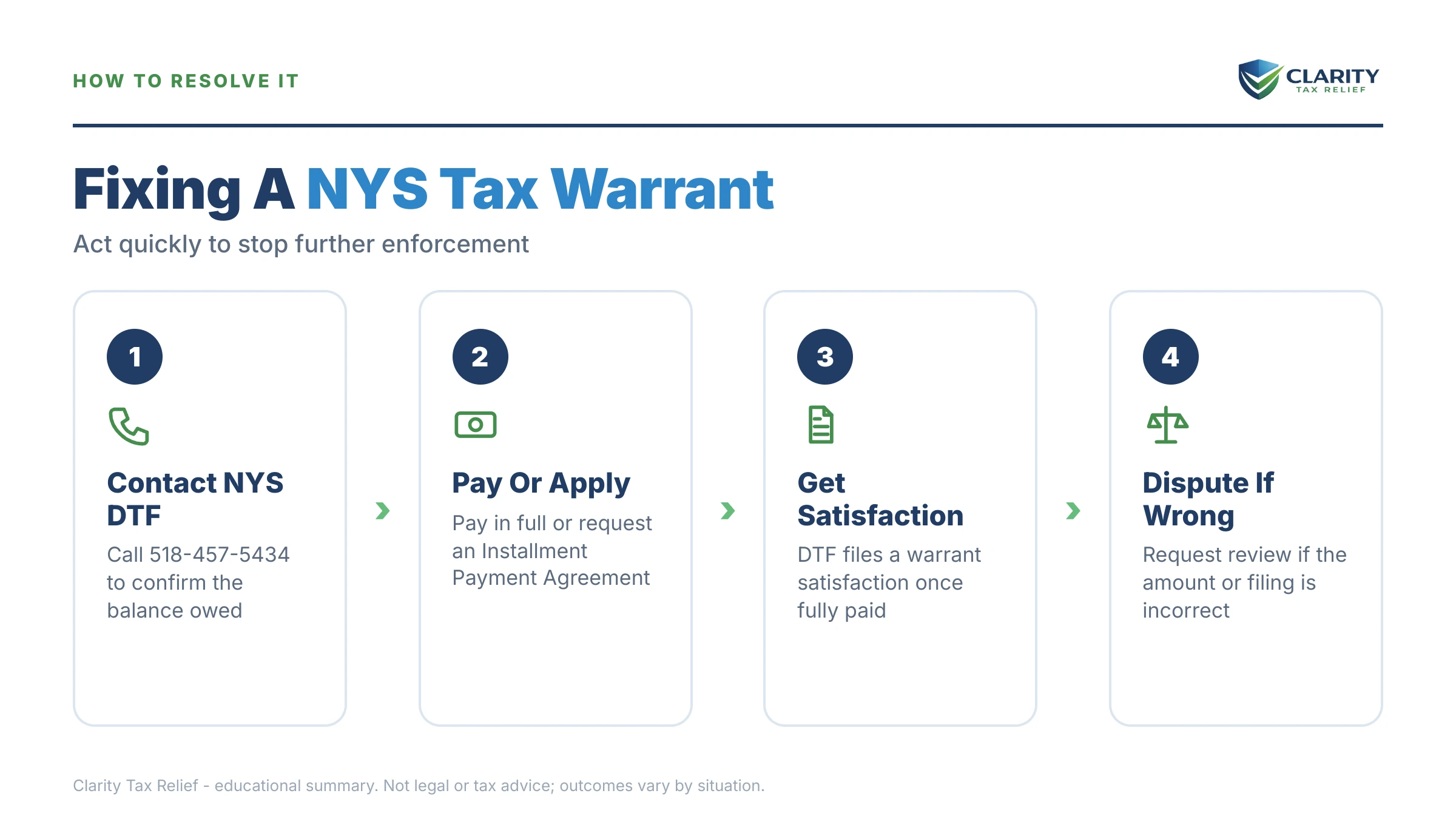
When you can handle a NYS tax warrant yourself
You can usually resolve a warrant on your own when the balance is modest, every return is filed. A straightforward monthly payment fits your budget. The Tax Department's online account handles simple installment agreements. The payoff-and-satisfaction steps above are doable solo. If the state's numbers match yours and you just need time, do not pay anyone to make that phone call for you. Experienced help changes the outcome in the harder scenarios: an income execution or bank levy already in motion, multiple unfiled years New York estimated for you, a joint-liability fight after a divorce, a warrant surfacing mid-closing on a property sale where the release or subordination has to be timed to the day, or an offer in compromise where the financial presentation decides everything.
Terms on your warrant, decoded
- Tax warrant: New York's civil judgment for unpaid tax, filed with the Department of State and the county clerk. A lien and collection tool, not a criminal charge.
- Docketing: the recording of the warrant with the county clerk, which makes the judgment official and the lien effective in that county.
- Income execution: New York's wage garnishment under a warrant, up to 10% of gross wages or 25% of disposable earnings, served on you first and then on your employer.
- Satisfaction of Judgment: the document the state files with the Department of State and the county clerk once the warranted balance is paid in full, marking the judgment resolved in the public record.
NYS tax warrant questions, answered
What is a tax warrant?
In New York, a tax warrant is the state's civil judgment for unpaid tax. The Tax Department files it with the Department of State and the county clerk, it becomes a public record. It creates a lien against your real and personal property. It lets the state garnish wages, levy bank accounts and, as a last resort, seize and sell property, without any further court proceeding.
What is a state tax warrant, and how is it different from an IRS lien?
A state tax warrant is a judgment plus a lien in one filing. An IRS lien secures the federal debt but the IRS must still send separate levy notices with appeal rights before it seizes anything, while New York's due process is complete when the warrant dockets. The IRS generally has 10 years to collect; a docketed New York warrant is enforceable for roughly 20.
Is a NYS tax warrant an arrest warrant?
No. A tax warrant is a civil money judgment, not a criminal charge, and no one is coming to arrest you. It gives the Tax Department the powers of a judgment creditor: garnishment, bank levy and a lien on property. Criminal tax cases are a separate and rare process involving willful fraud or evasion. They begin with an investigation rather than a warrant at the county clerk.
Can you go to jail for a tax warrant?
No. Owing tax you cannot pay is a civil matter in New York regardless of the amount. A tax warrant is enforced with income executions, levies and liens, not custody. Jail is a possibility only in criminal tax prosecutions for willful conduct such as fraud or evasion, which are charged separately and are not triggered by a warrant.
How do I find out if I have a NYS tax warrant?
Use the New York State Tax Warrants search tool on the Department of State's site, which lists open warrants by name, or check the county clerk's records where you live or own property. Your Tax Department online account shows your balance and collection status. If a lender or employer flagged it, ask them for the docket number so you can pull the exact filing.
How do I pay a tax warrant?
Request an Outstanding Judgment Balance Due letter from the Tax Department for the payoff amount projected to a date, then pay the full warranted balance online from a bank account, by card for a fee, or by check or money order payable to Commissioner of Taxation and Finance. Once the payment posts, the state files a Satisfaction of Judgment with the Department of State and the county clerk and sends you a copy.
How do I request a NYS tax warrant payoff amount?
Call the Tax Department with your taxpayer ID or collection case number and ask for a warrant payoff letter. The state provides an Outstanding Judgment Balance Due letter listing every outstanding warrant and the balance due projected to a specified date. If you need proof faster than the satisfaction can be filed, ask for a Notice of Pending Warrant Satisfaction, which most title companies accept once payment in certified funds has been received.
How long does a NYS tax warrant last?
A docketed New York tax warrant is generally enforceable for 20 years, the same as other New York money judgments and twice the IRS's 10-year collection statute. New York does not let a warranted balance age out on any practical timeline, so waiting is not a strategy. Payment in full, an installment payment agreement, an offer in compromise or hardship review is the realistic way out.
Does a payment plan make the tax warrant go away?
No. The Tax Department says that if you set up an installment payment agreement, the warrant will remain on file and continue to be a lien on your real and personal property until you pay the total warranted balance in full. What the agreement does is prevent additional collection action: no income execution, no bank levy, no seizure while you keep the terms. The satisfaction is filed after the last payment posts.
Will New York remove the tax warrant after I pay?
After you pay in full, the Tax Department sends a Satisfaction of Judgment to the Department of State and the county clerk, each files it. You receive a copy to keep. The public record then shows the judgment satisfied rather than erased; satisfied is the status lenders want to see. Allow time for the filings to post, and keep your proof of payment in the meantime.
Your next 24 hours
- Find the docket details. Pull the county, docket date, docket number and warrant amount from the copy the state mailed you, the New York Department of State's tax warrant search, or the county clerk's records.
- Gather three things: your most recent New York return, proof of your current income, and any income-execution or levy paperwork that has arrived, plus your divorce decree if a joint year is involved. Your online account at the New York State Department of Taxation and Finance fills in whatever is missing.
- Get the warrant reviewed free. There is no waiting period protecting you once a warrant is docketed, and interest compounds monthly either way, so have an experienced tax professional map your resolution options now, before the state picks one for you. Use the 2-minute form or call (888) 825-7779.
Primary sources: the New York State Department of Taxation and Finance pages on tax warrants and income executions, which carry the definitions, the payoff and satisfaction process. The wage-garnishment rules quoted above.
This guide is general information, not tax or legal advice for your specific situation. Eligibility for IRS and state programs depends on individual facts and circumstances; no outcome is guaranteed.