
State Back Taxes
Oregon Back Taxes: How the DOR Collects and How to Resolve It (2026)
The short answer: Oregon back taxes are collected by the Oregon Department of Revenue, which can record a distraint warrant and garnish wages without a court judgment. Your realistic options are a DOR payment plan, a settlement offer if you genuinely can't pay, a penalty waiver, and coordinating any IRS balance alongside.
You logged into Revenue Online, or finally opened the DOR envelope, and the balance is bigger than your withholding ever hinted at. Oregon's income tax carries the whole load in a state with no sales tax, and a W-2 paycheck that looked "handled" often wasn't. This is fixable, and the sequence is more mechanical than it feels.
Two documents drive everything on the Oregon side: the Notice of Deficiency and the Notice of Assessment. The image below shows you exactly what an Oregon DOR notice looks like and where to find the dates and letter type that control your rights. Those dates decide whether you can still dispute the balance or only arrange to pay it.
⏱ Your deadlines: the dates printed on your Oregon notice control. You typically have 30 days to object in writing to a Notice of Deficiency and typically 90 days to appeal a Notice of Assessment to the Oregon Tax Court's Magistrate Division. After that, there's no fixed "final" deadline — penalties and interest simply keep accruing, and a distraint warrant can be recorded at any point.
Why you owe Oregon back taxes
Oregon has no sales tax, so its income tax does the heavy lifting — rates reach 8.75% at relatively modest incomes and top out at 9.9%. For a W-2 employee, that structure means even a small withholding shortfall compounds fast: a second job, a bonus withheld at a flat rate, or a W-4 that never got updated after a raise can each leave a four-figure gap every single year.
The other common paths to an Oregon balance: the DOR adjusted your return (it cross-checks against IRS data, W-2s, and 1099s). You filed but couldn't pay. Or you didn't file at all and the DOR assessed tax for you using the income records it already has, with none of your deductions or credits. Oregon also stacks penalties in a way the IRS doesn't: a 5% failure-to-pay penalty, an additional 20% once a return is more than three months late, and a 100% penalty when you fail to file for three consecutive years. Interest runs on top at a rate the DOR sets annually.
One reassurance up front: an Oregon balance-due notice is a bill, not an audit and not an accusation. Nobody is questioning your honesty. The DOR's system simply shows a number, and it will keep escalating until the number is addressed.
What happens if you ignore Oregon back taxes
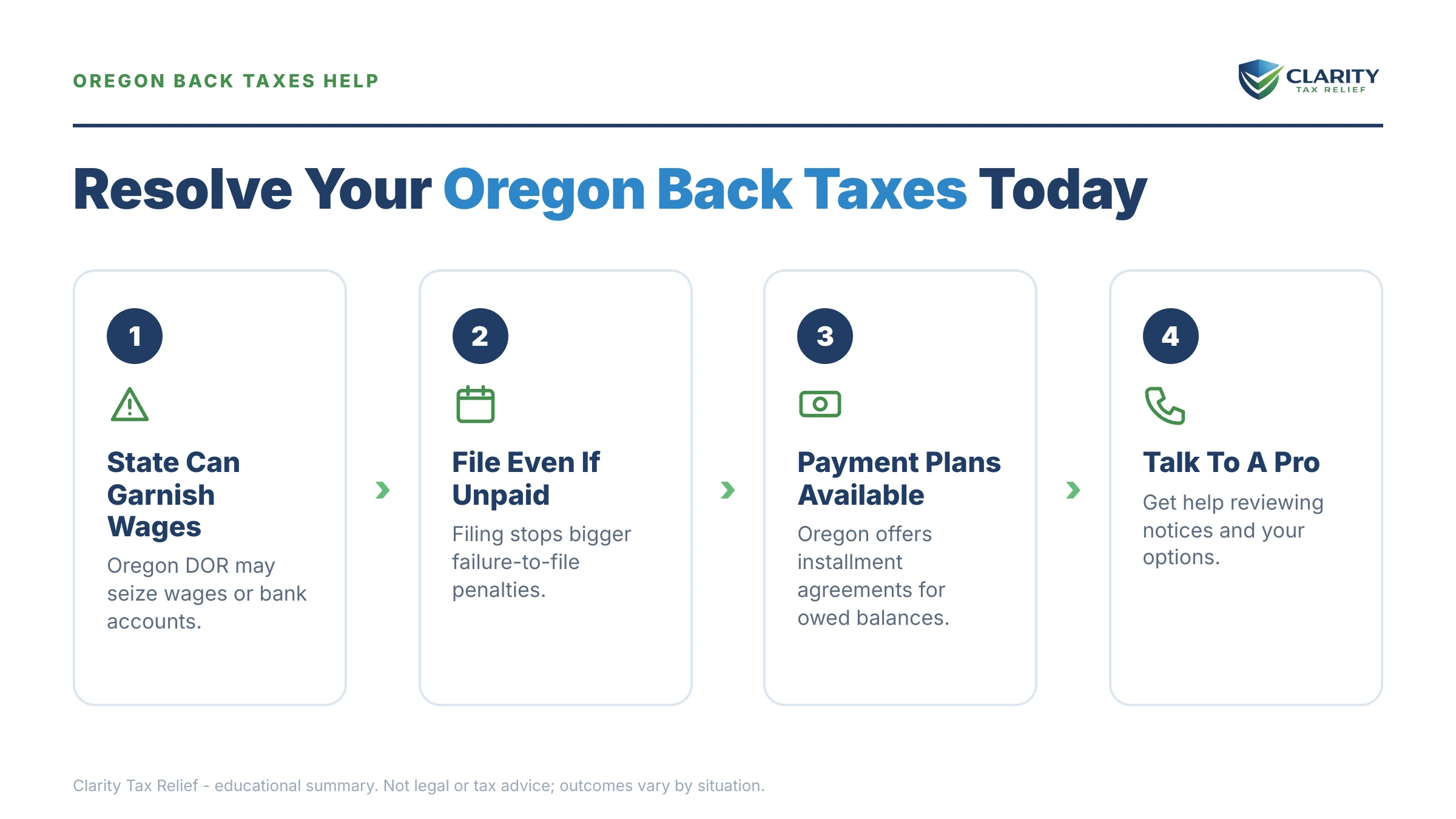
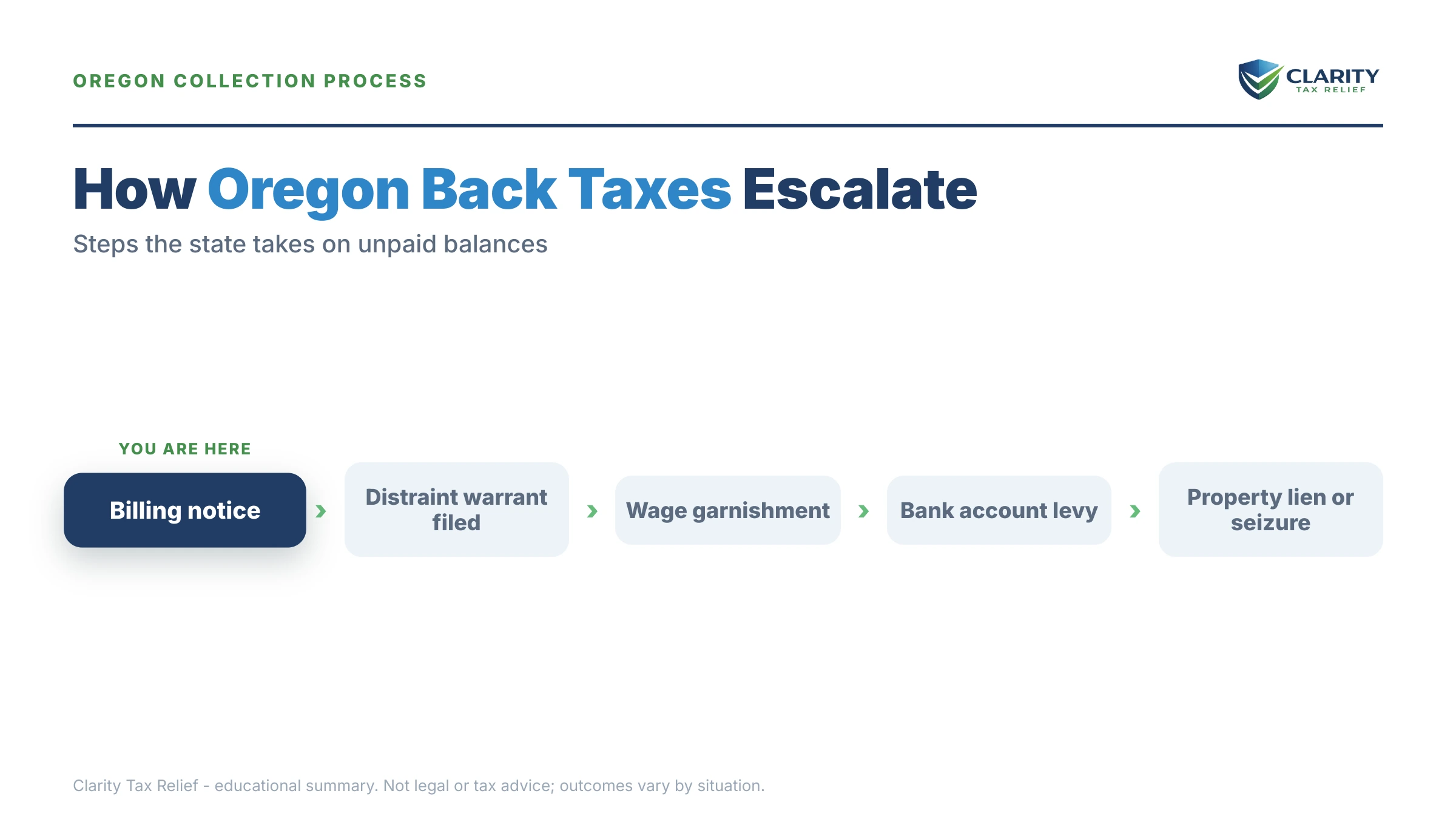
Ignored Oregon back taxes move from a letter to a recorded distraint warrant to a wage garnishment, with no courtroom in between. The sequence is automated and runs in this order:
- Billing notice or Notice of Deficiency. The DOR states or proposes the balance. If you disagree, this is your window to object in writing, typically 30 days from the notice date.
- Notice of Assessment. The debt becomes final. Your remaining dispute right is an appeal to the Oregon Tax Court's Magistrate Division, typically within 90 days.
- Demand letters and collection fees. The account moves to active collections, and the DOR can add collection fees to the balance. Long-delinquent accounts can be assigned to a private collection firm, which adds its own charges.
- Distraint warrant. The DOR records a warrant with the county clerk. It's a public record that functions like a civil judgment — it can attach as a lien to property you own and it authorizes enforced collection.
- Garnishment and offsets. With a warrant in place, the DOR can garnish wages — generally up to 25% of your disposable pay — reach bank accounts, and intercept your state refund, kicker credit included, every year until the debt is resolved.
Notice what's missing from that list: a lawsuit. Unlike an ordinary creditor, the DOR never needs to sue you. That's why "I'll deal with it when they take me to court" is the single most expensive plan an Oregon taxpayer can have.
Behind on Oregon taxes: maybe the IRS too?
Get both balances reviewed free before a distraint warrant or garnishment starts. An experienced tax professional will map your Oregon and federal options side by side — penalties and interest are accruing on both every month you wait.
Your options for resolving Oregon back taxes in 2026
Oregon offers four realistic resolution paths, and every one of them requires your returns to be filed first. The DOR will not discuss a plan, a settlement, or a penalty waiver on an account with missing returns — filing is the price of admission. It also stops the penalty escalator described above.
| Option | Who it fits | Cost & what to know |
|---|---|---|
| Pay in full (Revenue Online) | You can cover the balance now, even painfully | Stops penalty growth and the warrant/garnishment track immediately; interest runs through the payoff date |
| DOR payment plan | Steady income, can't pay all at once | Request through Revenue Online or by phone; interest continues at Oregon's annual rate; you must file and pay all future returns on time or the plan can default |
| Settlement offer (Oregon's version of an OIC) | Income and assets genuinely can't ever cover the debt | Full financial disclosure required; all returns must be filed; a hardship program with strict review, not a negotiation discount |
| Penalty waiver | Reasonable cause — serious illness, disaster, events outside your control | Requested in writing with documentation; interest is generally not waived even when penalties are |
| Hardship deferral | Paying anything would leave you unable to cover basic living costs | The DOR can temporarily suspend active collection while your situation is reviewed; the debt and interest remain — ask the DOR directly about your account |
What disqualifies you matters as much as what qualifies you. A settlement offer will be a non-starter if you have home equity, retirement savings, or income the DOR's math says could pay the debt over time. A payment plan defaults if you file next year's return late, even if you never miss a payment. And a penalty waiver needs a documented reason; "I forgot" and "money was tight" don't clear the bar.
If you also owe the IRS: the federal side of Oregon tax debt
Many Oregonians with a DOR balance owe the IRS for the same years — the same under-withholding shorts both returns at once. The two systems collect independently, and each can reach assets the other can't, so both need an arrangement. The full prioritization framework lives in our guide to state tax debt vs IRS. Here's how the two collectors compare on the points that matter:
| Feature | Oregon DOR | IRS |
|---|---|---|
| Where you check your balance | Revenue Online | IRS Online Account |
| Payment plans | Online or by phone; DOR sets terms; interest continues | Short-term up to 180 days ($0 setup); long-term up to 72 months online for balances of $50,000 or less |
| Settlement program | Settlement offer — strict, finances-based review | Offer in Compromise — $205 fee, roughly 1 in 5 accepted in FY2024 |
| Wage garnishment | Administrative, via distraint warrant — no court needed | Continuous levy, but only after LT11 and a 30-day window |
| Public record | Distraint warrant recorded with the county clerk | Notice of Federal Tax Lien |
| Collection deadline | No IRS-style 10-year expiration to count on | 10 years from assessment (CSED), pausable by appeals, an OIC, or bankruptcy |
Two federal mechanics hit Oregon taxpayers specifically. First, after a CP504 the IRS can seize your Oregon refund, kicker credit and all, through the state income tax levy program, with no further warning. Second, once your federal assessed debt passes $66,000 (the 2026 threshold), the IRS can certify it to the State Department and block your passport — see passport revoked tax debt. Your Oregon balance doesn't count toward that number; only the IRS side does.
The federal toolbox is broader than Oregon's: a streamlined installment agreement for balances of $50,000 or less, currently not collectible status for genuine hardship, and penalty relief through first time penalty abatement — which, starting summer 2026, is being supplemented by the Automatic Exemption from Penalty (AEP) that applies without any request. To see how fast the federal side grows while you decide, you can estimate it with our IRS penalty & interest calculator.
Worked example: say you owe $54,600 across Oregon and the IRS
Say you're a W-2 employee filing single, and two years of under-withholding left you owing $54,600 in total — $8,600 to the Oregon DOR and $46,000 to the IRS, penalties and interest included. This is a hypothetical, but the arithmetic is how both agencies actually think:
- Federal side: $46,000 is under the $50,000 online threshold, so a streamlined installment agreement over 72 months pencils to $46,000 ÷ 72 ≈ $639/month as a floor. Interest and the late-payment penalty keep accruing during the plan, so paying $700–$750 instead shortens the real payoff meaningfully.
- Oregon side: the DOR sets its own plan terms, but an $8,600 balance spread over roughly 36 months would run about $8,600 ÷ 36 ≈ $239/month, plus accruing interest.
- Combined: roughly $880–$990/month across both plans. If your budget genuinely can't support that, the answer isn't to skip one — it's to restructure: hardship review or CNC on the federal side while you clear the smaller, faster-to-garnish Oregon debt, or a settlement offer / OIC review if your assets and income are thin enough to qualify.
- Passport check: only the $46,000 federal portion counts toward the $66,000 certification threshold — you're under it, but one more assessed year could cross the line.
For a deeper federal playbook at this balance level, see I owe the IRS $50,000.
Oregon tax notice deadlines and the rights they protect
Every dispute right you have on an Oregon or IRS debt is attached to a specific notice and a specific window, and each right disappears when its window closes. The exact date printed on your notice always controls:
| Notice / event | Response window | Right at stake |
|---|---|---|
| Oregon Notice of Deficiency | Typically 30 days (printed date controls) | Written objection before the tax becomes a final assessment |
| Oregon Notice of Assessment | Typically 90 days | Appeal to the Oregon Tax Court, Magistrate Division |
| Distraint warrant recorded | None — the debt is already final | No dispute right remains; garnishment and liens can proceed until you arrange resolution |
| IRS CP504 | Pay-by date printed on the notice | Your Oregon refund (kicker included) becomes leviable via SITLP |
| IRS LT11 / Letter 1058 | 30 days | Collection Due Process hearing (Form 12153) before wage or bank levy |
How to respond to Oregon back taxes, step by step
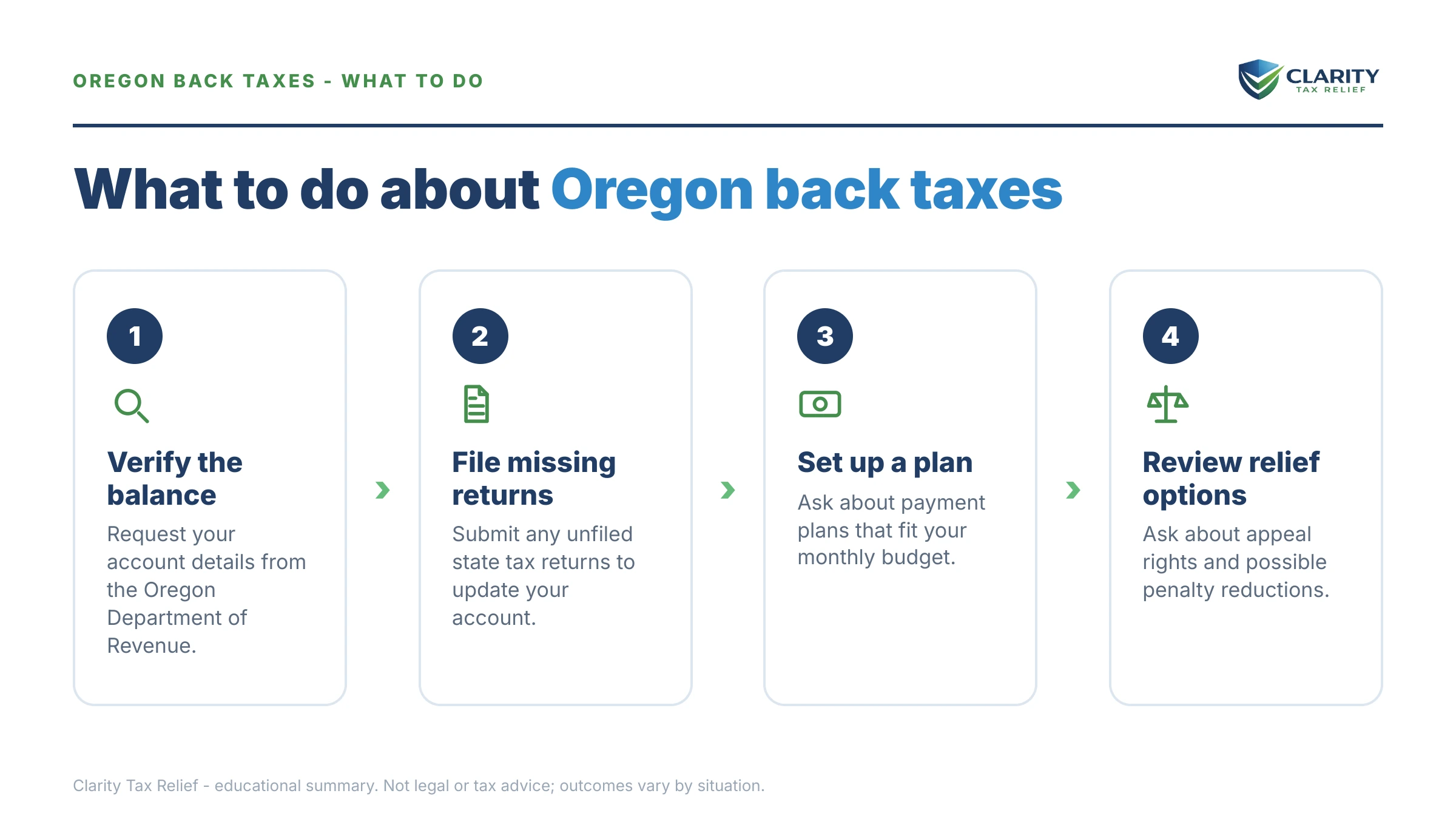
- Pull both balances. Log into Revenue Online for your Oregon balance and your IRS Online Account for any federal balance, so you're working from real numbers instead of fear.
- File every missing return. Oregon's penalties grow with each unfiled year and reach 100% at three consecutive years, and filing is required before any plan or settlement offer will be considered.
- Check your notice dates. If you dispute the amount, the objection and appeal windows printed on your Notice of Deficiency or Notice of Assessment control your rights — calendar them today.
- Set up arrangements on both debts. Size an Oregon DOR payment plan and any IRS plan together, so the combined monthly total is one you can sustain without defaulting on either.
- Request penalty relief. Ask Oregon for a penalty waiver if you have reasonable cause, and check IRS first-time abatement or the new automatic penalty exemption on the federal side.
Situations that change your Oregon tax debt options
Multiple unfiled years. Oregon's 100% penalty for three consecutive unfiled years means the clock on filing matters more here than in most states. If you're two years behind, filing this year's return on time isn't housekeeping — it's stopping a penalty that doubles the tax. Our guide for people who haven't filed taxes in 3 years covers the catch-up sequence on the federal side.
Self-employed or side income. If any of your income is 1099, Oregon expects quarterly estimated payments, and Portland-area self-employed workers may also owe the TriMet self-employment tax, filed with the DOR. A resolution that fixes old years but leaves this year's estimates unpaid just rebuilds the debt.
Portland metro local taxes. The Portland Arts Tax, the Metro Supportive Housing Services tax. The Multnomah County Preschool for All tax are administered by the City of Portland's Revenue Division, not the DOR. Resolving your DOR balance does nothing for these; they need their own check and, if delinquent, their own arrangement.
Married and filed jointly. Both spouses are on the hook for the full joint balance, and Oregon can garnish either spouse's wages. If the debt traces to one spouse's income or a return you didn't understand, ask about relief options before assuming you owe half.
You've moved out of Oregon. Leaving doesn't leave the debt behind. A recorded distraint warrant follows you as a judgment-like public record, and the DOR can still intercept refunds and pursue collection across state lines. Part-year residents also frequently owe Oregon for the months they lived or worked there.
Genuine hardship. If a garnishment or plan payment would leave you unable to cover rent, food, or medical care, say so — in writing, with numbers. The DOR can defer collection, and the IRS has a formal hardship status. Neither agency volunteers this; you have to ask and document.
When you can handle Oregon back taxes yourself, and when to get help
You can almost certainly handle this alone if: it's one tax year, you agree with the number, every return is filed. The balance fits a payment you can sustain — set the plan up through Revenue Online and be done. A single Oregon balance under a few thousand dollars rarely justifies professional fees.
Experienced help changes outcomes in specific situations: a distraint warrant is already recorded or a garnishment has started. You have three or more unfiled years and the 100% penalty is in play. You owe both Oregon and the IRS five figures and the plans have to be engineered together. You're weighing a settlement offer or OIC, where the financial disclosure math decides everything. Or you dispute the assessment and the Magistrate Division clock is running. In those cases, the sequencing — which returns to file first, which agency to stabilize first, which relief to request in what order — changes what you ultimately pay.
If your situation is on that second list, a free review of your Oregon and IRS notices with an experienced tax professional costs nothing and settles the "can I DIY this" question in one call — (888) 825-7779 or the 2-minute form.
Terms on your Oregon notice, decoded
- Distraint warrant — the recorded document that makes an Oregon tax debt work like a civil judgment; it's public and it authorizes garnishment. Not a criminal warrant.
- Notice of Deficiency — the DOR's proposed balance; your window to object in writing before it becomes final.
- Notice of Assessment — the balance made final; starts your window to appeal to the Oregon Tax Court's Magistrate Division.
- Revenue Online — the DOR's self-service portal, where you can see your balance, file, pay, and request a payment plan.
- Kicker offset — your Oregon kicker is claimed as a credit on your return, so any refund it creates goes to your unpaid balance first.
- CSED — the IRS's 10-year collection expiration date; it applies only to federal debt, not Oregon's. Details in how long can the IRS collect back taxes.
Primary sources if you want them: the Oregon Department of Revenue for state balances, plans, and Revenue Online access. The IRS's payment plans and installment agreements page for federal arrangements. And the Taxpayer Advocate Service if an IRS-side hardship isn't getting traction.
Oregon back taxes questions, answered
How long can Oregon collect back taxes?
Longer than you'd hope — Oregon's collection rules don't mirror the IRS's 10-year statute, and once the DOR records a distraint warrant the debt functions like a court judgment that can be renewed. Never build a strategy around waiting out an Oregon tax debt. If the age of an assessment matters to your case, have an experienced tax professional confirm the specific dates on your account before you make decisions.
Does Oregon have an offer in compromise program?
Yes — Oregon calls it a settlement offer. The DOR accepts one only when your finances show you could never realistically pay the full balance. You must have every required return filed before the DOR will consider it, and the review digs into your income, assets, and expenses. It is a hardship program, not a negotiation discount, so treat any pitch promising a certain result as a red flag.
Can the Oregon Department of Revenue garnish my wages without a court order?
Yes. Once your debt is final and a distraint warrant is recorded, the DOR can send a garnishment straight to your employer — no separate lawsuit needed. Oregon garnishments generally reach up to 25% of your disposable (after-tax) wages and continue until the debt is resolved or you set up an arrangement. A payment plan in good standing is the usual way to stop one.
Will Oregon take my kicker refund if I owe back taxes?
Yes. The kicker is claimed as a credit on your Oregon return, so it flows into your refund. The DOR applies any refund to your unpaid balance before sending you a dime. If you also owe the IRS, the federal government can intercept your Oregon refund too, through the State Income Tax Levy Program. Owing both means your kicker is effectively spoken for until the debts are handled.
Can the IRS take my Oregon state tax refund?
Yes. After a CP504 notice, the IRS can levy your Oregon refund through the State Income Tax Levy Program without any further warning. That's often the first actual seizure a taxpayer with both debts experiences, because it requires no final notice or hearing. If you've received a CP504, treat the federal debt as active — the next letter, LT11, opens the door to wage and bank levies.
What is a distraint warrant in Oregon?
A distraint warrant is the document the DOR records with a county clerk when a tax debt goes unpaid. It works like a civil judgment. It's a public record, it can attach as a lien to property you own in that county. It authorizes garnishment of wages and bank accounts. It is not a criminal warrant, and no one is coming to arrest you, but it is the signal that enforced collection has begun.
What happens if I haven't filed Oregon returns for three years?
Oregon's penalty structure escalates hard: a 5% failure-to-pay penalty, an additional 20% once a return is more than three months late, and a 100% penalty when you fail to file for three consecutive years — meaning the penalty alone can equal the tax. The DOR can also assess tax for you using W-2s, 1099s, and IRS data, with none of your deductions. Filing those returns yourself, even late, is almost always cheaper.
Should I pay Oregon or the IRS first if I owe both?
Address whichever agency is closest to garnishing you first, then get arrangements running with both — neither will wait politely while you pay the other. Oregon often moves to garnishment faster because a distraint warrant needs no court hearing, while the IRS must issue an LT11 and wait 30 days. The full decision framework is in our guide to state tax debt vs IRS priorities.
Can I set up an Oregon payment plan online?
Yes — Revenue Online, the DOR's self-service portal, lets you request a payment plan without calling anyone. You'll need every required return filed first, and interest continues at Oregon's annual rate while you pay. Miss a payment or fail to file a future return on time and the plan can default, which puts garnishment back on the table, so build in a cushion you can actually sustain.
Your next 24 hours
- Identify your notice and its dates. Find the letter type (Notice of Deficiency, Notice of Assessment, or a collection demand) and the response date printed on it. That one line tells you which rights are still open.
- Gather your numbers. Last two years of federal and Oregon returns, every DOR and IRS letter you've received, and a recent pay stub. Log into Revenue Online and your IRS Online Account so you know both true balances.
- Get a free case review. Send us what you found — the 2-minute form or (888) 825-7779. An experienced tax professional will map your Oregon and federal options together, before interest adds another month's cost and before a warrant or garnishment narrows them.
This guide is general information, not tax or legal advice for your specific situation. Eligibility for IRS programs depends on individual facts and circumstances; no outcome is guaranteed.