State Tax Debt
South Carolina Back Taxes: How SCDOR Collects and Every Way to Resolve It (2026)
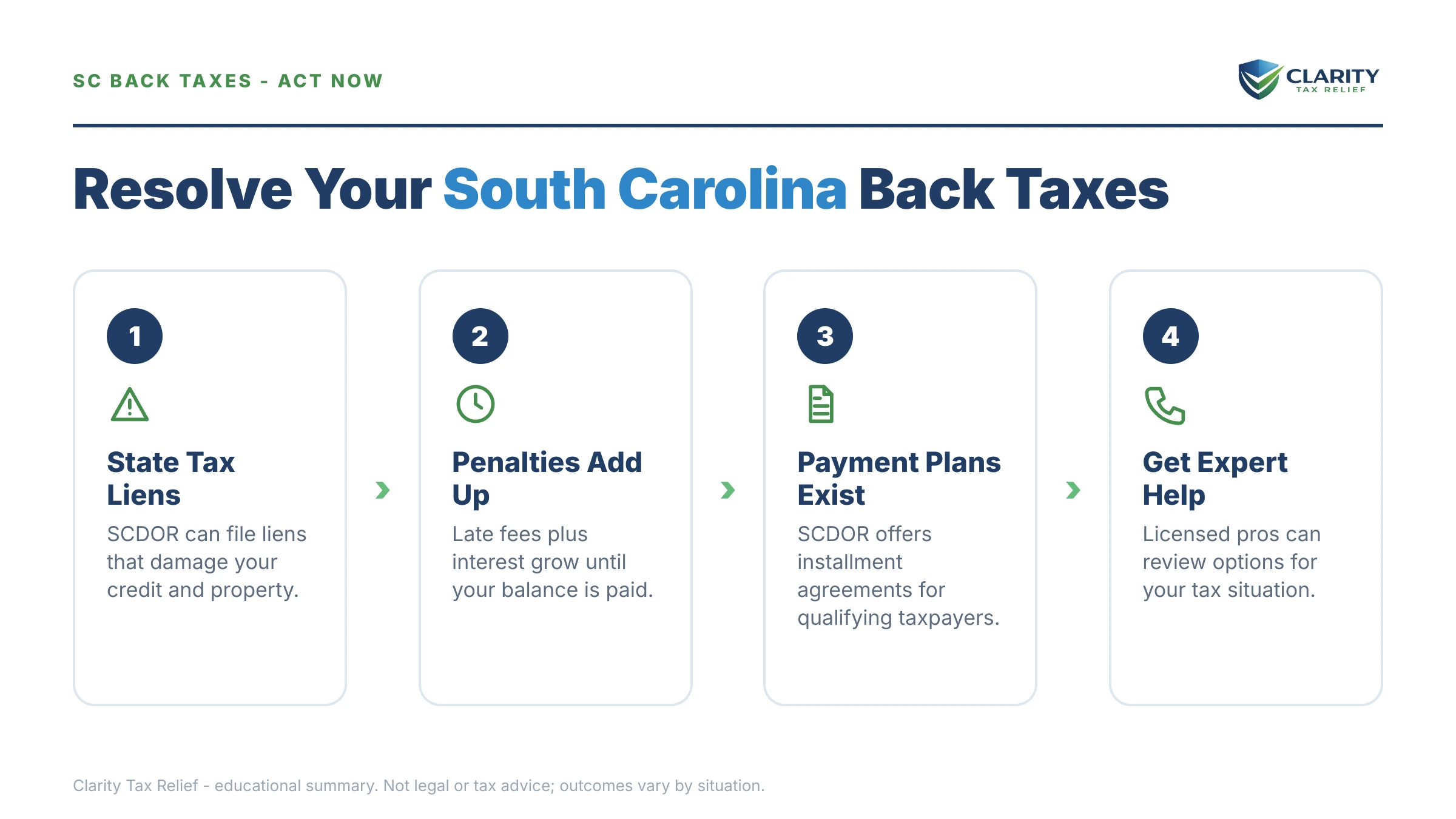
The short answer: South Carolina back taxes are collected by the South Carolina Department of Revenue (SCDOR), which can garnish your wages without a court order, levy bank accounts, seize refunds, and post a public lien to the statewide Tax Lien Registry. A payment plan through MyDORWAY stops enforcement — set it up before the deadline printed on your notice.
The letter is from the South Carolina Department of Revenue, the balance covers a year you thought was handled, maybe a year your ex-spouse swore was paid, and the number at the bottom is bigger than anything this month's budget can absorb. Take a breath: an SCDOR debt is one of the more fixable tax problems, precisely because the state's playbook is predictable.
This guide walks that playbook end to end: why the balance exists, the exact enforcement sequence SCDOR follows, every resolution option with its trade-offs, and a worked example of what a $19,700 balance actually costs to resolve. If you're not sure which SCDOR letter you're holding, the image below shows what these notices look like and where the balance, tax years, and your response deadline sit.
⏱ The clock that matters: the protest or payment deadline printed on your SCDOR notice. Once a proposed assessment becomes final, SCDOR can move to liens and wage garnishment without ever going to court, and penalties and interest keep accruing on the balance every month until it's resolved.
Why you owe South Carolina back taxes
Most South Carolina back-tax balances trace to one of five causes, and knowing yours changes the fix. The notice itself lists the tax type, the tax years, and how the total splits between tax, penalty, and interest.
- Under-withholding after a life change. A divorce is the classic version: your filing status flipped from joint to single or head of household mid-stream, your W-4 never caught up, and both your federal and South Carolina withholding came up short for the year.
- Self-employment or 1099 income with no state estimates. Contractors and side-hustlers who miss federal quarterlies almost always miss South Carolina's too — the state bill just arrives later and quieter.
- A federal change that South Carolina mirrored. SCDOR receives IRS data. If the IRS adjusted your return — a CP2000 notice, an audit change — expect a matching state assessment for the same year, sometimes long after you resolved the federal side.
- Unfiled state returns. When you don't file, SCDOR can assess an estimated liability built from federal data and employer reports. These estimates skip your deductions and credits, so they typically overstate what a real return would show.
- Business trust taxes. Employer withholding and sales tax you collected but didn't remit are the debts SCDOR pursues hardest — including against the business's licenses and, in some cases, the people behind it.
If the joint years on your notice come from a marriage that's over, know this now: your divorce decree does not bind SCDOR. On a jointly filed return, the state can collect the full balance from either spouse, whatever the family court ordered. We cover the federal version of that trap in divorce decree IRS debt — the state logic is the same.
“A lien is not a levy. A lien secures the government’s interest in your property when you don’t pay your tax debt. A levy actually takes the property to pay the tax debt.”
— Understanding a federal tax lien (IRS.gov)
What happens if you ignore SCDOR: the escalation sequence
SCDOR can garnish your wages administratively, no court judgment required, which makes South Carolina's tax collection faster than almost any private debt collection in the state. South Carolina generally bars private creditors from garnishing wages for consumer debts. The Department of Revenue is the exception. It doesn't need a judge's signature. Here's the order things happen when a notice goes unanswered:
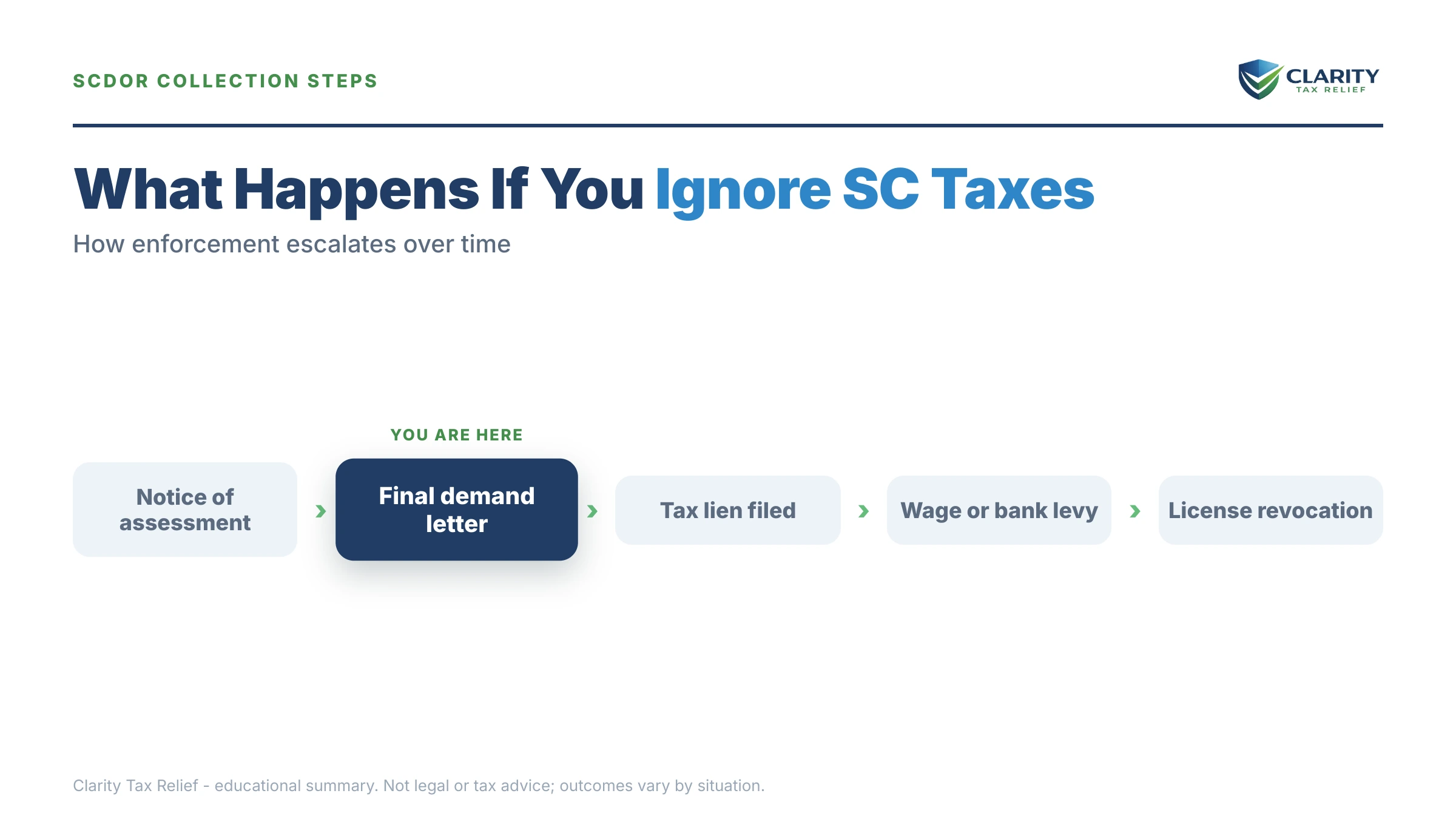
- Proposed assessment. SCDOR states what it intends to charge you. This is the stage with the most leverage: you have a written-protest right until the deadline printed on the notice. Respond here and you're negotiating; miss it and the number hardens.
- Final assessment and demand for payment. The balance is now legally fixed and collectible. Billing notices follow, each one with more interest attached.
- State tax lien posted to the Tax Lien Registry. Since 2019, South Carolina posts liens to a single statewide, public, searchable online registry instead of filing county by county. Anyone who searches your name — a mortgage lender, a buyer, a title company — finds it in seconds.
- Active enforcement. A wage levy goes straight to your employer, a bank levy to your bank. Your state refunds are applied to the debt. Businesses can see retail and other licenses put at risk over unpaid trust taxes.
- Long-tail collection. SCDOR also runs GEAR, a collection program with the same tool set, so a balance that goes quiet has not gone away. It waits for your next refund, your next employer, your next home sale.
Notice what's missing from that sequence: a lawsuit. Because every step is administrative, there is no courtroom moment where you get to tell your side — the protest window on the proposed assessment is your hearing. That's why the deadlines table below matters more than any other part of this page.
| Stage | Your window | What you lose if it passes |
|---|---|---|
| Proposed assessment | Protest deadline printed on the notice | Your right to dispute the amount before it becomes final |
| Final assessment / bill | Pay-by date on the notice | The chance to arrange payment before liens and garnishment |
| Lien posted to the State Tax Lien Registry | Immediate and public once posted | A clean public record — lenders and buyers will find it |
| Wage garnishment issued | Before your employer processes the first affected paycheck | A slice of every paycheck until the levy is released |
| Refund setoff | Ongoing, every filing season | Every state refund, applied to the balance until it's paid |
Holding an SCDOR notice right now?
SCDOR can move from a bill to a wage garnishment faster than most people expect, and once the protest deadline printed on your notice passes, the amount becomes final. Get your notice reviewed free by an experienced tax professional before that date: call (888) 825-7779 or use the 2-minute form.
Your options for resolving SC back taxes
Every South Carolina back-tax debt resolves through one of six doors. The right one depends on whether the balance is correct and what your budget can carry. The state's versions of these programs are narrower than the IRS's, so match yourself honestly:
| Option | Typically fits | What it requires | The trade-off |
|---|---|---|---|
| Pay in full via MyDORWAY | A correct balance you can cover within a month or two | Log in and pay, or use the voucher on your notice | None. This ends penalties, interest, and enforcement fastest |
| SCDOR payment plan | A correct balance you can't pay at once | All required returns filed; terms depend on your balance; every payment made on time | Interest and penalties keep accruing until the last payment |
| Penalty waiver request | Late filing or payment caused by events beyond your control — serious illness, disaster, a divorce that hid the mail | A written request with documentation | Interest on the tax itself generally stays |
| Written protest | A balance you dispute — an SCDOR estimate, or a mirrored federal change you already corrected | Filed by the deadline printed on your proposed assessment | Miss the window and the amount becomes final anyway |
| Settlement offer | Debt that genuinely exceeds anything SCDOR could ever collect from you | Full financial disclosure; SCDOR agrees only case by case | Rarely granted — most applicants fit a payment plan instead |
| Documented hardship | Any payment would leave you unable to cover basic living costs | Proof of income and necessary expenses, updated when SCDOR asks | The debt remains, interest grows, and enforcement can resume when finances improve |
Two honest notes on that table. First, South Carolina publishes fewer bright-line thresholds than the IRS — plan length and settlement eligibility are decided on your numbers, so confirm current terms with SCDOR through MyDORWAY before assuming anything. Second, no state program erases a debt because a company on the radio said it could. Anyone quoting you a settlement percentage before seeing your finances is guessing at best.
Say you owe SCDOR $19,700 after a divorce: a worked example
Say your divorce finalized last year and two balances surfaced: $11,200 on a jointly filed return your ex-spouse was "handling," plus $8,500 from your first single-filer year, when your W-4 still reflected married withholding. Total: $19,700 to SCDOR. This is a hypothetical, but the math is how the decision actually gets made.
- Straight payment plan. If SCDOR approves a 36-month agreement, that's roughly $19,700 ÷ 36 ≈ $547/month before the interest and penalties that keep accruing on the shrinking balance. Stretch the same debt to 48 months and it's about $410/month — lower payment, more total interest.
- Down payment first. Put $5,000 from the house-sale proceeds toward the balance and a 36-month plan on the remaining $14,700 runs about $408/month, and every dollar paid early is a dollar that stops generating interest.
- Attack the joint year. The $11,200 joint-year balance is collectible from either ex-spouse in full. But if your ex concealed the income or the non-payment, relief on joint liabilities may exist: the federal framework is covered in our guide to innocent spouse relief and how to qualify. A federal grant of relief is powerful evidence to bring to SCDOR for the matching state year. If relief succeeded on the joint year, your own exposure drops to the $8,500 you genuinely under-withheld — about $236/month over 36 months.
- Trim the penalties. If the late payment traces to documented turmoil — you never saw the notices because your ex controlled the mail during separation, for example — a written penalty waiver request can shave the penalty portion off the total before you set the plan amount.
The order matters: dispute or reduce what you can first (protest, joint-year relief, penalty waiver), then put a payment plan on whatever survives. Setting up a plan on an inflated balance locks in payments on money you might never have owed.
How to respond to South Carolina back taxes, step by step
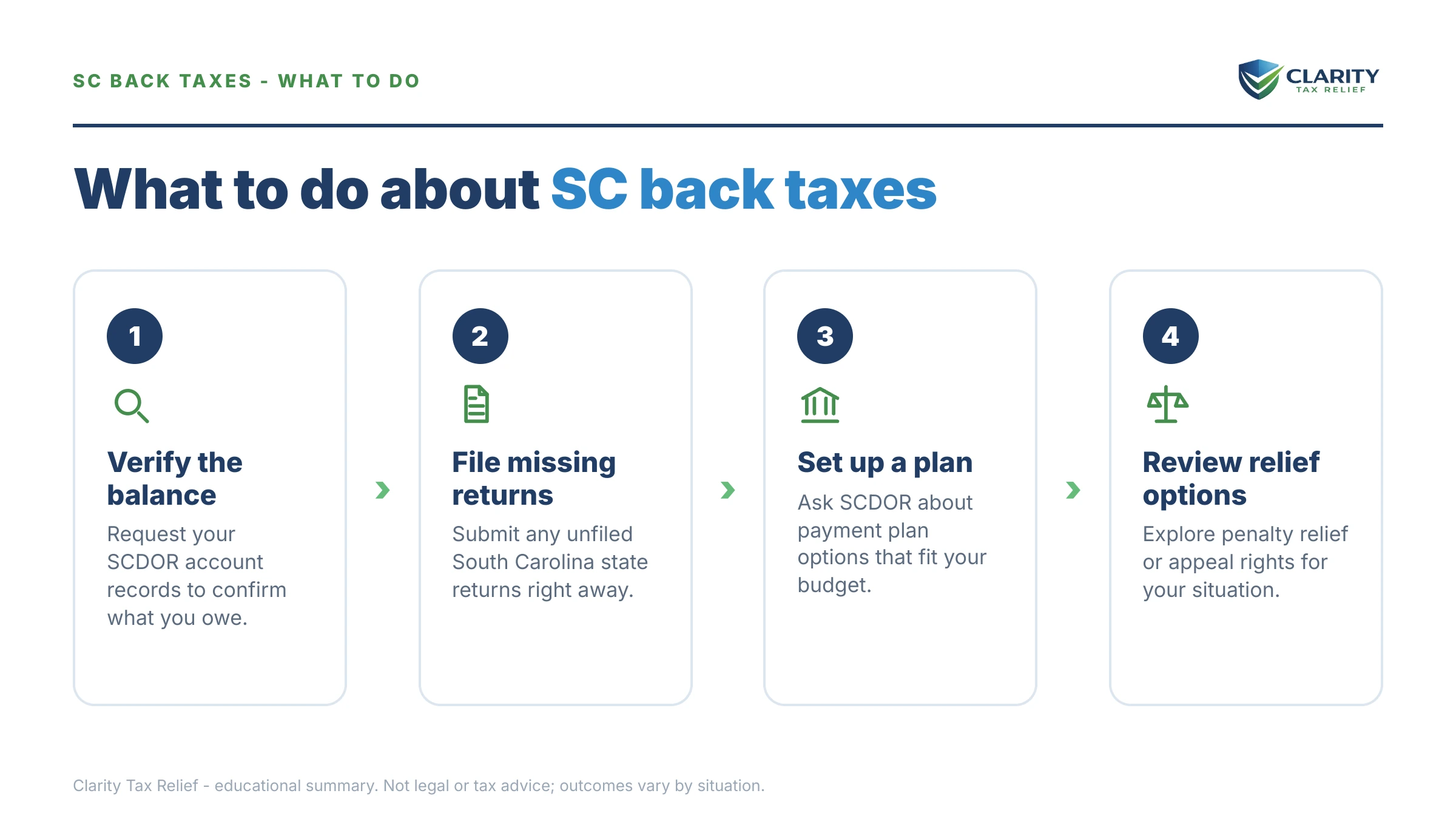
- Confirm the real balance. Log in to MyDORWAY or call SCDOR and pull every tax year with a balance — one letter rarely tells the whole story.
- File any missing returns. SCDOR's estimated assessments almost always overstate what a real return shows, and no payment agreement gets approved while returns are missing.
- Check the deadline on your notice. If you dispute the amount, file a written protest before the date printed on your proposed assessment, after that, the number becomes final.
- Pick your resolution. Pay in full, request a payment plan through MyDORWAY, ask for penalty relief in writing, or document hardship if any payment would break your budget.
- Coordinate the federal side. If you also owe the IRS, size both payment plans against one budget before committing to either — two agencies, one paycheck.
- Get a professional review if enforcement has started. A garnishment in motion, multiple unfiled years, or a disputed joint year from a divorce are the situations where experienced help changes the outcome.
Owe both SCDOR and the IRS? Read this before you pay either
Most South Carolina back-tax cases come with a federal twin, because the same missed withholding or unfiled year hits both returns. The two systems look similar and behave differently, and the differences decide your strategy:
| What matters | SCDOR (South Carolina) | IRS (federal) |
|---|---|---|
| Online account | MyDORWAY | IRS Online Account |
| Wage garnishment | Administrative — sent straight to your employer, no court order | Only after a final notice (LT11) plus a 30-day window with appeal rights |
| Tax liens | Posted to the statewide online State Tax Lien Registry | Notice of Federal Tax Lien recorded in county records |
| Payment plans | Through MyDORWAY; terms depend on balance and compliance | Up to 72 months online for balances of $50,000 or less |
| Settling for less | Limited, case-by-case settlement offers | Offer in Compromise — roughly 1 in 5 accepted in FY2024 |
| Collection window | State-specific — confirm your dates with SCDOR | 10 years from assessment (CSED), pausable by appeals, offers, or bankruptcy |
Three coordination rules. First, whoever is actively levying gets paid attention first — an SCDOR garnishment notice at your employer outranks an IRS letter in your mailbox, and vice versa. The full decision framework is in our hub on state tax debt vs IRS — which to resolve first.
Second, the agencies take from each other. The IRS can seize your South Carolina refund through the State Income Tax Levy Program, and refunds get crossed in both directions — see state refund taken for IRS debt. Counting on a refund to fund either payment plan is a mistake.
Third, the clocks are different. Your federal balance expires 10 years after assessment unless the clock is paused — you can estimate your own federal expiration date with our CSED Calculator — but South Carolina runs on its own statutes, so never build a wait-it-out strategy on the federal rule. On the federal side, set the plan up yourself in minutes using our walkthrough on how to set up an IRS payment plan online, and check whether first-time penalty abatement, or the new Automatic Exemption from Penalty rolling out in summer 2026 — trims the federal penalties before you finalize the number.
When you can handle South Carolina back taxes yourself
Handling it yourself versus getting professional help
Plenty of SCDOR cases need no professional at all, and knowing which kind you have saves you money either way. Handle it yourself when:
- The balance is correct, it covers one tax year. You can pay it in full or through a MyDORWAY payment plan your budget genuinely supports;
- It's your first notice, no lien has been posted, and no garnishment has been issued;
- You only need a penalty waiver and you have clean documentation of what went wrong.
Experienced help changes outcomes in a different set of situations: a wage or bank levy already in motion, multiple unfiled years with both SCDOR and the IRS, a disputed joint-year balance after divorce, business withholding or sales-tax debt where licenses and personal exposure are on the line, or a protest deadline days away on a proposed assessment you believe is wrong. In those cases the sequencing — what to protest, what to reduce, what to put on a plan, and in which order — is where the dollars are won or lost. If any of those describe your letter, have an experienced tax professional review your SCDOR notice free before you commit to a number.
Terms on your SCDOR notice, decoded
- Proposed assessment — SCDOR's statement of what it intends to charge you. The stage where you can still protest in writing before the amount becomes final.
- Final assessment — the balance is now legally fixed and collectible, and enforcement tools unlock.
- State Tax Lien Registry — South Carolina's statewide, public, searchable online database of state tax liens, which replaced county-by-county filing.
- Setoff — your refund applied to a debt instead of paid to you; South Carolina's Setoff Debt program also intercepts refunds for other agencies' debts.
- GEAR — Governmental Enterprise Accounts Receivable, SCDOR's collection program that pursues delinquent debts, including for other South Carolina government entities, with tax-style tools.
- MyDORWAY — SCDOR's online portal for checking balances, making payments, and requesting payment plan agreements.
South Carolina back taxes: FAQs
How long can South Carolina collect back taxes?
South Carolina sets its own collection and lien windows — do not assume the IRS's 10-year rule applies to an SCDOR debt. State tax liens sit on the public State Tax Lien Registry, and SCDOR can keep offsetting refunds and garnishing wages while a debt is enforceable. If the age of your debt matters to your strategy, confirm the specific dates for your assessment with SCDOR directly. Any federal balance runs on its own 10-year clock.
Can SCDOR garnish my wages without a court order?
Yes. Unlike most private creditors in South Carolina — who generally cannot garnish wages for consumer debts at all — SCDOR can send a wage levy directly to your employer administratively, with no court judgment. Your employer must comply once it receives the notice. The fastest ways to stop it are paying the balance, entering a payment plan SCDOR accepts, or documenting hardship — contact SCDOR before the first paycheck is taken, not after.
Does South Carolina offer payment plans for back taxes?
Yes. SCDOR sets up payment plan agreements, most easily through its MyDORWAY portal, with terms that depend on how much you owe and your compliance history. You will need to be current on filing all required returns, and penalties and interest continue to accrue while you pay. Missing a payment or falling behind on a new tax year can default the agreement and restart enforcement.
Can I settle South Carolina back taxes for less than I owe?
Sometimes, but far less routinely than the IRS's Offer in Compromise. SCDOR considers reduced settlements only in limited circumstances — typically genuine doubt about collectibility or liability — and evaluates your full finances before agreeing to anything. Be skeptical of anyone promising a specific settlement outcome on a state debt. For most South Carolina taxpayers, a payment plan or penalty relief is the realistic path.
Will SCDOR take my tax refund?
Yes — expect it. SCDOR applies your South Carolina refund to your unpaid balance, and through the Setoff Debt program state refunds are also intercepted for debts owed to other agencies. If you owe the IRS too, the IRS can seize your state refund through the State Income Tax Levy Program. Adjust your withholding so you stop over-refunding money that will only be intercepted.
My divorce decree says my ex pays the taxes — am I still liable?
If the return was filed jointly, yes. A divorce decree binds you and your ex-spouse — it does not bind SCDOR or the IRS, and either agency can collect a joint liability entirely from either name on the return. Your remedies are enforcing the decree against your ex in family court and pursuing innocent-spouse-type relief with the tax agencies where the facts support it.
What is the South Carolina State Tax Lien Registry?
It is SCDOR's statewide, public, searchable online database of state tax liens, which replaced county-by-county lien filing in 2019. Once your lien is posted, anyone — lenders, buyers, title companies — can find it by searching your name. A posted lien attaches to your property and can complicate selling or refinancing a home until the debt is resolved and the lien is satisfied.
If I owe both the IRS and South Carolina, who do I pay first?
Prioritize whichever agency has active enforcement against you — a garnishment or levy in motion outranks a letter. All else equal, SCDOR often moves from bill to wage garnishment faster than the IRS's multi-notice sequence, while the federal balance usually grows larger and carries tools like passport certification once it passes $66,000. Most people resolve both through parallel payment plans sized to what their budget actually supports.
What if I haven't filed South Carolina returns for several years?
File the missing returns before negotiating anything. SCDOR can assess tax based on estimates and federal data when you don't file. Those assessments typically overstate what you would owe on a real return — filing often shrinks the balance before you pay a dime. You also need to be filing-compliant before SCDOR will approve a payment agreement. If your federal returns are behind too, catch both up together.
Your next 24 hours
- Find three things on your SCDOR letter: the notice date, the response or pay-by deadline, and the tax years covered. Those three facts determine whether you're protesting, arranging payment, or both.
- Gather your file: the notice itself, your last state and federal returns for the years listed, proof of income, and, if any year was filed jointly, your divorce decree and anything showing who was responsible for the payment.
- Get the free case review: call (888) 825-7779 or use the 2-minute form. An experienced tax professional will map your SCDOR balance, and any federal twin — against your protest deadline and budget before interest adds another month to the total.
Primary sources: manage balances, payments, and payment plan requests with the South Carolina Department of Revenue (MyDORWAY is linked from its homepage). For any federal balance, current plan terms live on the IRS payment plans page, and free help with a federal hardship is available from the Taxpayer Advocate Service.
This guide is general information, not tax or legal advice for your specific situation. Eligibility for IRS programs depends on individual facts and circumstances; no outcome is guaranteed.