
State Tax Debt
Wisconsin Back Taxes: How the DOR Collects, and How to Resolve It (2026)
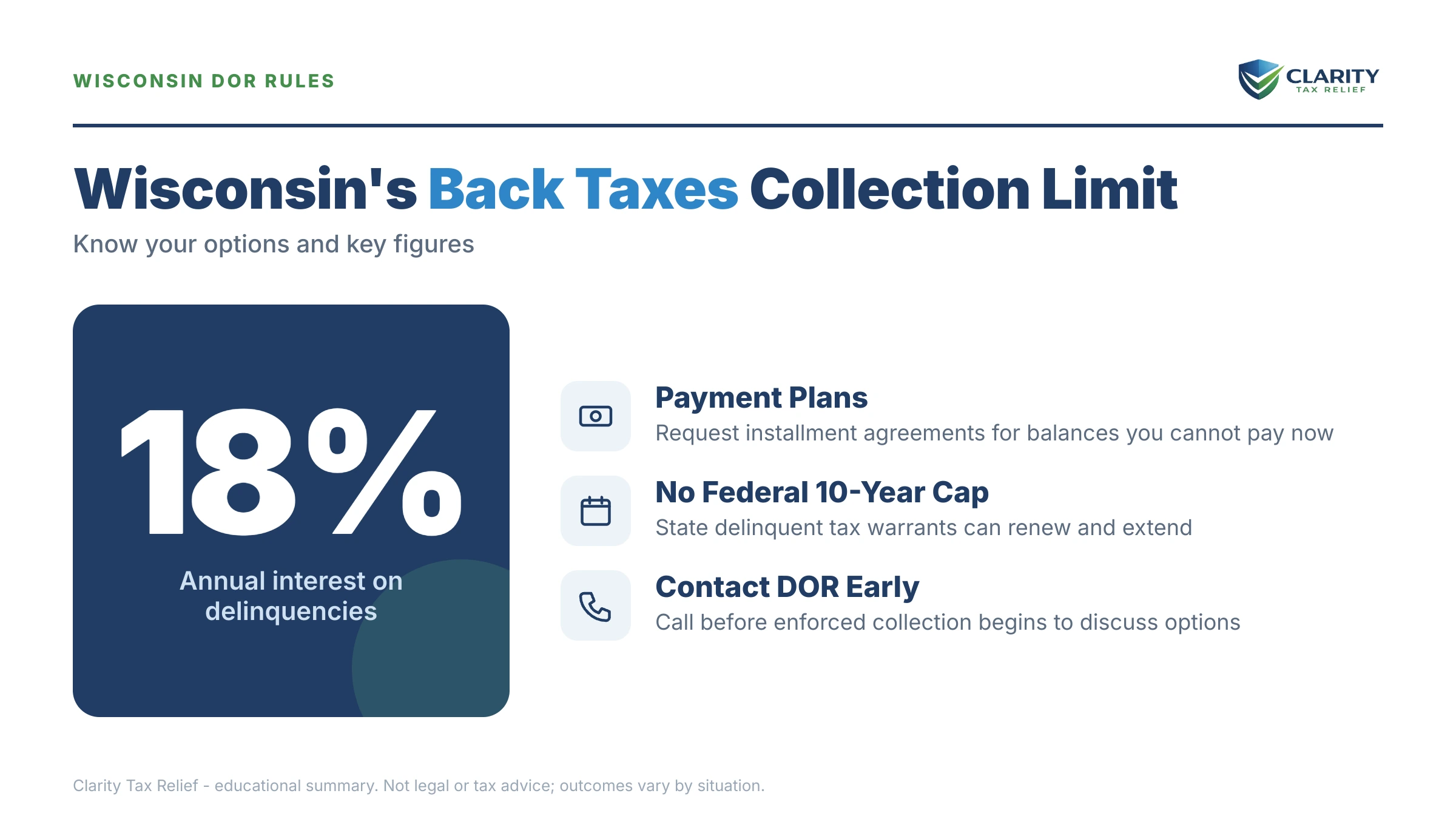
The short answer: Wisconsin back taxes are collected by the Wisconsin Department of Revenue, which charges 18% annual interest on delinquent balances, dockets tax warrants that work like court judgments, and can attach wages without suing you. You can resolve the debt by paying in full, a DOR installment agreement, or a Petition for Compromise.
The envelope is from Madison — a Wisconsin Department of Revenue Notice of Amount Due — and it landed right in the middle of your refinance paperwork. Take a breath: a Wisconsin tax balance is very fixable, and the order you fix it in is what decides whether your closing stays on schedule. This guide walks the whole map, from first notice to a clean title search.
⏱ The clock that's actually running: delinquent Wisconsin taxes accrue interest at 18% per year — 1.5% every single month. There is no single statutory countdown on a general balance, but your notice prints its own appeal deadline (typically 60 days from the notice date), and every month of delay compounds the total.
Why you owe Wisconsin back taxes
A Wisconsin back-tax balance almost always begins with a Notice of Amount Due from the Wisconsin Department of Revenue — a bill, not an audit. The image below shows exactly what a DOR balance notice looks like and where the tax year, amount, and response deadline sit, so you can match yours line by line.
Four situations produce most of these bills:
- You filed but couldn't pay in full. The DOR bills the shortfall plus interest, and the account eventually rolls to delinquent status.
- The IRS changed your federal return. Wisconsin piggybacks on federal figures, and the DOR is notified when the IRS adjusts your federal return — a CP2000 outcome in one year often produces a Wisconsin bill months later.
- You didn't file, so the DOR estimated your tax. Estimated assessments are built from wage and income data without your deductions, so they run high. If you have haven't filed taxes in 3 years or more, filing the real returns is usually the fastest way to shrink the number.
- Business trust taxes. Sales tax and employee withholding are collected on the state's behalf, and Wisconsin can pursue the responsible people personally when a business falls behind. If that's your situation, start with our guide to sales tax debt help — states treat trust taxes as their most serious category.
Whatever the origin, the mechanics from here are the same: the account ages, the cost compounds. The enforcement tools get sharper at each stage.
“An IRS levy permits the legal seizure of your property to satisfy a tax debt. It can garnish wages, take money in your bank or other financial account, seize and sell your vehicle(s), real estate and other personal property.”
— Levy (IRS.gov)
What happens if you ignore Wisconsin back taxes
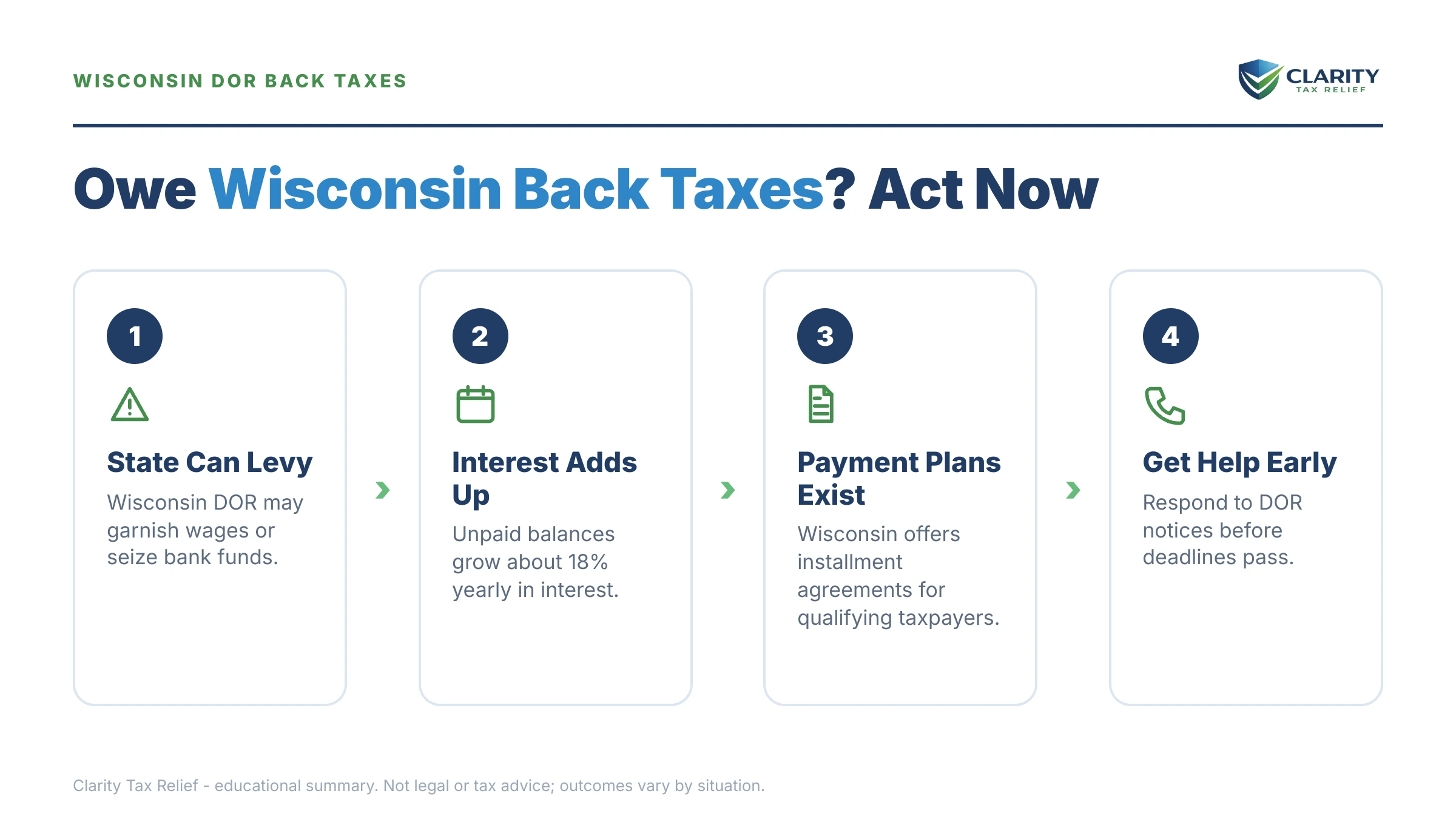
Unpaid Wisconsin taxes become delinquent, accrue 18% annual interest plus a collection fee, and end in a docketed tax warrant that works like a civil judgment. The DOR doesn't publish a fixed calendar, the stages arrive as your account ages, but the sequence itself is predictable:
- Notice of Amount Due. The first bill. It shows the tax year, the balance, and your appeal window. This is the cheapest moment in the entire sequence to act.
- Delinquent status. The unpaid balance is certified delinquent. Interest steps up to 18% per year. The DOR adds a delinquent collection fee on top (the exact fee appears on your delinquent notice).
- Delinquent tax warrant. The DOR files a warrant with the clerk of circuit court in your county. Once docketed, it acts like a money judgment: a public-record lien against your real estate and personal property that surfaces in every title search.
- Enforced collection. With or without a warrant, the DOR can attach your wages administratively, no lawsuit required, levy bank accounts, keep every Wisconsin refund, and intercept your federal refund through the Treasury Offset Program. (The reverse also happens: the IRS grabs state refunds too — see state refund taken for IRS debt.)
- Escalated pressure. Persistent delinquency can trigger certification that blocks or revokes professional licenses under Wisconsin law. The DOR's largest unresolved accounts are posted on its public delinquent-taxpayer website.
Notice what's missing from that list: a human deciding to go easy on you. Wisconsin's collection pipeline is largely automated, and each stage is materially harder, and more expensive — to unwind than the one before it.
Holding a Wisconsin DOR notice right now?
Get it reviewed free before 18% interest adds another month's charge, and before a tax warrant reaches your county's court record. An experienced tax professional will map your exact options in one call.
Your options for resolving Wisconsin back taxes
The Wisconsin DOR offers four main resolution paths — full payment, an installment agreement, a Petition for Compromise. An appeal — plus a fifth fix for non-filers. Here's how they compare:
| Option | Best for | Eligibility & the catch |
|---|---|---|
| Pay in full (My Tax Account) | You have cash or home equity and need the risk gone — e.g., before a refinance | No eligibility bar; stops 18% interest and warrant risk immediately |
| DOR installment agreement | Steady income, can't pay all at once | DOR approval required; 18% interest keeps accruing during the plan; missed payments can restart enforcement |
| Petition for Compromise (Form A-212) | Genuine inability to ever pay in full | Means-tested on income, expenses, and assets; home equity that could cover the debt usually disqualifies |
| Petition for redetermination (appeal) | The assessment itself is wrong | Must be filed within the window printed on your notice (typically 60 days); pauses the dispute, not the interest if you lose |
| File or amend the missing return | The DOR estimated your tax as a non-filer | The actual return generally replaces the inflated estimated assessment |
Three of these deserve a closer look:
The installment agreement is the workhorse. Most individual plans can be requested online through My Tax Account, the DOR's portal. Because interest runs at 18% during the plan, the shortest term you can genuinely afford always wins — the math two sections down shows exactly how much a longer plan costs.
The Petition for Compromise is Wisconsin's settle-for-less program, and it is narrower than the marketing around "tax settlement" suggests. The DOR reviews your full financial picture and accepts a compromise only when collecting in full is genuinely unrealistic. You may qualify if your income barely covers necessary living expenses and you have no reachable assets. But a homeowner with refinanceable equity is, almost by definition, not that person.
The appeal matters when the number is wrong: a payment that never posted, a federal adjustment that was itself reversed, income attributed to you in error. File the petition for redetermination inside the printed window, because once that window closes, the assessment generally becomes fixed and your leverage drops to payment terms only.
What $8,900 in Wisconsin back taxes actually costs
Say you owe the DOR $8,900 and you're planning to refinance your home this fall — at 18% interest, doing nothing for a year grows that balance to roughly $10,600. Here's the arithmetic on each path, all figures hypothetical and rounded:
- Do nothing: 1.5% per month on $8,900 is about $133 in new interest every month, before the delinquent collection fee. After 12 months: roughly $10,600, and likely a docketed warrant.
- 12-month plan: about $815/month. Total paid ≈ $9,790, so the plan costs roughly $890 in interest.
- 24-month plan: about $445/month. Total paid ≈ $10,660 — roughly $1,760 in interest, double the 12-month cost for the same debt.
- Pay in full at closing: if your refinance nets enough cash out, retiring the full $8,900 from proceeds costs $0 in further interest and clears the title issue in one move.
| Path | Monthly payment | Approx. interest cost | Refinance-ready |
|---|---|---|---|
| Pay in full now | One payment of $8,900 | $0 further | As soon as the DOR posts payment |
| 12-month DOR plan | ≈ $815 | ≈ $890 | About one year (when paid off) |
| 24-month DOR plan | ≈ $445 | ≈ $1,760 | About two years |
| Do nothing for 12 months | $0 | ≈ $1,700 in new interest; balance ≈ $10,600 plus fees | Blocked once a warrant dockets |
The takeaway: at 18%, time is the most expensive variable in the equation. Every path that ends the accrual sooner beats every path that doesn't.
Refinancing with a Wisconsin tax warrant on file
A docketed Wisconsin tax warrant is a judgment lien that appears in your title search, and most lenders will not close over it. If the warrant hasn't been filed yet, resolving the balance now keeps your county court record clean, which is the single best thing you can do for your loan file.
If a warrant is already docketed, the standard path is direct: request a payoff figure good through your closing date from the DOR, pay it (often from loan proceeds at closing, if your lender allows), and confirm the DOR files a satisfaction of the warrant with the circuit court. Keep a copy of the satisfaction — underwriters and future title searches will want it.
One caution for anyone who also owes the IRS: a federal tax lien is a separate instrument with its own payoff, subordination, and withdrawal procedures. Don't assume clearing the state warrant clears the federal side — see our guide to whether you can refinance with an IRS lien for that half of the problem.
How to respond to Wisconsin back taxes, step by step
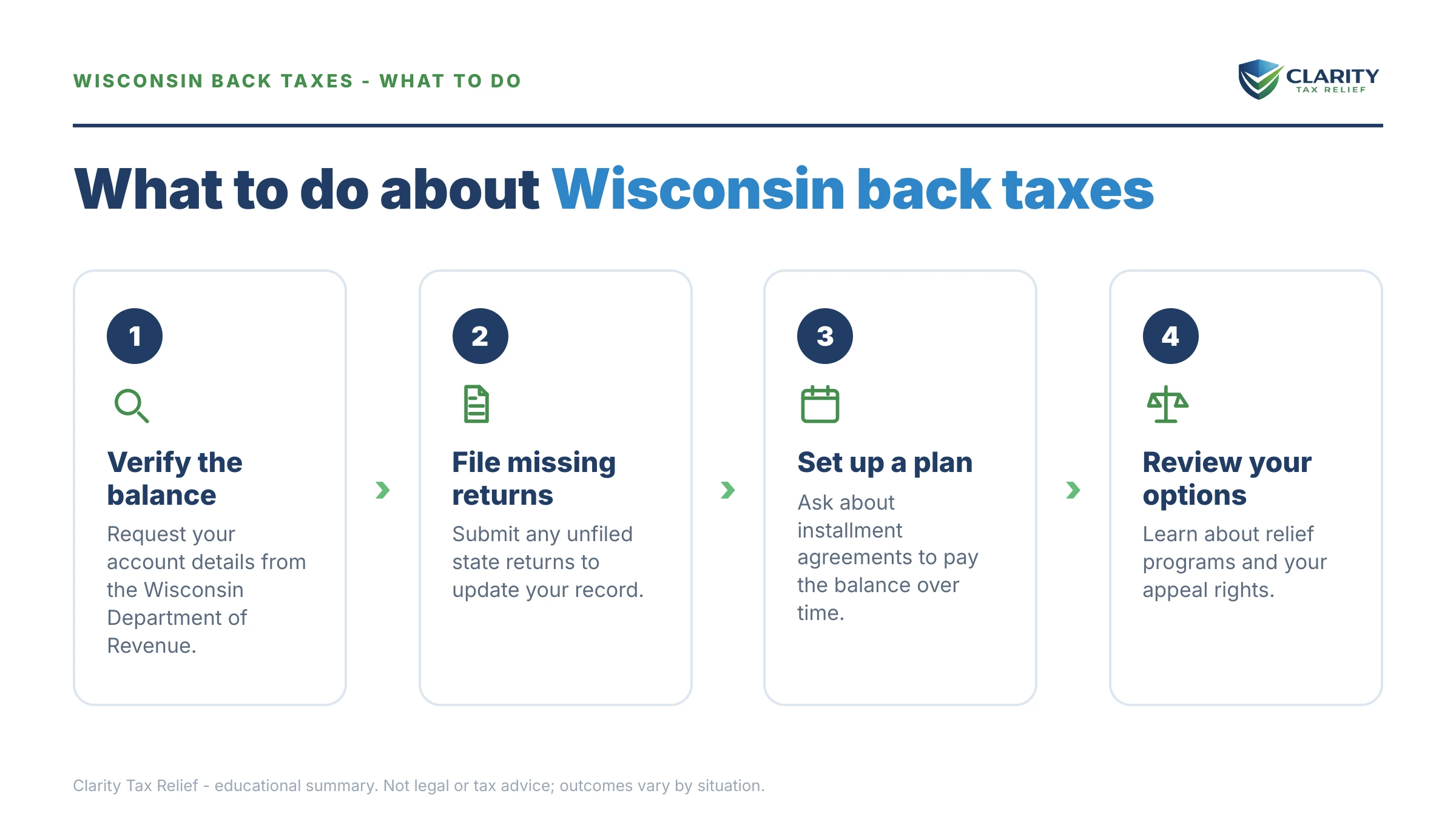
- Verify the assessment. Log in to My Tax Account, confirm the tax years and amounts match your records, and check the appeal deadline printed on your notice.
- File any missing Wisconsin returns. If the DOR estimated your tax because you didn't file, submitting the actual return usually replaces the inflated estimated figure.
- Choose your resolution before a warrant is docketed. Pay in full or lock in an installment agreement while your county court record is still clean. That is what protects a refinance.
- Handle any docketed warrant directly. Request a payoff figure from the DOR, pay it, and confirm a satisfaction of the warrant is filed with the circuit court.
- Get a professional review if the case is layered. A wage attachment, multiple unfiled years, business sales or withholding tax, or an IRS balance on top changes the right order of moves.
Owe both Wisconsin and the IRS? How the two debts differ
Wisconsin's DOR charges a fixed 18% delinquent interest rate and can attach wages without a court order — two ways it routinely moves faster than the IRS on the same size debt. If you owe both, the full sequencing framework lives in our hub on state tax debt vs IRS; here is the Wisconsin-specific side-by-side:
| Feature | Wisconsin DOR | IRS |
|---|---|---|
| Delinquent interest | 18% per year, fixed | Federal rate, adjusted quarterly — historically far lower |
| Lien instrument | Delinquent tax warrant, docketed in circuit court like a judgment | Notice of Federal Tax Lien, filed in county records |
| Wage action | Administrative wage attachment; no court, no final-notice waiting period | Wage levy only after a final notice (LT11/1058) and a 30-day appeal window |
| Settle for less | Petition for Compromise, Form A-212; means-tested | Offer in Compromise, Form 656; $205 fee, roughly 1 in 5 accepted in FY2024 |
| Online payment plan | My Tax Account | Up to 72 months online for balances of $50,000 or less |
| Collection clock | No IRS-style 10-year mirror; docketed warrants persist like judgments | 10 years from assessment (CSED), pausable by appeals, offers, bankruptcy |
Two interactions catch Wisconsin taxpayers off guard. First, the refund pipelines run both directions: the DOR keeps your Wisconsin refund and can intercept your federal refund, while the IRS can seize your state refund through the state income tax levy program. Second, the carrying costs are wildly unequal — Wisconsin's 18% usually dwarfs the federal accrual, which often argues for retiring the state balance first while holding the IRS side in a streamlined installment agreement. You can estimate the federal side's penalties and interest with our IRS Penalty & Interest Calculator, and set up federal terms directly at the IRS payment plans page. The exception that flips the order: if the IRS has issued a final notice of intent to levy, its 30-day clock takes priority over everything.
When you can handle Wisconsin back taxes yourself
Plenty of Wisconsin cases need no professional at all. If the notice is your first, the amount matches your own records. You can pay in full or comfortably carry a 12-month plan, set it up yourself through My Tax Account — the DOR's site at revenue.wi.gov walks through both options. A single year, an agreed amount, and an affordable payment is a do-it-yourself situation.
Experienced help changes outcomes in a narrower set of cases: a warrant already docketed in the middle of a refinance, a wage attachment or bank levy in motion, multiple unfiled years where estimated assessments overstate what you actually owe, business sales or withholding tax with personal-liability exposure, a Petition for Compromise where the financial presentation decides the result, or a stacked state-plus-IRS debt where sequencing determines total cost. In those, the value isn't filling out forms — it's knowing which move to make first.
If your situation is in that second list — a warrant, an attachment, or two agencies at once — a free case review will tell you in one conversation whether professional help would actually change your number.
Terms on your Wisconsin notice, decoded
- Delinquent tax warrant: the DOR's lien document, docketed with the circuit court, that functions like a civil money judgment, not an arrest warrant.
- Wage attachment: the DOR's administrative order requiring your employer to send part of each paycheck to the state, issued without a lawsuit.
- Petition for Compromise (Form A-212): Wisconsin's application to settle a tax debt for less than the full balance based on inability to pay.
- Petition for redetermination: the formal appeal that disputes a DOR assessment, due within the window printed on your notice.
- Refund offset: the automatic application of your state — and, through the Treasury Offset Program, federal — tax refunds to a delinquent Wisconsin balance.
- Satisfaction of warrant: the court filing that confirms a docketed warrant has been paid, which title companies and lenders look for.
Wisconsin back taxes: your questions answered
What is the interest rate on Wisconsin back taxes?
Delinquent Wisconsin taxes accrue interest at 18% per year, 1.5% per month, which is far higher than most federal rates. On an $8,900 balance, that is roughly $133 in new interest every month before any payment reduces principal. The Department of Revenue also adds a delinquent collection fee, so a balance left alone grows quickly.
What is a Wisconsin delinquent tax warrant?
A delinquent tax warrant is the DOR's lien document, docketed with the clerk of circuit court in your county. Once docketed, it works like a civil money judgment: it attaches to your real estate and personal property, appears in public records and title searches, and lets the DOR pursue enforced collection. It is not an arrest warrant.
Can the Wisconsin Department of Revenue garnish my wages?
Yes. The DOR can issue a wage attachment to your employer administratively. It does not need to sue you in court first. The attachment stays in place until the balance is paid or you set up an approved alternative, such as an installment agreement. Acting before the attachment starts almost always leaves you with a lower, more predictable monthly number.
Does Wisconsin have an offer in compromise for back taxes?
Wisconsin's version is the Petition for Compromise, filed on Form A-212, which asks the DOR to accept less than the full balance based on your inability to pay. It is means-tested: the DOR reviews your income, expenses, and assets. If you own a home with equity that could cover the debt, a compromise is unlikely to be approved.
Can I set up a Wisconsin DOR payment plan online?
Yes. The DOR's My Tax Account portal lets you request an installment agreement online for most individual balances. Interest continues to accrue at 18% per year while you pay, so shorter plans cost meaningfully less. If your balance is large or a warrant has already been docketed, the DOR may ask for financial details before approving terms.
Will Wisconsin back taxes stop me from refinancing my house?
An unpaid balance alone usually will not. But a docketed delinquent tax warrant almost always will, because it is a judgment lien that shows up in the title search. Most lenders require the warrant to be paid and satisfied at or before closing. If you plan to refinance, resolving the balance before a warrant is filed protects both your rate and your timeline.
Can Wisconsin take my federal tax refund for state back taxes?
Yes. Wisconsin participates in the federal Treasury Offset Program, so the DOR can intercept your federal income tax refund for delinquent state taxes. Your Wisconsin refund is applied to the balance automatically as well. If part of the refund belongs to a spouse who does not owe, act quickly — allocation relief may be possible on the federal side.
Does Wisconsin publish the names of people who owe back taxes?
Yes. The DOR posts its largest delinquent accounts, individuals and businesses, on a public website after collection notices have gone unanswered. Getting onto a payment plan or otherwise resolving the account is the way to stay off, or come off, the list. Most readers with a first notice are nowhere near this stage.
Should I pay Wisconsin or the IRS first if I owe both?
Usually the debt with the fastest-moving enforcement and the highest carrying cost comes first, and Wisconsin's 18% interest and administrative wage attachment often make the state the more urgent fire. But the answer flips if the IRS has issued a final notice of intent to levy. Compare both timelines before committing your cash to either one.
How long can Wisconsin collect back taxes?
Wisconsin's collection window does not mirror the IRS 10-year rule. A docketed tax warrant operates like a civil judgment that stays enforceable for many years. Waiting out the state is not a realistic strategy — at 18% annual interest, the balance grows by nearly a fifth every year — roughly doubling in five to six years of inaction. Resolution, not time, is what closes a Wisconsin account.
Your next 24 hours
- Find two things on your notice: the tax year(s) and total due, and the appeal deadline printed near the top. That date tells you whether disputing the amount is still on the table.
- Gather three documents: the notice itself, your Wisconsin return for that year, and proof of any payments you've already made (bank records or My Tax Account history).
- Get your free case review: call (888) 825-7779 or use the 2-minute form. With 18% interest compounding monthly and a tax warrant the next step in the sequence, the review costs nothing — waiting does.
This guide is general information, not tax or legal advice for your specific situation. Eligibility for IRS programs depends on individual facts and circumstances; no outcome is guaranteed.