
State Back Taxes
Colorado Back Taxes Payment Plan: How to Set One Up in 2026
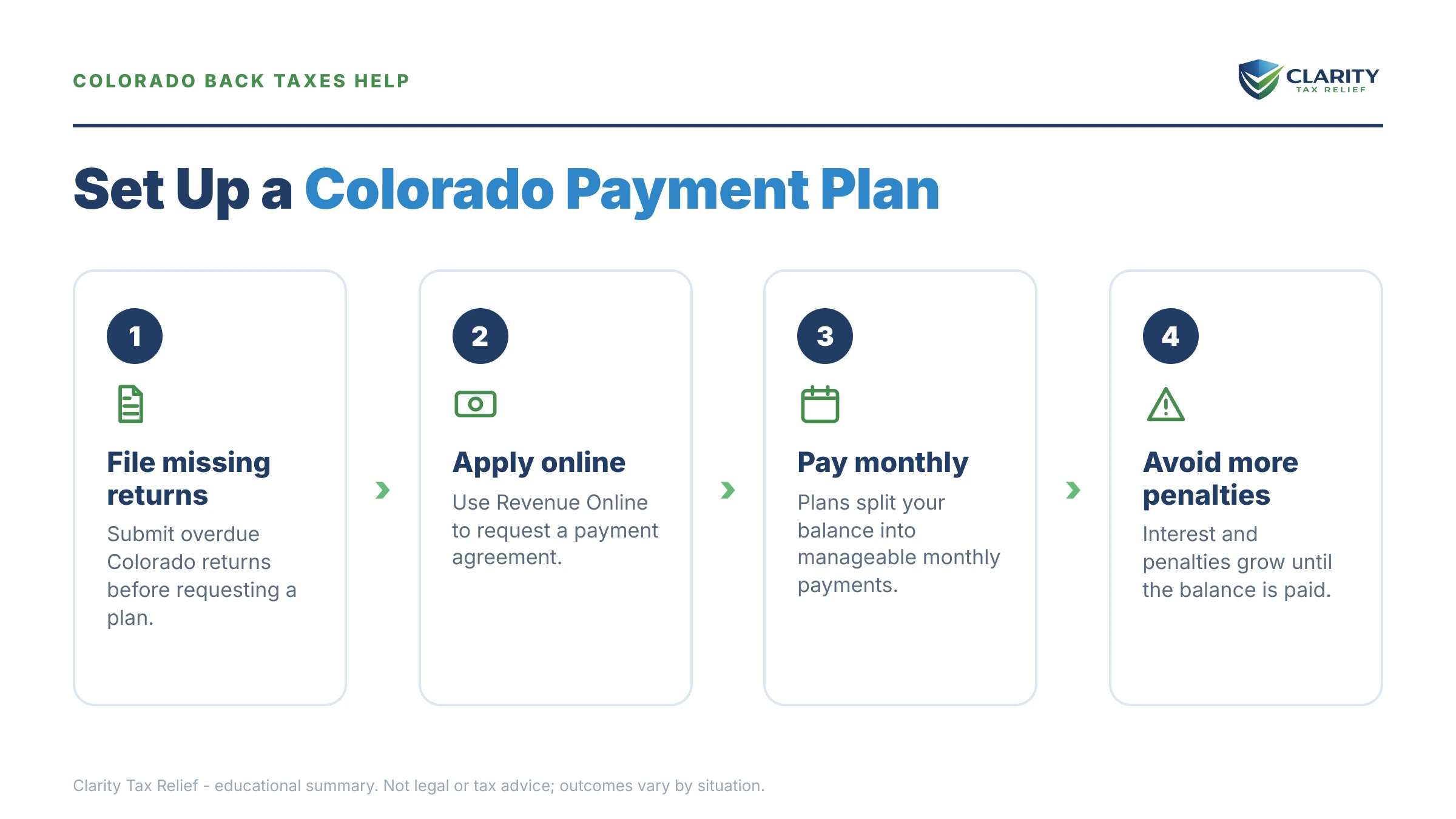
The short answer: yes. You can get a Colorado back taxes payment plan through the Department of Revenue's Revenue Online portal. You request monthly payments once your balance has been billed, and an approved plan in good standing generally stops enforced collection — wage garnishment, bank levies, distraint warrants — while interest continues to accrue.
Maybe you filed your first return since the divorce and Colorado says you owe. Maybe a Department of Revenue envelope just arrived billing a joint year you thought your ex was handling. Either way, the balance is real, it grows monthly, and the state's collection machine is fully automated. The fix, a monthly plan, is faster to set up than most people expect, and this guide walks through every option in order.
The image below shows exactly what a Colorado Department of Revenue balance notice looks like and where to find the three things that matter: the tax period being billed, the total due with penalty and interest, and the due date that starts your clock.
⏱ Your clock: the due date printed on your Colorado notice controls. There is no fixed statutory grace period while you decide — penalty and interest accrue monthly until the balance is paid or you're on an approved plan, and each unanswered notice moves your account one stage closer to a distraint warrant.
Why you owe Colorado back taxes in the first place
Colorado's income tax starts from your federal taxable income, so almost anything that changes your federal return creates a Colorado bill too. That single design choice explains most Colorado balances, and it's why state bills often arrive months after you thought a tax year was closed.
The most common triggers we see:
- A filing-status change after divorce. Withholding that covered a married-filing-jointly return often falls short once you file single or head of household. Colorado's flat tax applies to your whole taxable income, so even a modest shortfall in withholding shows up as a real balance.
- A joint-year debt following you out of the marriage. If a balance comes from a return you signed jointly, Colorado can collect the entire amount from either spouse — the decree assigning it to your ex doesn't bind the Department. (The same rule applies federally; see why the divorce decree doesn't control IRS debt.)
- An IRS adjustment that cascaded down. When the IRS changes your federal return — a CP2000, an audit, a math correction — Colorado eventually recalculates your state tax from the new federal figures and bills the difference, plus penalty and interest back to the original due date.
- Self-employment or side income with no Colorado withholding. 1099 income that surprised you federally surprises you at the state level too, because nothing was withheld for Colorado either.
- A return the Department filed or estimated for you. If you didn't file, Colorado can assess based on the information it has, usually a worse number than filing yourself would produce.
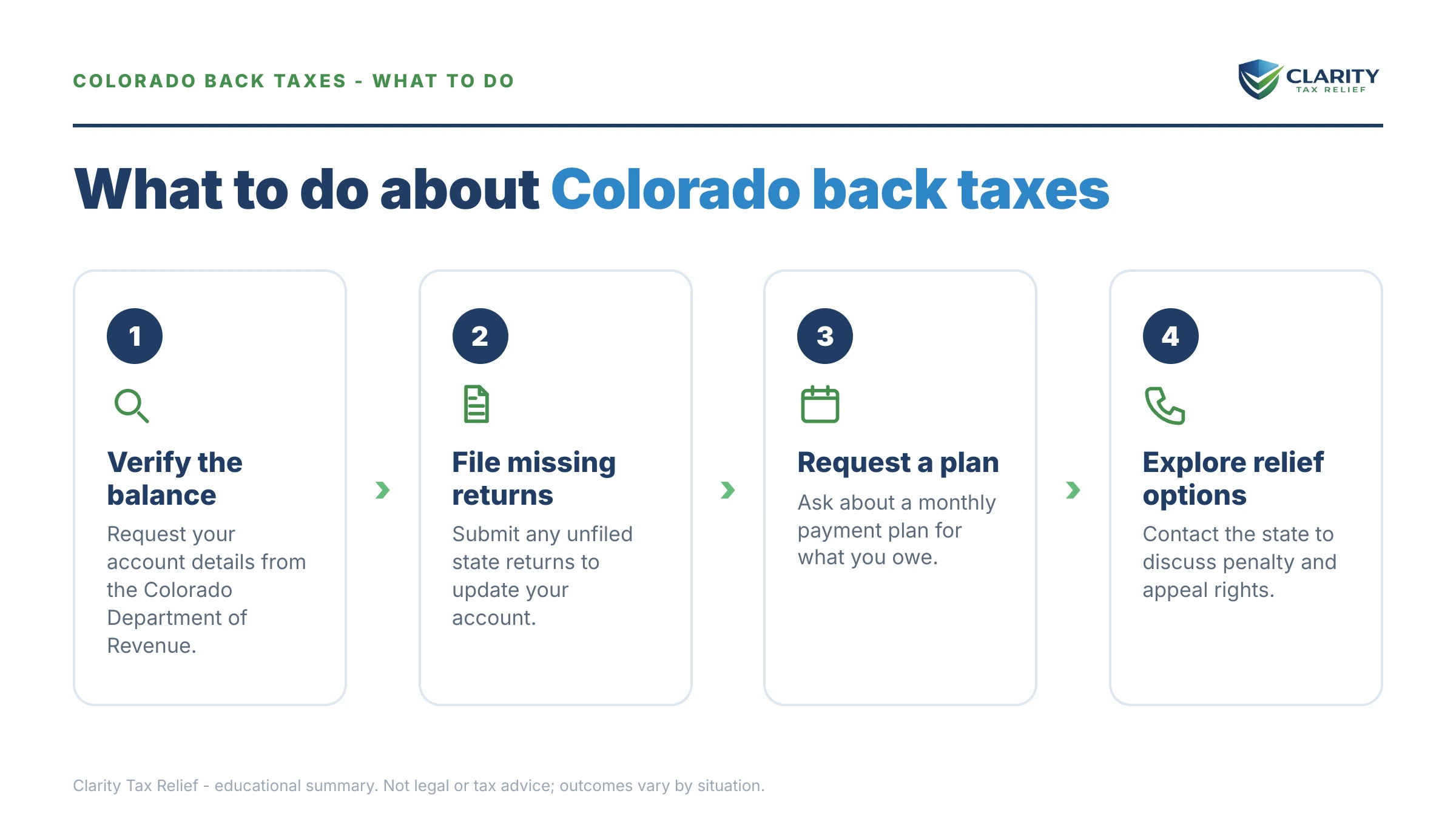
Before you agree to pay anything, verify the bill. Log into Revenue Online, pull the balance by tax year, and compare it to your own copies — the same figures highlighted in the image above. State bills built on estimated or IRS-adjusted numbers are sometimes reducible simply by filing or amending the actual return.
“A payment plan is an agreement with the IRS to pay the taxes you owe within an extended timeframe. You should request a payment plan if you believe you will be able to pay your taxes in full within the extended time frame.”
— Payment plans; installment agreements (IRS.gov)
What happens if you ignore a Colorado tax bill
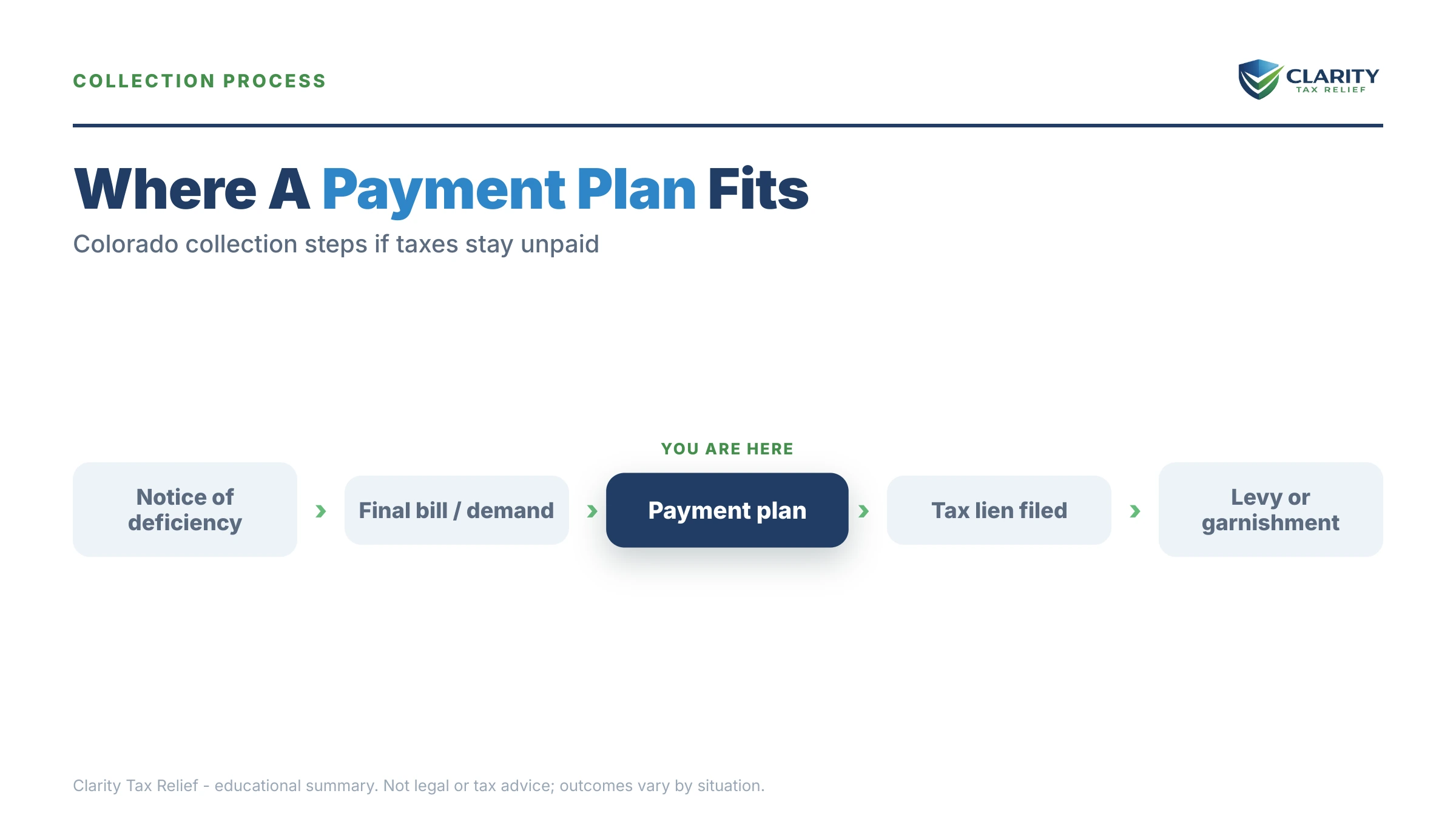
Colorado's collection process runs in stages, and each stage removes options you have at the one before it. The sequence doesn't require a human to review your file — it escalates on its own:
- Balance-due notice — the first bill after your return processes or the Department adjusts your account. Penalty and interest are already accruing, but no enforcement has started. This is the cheapest moment to act.
- Demand for payment — the Department's formal demand. Your window to protest the assessment itself is closing or closed; the account is moving into active collections.
- Distraint warrant — the Department's core enforcement document, filed with the county clerk and recorder. It becomes a public record against your property, Colorado's rough equivalent of a tax lien, and authorizes the seizure actions that follow. It can surface on background checks and complicate selling or refinancing a home.
- Enforced collection — wage garnishment sent to your employer, levies on bank accounts, and interception of state refunds (including any TABOR surplus refund paid through your return). Colorado does not need a court judgment to garnish administratively.
- Outside collection referral — accounts that stay unresolved may be referred out for collection, which can add collection costs on top of the tax, penalty, and interest.
Two things make this sequence sting more than the equivalent IRS track. First, state systems often move from first bill to garnishment faster than the IRS does. Second, a distraint warrant is public in the county where you live — a visibility problem a quiet IRS balance doesn't have until a federal lien is filed.
Holding a Colorado Department of Revenue notice right now?
Before a distraint warrant makes your balance a public record, have an experienced tax professional review your notice — which years are billed, whether the numbers are even right, and which plan or relief path fits your budget. Free, confidential, no pressure.
Your options for Colorado back taxes, compared
The Colorado Department of Revenue offers more than the pay-in-full-or-else framing on the notice, but each option has a gate. Here is the honest map:
| Option | Best for | Key requirement |
|---|---|---|
| Pay in full | Balances you can clear within a month or two | None — stops interest and the escalation sequence immediately |
| Monthly payment plan (Revenue Online) | Most filers with steady income | Balance already billed; stay current on every payment and every future filing |
| Hardship handling | No ability to pay after basic living expenses | Financial disclosure to the Department; the balance keeps accruing interest |
| Penalty relief request | Late penalties with a genuine compliance reason (illness, disaster, divorce-year chaos with documentation) | A reasonable cause the Department accepts; interest usually remains |
| Settlement (offer-style relief) | Rare cases with no realistic collection potential | Narrow criteria; the Department generally expects the federal side of the same debt resolved first |
| Dispute the assessment | Bills that are wrong — unposted payments, income that isn't yours, estimated assessments | Documentation, raised before the protest window on your notice closes |
Two notes on the bottom rows. Colorado's settlement relief is much narrower than the IRS Offer in Compromise — for most people the realistic outcomes are a plan, penalty relief, or hardship handling, not a reduced balance. And a dispute is only a dispute if you raise it in time. Once the assessment is final, the Department collects the number on the books, right or wrong, unless you can reopen it.
| Option | What it costs | Typical timeline |
|---|---|---|
| Pay in full | Balance plus penalty and interest accrued to date | Days — resolved as soon as the payment posts |
| Monthly payment plan | Full balance plus interest that accrues during the plan term | Months to a few years; the Department sets the term |
| Hardship handling | Nothing monthly, but interest keeps compounding on the full balance | Reviewed periodically as your finances change |
| Penalty relief | Free to request | Weeks to months for the Department to decide |
| Dispute / protest | Free, plus your time gathering proof | Weeks to months depending on the issue |
A worked example: $6,200 after a divorce
Say you owe Colorado $6,200 — a hypothetical but common shape: roughly $4,100 from the last jointly filed year, plus about $2,100 from your first year filing single, when your W-4 still assumed two incomes. Here is how the plan math looks on the principal alone:
- 12 months: $6,200 ÷ 12 ≈ $517/month
- 24 months: $6,200 ÷ 24 ≈ $258/month
- 36 months: $6,200 ÷ 36 ≈ $172/month
Interest keeps accruing during the plan at the rate set by state law (it's printed on your notice), so the true payoff runs somewhat above these figures, and the 36-month path pays meaningfully more total interest than the 12-month path. The practical move for a newly single budget: pick the term whose payment you can make every month without fail, because a defaulted plan is worse than a longer one. If $258 is safe and $517 is a stretch, take 24 months and pay extra in good months — Colorado doesn't penalize early payoff.
One more divorce-specific point in this scenario: the $4,100 joint-year piece is collectible in full from either you or your ex. If the decree assigned it to your ex and they aren't paying, your leverage runs through the divorce court, not the Department, and on any parallel federal joint debt, look at how to qualify for innocent spouse relief and who pays IRS debt after divorce.
How to set up a Colorado back taxes payment plan, step by step
- Pull your balance on Revenue Online. Create or log into your account at the Department of Revenue's Revenue Online portal and confirm the exact balance, the tax years billed, and how much penalty and interest has already been added.
- Verify the numbers against your returns. Match each billed year to the return you actually filed. If a year is wrong — a payment that never posted, income that isn't yours, a joint year your decree assigned to your ex — dispute it before agreeing to pay it.
- Decide how fast you can realistically pay. Interest accrues until the balance is gone, so pick the shortest term your budget genuinely supports, and stress-test that number against your real post-divorce monthly cash flow, not last year's.
- Request the plan through Revenue Online or DOR collections. Submit the payment plan request online, or call the Department's collections section if your situation needs explaining. Get the approved terms — amount, date, and length — in writing.
- Automate the payment and calendar your filing deadlines. Set the monthly payment to draft automatically and file every future Colorado return on time. A new unpaid balance or missed filing can default the plan even if every monthly payment was made.
- Resolve the federal side separately if you also owe the IRS. A Colorado plan does nothing for a federal balance. Set up an IRS arrangement on its own track so neither agency escalates while you pay the other.
Owe both Colorado and the IRS? Run two tracks
When you owe Colorado and the IRS
A Colorado payment plan and an IRS payment plan are completely separate agreements with separate rules — neither agency honors the other's arrangement. The same under-withholding or IRS adjustment that created your Colorado balance usually created a federal one too, so many readers here are carrying both.
| Question | Colorado DOR | IRS |
|---|---|---|
| Where you set up a plan | Revenue Online portal | IRS.gov Online Payment Agreement |
| Plan terms | Set case by case by the Department | Up to 72 months online for balances of $50,000 or less |
| Main lien/levy tool | Distraint warrant filed with the county clerk | Federal tax lien; levy only after an LT11 final notice plus 30 days |
| Can it take your refund? | Yes — state refunds, including TABOR surplus refunds, offset to state debt | Yes — and it can grab your Colorado refund through SITLP |
| Collection time limit | Set by state law — confirm what applies to your years with the Department | 10 years from assessment (the CSED), pausable by appeals, offers, and bankruptcy |
Sequencing matters more than most people realize — which agency to stabilize first depends on which one is closer to enforcement, and our guide to state tax debt vs IRS: which to resolve first walks through that decision in full. For the federal track itself, see how to set up an IRS payment plan online. Balances under $50,000 usually fit a streamlined installment agreement with no detailed financial disclosure. And note the crossfire risk: the IRS's State Income Tax Levy Program lets it seize your Colorado refund for federal debt, while your federal refund can be taken for state debt, so a refund you were counting on for the plan's first payment may never arrive.
When you can handle this yourself, and when help changes the outcome
Most single-year Colorado balances under a few thousand dollars are a do-it-yourself job. If the bill matches your return, you agree you owe it. A monthly payment fits your budget, set the plan up on Revenue Online today. You don't need to pay anyone for that, and you shouldn't.
Experienced help earns its cost when the situation has moving parts:
- A distraint warrant is already filed or garnishment has started. The order you negotiate releases and plans in determines how fast your paycheck recovers.
- You owe Colorado and the IRS at once. Two agencies, two sets of rules, one budget — sequencing wrong means one plan defaults to feed the other.
- The debt spans joint and single years after a divorce. Which years you attack, dispute, or seek relief on changes what you personally end up paying.
- You have unfiled years. Colorado (and the IRS) will estimate returns for you at worse numbers than reality. If you're behind, start with our guide for people who haven't filed taxes in 3 years, because filing correct returns often shrinks the balance before any plan is negotiated.
- The assessment is wrong and the protest window is closing. Deadline-driven disputes are where representation pays for itself.
Along Colorado's Front Range, we've written locally focused guides too — see tax relief in Denver and tax relief in Colorado Springs for what resolution looks like on the ground in each metro.
If your Colorado balance sits on top of a federal one, or a distraint warrant is already on file — a free case review at the 2-minute form or (888) 825-7779 can map both agencies' next moves before you lock into a plan you can't keep.
Terms on your Colorado notice, decoded
- Distraint warrant — the Department's enforcement filing with the county clerk; it works like a lien on your property and authorizes garnishment and levy.
- Revenue Online — the Colorado Department of Revenue's self-service portal for viewing balances, making payments, and requesting payment plans.
- Demand for payment — the formal notice that your assessment is final and the account is moving into enforced collection.
- Refund intercept / offset — the Department applying your state refund (including TABOR surplus refunds paid through your return) against your balance before paying you anything.
- Joint and several liability — on a jointly filed return, each spouse owes the entire balance, not half, regardless of what a divorce decree says.
- Protest rights — your time-limited window to dispute an assessment before it becomes final; the deadline is printed on the notice itself.
Colorado back taxes questions, answered
Does Colorado offer payment plans for back taxes?
Yes. The Colorado Department of Revenue lets most individual taxpayers request a monthly payment plan through its Revenue Online portal once a balance has been billed. The Department sets the terms based on how much you owe and what you can pay, and interest continues to accrue until the balance is paid off, so shorter plans cost less overall.
How long can a Colorado state tax payment plan last?
The Department of Revenue sets plan length case by case based on your balance and monthly ability to pay. There is no single published maximum that applies to everyone. Larger balances or longer terms may require financial information. Whatever term you are approved for, one rule is universal: miss a payment or a future filing deadline and the plan can default.
What is a Colorado distraint warrant?
A distraint warrant is the Colorado Department of Revenue's enforcement document — the state's rough equivalent of a federal tax lien and levy authorization combined. Once filed with the county clerk and recorder, it becomes a public record against your property and clears the way for the Department to garnish wages and levy bank accounts. Getting on an approved payment plan before a warrant issues is one of the main reasons to act early.
Can Colorado garnish my wages for back taxes?
Yes. The Department of Revenue can garnish wages administratively. It does not need to sue you first. It can also levy bank accounts and intercept state tax refunds. An approved payment plan in good standing generally protects you from these actions, which is why requesting one before enforcement starts matters.
Will Colorado keep my state refund or TABOR refund if I owe back taxes?
Expect it to. The Department of Revenue applies state income tax refunds — including any TABOR surplus refund paid through your return — against outstanding balances before sending you anything. Being on a payment plan does not stop refund offsets; they simply pay your balance down faster.
My divorce decree says my ex pays the tax debt — why is Colorado billing me?
Because a divorce decree binds you and your ex, not the tax agencies. If the debt comes from a jointly filed return, Colorado can collect the full amount from either spouse regardless of what the decree says. Your remedies are enforcing the decree against your ex through the divorce court and, for the federal portion of a joint debt, innocent spouse relief, if the IRS grants relief, ask the Department whether it will apply a matching adjustment.
Does Colorado settle back taxes for less than the full amount?
Rarely, and only in narrow circumstances. Colorado's offer-style relief is far more limited than the IRS program. The Department generally expects the federal side of the same debt to be resolved first. For most Colorado taxpayers, the realistic paths are a payment plan, penalty relief where the law allows it, or hardship handling, not a settlement. Be skeptical of anyone promising to settle a Colorado balance for pennies on the dollar. That pitch is the classic sign of a tax relief scam.
What happens if I miss a payment on my Colorado payment plan?
Your plan can default, which puts the full balance back into active collections — including distraint warrants, wage garnishment, and bank levies. If you see a payment problem coming, contact the Department before the due date. Adjusting a plan in good standing is far easier than reinstating a defaulted one. A new unfiled return or unpaid future balance can also default the plan even if every monthly payment was made.
If I owe both Colorado and the IRS, who do I pay first?
Set up something with both — silence toward either one invites enforcement. In practice, address whichever agency is closer to garnishing or levying first. State collection systems often move from first bill to enforcement faster than the IRS does. The federal side has well-defined tiers — a balance of $50,000 or less can usually go on an IRS plan of up to 72 months online — which makes the federal payment predictable while you work out terms with Colorado.
Can the IRS take my Colorado state tax refund?
Yes. Under the State Income Tax Levy Program, the IRS can intercept your Colorado refund and apply it to a federal tax debt, typically after it has sent a CP504 notice. The reverse also happens: your federal refund can be offset for state debts. If refunds keep disappearing, that is a sign at least one agency has an active collection file on you.
Your next 24 hours
- Find the due date and tax periods on your notice. They tell you which years are billed and how much time the Department's own paperwork gives you before the next stage.
- Gather your last two Colorado returns, the notice itself. Your current monthly income and expense numbers, plus your divorce decree if any billed year was filed jointly. That's everything needed to verify the balance and size a payment you can actually keep.
- Get a free case review. Interest is compounding on your balance either way — an experienced tax professional can tell you in one call whether to dispute, plan, or seek relief, and in what order. Use the 2-minute form or call (888) 825-7779.
Primary sources: the Colorado Department of Revenue's taxation site hosts Revenue Online, current penalty and interest rates, and payment plan instructions. For the federal side of a dual balance, start at the IRS payment plans page.
This guide is general information, not tax or legal advice for your specific situation. Eligibility for IRS programs depends on individual facts and circumstances; no outcome is guaranteed.