
State Back Taxes
Pennsylvania Back Taxes: How to Set Up a PA State Income Tax Payment Plan in 2026
What this episode covers
- How do I set up a payment plan for Pennsylvania state back taxes?
- Does Pennsylvania tax debt expire after ten years like IRS debt?
- Can the Pennsylvania Department of Revenue garnish wages without suing?
- Can Pennsylvania back taxes be settled for less than the full balance?
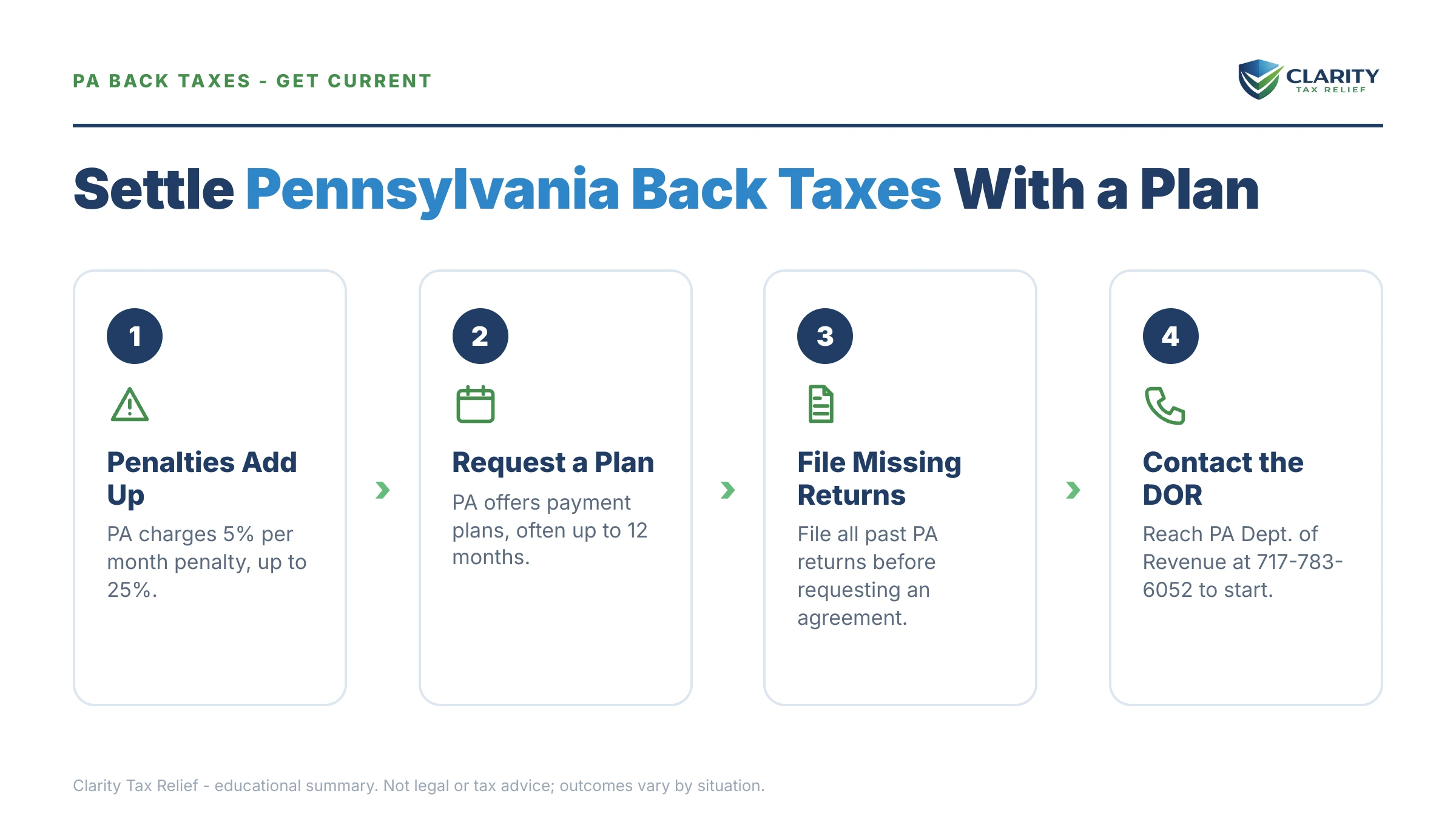
The short answer: yes — a Pennsylvania back taxes payment plan is available through the Department of Revenue. Most individuals can request a deferred payment plan online through myPATH or by calling the number on their collection notice. Penalties and interest keep accruing until the balance is paid, so a plan started early costs less.
The envelope says Commonwealth of Pennsylvania. The number inside is bigger than anything you budgeted for — tax you thought withholding covered, plus penalties and interest already stacked on top. Here's the part that matters: Harrisburg approves installment plans every day, and the sequence for getting one is short. This guide walks the whole map — the plan, the alternatives, and what the DOR does if the notice sits in a drawer.
⏱ The clock that matters: Pennsylvania back taxes have no automatic expiration — unlike IRS debt, there is no 10-year collection cutoff to wait out. Penalties and interest accrue monthly, and every ignored notice moves you a stage closer to a county-filed lien, added collection fees, and wage attachment. Any response deadline printed on your specific DOR notice controls.
Why you owe Pennsylvania back taxes
Pennsylvania taxes personal income at a flat 3.07%, and most back-tax balances trace to a handful of causes the Department of Revenue's automated systems catch reliably.
The common ones: withholding that didn't cover a second job or a bonus; 1099 side income with no Pennsylvania estimated payments behind it. Gambling or investment income that never made it onto the PA-40. Or a federal audit change the IRS shared with the state, which then rebilled you to match.
One cause deserves special attention: unfiled returns. When you skip a PA-40, the DOR can create an estimated assessment from the wage and income data it already has, and estimated assessments almost never include the deductions or credits a real return would. If part of your balance comes from years you never filed, the balance itself may be wrong, and fixing the returns comes before any payment plan.
Also worth ruling out: some Pennsylvanians confuse a state DOR bill with a local earned-income-tax bill from a collector like Berkheimer or Keystone Collections. Those are different debts owed to different agencies — more on that below.
“A payment plan is an agreement with the IRS to pay the taxes you owe within an extended timeframe. You should request a payment plan if you believe you will be able to pay your taxes in full within the extended time frame.”
— Payment plans; installment agreements (IRS.gov)
What happens if you ignore Pennsylvania back taxes
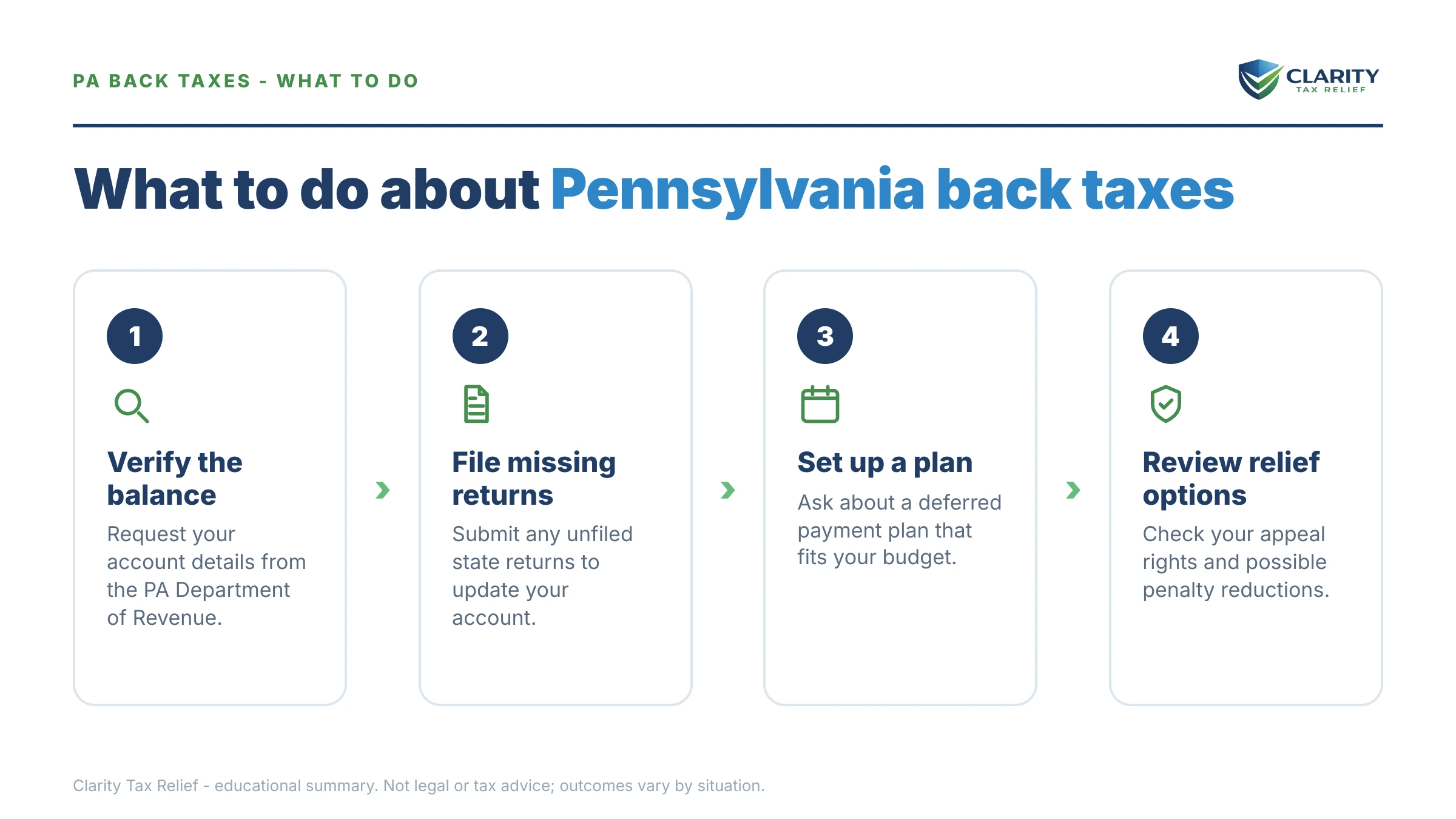
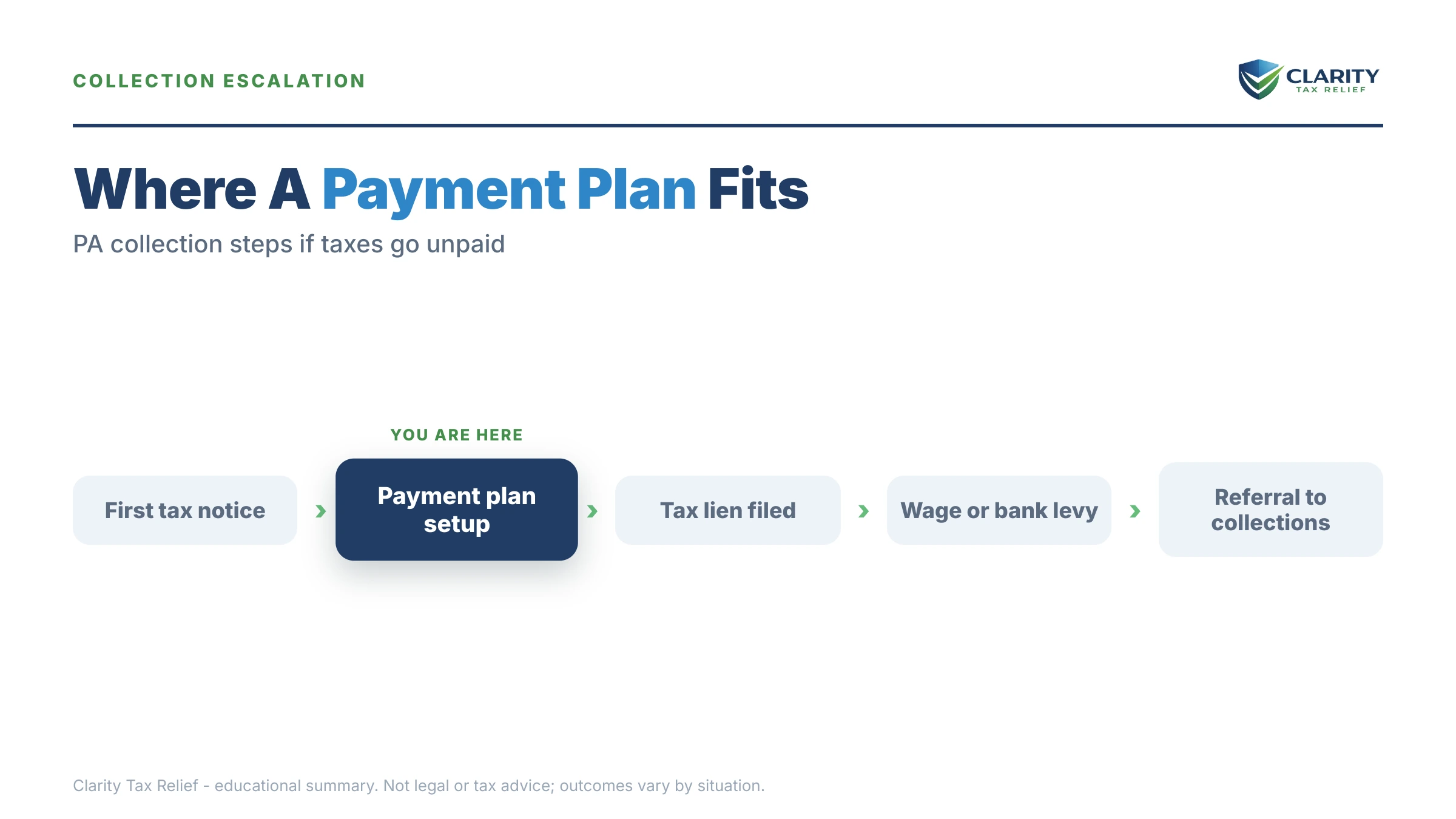
Unpaid Pennsylvania taxes escalate from billing notices to a county-filed lien, added collection-agency fees, and wage attachment, and the balance never ages out. Here is the typical sequence, though the DOR isn't required to move in strict order:
- Assessment and billing notices. The DOR bills the balance and adds penalties and interest monthly. This is the cheapest moment to act — no lien, no fees, full options.
- Lien filed with your county Prothonotary. A Pennsylvania tax lien is entered as a public judgment in the county where you live or own property. It attaches to real estate, complicates any sale or refinance, and shows up when lenders and employers search public records.
- Referral to a private collection agency. The DOR contracts with outside collection agencies, and referral adds collection fees on top of what you already owe. The debt gets more expensive at this stage even if nothing else happens.
- Wage attachment. Pennsylvania famously bars wage garnishment for most consumer debts, but state tax debt is an exception. The DOR can order your employer to withhold part of each paycheck without ever suing you.
- Referral to the Office of Attorney General. The hardest cases get litigation-grade collection through the AG's office. Options narrow, and negotiating leverage shifts almost entirely to the state.
Running alongside all of this: Pennsylvania keeps any state refund you're owed and applies it to the balance, and if you also owe the IRS, the federal side can grab your state refund too — see how a state refund taken for IRS debt works.
| Stage | What it means | What to do |
|---|---|---|
| Billing notices | Balance assessed; penalties and interest accruing monthly | Verify the balance on myPATH; pay or request a plan now — cheapest stage |
| Lien filed (Prothonotary) | Public judgment against you; attaches to real estate | Get on a plan; confirm release terms in writing once paid |
| Collection agency referral | Private collector calls; fees added to the balance | Verify the collector through the DOR before paying anyone |
| Wage attachment | Employer ordered to withhold from each paycheck | Contact the DOR immediately — a plan is the standard path to release |
| Attorney General referral | Litigation-grade collection on the hardest accounts | Get experienced professional help before responding |
Holding a Pennsylvania DOR notice right now?
The next stages — a county-filed lien and collection-agency fees added to your balance — are exactly what a plan set up now prevents. Get your Pennsylvania notice reviewed free by an experienced tax professional before the account escalates.
Your options for Pennsylvania back taxes, compared
The main relief the Pennsylvania Department of Revenue offers is a deferred payment plan — monthly installments requested through myPATH or the phone number on your collection notice. But it isn't the only move, and for some readers it isn't the right first move:
| Option | Best for | How to start |
|---|---|---|
| Pay in full | Balances you can clear within a month or two | Pay on myPATH; stops penalty and interest accrual immediately |
| Deferred payment plan | Correct balances you can't pay at once | Request through myPATH or the number on your notice; direct debit recommended |
| Appeal the assessment | Balances you believe are wrong, while the appeal window is still open | Petition the Board of Appeals before the deadline printed on your notice |
| File the real returns | Estimated assessments built on unfiled years | File the actual PA-40s; the true balance is usually lower |
| Penalty relief | Late penalties with a genuine cause behind them (illness, disaster) | Request relief from the DOR with documentation; interest generally stays |
| Bankruptcy | Rare cases with older tax debt and broader insolvency | Bankruptcy counsel — age-of-debt and filing rules decide what's dischargeable |
The deferred payment plan. This is the workhorse. Unlike the IRS, Pennsylvania doesn't publish neat tiers ("72 months online under $50,000"); terms are set case by case. Small balances paired with a realistic monthly payment go through routinely. Larger balances, like the five-figure example below, should expect the DOR to ask about income and expenses before agreeing to a long term, and to protect its position with a lien while you pay. Interest continues during the plan, at a rate Pennsylvania sets annually.
Appeal, but only while the window is open. If the assessed amount is wrong, a payment plan is the wrong first move, because paying an assessment doesn't fix it. Pennsylvania assessments carry a short appeal window to the Board of Appeals, printed on the notice itself. Once it passes, the assessment becomes final and your realistic dispute options shrink dramatically. Check that date before you do anything else.
Settlement expectations, honestly. Pennsylvania has no standing offer-in-compromise program the way the IRS does. Limited compromise generally happens inside the appeal process, before an assessment is final. Any firm promising to settle a final Pennsylvania assessment for pennies on the dollar is selling a program that doesn't exist at the state level. That pitch is a red flag, not a plan.
Hardship. The DOR has no published equivalent of the IRS's Currently Not Collectible status. Genuine hardship gets handled case by case, usually by negotiating a payment the state accepts as all you can do — which is one of the situations where experienced representation earns its cost.
If the debt is business tax — sales tax you collected or employer withholding — expect far less patience: states treat trust-fund money as theirs, not yours, and owners can be held personally liable. That's a different playbook; start with sales tax debt help.
What you need before you call
Have the notice in front of you, because the account number on it is what the department indexes everything by, and without it the call starts with ten minutes of identification. Know the tax liability by year rather than as a single total, since a plan is built per period.
Payment options narrow quickly once the numbers are on the table. If the balance is small enough and the income tax payment you can sustain clears it inside the department's window, you establish a payment plan and that is the end of it. Larger balances need a financial statement, and that is a different conversation with different paperwork.
How to set up a Pennsylvania back taxes payment plan, step by step
If your returns are filed and the balance is correct, you can usually get a plan requested in one sitting:
- Verify what you owe — log in to myPATH or pull every DOR notice and confirm the tax years, the balance breakdown. That the returns behind each assessment were actually filed.
- File any missing PA-40 returns — payment plans require filing compliance, and unfiled years trigger estimated assessments that are almost always higher than what you truly owe.
- Request the plan through myPATH or the notice phone number — propose a monthly amount you can keep every single month, not the biggest number you can imagine paying.
- Set up direct debit and calendar every due date — a defaulted plan sends the account straight back to enforcement, often with less patience the second time.
- Fix this year's withholding today — a new balance next April can default the plan, so adjust your withholding now so the problem doesn't renew itself.
- Get a professional review if a lien is filed or you owe five figures — the order you resolve state versus federal debt, penalties, and unfiled years changes the total cost.
Say you owe Pennsylvania $76,400: the math
This is a hypothetical, but it's the scale where the plan mechanics really matter. Say you're a W-2 employee, filing single, and three years of assessments — under-withheld wages plus a stretch of unfiled returns — add up to $76,400.
Straight-line, before continuing interest:
- 48 months: $76,400 ÷ 48 = about $1,592/month
- 60 months: $76,400 ÷ 60 = about $1,273/month
- 72 months: $76,400 ÷ 72 = about $1,061/month
Interest keeps accruing during the plan, so the true payoff runs somewhat higher than the straight division — another reason the shortest term you can genuinely sustain beats the longest term you can get approved.
Three things change the picture at this size. First, if any of that $76,400 rests on estimated assessments from unfiled years, filing the real PA-40s could shrink the balance before you commit to a payment — never put a plan on a number you haven't verified. Second, expect the DOR to want financial information and to secure a balance this large with a lien while you pay. Third, if a companion federal balance exists — the same under-withholding usually hits both returns — the federal side has its own rules. See what an IRS payment plan over 50000 requires and what to do when you owe the IRS $75,000.
Pennsylvania DOR vs. IRS: how the payment plan rules differ
Pennsylvania's payment-plan rules differ from the IRS's in three ways that matter: no published term tiers, no standing settlement program, and no 10-year collection expiration. If you're used to reading about federal options, don't map them onto Harrisburg:
| Feature | Pennsylvania DOR | IRS |
|---|---|---|
| Online portal | myPATH | IRS Online Account |
| Plan terms | Case by case; larger balances need financial disclosure | Up to 180 days short-term ($0 setup); up to 72 months online if you owe $50,000 or less |
| Collection time limit | No IRS-style automatic expiration; filed liens remain until resolved | 10 years from assessment (CSED), pausable by appeals, OIC, or bankruptcy |
| Wage garnishment | Allowed for tax debt despite PA's general garnishment ban | Continuous wage levy until released |
| Settle for less | No standing offer-in-compromise program | OIC exists but is means-tested — roughly 1 in 5 offers accepted in FY2024 |
| Penalty relief | Case-by-case relief with documented cause | First-time abatement, transitioning to automatic exemption (AEP) starting summer 2026 |
On the federal side, the mechanics are covered in our walkthrough of setting up an IRS payment plan online and the IRS's own payment plans page. Federal penalty relief works differently too — see first-time penalty abatement; Pennsylvania has no equivalent automatic program.
Owe both Pennsylvania and the IRS? Sequence it deliberately
When you owe Pennsylvania and the IRS at the same time, the debt closest to enforcement gets attention first, not automatically the bigger one. A state wage attachment already in motion outranks a federal balance still at the billing-notice stage, and vice versa.
Both agencies also expect a monthly payment, and each treats your payment to the other as just another expense, so the two plans have to be negotiated with the whole budget in view, not one at a time. The full decision framework lives in our guide to state tax debt vs IRS — which to resolve first.
Local Pennsylvania taxes are a separate problem
A payment plan with the Pennsylvania DOR covers state taxes only. It does nothing for local earned income tax or Philadelphia's wage tax, which are collected by entirely different agencies.
Most Pennsylvania municipalities and school districts collect their local earned income tax through private collectors such as Berkheimer or Keystone Collections, each with its own notices and payment arrangements. Philadelphia runs its own Department of Revenue. If you're behind across the board, list every agency you owe before negotiating with any of them — a plan that fixes Harrisburg while a local collector escalates isn't a fix.
When you can handle this yourself, and when help changes the outcome
You can set up a Pennsylvania payment plan yourself when three things are true: every return is filed, you agree with the balance. The monthly payment fits your budget without heroics. In that case, myPATH self-service or one phone call to the number on your notice is genuinely all this takes. You don't need to pay anyone.
Experienced help changes outcomes in the harder configurations: a wage attachment already hitting your paycheck. A lien filed and a home sale or refinance in your near future. Multiple unfiled years sitting under estimated assessments that overstate the debt. Business trust-fund taxes with personal liability attached. Or a combined state-and-federal balance at the scale of the example above, where the sequencing itself is worth real money. The question isn't whether you can call the DOR — it's whether you know what the state will accept before you propose it.
If your situation sits in that second list, a free review of your Pennsylvania notices by an experienced tax professional will tell you the resolution order before you commit to anything — start with the 2-minute form or call (888) 825-7779.
Terms on your Pennsylvania notice, decoded
- myPATH — the DOR's online portal at mypath.pa.gov, where you can view balances, make payments, and request a payment plan.
- Deferred payment plan — Pennsylvania's name for a monthly installment arrangement on a state tax balance.
- Prothonotary — the county civil-court clerk's office where Pennsylvania tax liens are entered as public judgments.
- Wage attachment — a DOR order requiring your employer to withhold part of each paycheck for state tax debt, no lawsuit required.
- Estimated assessment — a balance the DOR calculates for you when you don't file, usually higher than a real return would show.
- Board of Appeals — the DOR body that hears petitions disputing an assessment, within the window printed on your notice.
The DOR's official collections and payment information lives at the Pennsylvania Department of Revenue — always verify anything a caller tells you against that source.
Pennsylvania back taxes payment plan: your questions answered
Does Pennsylvania offer a payment plan for back taxes?
Yes. The Pennsylvania Department of Revenue offers deferred payment plans that let you pay a state tax balance in monthly installments. Most individuals can request one online through myPATH or by calling the number on their collection notice. Penalties and interest continue to accrue until the balance is paid, so a shorter plan costs less overall.
How long can a Pennsylvania tax payment plan last?
Terms are set case by case rather than published as fixed tiers like the IRS's 72-month online plans. Small balances with meaningful monthly payments are approved routinely. Larger balances or longer terms typically require financial disclosure so the DOR can see what you can genuinely pay. The number on your collection notice reaches the unit that sets your terms.
Can I settle Pennsylvania back taxes for less than I owe?
Usually not. Pennsylvania has no standing offer-in-compromise program like the IRS's; limited compromise generally happens only inside the appeal process, before an assessment becomes final. Be skeptical of anyone promising to settle a final Pennsylvania assessment for pennies on the dollar. That program does not exist at the state level. A payment plan, penalty relief, or a timely appeal are the realistic paths.
Can Pennsylvania garnish my wages for back taxes?
Yes. Pennsylvania generally bars wage garnishment for most consumer debts, but state tax debt is one of the exceptions — the Department of Revenue can order your employer to withhold part of each paycheck without suing you first. Setting up a payment plan before a wage attachment issues is the reliable way to keep your full paycheck.
Does Pennsylvania tax debt expire after 10 years like IRS debt?
No. The IRS generally has 10 years from assessment to collect; Pennsylvania has no comparable automatic expiration. A lien filed with your county Prothonotary stays enforceable until the debt is resolved. Waiting out a Pennsylvania balance is not a strategy — the debt grows monthly and the state's collection tools get stronger over time.
Will Pennsylvania file a tax lien if I'm on a payment plan?
It can. A payment plan stops active enforcement like wage attachment. But the DOR may still file, or keep — a lien to secure the debt while you pay, especially on larger balances. The lien is released once the balance is satisfied; ask for the release documentation and confirm the county record is actually cleared.
What is myPATH and do I need it?
myPATH is the Pennsylvania Department of Revenue's online portal — the state equivalent of the IRS online account. You can view notices, check balances, make payments, and request a payment plan there. You don't strictly need it (the phone number on your notice works too), but it's the fastest way to see exactly what the DOR's records show.
What happens if I miss a payment on my Pennsylvania plan?
A missed payment risks default, which puts your account back into active collection — lien, collection-agency referral, wage attachment. If you know a payment will be short, contact the DOR before the due date rather than after. Keeping the state informed is usually the difference between an adjusted plan and a defaulted one. A new unpaid tax year can also default an existing plan.
Is the collection agency calling about my Pennsylvania taxes legitimate?
It may be — the DOR refers delinquent accounts to private collection agencies, and fees get added to your balance when that happens. Verify before paying anything: log into myPATH or call the DOR using contact information from revenue.pa.gov, never a number the caller gives you. Payments should go to the Commonwealth of Pennsylvania, not to an individual or a payment app.
Your next 24 hours
- Find three things on your DOR notice: the tax years covered, the breakdown of tax versus penalties and interest, and any response or appeal deadline printed on it — that date controls your options.
- Gather your records: your last filed PA-40, every DOR notice you've received, and two recent pay stubs — that's everything needed to judge what monthly payment is realistic and whether the balance is even right.
- Get the free case review: an experienced tax professional will confirm whether a payment plan, an appeal, or filing the missing returns should come first, before the account picks up a lien or collection fees. Use the 2-minute form or call (888) 825-7779.
This guide is general information, not tax or legal advice for your specific situation. Eligibility for IRS programs depends on individual facts and circumstances; no outcome is guaranteed.