
State Tax Debt
Massachusetts DOR Back Taxes: What They Cost and How to Fix Them (2026)
The short answer: Massachusetts DOR back taxes grow at a late-pay penalty of 1% per month (up to 25%) plus interest, and the DOR can levy your wages and bank accounts without a court order. Your fixes: pay in full, a MassTaxConnect payment agreement, hardship status, penalty abatement, or, rarely, an Offer in Final Settlement.
The divorce is final, the accounts are split, the new lease is signed, and now an envelope from the Massachusetts Department of Revenue says a tax year you thought was closed still carries a balance, with your name on it. That jolt is real, but so is this: every DOR debt has a defined resolution path, and you're standing at the start of it, not the end.
This guide covers exactly how the DOR collects in 2026 — the notice order, what the state can actually take, and every program that resolves the debt. The image below shows what a DOR collection notice looks like and where to find the two lines that decide your next move: the notice type and the response date.
⏱ Your deadline: the response date printed on your DOR notice, typically 30 days from the notice date. That printed date controls, not a generic rule. After it passes, DOR can move from billing to liens and levies without going to court, while the 1%-per-month penalty and daily interest keep compounding.
Why you owe the Massachusetts DOR
A DOR back-tax balance almost always traces to one of five triggers, and the fix depends on which one is yours. Massachusetts taxes most income at a flat 5% (with a surtax on very high incomes), so even modest gaps in withholding or estimated payments turn into real balances fast.
- You filed but didn't pay in full. The return posted; the payment didn't. DOR bills the shortfall plus penalties and interest.
- DOR changed your return. A Notice of Intent to Assess proposes extra tax, often because Massachusetts received data from the IRS, an employer, or a broker that doesn't match your return. Federal audit adjustments flow to Massachusetts too; the state expects you to report them.
- You didn't file, so DOR estimated for you. When a year goes unfiled, DOR can assess tax based on whatever information it has. Those estimates almost never include your deductions, so they run high. Filing the real return, even years late, usually shrinks the number. If your records are gone, see filing back taxes without records.
- The debt is from a joint return. If you signed a joint Massachusetts return, you and your ex-spouse are each liable for the entire balance — regardless of who earned the income or what the divorce decree says. More on this in the worked example below, and in who pays tax debt after divorce.
- Business trust taxes. Sales, meals, and withheld payroll taxes are treated as money you held for the Commonwealth. DOR pursues these hardest, and responsible individuals can be held personally liable even after a business closes — see sales tax debt help.
Whatever the trigger, the balance shown on your notice is not the whole story. Penalties can sometimes be abated, estimated assessments can be replaced with real returns, and joint liabilities can sometimes be separated. Verify before you pay.
“An IRS levy permits the legal seizure of your property to satisfy a tax debt. It can garnish wages, take money in your bank or other financial account, seize and sell your vehicle(s), real estate and other personal property.”
— Levy (IRS.gov)
What happens if you ignore Massachusetts DOR back taxes
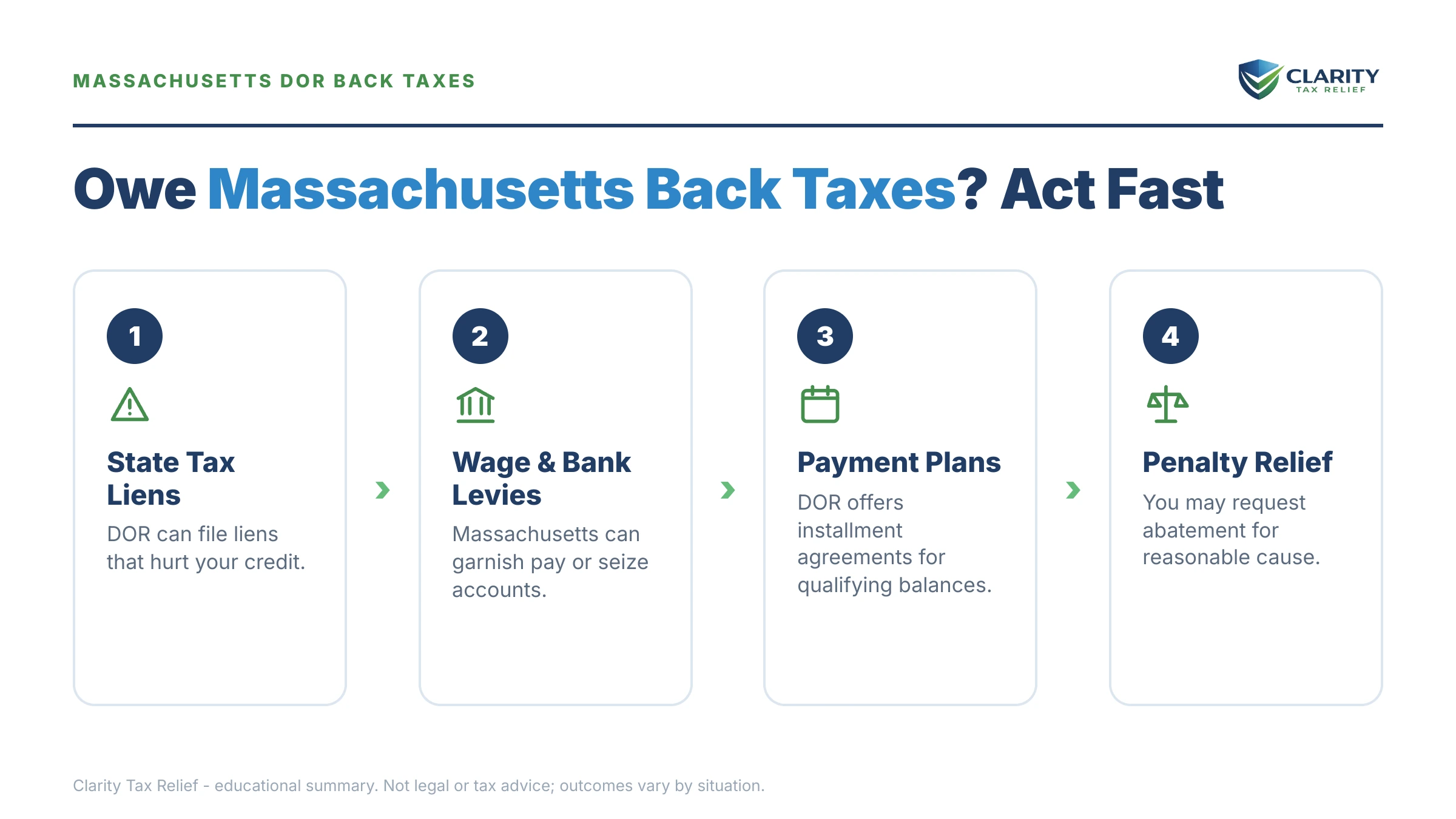
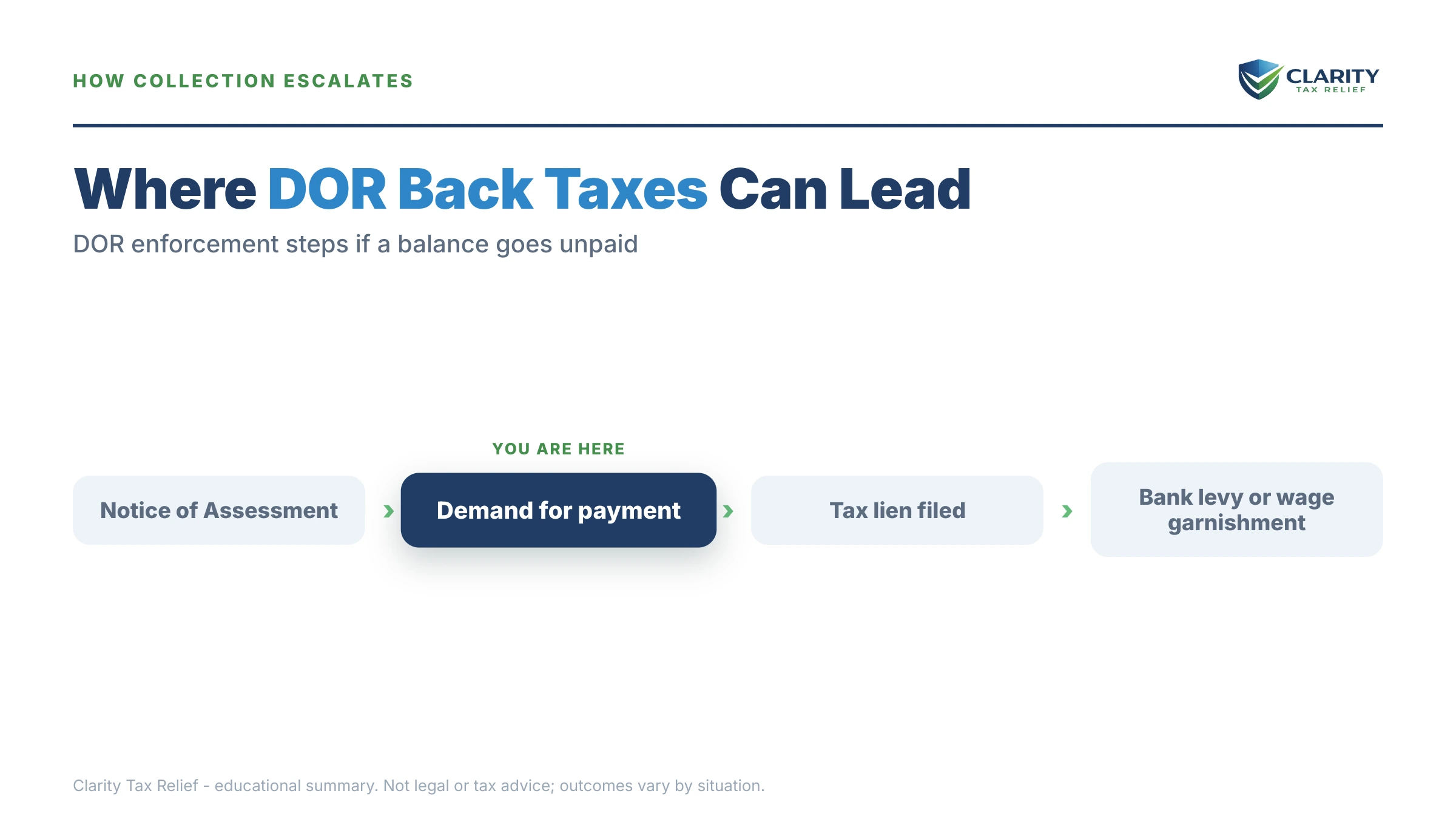
Massachusetts collection is a sequence, and it runs on automation — each unanswered notice unlocks a more aggressive tool. Here is the order most individual cases follow:
- Notice of Intent to Assess (NIA) — DOR proposes additional tax. You generally have 30 days from the notice date to dispute it with documentation before it becomes final. This is the cheapest exit on the whole timeline.
- Notice of Assessment (NOA) — the tax is now legally on the books. The notice prints a pay-by date; penalties and interest are already running. (If you filed and simply didn't pay, your case may start here.)
- Demand for payment — DOR's last routine bill. Collection charges can be added, and the account is queued for enforcement.
- Enforcement — a Massachusetts tax lien against your property, bank levies, a wage levy through your employer, interception of your state refunds, renewal holds at the RMV, and possible referral to a private collection agency. DOR also publishes a public list of delinquent taxpayers.
Two things make the DOR different from a private creditor. First, it never needs to sue you — assessment plus demand is all the legal authority DOR needs to levy a bank account or paycheck. Second, its levies reach places private creditors can't easily go, including your state refund every single year until the debt is gone.
The license angle catches people off guard. Massachusetts law lets DOR flag your driver's license and vehicle registration renewals at the RMV while a tax debt sits unresolved, and state boards can refuse to renew professional licenses — a nurse, real estate agent, contractor, or attorney can find a career document held hostage by an old tax year. And moving out of state doesn't reset anything: DOR collects across state lines and the lien follows your Massachusetts property record.
| Stage | What it means | Your window |
|---|---|---|
| Notice of Intent to Assess (NIA) | Proposed additional tax, not yet final | Generally 30 days from the notice date to dispute |
| Notice of Assessment (NOA) | Tax is legally assessed; penalties and interest accruing | Pay-by date printed on the notice |
| Demand for payment | Final routine bill; collection fees can be added | Date printed on the demand — last stop before enforcement |
| Tax lien | Public claim against your real estate and personal property | Remains until the debt is resolved and the lien released |
| Bank / wage levy | Funds seized from accounts; ongoing cut of each paycheck | Continues until released — a wage levy doesn't expire on its own |
| License & registration holds | RMV and professional-license renewals blocked | Lifted after payment or an approved arrangement |
While all of this runs, the meter runs too. Massachusetts charges a late-pay penalty of 1% per month, capped at 25%, twice the IRS's monthly rate, plus a separate 1%-per-month penalty (also capped at 25%) if the return itself was filed late. Interest accrues on top at the federal short-term rate plus 4 percentage points. The rate resets each quarter — 7% as of mid-2026, down from 8% earlier in the year.
Holding a DOR notice right now?
Send us a photo of it before the response date printed on it passes. An experienced tax professional will decode which stage you're at, what the DOR can and can't do next, and which resolution actually fits your numbers — free and confidential.
Your options for resolving Massachusetts back taxes
The DOR offers more resolution paths than its notices advertise, but each has its own eligibility test. The right one depends on your income, assets, and whether the assessed amount is even correct.
| Option | Who it fits | What it costs / key catch |
|---|---|---|
| Pay in full via MassTaxConnect | Anyone who can raise the money | Stops all penalty and interest accrual immediately — always the cheapest path |
| Payment agreement | Steady income, can't pay at once | Interest and the 1%/month penalty continue during the plan; missing a payment risks default |
| Hardship status | Paying would prevent covering basic living expenses | Pauses active collection; the debt, lien, and interest all remain |
| Penalty abatement (Form ABT) | Reasonable cause — illness, disaster, events beyond your control | Removes penalties only, not the tax or interest; must be requested in time |
| Offer in Final Settlement | Serious doubt DOR could ever collect in full | Full financial disclosure; strict review; rarely approved |
| Innocent spouse relief | Joint-return debt caused by a spouse or ex-spouse | Must show the understatement wasn't yours and you didn't know of it |
| Abatement dispute + Appellate Tax Board | The assessed tax itself is wrong | Strict deadlines; DOR keeps collecting unless you secure a hold |
Payment agreements through MassTaxConnect
A DOR payment agreement is the workhorse resolution for most Massachusetts filers. You request it through MassTaxConnect. Smaller balances are often approved self-service in minutes, while larger balances or longer terms require a financial statement and DOR sign-off. Interest and the monthly late-pay penalty keep accruing during the plan, so every extra month of term costs real money — take the shortest schedule your budget survives. Stay current on new-year filings and payments, because a missed return can default the whole agreement.
Hardship status
If paying DOR anything would leave you unable to cover rent, food, utilities, or medical care, DOR can mark the account as a financial hardship and pause active collection. It's Massachusetts' rough equivalent of the IRS's Currently Not Collectible status: levies stop. But the debt remains, interest grows. A lien typically stays or gets filed to protect the state's position. DOR revisits hardship periodically, so it's a shelter, not a solution.
Penalty abatement
Massachusetts penalties can be abated for reasonable cause — serious illness, a death in the family, a disaster, reliance on bad professional advice — using Form ABT. On an aged debt, penalties can be a quarter of the balance, so this is often the single biggest dollar lever available. The same reasonable-cause logic applies federally; see reasonable-cause penalty abatement for how these arguments are built. Note that interest itself is almost never waived — it's set by statute.
Offer in Final Settlement
Massachusetts can accept less than the full balance through an Offer in Final Settlement (Form M-656 with a full financial disclosure), but only when there is genuine doubt the state could ever collect the full amount from your income and assets. The review is strict, approval is rare, and DOR requires you to be current on all filings first. Anyone promising you a guaranteed Massachusetts settlement is selling, not advising — eligibility is a math test, not a negotiation trick.
Innocent spouse relief
If the debt comes from a joint return and traces to income or errors that were your spouse's — income you didn't know about and had no reason to know about — Massachusetts offers innocent spouse relief that can remove your liability for that portion. This matters enormously after divorce, because DOR is free to collect 100% of a joint debt from either signer. The federal version is covered in innocent spouse relief: how to qualify. If the same year produced an IRS balance, the two applications should be coordinated.
Disputing the tax itself
If the assessment is simply wrong — DOR taxed income that isn't yours, missed withholding, or double-counted a year — file an Application for Abatement (Form ABT). The deadline is generally the latest of three dates: three years from when the return was due, two years from the assessment date, or one year from the date you paid. If DOR denies the abatement, you can appeal to the Appellate Tax Board, generally within 60 days of the denial. Deadlines here are unforgiving; a strong case filed late is a dead case.
Say you owe DOR $8,900 after a divorce: the math
A hypothetical to make the numbers concrete. Say you're recently divorced and DOR says you owe $8,900 on the final joint return you and your ex filed for 2024 — his self-employment income was underwithheld, the decree says he pays "all tax debts," and he hasn't.
Fifteen months after the due date, here's what the $8,900 has become:
- Late-pay penalty: 1% × 15 months = 15% → about $1,335
- Interest: roughly 8% a year → about $890 over 15 months (illustrative, based on the rate in effect when this example was calculated. The rate resets each quarter and is 7% as of mid-2026)
- Approximate balance: $11,125, and it grows about $160 more each month it sits
Now the options, on those numbers. A 24-month payment agreement runs roughly $465 a month, a bit more in practice because penalty and interest accrue during the plan. A 12-month plan at roughly $930 a month cuts that accrual nearly in half. If the return had also been filed late, a second 1%-per-month penalty would have added another $1,335 by now — filing on time, even without paying, saved that entire layer.
But the divorce changes the analysis. Because the $8,900 traces to your ex's unreported income, an innocent spouse application could remove your liability for some or all of it. The decree, while useless against DOR, is enforceable against your ex in family court. The right sequence is often: verify the assessment, file for innocent spouse relief, and put a payment agreement in place to block levies while DOR decides. Order matters; that's precisely where an experienced tax professional earns their fee on a case like this.
How to respond to Massachusetts DOR back taxes, step by step
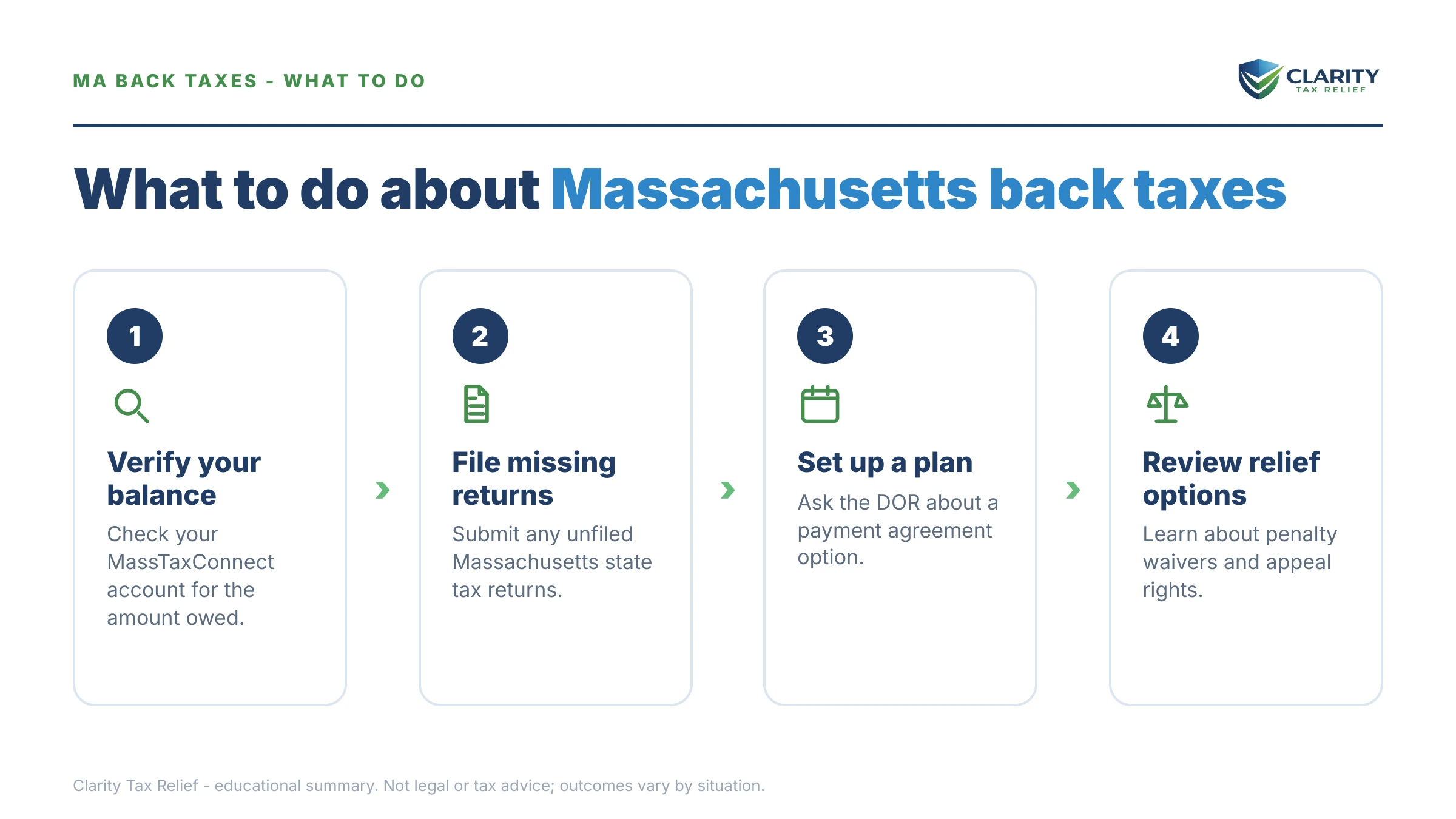
- Identify your notice and its date. Find the notice type (NIA, Notice of Assessment, or a demand for payment) in the header and the response date printed on it. That date controls everything else.
- Verify the balance on MassTaxConnect. Create or log into your MassTaxConnect account and compare DOR's figures, year by year, against your own returns and payment records.
- File every missing Massachusetts return. If DOR estimated a year for you, filing the actual return usually replaces the inflated estimate, and DOR won't approve any resolution while returns are missing.
- Set up your resolution before the response date. Pay in full, request a payment agreement, apply for hardship status, or start a settlement application — any approved arrangement stops enforcement from moving forward.
- Dispute anything that's wrong in writing. File Form ABT for an abatement within the deadline window, and appeal to the Appellate Tax Board if DOR denies it.
Massachusetts DOR vs. the IRS: what's different
The DOR's late-pay penalty accrues at twice the IRS's monthly rate, and Massachusetts is not bound by the IRS's 10-year collection statute. If you owe both — extremely common, since the same underwithheld year usually produces two bills — the differences below decide which fire to put out first.
| Item | Massachusetts DOR | IRS |
|---|---|---|
| Late-pay penalty | 1% per month, max 25% | 0.5% per month, max 25% |
| Late-file penalty | 1% per month, max 25% | 5% per month, max 25% |
| Online portal | MassTaxConnect | IRS Online Account |
| Payment plans | Via MassTaxConnect; larger balances need disclosure | Up to 72 months online for balances ≤ $50,000 |
| Settlement program | Offer in Final Settlement — strict, rare | Offer in Compromise — $205 fee; roughly 1 in 5 accepted in FY2024 |
| Collection time limit | State-law rules — the federal 10-year CSED does not apply | Generally 10 years from assessment, with pauses |
| License consequences | RMV and professional-license renewal holds | Passport certification at $66,000+ (2026) |
Which to resolve first depends on who's closer to levying and whose penalties are growing faster — the full decision framework is in state tax debt vs. IRS: which to resolve first. Two mechanics worth knowing: the IRS can seize your Massachusetts refund for a federal debt (see state refund taken for IRS debt), and Massachusetts can reach your federal refund through the reciprocal offset side of the Treasury Offset Program. Your refunds, both directions, are already spoken for until these debts are handled. Federal payment mechanics live at IRS.gov/payments.
When you can handle this yourself, and when help changes the outcome
Plenty of Massachusetts back-tax cases need no professional at all. Handle it yourself if: the balance is accurate and small enough to pay within a few months. You're current on filings and just need a straightforward MassTaxConnect payment agreement. Or your only issue is one late-filed return you can submit today. DOR's self-service tools are genuinely usable for those cases, and paying a firm to click through them wastes your money.
Experienced help changes outcomes in a different set of situations: a levy is already hitting your paycheck or bank account. Multiple years are unfiled and DOR has estimated assessments on the books. The debt is joint and an innocent spouse case needs building. You're weighing an Offer in Final Settlement, where the financial-disclosure math decides everything. The debt is business trust tax with personal-liability exposure. Or you owe DOR and the IRS at once and the sequencing isn't obvious. In those cases the fee usually buys back more than it costs — in released levies, abated penalties, or liability that lands on the right person.
If you're near the city and want the local picture — courts, DOR's Boston presence, and how enforcement plays out here — see our guide to tax relief in Boston. And if the deciding factor is that joint return, start with why tax agencies ignore your divorce decree. It reframes what the decree can and can't do for you.
Not sure which side of that line you're on? A free review with an experienced tax professional will tell you honestly whether your DOR case is a DIY payment agreement or something worth defending — call (888) 825-7779 or use the 2-minute form.
Terms on your DOR notice, decoded
- Notice of Intent to Assess (NIA): DOR's proposed extra tax, not final yet, and disputable within the printed window.
- Notice of Assessment (NOA): the moment a tax becomes legally collectible; penalties and interest are running from here.
- MassTaxConnect: DOR's online portal — where you check balances, file, pay, and request payment agreements.
- Lien vs. levy: a lien is a public claim securing the debt against your property. A levy is the actual taking — from a bank account, paycheck, or refund.
- Form ABT: the Application for Abatement — the form that disputes an assessed tax or requests penalty relief.
- Appellate Tax Board (ATB): the independent state body that hears appeals when DOR denies an abatement — see the Appellate Tax Board for its procedures.
Massachusetts DOR back taxes: your questions, answered
Can the Massachusetts DOR garnish my wages?
Yes. DOR can levy your wages through your employer without going to court. The levy stays in place until the debt is paid or you make other arrangements. Setting up a payment agreement or being placed in hardship status generally stops a wage levy. If a levy is already hitting your paycheck, act quickly — DOR will not release it retroactively.
Does Massachusetts have a statute of limitations on collecting back taxes?
Don't count on the IRS's 10-year rule. It does not apply to Massachusetts. State collection timelines are set by Massachusetts law, and DOR liens and enforcement can continue far longer than most people expect. Waiting out the clock is not a realistic strategy for a DOR debt; resolving it through a payment agreement, hardship status, or settlement is.
Can the DOR suspend my driver's license for back taxes?
Massachusetts law allows DOR to block the renewal of your driver's license and vehicle registration at the RMV while tax debts go unresolved, and state boards can refuse to renew professional licenses for the same reason. These holds typically lift once you pay or enter an approved payment arrangement. But they can surface at the worst possible time, usually when your renewal comes due.
Does Massachusetts have an offer in compromise program?
Yes, but under a different name: the Offer in Final Settlement. DOR can accept less than the full balance when there is serious doubt it could ever collect the full amount, based on a detailed financial disclosure. Approval is rare and the review is strict. It is not a program for people who simply don't want to pay, and DOR expects you to be current on all filings first.
My divorce decree says my ex pays the taxes — can DOR still come after me?
Yes. A divorce decree is a contract between you and your ex; it does not bind the DOR or the IRS. If the debt comes from a joint return, both signers remain fully liable, and DOR can collect the entire balance from whichever spouse is easier to reach. Your remedies are innocent spouse relief through DOR and, separately, enforcing the decree against your ex in family court.
Can I set up a Massachusetts DOR payment plan online?
Yes. MassTaxConnect lets you request a payment agreement online, and smaller balances are often approved in minutes without a financial statement. Larger balances or longer terms require more disclosure and DOR approval. Interest and the monthly late-pay penalty continue to accrue while you pay, so a shorter plan always costs less overall.
Will the DOR take my tax refunds?
Yes — Massachusetts automatically applies your state refunds to the balance until it's gone, even if you're current on a payment agreement. The state can also request an offset of your federal refund through the reciprocal offset program with the U.S. Treasury. If you routinely get large refunds, adjusting your withholding puts that money in your paycheck instead of DOR's hands.
What is a Notice of Intent to Assess from Massachusetts?
A Notice of Intent to Assess (NIA) is DOR's proposed change to your tax — the tax isn't final yet. You generally have 30 days from the notice date to dispute it with documentation before DOR issues a Notice of Assessment and the balance becomes legally collectible. The NIA window is your cheapest chance to fix an error; disputes after assessment require a formal abatement application.
Can the Massachusetts DOR levy my bank account?
Yes. Once a tax is assessed and demand has been made, DOR can seize funds directly from your bank account without a court judgment. Unlike a wage levy, a bank levy grabs what's in the account at that moment, and DOR can repeat it. A payment agreement, hardship status, or a pending settlement application is what stops bank levies — a notice you leave unanswered will not.
Your next 24 hours
- Find two lines on your notice: the notice type in the header (NIA, Notice of Assessment, or demand) and the response date printed on it. Those two facts determine which options are still open.
- Gather your paper: the notice, your last Massachusetts return, proof of any payments, current income figures — and, if the debt is from a joint return, your divorce decree. Then verify DOR's numbers against your own at the Massachusetts Department of Revenue's MassTaxConnect portal.
- Get your free case review before the response date passes: the balance grows at 1% per month plus interest every month it sits. An approved arrangement is what stops liens and levies. Call (888) 825-7779 or use the 2-minute form — an experienced tax professional will map your exact DOR options at no cost.
This guide is general information, not tax or legal advice for your specific situation. Eligibility for IRS programs depends on individual facts and circumstances; no outcome is guaranteed.