
State Back Taxes
Minnesota Back Taxes in 2026: How to Resolve What You Owe the State
The short answer: Minnesota back taxes are collected by the Minnesota Department of Revenue, which can intercept refunds, file liens, and levy wages and bank accounts without a court order. You can resolve the debt with a payment agreement, penalty abatement, hardship status, or, in limited cases, a compromise for less than the full balance.
You built the business yourself — the invoices, the mileage, the quarterly guesswork — and now a letter from St. Paul says a past year never got fully paid. That knot in your stomach is normal, and it's also the last unproductive minute you need to spend on this. Minnesota publishes real resolution paths, and every one of them works better the earlier you start.
⏱ Your clock: there is no single statutory deadline on Minnesota back taxes — the date that controls is the response date printed on your most recent Department of Revenue notice. Meanwhile, penalties and interest grow every month, and each letter in the state's sequence carries more enforcement power than the last.
Why you owe Minnesota back taxes
Minnesota back taxes almost always trace to one of four events: an unpaid balance on a filed return, missed estimated payments, an IRS adjustment that flowed to the state, or returns you never filed.
You filed but couldn't pay. This is the classic self-employed pattern: no employer withholding, quarterly estimates skipped in a tight cash-flow year. A balance due at filing. If that's your story, the same year probably generated a federal balance too — see the self-employment tax shock, explained and the penalty math when you didn't pay quarterlies.
A federal change reached the state. The IRS shares audit and underreporter adjustments with Minnesota. If the IRS added income to a past year — a CP2000, an audit, a 1099 you missed — a matching Minnesota bill often shows up months later, with its own penalties and interest attached.
You never filed, so Minnesota filed for you. When a return is missing, the Department can issue a Commissioner Filed Return built from W-2s, 1099s, and other data it holds. It includes zero business expenses, deductions, or credits, so for a sole proprietor, the assessed tax is usually far higher than the real number. Filing the actual return replaces it. If several years are missing, start with how many years of back taxes you have to file.
Your business collected trust taxes and didn't remit them. Sales tax and employee withholding are money the state considers already its own. It collects them more aggressively than income tax, with personal liability for the people responsible. A sole proprietor has no entity between themselves and that debt at all. Our guide to state sales tax debt help covers this branch in depth.
“Your refund may be reduced to pay a prior debt. This may include: Past-due child support Federal agency non-tax debts State income tax obligations Certain state unemployment compensation debt”
— Reduced refund (IRS.gov)
What happens if you ignore Minnesota back taxes
How the state escalates to liens and levies
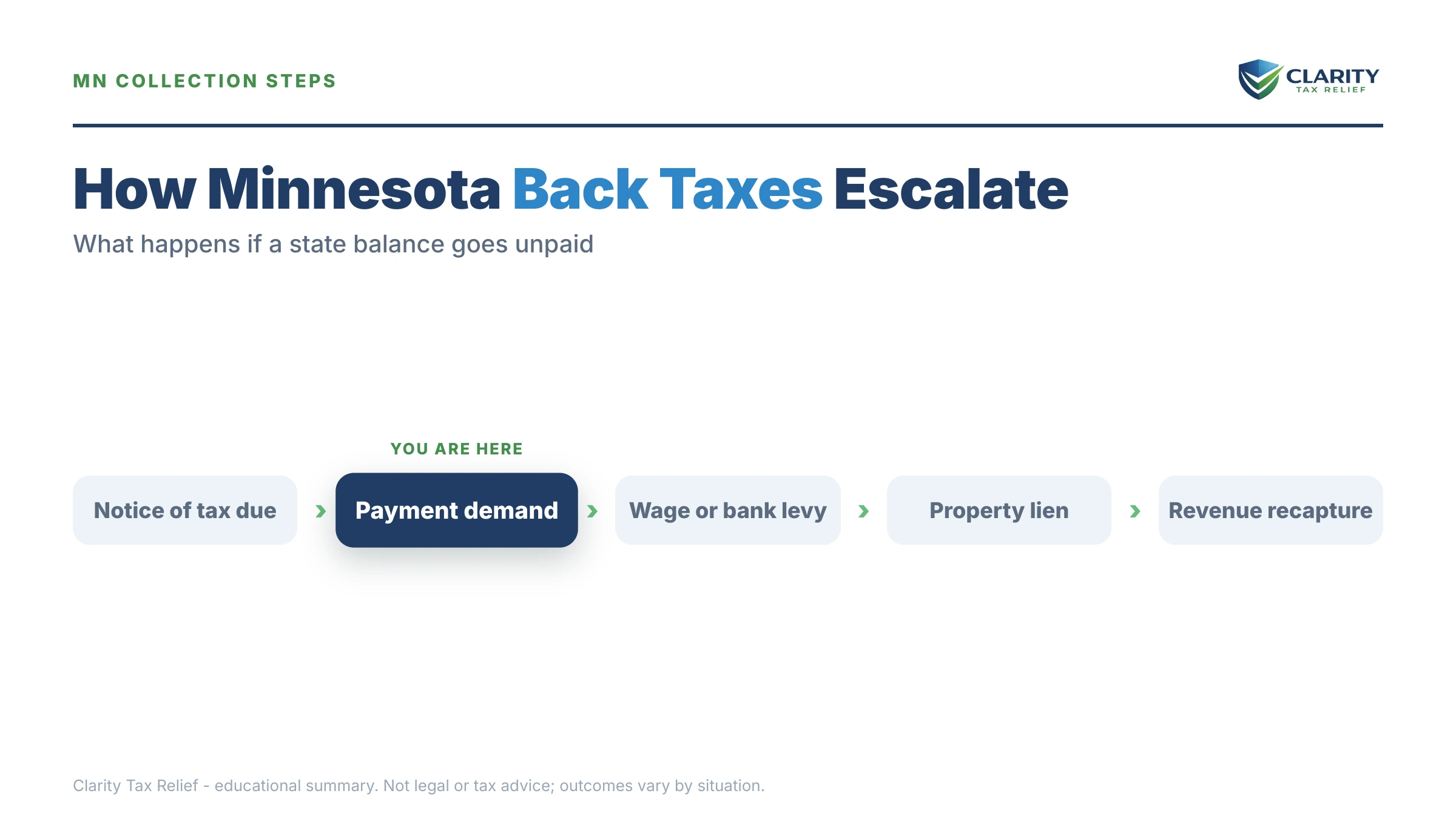
The Minnesota Department of Revenue can levy your wages, your bank accounts, and even payments your customers owe you — all administratively, without ever going to court. The sequence below is how an unpaid balance escalates. Don't calibrate your urgency to IRS pacing: the state's letter ladder is shorter than the IRS's five-notice sequence. Its automation doesn't wait for a human to review your file.
- Balance-due notice / order of assessment — the state's first bill. The tax year, amount, and response date are printed on it; disputing the amount gets much harder after that date passes.
- Demand for payment — the tone shifts. The Department now expects payment or a formal arrangement, and additional collection costs can start attaching to the balance.
- Revenue Recapture — your state refunds and even lottery winnings get applied to the debt automatically. This often starts early, before any of the harsher steps.
- Tax lien — filed in public records against your real estate and business assets. It complicates refinancing, closings, and business credit even though liens no longer appear on consumer credit reports.
- Levy — the Department can take funds from your bank account, up to 25% of disposable earnings from wages, and, critical for the self-employed, payments your customers owe you, by serving the levy directly on them.
- License actions and liquor posting — professional and occupational license issuance or renewal can be blocked for delinquent taxes, and hospitality businesses can be posted on the state's delinquent liquor list, cutting off alcohol purchases from wholesalers.
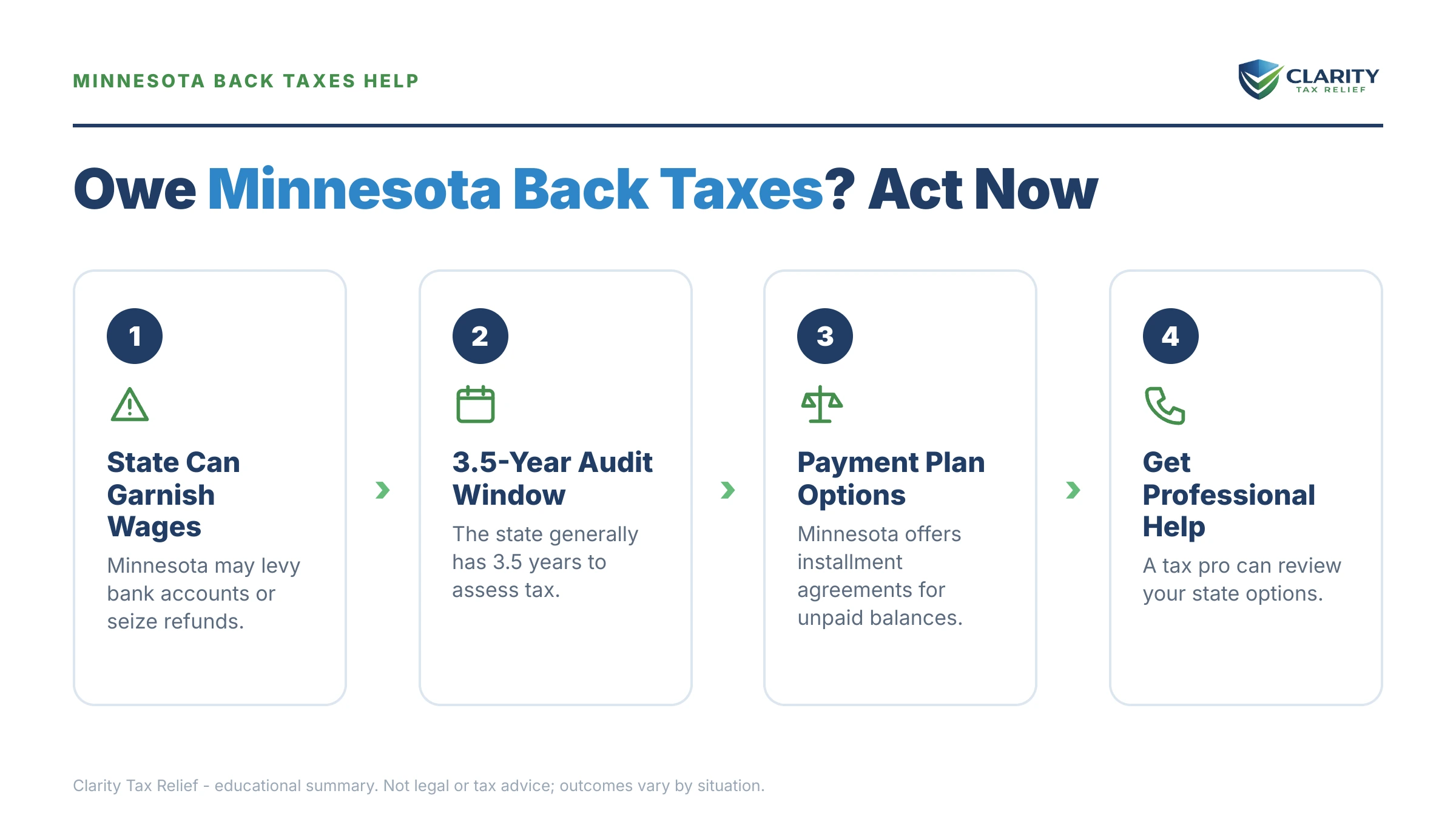
- Ongoing enforcement — the state repeats levies, renews liens, and keeps intercepting refunds. Minnesota's collection window is set by state law, is different from the IRS's 10-year rule, and can be extended by events on your account. This debt does not quietly expire.
Here's how those tools compare, and what actually stops each one:
| Enforcement action | What it reaches | How to stop or limit it |
|---|---|---|
| Revenue Recapture | State refunds, lottery winnings | Very little once you owe — expect refunds to be applied to the debt until it's paid, even on a payment agreement |
| Tax lien | Real estate, business assets; public record | Resolve the balance, then request the release; getting ahead of the lien filing is far cleaner |
| Wage levy | Up to 25% of disposable earnings, ongoing | A payment agreement set up before the levy is served, or a documented hardship showing after |
| Bank levy | Funds in the account when the levy hits | An agreement before service; a hardship-based release request after |
| Third-party / receivables levy | Payments your customers or clients owe you | An agreement before the levy lands — once customers get state paperwork, the business damage is done |
| License holds & liquor posting | Professional/occupational licenses; alcohol purchasing for bars and restaurants | Come into filing and payment compliance, typically via a payment agreement kept current |
| Federal refund offset | Your IRS refund, via the Treasury Offset Program | Resolve the state balance; see how the Treasury Offset Program works |
For a self-employed reader, the receivables levy is the one that changes businesses: a state levy served on your three biggest customers doesn't just take money. It tells every one of them you're in tax trouble.
Holding a Minnesota Department of Revenue notice right now?
Get it reviewed free before the state moves from letters to lien and levy. An experienced tax professional will decode exactly where your account stands, on the Minnesota side and the IRS side, and map your options. Free, confidential, no pressure.
Your options for resolving Minnesota back taxes
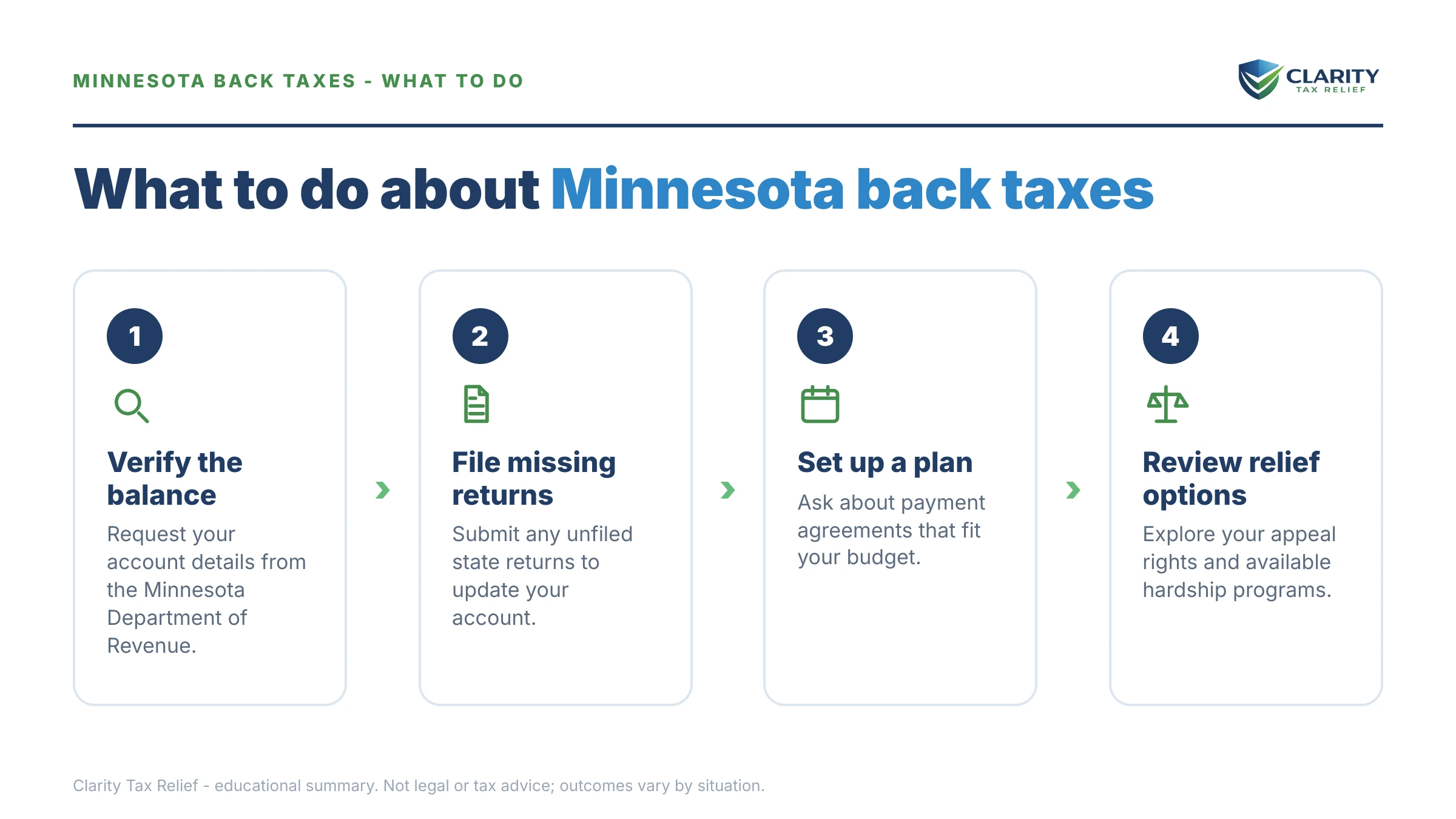
Minnesota offers five real paths out of back taxes: full payment, a payment agreement, penalty abatement, hardship status, and compromise. Which one fits depends on what you can actually pay, not on what a sales pitch promises.
| Option | Best fit | Key requirement |
|---|---|---|
| Pay in full | You can raise the money within weeks | None — payment stops further penalty and interest and ends the notice sequence |
| Payment agreement | Steady income, can't pay all at once | Stay current on new filings and estimated payments; falling behind can revoke the agreement |
| Penalty abatement | A real reason you fell behind — illness, disaster, bad written advice | A written request with documentation showing reasonable cause |
| Hardship / temporary delay | Paying anything would leave you unable to cover basic living costs | Full financial disclosure; the debt keeps growing while collection is paused |
| Compromise (settle for less) | You can never realistically full-pay — low income, no reachable assets | Full financial disclosure convincing the state that full collection is doubtful |
| Correct the assessment | The amount is wrong, or a Commissioner Filed Return inflated it | File the real return, or appeal within the window printed on the assessment order |
Payment agreement. This is the workhorse for most Minnesota balances. You can set one up online, by phone, or in response to a notice, and unlike the IRS's published 72-month online cap, the Department negotiates the term against your finances. Interest keeps accruing on the unpaid balance at Minnesota's annual rate — the state publishes the current figure each year — so shorter terms cost less in total. A setup fee may apply; confirm the current amount when you enroll. The condition people miss: the agreement lives or dies on staying current with this year's taxes. A self-employed person who misses 2026 quarterlies while paying down 2024 usually ends up with a revoked agreement and two years of debt.
Penalty abatement. Minnesota can remove penalties for reasonable cause — a documented illness, a disaster, reliance on incorrect written advice. It's a written request with evidence, not a form letter, and it reduces the balance rather than restructuring it. Interest on the tax itself is much harder to remove. Federal penalty programs like first-time abatement don't apply here; the state runs its own standards.
Hardship / temporary delay. If paying anything would leave you unable to cover rent, food, and utilities, the Department can pause active collection after reviewing your finances. This is a pressure valve, not a fix: penalties and interest keep accruing, refunds keep getting recaptured, and the state revisits your situation later.
Compromise. Minnesota can settle a debt for less than the full amount, its version of an offer in compromise, but only when full financial disclosure shows the state is unlikely to ever collect in full. It's a separate process from the federal OIC with its own standards, and an accepted IRS offer doesn't automatically settle the state side. If you have steady self-employment income and any equity, expect to be steered toward a payment agreement instead. A compromise is a genuine option for genuine inability, not a discount program.
Correcting the assessment. If the number is wrong — a Commissioner Filed Return that ignored your expenses, a federal adjustment you already resolved, a payment that never posted — fix the number before you negotiate payment of it. Filing the real return against a CFR is often worth more than any relief program on this list.
Here's what each path costs and how long it takes:
| Option | Upfront cost | Ongoing cost | Typical timeline |
|---|---|---|---|
| Pay in full | The balance itself | None — accrual stops | Immediate |
| Payment agreement | Possible setup fee (confirm the current amount with the Department) | Interest continues on the declining balance | Often set up the same week |
| Penalty abatement | Free to request | None — reduces the balance if granted | Weeks to a few months |
| Hardship / temporary delay | Free; full financial disclosure required | Penalties and interest keep accruing | Days to weeks once documented |
| Compromise | Full financial disclosure plus the offer funds | Interest accrues until a decision | Several months |
| Correct the assessment | Free (your time or a preparer's fee) | Balance accrues unless and until adjusted | Varies with the Department's processing |
A worked example: $8,900 in Minnesota back taxes as a sole proprietor
A hypothetical sole proprietor balance, step by step
Say you owe $8,900 to Minnesota for tax year 2024 — you're a self-employed sole proprietor, you filed on time (which spared you the much larger late-filing penalty). But the cash wasn't there in April. Clearly hypothetical numbers, but the structure is what matters:
- Do nothing: late-payment penalties and interest compound monthly, your 2026 state refund gets recaptured. The account marches through demand, lien, and levy — including possible levies served on your customers.
- 24-month payment agreement: $8,900 ÷ 24 ≈ $371/month before interest. Interest accrues on the shrinking balance at Minnesota's published annual rate, so the true monthly cost runs somewhat higher early on.
- 36-month payment agreement: $8,900 ÷ 36 ≈ $248/month before interest — easier on cash flow, but more months of interest, so a higher total cost.
- The accelerator: take the 36-month term for safety, then pay $300–$350 in good months. Every extra dollar goes to principal and cuts months of interest off the back end, with no prepayment penalty.
One more layer: the same 2024 Schedule C probably left a federal balance too. If your IRS debt is under $10,000, you're in guaranteed installment agreement territory on the federal side — the IRS must accept a qualifying three-year payment plan. Size the two payments together so you can honor both.
How to resolve Minnesota back taxes, step by step
- Gather every notice and request your account records. Collect all Department of Revenue letters and request a statement of account for each year you owe, so you know exact balances, assessment dates, and which years are actually in play.
- File any missing Minnesota returns. Replace Commissioner Filed Returns with your real returns. For a sole proprietor, your actual Schedule C expenses often cut the assessed balance sharply, because the state's version ignores every deduction.
- Verify the balance and note your appeal window. If you dispute an assessment, the response date printed on the order controls your right to challenge it — act before that date passes, because the debt becomes much harder to contest afterward.
- Choose and set up your resolution. Pay in full if you can. Otherwise open a payment agreement, request penalty abatement in writing, document hardship if you truly cannot pay, or pursue a compromise if full collection is genuinely doubtful.
- Stay current on this year's taxes. Make your 2026 estimated payments on time. New unpaid debt is the most common reason Minnesota payment agreements get revoked, and revocation puts you back in line for levy.
- Get a professional review if enforcement has started. If a levy is already in motion, a lien has been filed, or several years are unfiled, have an experienced tax professional review the account before you commit to a plan — the order you fix things in changes what you pay.
The Department's official information, forms, and payment portal live at the Minnesota Department of Revenue — that's the only site you should ever pay a Minnesota tax debt through.
If you owe both Minnesota and the IRS
Owing both agencies for the same year is the norm for the self-employed, not the exception, and the two debts collide in specific ways. The IRS can seize your Minnesota refund through the State Income Tax Levy Program, and Minnesota can take your federal refund through the Treasury Offset Program. Whichever agency you ignore, the other one's refund is the first casualty.
Which do you resolve first? Usually the state, because Minnesota reaches levy in fewer steps. But the honest answer depends on which agency is closer to enforcement on your account. The full decision framework lives in our hub on state tax debt vs. the IRS: which to resolve first. The short version is that the winning play is almost always an arrangement with both, sized so neither defaults.
On the federal side, balances under $50,000 can generally go on a plan of up to 72 months online — see how to set up an IRS payment plan online and the official IRS payment plans page. Federal failure-to-pay penalties run 0.5% per month on top of interest. You can estimate what the federal side is actually costing you with our IRS Penalty & Interest Calculator. Remember that federal relief programs — first-time abatement, the new Automatic Exemption from Penalty arriving in summer 2026, the IRS Offer in Compromise — fix only the federal balance. Minnesota's programs are separate applications with separate standards.
One 2026 reality check that applies to both sides: the IRS workforce shrank roughly 27% in 2025, and Minnesota's systems are heavily automated too. Being unable to reach a human never pauses a machine-issued levy. It just makes the levy harder to unwind after the fact.
When you can handle Minnesota back taxes yourself
Doing it yourself versus bringing in help
You can usually resolve a small Minnesota balance yourself with one phone call or an online payment agreement. Be honest about which side of this line you're on:
Handle it yourself when: it's one tax year, you agree with the amount, no levy or lien has landed yet. You can pay it off within a manageable term. Setting up a payment agreement directly with the Department is straightforward, and you don't need to pay anyone to do it.
Experienced help changes the outcome when: a levy has already been served on your bank, wages, or customers. Several years are unfiled or sitting as inflated Commissioner Filed Returns. The debt involves sales tax or withholding with personal-liability exposure. You owe Minnesota and the IRS at once and the sequencing matters. Or you're weighing a compromise, where the financial-disclosure math decides everything. In those cases the order of operations — returns first, penalties second, balance last — routinely changes the final number.
If the state has already served a levy on your account or your customers, don't negotiate alone — get a free Minnesota back-tax case review or call (888) 825-7779 before the next payment cycle gets taken.
If your dispute is really with the federal side of a shared problem and you can't get traction, the independent Taxpayer Advocate Service exists for exactly that. And if you'd rather have local context, we cover the metro specifically in our guides to tax relief in Minneapolis and tax relief in St. Paul.
Terms on your Minnesota notice, decoded
- Revenue Recapture — Minnesota's program for automatically applying your state refunds and lottery winnings to debts you owe the state.
- Commissioner Filed Return (CFR) — a return the Department files for you when you don't, using raw income data with no deductions or expenses. Replace it by filing the real return.
- Order of assessment — the formal document making a tax amount legally owed; the response date printed on it controls your window to dispute.
- Lien vs. levy — a lien is a public claim against your property; a levy is the actual taking of money or assets. The lien secures; the levy seizes.
- Compromise — Minnesota's process for settling a tax debt for less than the full balance when full collection is doubtful. Separate from the IRS Offer in Compromise.
- Liquor posting — the state's public list of tax-delinquent bars and restaurants, which legally blocks wholesalers from selling them alcohol.
Minnesota back taxes: your questions, answered
How long can Minnesota collect back taxes?
Minnesota's collection window is set by state law and is different from the IRS's 10-year rule, and certain events, like payment agreements or bankruptcy, can extend it. Because tax liens can also be renewed, waiting out the state is rarely a workable strategy. Request your account statement from the Department of Revenue to see the assessment dates that start the clock for each year you owe.
Does Minnesota offer a payment plan for back taxes?
Yes. The Minnesota Department of Revenue sets up payment agreements online, by phone, or in response to a notice. There is no single published maximum term like the IRS's 72-month online plan, the length depends on your finances, and interest keeps accruing while you pay. Miss a payment or fall behind on new taxes and the agreement can be revoked, putting you back in line for levy.
Can the Minnesota Department of Revenue garnish my wages without a court order?
Yes. State law lets the Department levy your wages administratively, no lawsuit or judge required, generally reaching up to 25% of your disposable earnings until the debt is paid or the levy is released. Self-employed people face a parallel risk: the state can send levies to your customers and take payments they owe you. A payment agreement in place before the levy is served prevents both.
Does Minnesota have an offer in compromise program?
Yes — Minnesota can compromise a tax debt for less than the full balance, but only after full financial disclosure shows the state is unlikely to ever collect in full. It is a separate process from the IRS Offer in Compromise, with its own forms and standards. An accepted federal offer does not automatically settle the Minnesota side. Most applicants with steady income and equity are steered to a payment agreement instead.
Will Minnesota take my tax refunds for back taxes?
Expect it. Under the state's Revenue Recapture program, Minnesota applies your state refunds, and even lottery winnings — to the debt automatically, usually before any other collection step. Minnesota income tax debts can also be certified for offset of your federal refund through the Treasury Offset Program. Refund interception typically continues even while you are on a payment agreement, so do not count on that money.
What is a Commissioner Filed Return in Minnesota?
It is a return the Department of Revenue files for you when you don't file — built from wage statements, 1099s, and other data, with no deductions, credits, or business expenses. For a self-employed person it usually overstates the real tax badly because it ignores every expense on your Schedule C. You can replace it by filing your actual return, which often shrinks the assessed balance significantly.
Should I pay Minnesota or the IRS first if I owe both?
Usually the state gets first attention, because Minnesota reaches levy in fewer steps than the IRS's long notice ladder. But the right order depends on which agency is closer to enforcement in your case. The workable answer is often an arrangement with both: a Minnesota payment agreement plus an IRS installment agreement, sized so you can honor both without defaulting on either.
Can Minnesota take my professional or business license for back taxes?
It can create serious license problems, yes. Minnesota can block the issuance or renewal of professional and occupational licenses for delinquent state taxes, and bars and restaurants that fall behind can land on the state's liquor posting list — which legally cuts off their alcohol purchases from wholesalers. Getting into a payment agreement and staying current is generally what clears these holds.
Can Minnesota remove penalties from my back taxes?
Minnesota can abate penalties when you show reasonable cause — serious illness, disaster, reliance on wrong written advice, and similar circumstances beyond your control. It is a request you make in writing with documentation; interest on the underlying tax is much harder to remove. Note that the IRS's first-time abatement and the new Automatic Exemption from Penalty are federal programs. They do not apply to your Minnesota balance.
Your next 24 hours
- Find the response date and letter ID on your most recent Minnesota Department of Revenue notice. That date is the only clock that matters, and the letter ID tells any professional exactly where your account sits in the sequence.
- Gather your paperwork: every state notice you've received, your last filed federal and Minnesota returns. Your current income records — invoices, 1099s, bank statements.
- Get a free case review at the 2-minute form or (888) 825-7779. Penalties and interest on a Minnesota balance grow every month, and levies stop being preventable once they're served — the review costs nothing and tells you exactly which path fits your numbers.
This guide is general information, not tax or legal advice for your specific situation. Eligibility for IRS programs depends on individual facts and circumstances; no outcome is guaranteed. The same is true of Minnesota Department of Revenue programs — confirm current fees, rates, and requirements directly with the Department.