
State Back Taxes
Michigan Back Taxes Payment Plan: How to Set One Up in 2026
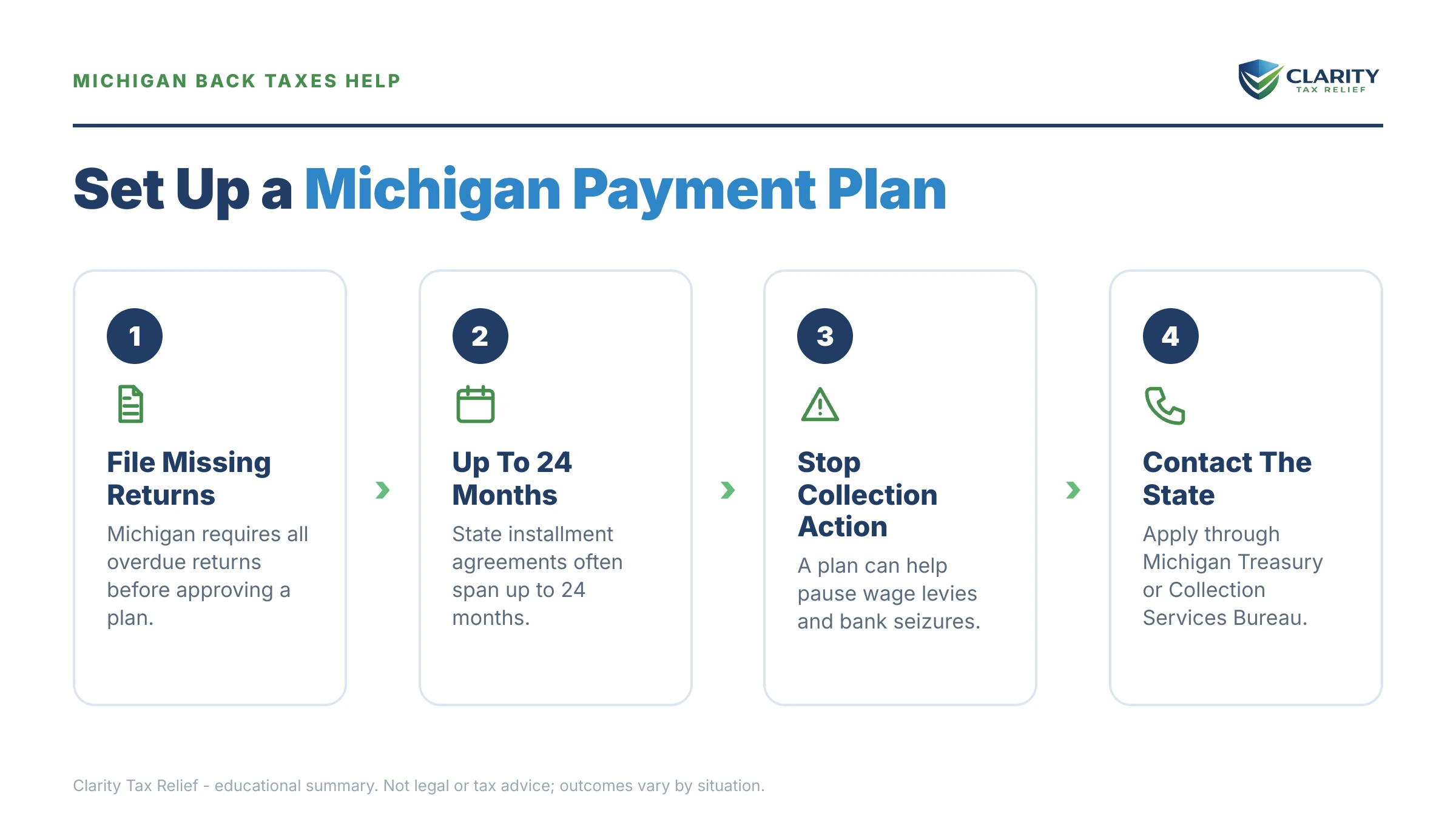
The short answer: a Michigan back taxes payment plan is an installment agreement set up directly with the Michigan Department of Treasury — through its Collections e-Service portal, by phone, or by mail. All Michigan returns must be filed first, interest keeps accruing during the plan, and longer terms require a financial review of your income and expenses.
The envelope from the Michigan Department of Treasury is thinner than the number inside it: state tax, penalty, and interest on income that never had a dollar withheld to cover it. Nothing has been garnished yet — which means you're reading this at the cheapest possible moment to fix it. Below is exactly how Michigan's payment plans work, what each option costs, and what happens if you wait.
Before you call anyone, the image below shows what Michigan Treasury's collection paperwork looks like and where to look for the assessment number, tax year, and response date you'll be asked for on every call.
⏱ Your deadline: Michigan has no single statutory grace window — the response date printed on your Michigan Treasury notice controls. Interest accrues on the unpaid balance the entire time, and Michigan resets its interest rate every six months, each January 1 and July 1. The clock that costs you the most is the accrual clock, and it's already running.
Why Michigan Treasury is billing you
The Michigan Department of Treasury bills you when a filed return shows unpaid tax, or when Treasury computes a balance itself using wage, 1099, and federal data you never filed against. For most readers of this page, it's one of three stories:
- You filed but couldn't pay. Self-employment and 1099 income has no withholding, so the balance lands all at once at filing time. Michigan's flat income tax applies to that income the same as wages, and penalty and interest start stacking the day the payment deadline passes.
- The IRS adjusted your federal return, and Michigan followed. Michigan receives federal data. If the IRS added income through a CP2000 notice or an audit, expect a matching Michigan bill months later, often after you thought the whole episode was closed.
- You didn't file, so Treasury estimated. When Michigan builds the number itself, it works from gross income with none of your business deductions. An estimated assessment on 1099 income is almost always higher than what an accurate return would show.
One important fork before you agree to pay anything: if you dispute the balance — Treasury estimated an unfiled year, or the assessment double-counts income — respond by the dispute deadline printed on your notice instead of setting up a plan. A payment plan on a wrong number just makes the wrong number official.
“A payment plan is an agreement with the IRS to pay the taxes you owe within an extended timeframe. You should request a payment plan if you believe you will be able to pay your taxes in full within the extended time frame.”
— Payment plans; installment agreements (IRS.gov)
What happens if you ignore Michigan back taxes
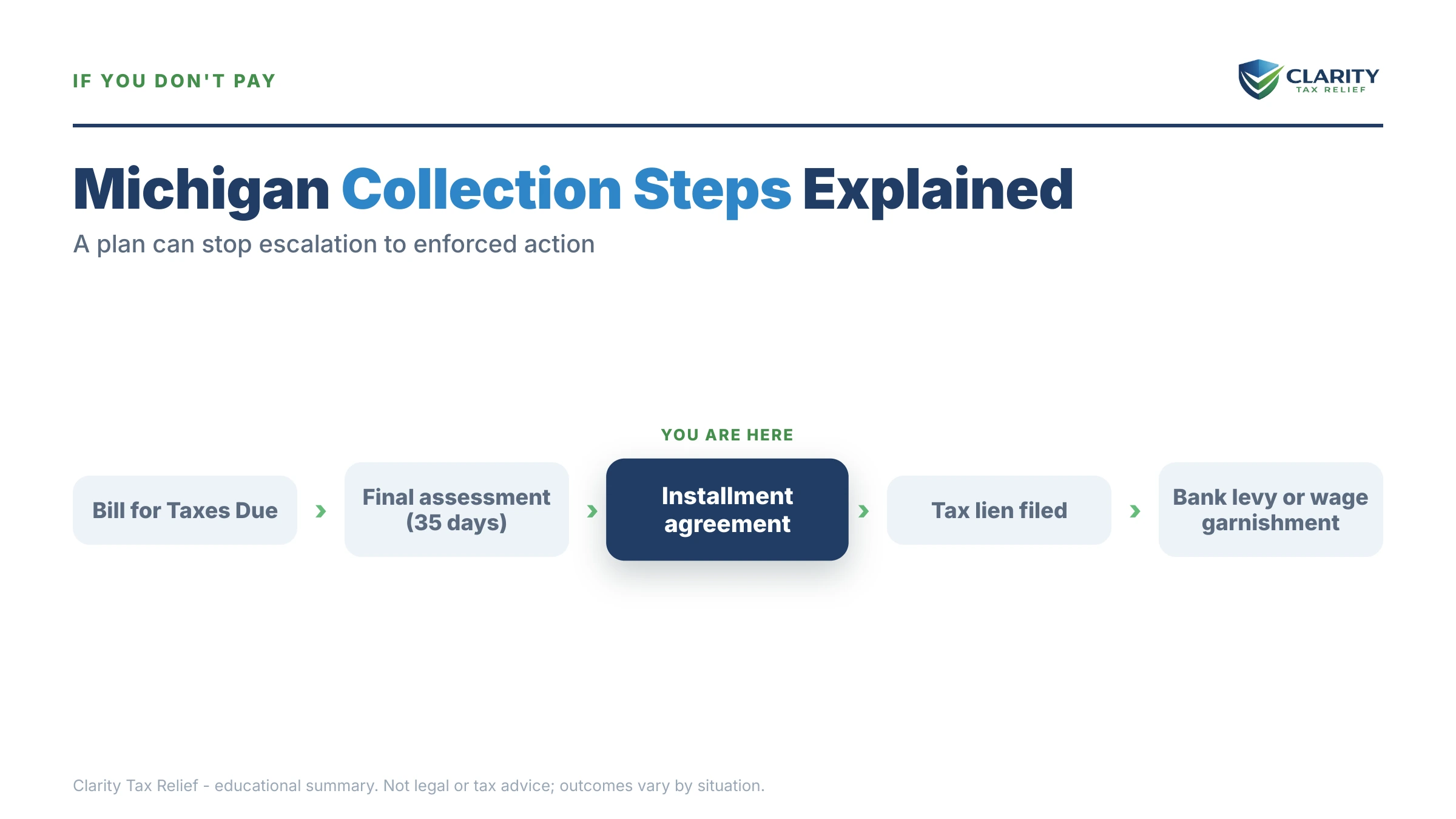
Michigan Treasury can move from mailed bills to a recorded tax lien, wage garnishment, and bank levy without ever taking you to court. The sequence runs in stages, and each stage removes options the previous one still had:
- Bill for Taxes Due / Intent to Assess — the first notice. If Treasury computed the number itself, this stage carries your dispute rights; the notice prints its own deadline.
- Final bill and demand — the last routine letter. The balance is now final and the account moves to Treasury's Collection Services Bureau.
- State tax lien — recorded as a public document. It attaches to your home and other property, complicates any sale or refinance, and signals to lenders that the state is ahead of them in line.
- Garnishment and levy — Treasury can garnish wages, levy bank accounts, and reach money owed to you by third parties. For a 1099 contractor, that third-party reach means Treasury can intercept client payments — a business-level problem, not just a paycheck problem.
- Refund and payment intercepts — your Michigan refund, Michigan lottery winnings, and — through the reciprocal offset agreement with the U.S. Treasury — your federal refund can all be taken and applied to the debt. See how state and federal refund offsets cross both directions.
- Referral to outside collection — Michigan contracts with collection agencies for aging accounts, which can add collection costs on top of tax, penalty, and interest.
None of these stages requires a human to decide you're worth pursuing. They're systematic — which is exactly why acting during stages one and two, while everything is still just paper, is so much cheaper than acting during stage four.
Owe Michigan, or Michigan and the IRS at once?
Get both balances reviewed free before Treasury moves from letters to liens and garnishment. An experienced tax professional will map which agency to handle first and what a realistic monthly number looks like — no pressure, no obligation.
Your options: a Michigan back taxes payment plan and four alternatives
The Michigan Department of Treasury offers installment agreements on back taxes, an Offer in Compromise program with three qualifying grounds, and penalty relief for reasonable cause. Here's the full menu, including the federal side if you owe both:
| Option | Best fit | Eligibility basics |
|---|---|---|
| Michigan installment agreement | You can pay monthly but not all at once | All Michigan returns filed; shorter terms with minimal paperwork, longer terms require a financial review |
| Michigan Offer in Compromise | You genuinely could never pay in full | One of three grounds: an accepted IRS offer on the same debt, doubt as to collectibility, or doubt as to liability |
| Michigan penalty waiver | The tax is right but penalties ballooned | Reasonable cause — illness, disaster, or circumstances genuinely beyond your control, documented in writing |
| IRS short-term plan | Federal balance you can clear within 180 days | $0 setup fee; interest and penalties continue while you pay |
| IRS long-term installment agreement | Federal balance of $50,000 or less | Up to 72 months, set up online; larger balances require financial disclosure |
| IRS Offer in Compromise | Federal debt exceeds what the IRS could ever collect from you | Strictly means-tested; the IRS accepted roughly 1 in 5 offers in FY2024 |
The Michigan installment agreement. You request it through Treasury's Collections e-Service portal, by phone using the number on your notice, or by mail. Treasury sets terms based on your balance and compliance history — a short plan is usually routine, while stretching payments over a longer period means opening your finances to review. Two rules hold regardless of term: every Michigan return must be filed before an agreement is finalized. A missed payment can default the plan and put the account straight back into enforced collection.
The Michigan Offer in Compromise. Michigan has run a formal OIC program since 2015. Its most distinctive feature is the piggyback ground: if the IRS accepted an Offer in Compromise on the same tax debt, Michigan will consider a matching offer for those years. The other two grounds are doubt as to collectibility (your assets and income genuinely can't cover the debt) and doubt as to liability (you don't actually owe it). Nothing here is quick or promised — Treasury runs the math on documentation, not hardship stories — but for the right facts it's a real path.
Penalty relief. Michigan can waive penalties for reasonable cause — a documented illness, disaster, or event beyond your control — though interest on the tax itself generally stays. It's a written request, it costs nothing to make, and on a multi-year balance it can meaningfully shrink what your payment plan has to cover.
Hardship. Michigan has no formal published equivalent of the IRS's Currently Not Collectible status. If paying anything would leave you unable to cover basic living expenses, raise hardship with Treasury directly and get experienced help — going silent is the one response that guarantees escalation.
The federal side. If you owe the IRS too, the playbook is different and better documented: a streamlined installment agreement covers balances up to $50,000 over 72 months, and balances above that line follow the over-$50,000 rules with financial disclosure. Which debt to attack first is its own decision — covered below.
What each option costs and how long it takes
Every Michigan and IRS payment option keeps interest running until the balance hits zero — the differences are in setup cost, speed, and paperwork:
| Option | Upfront cost | While it runs | How you start |
|---|---|---|---|
| Michigan installment agreement | No IRS-style published fee schedule — confirm terms with Treasury | Interest keeps accruing; the rate resets each January and July | Collections e-Service, phone, or mail — fast once returns are filed |
| Michigan Offer in Compromise | Application per Treasury's current requirements | Interest accrues during review | Written application with full financials; expect months, not weeks |
| Michigan penalty waiver | Free to request | Interest still accrues on the tax itself | Written reasonable-cause request with documentation |
| IRS short-term plan (up to 180 days) | $0 setup fee | 0.5%/month failure-to-pay penalty plus interest | Minutes online |
| IRS long-term installment agreement | Setup fee applies — lower with direct debit, waived for qualifying low-income taxpayers | Penalty and interest continue | Minutes online for balances of $50,000 or less |
| IRS Offer in Compromise | $205 fee plus 20% down on lump-sum offers — both waived with low-income certification | Offer payments per your chosen terms | Months of review; deemed accepted if the IRS doesn't decide within 2 years, with narrow exceptions — a returned or rejected offer stops the clock, and time during court disputes does not count |
Say you owe $83,100: a worked Michigan example
Say you're a 1099 contractor in Grand Rapids who skipped quarterly estimates for three strong years. The combined damage is $83,100 — $70,800 to the IRS and $12,300 to Michigan Treasury, penalties and interest included. This is hypothetical, but the math is how real cases get planned:
- Michigan side ($12,300): suppose Treasury approves a 24-month arrangement. $12,300 ÷ 24 ≈ $513 a month before accruing interest, so the real payoff runs slightly past the raw division, or the final payments run higher. A reasonable-cause penalty waiver, if your facts support one, would shrink that principal before the plan even starts.
- Federal side ($70,800): that balance sits above the $50,000 online-plan line, so you have two paths. Pay it down by $20,801 to reach $49,999, then request the 72-month online plan: $49,999 ÷ 72 ≈ $695 a month. Or keep the full balance and negotiate a non-streamlined agreement by disclosing your finances on Form 433-F. You can estimate how fast the federal side grows in the meantime with our IRS Penalty & Interest Calculator.
- The passport wrinkle: at $70,800, the federal debt alone crosses the $66,000 seriously-delinquent threshold for 2026 — meaning passport certification is on the table. Getting into an installment agreement takes the debt out of that category. Michigan debt, by contrast, never touches your passport.
- The combined budget: $513 + $695 ≈ $1,208 a month — on top of this year's quarterly estimates. That last part is the piece most plans die on: if the current year isn't covered, next April adds a fourth year of debt underneath both agreements. Start with how quarterly estimated taxes work and build the set-aside into your rates.
If $1,208 a month is genuinely impossible on your income, that's not the end of the road — it's the signal to look at the means-tested options (an IRS offer, Michigan's collectibility ground, hardship status on the federal side) instead of signing up for a plan that will default in month three.
How to respond to Michigan back taxes, step by step
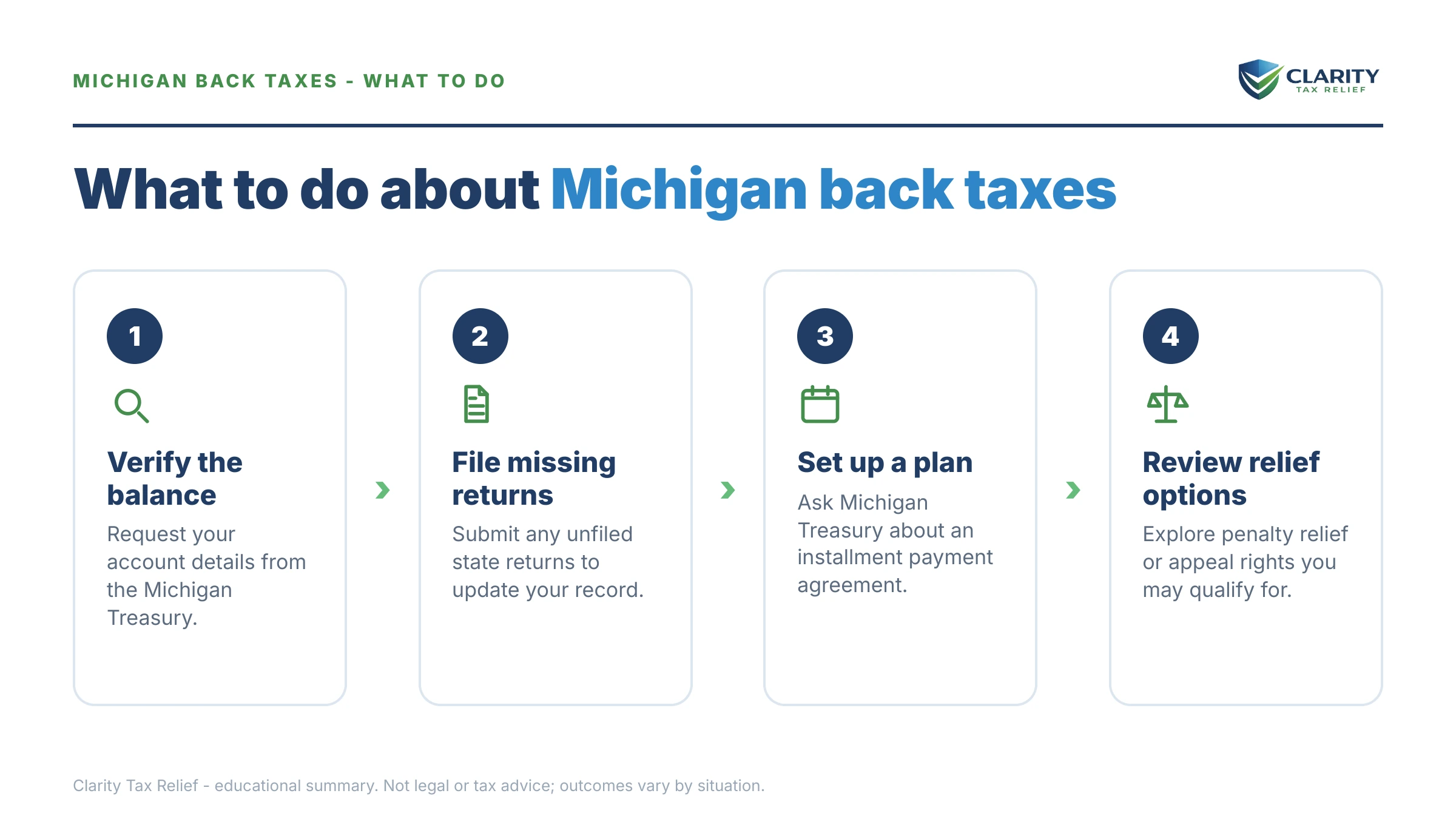
- Pull your numbers. Find the assessment number, tax years, and balance on your most recent Michigan Treasury notice, and log into your IRS online account if you owe federally too.
- File every missing return. Neither Michigan nor the IRS will finalize a payment agreement while returns are outstanding, and accurate returns often lower the balance you'll be paying on.
- Set up the federal plan online. If your IRS balance is $50,000 or less, a plan of up to 72 months takes minutes to request — see our IRS payment plan online walkthrough — so lock it in and learn your federal monthly number first.
- Contact Michigan Treasury. Request an installment agreement through Collections e-Service or the number on your notice, offering a monthly amount your budget can actually sustain alongside the IRS payment.
- Put both plans on autopay. Direct debit prevents the missed payment that defaults an agreement and restarts collection from a worse position.
- Fix your current-year estimates. A payment plan only works if this year's taxes aren't digging a fresh hole underneath it — set aside quarterlies starting now.
Michigan Treasury vs. the IRS: which do you pay first?
Michigan Treasury and the IRS collect independently — neither waits its turn, and each can intercept the other's refund. The general rule: the agency closest to taking money gets handled first. An active garnishment or final-stage notice outranks a first bill, whichever letterhead it's on. In 2026 the IRS is harder to reach by phone than ever after deep staffing cuts. But its automated levies never stopped, so "the IRS is slow" is not a strategy. The full decision framework lives in our guide to state tax debt vs IRS — which to resolve first. Here's how the two collectors differ on the points that change your plan:
| What matters | Michigan Treasury | IRS |
|---|---|---|
| Who collects | Collection Services Bureau, plus contracted collection agencies on aging accounts | Automated collection systems; revenue officers on larger cases |
| How you get a plan | Collections e-Service portal, phone, or mail | Self-service online for most balances up to $50,000 |
| Settling for less | Michigan OIC — three grounds, including a matching offer after an accepted IRS OIC | Federal OIC — means-tested; roughly 1 in 5 accepted in FY2024 |
| Refund offsets | Takes your state refund and lottery winnings; reaches your federal refund via reciprocal offset | Takes your federal refund; can levy your state refund |
| Passport consequences | None — state debt never triggers passport action | Certification possible once federal debt passes $66,000 (2026) |
When you can handle this yourself, and when help changes the outcome
A Michigan-only balance you agree with, with all returns filed and a budget that covers a short plan, is a genuine do-it-yourself situation. Set the agreement up through Collections e-Service or the phone number on your notice, put it on autopay, and you're done — no firm needed, ours included. The same is true on the federal side for smaller agreed balances; the IRS payment plans page handles those in minutes.
Experienced help earns its cost when the situation has moving parts: a garnishment or bank levy already issued, multiple unfiled years at both agencies where filing order changes the assessed totals, a federal balance above the $50,000 disclosure line, offer-in-compromise math on either side, or a business that owes Michigan sales or withholding tax — trust taxes that carry personal liability for the people who ran the business. Self-employed cases sit in the middle: the consultant and freelancer back-tax playbook covers what's DIY-able there. If the federal side of a hardship case stalls, the Taxpayer Advocate Service is a free, independent escalation path.
Not sure which side of that line you're on? Have an experienced tax professional look at your Michigan notices free — call (888) 825-7779 or use the 2-minute form — before interest compounds through another rate reset.
Terms on your Michigan notice, decoded
- Assessment number — Treasury's ID for a specific debt; you'll need it for every call, payment, and agreement request.
- Intent to Assess — Treasury's proposal of a balance it computed itself. The stage where your dispute rights live, with the deadline printed on the notice.
- Final Assessment — the balance made official; collection tools unlock from here.
- State tax lien — a recorded public claim against your property securing the debt. It doesn't take money by itself. But it clouds every sale or refinance.
- Levy / garnishment — the actual taking: wages, bank accounts, or payments owed to you by third parties.
- Reciprocal offset — the Michigan–U.S. Treasury agreement letting each government seize the other's refund to cover your debt.
Michigan back taxes payment plan: your questions, answered
How do I set up a payment plan for Michigan back taxes?
You request an installment agreement directly from the Michigan Department of Treasury — through its Collections e-Service portal, by phone using the number on your notice, or by mail. Have your assessment number, the balance, and a realistic monthly figure ready. Shorter terms are usually approved with minimal paperwork, longer terms require a financial review, and Treasury generally won't finalize an agreement while you have unfiled Michigan returns.
Can I settle Michigan back taxes for less than I owe?
Sometimes — Michigan has operated a formal Offer in Compromise program since 2015. But you must fit one of three grounds: the IRS accepted an offer on the same tax debt, there is genuine doubt you could ever pay in full, or there is genuine doubt you actually owe the amount. Approval is means-tested and fully documented, no outcome is promised, and interest keeps accruing while Treasury reviews your offer.
Will Michigan garnish my wages for back taxes?
Yes. Once routine billing notices go unanswered, Michigan Treasury can garnish wages and levy bank accounts. A garnishment generally continues until the debt is resolved or an agreement is in place. If you're a 1099 contractor with no wages to garnish, Treasury can pursue your bank accounts and payments owed to you by the businesses you invoice, often more disruptive than a paycheck garnishment.
Can Michigan take my federal tax refund for state back taxes?
Yes. Michigan participates in the reciprocal offset program with the U.S. Treasury, so a federal refund can be intercepted and applied to a Michigan tax debt. The IRS can take your Michigan refund for federal debt. A payment agreement doesn't always stop refund offsets, so if you owe back taxes, adjust your withholding or estimates instead of counting on a big refund arriving.
Should I set up my IRS payment plan or my Michigan payment plan first?
Start with whichever agency is closest to taking money — an active garnishment or final-stage notice outranks a first bill. If both debts are still at the billing stage, lock in the IRS plan first because it's instant and self-service online, then call Michigan with a monthly number that already accounts for the federal payment. Never promise Treasury money your budget can't sustain alongside the IRS plan.
Does a Michigan payment plan stop penalties and interest?
No. An installment agreement stops enforced collection — garnishments, levies, escalating notices — but interest continues to accrue on the unpaid balance, and Michigan resets its interest rate every six months. A shorter plan almost always costs less in total, and paying one off early is worth doing if your income jumps. Penalty relief is a separate request made on reasonable-cause grounds.
What if I haven't filed Michigan returns for several years?
File the missing returns before you ask for anything. Treasury generally won't finalize an installment agreement or consider an offer while returns are outstanding, and unfiled years let the state estimate your tax at figures that are usually worse than reality. For a 1099 contractor, filing accurate returns with legitimate business deductions often shrinks the assessed balance before any payment plan is even negotiated.
How do I know a letter from the Michigan Department of Treasury is real?
A real Michigan Treasury notice arrives by postal mail, names a specific tax year and assessment number, and directs payment to the State of Michigan — never to gift cards, wire services, or payment apps. Verify any balance by contacting Treasury through the phone number or portal listed at michigan.gov/treasury, not contact details printed on a letter you doubt. Scammers imitate state collectors precisely because state notices are less familiar than IRS ones.
Your next 24 hours
- Find the assessment number and balance on your most recent Michigan Treasury notice — and, if you owe federally too, pull that balance from your IRS online account so you're planning around real totals, not guesses. Treasury's own contact channels are listed at michigan.gov/treasury.
- Gather three things: your last filed return, every notice you've received from Michigan and the IRS, and your 1099s or income records for any unfiled years.
- Get a free case review — call (888) 825-7779 or use the 2-minute form. Interest compounds monthly on both balances and Michigan's collection stages only move in one direction. A plan set up this week costs less than the same plan set up after a lien or garnishment lands.
This guide is general information, not tax or legal advice for your specific situation. Eligibility for IRS programs depends on individual facts and circumstances; no outcome is guaranteed.