
California Tax Debt
FTB Tax Lien: What It Attaches To, How Long It Lasts, and How to Remove It (2026)
The short answer: an FTB tax lien is a public claim the California Franchise Tax Board records against everything you own for unpaid state taxes. It can stay enforceable for up to 20 years, twice the IRS window, and it is removed only by resolving the balance: full payment, an accepted settlement, or expiration.
Most people don't learn about an FTB tax lien from the FTB. They learn about it from a loan officer who ran title, an escrow company holding up a closing, or the sudden stack of "we can help with your tax problem" letters that arrive the week the lien hits the county recorder, because marketers watch those public filings faster than the mail reaches you.
However you found out, the lien itself is only a symptom. The underlying California tax balance is the disease, and it has real cures — several of them. This guide walks through every one, including the path that shrinks the balance itself when the FTB invented it from raw 1099 data.
The recorded document is surprisingly short — the image below shows you exactly what a California Notice of State Tax Lien looks like and where to find the amount, the tax years covered, and the county where it was recorded.
⏱ The real clock: a recorded FTB lien can stay enforceable for up to 20 years under California Revenue & Taxation Code §19255, and interest plus collection fees keep accruing on the balance every month. Keep in mind that the 20-year collection clock can be paused or extended by events like bankruptcy, an offer-in-compromise review, an installment agreement, or time spent out of state, and a recorded lien itself lasts 10 years and can be renewed until the debt expires. If you received a pre-lien warning instead of a recorded lien, the respond-by date printed on that notice is the deadline that decides whether the lien gets filed at all.
Why the FTB filed a tax lien against you
The FTB records a Notice of State Tax Lien when a California tax balance goes unpaid after the FTB has demanded payment — including balances the FTB created itself from 1099 data when you never filed. There are four common paths to this moment:
- You filed but didn't pay. A self-employment year with no withholding is the classic case — the return was honest, the money just wasn't there in April.
- You didn't file, so the FTB filed for you. The FTB matches 1099-NEC, 1099-K, and wage data against its filing records. When a return is missing, it can issue a Notice of Proposed Assessment, often taxing your gross receipts with zero business deductions, plus penalties. For contractors, these assessments are routinely far higher than the real liability.
- An audit or adjustment created the balance. A residency determination, a disallowed deduction, or a federal audit change that flowed down to California.
- You moved and never saw the demand letters. The FTB mails to your last known address. Legally, that counts as notice — even if the letters went to an apartment you left two years ago.
Once recorded — with the county recorder for real estate, and sometimes with the California Secretary of State for personal and business property — the lien becomes public record. A lien fee gets added to the balance you already owe. This page covers the lien specifically. For the full picture of how FTB collections work end to end, start with our California FTB back taxes guide.
“Assets — A lien attaches to all of your assets (such as property, securities, vehicles) and to future assets acquired during the duration of the lien.”
— Understanding a federal tax lien (IRS.gov)
What an FTB tax lien attaches to
An FTB tax lien attaches to all of your real and personal property, and to property you acquire after the lien is recorded, for as long as the debt remains collectible. That "after-acquired" reach is what surprises people most:
- Your home, or a home you buy next year in the same county.
- Business assets — equipment, tools, vehicles, and receivables if you operate as a sole proprietor or single-member LLC.
- Sale and refinance proceeds — title companies find the lien and require a payoff before anything closes.
One thing it no longer touches: your credit score. The major bureaus removed all tax liens from credit reports in 2018. But the lien remains fully visible in public records — the same recorder and Secretary of State indexes covered in our tax lien public record guide — which is exactly where mortgage underwriters, commercial clients running vendor checks, and licensing boards look.
FTB tax lien vs. IRS federal tax lien: they are not the same animal
An FTB tax lien is enforceable for up to 20 years, twice as long as an IRS federal tax lien. The removal machinery is different too. If you owe both agencies, don't assume the federal rules carry over.
| Feature | FTB (California) tax lien | IRS federal tax lien |
|---|---|---|
| How long it can be enforced | Up to 20 years (R&TC §19255) | Generally 10 years from assessment (the CSED), subject to tolling |
| Where it's recorded | County recorder; sometimes CA Secretary of State | County/state recording offices as a Notice of Federal Tax Lien |
| Withdrawal after resolution | No broad withdrawal program — the FTB releases liens; the filing history stays public | Withdrawal possible in defined cases via Form 12277 |
| Credit reports | Not reported since 2018, but public record | Not reported since 2018, but public record |
| Appeal structure | No federal-style CDP hearing; FTB has its own protest and advocate channels | Collection Due Process rights attach to lien filing |
Two of these differences do the most damage. First, the 20-year window means an FTB lien almost never gets "waited out" — see whether liens die on their own in does irs tax lien expire for the federal comparison. Second, the lack of a withdrawal program means even a paid FTB lien leaves a recorded history, so the earlier you resolve it, the shorter that paper trail runs.
What happens if you ignore an FTB tax lien
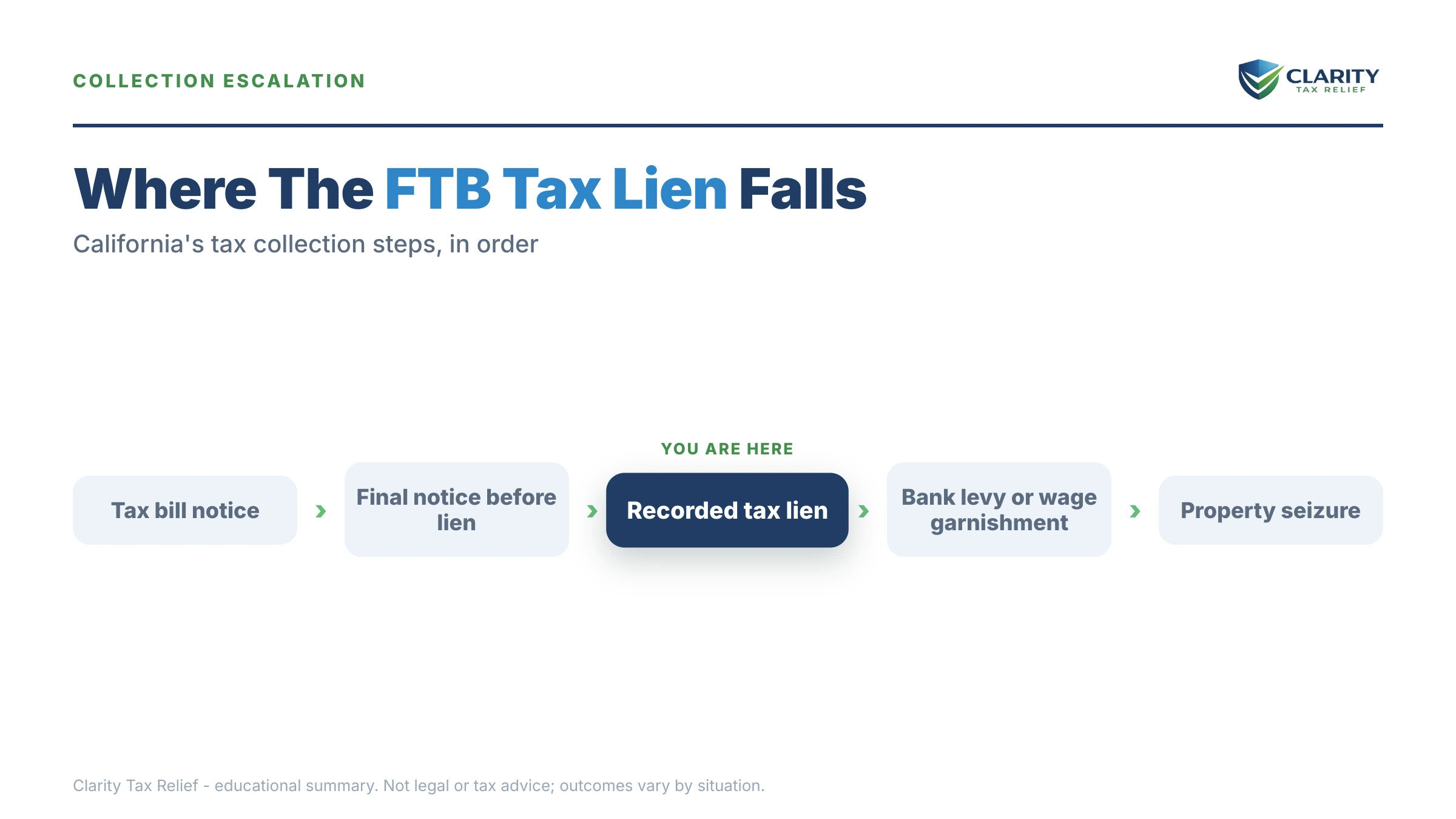
A recorded lien is a milestone in the FTB's collection sequence, not the end of it — enforcement keeps running on top of the lien. Here is the order things happen in:
- Demand notices. Statements of balance due and a final demand go to your last known address. Whether you saw them or not, they legally happened.
- The lien records. The Notice of State Tax Lien is filed with the county recorder (and possibly the Secretary of State). A lien fee is added to your balance.
- Public-record fallout. Title companies, lenders, and data brokers index the filing. Refinances stall, escrow demands appear, and the solicitation letters start.
- Active collection continues alongside. The lien doesn't replace seizure — an FTB bank levy can take money from your accounts and an FTB wage garnishment can attach your pay while the lien sits on record. For contractors, orders to withhold can even reach payments your clients owe you.
- Large balances go public by name. Cross $100,000 with a recorded lien and you risk the FTB Top 500 delinquent list, which carries state license suspension consequences on top of the lien.
- The 20-year horizon. Under California's 20-year collection statute, the FTB can keep the lien alive and keep collecting for two decades. There is no realistic outlast-it strategy here.
Every stage adds cost: interest accrues, collection fees stack, and each new asset you acquire slides under the lien automatically.
FTB lien on your record right now?
Every month it sits there, interest and fees grow the payoff, and the lien attaches to whatever you acquire next. Get your FTB lien and balance reviewed free by an experienced tax professional: we'll check whether the assessment behind it is even correct before you pay a dollar.
How to remove an FTB tax lien: your options
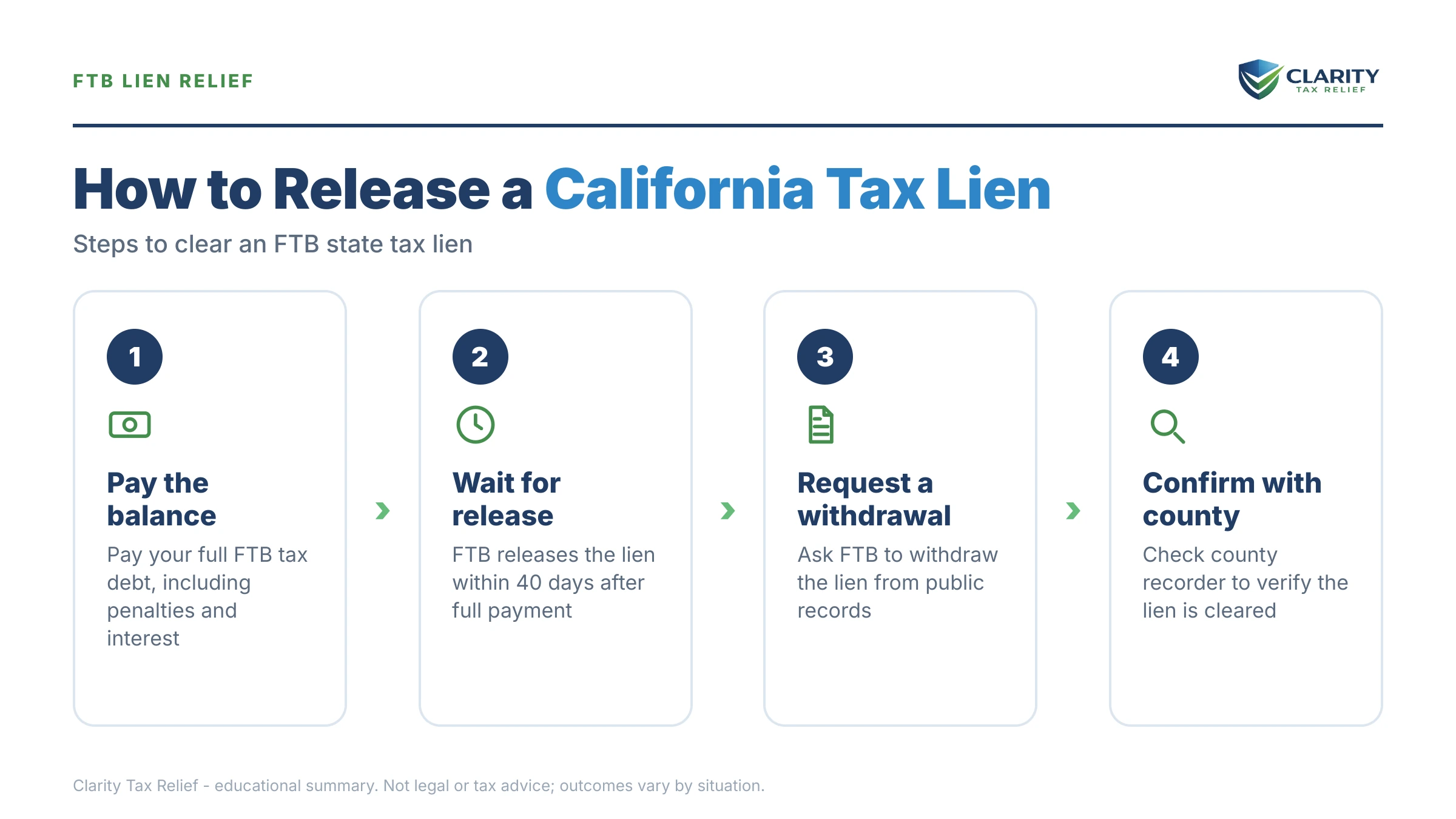
The only reliable way to remove an FTB tax lien is to resolve the underlying balance — pay it, settle it through an accepted offer, or (in theory) outlast the 20-year statute. Each path treats the lien differently:
| Option | Who it fits | What happens to the lien |
|---|---|---|
| Pay in full | Anyone with access to the funds (savings, refinance where possible, borrowing) | FTB records a release with the county; fastest path off the record |
| FTB payment plan | Balances of $25,000 or less generally qualify for the streamlined online plan (up to 60 months); larger balances require a financial statement | Stops levies and garnishment, but the lien typically stays until paid in full |
| FTB offer in compromise | Taxpayers who genuinely cannot pay the full amount now or in the foreseeable future — strictly means-tested | Released after the accepted offer is completed |
| FTB currently not collectible (hardship) | Income barely covers necessary living expenses; documented via financial statement | Pauses active collection, but the lien stays and interest keeps accruing |
| Partial release / subordination | A specific property sale or refinance that can't clear the full balance | Frees one property or repositions the lien so a deal can close; the lien survives as to everything else |
| Statute expiration | Almost no one — the window is 20 years | Lien becomes unenforceable when the debt does; two decades of collateral damage first |
Two details matter more than the table can show. First, if your balance came from a Notice of Proposed Assessment on unfiled years, filing the actual returns can shrink the debt before you resolve it, often dramatically, because the FTB's assessment ignored every deduction you were entitled to. Second, "release" is not "erase": once the balance is resolved, the FTB records a release, but the original filing stays in the public index. The mechanics of confirming a release are the same discipline we cover for federal liens in getting a lien released after payment. You verify the recording; you don't assume it.
Owe the FTB money? Realistic options by balance
What's realistic depends heavily on how much sits behind the lien. These bands describe how cases typically play out:
| Balance | Realistic paths | Lien reality |
|---|---|---|
| Under $10,000 | Pay in full if possible; otherwise the streamlined online payment plan | A lien may not have been filed yet — resolving fast can keep it that way |
| $10,000 – $25,000 | Streamlined online plan (up to 60 months); check for penalty relief on top | Lien often already recorded; it typically stays until the last payment |
| $25,000 – $100,000 | Plan with a financial statement (Form 3561), hardship status, or an FTB OIC if the math supports it; attack any gross-income assessment first | Lien is standard at this level; expect escrow demands on any property transaction |
| Over $100,000 | Negotiated resolution with full financial disclosure — professional representation earns its cost here | Top 500 list exposure with a recorded lien, including license consequences |
Worked example: a 1099 contractor with a $41,800 FTB lien
Say you owe the FTB $41,800 — a hypothetical, but a common shape. You're a 1099 contractor. You skipped filing for two busy years, the FTB matched your 1099-NEC data, issued Notices of Proposed Assessment taxing your gross receipts with no expenses, added penalties and interest, and recorded a lien in your county. Here's how the three main paths compare:
- Path 1 — attack the assessment first. If the FTB taxed, say, $160,000 of gross 1099 income across those years. But your real net after mileage, materials, and subcontractor costs was closer to $95,000, filing the actual returns replaces the inflated assessments. A meaningful slice of that $41,800 can disappear before you negotiate anything — which is why this is almost always step one on unfiled-year liens.
- Path 2 — payment plan on the (corrected) balance. At $41,800 you're above the FTB's streamlined online threshold, so expect to document your finances on FTB Form 3561. Straight-line math: $41,800 ÷ 60 months ≈ $697 per month before the interest that keeps accruing during the plan. If Path 1 cut the balance to $24,000, you'd be under the streamlined line — roughly $400/month over 60 months, set up online with no financial disclosure.
- Path 3 — hardship or settlement. If contract work dried up and $697 a month is fantasy, hardship status can pause collection while the lien stays on record — or, if your income and assets genuinely can't cover the debt within the collection window, an FTB offer in compromise puts a permanent number on it. Both are means-tested on your documented finances, not on how much you'd like to pay.
Notice what none of the paths do: make the lien vanish overnight. The lien follows the balance. Shrink and resolve the balance, and the release follows.
Selling or refinancing a house with an FTB lien
An FTB tax lien does not stop you from selling a house. It gets paid out of escrow at closing. The title company requests a demand for payoff from the FTB, the lien amount comes off your proceeds. The FTB issues a release for the recording. Thousands of California sales close this way every year.
The hard cases are thin-equity ones. If sale proceeds won't cover the full lien, the FTB may consider a partial release of that specific property so the deal can close. But that takes lead time and documentation, so start weeks before your closing date, not days. Refinances work similarly through subordination-style arrangements, where the FTB agrees to let the new loan take priority because the refinance helps you pay. The federal version of the home-equity problem works on parallel logic — see irs tax lien on my house if you're carrying both liens on the same property.
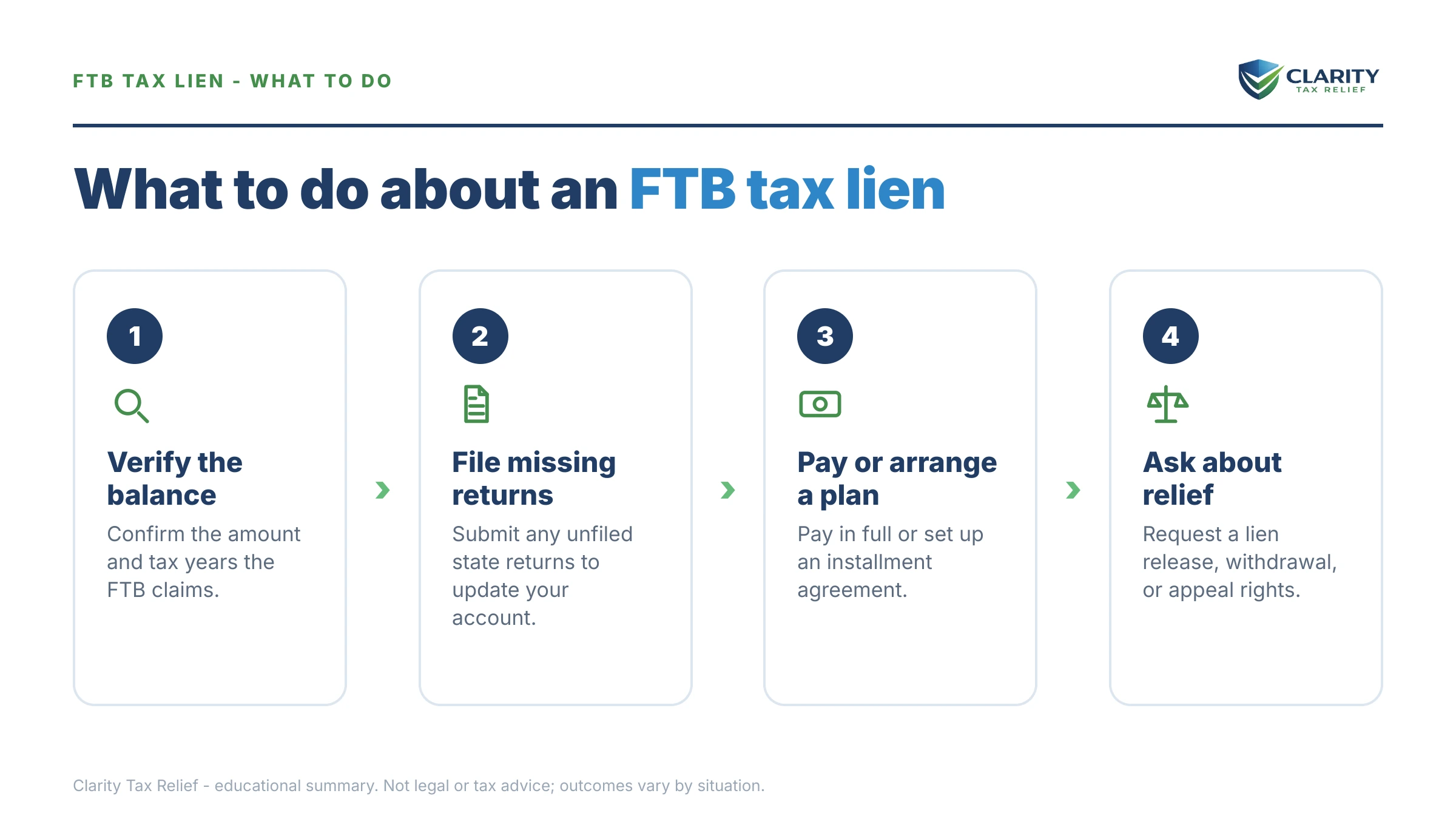
How to respond to an FTB tax lien, step by step
- Confirm the lien and your exact balance. Pull the recorded Notice of State Tax Lien from the county recorder, then log in to your FTB account or call the FTB for a current payoff that includes fees and interest — the recorded amount is a snapshot, not the payoff figure.
- Check whether the assessment is even correct. If the FTB assessed you from 1099 or wage data because you never filed, file the real return — deductions the FTB never saw can shrink the balance behind the lien substantially.
- Pick the resolution path that fits your finances. Full payment, a payment plan, hardship status, or an FTB Offer in Compromise — the options table above shows what each one does to the lien itself.
- Set it up before enforcement escalates. A lien does not stop bank levies or wage garnishment; getting into an approved arrangement does. Interest and collection fees keep accruing until the balance is resolved.
- Verify the release gets recorded. After you resolve the balance, confirm the FTB sends a release to every county where the lien was recorded, and to the Secretary of State if a filing exists there, and keep a copy with your records.
When you can handle an FTB lien yourself, and when help changes the outcome
Be honest with yourself about which case you have. You can likely handle this alone if:
- The balance is one you agree with, from returns you actually filed;
- It's $25,000 or less, so the streamlined online payment plan is on the table; and
- No escrow, refinance, or license issue is on a clock.
Experienced help tends to change the outcome, not just the stress level, when:
- The balance is built on gross-income assessments from unfiled years. Reconstructing contractor expenses and replacing the FTB's numbers is where the biggest dollar swings live.
- You're above $25,000 and facing Form 3561 financial disclosure — what you list and how you present allowable expenses shapes your monthly payment.
- A property transaction has to close around the lien — payoff demands, partial releases, and timing are unforgiving.
- You owe the IRS too. Sequencing matters: the two agencies have different statutes, different programs, and different appetites for your same dollars.
- You're anywhere near $100,000, where the Top 500 list and license consequences enter the picture.
If your lien is tangled up with unfiled years or a closing that can't wait, get a free FTB lien case review through the 2-minute form or at (888) 825-7779 before you file or sign anything.
Terms on your Notice of State Tax Lien, decoded
- Notice of State Tax Lien — the recorded document itself; it announces the FTB's legal claim, it doesn't seize anything by itself.
- Release of lien — the follow-up recording that says the claim is satisfied; the original filing stays in the public index as history.
- Demand for payoff — the FTB's official statement of the exact amount needed to clear the lien, usually requested by escrow or a lender.
- Partial release — the FTB frees one specific property from the lien (typically so a sale can close) while the lien survives against everything else.
- Subordination — the FTB agrees to stand behind a new lender's claim so a refinance can fund, usually because the refinance helps pay the tax.
- R&TC §19255 — the California statute giving the FTB its 20-year collection window, the reason "wait it out" isn't a plan here.
FTB tax lien questions, answered
How long does an FTB tax lien last?
Up to 20 years. California's collection statute under Revenue and Taxation Code §19255 gives the FTB 20 years to collect, twice the IRS's 10-year window. A recorded lien stays enforceable as long as the debt is collectible. Waiting one out means two decades of blocked refinances, escrow demands, and ongoing levy exposure, which is why almost nobody realistically does it.
Does an FTB tax lien show up on my credit report?
No — the three major credit bureaus stopped reporting all tax liens in 2018, so it won't lower your credit score directly. It is still a public record, though. Mortgage lenders, title companies, landlords, and some employers find it through county recorder and Secretary of State searches, so it affects lending decisions even without touching your score.
How do I remove an FTB tax lien?
Resolve the balance: pay in full, complete an accepted FTB Offer in Compromise, or let the 20-year statute expire. After full payment, the FTB records a release with the county where the lien was filed. Unlike the IRS, the FTB has no broad lien-withdrawal program, so the recorded lien and its release remain in the public record history even after you pay.
Does an FTB payment plan remove the tax lien?
Generally no. An approved installment agreement stops levies and garnishment, but the recorded lien typically stays in place until the balance is paid in full. The FTB can also still record a new lien while you're on a plan to protect its claim. The plan's real value is stopping active seizure while you pay the debt down.
Can I sell my house with an FTB tax lien on it?
Yes — most FTB liens are actually paid off through escrow. The title company requests a demand for payoff from the FTB, the lien amount comes out of your sale proceeds at closing. The FTB issues a release. If the proceeds won't cover the full lien, the FTB may consider a partial release of the specific property. But you should start that conversation well before your closing date.
Is an FTB tax lien the same as a levy?
No. A lien is a recorded legal claim against your property. A levy is the actual seizure of money — from a bank account or a paycheck. The FTB uses both, often at the same time: the lien protects its position while orders to withhold and wage garnishments take cash. Resolving the balance addresses both.
How do I find out if the FTB filed a lien against me?
Check three places: the recorder's office in any county where you live or own property, the California Secretary of State's lien filings. Your own FTB notices or MyFTB account. The FTB mails lien notices to your last known address, so if you've moved since your last California filing, a lien can exist for years before you learn about it.
Will bankruptcy remove an FTB tax lien?
Usually not from property you already own. Bankruptcy can discharge your personal liability for qualifying older income taxes. But a lien recorded before the filing generally survives against property you owned at that time. Whether the underlying tax qualifies for discharge at all depends on strict timing rules, so this is a question for a bankruptcy attorney with tax experience.
Does the FTB notify you before filing a tax lien?
Yes — the FTB mails demand notices, and typically a pre-lien warning, to your last known address before recording. The problem is "last known address": for a 1099 contractor who moved and skipped a filing year, those notices often go to an old apartment. Legally, mailing to the last known address counts as notice, even if you never saw it.
Your next 24 hours
- Find the recorded document. Pull the Notice of State Tax Lien from your county recorder (many California counties have online indexes) and note the recording date, the amount. The tax years, then log in at ftb.ca.gov to see your current balance with fees and interest. If you run a business, also check for filings with the California Secretary of State.
- Gather your paperwork. Every FTB notice you have, your last filed California return, and 1099s or income records for any unfiled years — that's everything needed to test whether the balance behind the lien is even correct.
- Get the lien reviewed free. Use the 2-minute form or call (888) 825-7779. Interest and collection fees are accruing on the balance right now. The lien attaches to everything you acquire until it's resolved — the review costs nothing and tells you which path fits your numbers.
This guide is general information, not tax or legal advice for your specific situation. Eligibility for IRS programs depends on individual facts and circumstances; no outcome is guaranteed.