
California State Taxes
Moving Out of California Taxes: What You Still Owe in 2026 (and What Follows You)
The short answer: leaving California doesn't end your state taxes automatically. You file a part-year Form 540NR for your move year, California keeps taxing California-source income (rentals, real estate sales, stock vested for California work), and any FTB balance follows you — the FTB can collect it for 20 years from assessment.
The divorce is final, the house closed escrow, and the truck is pointed at Reno or Boise, and then a Franchise Tax Board envelope finds your new address anyway. The "moving out of California taxes" question really has three parts: your move-year return, the income California can still reach, and any FTB balance riding along. All three follow clear rules, and every one of them can be handled from out of state.
⏱ The clocks that matter: there is no single "you left" deadline, but your move-year Form 540NR is due at the normal filing deadline, and if you owe the FTB, it can collect for 20 years from assessment while interest and collection fees accrue the whole time.
Moving out of California taxes: why leaving doesn't end them
California taxes people on two independent grounds, residency and income source, and moving only changes the first one. For the year you leave, you're a part-year resident: California taxes everything you earned through your move date, plus California-source income after it, all reported on Form 540NR.
From January 1 of the following year, if you've genuinely broken residency, California can only tax income with a California source. That word "genuinely" is where movers get hurt. California presumes it keeps your domicile, your one true home, until you prove you've built a new one somewhere else.
There is one narrow shortcut: leave under an employment contract lasting at least 546 consecutive days and you may qualify as a nonresident under California's safe-harbor rule, subject to limits on return visits and investment income. For everyone else, residency ends when your ties end — not when the moving truck rolls.
The image below shows how the whole picture fits together at a glance — worth a look before you file your final California returns.
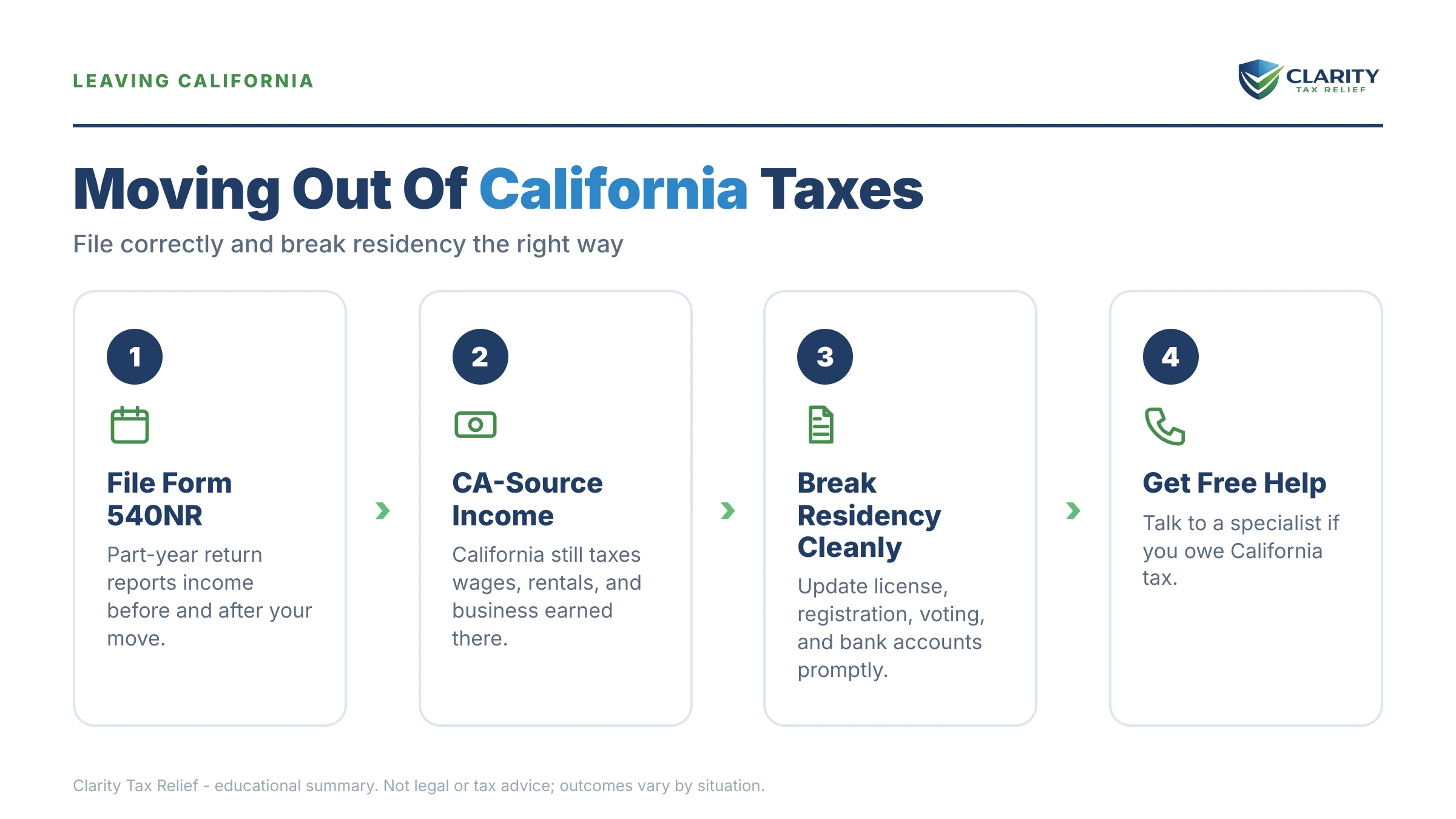
What California still taxes after you move
After you leave, California can only tax California-source income, but more income is California-source than most movers expect. The table below is the reference most people wish they'd had before setting a closing date or a vesting schedule.
| Income type | Still taxed by California after you move? |
|---|---|
| Wages earned before your move date | Yes — reported on your part-year Form 540NR |
| Wages for work performed outside California after the move (W-2) | No — even if your employer is in California |
| Self-employment income from California clients | Possibly — the FTB uses market-based sourcing rules for some business income |
| Rent from California real estate | Yes — California-source every year you own it |
| Gain on the sale of California real estate | Yes, and escrow typically withholds 3⅓% of the price on Form 593 unless you certify an exemption, such as a principal-residence sale |
| RSUs and stock options earned for California workdays | Yes — the California-workday portion, even if they vest after you leave |
| 401(k), IRA, and pension distributions once you're a nonresident | No — federal law (4 U.S.C. §114) bars it, even for CalPERS pensions |
| Interest, dividends, and stock gains after the move | No — intangible income follows your residence |
The retirement row is the single biggest relief for most people leaving: federal law prohibits California from taxing retirement income paid to a nonresident, no matter where the pension was earned. The stock-compensation row is the biggest trap — equity earned during California workdays keeps a California source no matter where it vests.
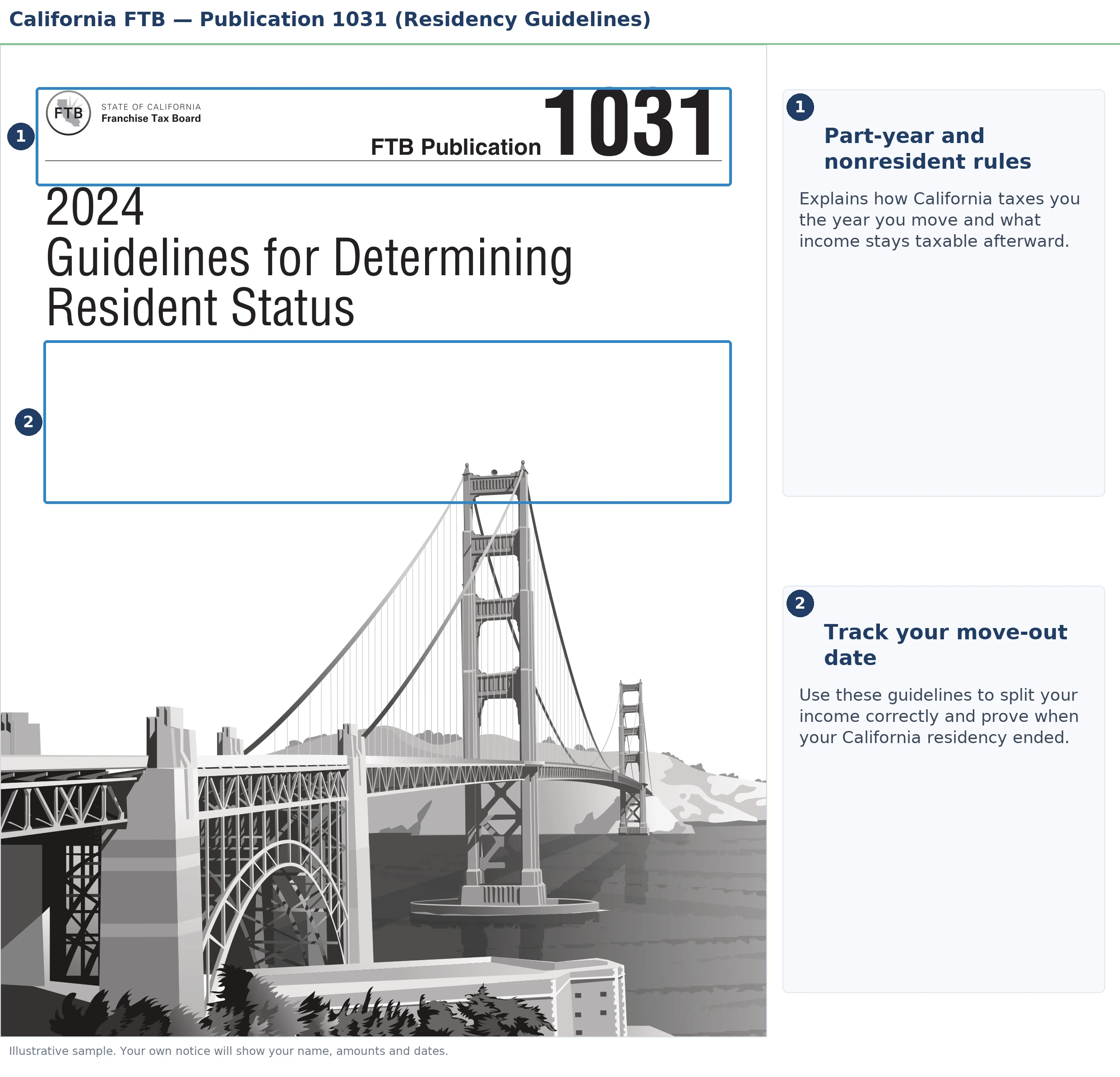
Is there a California exit tax in 2026?
No — California has no exit tax in 2026. Wealth-tax bills with provisions aimed at departing residents were introduced in Sacramento but never became law. What gets called an "exit tax" online is usually the ordinary move-year bill: part-year taxes, Form 593 withholding on a home sale, and old FTB debt that travels with you. If that rumor is what brought you here, the full breakdown is in our California exit tax guide.
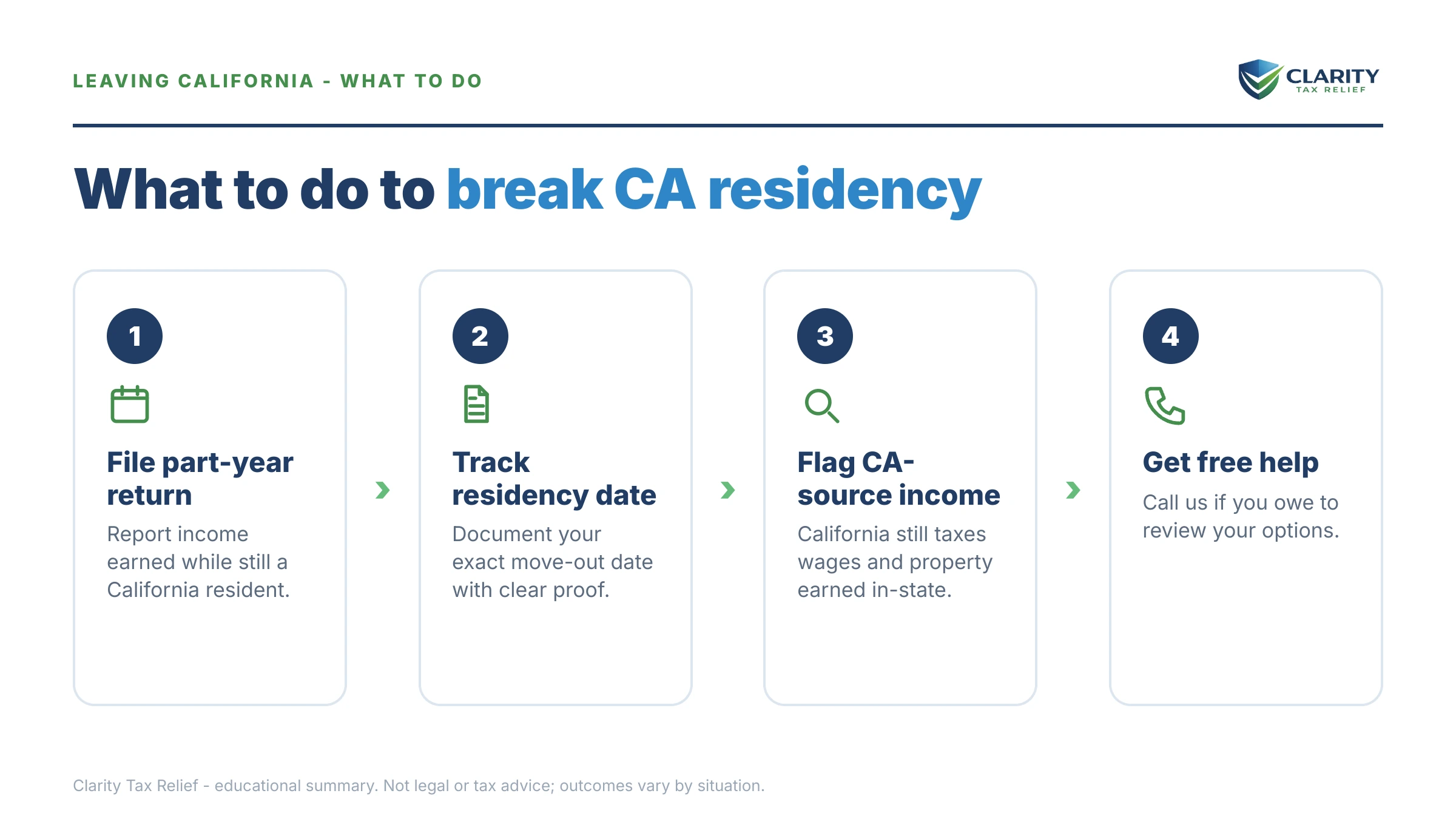
How California decides you're still a resident
The FTB uses a "closest connections" test: whichever state holds the strongest overall web of your ties is where you're a resident — regardless of what your driver's license says. No single tie decides it; the pattern does. In a California residency audit, the burden of proof is on you, not the FTB.
| Tie that keeps you a California resident | The counter-move |
|---|---|
| California driver's license and vehicle registration | Get your new state's license and re-register vehicles promptly |
| Homeowner's exemption on a California property | Drop the exemption; establish and document a primary home elsewhere |
| California voter registration | Register to vote in your new state |
| Children in California schools / custody time in California | You can't always change this, so keep a precise calendar of where you live and sleep |
| California doctors, dentists, accountants, attorneys | Move your providers and professional relationships |
| California bank branches, safe deposit boxes, club memberships | Move accounts and close or transfer memberships |
| More days spent in California than in your new state | Keep a day count — travel records win residency disputes |
The custody row deserves a beat if you're leaving after a divorce. Children who stay in California schools are one of the heaviest ties in the FTB's analysis. A shared custody schedule guarantees regular return trips. That doesn't make you a resident by itself. But it means your calendar, lease, and paper trail have to be airtight, because the FTB will look.
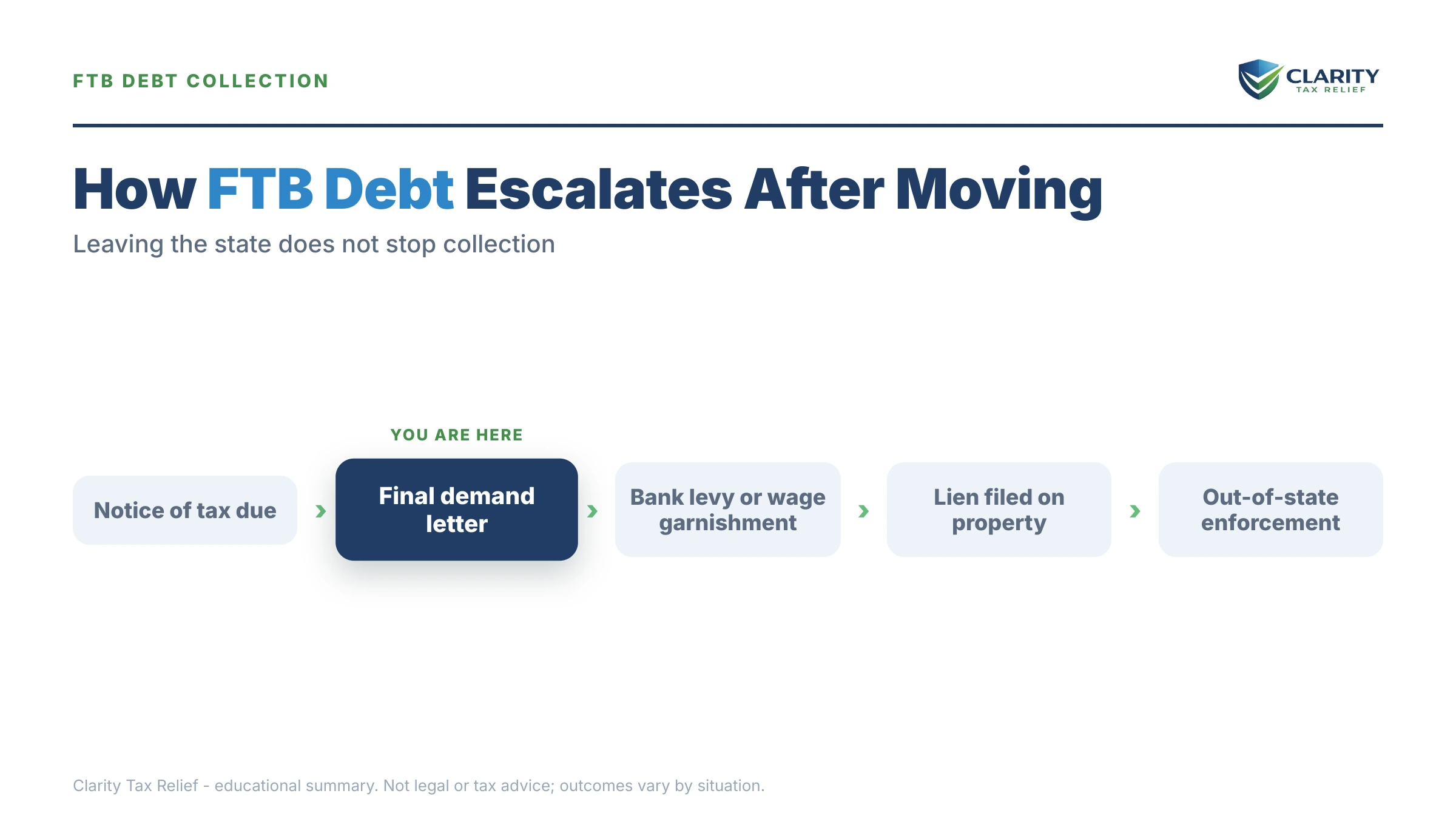
What happens if you move away owing the FTB
An FTB balance does not stay behind at your old address — under R&TC §19255, the FTB can collect for 20 years from the date it assessed the tax, twice the IRS's 10-year window. The full math on that clock is in our guide to California's 20-year collection statute. If you leave a balance unresolved, enforcement escalates in a predictable sequence:
- Demand notices follow you. The FTB skip-traces new addresses through DMV records, employers, banks, and IRS data sharing. Moving doesn't hide you; it just delays the mail.
- Collection fees stack onto the balance. The FTB adds its own collection cost recovery fees on top of accruing interest, so a stalled balance grows faster than interest alone suggests.
- A state tax lien is recorded. An FTB tax lien is a public record that attaches to property you own and complicates any future California purchase, refinance, or sale.
- Bank accounts get levied — including out-of-state ones. The FTB issues Orders to Withhold that national banks honor regardless of which state your branch is in.
- Wages get garnished — often even outside California. An FTB wage garnishment goes to your employer, and large multi-state employers routinely comply for employees anywhere.
- Refunds get intercepted and, for the largest debts, licenses and public listing come into play. California can take state refunds and, for its biggest delinquencies, suspend professional licenses and publish names.
Notice what's missing from that list: any step that requires you to still live in California. Distance changes nothing about the FTB's reach. It only changes how surprised people are when the levy lands.
Leaving California with an FTB balance, or already gone?
Interest and collection fees keep accruing no matter what state you're in, and the FTB's 20-year clock is longer than any move. Get your balance and residency situation reviewed free, before a lien or levy makes every option harder. Call (888) 825-7779 or use the 2-minute form.
Your options if you owe the FTB when you leave
You don't have to live in California to use the FTB's resolution programs — payment plans, hardship deferrals, penalty relief. The FTB's own Offer in Compromise all work from out of state. If you owe the IRS too, resolve them in the right order. Our guide to state tax debt vs IRS covers the sequencing, and owe California state taxes cant pay goes deep on each California program.
| Option | Best for | Key hurdle |
|---|---|---|
| FTB payment plan | Steady income; you can pay in full over time | You must stay current on all future filings; interest and fees continue until paid off |
| FTB offer in compromise | No realistic ability to ever pay in full | The FTB scrutinizes assets, income, and future earning power; home equity or strong earnings usually disqualify |
| FTB hardship deferral (financial statement on FTB Form 3561) | Genuine short-term inability to pay anything | Full financial disclosure required; the FTB revisits your situation and the debt keeps growing |
| FTB penalty abatement | Penalties tied to a one-time event with reasonable cause | Interest generally stays even when penalties come off |
| FTB innocent spouse relief | A joint-return balance that traces to an ex-spouse's income | You must show the understatement is attributable to your ex and that you didn't know or benefit |
A worked example: leaving with $19,700 on the books
Say you're recently divorced, the decree assigns your ex a $19,700 FTB balance from a joint 2023 return assessed in mid-2025. You moved to Nevada on June 1, 2026. Here's the honest math, using hypothetical round numbers:
- The decree doesn't bind the FTB. On a joint return you are both liable for the full $19,700. The FTB collects from whoever is easier to reach, often the one with the W-2 job, which may be you.
- The clock runs to roughly 2045. Twenty years from a mid-2025 assessment means the FTB can pursue this balance for most of your working life, with interest and collection fees compounding the whole way.
- Payment plan math: $19,700 ÷ 48 months ≈ $410/month. Stretched to 60 months, $19,700 ÷ 60 ≈ $328/month, plus continuing interest in both cases, so the real total paid is higher.
- If your post-divorce budget can't carry that, a hardship deferral pauses collection while you rebuild. An FTB Offer in Compromise is possible if your assets and income genuinely can't cover the debt.
- If the $19,700 traces to your ex's unreported income, FTB innocent spouse relief can remove your liability entirely — a stronger fix than any payment plan, when the facts support it.
Your move-year filing in this scenario is simple by comparison: the 540NR reports your January-through-May wages to California, and because Nevada has no income tax, there's no credit-for-taxes-paid puzzle on the new-state side.
How to handle taxes when moving out of California, step by step
- Document your move date. Save the one page that proves it — new lease or closing statement, utility start date, first-day-of-work letter — because every California residency question starts with that date.
- Cut your California ties the same season you leave. Swap your driver's license and vehicle registration, register to vote in the new state, drop the homeowner's exemption on any California property, and move your doctors, dentist, and mailing address.
- File Form 540NR for your move year. Report everything you earned through your move date plus any California-source income after it. In later years, file a 540NR only if California-source income continues.
- Resolve any FTB balance before collection turns involuntary. A payment plan, Offer in Compromise, hardship deferral, or innocent spouse claim can all be set up from out of state, and each is easier before a lien or levy lands.
- Keep a residency file for at least four years. Store calendars, travel records, and the documents above together. If the FTB opens a residency audit on your move year, the burden of proof is on you.
When you can handle this yourself
Most clean moves need no professional help at all. If you're a W-2 employee leaving with no California property, no stock compensation, and no FTB balance, you can file the 540NR, work through the ties table above, and be done. Small balances you can pay within a few months are also a self-serve fix — the FTB's online tools at ftb.ca.gov handle payments and basic plans directly, just as IRS.gov/payments does on the federal side.
Experienced help changes outcomes in a narrower set of situations: a residency audit that's already open, a joint liability tangled up with a divorce, self-employment income from California clients under market-based sourcing, an FTB levy or garnishment already in motion, or FTB debt layered on top of IRS debt where the payment order matters. In those cases, an experienced tax professional's first job is usually stopping enforcement. The second is picking the program the FTB's own math supports.
Terms on your move, decoded
- Domicile: the one place you intend to return to. You can have several residences, but only one domicile, and California presumes it keeps yours until you prove otherwise.
- California-source income: income generated by California property, work performed in California, or (for some business owners) California customers — taxable no matter where you live.
- Form 540NR: California's nonresident and part-year resident return — what you file for your move year and any later year with California-source income.
- Closest connections test: the FTB's residency standard — whichever state holds the strongest overall web of your ties wins, regardless of where your mail goes.
- R&TC §19255: the California statute giving the FTB 20 years from assessment to collect a tax debt.
- Earnings Withholding Order: the FTB's wage garnishment order, which many national employers honor even for employees working outside California.
Moving out of California tax questions, answered
Do I still have to pay California taxes if I move out of state?
Yes, for two categories: everything you earned through your move date, and California-source income afterward. You report both on a part-year Form 540NR for your move year. Once you are genuinely a nonresident, wages you earn working in another state are no longer taxable by California, but rent from California property, gains on California real estate, and stock compensation earned for California workdays still are.
Is there a California exit tax when you move in 2026?
No. California has no exit tax in 2026 — wealth-tax proposals that included provisions for departing residents were introduced in the legislature but never became law. What people call an exit tax is usually the ordinary move-year bill: part-year taxes on Form 540NR, real estate withholding when you sell a California home, and any existing FTB balance that follows you out of state.
How long can California collect back taxes after I move away?
20 years from the date the tax was assessed, under California Revenue and Taxation Code §19255 — twice the IRS's 10-year collection window. Moving out of state does not pause or shorten that clock, and interest and collection fees keep accruing the entire time. Before making any payoff decision on an old balance, confirm the assessment date on your FTB account so you know exactly where you stand.
Can the FTB garnish my wages if I live in another state?
Often, yes. The FTB issues an Earnings Withholding Order to your employer, and large multi-state employers routinely honor it even for employees working outside California. The FTB can also levy accounts at national banks no matter which branch you use. If a garnishment is already in motion, getting into a payment plan or documented hardship status is usually the fastest way to stop it.
How does California know if I really moved?
The FTB compares the story your paperwork tells: driver's license, voter registration, homeowner's exemption, where your children attend school, where your doctors are, and how many days you spent in each state. It also receives data from employers, banks, and the IRS. In a residency audit, the burden of proof is on you — which is why documenting your move date matters more than announcing it.
Do I have to file a California tax return the year I move out?
Almost always, yes. You file Form 540NR as a part-year resident, reporting all income earned through your move date plus any California-source income after it. In later years, you file a 540NR only if you still have California-source income, such as rent from a California property. Skipping a required return invites an FTB demand-to-file notice and an estimated assessment that is usually worse than reality.
Does California tax my 401(k), IRA, or pension after I move?
No. Federal law (4 U.S.C. §114) bars any state from taxing retirement income paid to a nonresident — including 401(k) and IRA distributions and pensions, even a CalPERS pension earned entirely from California work. The protection applies only once you are genuinely a nonresident, which is one more reason to establish and document your new residency cleanly before you start taking distributions.
My divorce decree says my ex pays our California tax debt — am I off the hook?
No. A divorce decree binds you and your ex, not the Franchise Tax Board. On a joint return, both spouses are jointly and severally liable, so the FTB can collect the full balance from whichever of you is easier to reach. Your remedies are FTB innocent spouse relief if the debt traces to your ex's income, or going back to family court to enforce the decree against your ex.
Your next 24 hours
- Pin down your move date and pull the one document that proves it — lease, closing statement, or utility start. Every residency and sourcing question hangs on that date.
- Gather your last California return, any FTB notices. A quick list of California ties still open — license, voter registration, property, accounts, homeowner's exemption.
- If you're carrying an FTB balance into the move — like the $19,700 example above — get a free case review before interest and collection fees grow it and before enforcement starts: the 2-minute form at claritytaxrelief.com/#consult or (888) 825-7779.
This guide is general information, not tax or legal advice for your specific situation. Eligibility for IRS programs depends on individual facts and circumstances; no outcome is guaranteed.