
California FTB Notices
FTB Notice Decoder: What Every California Tax Letter Means (2026)
The short answer: an FTB notice is a letter from California's Franchise Tax Board — the state's income-tax collector, separate from the IRS. The notice name printed at the top tells you the stage: a bill, a proposed assessment, a demand to file, or a final warning before levy. The printed response date controls your deadline.
The envelope says "State of California Franchise Tax Board," the balance says $7,400, and the phrase "before we take collection action" is doing exactly what it was written to do. You rent, you have one checking account, and a levy would land on the same money your rent comes from. Here's the good news: every FTB letter follows a script, and this FTB notice decoder teaches you to read it — which letter you're holding, how much time it gives you, and which single move stops the machine.
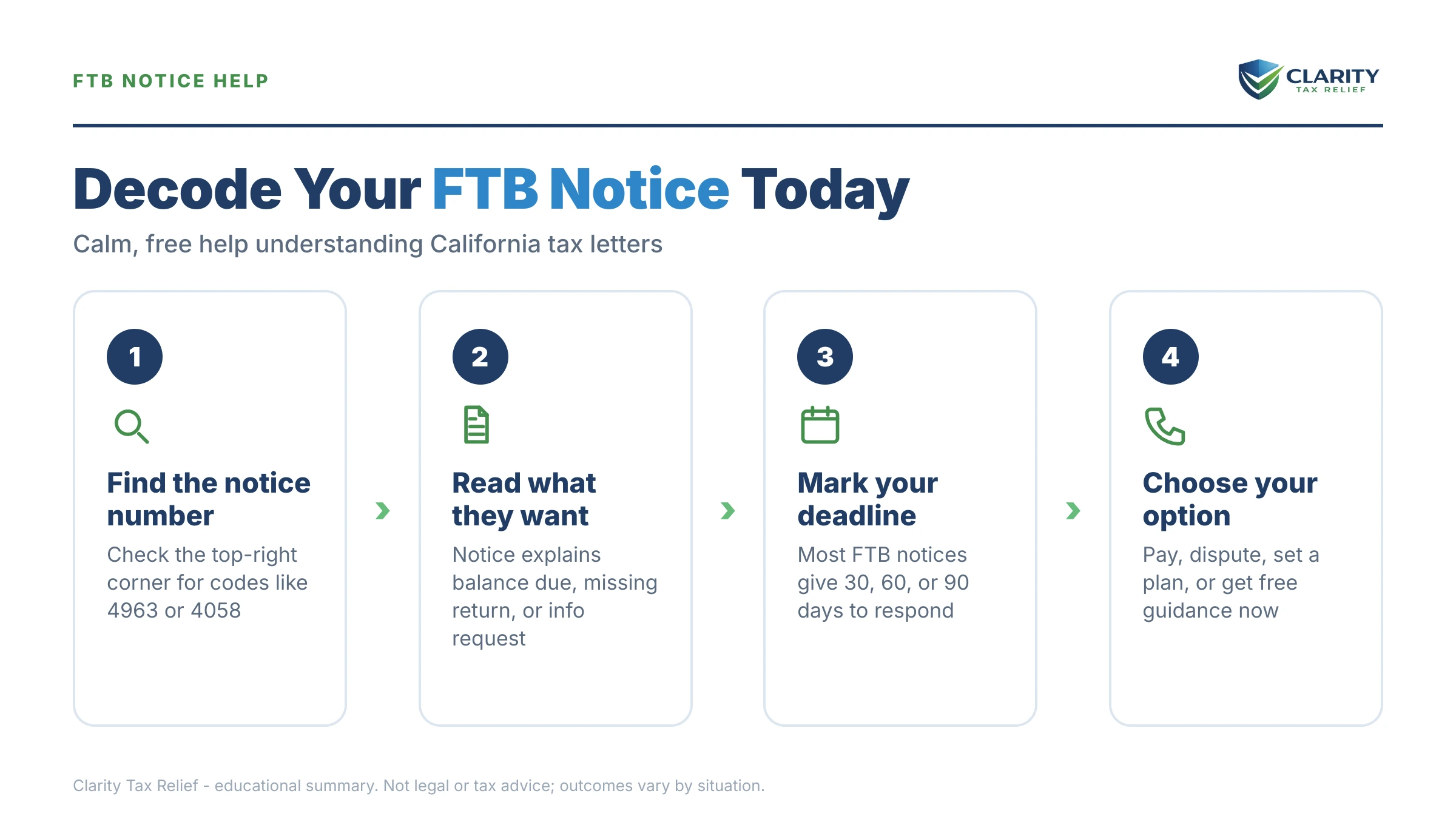
The image below shows you exactly what a real FTB notice looks like and where to find the two items that matter most — the notice name and the response date. Locate those on your letter, then match them in the decoder table.
⏱ Your deadline: the response date printed on your specific notice controls — each FTB notice type sets its own window, and there is no single statewide day count. Interest and FTB collection fees keep accruing on any unpaid balance in the meantime, and once a Final Notice Before Levy expires, the FTB can garnish or levy without sending another letter.
Why you got a letter from the Franchise Tax Board
The Franchise Tax Board is California's income-tax collector — a separate agency from the IRS with its own notices, its own penalties, and a 20-year window to collect. An FTB letter means one of four things: you filed a California return with a balance you didn't fully pay, the FTB changed your return, the FTB believes you should have filed and didn't, or an existing balance is moving deeper into collections.
The "should have filed" letters surprise people the most. The FTB cross-matches W-2s, 1099s, mortgage interest, property sales, and professional licenses against filed returns. When California-source income shows up under your Social Security number with no return attached, a Request or Demand for Tax Return goes out, even if you moved out of state years ago.
One more wrinkle unique to the FTB: it also collects debts that aren't income tax at all, like court-ordered fines and fees referred by California courts. The letterhead looks identical, but the resolution path is different — check the notice name before assuming anything. If your envelope came from the IRS instead, start with why did I get a letter from the IRS. If it's about sales tax, that's a different agency entirely — see the CDTFA notice of determination guide. For the full picture of how state balances get resolved, the California FTB back taxes hub covers the programs in depth.
FTB notice decoder: every common notice, decoded
The notice name printed at the top of your letter, not the tone of the language, tells you which stage of the FTB's process you're in. Find yours here:
| FTB notice | What it means | Your move |
|---|---|---|
| Return Information Notice | The FTB corrected your return — math, credits, or withholding — and recalculated what you owe or your refund. | Compare it line-by-line against your return. Agree? Pay or set up a plan. Disagree? Respond with proof by the printed date. |
| Statement of Tax Due / Income Tax Due Notice | A straightforward bill: the FTB says you owe tax, penalties, and interest for a specific year. | Verify the balance in MyFTB, then pay or arrange a payment plan before the printed date. |
| Request for Tax Return | The FTB found California income under your SSN and no return. It's asking you to file or explain why you don't need to. | Respond by the printed date — file, or document why you had no filing requirement (for example, you were a nonresident). |
| Demand for Tax Return | The escalated version. Ignore it and the FTB files an estimated assessment for you, plus a demand penalty of 25% of the assessed tax. | Do not let this one lapse. See FTB demand to file for the exact response playbook. |
| Notice of Proposed Assessment (NPA) | The FTB intends to add tax, often from an estimate, an audit, or an IRS adjustment it mirrored. It is not final yet. | Protest in writing by the date printed on the NPA (typically 60 days from the notice date). Miss it and the assessment becomes final. |
| Final Notice Before Levy | The last letter before enforcement. After the printed date, the FTB can levy without further warning. | Act now — pay, get a plan approved, or get help. The FTB intent to levy guide covers this notice in detail. |
| Notice of State Tax Lien | The FTB recorded a lien — a public claim against your property and future assets. See FTB tax lien. | The lien follows the debt. Resolving the balance is the only path to release; a plan can stop further enforcement. |
| Earnings Withholding Order for Taxes (EWOT) | A wage garnishment order sent to your employer — up to 25% of your disposable pay, every check, until released. | You can often reduce or release it by proving hardship or getting a plan in place. See FTB wage garnishment. |
| Order to Withhold (OTW) | A bank levy. This order goes to your bank, not to you — the funds are frozen when it arrives. See FTB bank levy. | Move fast: hardship claims and payment arrangements can sometimes recover or release funds, but the window is short. |
| Court-Ordered Debt notice | The FTB is collecting a court fine, fee, or victim restitution referred by a California court, not income tax. | Different rules apply, including its own payment-plan process. Don't treat it like a tax bill. |
What happens if you ignore an FTB notice
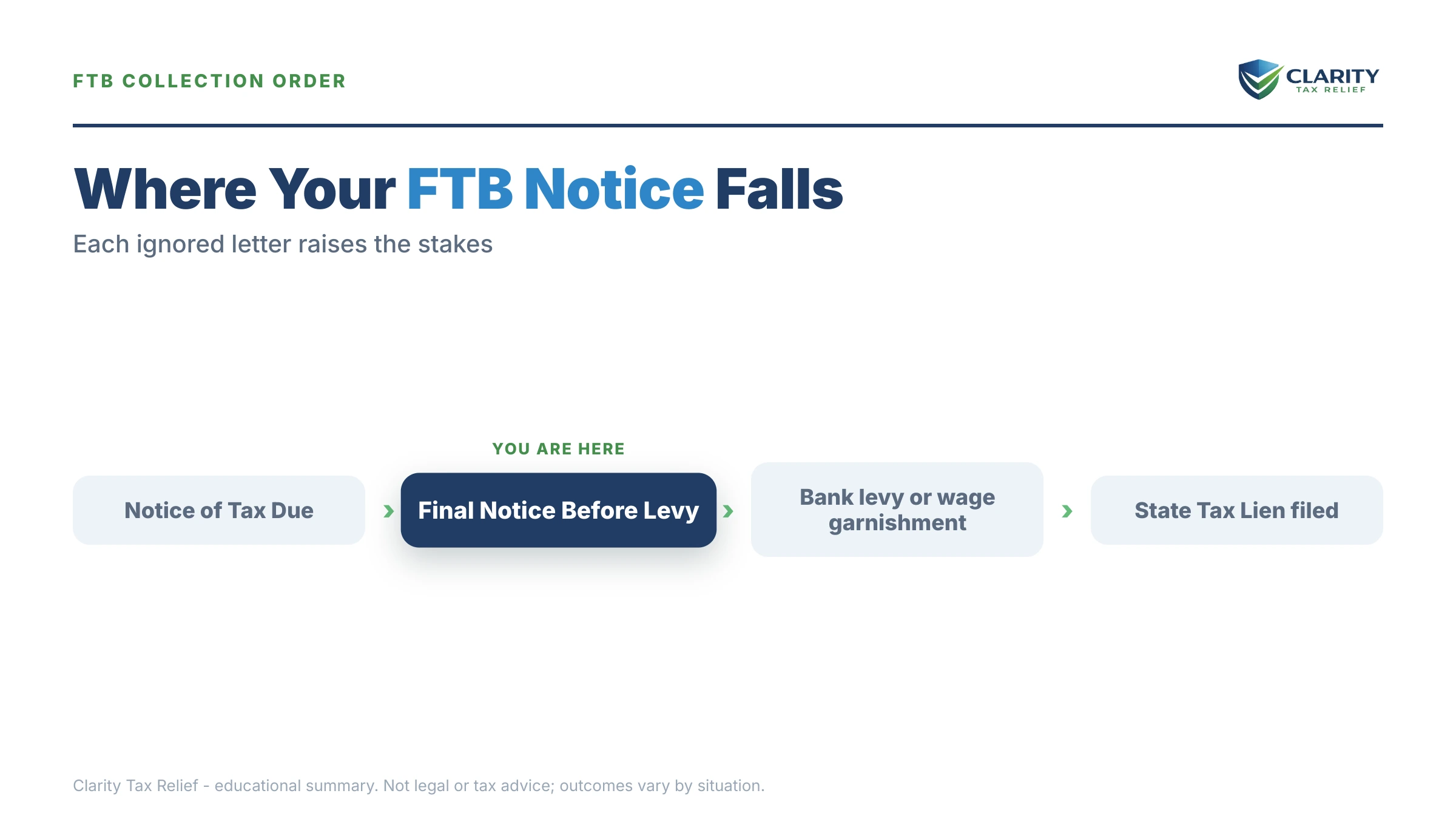
The FTB escalates faster than the IRS: after one Final Notice Before Levy, it can garnish a quarter of your paycheck or freeze your bank account without sending another letter. The sequence is automated, and each stage adds cost:
- The bill stage. A Return Information Notice or Statement of Tax Due arrives. No enforcement yet, but penalties and interest are compounding on the balance every month you wait.
- Final Notice Before Levy. The last required warning, mailed to your last known address. Once its printed date passes, the FTB owes you no further notice before taking money.
- Fees and the lien. The FTB adds its own collection fees to the balance and can record a Notice of State Tax Lien at the county recorder — a public record that attaches to real estate and complicates any sale, refinance, or major purchase.
- Levy and garnishment. An Order to Withhold goes to your bank and freezes what's there, up to the balance. An EWOT goes to your employer and takes up to 25% of disposable pay continuously until the debt is collected or the order is released. Neither order is mailed to you first. (The IRS runs a similar play with its own warnings — see can the IRS freeze my bank account without notice for how the federal version compares.)
- The pressure points. The FTB intercepts state refunds and lottery winnings, and for the state's largest delinquencies it publishes the Top 500 list — which can trigger suspension of professional and driver's licenses.
And unlike the IRS's 10-year clock, the FTB generally has 20 years from assessment to collect under Revenue and Taxation Code Section 19255. Outlasting the FTB is not a plan; it's two decades of levies, liens, and intercepted refunds.
Is your FTB notice a levy warning?
If your letter says Final Notice Before Levy, or your bank or employer has already received an order — the date printed on that notice is the only warning you get. Send us a photo of it: an experienced tax professional will decode exactly where you stand and what stops the next step, free and confidential, before that printed date passes.
Your options for resolving an FTB balance
Every FTB notice ultimately points to the same short menu of resolutions — the notice type just determines how much time you have to pick one. The FTB runs its own versions of these programs; an IRS agreement does not cover a state balance, and vice versa.
| Option | Who it fits | What to know |
|---|---|---|
| Pay in full | You agree with the balance and can cover it. | Stops interest, fees, and the notice sequence immediately. Payable online through your MyFTB account. |
| FTB payment plan | Individuals who owe $25,000 or less and can pay within 60 months, with all returns filed. | Generally available online at those thresholds. Interest and fees keep accruing; a missed payment can default the plan and restart enforcement. |
| Hardship status | Paying anything would leave you unable to cover basic living costs. | Requires a financial statement (FTB Form 3561). Collection pauses while it's in place, but the debt and interest remain and the FTB re-reviews your finances periodically. |
| FTB offer in compromise | No realistic ability to ever pay in full — limited income, few assets. | A separate program from the IRS OIC with its own application and its own math. The FTB decides based on what it could actually collect, not on hardship alone. |
| FTB penalty abatement | Clean compliance history, or a documented cause beyond your control. | California offers a one-time abatement of timeliness penalties for individuals, plus reasonable-cause relief. Interest generally stays unless the underlying tax or penalty falls. |
| Protest and appeal | You dispute a Notice of Proposed Assessment. | File a written protest by the NPA's printed date. If the FTB denies it, you can appeal to California's independent Office of Tax Appeals. |
A worked example: a renter with a $7,400 FTB balance
Say you owe the FTB $7,400, you take home $4,000 a month, and your rent is $1,850. This is hypothetical, but the arithmetic is real.
If you wait for enforcement: an EWOT takes up to 25% of disposable earnings — roughly $1,000 out of every monthly paycheck — until the $7,400 plus accruing interest and collection fees is collected. That's most of a year losing a quarter of every check, on the FTB's schedule. Or an Order to Withhold sweeps up to $7,400 from your bank account in one shot, rent money included, with the freeze happening before you even know the order exists.
If you act first: $7,400 spread over the FTB's 60-month maximum is a floor of about $124 a month, though interest keeps accruing, so a $150 monthly plan realistically finishes in roughly four and a half years. Push it to $250 a month and you're done in about two and a half years and pay meaningfully less interest. Either way, the difference between a payment you choose and a garnishment the FTB chooses is roughly $850 a month of breathing room — the gap between making rent comfortably and not.
How to respond to an FTB notice, step by step
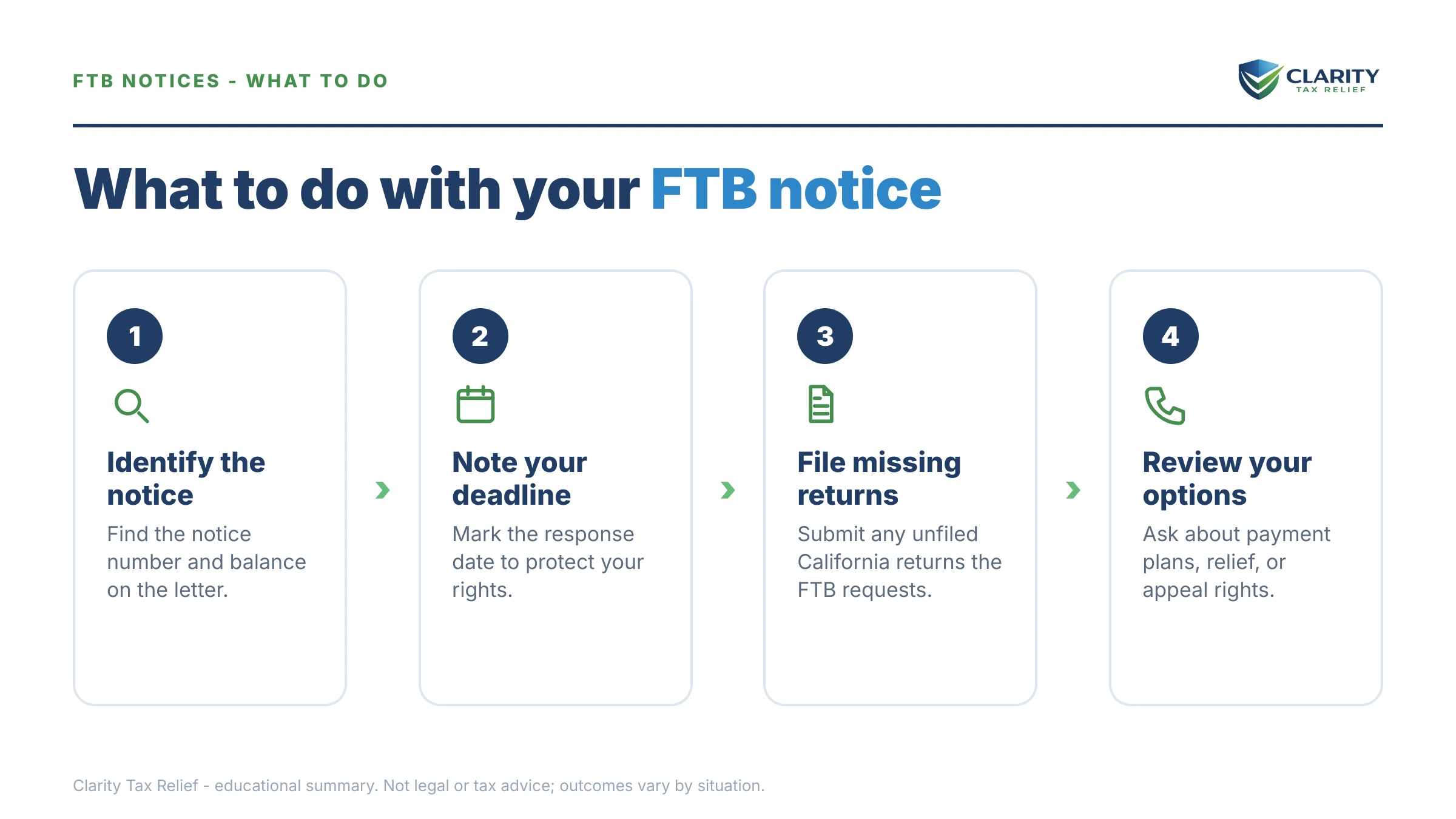
- Identify the notice. Find the notice name at the top of the first page and the response date, then match it in the decoder table above.
- Verify the balance. Create or log in to a MyFTB account and compare the amount, tax year, and payment history against your own records before you pay anything.
- Update your address. If you've moved, correct it with the FTB immediately — levy warnings go to your last known address. The orders that follow go to your bank or employer, not to you.
- Respond before the printed date. Pay, set up a payment plan, or file a protest if you disagree — any of the three stops the escalation. Silence never does.
- Get help if enforcement has started. If your notice mentions levy, lien, or a withholding order, have an experienced tax professional review it before the printed window closes.
When you can handle an FTB notice yourself
Plenty of FTB notices need no professional at all. If you're holding a first bill you agree with and can pay, or can clear within a standard online plan — handle it directly through MyFTB and keep your money. The same goes for a Return Information Notice whose correction you can verify against your own return, or a Request for Tax Return for a year you simply need to file.
Experienced help tends to change the outcome in four situations: a levy or garnishment already in motion, where release paths and hardship claims are time-sensitive and technical. A Demand for Tax Return with multiple unfiled years, where filing order affects the 25% demand penalty and the estimated assessments. A residency dispute — the FTB claiming you were a Californian in a year you say you weren't, which turns on evidence, not argument. And owing both the IRS and the FTB at once, where the sequence you resolve them in changes what each agency will accept.
Honest rule of thumb: the smaller and simpler the notice, the more you should do it yourself. The closer the letter is to your paycheck or bank account, the more a reviewed strategy pays for itself.
Terms on your FTB notice, decoded
- Notice of Proposed Assessment (NPA): tax the FTB intends to add. It becomes final and collectible if you don't protest by the printed date.
- Demand penalty: a penalty of 25% of the assessed tax, added when you ignore a Demand for Tax Return or a demand for information.
- Earnings Withholding Order for Taxes (EWOT): a continuous wage garnishment sent to your employer, taking up to 25% of your disposable pay each period.
- Order to Withhold (OTW): a levy sent to your bank or another party holding your money, freezing funds up to the balance owed.
- Collection cost recovery fee: a fee the FTB adds to your balance once enforced collection begins — separate from penalties and interest, and adjusted periodically.
- 20-year collection statute: the FTB's window to collect under R&TC §19255 — see California's 20-year collection statute for how it runs and what can extend it.
You can verify any balance and see every notice on your account through MyFTB at the official Franchise Tax Board website, and pay or apply for a payment plan directly at ftb.ca.gov/pay.
FTB notice questions, answered
Is the FTB the same as the IRS?
No. The Franchise Tax Board is a California state agency that collects state income tax, entirely separate from the IRS. You can owe one and not the other, and resolving a federal debt does nothing to a state one. The two agencies also run on different rules — most importantly, the FTB has 20 years to collect, double the IRS's 10-year window.
How long can the FTB collect back taxes?
Generally 20 years from the date the tax was assessed, under California Revenue and Taxation Code Section 19255. That is twice the IRS's collection window, so waiting out an FTB debt is rarely a realistic strategy. Certain events can extend the period further, so treat 20 years as a floor, not a promise.
Can the FTB take money from my bank account without warning?
The FTB must first send a Final Notice Before Levy to your last known address. But the Order to Withhold that actually freezes your account goes to your bank, not to you. If you have moved and never updated your address, the first warning you see may be missing money. Update your address with the FTB the moment you learn you owe.
How do I know my FTB letter is real?
A genuine FTB notice arrives by postal mail, names a specific notice type, and matches the balance shown in your MyFTB online account. The FTB never demands payment by gift card, wire transfer, or payment app. If anything feels off, look up the FTB's phone number yourself on the official state website rather than calling a number printed on a suspicious letter.
Can I set up an FTB payment plan online?
Usually, yes — the FTB's online installment agreement is generally available to individuals who owe $25,000 or less, can pay the balance within 60 months, and have filed all required returns. Interest and applicable fees continue to accrue while you pay. If you owe more or need longer, a plan is still possible, but the FTB will want financial details first.
Does the FTB forgive penalties?
Sometimes. California now offers a one-time abatement of timeliness penalties for individuals with a clean compliance history, and reasonable-cause relief is available when circumstances beyond your control — serious illness, disaster, bad professional advice — caused the problem. Interest is much harder to remove; it generally stays unless the underlying tax or penalty is reduced.
I moved out of California — why is the FTB still writing to me?
Because moving does not erase a California tax year. The FTB pursues former residents for years they lived or earned in the state. It sends demands to file when California-source income — rent, wages, a property sale — shows up under your Social Security number. With a 20-year collection window, these letters can follow you across state lines for a long time, so respond rather than assume distance protects you.
What is the difference between FTB, CDTFA, and EDD notices?
They are three different California agencies. The FTB handles personal and business income tax, the CDTFA handles sales and use tax, and the EDD handles payroll taxes. Each has its own notices, deadlines, and resolution programs, so a payment plan with one does not cover a balance with another. Check the letterhead first. It determines everything that follows.
Your next 24 hours
- Find two things on your letter: the notice name at the top of the first page and the response date. Write both down. They define your entire situation.
- Gather your paperwork: the notice itself, your most recent California return (if you filed one), proof of any payments you've made. A current pay stub.
- Get a free case review before the printed date passes: use the 2-minute form or call (888) 825-7779. An experienced tax professional will decode your exact notice and map the option that protects your paycheck and your bank account.
This guide is general information, not tax or legal advice for your specific situation. Eligibility for IRS programs depends on individual facts and circumstances; no outcome is guaranteed.