
State vs. Federal Tax Debt
FTB vs IRS: Which First? How to Prioritize When You Owe Both (2026)
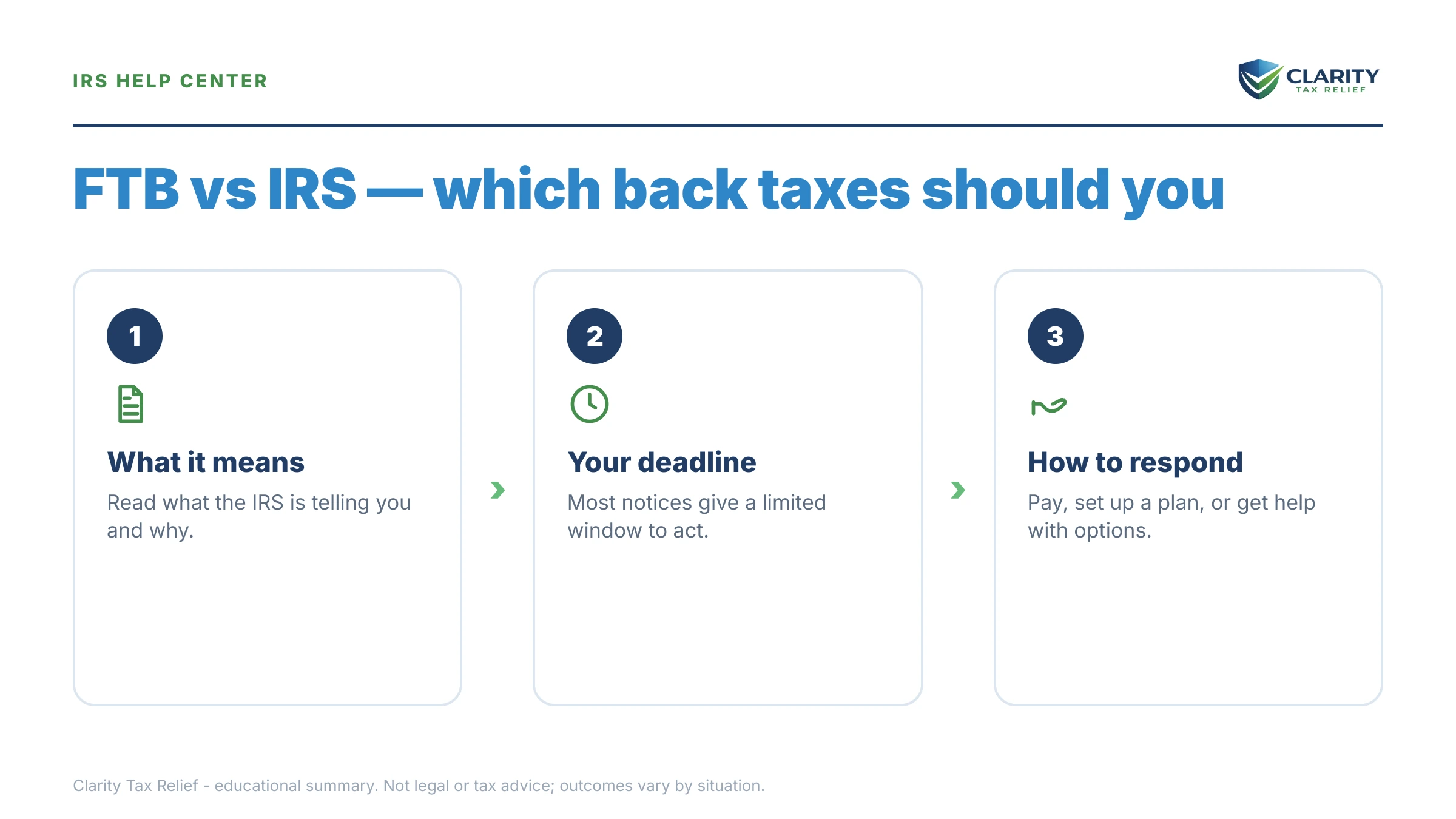
FTB vs IRS — which first? Respond first to whichever agency has sent an intent-to-levy notice; an active levy threat always jumps the line. If both are still just billing you, structure the IRS resolution first — its payment programs anchor your monthly budget — then build the FTB agreement around it.
The divorce is final, but the joint tax years aren't, and now two envelopes are arriving for the same marriage: one from Sacramento, one from the IRS. It feels like being billed twice for one problem. It isn't. It's two separate debts with two separate playbooks, and the order you work them in is a real decision with real dollar consequences. Here's the map.
⏱ The clock that's actually running: there is no single response deadline covering both debts, but interest and late-payment penalties accrue monthly at each agency, and the FTB can collect for 20 years under R&TC §19255, twice the IRS's 10. Waiting doesn't run out either clock in any useful way; it just grows both balances.
Why you owe both the FTB and the IRS at the same time
Owing both agencies is usually the normal outcome of one problem, not two: most federal balances create a matching California balance for the same tax years. Same income, two returns, two bills.
An IRS adjustment often triggers an FTB one later, because California receives federal data and re-bills the state side of the same change. So the balances rise together, but they never merge. Paying one does nothing to the other.
If the debt comes from joint returns filed during your marriage, both agencies apply joint and several liability: each ex-spouse can be pursued for 100% of a joint-year balance, no matter what the settlement papers say. Your decree is a contract between you and your ex — the collectors never signed it. Our guide to divorce decree IRS debt covers why, and the FTB takes the same position on the state side.
“An IRS levy permits the legal seizure of your property to satisfy a tax debt. It can garnish wages, take money in your bank or other financial account, seize and sell your vehicle(s), real estate and other personal property.”
— Levy (IRS.gov)
FTB vs IRS which first: the triage rule that actually works
The rule that decides FTB vs IRS which first is enforcement stage, not agency: the letter threatening a levy gets your first response, and ordinary bills get sequenced behind it. Read each notice for the words "intent to levy," "final notice," or a warning about wages and bank accounts — that language marks the hot file.
When neither agency is at the levy stage, two tiebreakers apply. First, the FTB usually escalates faster than the IRS — fewer warning letters, quicker orders to your bank and employer, plus tools the IRS doesn't have, like license suspensions. Our comparison of is the FTB worse than the IRS walks through the differences.
Second, time favors dealing with California, not outlasting it. The IRS generally has 10 years from assessment to collect; the FTB has 20 under California's 20-year collection statute. You can estimate how much time remains on your federal clock with our CSED Calculator, but there's no realistic wait-it-out play against Sacramento.
Yet for structuring the resolutions, most people should build the IRS agreement's framework first. The federal side usually holds the larger balance, its program thresholds are published and predictable, and, when the IRS reviews your finances, it may count an existing state installment payment as a necessary expense. That interplay is why sequence changes what each agency demands per month.
One more federal-only wrinkle: passport certification. In 2026 the IRS can certify seriously delinquent debt to the State Department at $66,000, but only the federal balance counts toward that threshold. Your FTB debt never affects your passport. (Outside California? The same triage logic applies to any state — see state tax debt vs IRS.)
What happens if you ignore either one
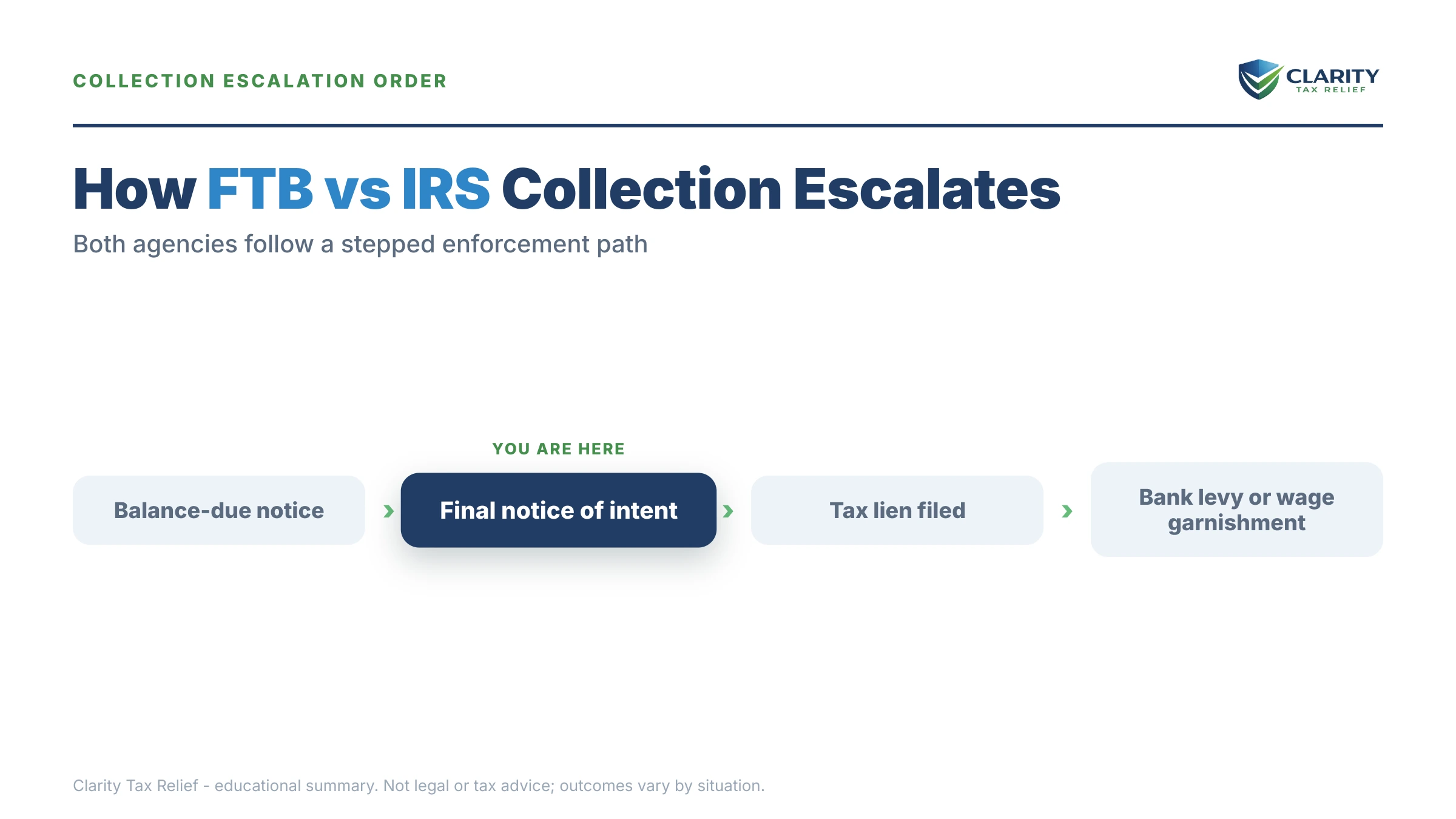
Both agencies escalate automatically, but the FTB's ladder is shorter and its reach is wider. Here is the sequence on each track, stage by stage:
- Billing. The IRS sends a CP14, then CP501/CP503 reminders — bills with no enforcement power yet. The FTB sends its own balance-due notices and begins tacking on collection fees.
- Pre-levy warnings. The IRS issues a CP504, which lets it seize your state refund under IRC §6331(d). The FTB issues its own FTB intent to levy notice, and typically with less runway than the federal version.
- Levy powers unlock. The IRS's LT11/Letter 1058 starts a 30-day clock with Collection Due Process appeal rights before wages and bank accounts are fair game. The FTB moves to earnings withholding orders and bank levies — see FTB wage garnishment — and a wage levy from either agency is continuous until it's released.
- The long tail. Liens attach to your property on both tracks, refunds are intercepted every year, the FTB can suspend licenses and business entities. The clocks keep running — 10 years federal, 20 state.
Don't count on 2026 staffing cuts to slow this down. The IRS workforce shrank roughly 27% in 2025. But the notices, liens, and levies on both tracks are generated by automated systems that never took a furlough.
Owing Sacramento and the IRS at the same time?
Two balances are accruing interest at once, and the order you resolve them in changes what each agency demands. Get both notices reviewed free by an experienced tax professional — we'll map which file is hot and what each track should cost you monthly.
Your resolution options with each agency
Every major federal relief program has a California cousin, but an accepted IRS resolution does nothing to your FTB balance, and vice versa. Each agency requires its own application and its own financial review. The mechanics of the federal programs are covered in our guide to how to settle tax debt yourself. Here's how the two menus line up.
| Resolution option | IRS version | FTB (California) version |
|---|---|---|
| Payment plan | Short-term: up to 180 days, $0 setup. Long-term: up to 72 months online for balances ≤ $50,000 | The FTB runs its own installment agreements with its own thresholds — see FTB payment plan |
| Settle for less (OIC) | $205 fee + 20% down on lump-sum offers (both waived with low-income certification); roughly 1 in 5 accepted in FY2024 | Separate program with its own financial test — see FTB offer in compromise; an IRS acceptance doesn't transfer |
| Hardship pause | Currently Not Collectible status: collection stops, debt and interest remain | The FTB has its own hardship review, requiring its own financial statement |
| Penalty relief | First-Time Abate (being replaced by the Automatic Exemption from Penalty starting summer 2026) plus reasonable cause | The FTB applies its own abatement standards and process, separate from the IRS's |
| Innocent spouse relief | Form 8857, based on federal criteria | Separate state request — see FTB innocent spouse; winning federally helps but doesn't decide it |
After a divorce, the innocent spouse row deserves a hard look before you agree to pay anything. If the balance came from your ex's income or your ex's underreporting, relief can remove your name from part or all of a joint-year debt. But you must request it on both tracks separately.
What each option costs and how long it takes
Cost and speed differ sharply between the two agencies, and the notice never spells either out. Use this as your planning baseline, and see best way to pay the IRS for the cheapest federal payment channels.
| Option | Upfront cost | Typical timeline |
|---|---|---|
| IRS short-term plan | $0 setup fee | Full payment within 180 days |
| IRS long-term installment agreement | Modest setup fee (lowest with direct debit; reduced or waived for low-income filers) | Up to 72 months online at ≤ $50,000; interest and penalties continue accruing |
| IRS Offer in Compromise | $205 + 20% down on lump-sum offers (both waived with low-income certification) | Months of review; deemed accepted if the IRS doesn't decide within 2 years, with narrow exceptions — a returned or rejected offer stops the clock, and time during court disputes does not count |
| FTB installment agreement | The FTB adds its own fees to delinquent accounts | Terms set by the FTB's rules — verify current thresholds at ftb.ca.gov or our FTB payment plan guide |
| FTB Offer in Compromise | Separate state application; no acceptance is guaranteed | Reviewed on the FTB's own schedule, independent of any federal offer |
Worked example: $68,500 split between the IRS and the FTB
Say you came out of your divorce owing $68,500 across both agencies: $52,000 to the IRS from two joint years, and $16,500 to the FTB for the matching California balances. Everything is at the billing stage. Here's the sequencing math — hypothetical numbers, real method.
Federal track first. $52,000 sits just above the $50,000 online-plan ceiling. Paying $2,100 up front drops the balance to $49,900 and unlocks the streamlined 72-month online agreement: $49,900 ÷ 72 ≈ $694 a month before the interest and 0.5% monthly late-payment penalty that keep accruing, so in practice you'd set the payment a bit higher or expect the plan to run its full term.
State track second. The $16,500 FTB balance goes on its own installment agreement. For illustration only: $375 a month clears $16,500 in about 44 months, before FTB interest and fees. Combined outlay: roughly $1,069 a month across both agencies.
Two sequencing payoffs hide in this example. Because only federal debt counts toward passport certification, the $52,000 IRS balance stays under the $66,000 threshold — the combined $68,500 is irrelevant there. And if the state agreement exists when the IRS reviews your budget, part of that $375 may be treated as a necessary expense, softening the federal demand.
If $1,069 a month simply isn't there after the divorce reset your household budget, that's not failure — it's the signal to run the hardship and offer math on one or both tracks instead of forcing an agreement that will default.
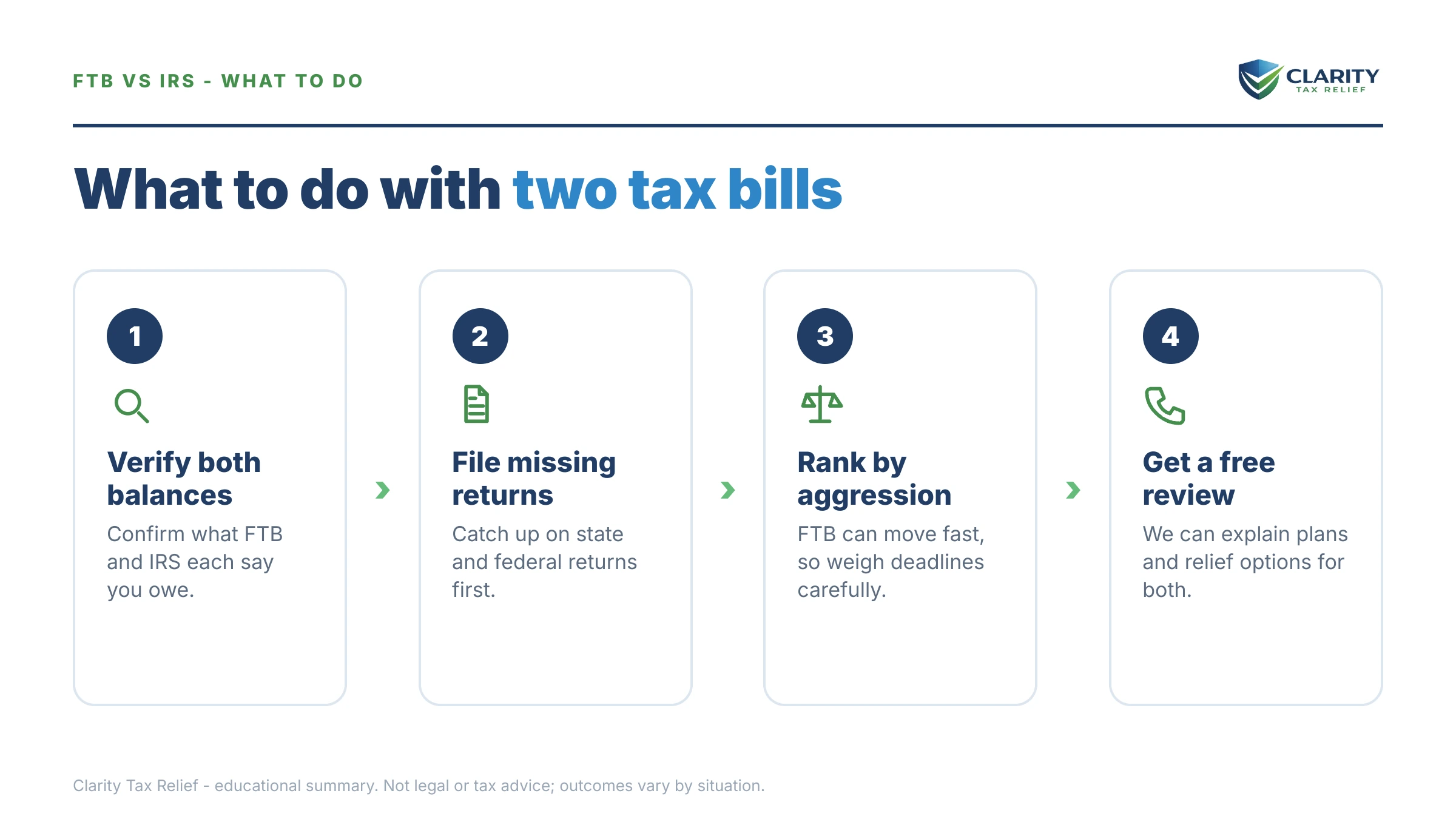
How to respond when you owe both, step by step
- Pull both balances. Log into your IRS online account and MyFTB the same day so you're working from real numbers, not month-old notice snapshots.
- Rank your notices by enforcement stage. A final intent-to-levy notice from either agency gets the first response; bills can wait a week, levies can't.
- File every missing return, federal and state. Neither agency will approve a payment plan or settlement while returns are outstanding, and failure-to-file penalties dwarf late-payment penalties.
- Set up your IRS resolution. Choose the payment plan, hardship status, or offer that fits the table above, and get the agreement confirmed in writing.
- Set up your FTB arrangement. Apply for the FTB's own installment agreement or offer — nothing from the IRS side carries over automatically.
- Protect both agreements. Fix your withholding or estimated payments so next April's return doesn't default either plan.
When you can handle this yourself
Plenty of two-agency cases are genuinely DIY. If both debts are still at the billing stage, you agree with the amounts. The federal balance is at or under $50,000, you can set up the IRS plan yourself at the official IRS payment plans page and apply for the state agreement directly through the Franchise Tax Board. A small balance you can clear within 180 days federally doesn't need anyone's help.
Experienced help changes outcomes in four situations: a levy or garnishment is already in motion on either track. You have unfiled years at one or both agencies. You're weighing innocent spouse relief after a divorce, where the federal and state requests must be built consistently. Or you're a realistic settlement candidate — the IRS's own criteria are on its Offer in Compromise page, and running that math twice, against two different agencies' standards, is where sequencing mistakes get expensive.
Terms you'll see on both sets of notices, decoded
- CSED — the Collection Statute Expiration Date: the day the IRS's 10-year window to collect a federal tax debt closes.
- R&TC §19255 — the California law giving the FTB 20 years from assessment to collect, double the federal window.
- EWOT / Order to Withhold — the FTB's wage garnishment and bank levy orders, sent straight to your employer or bank.
- SITLP — the State Income Tax Levy Program, which lets the IRS seize your state refund for federal debt.
- CDP rights — Collection Due Process: your 30-day right to a hearing (requested on Form 12153) after the IRS's final levy notice.
- Joint and several liability — each spouse on a joint return owes 100% of the balance, regardless of what the divorce decree says.
FTB vs IRS questions, answered
Should I pay the FTB or the IRS first?
Respond first to whichever agency is closest to levying — an intent-to-levy notice outranks a bill from either side. If both are still at the billing stage, structure your IRS resolution first, because federal programs like the 72-month online payment plan anchor your monthly budget, then build the FTB arrangement around it. If money is too tight for both, that is a hardship conversation, not a coin flip.
Does paying the IRS reduce what I owe the FTB?
No. The IRS and the Franchise Tax Board are separate governments collecting separate debts, and a payment to one never touches the other's balance. The same goes for settlements: an accepted IRS offer in compromise leaves your FTB balance fully intact. You need a resolution with each agency, even though both debts usually trace back to the same tax years.
Can the IRS take my California state refund?
Yes. Under the State Income Tax Levy Program, the IRS can seize your California refund for federal back taxes — a CP504 notice announces exactly that intent under IRC §6331(d). The FTB also intercepts state refunds for its own balances, so if you owe both, any refund is usually gone before it reaches you. Adjust your withholding so you stop generating refunds either agency can grab.
How long can the FTB collect compared to the IRS?
The FTB generally has 20 years from assessment to collect under California R&TC §19255 — twice the IRS's 10-year collection statute. That gap changes strategy: taxpayers near the end of the federal clock sometimes have realistic wait-it-out math with the IRS, but almost never with the FTB. Events like an offer in compromise or bankruptcy can pause the federal clock, so verify your real dates before counting on either.
Can I be on payment plans with both agencies at the same time?
Yes, and most people who owe both end up there. The order matters, though: when the IRS reviews your finances, it may treat an existing state installment payment as a necessary expense — which can lower what the IRS demands each month. Ask an experienced tax professional to run the numbers both ways before you lock in either agreement.
My divorce decree says my ex pays the back taxes — am I safe?
No. A divorce decree binds you and your ex, not the IRS or the FTB — both agencies can still collect the full joint balance from either name on the return. Your real remedies are innocent spouse relief (Form 8857 federally. The FTB's own program on the state side) or enforcing the decree against your ex in family court while you keep collections at bay.
Is the FTB really more aggressive than the IRS?
In speed and duration, usually yes. The FTB works with a 20-year collection statute, adds its own collection fees, and can reach beyond money — suspending professional licenses and business entities in ways the IRS cannot. The IRS's endgame powers are just as serious, but its notice sequence typically gives you more warnings first. Treat an FTB collection notice as a shorter fuse.
Can one offer in compromise settle both debts?
No. The IRS and the FTB each run their own offer in compromise program with separate applications, separate financial reviews, and separate decisions. The IRS accepted roughly 1 in 5 offers in FY2024. The FTB applies its own standards — acceptance by one doesn't obligate the other. Some taxpayers settle with one agency and pay the other through an installment plan.
Your next 24 hours
- Sort your letters into two piles, IRS and FTB, and find the enforcement language on each: any notice mentioning "intent to levy" or "final notice" is your hot file, from either agency.
- Gather your last filed federal and California returns, every notice from both agencies. Your current income information — that's everything needed to price both resolutions.
- Get a free two-track case review — the form at claritytaxrelief.com/#consult or (888) 825-7779. Interest is compounding on two balances at once; sequencing them correctly is the cheapest decision you'll make this year.
This guide is general information, not tax or legal advice for your specific situation. Eligibility for IRS programs depends on individual facts and circumstances; no outcome is guaranteed.