
California Tax Debt
California Exit Tax in 2026: What's Real, What's a Myth, and What Actually Follows You
The short answer: there is no California exit tax in 2026 — no law charges a fee, wealth tax, or percentage of your assets for moving away, and every bill proposing one has failed. What is real: the FTB can tax California-source income after you leave, audit your move, and collect existing debt for 20 years.
Maybe you're planning the move and someone warned you that California will "charge you to leave." Or maybe you already left, and the Franchise Tax Board just proved it can still find you, with a notice forwarded from your old apartment or money suddenly frozen in your checking account. Both versions of the worry have the same cure: knowing precisely what California can and can't touch once you cross the state line.
The image below maps that line — the income and debts that follow you out of California and the ones that don't — so you can see exactly where your own situation falls before you make a single move.
⏱ The clock that's actually running: there is no exit-tax deadline, because there is no exit tax. But under R&TC §19255, the FTB can collect a California tax debt for 20 years from the date it became due, twice the IRS window, and interest accrues the entire time. If an Order To Withhold has already hit your bank account, act the day you learn about it.
Is there a California exit tax in 2026?
There is no California exit tax in 2026 — no law charges departing residents a fee or a share of their wealth for leaving the state. No exit-tax or wealth-tax bill has ever passed the California Legislature.
The rumor has a real origin, which is why it refuses to die. In 2020, AB 2088 proposed a statewide wealth tax that would have kept applying, on a phased-down basis, to people for years after they moved away. In 2023, AB 259 revived the wealth-tax idea. Both bills generated national headlines and viral posts, and both died without becoming law. Every time a similar bill is introduced, the "California exit tax" panic cycles through social media again.
The myth causes damage in both directions. Some people delay a genuinely smart move out of fear of a phantom tax. Others assume that leaving wipes the slate clean, and then a rent payment bounces because the FTB reached into an out-of-state bank account over a balance they thought they'd left behind.
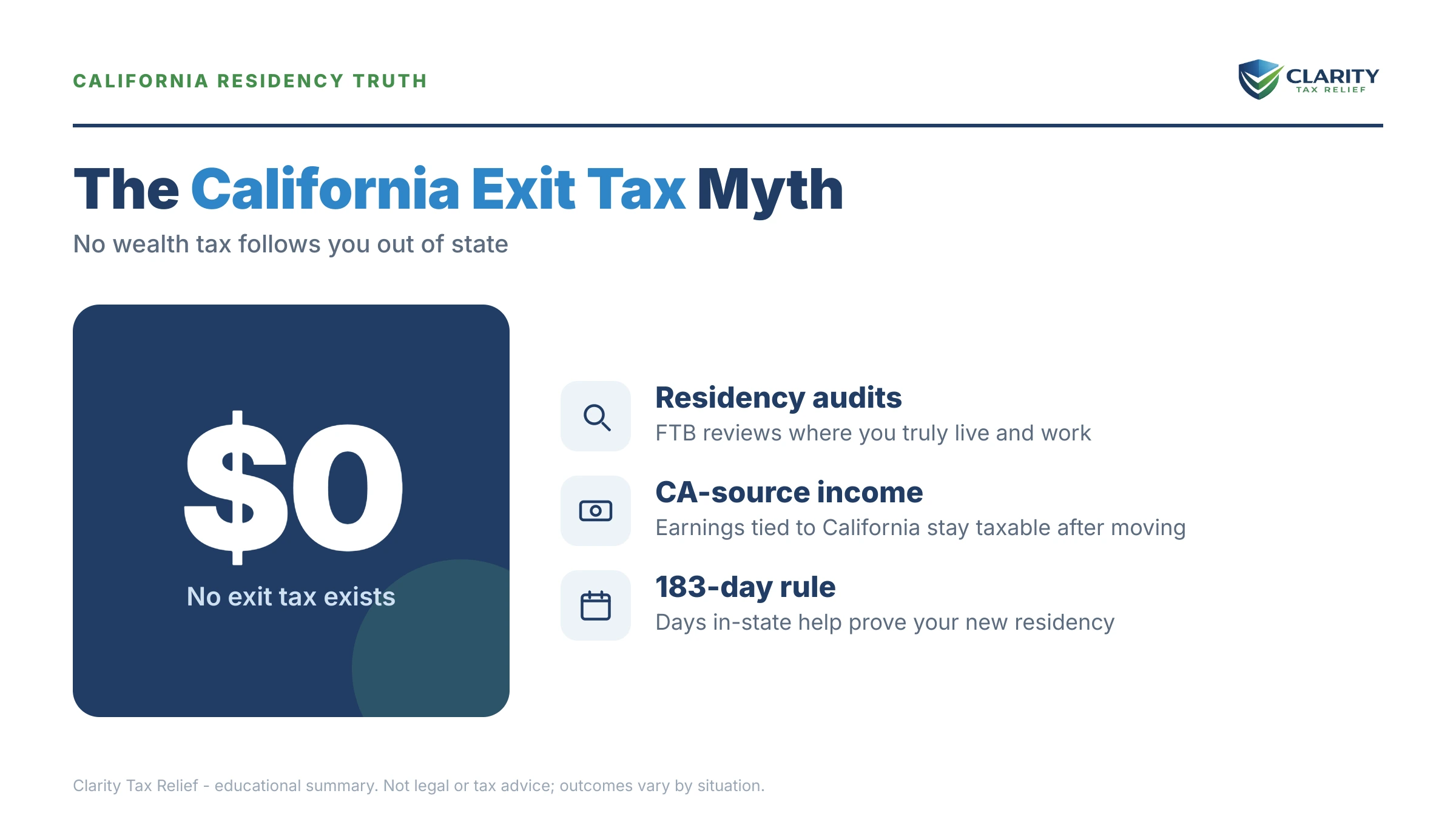
What California can still tax after you move
California taxes nonresidents on California-source income, no matter where they live. That single rule, not any exit tax, explains almost every FTB letter that follows someone to a new state. Only California-source income remains taxable after a genuine move; your new state gets everything else.
Start with the myths, because they're what most readers arrive holding:
| The claim | Myth or real? | What's actually true |
|---|---|---|
| California charges a percentage of your wealth when you leave | Myth | Wealth-tax bills with trailing provisions (AB 2088, AB 259) were introduced but never passed. |
| California keeps taxing everything you earn after you move | Myth | Only California-source income stays taxable; your new state taxes the rest. |
| Leaving the state stops FTB collection of old debt | Myth | The FTB can collect for 20 years and routinely enforces across state lines. |
| You can stop filing California returns the year you leave | Myth | Your exit year usually requires a part-year Form 540NR. |
| California can tax your pension after you move | Myth | Federal law (4 U.S.C. §114) bars states from taxing nonresidents' qualified retirement income. |
| The FTB can audit whether you really moved | Real | Residency audits examine your closest connections, sometimes years after the move. |
Now the substance behind the "real" column. In the year you move, you generally file Form 540NR as a part-year resident: worldwide income up to your move date, California-source income afterward. After a clean move, this is the income that stays on California's books:
| Income type | Taxable by California after you move? | Why |
|---|---|---|
| Wages for work physically performed in California | Yes | Wages are sourced to where the work was done, not where you live when paid. |
| RSUs and stock options earned during California employment | Partly | The portion tied to California workdays stays California-source when it vests or is exercised. |
| Rent from California real estate | Yes | Real-property income is sourced to where the property sits. |
| Sale of California real estate, including installment payments | Yes | Gain follows the property; installment payments stay taxable year after year. |
| California business, partnership, or S-corp (K-1) income | Yes, apportioned | Taxed to the extent the business operates in California. |
| Interest, dividends, and stock gains as a true nonresident | Generally no | Intangibles are sourced to your state of residence when sold. |
| Pension, 401(k), and IRA distributions | No | Federal law bars states from taxing nonresidents' qualified retirement income. |
The phrase doing heavy lifting in that table is "true nonresident." If you claim you left but kept a home, a spouse, a business, or your daily life in California, the FTB can open a California residency audit and argue you never really moved — which converts "generally no" into "yes, all of it, plus penalties." If your move is still ahead of you, our guide to moving out of California taxes covers how to sever ties cleanly. And if your worry is federal debt too, see how to sequence state tax debt vs IRS obligations before committing money to either.
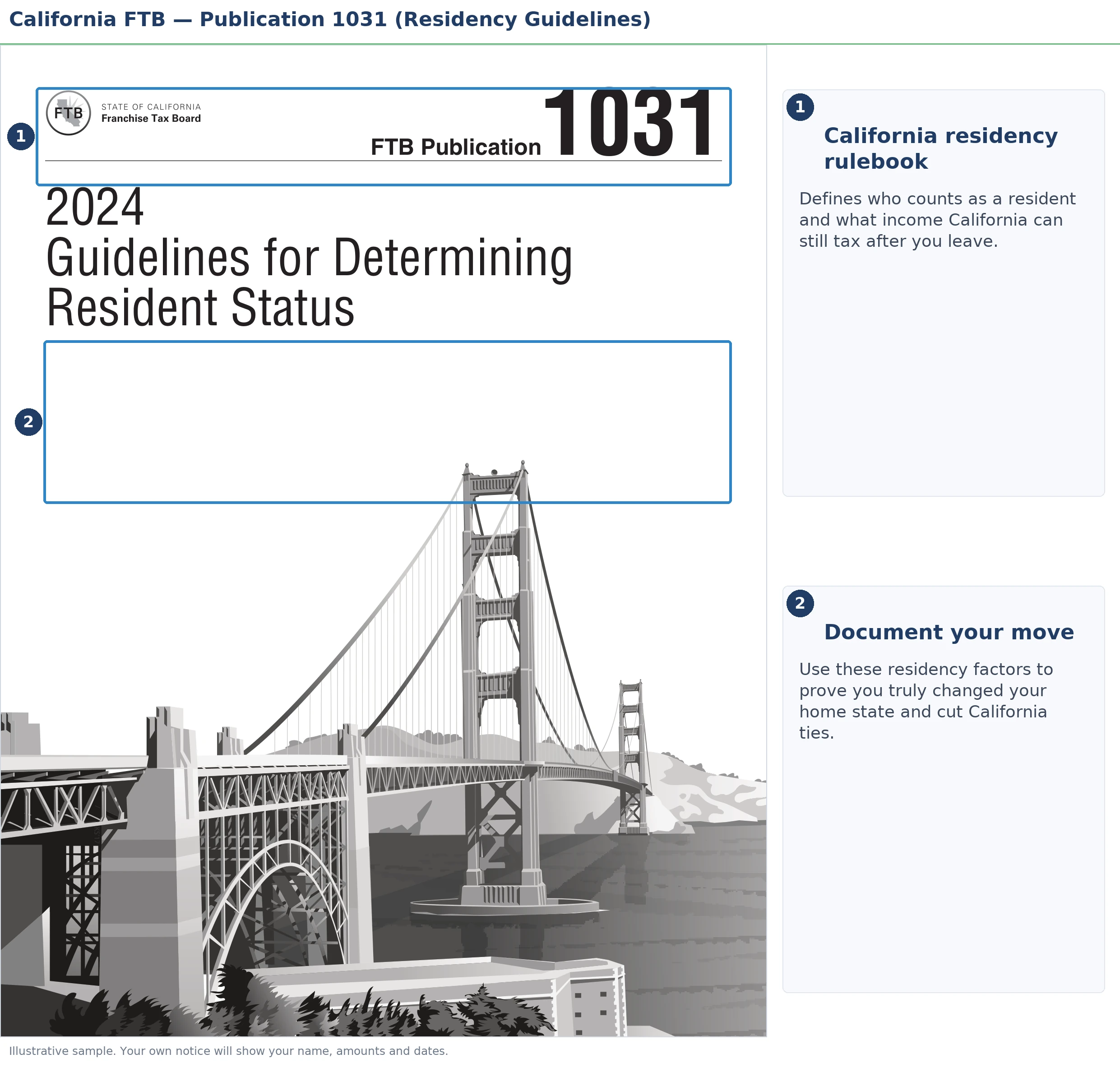
What happens if you ignore the FTB after leaving California
Ignoring the FTB from another state does not slow it down — its collection machine is automated, cross-border, and backed by a 20-year statute. The sequence runs in stages, and each stage is harder to unwind than the one before it:
- Demand notices. A Statement of Tax Due or demand for payment, with penalties and interest already attached. Cheapest moment to act.
- Collection fees added. Once the account moves into active collection, the FTB tacks cost-recovery fees onto the balance itself.
- State tax lien. A public record. As a renter you may have no home for it to attach to. But it attaches to property you acquire later and can surface in financing and background checks. See FTB tax lien.
- Order To Withhold. The FTB's bank levy. Because most national banks do business in California, an FTB bank levy can freeze an account you opened in Nevada, Texas, or Florida.
- Earnings Withholding Order for Taxes. Wage garnishment, routinely honored by multi-state employers. See FTB wage garnishment.
- Intercepts and the long clock. Refund intercepts, interagency offsets, and behind all of it, California's 20-year collection statute, which certain events can stretch even longer.
Compare that with the IRS, which generally gets 10 years to collect. The FTB gets 20, so a debt you leave behind in your twenties can legally follow you into your forties.
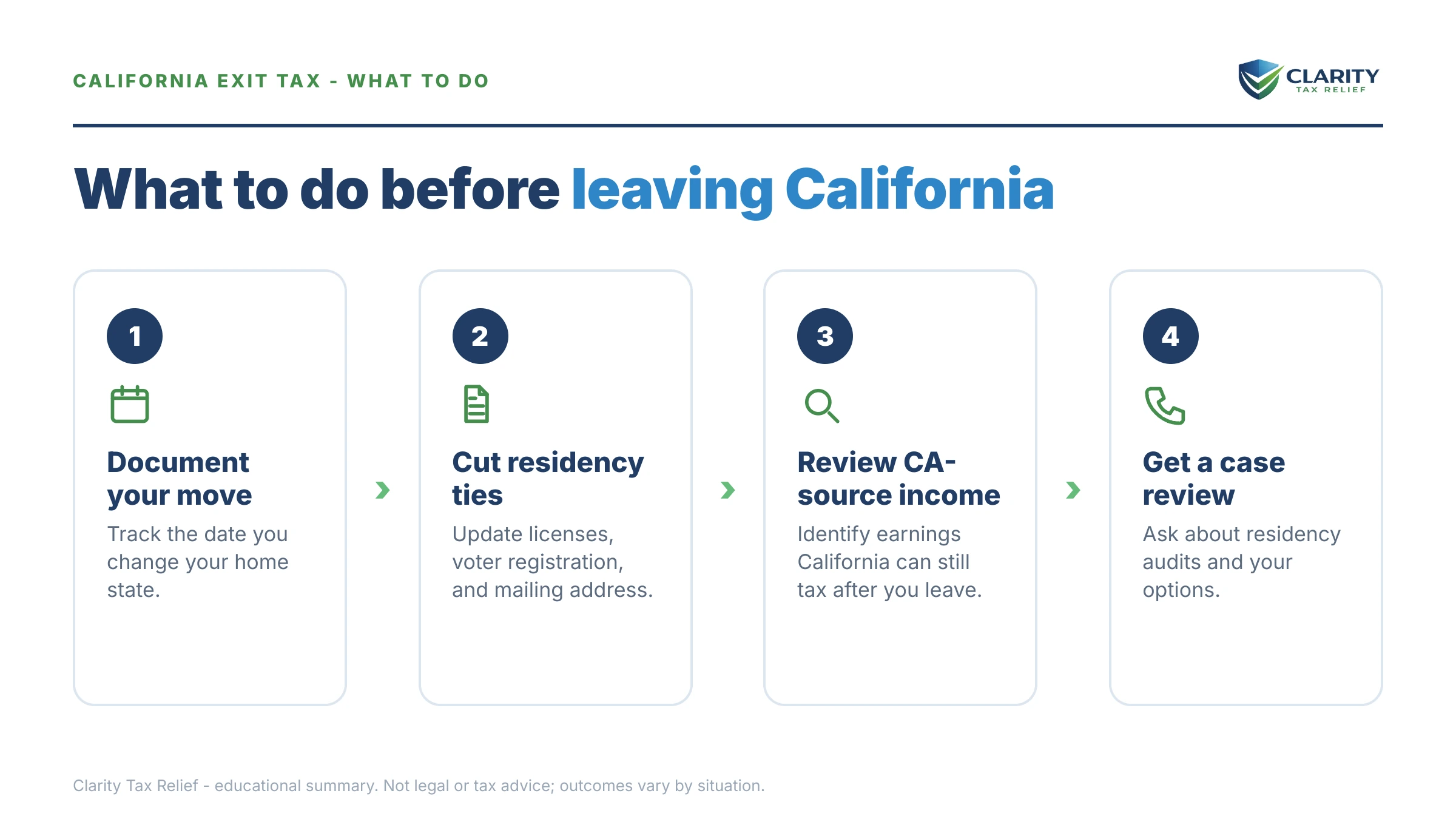
Did California levy you from out of state?
An FTB Order To Withhold doesn't care where you live now, and interest posts on the balance every month it sits. Send us your notice: an experienced tax professional will review your move date, your balance, and your realistic options in one free, no-pressure call.
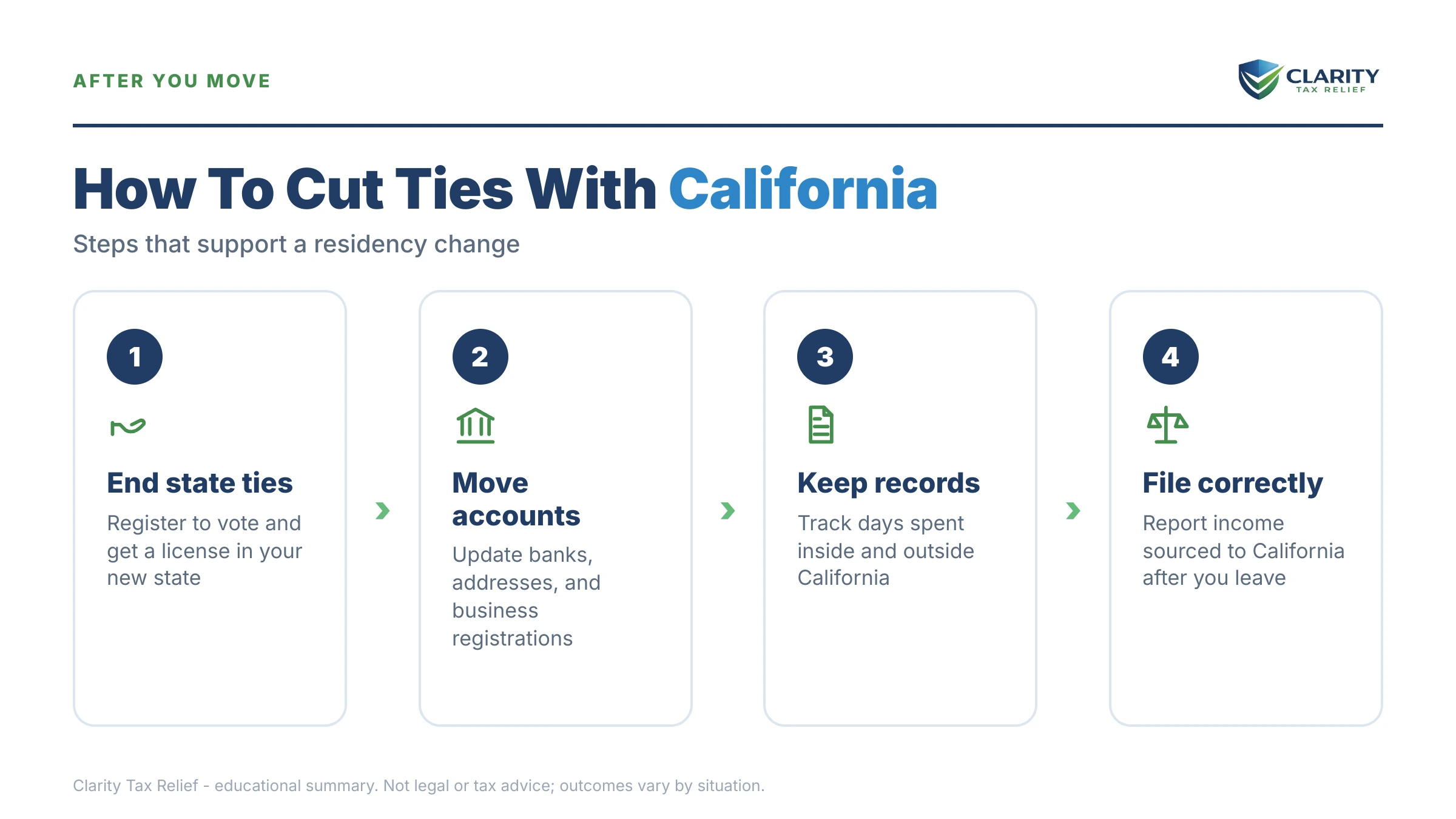
Your options for California tax debt after you've moved out of state
Most FTB balances under $25,000 can be resolved with a payment plan you set up from anywhere in the country. Every option below works whether you live in Sacramento or Savannah — the FTB cares about getting paid, not about your ZIP code:
| Option | Typical eligibility | What to know |
|---|---|---|
| Pay in full | Anyone | Stops interest and enforcement fastest; payable online from any state. |
| FTB payment plan | Generally a balance of $25,000 or less, paid within 60 months, with all returns filed | Interest keeps accruing; active levies usually pause once the agreement is in place. |
| FTB offer in compromise | Must show you can't pay in full now or in the foreseeable future | Means-tested on your assets and income — the FTB's math decides, not marketing promises. |
| Hardship deferral | Documented inability to cover basic living expenses | Collection pauses, but the debt, interest, and 20-year clock keep running. |
| FTB penalty abatement | Reasonable cause, or California's one-time timeliness-penalty abatement (tax years 2022 and later) | Removes penalties, not the underlying tax, but on old balances that's real money. |
One critical caveat: these are California's programs with California's rules. IRS thresholds, fees, and timelines don't apply here — a mistake that trips up people who resolved a federal balance and assume the FTB works the same way.
A worked example: $13,600 and a levy from 130 miles away
Say you rented in Sacramento, moved to Reno last year, and owe the FTB $13,600 across your final two California years. You assumed distance would protect you, until an Order To Withhold froze $2,100 in the checking account you opened in Nevada, because your bank has California branches and must comply.
Here's the realistic math. At $13,600 with all returns filed, you're squarely inside the FTB payment-plan range: $13,600 ÷ 60 months ≈ $227 per month before interest — plan for the payoff to run modestly higher because interest continues to accrue during the agreement. As a renter, there's no house for a lien to cloud, so the plan itself is the whole fix: once it's active, the FTB generally stops issuing new levies. You can ask that the frozen funds be released or credited rather than losing your rent money.
Contrast that with doing nothing: collection fees join the balance, the next Order To Withhold hits a paycheck instead of savings. The debt sits collectible for two decades. On a $13,600 balance, roughly $227 a month is almost always cheaper than what the escalation sequence takes on its own schedule.
How to respond to FTB collection after leaving California, step by step
- Verify what the FTB says you owe. Log into MyFTB or call the number on your notice. Confirm the tax years, the balance, and whether any return was estimated for you.
- Document your move date. Gather your lease, driver's license change, voter registration, and utility records — residency evidence decides what California can tax.
- File any missing returns. Include the part-year Form 540NR for your exit year, and replace any FTB-estimated assessment with your real numbers.
- Pick a resolution and set it up. Choose a payment plan, Offer in Compromise, or hardship deferral, and put it in place before enforcement escalates further.
- Get an active levy or audit reviewed. If money is already frozen or a residency audit is open, have an experienced tax professional take over communication with the FTB.
When you can handle this yourself, and when help changes the outcome
You can usually handle an FTB balance yourself when it's small, undisputed, and your returns are all filed. If you agree with the number, owe under $25,000, and can manage the monthly payment, setting up a plan directly through the FTB's official site at ftb.ca.gov is straightforward and costs you nothing in professional fees. The same goes for a single missing 540NR you can prepare from records you already have.
Experienced help changes outcomes in a narrower set of situations: an Order To Withhold or wage garnishment already in motion, an open residency audit, RSU or equity-sourcing disputes worth five figures, multiple unfiled part-year returns, or a balance large enough that the FTB is scrutinizing your finances line by line. In those cases, the difference between a well-documented move date and a sloppy one, or between an accepted and rejected offer — is often the entire result. Our California tax debt relief guide walks through what each path costs and requires.
Terms on your FTB notice, decoded
- California-source income: income tied to California by where the work was done, where the property sits, or where the business operates — taxable even after you become a nonresident.
- Closest connections test: the FTB's residency yardstick — where your home, family, doctors, bank accounts, and daily life actually are, not just your mailing address.
- 546-day safe harbor: leave California under an employment-related contract for at least 546 consecutive days and you're generally treated as a nonresident, subject to conditions on return visits and investment income.
- Order To Withhold (OTW): the FTB's levy on bank accounts and other funds held by third parties — including many out-of-state institutions.
- Earnings Withholding Order for Taxes (EWOT): the FTB's continuous wage garnishment, sent to your employer and honored by most multi-state companies.
- R&TC §19255: the California statute giving the FTB 20 years from the date a liability became due to collect it.
California exit tax FAQs
Does California have an exit tax in 2026?
No. There is no California exit tax in 2026 — no fee, wealth tax, or asset charge applies just because you move away. Bills that would have taxed former residents, including AB 2088 in 2020 and AB 259 in 2023, never became law. What does exist is the FTB's power to tax California-source income and collect existing debt after you leave.
Can California tax me after I move to another state?
Yes, but only on California-source income, not on everything you earn in your new state. Wages for work performed in California, rent and sale proceeds from California property, apportioned California business income, and equity compensation earned during California employment remain taxable. A true nonresident's interest, dividends, and out-of-state wages are not.
Do I owe California tax on stock I sell after moving away?
Generally no — gains on stocks and other intangibles sold by a true nonresident are sourced to your new state. The big exceptions are RSUs and options earned while you worked in California, which stay partly California-source, and installment payments from a California property sale. Disputes over your exact residency-change date are the FTB's favorite audit target.
Can the FTB levy my bank account or garnish my wages in another state?
Often, yes. An FTB Order To Withhold reaches accounts at banks that do business in California, which includes most national banks, regardless of the branch where you opened the account. Wage garnishment orders are routinely honored by multi-state employers. Moving does not put your money out of the FTB's reach.
How long can California collect back taxes after I leave?
Twenty years from the date the liability became due and payable, under Revenue and Taxation Code section 19255 — twice the IRS's 10-year window. Certain events, such as installment agreements or bankruptcy, can extend it further. Waiting out a California tax debt from another state is rarely a realistic plan.
What triggers a California residency audit when you move?
A large income event near your move date is the classic trigger — a business sale, an IPO, a big capital gain reported the year after you claim you left. Ongoing California ties also raise flags: a home you kept, a spouse who stayed, a California doctor, club, or business. The FTB weighs your closest connections, not just your new address.
Do I have to file a California return the year I move out?
Usually yes. In your exit year you typically file Form 540NR as a part-year resident, reporting worldwide income up to your move date and California-source income afterward. Skipping that return is one of the fastest ways to draw an FTB demand to file. An assessment based on numbers the FTB estimates for you.
If you want to track future exit-tax and wealth-tax proposals yourself, bill text and status for measures like AB 2088 and AB 259 are published at California Legislative Information — the primary source, not the panic posts.
Your next 24 hours
- Find the facts on your FTB notice: the notice name, your account ID, the balance, and every tax year listed. Those years determine whether the debt is even yours to fight or simply yours to resolve.
- Gather three things: your last California return, your move-date evidence (lease, driver's license change, utility shutoff), and any levy paperwork from your bank or employer.
- Get a free case review — call (888) 825-7779 or use the 2-minute form. Interest posts monthly and the FTB's 20-year window means this debt will not age out on its own. One call maps whether a payment plan, offer, or residency defense fits your facts.
This guide is general information, not tax or legal advice for your specific situation. Eligibility for IRS programs depends on individual facts and circumstances; no outcome is guaranteed. State programs, including FTB programs, have their own separate eligibility rules.