
California Tax Debt
Owe California State Taxes and Can't Pay? Your 2026 Options
The short answer: if you owe California state taxes you can't pay, the Franchise Tax Board (FTB) offers payment plans (online when you owe $25,000 or less), hardship status that pauses collection, and its own Offer in Compromise. Move before enforcement: the FTB can garnish wages, levy bank accounts, and collect for 20 years.
The number on your FTB notice is bigger than anything your budget can absorb — maybe it grew out of an IRA withdrawal with no California withholding, a home sale, or years the FTB assessed for you when no return came in. That knot in your stomach is understandable, but this is a solvable problem with a known map. California has formal programs for people who can't pay in full, and every one of them works better the earlier you start.
Three facts shape everything on this page: the FTB's collection window is 20 years (twice the IRS's), its enforcement is almost entirely automated, and its self-service payment plan cuts off at a $25,000 balance — above that, everything runs through a financial statement. This guide covers all of it; for the full library of California notices and programs, see our California FTB back taxes hub.
⏱ Your real clock: the "pay by" date printed on your most recent FTB notice controls what happens next — once it passes, the account moves toward liens and levies. Meanwhile, interest accrues every day, a late-payment penalty accrues monthly, and California's 20-year collection statute means this debt will not quietly age out.
Why you owe the FTB, and why the balance keeps growing
Most FTB balances start one of three ways: a filed return you couldn't pay, an FTB adjustment to a return you did file, or an estimated assessment the FTB built for a year you never filed. That last category matters, because the FTB's estimates use gross income data — 1099s, W-2s, escrow records — with no deductions, so the assessed number is often larger than what a real return would show. Filing the missing return is sometimes the single biggest reduction available.
Once a balance exists, it compounds on three fronts. The FTB's late-payment penalty starts at 5% of the unpaid tax and adds 0.5% for each month the balance sits, up to a 25% cap. Interest accrues daily at a rate the state adjusts periodically. And when the account moves into active collection, the FTB tacks on a collection cost recovery fee — a flat charge just for the privilege of being collected against.
One check before anything else: make sure it's actually the FTB you owe. California splits its tax enforcement across agencies — California back sales tax belongs to the CDTFA, and California EDD payroll tax belongs to the EDD. Each has its own notices, its own plans, and its own rules; the fixes on this page apply to FTB income-tax debt.
“Explore all other payment options before you submit an offer in compromise. The Offer in Compromise Program is not for everyone.”
— Offer in compromise (IRS.gov)
What happens if you ignore FTB debt
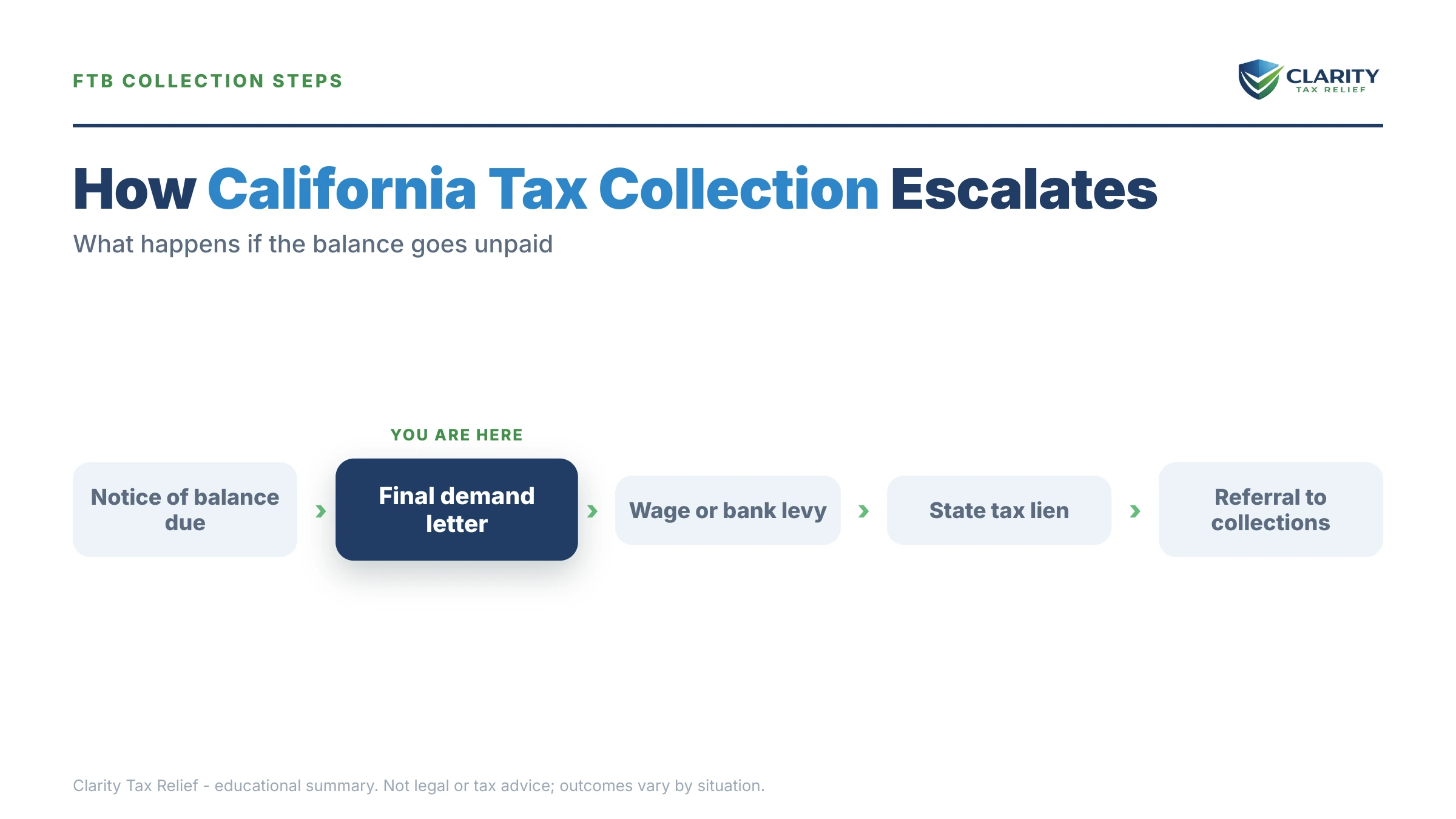
The FTB can garnish wages and levy bank accounts without going to court — its collection orders are administrative, issued by an automated system that never takes a day off. The sequence runs in stages, and each stage removes options the previous one still allowed:
- Balance-due notice. The first bill. Nothing is enforced yet; interest and the monthly penalty are the only things moving. This is the cheapest moment you will ever have.
- Collection notices and fees. The account shifts into active collection, the collection cost recovery fee is added, and the letters get shorter and firmer.
- Final notice before enforcement. The FTB's pre-levy notice states its own deadline on its face. After that date passes, liens and levies are authorized without further warning.
- Enforcement. A state tax lien is recorded against your property. An Earnings Withholding Order for Taxes goes to your employer — FTB wage garnishment typically takes up to 25% of disposable pay, every check, until released. An Order to Withhold hits your bank account. State refunds are intercepted automatically, and offset programs can reach other government payments.
- Long-tail enforcement. Debts over $100,000 can land you on the FTB's public Top 500 delinquent list, which carries professional and driver's license suspension for those named. Liens can be renewed across the full 20-year window.
Here is the stage-by-stage view — note the third column, because a resolution path stays open at every stage:
| Stage | What the FTB can do | What you can still do |
|---|---|---|
| Balance-due notice | Nothing enforced; interest and monthly penalty accrue | Pay, start a plan, or dispute the amount |
| Active collection | Adds collection cost recovery fee; account queued for enforcement | Every option still open; file missing returns first |
| Final notice before levy | Lien and levy authorized after the printed deadline | Set up an arrangement before that date passes |
| Enforcement | Recorded lien; wage garnishment up to 25% of disposable pay; bank levy; refund intercepts | Negotiate a release by getting into an arrangement or proving hardship |
| Long-tail | Top 500 public listing ($100,000+), license suspension, renewed liens for up to 20 years | Payment plan, hardship, and offer programs remain available |
The 2026 wrinkle: unlike the IRS, the FTB never suffered a staffing collapse — its collection machine is fully funded, fully automated, and fast. Silence is the one strategy with a 0% success rate.
Owe the FTB more than you can pay?
The FTB's next step is automated. It doesn't wait for you to figure things out. Get your balance and notices reviewed free before a garnishment or bank levy starts. An experienced tax professional will map your realistic options in one call.
Your options when you owe California state taxes and can't pay
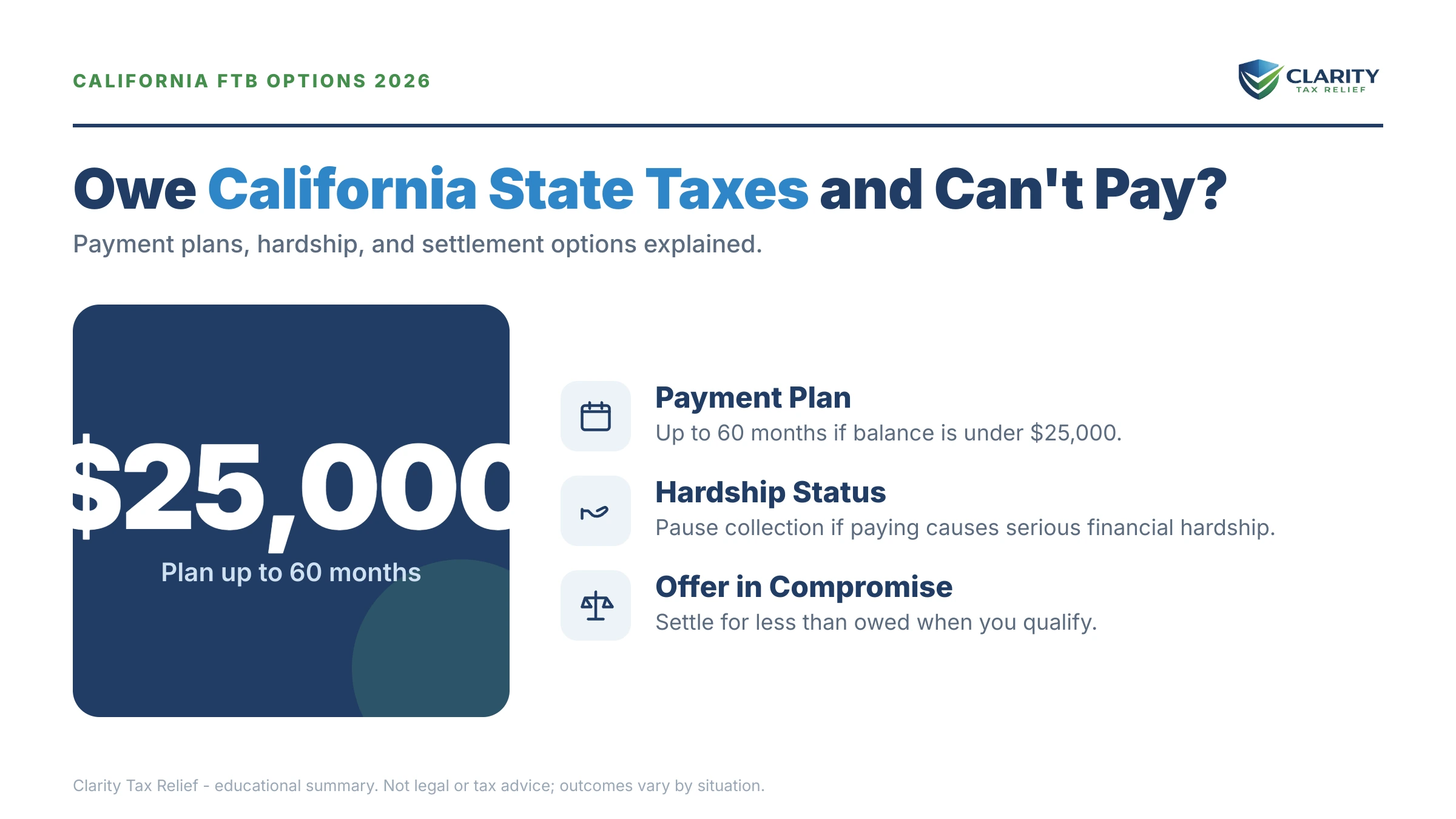
California offers four main paths when you can't pay the FTB in full: a payment plan, hardship status, an Offer in Compromise, and penalty relief. Which one fits is a math question — your income, your necessary expenses, and your equity — not a matter of persuasion.
| Option | Generally fits when | What it requires |
|---|---|---|
| Pay in full | You can borrow or liquidate more cheaply than the penalty-plus-interest accrual | Stops all accrual and enforcement immediately |
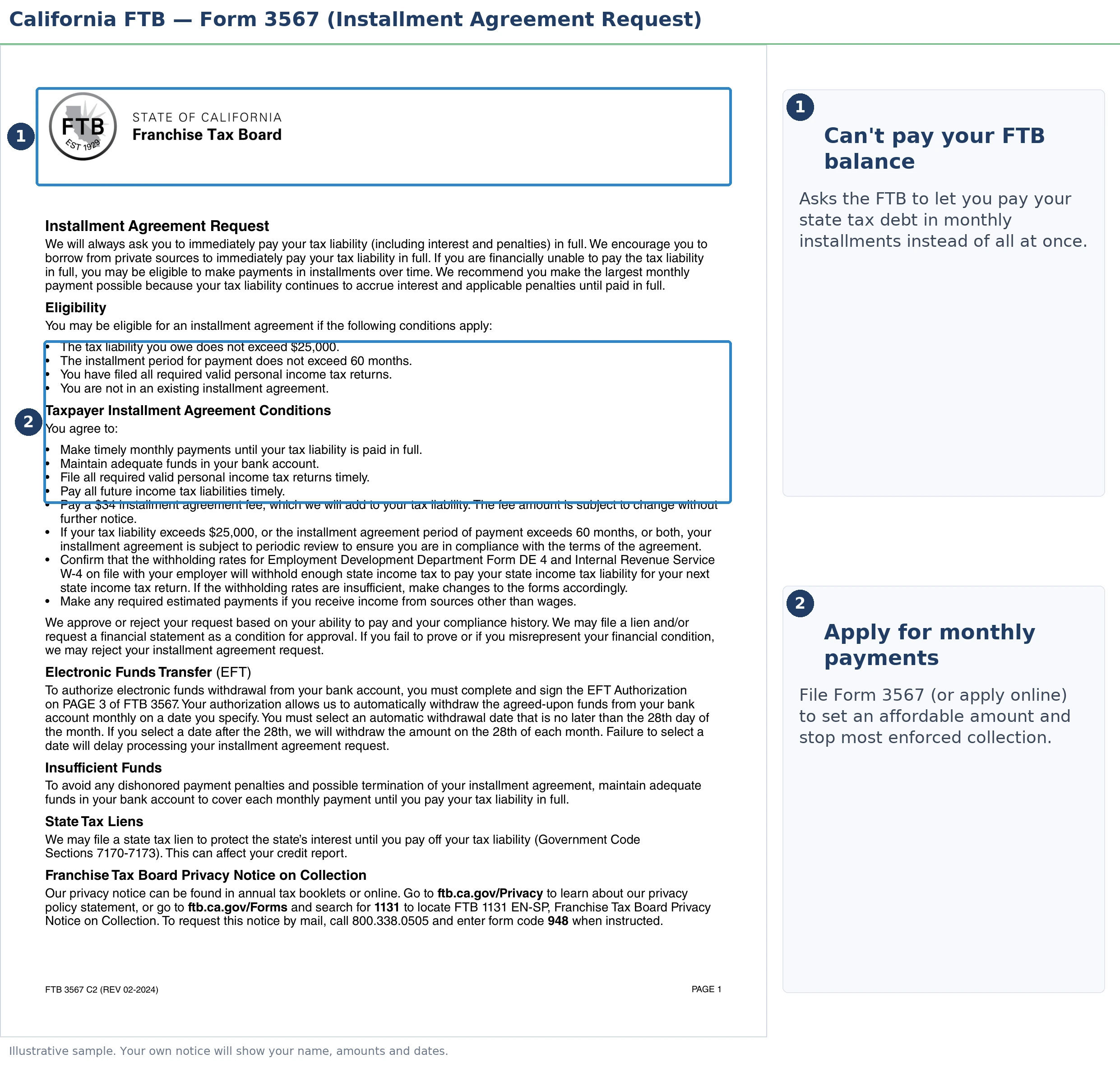
| Online installment agreement | Balance of $25,000 or less, payable within 60 months | All returns filed; modest setup fee; interest and penalties continue |
| Negotiated installment agreement | Balance above $25,000, or you need longer terms | Financial statement (Form FTB 3561) documenting income, expenses, and assets |
| Hardship deferral (FTB's version of CNC) | Any payment would leave you unable to cover basic living costs | Form FTB 3561; typically re-reviewed each year; debt and interest remain |
| FTB Offer in Compromise | Income and assets genuinely can't cover the debt within the collection period | Full financial disclosure; strictly means-tested; no shortcut exists |
| Penalty abatement | First-time slip or a documented reasonable cause (illness, disaster) | A request with support; reduces penalties, not the underlying tax |
| Bankruptcy | Older income-tax years meeting strict timing tests | Legal counsel; narrow fit — most recent tax debt survives |
The installment agreement is the workhorse. Under $25,000 with all returns filed, you can set up an FTB payment plan yourself in minutes. Above $25,000, the FTB wants FTB Form 3561, a line-by-line financial statement, and sets the payment off what your documented budget supports, not what a formula demands.
Hardship status — the FTB's equivalent of currently-not-collectible — pauses garnishments and levies when the numbers show that any payment would break your basic living budget. The debt doesn't go away and interest keeps running, but enforcement stops. See FTB currently not collectible for how the annual review cycle works.
The FTB Offer in Compromise is real but narrow: the state resolves the debt for less than the balance only when your income and assets, projected across the remaining collection period, genuinely can't cover it. Because California has 20 years to collect, the state's math is tougher than the IRS's — more future years of your income count against you. Full details in our FTB offer in compromise guide.
Penalty relief can shave real money off the top. California now has a one-time penalty abatement for individuals with a clean compliance history, plus traditional reasonable-cause relief for illness, disaster, and similar events — our FTB penalty abatement guide walks through both. On a five-figure balance, removing a 25%-capped penalty is not a rounding error.
A worked example: $76,400 on a fixed income
Say you owe the FTB $76,400 — several years of tax on IRA withdrawals that had no California withholding, plus penalties and interest — and you're retired, living on $2,410 a month in Social Security and an $840 pension. This is a hypothetical, but the arithmetic is exactly what the FTB runs:
- Full payoff over 60 months: $76,400 ÷ 60 ≈ $1,274 a month before ongoing interest — nearly 40% of a $3,250 monthly income. Not viable, and the FTB's own financial analysis would agree.
- The Form 3561 math: income of $3,250 against documented living costs of $3,120 (housing, utilities, food, Medicare and supplemental premiums, transportation) leaves about $130 a month of ability to pay.
- What $130 buys the state: even across 18 remaining collection years (216 months), $130 × 216 ≈ $28,000 — far short of $76,400. That gap is precisely what makes an account a genuine hardship or offer candidate.
- Equity decides the ending. With no meaningful home equity, an FTB Offer in Compromise built on that math has a real foundation. With $280,000 of home equity, the FTB sees more than the full balance reachable through a lien — an offer becomes unlikely. The realistic path is hardship status now, with a recorded lien the state collects if and when the home sells.
- One protection worth knowing: the FTB cannot garnish the $2,410 Social Security check itself — federal law shields it from state tax collection — which both protects your floor and strengthens the hardship case.
Same debt, two different right answers, decided entirely by one asset line. That's why the financial statement, not the balance, drives every FTB outcome.
How the FTB differs from the IRS (and why it matters if you owe both)
Owing the FTB is not the same as owing the IRS — California can collect for 20 years under R&TC §19255, double the federal 10-year statute. The FTB also moves faster: fewer warning letters before enforcement, heavier automation, and garnishment authority that reaches further than most creditors'. Our comparison of state tax debt vs IRS covers the sequencing question in depth. The short version is that the agency actively enforcing gets attention first, and both eventually need an arrangement, because each expects its plan honored regardless of the other's.
Two more California-specific traps. First, moving doesn't help: the debt, the lien, and the 20-year clock follow you. The FTB routinely collects from former residents — see moving out of California taxes before you assume distance is a strategy. Second, the FTB and IRS trade data, so a balance resolved with one agency can surface as an assessment from the other if the underlying income was never reported to both.
How to respond, step by step
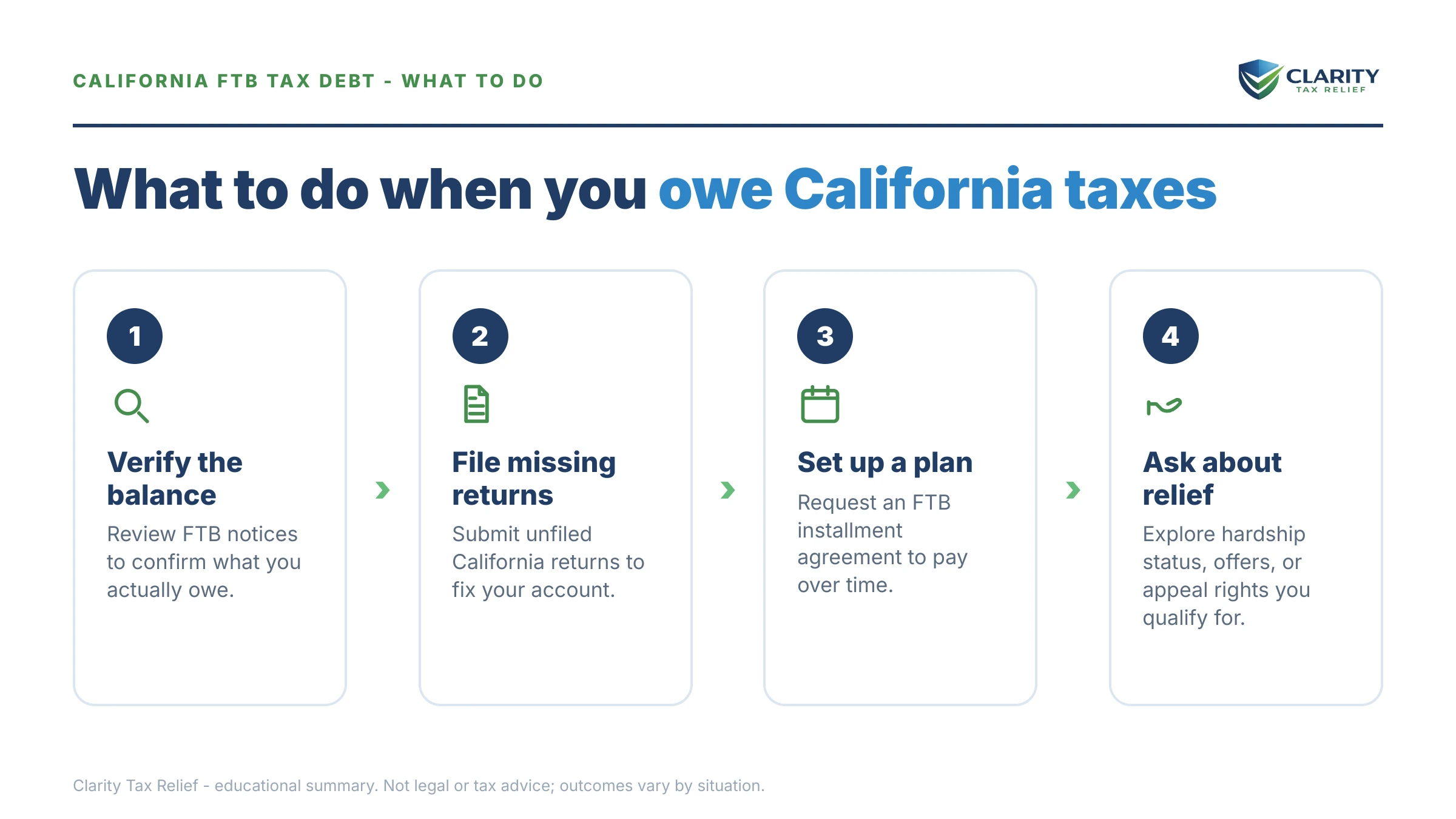
- Confirm exactly who you owe and how much. Log into MyFTB or call the Franchise Tax Board to verify the balance, the tax years involved, and whether any of it comes from an estimated assessment for a year you never filed.
- File every missing California return. The FTB will not approve a payment plan, hardship status, or an offer while required returns are unfiled. Its estimated assessments almost always overstate what a real return would show.
- Pay whatever you can right now. Every dollar paid shrinks the base that the monthly penalty and daily interest grow on. A partial payment signals good faith before you ask for an arrangement.
- Apply for the arrangement that fits your numbers. Set up an online installment agreement if you owe $25,000 or less and can pay within 60 months. Otherwise complete Form FTB 3561 so the FTB can approve a negotiated plan, hardship deferral, or Offer in Compromise.
- Get experienced help if enforcement has already started. A wage garnishment, bank levy, or recorded lien changes the order of operations — release negotiations come first. An experienced tax professional can usually move faster than you can alone.
When you can handle this yourself
If you owe the FTB $25,000 or less, have every return filed, and can genuinely afford the 60-month payment, set the plan up yourself — no professional needed, and no one should charge you for it. The same goes for a first notice you agree with and can pay within a few months: pay it, request the one-time penalty abatement, and move on.
Experienced help changes outcomes in specific situations: a garnishment or bank levy already in motion, a balance like $76,400 that requires negotiating Form 3561 numbers the FTB will push back on, multiple unfiled years sitting under estimated assessments, an Offer in Compromise where one misstated asset sinks the application, or parallel debts to the FTB and IRS that need sequencing. In those cases the question isn't whether you can do it alone — it's whether the cost of a misstep exceeds the cost of help. If you also owe the federal side, the IRS's own payment plan options run on entirely different thresholds than California's.
Terms on your FTB notices, decoded
- Earnings Withholding Order for Taxes (EWOT): the FTB's wage garnishment order, sent directly to your employer and continuous until the debt is paid or released.
- Order to Withhold: the FTB's bank levy — a one-time grab of whatever is in the account when the order lands.
- State tax lien: a public claim recorded against your property that secures the debt and complicates selling or refinancing.
- Form FTB 3561: the financial statement (income, expenses, assets) that drives every negotiated FTB outcome above the self-service thresholds.
- Hardship deferral: the FTB's pause on collection when payment would prevent you from meeting basic living costs, typically re-reviewed annually.
- Collection cost recovery fee: a flat fee the FTB adds when your account moves into active collection.
Owe California taxes and can't pay: your questions, answered
Can the California FTB take my Social Security check?
No — federal law (42 U.S.C. §407) prevents state tax agencies from garnishing Social Security benefits, so the FTB cannot intercept your monthly check the way the IRS can under its federal levy program. The risk shifts once benefits sit in a bank account: if the funds are commingled with other money, a bank levy can get complicated. Keep records showing which deposits are Social Security so exempt funds can be identified and returned.
How long can California collect unpaid state taxes?
Twenty years. Under Revenue and Taxation Code §19255, the FTB generally has 20 years from the date a liability becomes due and payable to collect — double the IRS's 10-year window. Certain events, such as bankruptcy, can pause or extend that period, so waiting out the clock is rarely a realistic strategy in California.
Does the FTB offer payment plans if I can't pay in full?
Yes. Individuals can generally set up an FTB installment agreement online when they owe $25,000 or less and can pay the balance within 60 months, with all required returns filed. Larger balances aren't excluded. They just require a financial statement (Form FTB 3561) so the FTB can set a payment based on what your budget actually supports. Interest and penalties continue to accrue while you pay.
Can I settle California tax debt for less than I owe?
Sometimes — the FTB runs its own Offer in Compromise program, separate from the IRS version, for taxpayers who genuinely cannot pay the full balance from income and assets before the collection period ends. It is means-tested: the FTB examines your income, expenses, equity, and earning potential, and approves offers only when the amount offered is the most it could reasonably expect to collect. Anyone promising you a specific settlement before reviewing your finances is selling marketing, not tax law.
How much can the FTB garnish from my paycheck?
An FTB Earnings Withholding Order for Taxes typically takes up to 25% of your disposable earnings — the amount left after legally required deductions — and it continues every pay period until the debt is paid or the order is released. That is generally more aggressive than what an ordinary judgment creditor could take. If the garnishment leaves you unable to cover basic living expenses, you can ask the FTB for a hardship modification with documentation.
Will moving out of California erase my FTB debt?
No. The debt, any recorded lien, and the 20-year collection clock all follow you across state lines. The FTB can levy accounts at national banks, intercept refunds through offset programs, and pursue former residents with the same automated tools. Moving can also raise residency questions about which years you owe California tax at all — a separate issue worth reviewing before you assume the balance is correct.
Is the FTB harder to deal with than the IRS?
In several ways, yes. California's collection window is 20 years versus the IRS's 10, its enforcement is heavily automated. Its garnishment and levy tools reach far with fewer warning notices. On the other hand, the FTB offers real resolution programs — payment plans, hardship status, penalty abatement. An Offer in Compromise — so an FTB balance is very fixable if you act before enforcement starts.
What if I owe both the IRS and California?
Address both, but prioritize whichever agency is actively enforcing — a final levy notice or a garnishment already in motion outranks an agency still sending bills. Many people run parallel arrangements: an IRS installment agreement and an FTB payment plan at the same time. Your combined monthly capacity matters, because each agency expects its plan to be honored regardless of the other's.
Your next 24 hours
- Find the controlling dates. Pull your most recent FTB letter and locate the notice date, the tax years listed, and the "pay by" deadline printed on it. That date, not a generic rule, decides how much room you have.
- Gather your file. Your last filed California return, every FTB notice you've received, and a simple list of monthly income and expenses. That list is the backbone of Form FTB 3561 and of every option above.
- Get a free case review. Interest accrues daily and the FTB's next step is automatic, so don't sit on it — call (888) 825-7779 or use the 2-minute form and an experienced tax professional will map which of these options your numbers actually support.
You can verify balances and program details directly with the state at the California Franchise Tax Board website.
This guide is general information, not tax or legal advice for your specific situation. Eligibility for IRS programs depends on individual facts and circumstances; no outcome is guaranteed.