
California FTB
FTB Form 3561: How to Fill Out California's Financial Statement (2026)
The short answer: FTB Form 3561 is the California Franchise Tax Board's financial statement — the state's version of IRS Form 433-F. The FTB generally requires it when you owe more than $25,000, need more than 60 months to pay, or are asking for hardship status. What you report on it sets your monthly payment.
You asked the FTB for a payment plan, or for breathing room, and instead of a yes, you got a letter demanding a "completed financial statement" listing every dollar you earn, spend, and own. That's not a rejection. It's the FTB saying your balance is big enough that the numbers, not a checkbox, will decide what happens next, and you control what those numbers show.
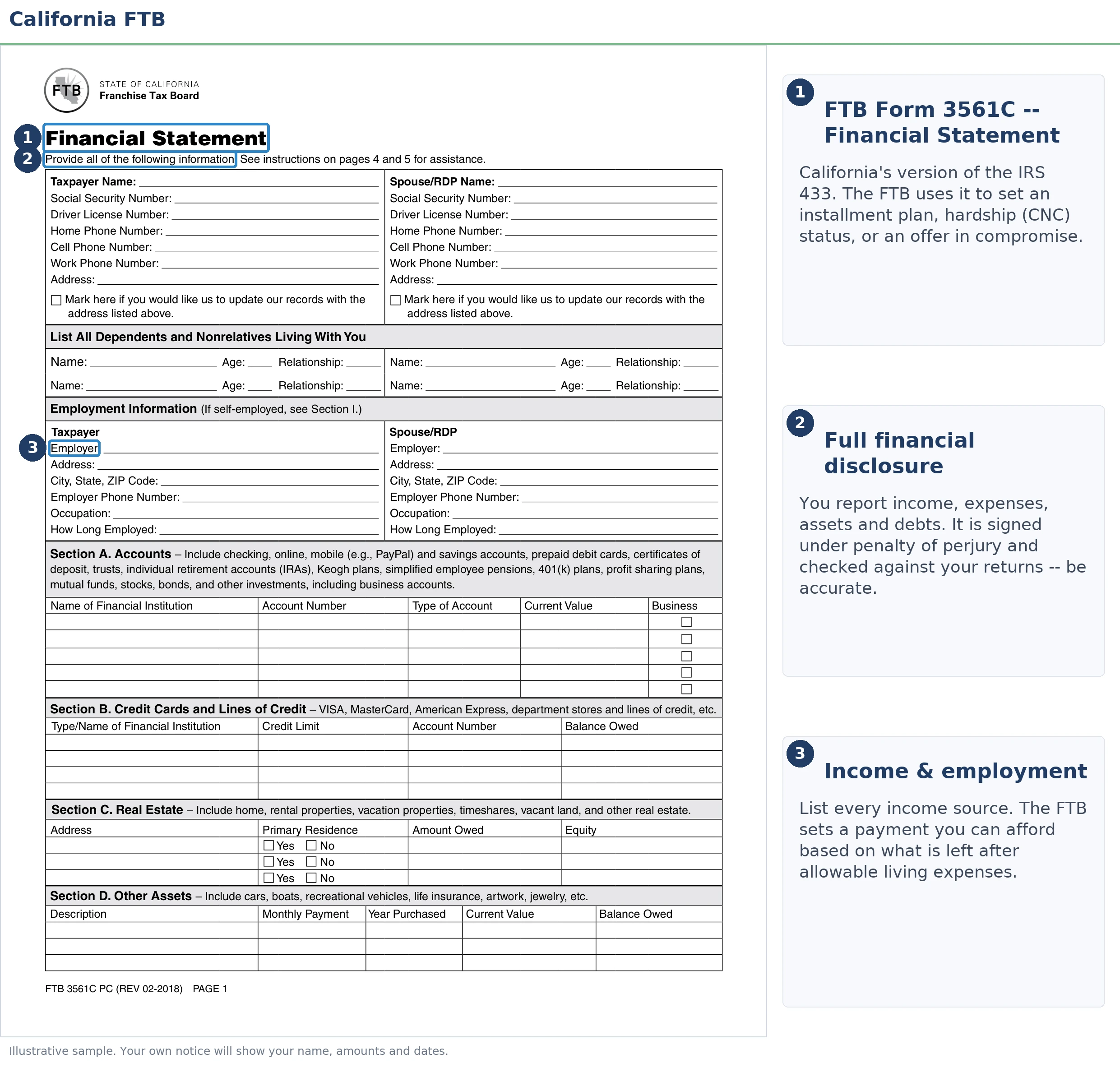
Filled out carelessly, FTB Form 3561 locks you into a payment you can't sustain. Filled out completely and strategically, it's the document that turns a five-figure California balance into a manageable arrangement. Farther down, the image shows exactly what Form 3561 looks like and which sections deserve the most care before you sign it.
⏱ Your deadline: the response date printed on the FTB letter that requested your Form 3561. There is no single statutory window. While the form sits unreturned, interest keeps accruing, a collection cost recovery fee can be added, and involuntary collection can resume. The date on your letter is the clock that matters.
What FTB Form 3561 is and why the FTB wants yours
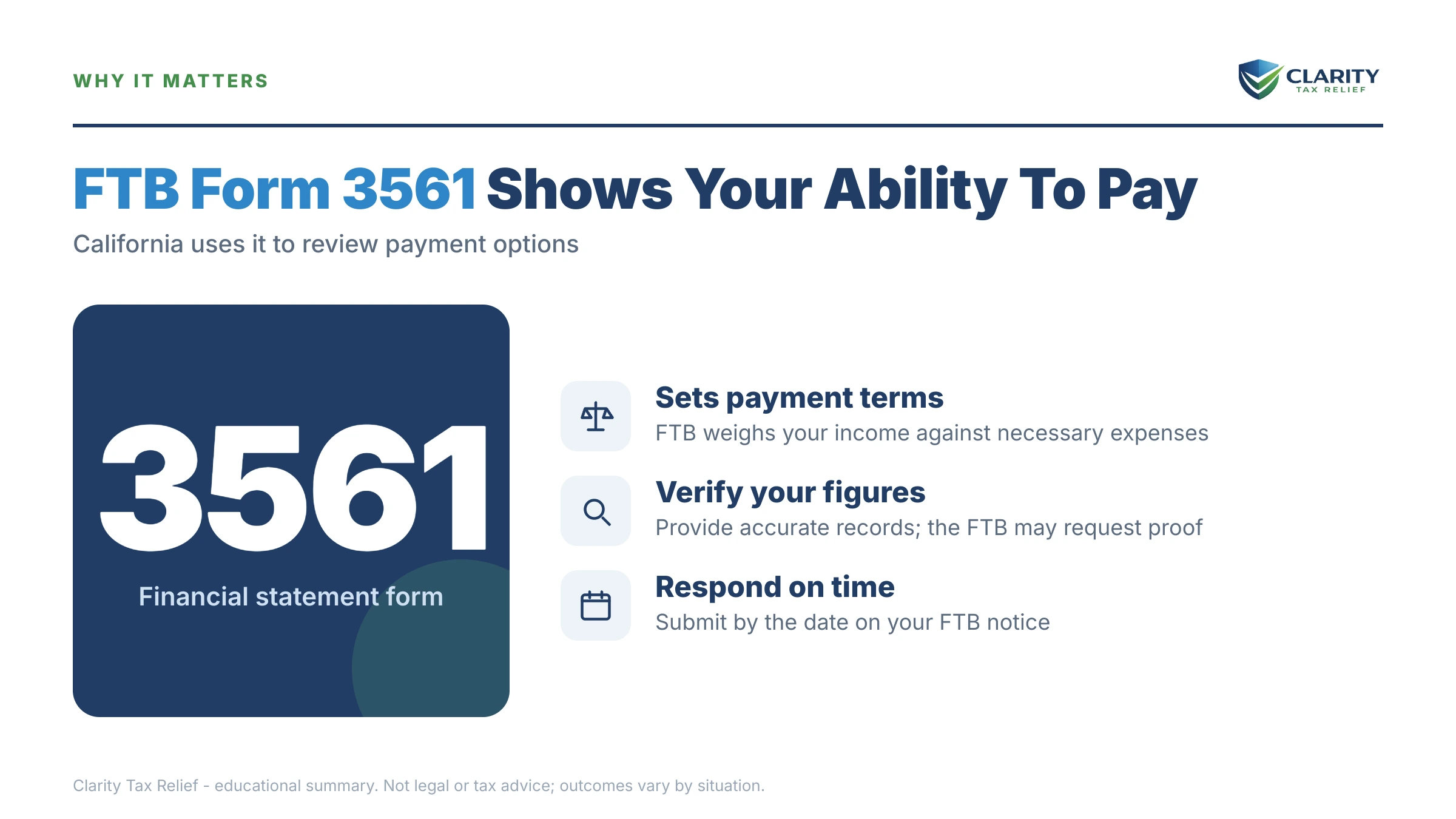
Form 3561 is the Franchise Tax Board's Financial Statement — the document that tells the FTB exactly what you can afford to pay on a California income tax debt. It covers your income from every source, your monthly living expenses, your bank accounts, vehicles, real estate, and other assets, plus your other debts.
The FTB doesn't send this form as a formality. It appears in three situations: you requested a payment arrangement your balance is too large for, you asked the state to pause collection for financial hardship, or an FTB collector wants updated financials on an account already in collection. In every case, the same rule applies: the numbers on this form become the FTB's baseline for what it will demand from you.
One thing Form 3561 is not: an IRS document. It resolves nothing on your federal account. If you owe both agencies, common for self-employed Californians, the federal side runs on its own financial statement, covered in our Form 433-F walkthrough. The general playbook for negotiating a tax debt on your own lives in our guide to how to settle tax debt yourself.
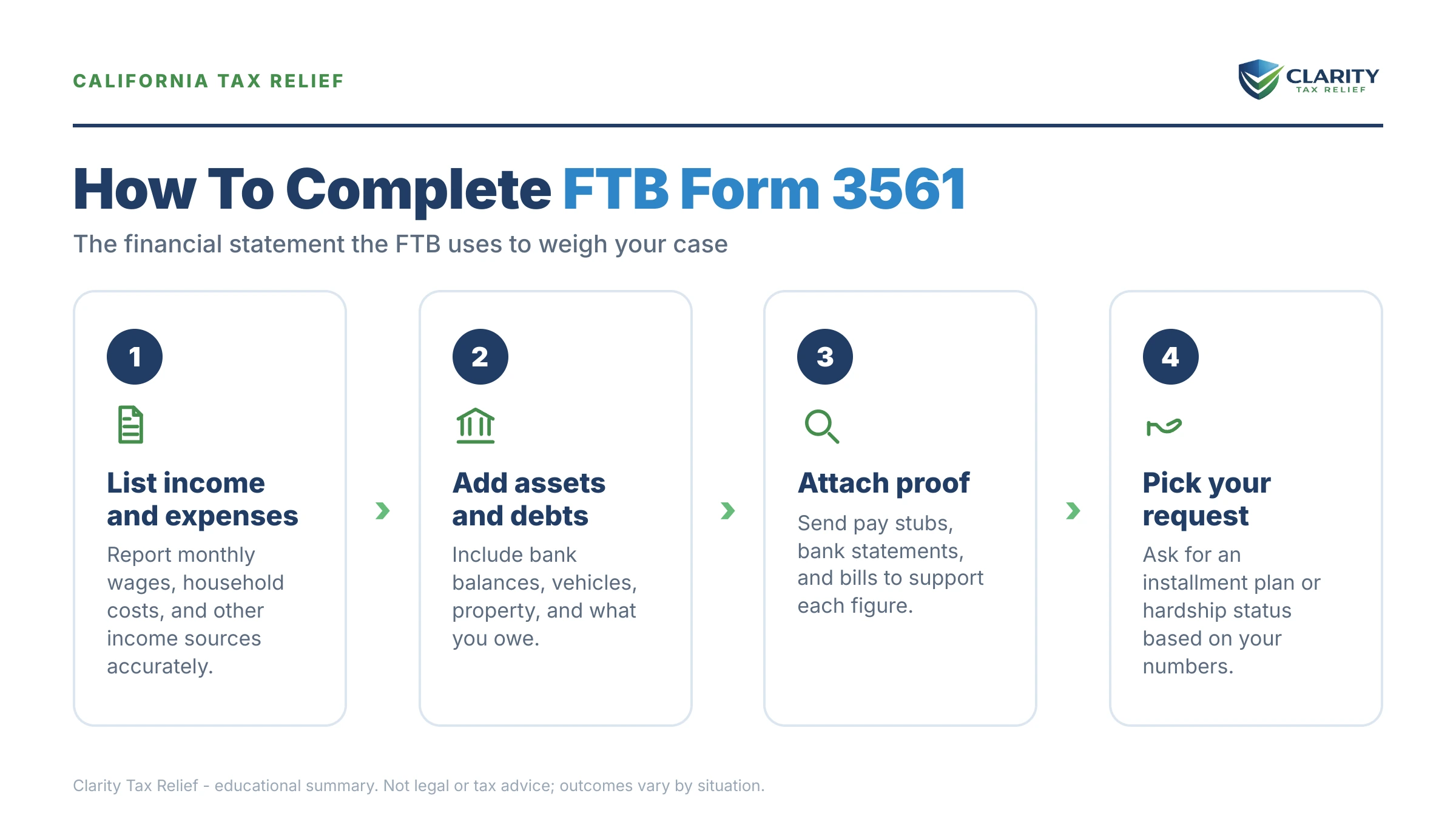
“If you are unable to make the minimum required payment amount, you will receive directions for completing either Form 9465, Installment Agreement Request PDF and Form 433-F, Collection Information Statement PDF”
— Online payment agreement application (IRS.gov)
When does the FTB require Form 3561?
The FTB generally requires Form 3561 when you owe more than $25,000 or need more than 60 months to pay. Below those thresholds, most individuals can typically set up an FTB payment plan online without disclosing their finances at all. Above them, the FTB wants proof before it agrees to anything.
The form is also the gateway to hardship status — the FTB's rough equivalent of currently-not-collectible, where collection is paused because your income can't cover basic living costs. You can't get that status by asking; you get it by demonstrating it, line by line, on this form. Our guide to FTB currently not collectible covers what happens after the FTB says yes.
| Option | Typical eligibility | Form 3561 required? |
|---|---|---|
| Pay in full | Anyone; stops interest immediately | No |
| Online payment plan | Generally $25,000 or less, paid within 60 months, all returns filed | No |
| Payment arrangement above the thresholds | Balance over $25,000, or payoff longer than 60 months | Yes. It sets your monthly amount |
| Financial hardship (collection pause) | Income can't cover necessary living expenses; reviewed periodically | Yes. It proves the hardship |
| FTB Offer in Compromise | You genuinely can't pay in full now or in the foreseeable future | Uses its own application package with similar financial disclosure |
What happens if you ignore the FTB's request
An unreturned Form 3561 usually gets your payment-plan or hardship request denied, and puts your account back on the FTB's enforcement track. California's collection machine is more aggressive than the IRS's, and it moves through these stages:
- Your request is closed. The arrangement or hardship review that triggered the form is denied for non-response, and the full balance is due.
- Costs stack onto the balance. Interest keeps compounding. The FTB can add its collection cost recovery fee — see FTB collection fees for how these charges pile up.
- Involuntary collection resumes. The FTB can issue an Order to Withhold against your bank account and an Earnings Withholding Order against your paycheck — how much can FTB garnish breaks down the paycheck math.
- A state tax lien is filed. It attaches to your property and becomes public record, complicating any sale or refinance.
- The largest balances face the harshest tools. Debts over $100,000 risk California's Top 500 delinquent list, which carries FTB license suspension exposure for professional and driver's licenses.
The stage that hurts most is the third one, because it's silent: the first sign of an FTB bank levy is often money already frozen. And unlike the IRS's 10-year clock, the FTB can collect for up to 20 years under R&TC §19255 — waiting it out is not a realistic strategy in California. See California's 20-year collection statute for why that changes everything.
FTB letter asking for a financial statement?
Send us a copy before the response date on your letter passes. An experienced tax professional will review your Form 3561 numbers, flag the expense entries the FTB is most likely to challenge, and map your realistic options — free and confidential.
Your realistic options at every balance level
What Form 3561 gets you depends heavily on how much you owe the FTB. The same form supports very different outcomes at different balance levels:
| FTB balance | Realistic path | Financial statement? |
|---|---|---|
| Under $10,000 | Online payment plan; even modest monthly payments clear it within 60 months | Usually not needed |
| $10,000 – $25,000 | Online plan still available if you can pay it off within 60 months (roughly $167–$417/month before interest) | Usually not needed |
| $25,001 – $100,000 | Negotiated arrangement built on Form 3561; hardship or an FTB OIC if the numbers show you can't pay | Yes — Form 3561 territory |
| Over $100,000 | Heightened scrutiny, likely lien, Top 500 and license exposure; professional representation strongly advisable | Yes, plus deeper asset review |
A worked example: $61,200 with three years unfiled
Say you're a gig worker who didn't file California returns for three years, and the FTB's filing-enforcement assessments now total $61,200. Those assessments were built from gross 1099 data — no mileage, no platform fees, no expenses. Step one isn't the payment plan. It's filing the real returns, which we cover under FTB demand to file, because actual returns frequently shrink an estimated balance before you negotiate a dime of it.
Now run the payment math on $61,200. Spread over 60 months, that's $61,200 ÷ 60 = $1,020 a month before interest, and because the balance tops $25,000, Form 3561 is required either way. Suppose your form shows $5,900 in average monthly gig income and $5,150 in documented, necessary expenses. That leaves $750 a month of capacity — $270 short of a 60-month payoff.
That gap is exactly what the financial statement exists to resolve. Honest, documented numbers give the FTB grounds to accept a longer term at $750, and if your expenses legitimately consume your income, the same form supports hardship status instead. Inflate your income or skip expenses you actually pay, and you've volunteered for a $1,020 payment that will default by winter.
Section by section: what Form 3561 asks for
Form 3561 walks through four bodies of information, and each one has a trap for the unprepared. The image below shows exactly what the form looks like and where each section sits, so you can follow along with your own copy.
Income. Wages, self-employment, rental income, benefits — everything. Gig income is the hard part: it swings month to month, so average several recent months rather than cherry-picking your best or worst. The FTB will compare your figure against your bank deposits, so the two need to reconcile.
Expenses. Housing, utilities, food, transportation, insurance, medical, child care, and payments on other debts. The FTB tests these for reasonableness. It can disallow amounts it considers excessive, and every disallowed dollar becomes a dollar it expects in your monthly payment. If an expense is unusual but necessary (a medical condition, tools or a vehicle your work requires), document why.
Assets. Bank balances, vehicles, real estate, retirement accounts, and anything else of value. Understate nothing — the FTB cross-checks against DMV records, county property rolls, and the bank information it already holds from employer and financial-institution reporting.
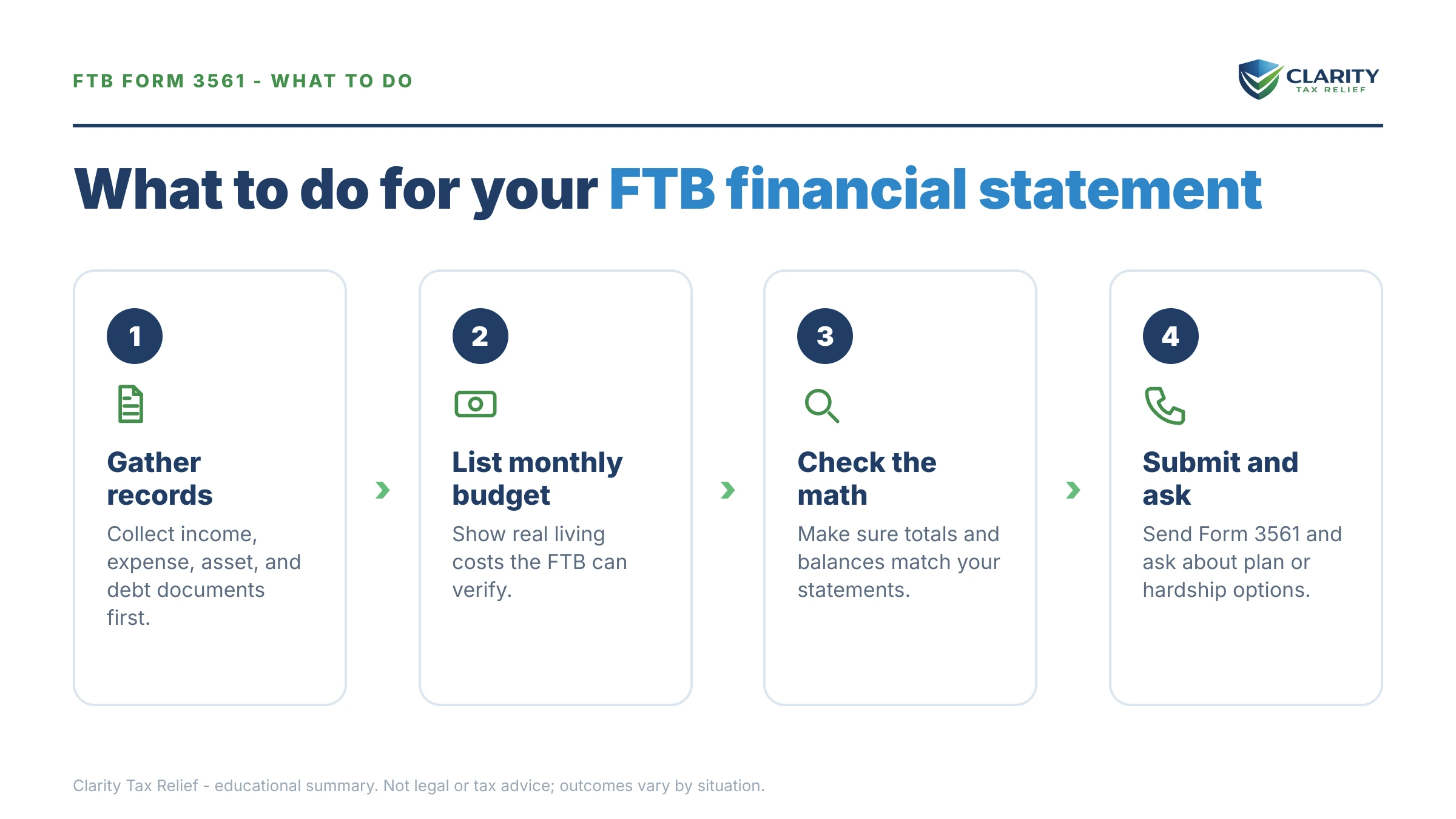
Verification. The form is signed under penalty of perjury and expects supporting documents: recent bank statements (typically three months), pay stubs or platform earnings reports, and proof of major expenses. Self-employed filers should attach a simple profit-and-loss summary. Incomplete backup is the number-one reason these packages stall.
How to complete and submit FTB Form 3561, step by step
- File any missing California returns first. Filing-enforcement assessments are usually inflated — filing the real returns can shrink the balance before you negotiate how to pay it.
- Gather three months of financial proof. Pull bank statements, pay stubs or gig-platform earnings reports, and bills for every expense you plan to claim.
- Complete every line of the form. Blank sections cause rejections and delays — write "none" or "0" instead of leaving a field empty.
- Propose a monthly payment your budget can sustain. A defaulted arrangement puts you in a worse position than a slower one that holds.
- Submit it as instructed and confirm receipt. Send it the way the FTB's letter directs, keep a complete copy, and calendar a follow-up call if you hear nothing.
One California-specific wrinkle on the payment side: if you've previously triggered the state's electronic-payment requirement, your installment payments must be made electronically or you'll face an additional penalty — details in our guide to FTB mandatory epay.
FTB Form 3561 vs. IRS Form 433-F: same idea, different rules
Form 3561 and IRS Form 433-F do the same job for two different governments, and neither one satisfies the other. If you owe both — the usual pattern when unfiled self-employment years catch up at once — you're looking at two financial statements, two negotiations, and two sets of rules.
The differences matter. The IRS applies published national and local expense standards; the FTB runs its own reasonableness review. The IRS generally has 10 years to collect; the FTB has up to 20 years. IRS hardship status can realistically outlast the federal collection window. The FTB's longer statute means hardship in California is usually a pause, not an endgame. And the agencies don't coordinate — a payment plan with one does nothing to stop levies from the other, so sequencing which agency to resolve first is a genuine strategic decision.
When you can handle Form 3561 yourself
Plenty of people complete this form without help, and you may be one of them. If your returns are all filed, your income is a straightforward W-2, your expenses are ordinary, and you're simply documenting an arrangement you can clearly afford, Form 3561 is tedious but manageable on your own.
Experienced help changes the outcome in the harder fact patterns: multiple unfiled years sitting on inflated estimated assessments, gig or business income the FTB will scrutinize deposit by deposit, a garnishment or bank levy already in motion, balances near the $100,000 enforcement tier, or a case where the honest numbers point toward hardship or an Offer in Compromise rather than a payment plan. In those situations, how the financial statement is built — which returns get filed first, how variable income is averaged, how necessary expenses are documented — directly determines the payment you live with for years.
Terms on your FTB paperwork, decoded
- Financial statement — the sworn snapshot of your income, expenses, and assets that Form 3561 provides. The FTB's basis for deciding what you can pay.
- Installment agreement — the FTB's formal monthly payment arrangement; interest continues while you pay.
- Financial hardship — the FTB's pause on collection when your income can't cover necessary living expenses; the debt and interest remain.
- Collection cost recovery fee — a fee the FTB adds to delinquent accounts to cover its collection costs, on top of tax, penalties, and interest.
- Earnings Withholding Order (EWOT) — the FTB's wage garnishment, sent to your employer and continuous until released.
- Order to Withhold (OTW) — the FTB's one-time grab of funds from a bank account; the topic of our FTB bank levy guide.
You can read the FTB's own materials and download current forms directly from the California Franchise Tax Board. If you're juggling a federal balance alongside the state one, the IRS's payment options live at IRS.gov/payments.
FTB Form 3561 questions, answered
What is FTB Form 3561 used for?
FTB Form 3561 is the Franchise Tax Board's financial statement, used to document your income, expenses, assets, and debts when you ask for a payment arrangement or hardship status on a California tax balance. The FTB uses it to calculate what you can pay each month. It is roughly California's equivalent of IRS Form 433-F, but it only covers your state account.
When does the FTB require Form 3561?
Generally when your balance is over $25,000, when you need more than 60 months to pay, or when you are asking the FTB to pause collection for financial hardship. Balances of $25,000 or less that can be paid within 60 months typically qualify for a payment plan without a financial statement. The FTB can also request updated financials at any point in an existing arrangement.
What documents do I attach to FTB Form 3561?
Expect to support your numbers with recent proof: pay stubs or gig-platform earnings statements, recent bank statements (typically the last three months), and documentation for major expenses like rent, insurance, and medical costs. Self-employed filers should include a recent profit-and-loss summary. Unsupported figures are the most common reason the FTB pushes back on a proposed payment.
Is FTB Form 3561 the same as IRS Form 433-F?
No. Both are collection financial statements, but they go to different agencies and neither satisfies the other. If you owe the IRS and the FTB, you may need to complete both forms. The two agencies apply different expense standards and very different collection timelines: generally 10 years for the IRS versus up to 20 years for the FTB.
What happens if I don't return Form 3561?
The FTB will usually deny the payment arrangement or hardship request that triggered it, and involuntary collection can resume: bank levies, wage garnishment. A state tax lien. Interest keeps accruing the entire time, and California's collection window runs up to 20 years, so the balance does not quietly age out. Returning the form, even late, is almost always better than silence.
Can the FTB reject expenses I list on Form 3561?
Yes. The FTB evaluates whether your expenses are reasonable and necessary. It can disallow amounts it considers excessive — a high car payment or discretionary spending are common targets. Every disallowed dollar raises the monthly payment the FTB believes you can afford. Documenting why an expense is necessary, such as medical needs or work requirements, is the best defense.
Do I have to file missing returns before the FTB approves a payment plan?
As a practical matter, yes — the FTB expects you to be current on filing before it finalizes a payment arrangement. More importantly, unfiled years often carry inflated filing-enforcement assessments built from gross 1099 data with no deductions. Filing the real returns first frequently lowers the balance you are arranging to pay, which changes the entire Form 3561 calculation in your favor.
Does submitting Form 3561 stop FTB collection?
Not automatically. A pending request can lead the FTB to hold new enforcement while it reviews, but interest continues and existing garnishments or levies do not release on their own. If a levy or garnishment is already in motion, ask the FTB directly for a hold or release, and get help fast, because at that stage timing matters more than paperwork order.
Your next 24 hours
- Find the response date on the FTB letter that came with or requested your Form 3561 — that date, not a statutory clock, is your real deadline.
- Gather your last filed return, three months of bank statements. Your income records — for gig work, that's your platform earnings summaries and mileage or expense records.
- Get a free case review before you sign anything — call (888) 825-7779 or use the 2-minute form. Interest and FTB fees accrue while the form sits unreturned, and the numbers you submit set your payment for years.
This guide is general information, not tax or legal advice for your specific situation. Eligibility for IRS programs depends on individual facts and circumstances; no outcome is guaranteed. The same is true of California Franchise Tax Board programs.
Read the transcript
Host: So you asked California for a payment plan, and what came back wasn't a yes or a no. It was a letter demanding a completed financial statement. Every dollar you earn, spend, and own.
Tax specialist: Right. That's FTB Form 3561. And the first thing I'd want a listener to hear is that it's not a rejection. It's the Franchise Tax Board saying your balance is big enough that a checkbox won't decide this. The numbers will.
Host: Big enough meaning what?
Tax specialist: Generally over $25,000. Or you need more than 60 months to pay it off. Or you're asking the state to pause collection for hardship. Under those thresholds most individuals can typically set up an FTB plan online without disclosing finances at all.
Host: Over $25,000, more than 60 months. Okay. And this is the state version of the federal form?
Tax specialist: It's roughly California's equivalent of IRS Form 433-F, yes. But, and this matters. It resolves nothing on your federal account. Neither form satisfies the other agency.
Host: Wait. So somebody who owes both is filling out two of these?
Tax specialist: Two financial statements, two negotiations, two sets of rules. Which is the common pattern, honestly, when unfiled self-employment years catch up all at once. And the agencies don't coordinate. A plan with one does nothing to stop a levy from the other.
Host: Hm. Let's talk deadline, because that's what people panic about. How long do they have?
Tax specialist: There's no single statutory window. Your deadline is the response date printed on the FTB letter that asked for the form. That date, not some general rule.
Host: So go find the letter.
Tax specialist: Go find the letter. Because while the form sits unreturned, three things are happening. Interest keeps accruing. The FTB can add its collection cost recovery fee on top of tax, penalties, and interest. And involuntary collection can resume.
Host: Spell out that last part. What does resume mean in California?
Tax specialist: It moves through stages. First, the request that triggered the form gets closed — denied for non-response, full balance due. Then costs stack onto the balance. Then involuntary collection: the FTB can issue an Order to Withhold against your bank account, or an Earnings Withholding Order against your paycheck. And a state tax lien can be filed, which attaches to your property and becomes public record.
Host: Which of those does the most damage?
Tax specialist: The bank one, I'd say, because it's silent. The first sign of an FTB bank levy is often money that's already frozen. Nobody calls you first.
Host: Okay, and the thing I keep hearing about California is the clock is longer.
Tax specialist: Way longer. The IRS generally has 10 years to collect. The FTB has up to 20 years, under R&TC 19255. So waiting out a California balance isn't a realistic strategy. It doesn't quietly age out.
Host: Twenty years. Alright, let's get into the form itself. Where do people hurt themselves?
Tax specialist: Expenses. The FTB tests what you claim for reasonableness. It can disallow amounts it considers excessive. A high car payment, discretionary spending, those are common targets. And here's the mechanic that matters: every dollar it disallows becomes a dollar it expects in your monthly payment.
Host: Oh, that's the part people miss. It's not that they cross out the line. It's that the money reappears as payment capacity.
Tax specialist: Exactly. So if an expense is unusual but genuinely necessary — a medical condition, tools or a vehicle your work requires — you document why. That's the defense. Not arguing, documenting.
Host: What about the income side?
Tax specialist: Gig income is the hard part, because it swings month to month. Average several recent months instead of cherry-picking your best or your worst. And know that the FTB compares your figure against your bank deposits, so the two have to reconcile.
Host: And assets, I assume, they already know a lot?
Tax specialist: Understate nothing. They cross-check DMV records, county property rolls, and bank information they already hold from employer and financial-institution reporting. Plus the form is signed under penalty of perjury.
Host: Can you walk me through what the numbers actually do? Like an example.
Tax specialist: Sure. Take the one from the article. Gig worker, didn't file California returns for three years, and the FTB's filing-enforcement assessments now total $61,200.
Host: $61,200. And step one is the payment plan?
Tax specialist: No — step one is filing the real returns. Those assessments were built from gross 1099 data. No mileage, no platform fees, no expenses at all. Real returns frequently shrink the balance before you negotiate a dime of it.
Host: Okay, so file first, then the math.
Tax specialist: Then the math. $61,200 spread over 60 months is $1,020 a month before interest. Now say the form shows $5,900 in average monthly gig income and $5,150 in documented, necessary expenses. That's $750 of capacity.
Host: So they're short.
Tax specialist: $270 short. And that gap is exactly what the financial statement exists to resolve. Honest, documented numbers give the FTB something to evaluate for a longer term at $750. If the expenses legitimately consume the income, the same form is what supports a hardship request instead. What you don't want to do is inflate income or skip expenses you actually pay, because then you've volunteered for a $1,020 payment that defaults by winter.
Host: And a defaulted plan is worse than a slow one.
Tax specialist: Much worse. Propose something your budget can sustain.
Host: Say the verification piece again, simply. What's in the envelope?
Tax specialist: Recent bank statements, typically three months. Pay stubs, or platform earnings reports if you're gig. Proof of the major expenses. And if you're self-employed, a simple profit-and-loss summary. Incomplete backup is the number-one reason these packages stall.
Host: Also — fill every line?
Tax specialist: Every line. Write "none" or "0" rather than leaving a field blank. Blanks cause rejections and delays.
Host: Who can do this alone?
Tax specialist: Plenty of people can. If all your returns are filed, your income is straightforward W-2, your expenses are ordinary, and you're just documenting an arrangement you can clearly afford — it's tedious, not mysterious.
Host: And when it isn't?
Tax specialist: Multiple unfiled years sitting on inflated estimated assessments. Gig or business income the FTB will scrutinize deposit by deposit. A garnishment or levy already in motion. Balances near that $100,000 tier, where you're also looking at Top 500 list and license suspension exposure. Or a case where the honest numbers point toward hardship or an Offer in Compromise instead of a plan.
Host: One more — does sending the form in stop collection?
Tax specialist: Not automatically. A pending request can lead the FTB to hold new enforcement while it reviews, but interest continues, and existing garnishments or levies don't release on their own. If something's already running, you ask the FTB directly for a hold or a release.
Host: So, next 24 hours. Find the response date on that FTB letter — that's the real deadline, not a statutory clock. Pull your last filed return, three months of bank statements, and your income records. For gig work that's platform earnings summaries and your mileage or expense records.
Tax specialist: And before you sign anything, get a review of the numbers. Someone can flag the expense entries the FTB is most likely to challenge and map what's actually on the table. That's (888) 825-7779, free and confidential.
Host: (888) 825-7779. Send us a copy of the letter before that response date passes.