
California FTB
FTB Mandatory e-Pay in 2026: What Triggers It, the 1% Penalty, and How to Get Out
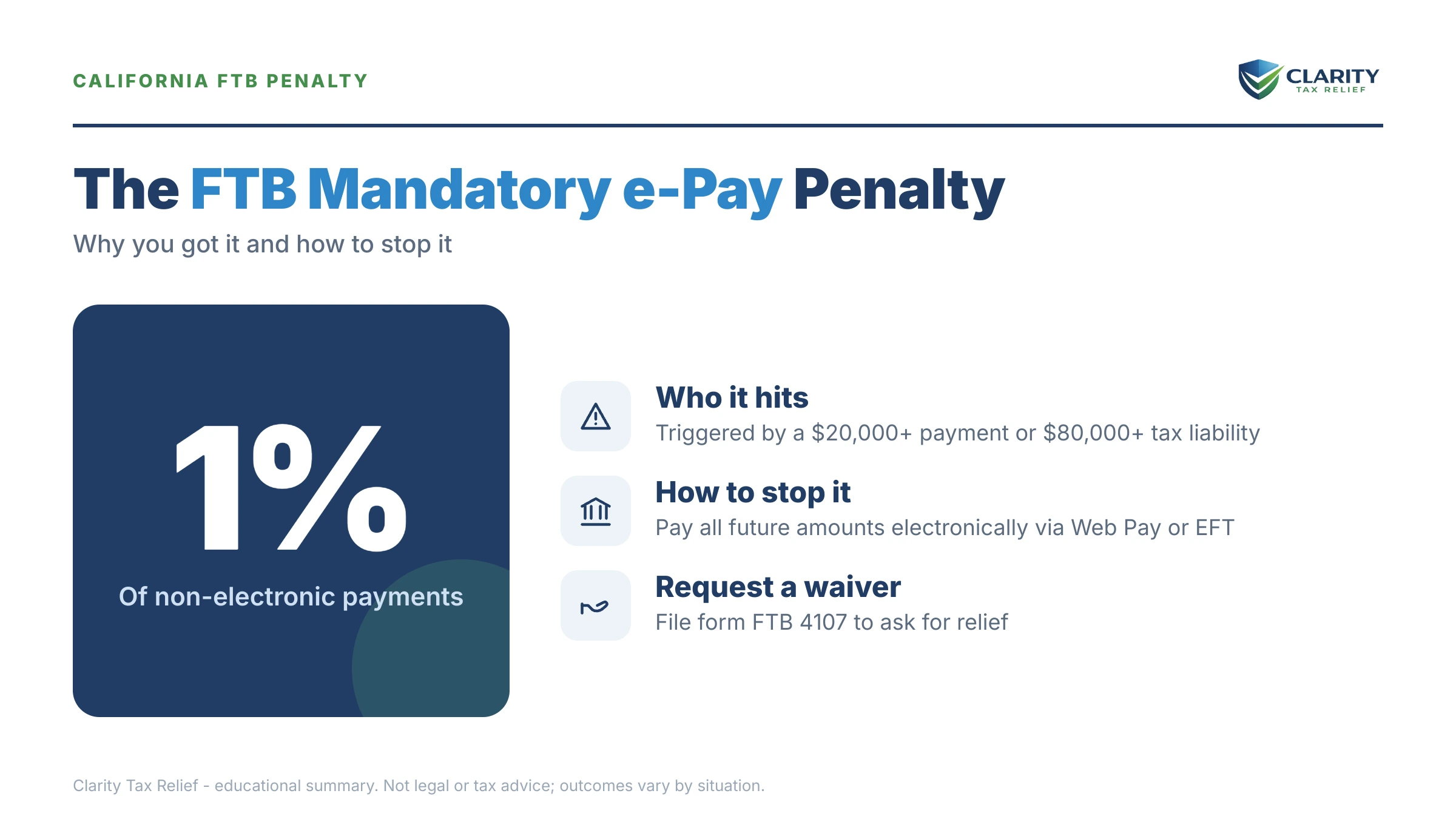
The short answer: FTB mandatory epay is California's rule that once a single estimated or extension payment tops $20,000, or a return shows total tax over $80,000 — every future FTB payment must be electronic. Pay by check afterward and the FTB adds a 1% penalty, automatically, on every paper payment.
Maybe you mailed the Franchise Tax Board a perfectly good check and got billed an extra 1% for it. Or maybe an FTB letter just told you that all of your payments must now be electronic — forever. Either way, you didn't do anything wrong on the tax itself; you crossed a payment threshold most Californians have never heard of.
The fix is genuinely mechanical: change how the money moves, and, if you no longer belong on the list, file one form to get off it. This guide covers both, plus what the penalty costs and how it interacts with back taxes and unfiled years.
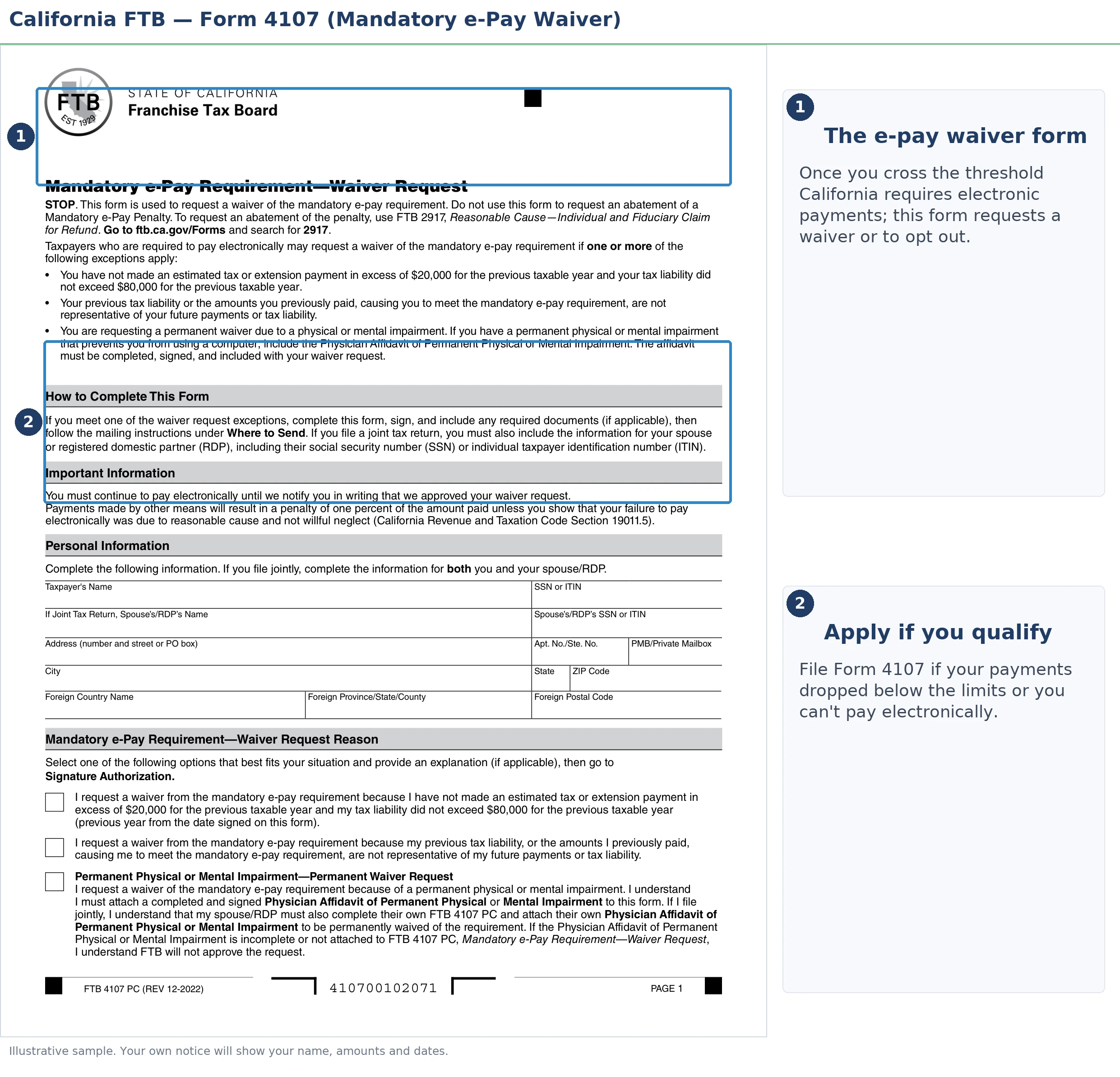
The FTB notifies you by letter when you cross a threshold, and that letter is easy to mistake for junk mail — the image below shows you exactly what the FTB's mandatory e-Pay notification looks like and where to look for your effective date.
⏱ The clock on this one is per payment, not per notice. There is no response window to miss — the rule is already in effect from your trigger date. Every payment you make by check, money order, or cash after that date costs an extra 1% of the payment, automatically, and interest accrues on each penalty until it's paid.
Why the FTB put you on mandatory e-Pay
California's mandatory e-Pay rule (Revenue and Taxation Code §19011.5) flags an individual the moment one estimated tax or extension payment exceeds $20,000, or an original return shows total tax liability over $80,000. The trigger is a one-time event with a permanent effect: once you're flagged, the requirement covers every FTB payment you ever make, until the FTB formally releases you.
Two details in those triggers surprise people. First, the $20,000 test is per payment, not per year — four quarterly payments of $19,000 each never trigger it, while one payment of $20,001 does. Gig workers and other 1099 earners hit this exact trap: one strong year, one oversized Q4 or extension payment, flagged for life.
Second, the $80,000 test looks at total tax liability on the return — the tax computed before your withholding and payments are subtracted. You can trigger it in a year you got a refund.
| Trigger event | Threshold | Effect |
|---|---|---|
| Single estimated tax payment | More than $20,000 | All future payments must be electronic |
| Single extension payment | More than $20,000 | All future payments must be electronic |
| Original return, total tax liability | More than $80,000 | All future payments must be electronic |
| Business entities (separate EFT rule) | Own thresholds under R&TC §19011 | Non-EFT payments penalized at 10%, not 1% |
Note that last row: corporations and other business entities live under a separate electronic funds transfer mandate with a much harsher penalty — 10% of any amount paid by non-electronic means. If you run an entity as well as your personal return, the two rules apply independently. This article covers the individual rule; for the broader California picture, start with our California FTB back taxes hub.
“Reasonable cause is determined on a case-by-case basis considering all the facts and circumstances of your situation.”
— Penalty relief for reasonable cause (IRS.gov)
The 1% penalty: what a paper check actually costs
The mandatory e-Pay penalty is 1% of whatever you pay by non-electronic means, and it posts automatically — no human reviews it first. It stacks on top of any late-filing penalty, late-payment penalty, and interest already on the account. It applies even when the underlying payment is on time and in full. Paying the right amount the wrong way is, by itself, a penalized act.
A worked example (hypothetical). Say you're a gig worker. 2022 was your best year, and you sent the FTB a single extension payment of $21,500 in April 2023. That one payment crossed $20,000 — you've been on mandatory e-Pay ever since, whether or not you noticed the letter. Then work dried up, you didn't file for 2023, 2024, or 2025, and after catching up you owe $19,700 across the three years.
- Mail one $19,700 check: 1% × $19,700 = $197 in e-Pay penalty — added on top of the failure-to-file and failure-to-pay penalties and interest already on those years, and itself accruing interest.
- Pay the same $19,700 through Web Pay: $0 extra. Same money, same day. The only difference is the channel it moves through.
- Can't pay it at once? An FTB installment agreement is generally available when you owe $25,000 or less and can pay within 60 months: $19,700 ÷ 60 ≈ $329/month, with interest continuing to accrue on the shrinking balance. Note that a guaranteed installment agreement is narrower: it applies to individuals only, with an income-tax balance of $10,000 or less excluding penalties and interest, all required returns filed, timely filing and payment for the past 5 years with no installment agreement during that period, and full payment within 3 years. The plan runs on automatic bank withdrawal — which satisfies the e-Pay rule on its own.
Notice what the example shows: the amount you owe never has to reach $20,000 for the penalty to bite. The trigger was years ago; the penalty applies to any paper payment afterward, even a $500 one ($5 penalty). Small, repeated checks quietly bleed money.
What happens if you ignore it
Ignoring mandatory e-Pay doesn't trigger a dramatic enforcement event. It makes every other FTB problem you have more expensive, in a fixed sequence:
- Each paper payment adds 1%. The penalties post automatically, accrue interest, and appear on your next FTB bill — which people then pay by check again, adding another 1%.
- Unfiled years surface. The FTB matches 1099s and other income records against filings. Miss returns and you'll receive an FTB demand to file — a formal order, not a suggestion.
- The FTB files for you. No response brings a Notice of Proposed Assessment built from raw income records — for a gig worker, that means gross 1099 income with none of your mileage or expense deductions, so the assessed tax usually runs far higher than reality.
- Fees stack onto the balance. Once the account moves to collections, the FTB adds its own charges — see FTB collection fees for what gets tacked on and when.
- Enforcement begins. Bank levies (Orders to Withhold), wage garnishment through an Earnings Withholding Order, and tax liens follow. And unlike the IRS's 10-year window, California's 20-year collection statute means waiting the FTB out is not a realistic plan.
The e-Pay penalty is the smallest number in that sequence, but it's the one you control completely, starting with your very next payment.
Flagged for mandatory e-Pay with unfiled years behind it?
The 1% penalty is the symptom; the unfiled returns and growing balance are the disease. An experienced tax professional will review your FTB account free — which years are open, what's been assessed. The cheapest sequence to fix all of it — while interest and penalties are still accruing.
Your options: every way to pay the FTB electronically
Complying with mandatory e-Pay costs nothing if you use the right channel — Web Pay, the FTB's direct bank-account option, is free. Here is how the electronic methods compare once you're flagged:
| Payment method | Cost | Best for |
|---|---|---|
| Web Pay (direct from bank account) | Free | Almost everyone — bills, estimates, return balances |
| Electronic funds withdrawal (with an e-filed return) | Free | Paying a balance at the moment you file |
| Credit card (third-party processor) | Processing fee applies | Cash-flow emergencies only — the fee is avoidable |
| Installment agreement auto-withdrawal | Setup fee; interest continues | Balances you can't pay at once — satisfies e-Pay by design |
| Check or money order | 1% penalty per payment | Only allowed after the FTB approves a Form 4107 waiver |
If the balance itself is the problem, the playbook is the same one we lay out in how to settle tax debt yourself, adapted to California: file everything first, then choose between paying in full, an FTB payment plan, hardship deferral, or, in genuinely limited cases, an offer. Balances over the streamlined plan limits generally require a financial disclosure on FTB Form 3561, the FTB's collection information statement. And if you can't pay anything at all, start with owe California state taxes and can't pay before you commit to a plan you'll default on.
How to get off mandatory e-Pay: Form FTB 4107
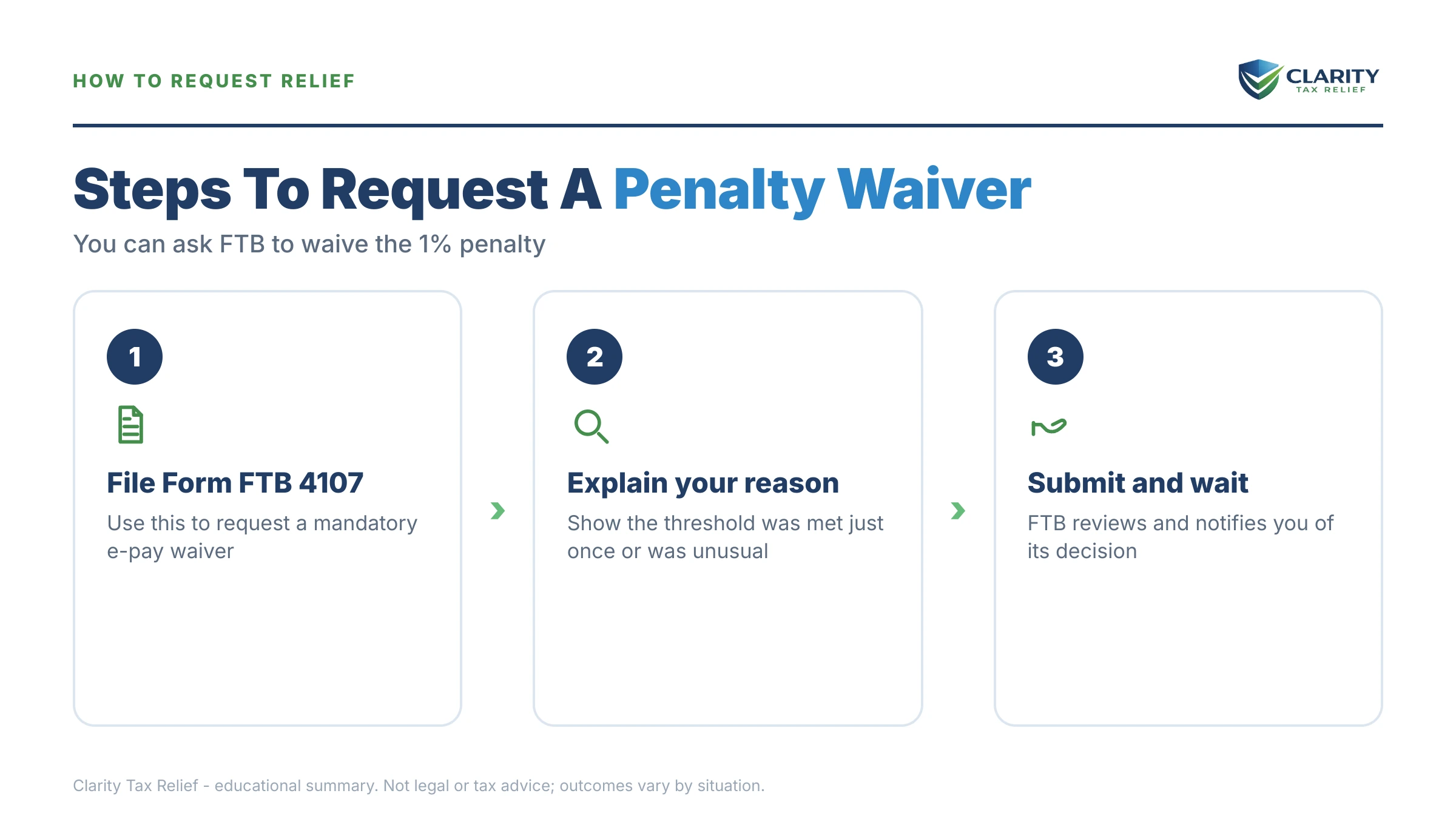
Form FTB 4107 — Mandatory e-Pay Election to Discontinue or Waiver Request — is the only exit, and it offers two distinct paths. A discontinuation asks the FTB to remove the requirement because you've since fallen back below both thresholds — no payment over $20,000 and total tax liability of $80,000 or less. A waiver asks the FTB to excuse you because your circumstances genuinely prevent electronic payment.
Two rules protect you while a request is pending. First, keep paying electronically until the FTB approves the request in writing — a pending Form 4107 does not shield a paper check from the 1% penalty. Second, keep the approval letter permanently; it's your proof if a penalty posts by mistake later.
Already been charged? The 1% penalty can be abated for reasonable cause — a bank failure, a documented error outside your control, circumstances that made electronic payment impossible for that specific payment. "I didn't know about the rule" rarely succeeds on its own, because the FTB's position is that it mailed you a notification letter when you crossed the threshold. The request process mirrors other state penalty relief — our FTB penalty abatement guide walks through what the FTB accepts as reasonable cause.
| Your situation | Relief path | What to show |
|---|---|---|
| Payments and tax now below both thresholds | Form FTB 4107 — discontinuation | Prior-year figures under $20,000/$80,000 |
| Genuinely unable to pay electronically | Form FTB 4107 — waiver | The specific barrier (banking access, etc.) |
| 1% penalty already assessed | Written reasonable-cause request | Documentation the paper payment was outside your control |
| Penalty posted after a written approval | Dispute with the FTB | Your approval letter and payment records |
How to respond to FTB mandatory e-Pay, step by step
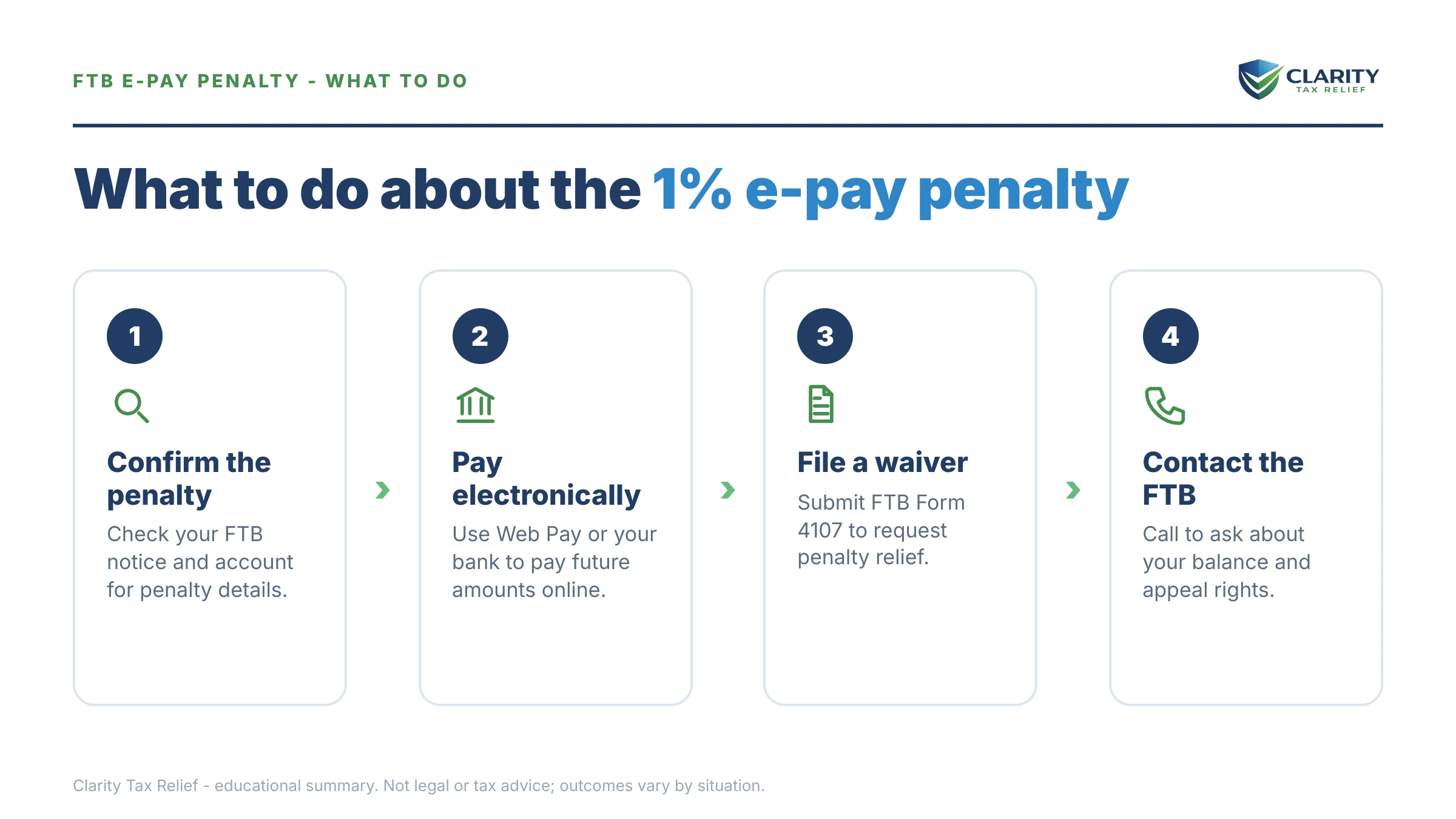
- Confirm your status — find the FTB letter that flagged you, or log in to MyFTB, and verify you're on mandatory e-Pay and when it took effect.
- File any unfiled returns — the FTB won't approve a payment plan or most relief requests until every required return is filed — and unfiled years are the bigger fire.
- Pay electronically from now on — use Web Pay (free, straight from your bank account) for every payment you make, no matter how small, so no new 1% penalties post.
- Set up a payment plan if you can't pay in full — apply for an FTB installment agreement. The automatic bank withdrawal it runs on satisfies the e-Pay rule by itself.
- Request a waiver or discontinuation if you qualify — file Form FTB 4107 if you've fallen back below the thresholds or genuinely can't pay electronically, and keep paying electronically until the FTB approves it in writing.
- Ask for relief on any 1% penalties already charged — request reasonable-cause abatement in writing, with documentation showing why the paper payment was outside your control.
When you can handle this yourself
Most people can resolve mandatory e-Pay alone in an afternoon. If you're current on filing, your only issue is the flag itself. You have a bank account, the fix is switching to Web Pay — free, immediate, done. Filing Form 4107 for a straightforward discontinuation (your numbers clearly dropped below both thresholds) is also a reasonable DIY task, as is a single small reasonable-cause request with clean documentation.
Experienced help changes the outcome when the e-Pay flag sits on top of a bigger problem: multiple unfiled years with a demand-to-file or proposed assessment already issued, a balance the FTB has assessed from gross 1099 income without your deductions, garnishment or a bank levy in motion, or a stack of penalties across several years where the order you challenge them in changes the total. In those cases, the $197-class penalty is a rounding error next to what proper filings and penalty relief can recover, and next to what a wrongly-assessed year costs if it stands.
Terms on your FTB letter, decoded
- Mandatory e-Pay — the individual requirement under R&TC §19011.5 to make all FTB payments electronically once a threshold is crossed.
- Web Pay — the FTB's free online payment system that pulls directly from your bank account.
- Form FTB 4107 — the Mandatory e-Pay Election to Discontinue or Waiver Request; the only form that removes the requirement.
- Electronic funds withdrawal (EFW) — paying a balance directly from your bank account as part of an e-filed return.
- MyFTB — your online FTB account, where you can see notices, balances, payment history, and your e-Pay status.
- Reasonable cause — the FTB's standard for excusing a penalty: circumstances outside your control, shown with documentation, not mere unawareness of the rule.
FTB mandatory e-Pay questions, answered
What is FTB mandatory e-pay?
FTB mandatory e-Pay is a California requirement that individuals make all Franchise Tax Board payments electronically once they cross a threshold. You're flagged when a single estimated tax or extension payment exceeds $20,000, or when you file an original return showing total tax liability over $80,000. Once flagged, the requirement covers every payment you make to the FTB — bills, estimates, and return balances — no matter how small.
What triggers mandatory e-pay in California?
One payment over $20,000, or one return showing more than $80,000 in total tax liability. The $20,000 test applies per payment, not per year — four quarterly payments of $19,000 each ($76,000 total) do not trigger the rule, but one payment of $20,001 does. The $80,000 test looks at total tax liability on the return before withholding and payments are subtracted, so a big refund year can still trigger it.
What is the penalty for not paying the FTB electronically?
The penalty is 1% of any amount you pay by non-electronic means, added automatically under Revenue and Taxation Code Section 19011.5. Mail the FTB a $10,000 check while flagged and the penalty is $100; a $19,700 check costs $197. The FTB can remove the penalty for reasonable cause, but you have to request it in writing. It will not reverse the charge on its own.
How do I get out of FTB mandatory e-pay?
File Form FTB 4107, Mandatory e-Pay Election to Discontinue or Waiver Request. It offers two paths: a request to discontinue if your payments and tax liability have since fallen back below both thresholds, or a waiver if your circumstances genuinely prevent electronic payment. Keep paying electronically until the FTB approves your request in writing — a pending Form 4107 does not stop the 1% penalty.
Is FTB mandatory e-pay permanent?
By default, yes — the requirement continues indefinitely once triggered, even in years when you owe very little. It does not reset annually the way estimated-tax rules do. The only exits are an approved discontinuation or waiver through Form FTB 4107, and until the FTB grants one, a $200 payment is held to the same electronic requirement as a $20,000 one.
Does mandatory e-pay apply to FTB payment plan payments?
Yes — every payment to the FTB is covered, including installment agreement payments. In practice this is rarely a problem, because FTB payment plans are collected by automatic withdrawal from your bank account, which satisfies the electronic requirement. The risk point is one-off extra payments: if you mail a check to pay a plan down faster while flagged, that check picks up the 1% penalty.
Does the IRS have a mandatory e-pay rule like the FTB's?
No. There is no federal equivalent for individuals. The IRS accepts paper checks from individual taxpayers without charging a penalty based on the payment method. Mandatory e-Pay is a California-specific rule, which trips up people who owe both agencies: the same habit of mailing checks is free with the IRS and costs 1% per payment with the FTB once you're flagged.
Your next 24 hours
- Find your effective date. Pull the FTB letter that flagged you, or log in to MyFTB, and confirm when mandatory e-Pay started and whether any 1% penalties have already posted to your account.
- Gather your paper trail. Your last filed California return, any FTB notices, your 1099s for the unfiled years, and records of every payment you've made — this is everything needed to price your real options.
- Get the free case review. Interest and penalties on unfiled years accrue every month they sit — call (888) 825-7779 or use the 2-minute form and an experienced tax professional will map the cheapest path through the flag, the penalties. The balance.
Official resources: make electronic payments through the FTB's payment options page, and find Form FTB 4107 and mandatory e-Pay details at the California Franchise Tax Board.
This guide is general information, not tax or legal advice for your specific situation. Eligibility for IRS programs depends on individual facts and circumstances; no outcome is guaranteed.