
State Tax Debt
California Tax Debt Relief in 2026: Every Real FTB, CDTFA & EDD Option
The short answer: California tax debt relief runs through three agencies — the FTB for income tax, the CDTFA for sales tax, and the EDD for payroll tax. Real options include installment agreements, the FTB Offer in Compromise, financial hardship status, and penalty abatement. The FTB can collect for 20 years, so acting early is what lowers the cost.
Maybe the balance grew quietly across a few retirement-era returns — a pension you didn't withhold enough on, an IRA withdrawal that pushed you into a bracket you didn't expect — and now the letters from Sacramento arrive faster than you can answer them. On a fixed income, a five-figure state balance feels like a problem with no exits.
It isn't. California has real relief programs. But they follow a different map than the IRS programs you may have read about, they're run by three separate agencies, and the deadlines and thresholds you've seen on federal guides mostly do not apply here. This guide walks the entire California map — who's collecting, what they can take, and every program that actually exists in 2026.
⏱ The real clock: the FTB can collect a California tax debt for 20 years from assessment under Revenue & Taxation Code §19255, twice the IRS's window, and interest plus collection fees accrue the entire time. If the notice in your hand shows a specific response date, that printed date controls. Act before it.
Why you owe California, and which agency is collecting
California tax debt is collected by three different agencies, each with its own notices, its own enforcement tools, and its own relief programs. The first thing to do with any California tax letter is check the letterhead, because the fix depends entirely on who sent it.
For individuals, including retirees, the collector is almost always the Franchise Tax Board (FTB). Common triggers:
- A return filed without full payment. Withholding on pensions and IRA distributions often runs light, and California taxes most retirement income that the federal government also taxes.
- An FTB assessment for a year you never filed. California sends a Demand for Tax Return when its data — 1099s, mortgage interest, licenses — suggests you should have filed. If you don't respond, the FTB assesses tax for you, usually at a worst-case number.
- A federal audit that followed you home. When the IRS adjusts a return, the FTB receives that data and issues its own assessment for the state share, sometimes years later.
- A residency dispute. If you moved into or out of California mid-year, the FTB may have taxed more income as Californian than actually was.
Business owners and former business owners may instead be dealing with the CDTFA (sales and use tax) or the EDD (payroll tax), and both can pursue individuals personally for certain business balances, even after the business closes.
| Agency | Tax it collects | Signature enforcement | Deep-dive guide |
|---|---|---|---|
| Franchise Tax Board (FTB) | Personal & business income tax, some court-ordered debt | Bank levies, wage garnishment, state tax liens, refund intercepts | California FTB back taxes |
| CDTFA | Sales & use tax, special fees | Permit revocation, personal liability for owners, liens and levies | California back sales tax |
| EDD | Payroll taxes (UI, SDI, withholding) | Assessments with personal liability for responsible individuals | California EDD payroll tax |
| IRS (federal) | Federal income & payroll tax | Federal levies, liens, passport certification | State tax debt vs IRS — which first |
If you owe both California and the IRS on the same years, the order you resolve them in matters — each agency's payment plan counts as an expense in the other's affordability math. The state tax debt vs IRS guide covers that sequencing; this article stays on the California side.
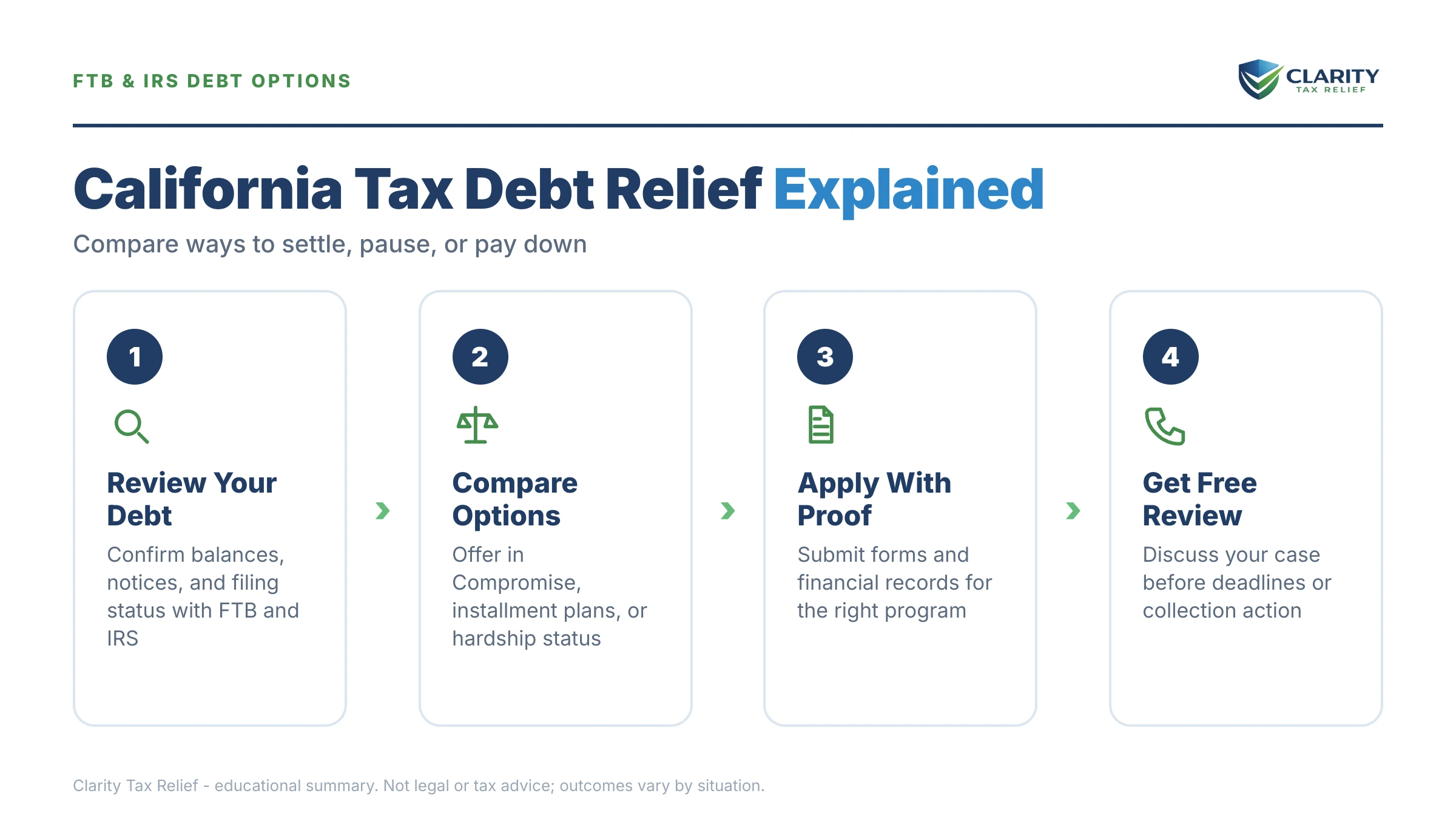
“An offer in compromise allows you to settle your tax debt for less than the full amount you owe. It may be a legitimate option if you can't pay your full tax liability or doing so creates a financial hardship.”
— Offer in compromise (IRS.gov)
What happens if you ignore California tax debt
The FTB can pursue a tax debt for 20 years from assessment. Its collection machine is almost entirely automated, so it never depends on a human deciding your file matters. Ignoring the letters doesn't slow the sequence; it just makes each stage more expensive. Here is the order things escalate in:
- Balance due notice. The first bill. Interest is already accruing, and the FTB's interest rate adjusts periodically — the balance is never standing still.
- Demand for payment, plus collection fees. Once your account moves into active collections, the FTB adds its own cost-recovery fees on top of the tax, penalties, and interest. You now owe more for having waited.
- Intercepts. The FTB grabs money it can reach without a levy: state tax refunds, lottery winnings, unclaimed property payouts.
- State tax lien. The FTB records a lien with the county. It attaches to your home and anything else you own there, becomes a public record, and complicates any sale or refinance — see the FTB tax lien guide.
- Levy and garnishment. An Order to Withhold freezes and takes funds from your bank account. An Earnings Withholding Order for Taxes takes a share of wages if you still work — the FTB wage garnishment guide covers how much and how to stop it.
- Public pressure for the largest debts. Californians owing among the state's biggest balances can land on the FTB Top 500 delinquent taxpayer list, which can trigger suspension of driver's and professional licenses.
Two things make this sequence harsher than the IRS version. First, the 20-year window means the balance can outlast your patience, your savings, and, bluntly, much of your retirement. Second, unlike IRS debt, there is no widely available expiration strategy to plan around. The FTB statute of limitations on collections guide explains why waiting it out fails.
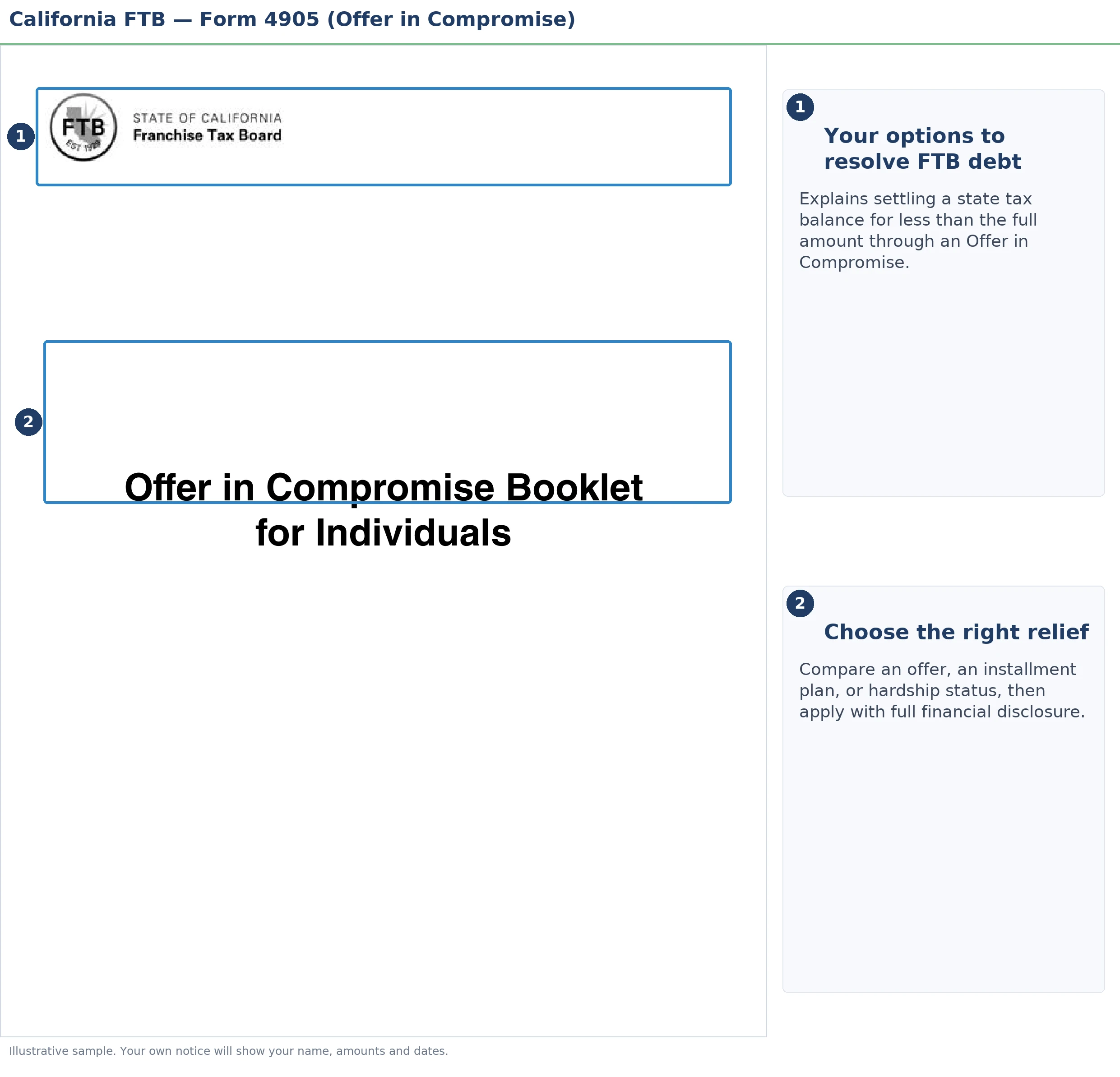
Carrying a California tax balance right now?
Whether it's an FTB bill, a CDTFA assessment, or an EDD letter, get it reviewed free before the next automated step — interest and collection fees are accruing either way. An experienced tax professional will map exactly where your account sits and which program fits your income.
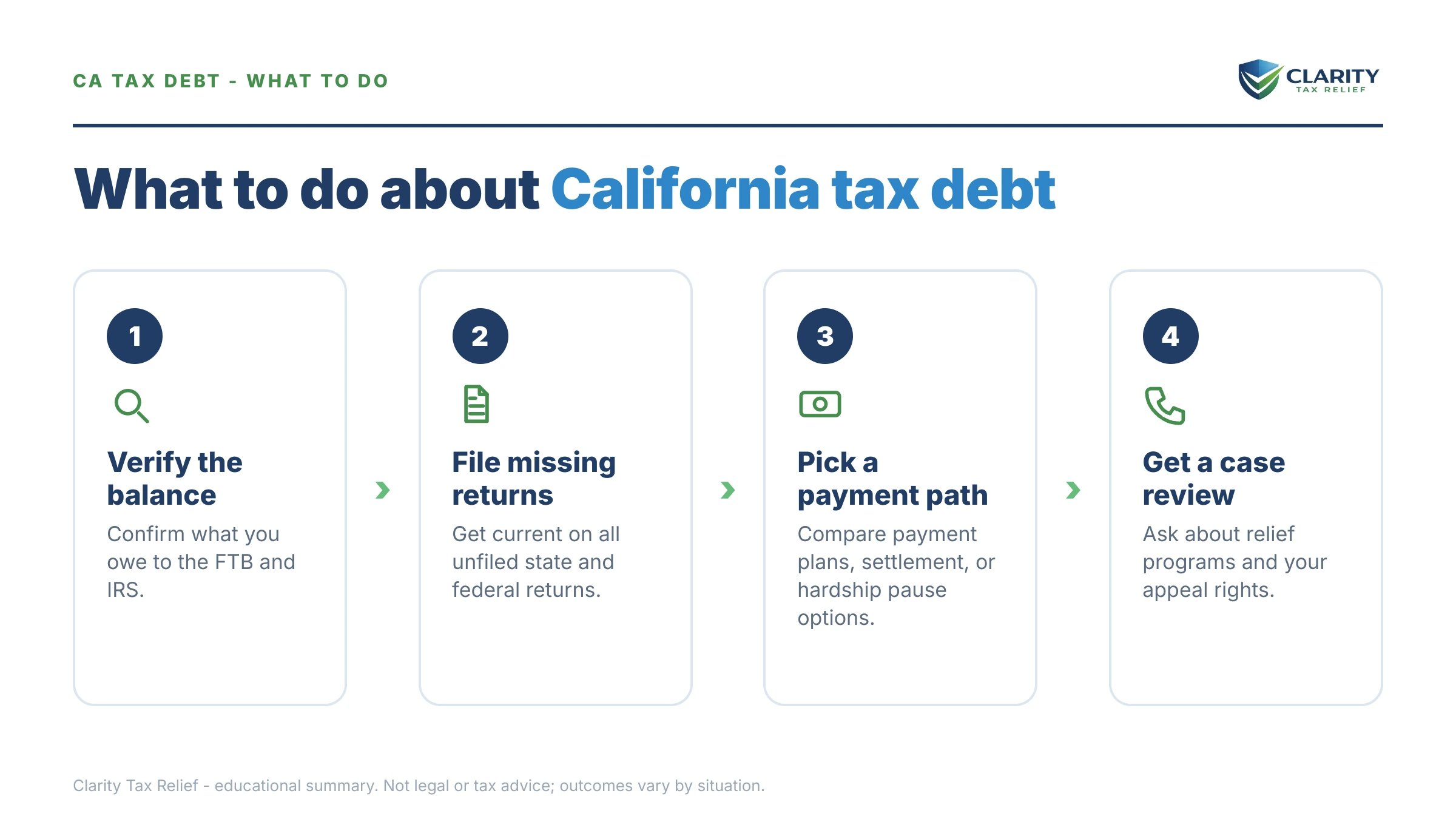
California tax debt relief options in 2026
Every California relief program shares one gate: all required returns must be filed before the state will approve anything. File first, even if you can't pay a dollar, then match your finances to one of the programs below.
Live in Southern California? We also have a dedicated guide to tax relief in Los Angeles covering LA-specific help options.
| Option | Best for | Key requirement | What it stops |
|---|---|---|---|
| FTB installment agreement | You can pay the balance over time | All returns filed; stay current on new taxes | Levies and garnishment, once accepted |
| FTB Offer in Compromise | No realistic ability to ever pay in full | All returns filed; full financial disclosure; you don't dispute the tax | Collection — for less than the full balance, if accepted |
| FTB financial hardship status | Essentials consume your entire income | Form FTB 3561 financial statement | Active collection while hardship lasts (interest continues) |
| Penalty abatement | Penalties inflated the balance | One-time abatement (individuals, tax years 2022+) or reasonable cause | The penalty portion only |
| CDTFA / EDD payment plans | Sales or payroll tax balances | Agency-specific terms; personal-liability rules apply | Escalating enforcement on business debt |
FTB payment plans
The workhorse option. The FTB offers monthly installment agreements, and smaller balances can usually be set up online through a MyFTB account — as of this writing, the online application generally handles balances up to $25,000 with up to 60 months to pay, but confirm current limits at ftb.ca.gov before relying on them. Larger balances typically require submitting a financial statement first. Interest continues while you pay, and one late payment or one new unpaid year can default the whole agreement. Full walkthrough: FTB payment plan.
FTB Offer in Compromise
California will accept less than the full balance, but only when your financial disclosure shows the state could never collect it in full. Unlike the IRS's largely formula-driven approach, the FTB explicitly weighs factors like your age, health, and whether your income is realistically going to improve. That framing matters for retirees: a fixed income, no significant assets, and no earning years ahead is exactly the profile the program was built to evaluate. It is not fast, it is not automatic, and you must not be disputing that you owe the tax. Details and the application path: FTB offer in compromise.
FTB financial hardship status
If paying anything would leave you unable to cover housing, food, utilities, and medical costs, the FTB can pause active collection based on a Form FTB 3561 financial statement. Understand what this is and isn't: the debt remains, interest keeps accruing. The FTB revisits your situation, with a 20-year collection window, hardship is a shelter, not a resolution. For many people it's the right first move while a longer-term fix (an offer, or simply outlasting a temporary income dip) takes shape. See FTB currently not collectible.
Penalty abatement
Penalties are often the most attackable slice of a California balance. California added a one-time penalty abatement for individual filers (available for tax years 2022 and later) for taxpayers with a clean compliance history, and reasonable-cause relief — serious illness, disaster, circumstances genuinely beyond your control — remains available for other years and other penalties. Note this is separate from the IRS's first-time abatement and the new federal Automatic Exemption from Penalty rolling out in summer 2026; California's rules are its own. How to request it: FTB penalty abatement.
CDTFA and EDD balances
Sales tax and payroll tax debts play by harsher rules because the state treats them as money you collected on its behalf. Both agencies offer payment plans. The CDTFA has its own offer program, but both can also assess owners, officers, and other responsible individuals personally, so the resolution strategy has to protect you as well as the business. Start with California back sales tax for CDTFA debt and California EDD payroll tax for EDD assessments.
What about amnesty?
California has run tax amnesty windows in the past, and marketers love to imply one is always open. It isn't — amnesty exists only when the legislature creates it. The California tax amnesty guide covers what's actually available versus what's sales copy.
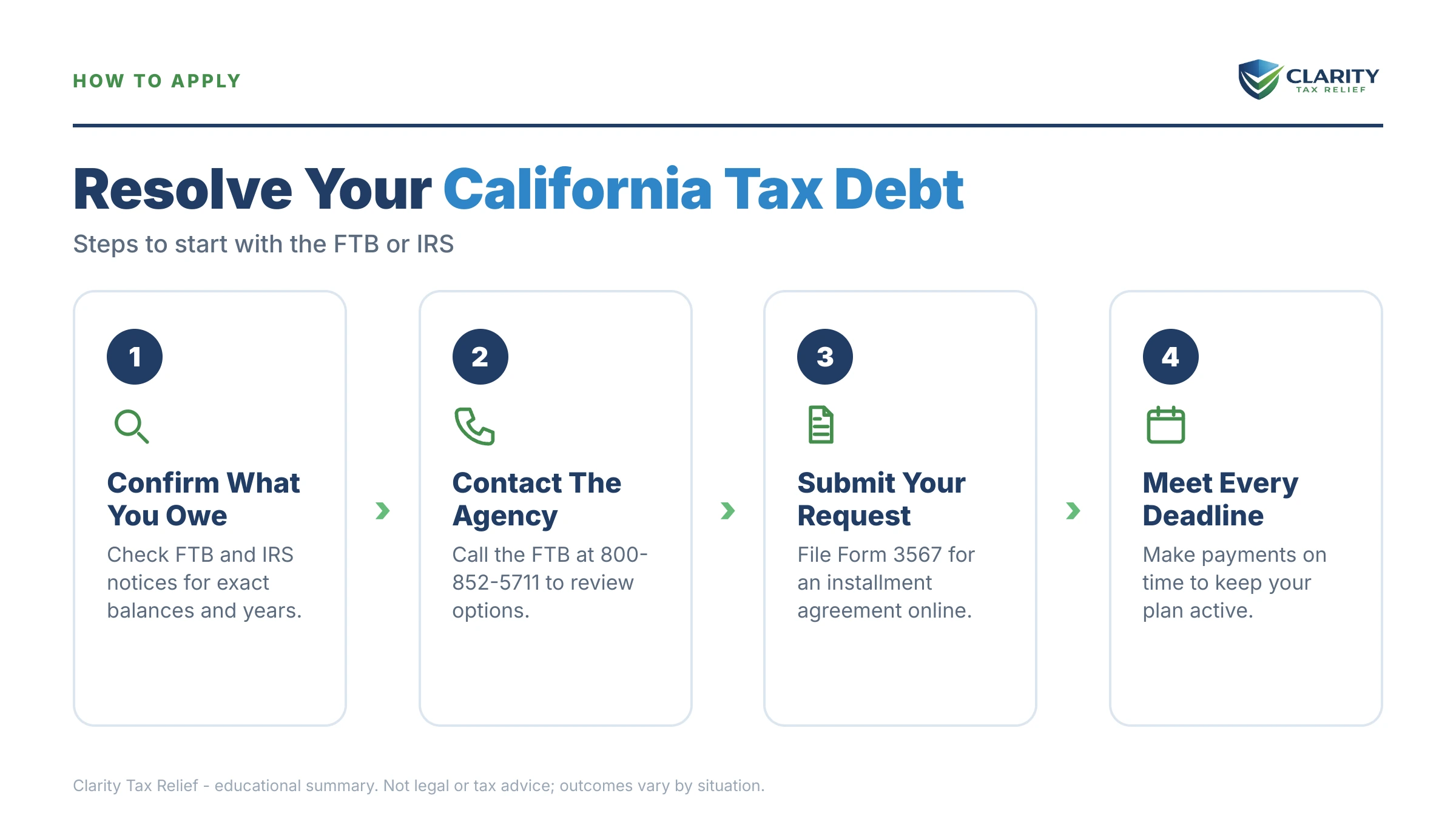
Say you owe the FTB $23,800: the math on every option
A concrete, hypothetical scenario shows how the options actually compare. Say you owe the FTB $23,800 across three tax years, you're retired. Your income is $2,150 a month in Social Security plus a $310 pension — $2,460 total.
- Payment plan: $23,800 spread over 60 months is $23,800 ÷ 60 ≈ $397 a month — about 16% of your $2,460 income, before interest that continues accruing. If rent, utilities, food, and medications already consume $2,300 a month, this plan fails in month two. A payment plan is the right answer only when the math survives your real budget.
- Hardship status: that same budget — $2,460 in, roughly $2,300 out on essentials — is a textbook Form FTB 3561 hardship showing. Collection pauses. But interest keeps running, and with 20 years on the clock, the FTB will be back to re-check. Hardship buys safety, not closure.
- FTB Offer in Compromise: here the picture changes. Fixed income, no realistic earning years ahead, and, say, $1,900 in the bank and no home equity. The FTB's question becomes: what could the state ever actually collect? If the honest answer is a few thousand dollars (perhaps raised with family help), an offer in that neighborhood is worth pursuing. No amount is promised and every offer is means-tested, but this is the profile the program exists for.
- Penalty abatement first, regardless: if, of the $23,800, roughly $4,100 is late-payment penalties, an abatement request can shrink the problem before you negotiate the rest — smaller balance, smaller plan payment, smaller offer gap.
The order matters: file anything missing, attack the penalties, then resolve the remaining balance with the program your budget actually supports.
FTB vs. IRS: why California tax debt is different
The FTB can chase a balance twice as long as the IRS. That single difference reshapes every strategy you may have read on federal-focused guides. Here's the side-by-side that matters in 2026:
| Issue | IRS (federal) | California FTB |
|---|---|---|
| Collection window | 10 years from assessment (pausable by appeals, offers, bankruptcy) | 20 years from assessment under R&TC §19255 |
| Penalty forgiveness | First-Time Abate; Automatic Exemption from Penalty (AEP) begins summer 2026 | One-time abatement for individuals (tax years 2022+); reasonable cause otherwise |
| Settlement program | IRS Offer in Compromise — roughly 1 in 5 accepted in FY2024 | FTB Offer in Compromise — own criteria, weighing age, health, and future income prospects |
| Social Security | Can take up to 15% via the Federal Payment Levy Program | Cannot levy Social Security benefits directly |
| Travel & licenses | Passport certification at $66,000+ (2026 threshold) | No passport power, but license suspension for Top 500 debtors |
The practical takeaway: strategies built around the IRS clock — partial-pay plans designed to expire at the 10-year mark, for instance — simply don't translate to an FTB balance. California debt has to be resolved, not outlasted.
On Social Security? What the FTB can, and can't, touch
The FTB cannot levy your Social Security benefits directly — federal law shields them from state tax collectors, which puts California in a weaker position against a retiree than the IRS is (the IRS can take up to 15% of a benefit through the Federal Payment Levy Program).
But don't confuse a protected benefit with a protected life. The FTB can still levy a bank account, and once benefits are deposited and mixed with other money, sorting out what's shielded gets messy — federal rules give direct-deposited benefits some protection at the bank, but it's not something to bet the rent on. The FTB can also record a lien against your home, intercept your state refund, and reach a pension or other non-Social-Security income.
For a retiree, that leads to a clear strategy: your protected income is leverage, not an excuse to ignore the debt. A hardship filing or a well-built FTB offer uses that fixed-income reality on paper, where it lowers what the state can demand, instead of leaving the FTB to find your bank account first. If most of your income is Social Security and the balance is federal rather than state, start with state tax debt vs IRS to sequence the two correctly.
How to respond to California tax debt, step by step
- Identify the collector. Pull out the most recent letter and find the agency name — Franchise Tax Board, CDTFA, or EDD — plus the account number and tax years. Everything downstream depends on which agency is collecting.
- File every missing return. No California relief program — payment plan, hardship status, or Offer in Compromise — will be approved with unfiled returns outstanding. The FTB's own estimated assessments almost always overstate what you truly owe.
- Verify the balance. Register for a MyFTB account at ftb.ca.gov and compare the balance there against your notices. Separate the tax itself from penalties, interest, and collection fees — the add-ons are often the part you can attack.
- Pick your program and apply. Match your income and assets to a payment plan, hardship status, or Offer in Compromise — then set it up before a lien or levy narrows your choices.
- Get experienced help if enforcement has started. A recorded lien, an active garnishment, or debts to more than one agency change the order of operations. Have an experienced tax professional map the sequence before you commit to terms.
For sales or payroll balances, the agency sites are cdtfa.ca.gov and edd.ca.gov — always verify any figure or program term against the agency itself before you sign an agreement.
When you can handle this yourself
Plenty of California tax debt genuinely doesn't need professional help. Handle it yourself when:
- The balance is small and the notice is right. If you agree with the number and can pay it, or set up a modest FTB payment plan online — do exactly that and be done.
- It's one year, one agency, no enforcement yet. A single FTB bill with no lien, levy, or unfiled years is a straightforward online fix.
- Only the penalty is the problem. A one-time abatement request for a clean-history year is a form-level task, not a case.
Experienced help changes outcomes in a different set of situations: a levy or garnishment already in motion, multiple unfiled years the FTB has estimated for you, an FTB Offer in Compromise (where the financial presentation largely decides the result), CDTFA or EDD debt with personal-liability exposure, a residency dispute over how much you owe at all, or California and IRS balances stacked on the same years. In those cases, the sequencing and the paperwork are the outcome, and mistakes are expensive over a 20-year window.
If your situation is on that second list — especially a fixed income facing an FTB levy or an offer decision — a free review of your notices with an experienced tax professional costs nothing and settles the strategy question in one call: start the 2-minute form or dial (888) 825-7779.
Terms on your California notices, decoded
- Order to Withhold (OTW): the FTB's bank levy — an order to your bank to hold and hand over funds from your account.
- Earnings Withholding Order for Taxes (EWOT): the FTB's wage garnishment — a continuing order to your employer to send part of each paycheck to the state.
- Collection Cost Recovery Fee: a fee the FTB adds to your balance once the account enters active collections — the state bills you for chasing you.
- State tax lien: a public claim recorded at the county against everything you own there. It doesn't take anything. But it blocks clean title until resolved.
- R&TC §19255: the California law giving the FTB 20 years from assessment to collect — the single biggest difference from IRS debt.
- Top 500 list: the FTB's twice-yearly public list of the state's largest delinquent taxpayers, which can trigger license suspensions.
California tax debt relief questions, answered
Does California have a tax debt forgiveness program?
Not a blanket one. The closest thing is the FTB Offer in Compromise, which settles a balance for less than the full amount only when your income and assets show the state could never collect it in full. Retirees on fixed incomes with no significant assets are among the profiles the FTB genuinely considers, but every offer is means-tested — nothing is automatic and nothing is promised.
How long can the FTB collect back taxes?
Generally 20 years from the date the tax was assessed, under Revenue and Taxation Code Section 19255 — twice the IRS's 10-year window. Certain events can extend that period further. That is why waiting out a California balance almost never works: interest accrues the entire time. The FTB's enforcement runs on automation, not patience.
Can the FTB garnish my Social Security check?
No. Social Security benefits are protected from state tax collectors by federal law, so the FTB cannot intercept your monthly benefit the way the IRS can — the IRS may take up to 15% of it through the Federal Payment Levy Program. Once benefits sit in a bank account mixed with other money, though, an FTB bank levy gets more complicated, so do not treat the account itself as untouchable.
Can I settle my California tax debt for less than I owe?
Sometimes, through the FTB Offer in Compromise. You must have filed every required return, not be disputing that you owe the tax, and show through full financial disclosure that you cannot pay the balance now or in the foreseeable future. The FTB weighs your age, health, income, and assets, factors that often work in a retiree's favor, but acceptance is never assured.
Does the FTB offer payment plans?
Yes. The FTB offers monthly installment agreements, and smaller balances can usually be set up online through a MyFTB account. You must have filed all required returns and stay current on future taxes, and interest continues to accrue while you pay. Larger balances typically require a financial statement before the FTB agrees to terms.
I moved out of California — do I still owe the FTB?
Yes. The FTB collects across state lines: it records liens, uses out-of-state collection tools, and the 20-year collection window does not shrink because you left. If the debt arose around the time you moved, the real question may be whether California correctly treated you as a resident for those years — a residency challenge can change the amount itself, not just the payment terms.
Will California tax debt show up on my credit report?
Tax liens no longer appear on the three consumer credit bureaus' reports, so your score will not drop from the lien itself. But a recorded California state tax lien is still a public record: mortgage lenders, title companies, and anyone searching county records will find it. It generally must be resolved before a real estate sale or refinance can close.
Is the FTB harder to deal with than the IRS?
In several ways, yes. The FTB has a 20-year collection window versus the IRS's 10, adds its own collection fees to your balance, and runs a heavily automated system with fewer relief programs. The IRS's 2025 staffing cuts made humans harder to reach there too, but California's liens, bank levies, and wage garnishments have never depended on staffing.
Your next 24 hours
- Find the letterhead. Pull your most recent California notice and identify the agency — FTB, CDTFA, or EDD — plus the tax years and the total balance. That one detail determines every option that follows.
- Gather three things: your last filed California return, every state notice you've received, and a simple list of your monthly income and essential expenses. That's the entire packet any relief program starts from.
- Get your free case review. Call (888) 825-7779 or use the 2-minute form. An experienced tax professional will match your income and your balance to the right California program — payment plan, hardship, offer, or penalty relief — before interest, collection fees. The next automated enforcement step add to the cost.
This guide is general information, not tax or legal advice for your specific situation. Eligibility for IRS programs depends on individual facts and circumstances; no outcome is guaranteed. The same is true of California FTB, CDTFA, and EDD programs — always verify current terms with the agency.