
California Tax Debt
California Tax Amnesty in 2026: What's Real, What Replaced It, and Your Actual Options
The short answer: there is no California tax amnesty program open in 2026. The state's last general amnesty closed in 2005, and none has been announced since. What exists instead: the FTB's one-time penalty abatement, payment plans, Offer in Compromise, and hardship status — real programs with real eligibility rules, not a blanket forgiveness window.
You saw an ad, or a headline — promising "California tax amnesty," and you searched to find out whether the state will really wipe the slate clean before you drain savings you can't replace. It's a reasonable hope, especially on a fixed income. Here's the honest map: the amnesty itself is history, but California runs several permanent programs that can remove penalties, stretch payments, pause collection, or in genuine hardship cases settle the debt, and this guide shows which one fits which situation.
⏱ The real clock: there is no amnesty deadline to wait for, but there is a clock running against you. Penalties and interest accrue on an FTB balance monthly, and California can collect for 20 years under Revenue and Taxation Code §19255 — twice the IRS's collection window. Waiting for a forgiveness program that isn't coming only raises the price of fixing this.
Is there a California tax amnesty program in 2026?
California has not offered a general tax amnesty since 2005, and no new amnesty is scheduled or pending for 2026. An amnesty requires the Legislature to pass a bill creating one. Nothing of the kind has been enacted, and neither the Franchise Tax Board (FTB) nor the CDTFA has announced a program.
So why do you keep seeing the word? Two reasons. First, some marketing uses "amnesty" loosely to describe ordinary relief programs — penalty abatement, payment plans, settlement offers — that have always existed. Those programs are real, but they're means-tested and rule-bound, not an open window where debt vanishes.
Second, other states do periodically run amnesties, so national headlines keep the term alive. California took a different path: instead of occasional amnesty windows, it built permanent, always-open relief programs — which is actually better news for you, because you don't have to wait for a window to open.
If a company tells you it can enroll you in "the California amnesty program" today, treat that as a red flag, not a lifeline. The distinction matters because the real programs have specific requirements you can start meeting this week.
“Explore all other payment options before you submit an offer in compromise. The Offer in Compromise Program is not for everyone. Be sure to check the qualifications of any tax professional you hire to help you file an offer.”
— Offer in compromise (IRS.gov)
What California's past tax amnesties actually were
California's last general tax amnesty ran for roughly two months in early 2005 and applied to tax years 2002 and earlier. Taxpayers who came forward paid their tax and interest in full; in exchange, the state waived penalties and criminal exposure for the covered years. It covered both income tax (FTB) and sales and use tax (then administered by the Board of Equalization).
Notice what even a real amnesty did not do: it never erased the tax itself, or the interest. Amnesty waived penalties only, and taxpayers who were eligible but stayed silent faced new, harsher penalties afterward. Amnesty was designed as a stick as much as a carrot.
A far narrower voluntary-compliance window opened in 2011, limited to abusive tax shelters and unreported offshore income. Since then: nothing general, for over two decades. The realistic conclusion is that a new amnesty is not part of any sound plan for a balance you owe today — the permanent programs below are.
What happens if you wait for an amnesty that never comes
The FTB's collection system is automated, aggressive, and, unlike the IRS, has 20 years to work on you. If you sit on a balance hoping for forgiveness, this is the sequence that unfolds, in order:
- Balance-due and demand notices. The FTB bills you, then issues a formal demand for payment. Interest accrues the entire time.
- Collection fees get added. Once your account moves to enforced collection, the FTB tacks its FTB collection fees onto the balance. You now owe more for having waited.
- A state tax lien is recorded. The lien attaches to your home and other property in the county where it's filed, and it's public record.
- Refund and payment intercepts. State tax refunds, lottery winnings, and certain other state payments get swept toward the debt automatically.
- Bank levy (Order to Withhold). The FTB can take funds sitting in your bank account. For retirees, this is usually the first enforcement that truly hurts, even when the money in the account came from protected benefits, you may have to prove it to get funds back.
- Wage withholding, for those still working. An earnings withholding order takes a slice of every paycheck until the debt is resolved or released.
- Public listing and license consequences for the largest debts. Six-figure delinquencies can land on the state's FTB Top 500 delinquent taxpayer list, which carries professional and driver's license suspension consequences.
And the backstop that makes waiting uniquely bad in California: California's 20-year collection statute. An IRS debt has a 10-year expiration date that sometimes makes patience part of a strategy. An FTB debt does not — a balance from your early sixties can legally follow you into your eighties.
Owe California and hoping for amnesty?
Stop waiting for a program that isn't coming while interest compounds every month. Send us your FTB notice — an experienced tax professional will map which real California program fits your income and assets, free and confidential.
California tax forgiveness in 2026: the programs that actually exist
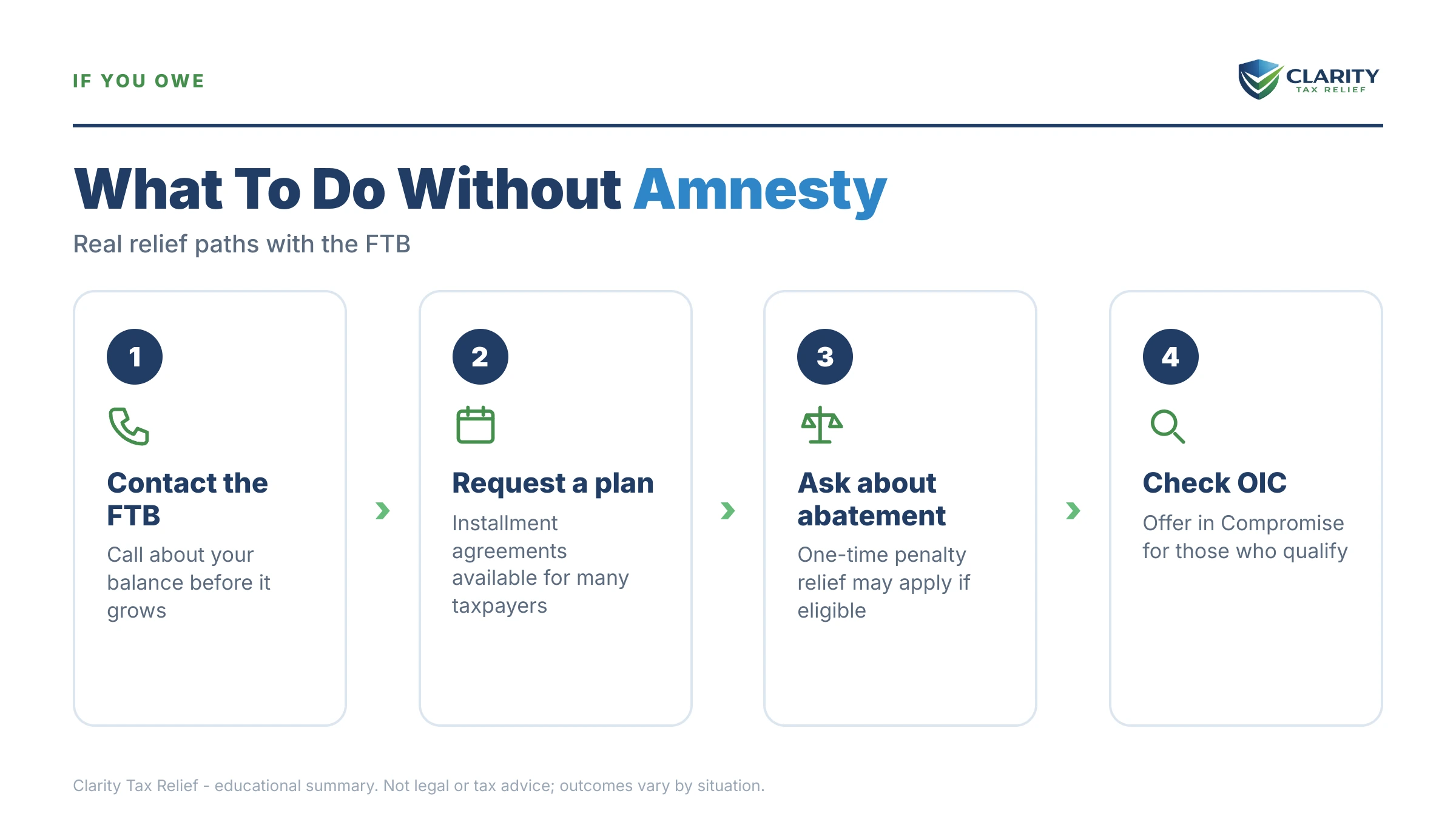
California replaced amnesty windows with five permanent relief programs, and each one can accomplish part of what people hope "amnesty" means. Here's the full menu, with who may qualify:
| Program | Who may qualify | What it actually does |
|---|---|---|
| One-time penalty abatement (FTB) | Individuals; tax years 2022 and later; all returns filed; tax paid or on a plan | Removes late-filing and late-payment penalties once per lifetime |
| Reasonable-cause penalty relief | Any year, if circumstances beyond your control (illness, disaster) caused the lapse | Removes penalties with documentation; tax and interest remain |
| FTB payment plan | Online setup generally for balances of $25,000 or less payable within 60 months | Stops enforced collection while you pay monthly; interest continues |
| Hardship status (FTB) | Paying anything would prevent basic living expenses — common on fixed incomes | Pauses enforced collection; the debt and the 20-year clock remain |
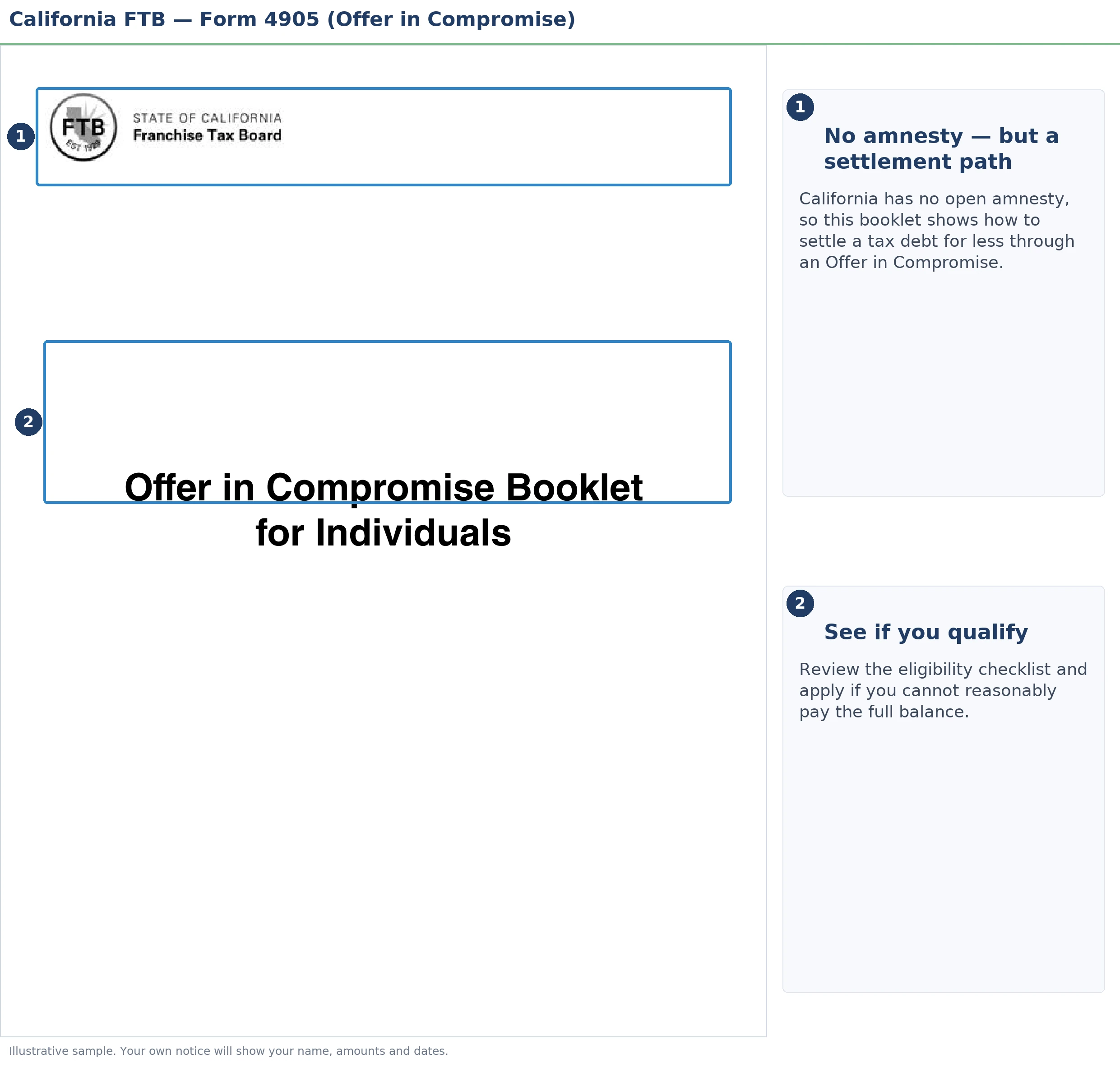
| Offer in Compromise (FTB / CDTFA / EDD) | Those who genuinely cannot pay in full now or in the foreseeable future | Settles the debt for less than the balance — means-tested, never automatic |
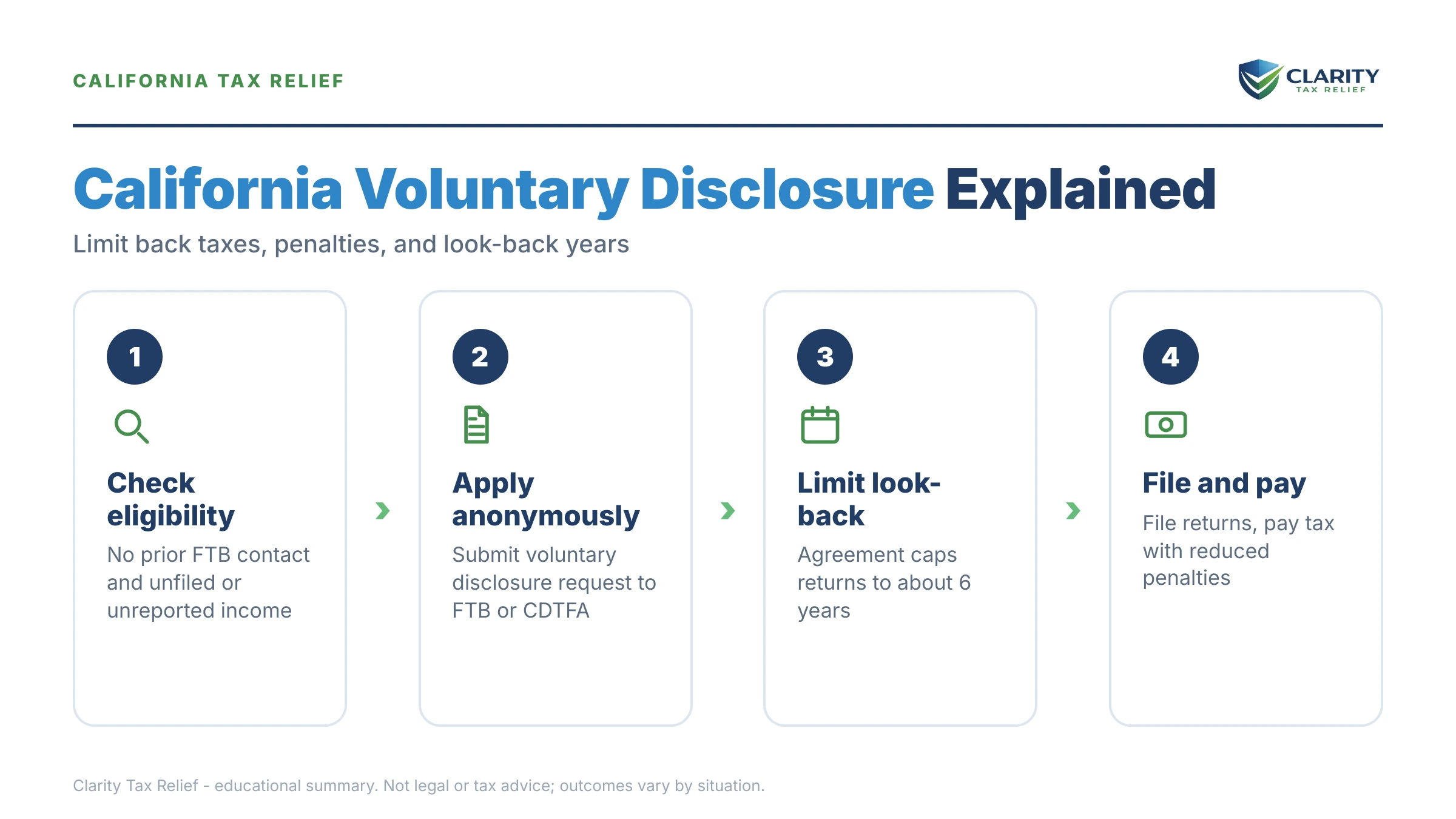
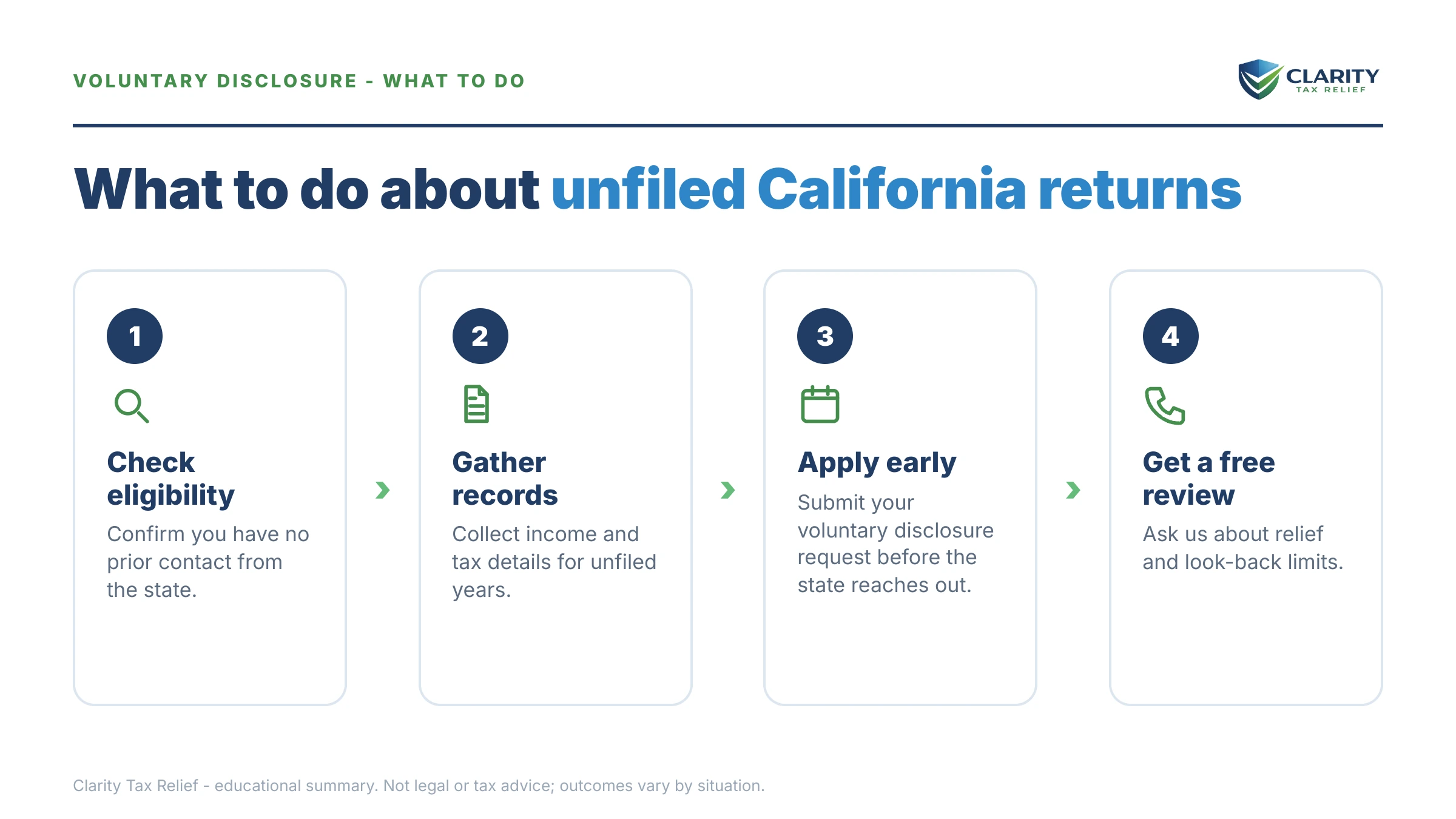
| Voluntary disclosure (FTB / CDTFA) | Non-filers, mainly businesses, who come forward before the state finds them | Limits how many back years are assessed and waives certain penalties |
A few of these deserve a closer look, because they're the closest living relatives of amnesty:
One-time penalty abatement is the newest and most amnesty-like. Since it took effect for tax years 2022 and later, an individual who filed late or paid late can have those timeliness penalties erased once per lifetime — no proof of hardship required, just filing compliance and payment (or a payment arrangement) on the tax itself. Full mechanics are in our FTB penalty abatement guide.
Payment plans don't reduce anything, but they end the escalation sequence above. Setup details, thresholds, and what the FTB asks for are covered in our FTB payment plan walkthrough.
Hardship status is the program retirees on Social Security overlook most. If your monthly income covers only essentials, the FTB can code your account as uncollectible and stop levies. The debt doesn't disappear, but neither does your grocery money. See FTB currently not collectible status for how to request it.
The Offer in Compromise is the only program that reduces the tax itself. The FTB weighs your age, income, and assets, and accepts only when your offer represents the most it could reasonably collect over time. A fixed income and few assets make a stronger case than the ads imply, but it's the state's math, not yours, that decides. Our FTB offer in compromise guide covers the application.
FTB, CDTFA, or EDD: which agency actually holds your debt
"California tax amnesty" searches lump together three separate agencies that never share a case file. Before you can pick a program, you need to know whose letterhead is on your notice:
| Agency | What it collects | Closest thing to amnesty |
|---|---|---|
| Franchise Tax Board (FTB) | Personal and business income tax | One-time penalty abatement, OIC, payment plans, hardship status |
| CDTFA | Sales and use tax, special taxes and fees | Voluntary disclosure (limited lookback, often three years), OIC, payment plans |
| EDD | Payroll taxes — UI, SDI, and PIT withholding | Installment agreements and OIC — no amnesty or lookback relief |
Most readers of this page owe the FTB — start with our California FTB back taxes hub if that's you. Business owners behind on sales tax should read California back sales tax, because CDTFA voluntary disclosure only works before the agency contacts you. Employers with payroll assessments face personal-liability rules covered in California EDD payroll tax.
One more fork in the road: if you owe both California and the IRS, the order you resolve them in changes the outcome — the two systems have different statutes, different garnishment rules, and different settlement math. That decision framework lives in state tax debt vs IRS.
Say you owe the FTB $19,700: a worked example
A clearly hypothetical scenario, with the math shown. Say you're 71, living on Social Security, and in 2023 you pulled money from an IRA to replace a roof. California taxed the withdrawal (unlike your Social Security, which California doesn't tax), you filed that return a year late, and today's FTB notice reads $19,700 — roughly $14,000 in tax, $3,500 in late-filing and late-payment penalties, and $2,200 in interest.
Here's how the real programs change that number:
- One-time penalty abatement first. Tax year 2023 qualifies (it's 2022 or later). If you've filed everything and never used the abatement, removing the $3,500 in timeliness penalties drops the balance to about $16,200 — before you've negotiated anything.
- Then a payment plan. $16,200 spread over 60 months is $270/month before continuing interest — versus roughly $328/month on the full $19,700. Enforced collection stops while the plan is active.
- If $270/month isn't survivable: a Social Security check of, say, $1,900/month that barely covers rent, food, and medicine is exactly what hardship status exists for — collection pauses while your situation is reviewed periodically.
- If it will never be payable: with no significant assets beyond modest home equity and no realistic future income growth, an FTB Offer in Compromise may settle the account for what the state could actually collect — an amount its analysts calculate from your finances, not a percentage anyone can promise in advance.
That sequencing — penalties off first, then match the remaining balance to your real capacity — is the closest thing to "amnesty" California offers, and it's available every day of the year.
How to respond, step by step
- Identify which agency you owe. Pull every California notice you've received and check the letterhead — Franchise Tax Board (income tax), CDTFA (sales and use tax), or EDD (payroll tax). Each agency keeps separate balances and runs separate programs.
- File every missing California return. No FTB relief — abatement, payment plan, OIC, or hardship status — gets approved while required returns are unfiled. Filing also stops the late-filing penalty, which caps at 25% of the tax, from growing further.
- Request one-time penalty abatement if it fits. If your balance includes late-filing or late-payment penalties for tax year 2022 or later and you've never used it, ask the FTB for one-time abatement before negotiating anything else — it can shrink the debt you then have to resolve.
- Resolve the remaining balance. Set up a payment plan, request hardship status, or evaluate an Offer in Compromise — whichever your income and assets genuinely support. Any of the three stops enforced collection while it's in place.
- Get a professional review before signing financial disclosures. FTB Form 3561 tells the state everything about your finances, and what you disclose shapes every option afterward. Have an experienced tax professional look at your numbers first — the free review costs nothing.
When you can handle this yourself
Plenty of California tax debts don't need professional help, and you should know which kind is which. You can likely handle it alone if: the balance is one you can pay off within a few months. It's a single tax year and you agree with the numbers. Or the only relief you need is the one-time penalty abatement for a 2022-or-later year, which is a straightforward request once your returns are filed. Setting up a standard FTB payment plan online is also genuinely simple.
Experienced help changes the outcome when: a bank levy or wage withholding is already in motion. You have multiple unfiled California years (the FTB files estimated assessments for non-filers, and they're almost always too high). You're weighing an Offer in Compromise, where how your finances are presented on Form 3561 largely decides acceptance. You owe both the FTB and the IRS and need the sequencing right. Or the debt involves a business, the CDTFA, or the EDD, where personal liability rules raise the stakes. For the full menu of professional and self-help paths, see California tax debt relief.
Terms you'll see, decoded
- Tax amnesty — a temporary, legislature-authorized window where penalties (never the tax itself) are waived for taxpayers who come forward; California's last general one closed in 2005.
- Voluntary disclosure — a standing program for non-filers who approach the state before it finds them, limiting how many back years get assessed and waiving certain penalties.
- One-time penalty abatement — California's once-per-lifetime removal of late-filing and late-payment penalties for individuals, tax years 2022 and later.
- Offer in Compromise (OIC) — a means-tested settlement where the state accepts less than the full balance because it's the most it could realistically collect.
- Hardship status — an account designation that pauses enforced collection when paying would prevent basic living expenses; the debt itself remains.
- R&TC §19255 — the California statute giving the FTB 20 years to collect a liability, twice the IRS's 10-year window.
Official program pages live at the Franchise Tax Board, the California Department of Tax and Fee Administration, and the Employment Development Department — always confirm a program's current terms with the agency directly.
California tax amnesty questions, answered
Does California have a tax amnesty program in 2026?
No. California has not run a general tax amnesty since 2005, and the Legislature has not authorized a new one for 2026. Companies advertising "California tax amnesty" are usually describing the state's permanent relief programs — penalty abatement, payment plans, Offer in Compromise, and hardship status — which are real but means-tested, not open forgiveness windows.
When was the last California tax amnesty?
The last general amnesty ran for roughly two months in early 2005 and covered tax years 2002 and earlier. Participants paid the tax and interest in full but had penalties waived. A much narrower voluntary-compliance window in 2011 targeted abusive tax shelters and unreported offshore income. Nothing comparable has been offered since, and no new amnesty has been announced.
Does the FTB ever forgive tax penalties?
Yes, in two main ways. The one-time penalty abatement can erase failure-to-file and failure-to-pay penalties for tax years 2022 and later if you have filed all required returns and paid, or arranged to pay — the underlying tax. For older years or other penalties, the FTB considers reasonable-cause relief when circumstances beyond your control, like serious illness, caused the noncompliance.
Does California tax debt expire?
Eventually, but California gives itself 20 years to collect under Revenue and Taxation Code Section 19255, double the IRS's 10-year window. For most people that means outwaiting the FTB is not a realistic strategy; penalties, interest, and collection fees compound the balance for two decades. Certain events can extend the window even further.
Can the FTB garnish my Social Security check?
The FTB cannot attach your monthly Social Security benefit the way the IRS can through the Federal Payment Levy Program. That is a federal power states don't share. However, the FTB can levy bank accounts, and once benefits are deposited you may need to show the funds are exempt. If Social Security is your main income, ask the FTB about hardship status before any levy is issued.
What is the FTB one-time penalty abatement?
It is California's version of first-time penalty relief, available to individuals for tax years 2022 and later. It removes timeliness penalties, failure to file and failure to pay, once per lifetime, provided you have filed all required returns and paid or arranged to pay the tax. It does not reduce the underlying tax or the interest on it, and business entities are not eligible.
Is there amnesty for California sales tax debt?
No standing amnesty, but the CDTFA runs voluntary disclosure programs for businesses that should have registered and collected sales or use tax. Coming forward voluntarily generally limits how many past years the CDTFA will assess and can waive certain penalties. Once the CDTFA finds you first, through an audit or a lead, those benefits are off the table, so timing matters.
Can I settle California tax debt for less than I owe?
Sometimes, through an Offer in Compromise — the FTB, CDTFA, and EDD each run one. Approval turns on ability to pay: the agency looks at your income, assets, and age, and accepts only when the offer represents the most it can reasonably expect to collect. Fixed-income retirees with no significant assets can be genuine candidates, but nothing is automatic, and no outcome is guaranteed.
Your next 24 hours
- Find your most recent California notice and note three things: the agency name on the letterhead, the tax year. The total balance — that determines which programs are even on the table.
- Gather your last filed California return, every notice you've received. Your income picture — Social Security statement (SSA-1099), pension or IRA statements, and bank balances. Every relief program starts with these documents.
- Get a free case review. Since no amnesty is coming and interest accrues on the balance every month, the cheapest day to start is today. Use the 2-minute form or call (888) 825-7779 — an experienced tax professional will tell you which California program your numbers actually support.
This guide is general information, not tax or legal advice for your specific situation. Eligibility for IRS programs depends on individual facts and circumstances; no outcome is guaranteed. Eligibility for California FTB, CDTFA, and EDD programs is likewise determined by each agency based on individual facts.