
California FTB
CA Form 5805: California's Underpayment of Estimated Tax Penalty, the Safe Harbor and the Waiver
What this episode covers
- How does California's estimated tax payment schedule differ from the IRS schedule?
- How is the California underpayment of estimated tax penalty calculated?
- Does California's one-time penalty abatement cover the estimated tax penalty?
- What is the annualized income method on California Form 5805?
The short answer: CA Form 5805, Underpayment of Estimated Tax by Individuals and Fiduciaries, is the Franchise Tax Board form that figures California's underpayment of estimated tax penalty. The penalty is an interest-style charge added when your withholding and estimated payments fall short of the state's 30%/40%/0%/30% installment schedule. The FTB's own description of the math: "The number of days late is first determined, then multiplied by the effective interest rate for the installment period." Most people never fill the form out, because the FTB computes the penalty and bills it. You complete Form 5805 yourself only to request a waiver or to use the annualized income method, and the penalty is not covered by California's one-time penalty abatement.
You spotted it on your California return, or on an FTB notice: a line labeled "underpayment of estimated tax," adding hundreds or thousands to a balance you were already bracing for. The good news is that this penalty follows exact, published math. It can be checked, sometimes recomputed lower, occasionally waived. The balance behind it can be resolved before it ever reaches a lien or a lender's file.
Two things make California's version different from the IRS penalty most articles describe. One is the state's lopsided 30/40/0/30 payment schedule. The other is that California's one-time penalty abatement does not reach it. This guide covers what Form 5805 is, who has to file it, the payment schedule, the safe harbors, how the penalty is computed, and the two ways the form itself can lower the number. Figures and dates were checked against ftb.ca.gov on October 5, 2026.
⏱ The clock on this penalty: the underpayment penalty stops growing at the return's original due date, but any balance left unpaid after that starts a separate late-payment penalty, in the FTB's words "5% of the unpaid tax (underpayment), and 0.5% of the unpaid tax for each month or part of the month it's unpaid not to exceed 40 months," plus interest. If the FTB bills the penalty after you file, it says you "must pay the penalty within 15 days of the billing to avoid additional interest charges."
What is CA Form 5805?
Form FTB 5805 is California's Underpayment of Estimated Tax by Individuals and Fiduciaries. The FTB's instructions describe its job in one sentence: use it "to see if you owe a penalty for underpaying your estimated tax and, if you do, to figure the amount of the penalty." It is the state counterpart of IRS Form 2210, and it is attached to Form 540, Form 540NR or Form 541 rather than filed on its own. The 2025 version, the one you file with a 2025 return in 2026, has four sides.
Side 1 is Part I, four yes-or-no questions that decide whether you have to attach the form at all: whether you are requesting a waiver, whether you are using the annualized income method, whether your withholding was uneven, and whether you are an estate or trust. Side 2 is Part II, which computes your required annual payment and, under the short method, the penalty. Sides 3 and 4 hold Part III, the annualized income installment schedule, and Worksheet II, the regular method that figures the penalty installment by installment. The penalty total lands on Form 540 line 113, Form 540NR line 123 or Form 541 line 45, with a box checked beside it.
Who must file Form 5805 in California?
Almost nobody has to. The instructions say so directly: "Generally, you do not have to complete this form. If you owe a penalty, the Franchise Tax Board (FTB) figures the penalty for you and sends you a bill after you have filed your tax return. You must pay the penalty within 15 days of the billing to avoid additional interest charges." You attach the form only when you answer "Yes" to a question in Part I, which in practice means one of three things: you are requesting a waiver of the penalty, you are using the annualized income installment method, or your California withholding came out unevenly and you want it credited on the dates it was actually withheld. Estates and trusts answering "Yes" to Question 4 complete Part I only. Exempt trusts use Form 5806, the corporate version.
Whether you owe the penalty is a separate question from whether you file the form. You are subject to it when you were required to make estimated payments and an installment was missed, late or short. If none of the Part I questions apply to you, leave the form off and let the FTB bill it; filing a 5805 that only confirms the FTB's own math gains nothing.
Why did you get the California underpayment penalty?
The FTB charges the penalty when, for an estimated tax installment, you "did not pay, paid late, [or] underpaid," even if you paid every dollar of tax by the filing deadline. The requirement to pay estimates at all kicks in when you expect to owe at least $500 in California tax after withholding ($250 if married/RDP filing separately). The Form 5805 instructions add the mirror-image relief: "If in the prior year your tax liability, less any credits for the prior year, was less than $500 ($250 for married/RDP filing separately) you are not subject to the underpayment of estimated tax penalty."
The usual sources: self-employment or 1099 income with no withholding, a stock or crypto sale, rental income, a home sale with capital gains, RSU vesting where the default withholding was too low, or a first year of business income. The penalty is authorized by Revenue and Taxation Code section 19136, which largely mirrors the federal rule; the payment schedule it enforces does not. You see it one of two ways: as an amount on Form 5805 attached to your return, or, if the FTB runs the math, as a bill after you file. It is not an audit and nobody is questioning your income. It is a mechanical charge for paying the right amount at the wrong times.
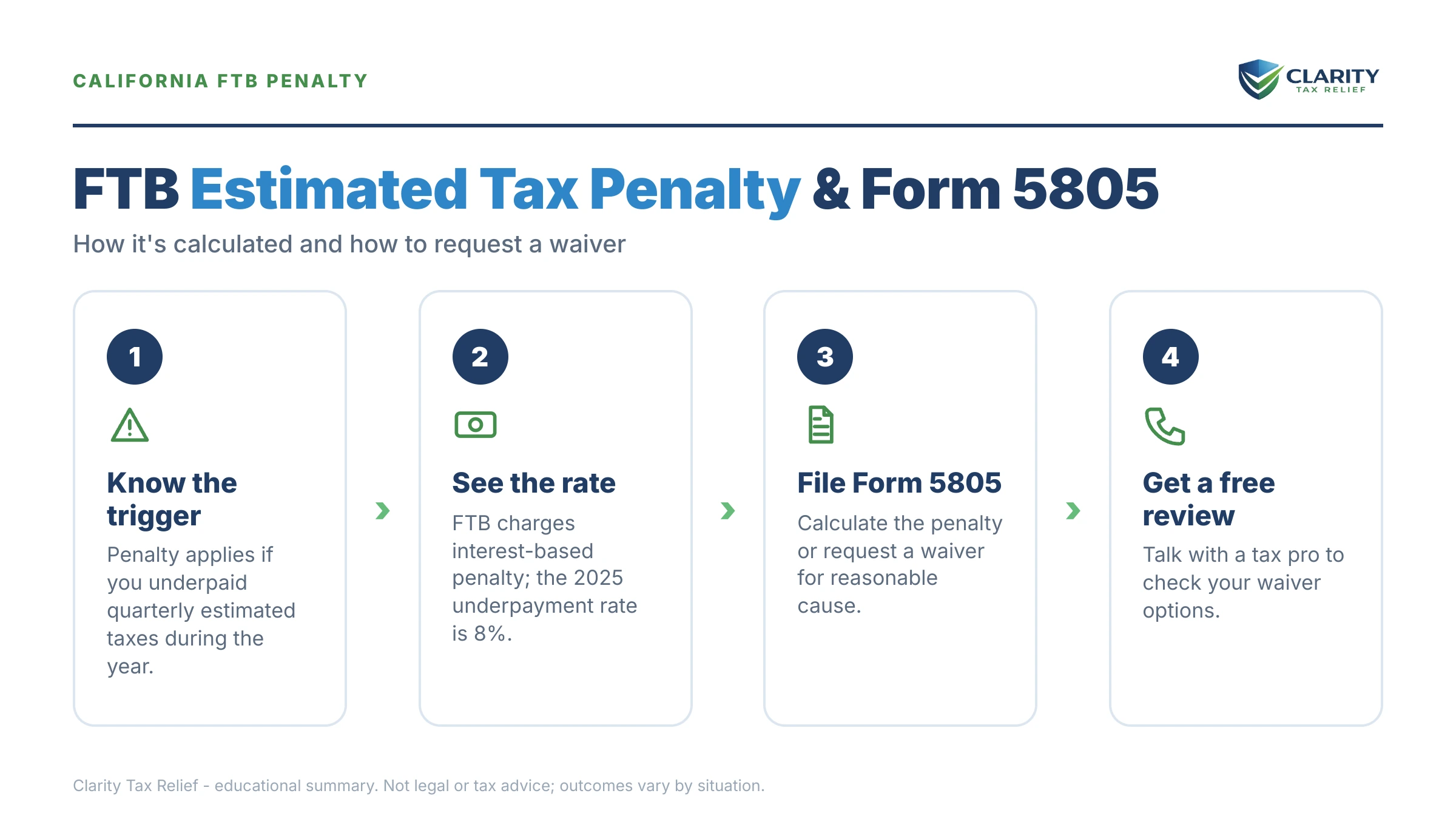
What is the California estimated tax payment schedule? 30/40/0/30
California front-loads estimated taxes. Seventy percent of your required annual payment is due by June 15, 30% in April and 40% in June, with nothing due in September. The FTB states it plainly: "Your tax payments are due in 4 payments. California differs from federal." This is the single biggest reason people who dutifully pay four equal quarterlies still get the penalty: the even federal schedule underpays California's first two installments.
| Installment | Due date | California (FTB) share | IRS share |
|---|---|---|---|
| 1 | April 15, 2026 | 30% | 25% |
| 2 | June 15, 2026 | 40% | 25% |
| 3 | September 15, 2026 | 0% | 25% |
| 4 | January 15, 2027 | 30% | 25% |
Farmers and fishermen (at least two-thirds of gross income from farming or fishing) are on a different schedule entirely: one installment, due January 15, and no penalty at all if the return is filed and the whole tax paid by March 1. They use Form 5805F, covered below.
How is the CA underpayment penalty calculated?
The penalty behaves like interest rather than a flat charge. The FTB's description: "We calculate the penalty on the unpaid amount from one of these (whichever is earlier): The due date of the estimated tax installment to the date we receive your payment [or] The due date of the tax return... The number of days late is first determined, then multiplied by the effective interest rate for the installment period." There is no flat percentage. Time is the whole game. The statute is Revenue and Taxation Code section 19136.
The rate is not fixed. The FTB resets it twice a year and publishes current and past rates. For July 1 through December 31, 2026 the estimate penalty rate is 7%. It was 7% for the twelve months ending June 30, 2026 and 8% for the first half of 2025, so a 2025 underpayment that ran from April 2025 to April 2026 crossed two rate periods.
| Period | Estimate penalty rate |
|---|---|
| July 1, 2026 to December 31, 2026 | 7% |
| July 1, 2025 to June 30, 2026 | 7% |
| January 1, 2025 to June 30, 2025 | 8% |
| July 1, 2024 to December 31, 2024 | 8% |
| January 1, 2024 to June 30, 2024 | 7% |
On the form itself, the short method in Part II applies one rate to your total underpayment for the year; the regular method in Worksheet II on Side 4 figures each installment's days late separately. A payment made after an installment date is applied to the oldest underpaid installment first, which the instructions illustrate with a $1,200 June payment of which $500 is swept back to cover an April shortfall.
Withholding gets special treatment: it counts as paid evenly across the year no matter when it actually came out of your check. Estimated payments do not; they count only on the day they arrive. (New to quarterlies entirely? Start with how quarterly estimated taxes work, then come back for California's twist.) One more California-only wrinkle: once you make a single estimated payment over $20,000 or file a return with total tax over $80,000, you fall under FTB mandatory e-pay. A paper check afterward draws a separate 1% penalty.
What is the California estimated tax penalty safe harbor?
Your "required annual payment" is the smaller of two targets, in the FTB's words: "90% of the current year's tax [or] 100% of the prior year's tax (including alternative minimum tax)." Pay that amount on the 30/40/0/30 schedule, through withholding and timely installments, and there is no penalty regardless of what the final return shows. Two income thresholds change the prior-year option, and neither is adjusted for inflation.
If your prior-year California AGI is more than $150,000 ($75,000 married/RDP filing separately), the FTB says "you must base your estimated tax based on the lesser of: 90% of your tax for the current tax year [or] 110% of your tax for the prior tax year." And if your current-year California AGI is $1,000,000 or more ($500,000 filing separately), "You must pay your estimated tax based on 90% of your tax for the current tax year." The prior-year safe harbor disappears entirely under Revenue and Taxation Code section 19136.3, which is brutal in a windfall year you could not predict. The $150,000 rule does not apply to farmers or fishermen.
| Your situation | Required annual payment (the smaller of) | Prior-year option |
|---|---|---|
| Prior-year California AGI of $150,000 or less ($75,000 or less married/RDP filing separately) | 90% of current-year tax, or 100% of prior-year tax including AMT | Available |
| Prior-year California AGI over $150,000 (over $75,000 married/RDP filing separately) | 90% of current-year tax, or 110% of prior-year tax including AMT | Available at 110% |
| Current-year California AGI of $1,000,000 or more ($500,000 or more married/RDP filing separately) | 90% of current-year tax | Not available |
| Farmers and fishermen (two-thirds of gross income from farming or fishing) | One installment by January 15, or file and pay in full by March 1 | The 110% rule does not apply |
| Prior-year tax after credits under $500 ($250 married/RDP filing separately) | Not subject to the penalty | Not needed |
Form 5805 does this arithmetic on Side 2, Part II, lines 1 through 6. Line 5 is where the prior-year figure goes, and the instructions tell million-dollar filers to skip it and enter 90% of the current year instead. If you did not file a California return for the prior year, or that year covered fewer than twelve months, line 5 is also skipped and the current-year figure controls.
California estimated tax penalty calculator: a worked example
Say you are self-employed, your 2025 California tax comes to $83,100 with no withholding, and you paid nothing until filing in April 2026. With no usable prior-year safe harbor, your required annual payment is 90% of $83,100, or $74,790, split 30/40/0/30: $22,437 due April 15, 2025 (underpaid about 12 months), $29,916 due June 15 (about 10 months), nothing in September, and $22,437 due January 15, 2026 (about 3 months).
At an illustrative 8% annual rate that is roughly $1,800 + $1,990 + $440, about $4,200 of penalty on top of the $83,100, before any late-payment penalty or interest if you cannot pay at filing. (The real 2025 rate was 8% through June 30, 2025 and 7% after, so the FTB's bill would come in a little lower.) Flip the scenario: had you paid April and June on time and missed only January, the penalty falls to roughly $443. The first two dates carry almost all of the risk. If you also skipped your federal quarterlies, estimate that side with our IRS Penalty & Interest Calculator, and if the federal balance needs a plan, the IRS payment plan calculator shows the monthly figure.
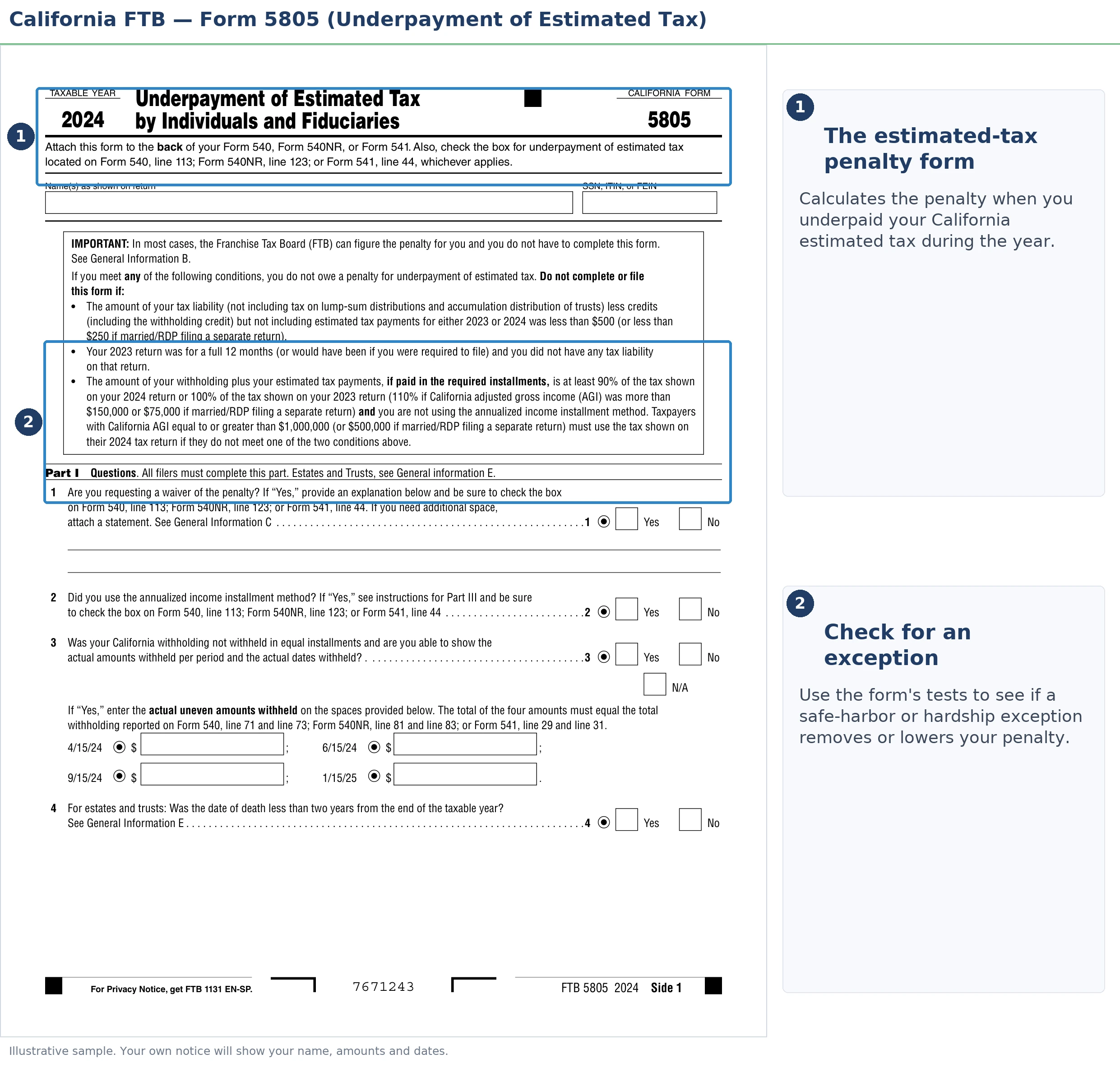
How do you request a waiver on Form 5805, or use the annualized income method?
The two reasons to complete and attach Form 5805 are the two things that can lower the number. Both start with a "Yes" in Part I on Side 1.
The waiver (Part I, Question 1)
The FTB allows a waiver request "if either one of the following apply: You underpaid an estimated tax installment due to a casualty, disaster, or other unusual circumstance and it would be against equity and good conscience to impose the penalty. You retired after age 62 or became disabled in 2024 or 2025 and your underpayment was due to reasonable cause." There is a third, narrower ground in the instructions: the penalty does not apply to the extent an installment was underpaid because of a law change enacted during and effective for that same year.
To request it you check the "Yes" box on Form 5805, Part I, Question 1, explain the reason in the space provided (attach a statement with your name and tax ID if you need more room), complete the form through Part II, line 12 (Worksheet II, line 13 under the regular method) without regard to the waiver, write the amount you want waived in parentheses on the dotted line next to Part II, line 13, subtract it, enter the result on line 13, check the box on Form 540 line 113 (540NR line 123, 541 line 45), and attach the 5805 to the back of the return. Reasonable cause here is tied to the retirement or disability ground; ordinary cash-flow problems, forgetting, and "my preparer never told me" are not on the list.
The annualized income installment method (Part III, Sides 3 and 4)
"If your income varied during the year and you use the annualized income installment method to determine your estimate payment requirements, you must complete form FTB 5805, including Side 3 and Side 4," and attach it with the same box checked. The instructions put the payoff plainly: "you may be able to lower or eliminate the amount of one or more required installments." This is the most underused fix in the area.
If your income landed late in the year, a stock sale in November, a business that booms in the fourth quarter, the method ties each installment to when you actually earned the money instead of assuming it came evenly, and for a windfall after June 15 it can erase most of the penalty on the two heavy early installments. Part III lines 1 through 16 figure the tax on your income as earned in each period, lines 17 through 23 turn that into the required installment, and the form automatically takes the smaller of the annualized figure and the regular one. Two rules: if you annualize for one payment date you must annualize for all four, and Form 540NR filers have an extra worksheet at the end of the Part III instructions. It is tedious arithmetic, and it is free.
Form 5805F for farmers and fishermen
If at least two-thirds of your gross income for the current or prior year came from farming or fishing, you do not use Form 5805 at all. The FTB's rule: "Farmers and fishermen are required to make one estimate payment. For calendar year taxpayers, the due date is January 15, 2026. If you file Form 540, Form 540NR, or Form 541 and pay the entire tax due by March 1, 2026, you do not owe a penalty for underpaying estimated tax." Any penalty that does apply is figured on Form FTB 5805F, Underpayment of Estimated Tax by Farmers and Fishermen, and the 110% high-income rule does not apply to this group.
Can the FTB abate the estimated tax penalty?
Two separate fights hide inside an FTB bill: the estimated tax penalty, and the late-payment penalty and interest on any balance left after the filing deadline. They use different tools. California's one-time penalty abatement (R&TC section 19132.5) does not cover the estimated tax penalty; it applies to late-filing and late-payment penalties. If a firm promises to "abate" this penalty with a clean-history request, it is describing the wrong penalty. The paths that reach the estimated tax penalty are the ones above: the safe harbor (prevention), the annualized recompute, and the Form 5805 waiver.
Our FTB penalty abatement guide maps which California penalties each tool actually reaches, and the estimated tax penalty waiver guide covers the parallel federal Form 2210 exceptions. The late-payment penalty on the underlying balance, by contrast, is the one that one-time abatement or reasonable cause can remove. It is the one that keeps growing: 5% of the unpaid tax plus 0.5% a month for up to 40 months, plus interest, with an FTB collection cost recovery fee added once the account moves into enforcement.
Staring at an FTB estimated tax penalty on top of a balance you can't pay?
Every month it sits, the late-payment penalty and FTB interest stack higher, and a recorded lien can stall a refinance for months. Get your California balance and penalty reviewed free by an experienced tax professional before the FTB's automated collection moves first.
What if you can't pay the balance behind the penalty?
The penalty freezes at the filing deadline. The balance it rides on does not. The FTB is a faster, more automated collector than the IRS. Left alone, the account draws the late-payment penalty and interest, then demand notices and the collection fee, then an FTB tax lien recorded with the county (the item most likely to surface in refinance underwriting), then an Order to Withhold against a bank account or an Earnings Withholding Order against wages, with no court order needed, and California's 20-year collection statute behind all of it. The options: pay in full online at ftb.ca.gov (electronically, if mandatory e-pay applies).
An FTB payment plan, which individuals owing $25,000 or less can request online with up to 60 months to pay and every return filed. A financial disclosure on FTB Form 3561 for larger balances. An FTB offer in compromise when there is no realistic ability to ever pay in full. Or a hardship deferral, which is temporary and reviewed while interest keeps accruing. Whichever you pick, fix the current year at the same time: increase withholding, which counts as paid evenly all year, or start paying this year's 30/40/0/30 installments so next April's return does not repeat the penalty.
Before you call the FTB, run the numbers. Our free California FTB payment plan calculator takes your balance, penalty included, and shows what a monthly installment agreement would look like and roughly how much interest it carries. Try it first; it is the figure the FTB will ask you about.
How to handle a CA Form 5805 penalty, step by step
- Check the math. Compare the installments the FTB says you missed against the payments it credited; MyFTB shows the estimated payments on your account. Withholding counts as paid evenly across the year; estimates count only on the day they arrive.
- Test the safe harbor. If your withholding and timely installments reached 90% of this year's tax or 100% of last year's (110% above $150,000 of prior-year AGI), there is no penalty.
- Decide whether to attach Form 5805. Only if you answer "Yes" in Part I: a waiver request, the annualized income method, or uneven withholding. Otherwise let the FTB bill it.
- Run the annualized method if your income came late in the year. Part III ties each installment to when you earned the money and can lower or eliminate the heavy early installments.
- Request the waiver only on a listed ground. A casualty, disaster or unusual circumstance, or retirement after age 62 or disability with reasonable cause. Explain it in Part I, Question 1 and attach the form.
- Pay the bill within 15 days, or put the balance on a plan. Individuals owing $25,000 or less can request an FTB payment plan online with up to 60 months. Then fix the current year's withholding or installments.
Common CA Form 5805 mistakes
- Paying four equal quarterlies. The federal schedule underpays California's 30% April and 40% June installments even when the yearly total is right.
- Asking for one-time penalty abatement. R&TC 19132.5 reaches late-filing and late-payment penalties, not this one.
- Relying on the prior-year safe harbor at $1 million of AGI. It disappears; only 90% of the current year counts.
- Skipping the annualization worksheet after a late-year windfall. It is tedious arithmetic, and it is free.
- Mailing a paper check after triggering mandatory e-pay. That draws a separate 1% penalty.
Can you handle this yourself, or does help change the outcome?
Most FTB estimated tax penalties are a do-it-yourself fix. If the penalty is a few hundred dollars, the math checks out, and you can pay the balance, pay it. The same if your income was steady and there is no annualization or waiver angle to work, and setting up a payment plan on a balance under $25,000 is an online task most people finish in an evening. Experienced help earns its cost in specific situations: a five-figure balance where Form 3561 disclosure is required and every number you submit shapes your monthly payment.
A windfall year where the annualization worksheet could cut thousands off the penalty but the arithmetic is painful. Multiple years of missed quarterlies (see the penalty math when you didn't pay estimated taxes for how the years stack). A lien already recorded or threatened while a refinance or sale is pending. Or a matching federal balance, where the order you resolve the two debts changes your total cost. If the FTB has already issued a levy or garnishment, get help the same week; releases are possible but timing-sensitive. Our pricing page lists the investigation fee ($495 for individuals, $695 for businesses) and what it covers, and this cost comparison explains how firms in this industry charge so you can judge any quote.
Terms on your notice, decoded
- Form FTB 5805: the California form that computes the underpayment penalty installment by installment. The only place to request the waiver or use the annualized method. Its farmer and fisherman cousin is Form 5805F.
- Safe harbor: the payment target (90% of this year or 100%/110% of last year) that, if met on schedule, makes the penalty disappear entirely.
- Underpayment period: the days between an installment's due date and the day you paid it, or the return's due date, whichever is earlier. The penalty is interest for exactly this window.
- One-time penalty abatement: California's clean-record relief under R&TC section 19132.5 for late-filing and late-payment penalties; it does not reach the estimated tax penalty.
CA Form 5805 FAQs
What is CA Form 5805?
Form FTB 5805, Underpayment of Estimated Tax by Individuals and Fiduciaries, is the California form used to see whether you owe the underpayment of estimated tax penalty and, if so, to figure the amount. It is the state counterpart of IRS Form 2210 and attaches to Form 540, 540NR or 541. Side 1 holds the Part I questions, Side 2 computes the required annual payment and the short-method penalty, and Sides 3 and 4 carry the annualized income schedule and the regular-method worksheet.
Who must file Form 5805 in California?
Generally nobody. The FTB says it figures the penalty for you and sends a bill after you file, payable within 15 days of the billing to avoid additional interest. You complete and attach Form 5805 only if you answer "Yes" to a Part I question: you are requesting a waiver (Question 1), using the annualized income installment method (Sides 3 and 4), or showing that your withholding was uneven. In each case you also check the box on Form 540 line 113, Form 540NR line 123 or Form 541 line 45.
What is the California estimated tax payment schedule?
California front-loads its installments: 30% of the required annual payment is due April 15, 40% by June 15, nothing on September 15, and the final 30% by January 15 of the following year, so 70% is due by mid-June. For tax year 2026 the dates are April 15, 2026, June 15, 2026, September 15, 2026 and January 15, 2027. The FTB's own page notes that California differs from federal, and taxpayers who copy the IRS's even 25% quarterly schedule underpay the first two California installments even though they paid the same yearly total.
What is the safe harbor for California estimated tax payments?
You avoid the penalty by paying, through withholding and timely installments, the smaller of 90% of your current-year California tax or 100% of your prior-year tax, including alternative minimum tax. If your prior-year California AGI was more than $150,000 ($75,000 married/RDP filing separately), the prior-year target rises to 110%. If your current-year AGI is $1,000,000 or more ($500,000 filing separately), the prior-year option disappears and you must pay 90% of the current year's tax.
How is the California tax penalty for underpayment calculated?
Installment by installment. For each underpaid installment the FTB counts the days from its due date to the date it received your payment or the due date of the return, whichever is earlier, and multiplies the unpaid amount by the effective interest rate for that period. There is no flat percentage. The estimate penalty rate is 7% for July 1 through December 31, 2026. Withholding counts as paid evenly through the year; estimated payments count on the day they arrive.
How do I request a waiver of the penalty on Form 5805?
Check the "Yes" box on Form 5805, Part I, Question 1 and explain the reason in the space provided, attaching a statement if you need more room. The FTB allows the waiver only if the underpayment was due to a casualty, disaster or other unusual circumstance and imposing the penalty would be against equity and good conscience, or if you retired after age 62 or became disabled in 2024 or 2025 and the underpayment was due to reasonable cause. Figure the penalty without regard to the waiver, write the amount waived in parentheses beside Part II, line 13, subtract it, check the box on Form 540 line 113 or 540NR line 123, and attach the form. California's one-time penalty abatement does not reach this penalty.
What is the annualized income method on Form 5805?
Part III on Sides 3 and 4 lets you figure each installment from the income you actually earned in that period instead of assuming it arrived evenly. If your income came late in the year, it can lower or eliminate the required amount for the early installments and the penalty on them. You must use it for all four payment dates if you use it for one, attach the form and check the box on Form 540 line 113 or 540NR line 123. Farmers and fishermen use Form 5805F instead and owe no penalty if they file and pay in full by March 1.
How do I avoid the FTB estimated tax penalty next year?
Hit a safe harbor early. The most reliable fix is withholding, because California treats withheld tax as paid evenly across the year no matter when it comes out. A December withholding increase can cure the whole year. If you cannot add withholding, calendar the 30/40/0/30 installment dates and pay 100% (or 110%) of last year's tax on that schedule, using the Form 540-ES vouchers or Web Pay.
The bottom line on CA Form 5805
California's underpayment penalty is interest for paying the right amount at the wrong times, on a 30/40/0/30 schedule that four equal quarterlies will miss. The FTB computes and bills it; you complete Form 5805 only to request a waiver or to annualize uneven income, and the state's one-time abatement does not reach it. Meet the safe harbor through withholding and on-time installments and the penalty never appears. If a balance is left, it keeps growing after the filing deadline, so pay it or get it on a plan.
Your next 24 hours
- Find the penalty figure. Pull the Form 5805 attached to your return, or your FTB bill, and note the penalty amount, the installments it says you missed and the payments the FTB actually credited; MyFTB shows the estimated payments on your account.
- Gather your evidence. Your last two California returns, proof of every estimated payment and withholding, and, if your income was uneven, a rough quarter-by-quarter income breakdown. That is everything a waiver or annualization case is built from.
- Get the free case review. Send us the notice and the numbers at the 2-minute form or call (888) 825-7779. Interest and the late-payment penalty accrue on the balance every month it sits, and resolving it before a refinance is far easier than after a lien hits the county record.
Primary sources: the Franchise Tax Board's estimated tax payments page (who must pay, the safe harbor and the 30/40/0/30 schedule), its common penalties and fees page (how the estimated tax and late-payment penalties are computed), its interest and estimate penalty rates table, and the 2025 Instructions for Form FTB 5805 (who must file, the waiver, the annualized method and Form 5805F). All four were checked on October 5, 2026.
This guide is general information, not tax or legal advice for your specific situation. Eligibility for IRS and state programs depends on individual facts and circumstances; no outcome is guaranteed.