
IRS Forms
1040 EZ Form: Is It Still Used, and What to File Instead in 2026
The short answer: the 1040 EZ is gone. The IRS discontinued it after tax year 2017, so there is no 2025 1040EZ and there will not be a 2026 one. For 2018 and later, everyone files Form 1040 (or Form 1040-SR at 65 or older). The IRS still publishes the 2015, 2016 and 2017 revisions of Form 1040-EZ, and the only people who need one today are late filers closing out those years.
You went looking for the short form you remember and it has vanished from every software menu. Maybe you dug out an old W-2, maybe a lender or a state letter forced the question about a year you never filed. Either way, the form was retired. Your filing obligation was not. This guide covers what replaced the EZ, how to file a simple return today, where the old 2015 to 2017 forms live, and what to do if one of those years is still open.
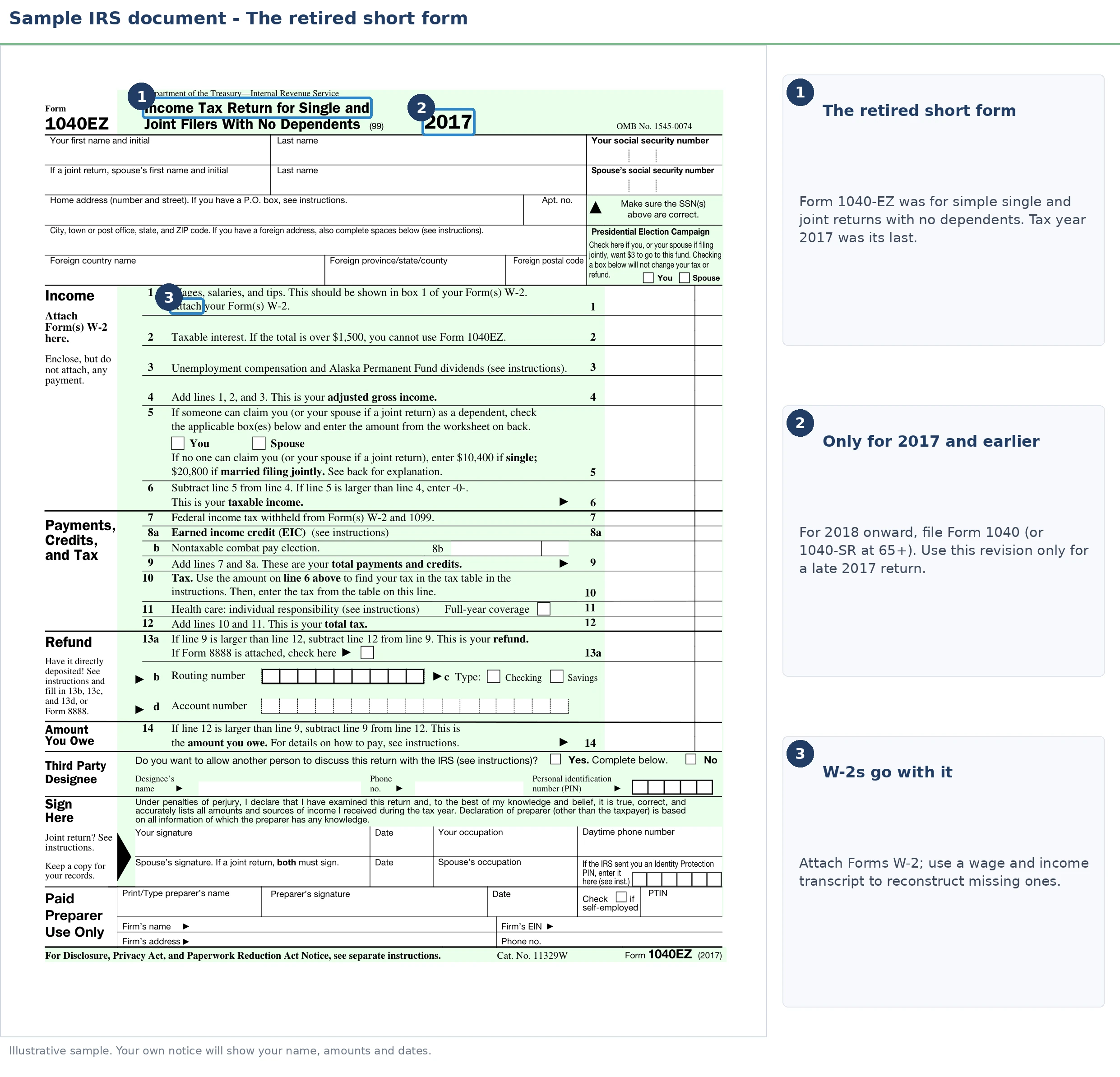
If you found a blank 1040-EZ in a drawer and are not sure it is even the right document, the image below shows what the retired short form looks like, so you can confirm the tax year printed on it before you fill in a single line.
⏱ The honest clock: there is no fresh deadline on a 2015 to 2017 return, because the major clocks already ran. The refund window for those years is closed, the failure-to-file penalty on any balance has typically hit its 25% cap, and interest keeps accruing daily until the return is filed and the tax is paid.
Is the 1040 EZ still used?
No. The IRS's own page for the form says that for tax year 2018 and later you will no longer use Form 1040-EZ, and will use Form 1040 or Form 1040-SR instead. Tax software does not offer the EZ for recent years because it cannot. The last year it was valid for was 2017.
The EZ was the short form for the simplest returns: wage income, no dependents, standard deduction, a signature, done. The 2018 redesign folded that simplicity into the main Form 1040 itself. A simple return today is a Form 1040 with no schedules attached, which is roughly what the EZ was all along.
So why does the IRS still publish it? For late filers. The IRS keeps the 2015, 2016 and 2017 revisions of Form 1040-EZ and their instructions available because an old tax year must be filed on that year's form. That is probably the situation that brought you here.
Is there a 2025 1040EZ?
No. A 2025 tax return (the one due in April 2026) goes on the 2025 Form 1040 or Form 1040-SR. Searches for "2025 1040ez" and "federal 1040ez" are common because people remember the name, but no federal short form has existed for eight filing seasons. If a website offers you a "2025 1040EZ," it is either mislabeling the regular Form 1040 or it is not an IRS form at all. Some states still run their own short forms for state income tax, which is a separate return from the federal one.
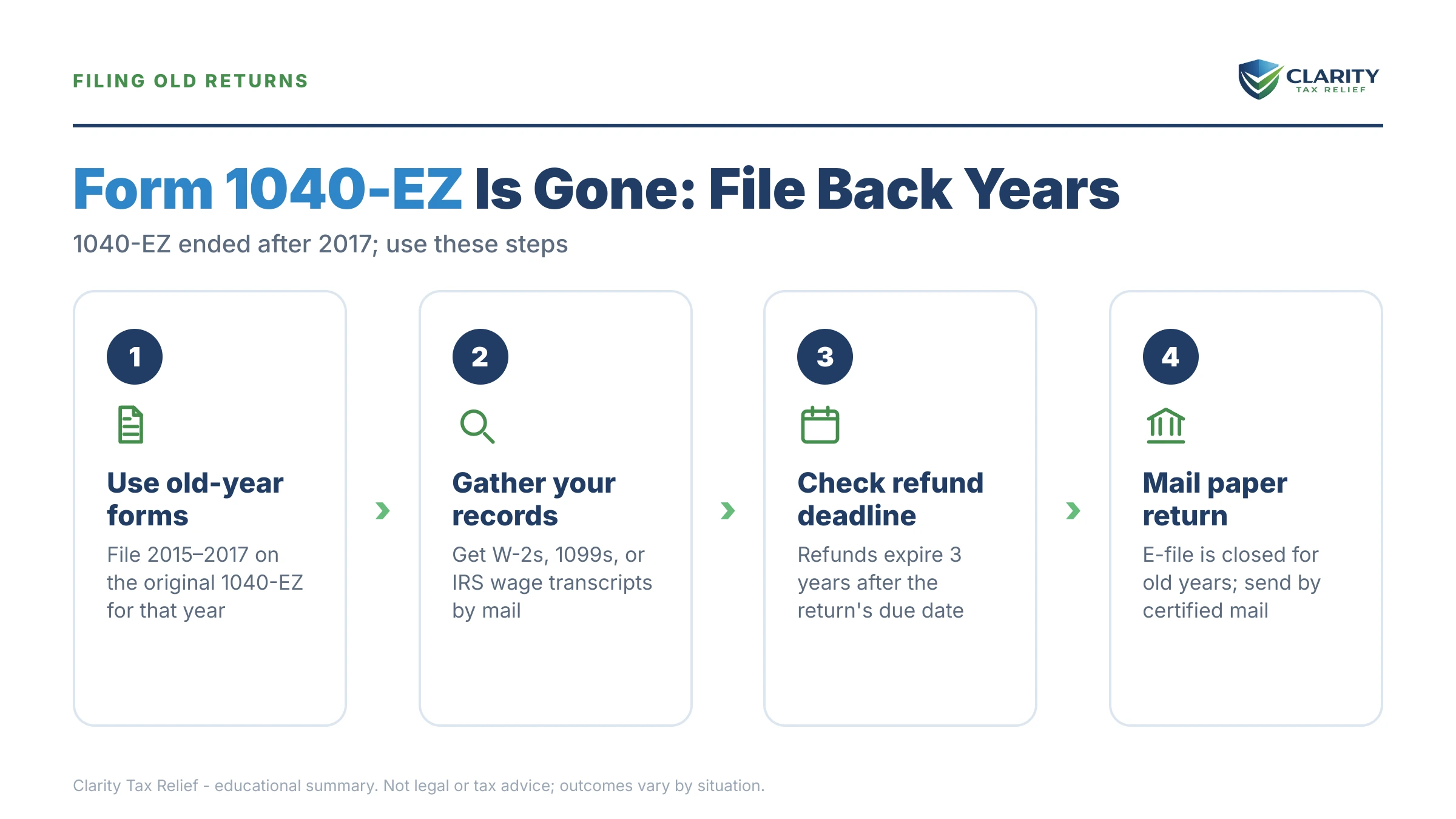
What replaced the 1040 EZ?
Two forms took its place. Form 1040 is the single return every individual files for 2018 and later. Form 1040-SR is, in the IRS's words, an optional alternative to Form 1040 for taxpayers who are age 65 or older; it has larger print and the same schedules and instructions. The numbered schedules (1, 2 and 3) only attach when you have additional income, adjustments, extra taxes or credits to report. A W-2-only filer taking the standard deduction attaches none of them.
You must file an old tax year on that year's form revision. A 2017 return goes on the 2017 form with the 2017 tax table, never the current one. A 2017 return typed onto a 2026 Form 1040 will be rejected or badly mis-processed, because the tax law changed between those forms.
| Tax year | Form to file | Where it stands in October 2026 |
|---|---|---|
| 2015, 2016, or 2017 | That year's Form 1040-EZ revision, or that year's full Form 1040 if the EZ did not fit your situation | Both are still published on IRS.gov. Paper filing; use that year's instructions and tax table. |
| 2018 through 2024 | That year's Form 1040 (or Form 1040-SR at 65 or older) | The EZ does not exist for these years, even for the simplest return. Prior-year revisions are on IRS.gov. |
| 2025 (was due April 2026) | 2025 Form 1040 or Form 1040-SR | There is no 2025 1040EZ. If you have not filed yet, file now; the failure-to-file penalty grows monthly. |
| 2026 (files in 2027) | Form 1040 or Form 1040-SR | The current return, e-fileable, and what tax software prepares by default. |
| Any year you already filed but got wrong | Form 1040-X | Amendments do not use the EZ either. See our Form 1040-X guide. |
One nuance for 2015 to 2017: the EZ is optional, never required. If that year you were single or married filing jointly with only wage income and no dependents, the EZ works. If you had self-employment income, dependents, itemized deductions, or credits worth claiming, use that year's full Form 1040 instead. A 1099 side gig in 2017 never fit on the EZ, and skipping the self-employment schedules also skips the Social Security earnings credit that filing would give you.
How to file a simple return now that the 1040 EZ is gone
A simple return is just as cheap to file as it was in the EZ days, and usually easier. Form 1040 with no schedules takes most wage earners well under an hour in software. The IRS lists these routes on its How to File page, and all of the free ones are run or vetted by the IRS itself.
| Option | Who it is for | Cost |
|---|---|---|
| IRS Free File guided software | Adjusted gross income of $89,000 or less | Free. Brand-name software prepares and e-files the return; some partners include a state return. |
| Free File Fillable Forms | Any income level | Free. Electronic versions of the paper forms with limited calculations and no state filing. Closest thing to the old EZ experience. |
| VITA / TCE free tax help | Income of $69,000 or less, people with disabilities, taxpayers 60 or older, or those who need language support | Free, in person, prepared by IRS-certified volunteers. |
| Commercial tax software | Anyone | Varies by vendor; many have a free tier for a schedule-free Form 1040. |
| Paper Form 1040 by mail | Anyone, and the only route for most old years | Free, but slower to process and no e-file confirmation. |
If your only problem is a current-year return you have not gotten around to, pick a row above and file it this week. The rest of this guide is for the harder case: a 2015 to 2017 year, or any year, that was never filed at all.
How do you get an old 1040 EZ for 2017 and earlier?
Go to the prior-year forms and instructions section of IRS.gov. The IRS's About Form 1040-EZ page links the 2015, 2016 and 2017 revisions directly, and the prior-year search lets you pull each year's instruction booklet. Download the form and the instructions for the same year; the booklet holds that year's tax table and the mailing address for your state, and neither has been the same from one year to the next.
Years before 2015 are also in that search, though the IRS only highlights the last three EZ revisions. For an older year, or for any year with 1099 income, use that year's full Form 1040 and its instructions instead.
What happens if you never file that 2017 return?
An unfiled tax year never expires. The 10-year collection statute does not start running until a tax is assessed, and nothing gets assessed until you file or the IRS files for you. Ignoring an old year does not age it out. It hands the IRS the pen. The sequence runs in this order:
- CP59. The IRS's first "we have no return on file" letter, asking you to file or explain. See our CP59 notice guide.
- CP516 / CP518. Escalating requests; CP518 is the final reminder before the IRS acts without you.
- Substitute for Return (SFR). The IRS prepares the year itself using only the W-2s and 1099s it has. Its own page warns this return might not give you credit for deductions and exemptions you are entitled to. It is almost always the most expensive version of your return; details in IRS filed a substitute return.
- CP2566 / CP3219N. The proposed assessment, then a statutory Notice of Deficiency giving you 90 days to contest in Tax Court. Do nothing and the SFR amount becomes a legal debt. See the CP3219N notice.
- Collections. Once assessed, the inflated balance enters the normal collection stream: a CP14 balance-due notice, then levy-track notices, then enforcement. Only now does the 10-year collection clock finally start, on the SFR's number, not yours.
The fix at any stage before assessment is the same: file the real return. Filing your own accurate return, even years late, replaces the IRS's worst-case math with yours, and for a simple wage year the difference is often the entire balance.
Digging out of a 2017 (or older) unfiled year?
Interest accrues daily on any old balance, and an IRS-prepared substitute return is usually the most expensive version of your year. Get a free review of exactly which years are open, what the IRS already has on file, and the cheapest order to fix it. Call (888) 825-7779 or use the 2-minute form.
What does filing a 2015 to 2017 return late in 2026 cost, and what do you get?
A late 2015 to 2017 return can no longer produce a refund, but it can still stop penalties from attaching to a phantom balance and close the year for good. Here is the practical rulebook for an old year, in one place:
| Question | The answer in October 2026 |
|---|---|
| Which form revision? | That exact tax year's Form 1040-EZ (or full 1040), with that year's instructions and tax table. |
| Where do I get it? | Free from the prior-year forms area of IRS.gov. The 2015, 2016 and 2017 revisions are still published. |
| Can I e-file it? | Not through consumer software, which only carries recent years. Old years are filed on paper, mailed to the address in that year's instructions. |
| Refund from that year? | Forfeited. The IRS says you must file to claim a refund within 3 years of the return due date, and that window closed for all of 2015 to 2017. See can I still get a refund from 3 years ago. |
| Penalties if I owe? | Failure-to-file (5% per month, capped at 25%) plus failure-to-pay (0.5% per month, capped at 25%), both fully accrued on a 2017 balance, plus daily interest. |
| Penalties if I don't owe? | $0. Both penalties are percentages of unpaid tax. If withholding covered you, filing late costs nothing but the lost refund. |
| My records are gone? | The IRS kept copies. A wage and income transcript lists the W-2 and 1099 forms filed under your SSN, for the current year and nine prior years. |
| Interest rate? | Resets quarterly. For July through September 2026 the IRS underpayment rate was 7%, and it accrues daily on tax plus penalties until paid. |
How many years do you actually have to file? The IRS's general enforcement practice asks non-filers for the most recent six years of returns, though it can require more when larger amounts or business income are involved. The full picture is in how many years of back taxes you have to file. If you are behind on several years, our guide to voluntarily filing old tax returns covers the order that costs least.
Do not forget the state side. States run their own forms, their own deadlines, and their own collection clocks. California's FTB, for example, can collect for 20 years, twice the IRS window. If you lived in a state with an income tax in 2017, that year likely needs a state return on that state's old form too.
A worked example: $2,900 owed on a 2017 return filed in 2026
Say your reconstructed 2017 return shows $2,900 of tax and your withholding covered none of it. Here is the math, clearly hypothetical:
- Failure-to-file penalty: 5% of the unpaid tax per month, capped at 25%. That cap was hit long ago. 25% × $2,900 = $725.
- Failure-to-pay penalty: 0.5% per month up to its own 25% cap, also fully accrued by now, so up to another $725. In the months when both penalties ran at once, the IRS reduces the filing penalty by the 0.5% payment penalty, so the combined total lands a little under 50% of the tax. The mechanics are in failure-to-file vs. failure-to-pay penalty.
- Interest: accrues daily on tax plus penalties at a rate that resets every quarter (7% for the third quarter of 2026). The IRS computes the exact figure when your return posts. You can estimate it with our IRS penalty and interest calculator.
Ballpark: roughly $4,300 in tax and penalties before interest, and somewhere in the range of $5,500 to $6,000 once eight-plus years of interest lands, depending on the quarterly rates. Painful, but fixed and finite once filed. A payment plan can spread it monthly, and the IRS drops the failure-to-pay rate to 0.25% per month while an approved plan is in place for a return that was filed on time. Run the numbers with our IRS payment plan calculator to see what a monthly amount would look like.
Now flip the scenario: if your 2017 W-2 withholding actually covered the full $2,900, there is no unpaid tax. Both penalties compute to $0, and your only real loss is the refund the three-year rule already forfeited. That is why pulling your transcript before panicking is step one. Many EZ-era filers were over-withheld and owe nothing.
How to file an old 1040-EZ-era return, step by step
- Confirm which years are actually unfiled. Log into your IRS online account or request account transcripts. The IRS's records, not your memory, decide what is missing and whether the IRS already assessed anything for you. If a transcript is full of codes you do not recognize, our IRS transcript code guide decodes them.
- Pull your income records for that year. Request a wage and income transcript through your IRS online account or with Form 4506-T (check the box on line 8). It lists the W-2 and 1099 forms the IRS received under your Social Security number for that year.
- Download that year's form and instructions. Get the 2015, 2016, or 2017 revision of Form 1040-EZ, or that year's full Form 1040 if the short form did not fit your situation, from the prior-year forms section of IRS.gov.
- Complete the return, sign it, and mail it. Use that year's tax table, sign in ink, mail it to the address in that year's instructions, and keep proof of mailing plus a full copy.
- Deal with any balance before the notices start. Pay what you can at IRS.gov/payments, then set up a payment plan or look into penalty relief. Filing first is what stops the largest penalty from growing.
For step 2, our guides to Form 4506-T and the IRS wage and income transcript walk through the request line by line. The transcript is the single most useful document in an old-year filing. It is the same data the IRS would use to build a substitute return against you. If you would rather call the IRS than use the online account, budget real time: our 188-call hold time study measured how long that wait actually runs.
Common mistakes with an old 1040-EZ-era return
- Typing a 2017 return onto a current Form 1040. An old year goes on that year's revision with that year's tax table, or it is rejected or mis-processed.
- Using the EZ for a year with 1099 income. A side gig never fit on the short form. Use that year's full Form 1040 with the self-employment schedules.
- Assuming an unfiled year ages out. The 10-year collection clock does not start until something is assessed, and nothing is assessed until you file or the IRS files for you.
- Filing before pulling the wage and income transcript. The transcript shows what the IRS already has and whether withholding covered you. Many EZ-era filers owe nothing.
- Forgetting the state return. States run their own forms and clocks; California's FTB can collect for 20 years.
Can you handle this yourself, or does help change the outcome?
A single old year of plain W-2 income is one of the most DIY-friendly problems in tax. If your wage and income transcript shows one or two W-2s, no 1099s, and your withholding looks close to covering the tax, you can download the 2017 revision, copy the numbers over, and mail it in an afternoon. If a small balance results, setting up a payment plan online is straightforward.
Experienced help changes the outcome in specific situations: the IRS already filed a substitute return (your accurate return now has to displace an existing assessment, and collections may already be moving); multiple unfiled years stacked together; 1099 or self-employment income in the old year (the EZ never applied, you need that year's full 1040 with self-employment schedules, and the math has traps); or a balance large enough that the resolution strategy matters as much as the return itself. If money is tight, a Low Income Taxpayer Clinic may represent you for free. If you are weighing a paid firm, read what tax relief actually costs first; our own investigation fee is $495 for individuals and $695 for businesses, and the pricing page spells out what that covers.
Terms on your old return, decoded
- Revision: the specific year's printing of a form. The "2017" at the top of a 1040-EZ means it can only be used for tax year 2017.
- Wage and income transcript: the IRS's record of the W-2, 1098, 1099 and 5498 forms filed under your SSN for a year, available for the current year and nine prior years.
- Substitute for Return (SFR): a return the IRS prepares for a non-filer using the income documents it holds, generally without the deductions or exemptions you could have claimed.
- Failure-to-file penalty: 5% of unpaid tax per month a return is late, capped at 25%. Ten times the failure-to-pay rate, which is why filing always comes first.
- CSED: the 10-year collection statute expiration date. It starts at assessment, so an unfiled year has no expiration clock running at all.
1040 EZ questions, answered
Is the 1040 EZ still used?
No. The IRS discontinued Form 1040-EZ after tax year 2017. For tax year 2018 and later, every individual files Form 1040, or Form 1040-SR if age 65 or older. The only reason to use a 1040-EZ today is a late return for 2015, 2016, or 2017, and the IRS still publishes those three revisions.
Is there a 2025 1040EZ form?
No. There is no 2025 1040EZ, and there will not be a 2026 one either. A 2025 tax return (the one due in April 2026) is filed on the 2025 Form 1040 or Form 1040-SR. A simple wage-only return still goes on Form 1040; it just has no schedules attached.
What replaced the federal 1040EZ?
The redesigned Form 1040, which every individual filer has used since tax year 2018, plus Form 1040-SR, an optional large-print version for taxpayers age 65 or older. Both use the same schedules and instructions. The simplicity of the EZ was folded into the main form: you only attach Schedules 1, 2 or 3 when your situation calls for them.
How do I file a simple tax return now that the 1040 EZ is gone?
File Form 1040 with no schedules. If your adjusted gross income is $89,000 or less, IRS Free File guided software prepares and e-files it at no cost; above that, Free File Fillable Forms is free at any income level. VITA and TCE sites prepare returns in person for people earning $69,000 or less, people with disabilities, and taxpayers 60 and older.
Where can I get an old 1040 EZ for 2017 or earlier?
From the prior-year forms and instructions section of IRS.gov, free. The IRS About Form 1040-EZ page links the 2015, 2016 and 2017 revisions, and the prior-year search covers each year's instruction booklet. Use the instructions from the same year; they hold that year's tax table and the mailing address for your state.
Can I still file a 2017 tax return in 2026?
Yes. The IRS says you can file a tax return for any prior year, and nothing stops it from accepting a late 2017 return. Use the 2017 revision of the form and mail it on paper to the address in the 2017 instructions. If you owe, penalties and interest are added. If you were due a refund, the money is gone, but filing still closes the year.
What if I don't have my W-2 from an old year?
Request a wage and income transcript from the IRS. It shows the W-2, 1098, 1099 and 5498 forms filed under your Social Security number and is available for the current year and the nine prior tax years. Get it through your IRS online account or by mailing Form 4506-T with the box on line 8 checked. For a wage-only year, that transcript is usually enough to rebuild the return.
What penalties apply if I file a 2017 return now and owe?
Two penalties plus interest. The failure-to-file penalty is 5% of the unpaid tax per month, up to 25%; the failure-to-pay penalty is 0.5% per month, up to its own 25%. Both reached their caps on a 2017 balance years ago. If your withholding covered the tax, there is no unpaid tax and both penalties are $0.
The bottom line on the 1040 EZ
The 1040 EZ ended with tax year 2017. Everything from 2018 forward goes on Form 1040 or Form 1040-SR, and a simple return today is a Form 1040 with no schedules. The IRS still publishes the 2015, 2016 and 2017 revisions for late filers, and an old year has to go on its own year's form, on paper. The refund for those years is gone, but filing still replaces the IRS's worst-case math with yours, and if withholding covered the tax, the penalties compute to zero.
Your next 24 hours
- Check the year on the form you are holding. The tax year is printed at the top of every 1040-EZ revision, and it only works for that exact year. If it says 2015, 2016, or 2017, it is still usable; anything you are filing for 2018 or later needs Form 1040.
- Request your wage and income transcript. Through your IRS online account or Form 4506-T. It tells you what the IRS already knows about that year's income and whether withholding covered you, before you commit anything to paper.
- Get a free case review. If more than one year is open, the IRS already sent letters, or the old year had 1099 income, call (888) 825-7779 or use the 2-minute form. Interest accrues daily on any old balance, and the review costs nothing.
Official sources: the IRS's About Form 1040-EZ page, the prior-year forms and instructions search, the How to File page, the failure-to-file penalty page, and IRS.gov/payments for paying any balance a late return creates.
This guide is general information, not tax or legal advice for your specific situation. Eligibility for IRS programs depends on individual facts and circumstances; no outcome is guaranteed.