
Choosing Help
What Tax Relief Actually Costs: Company Fees Compared for 2026
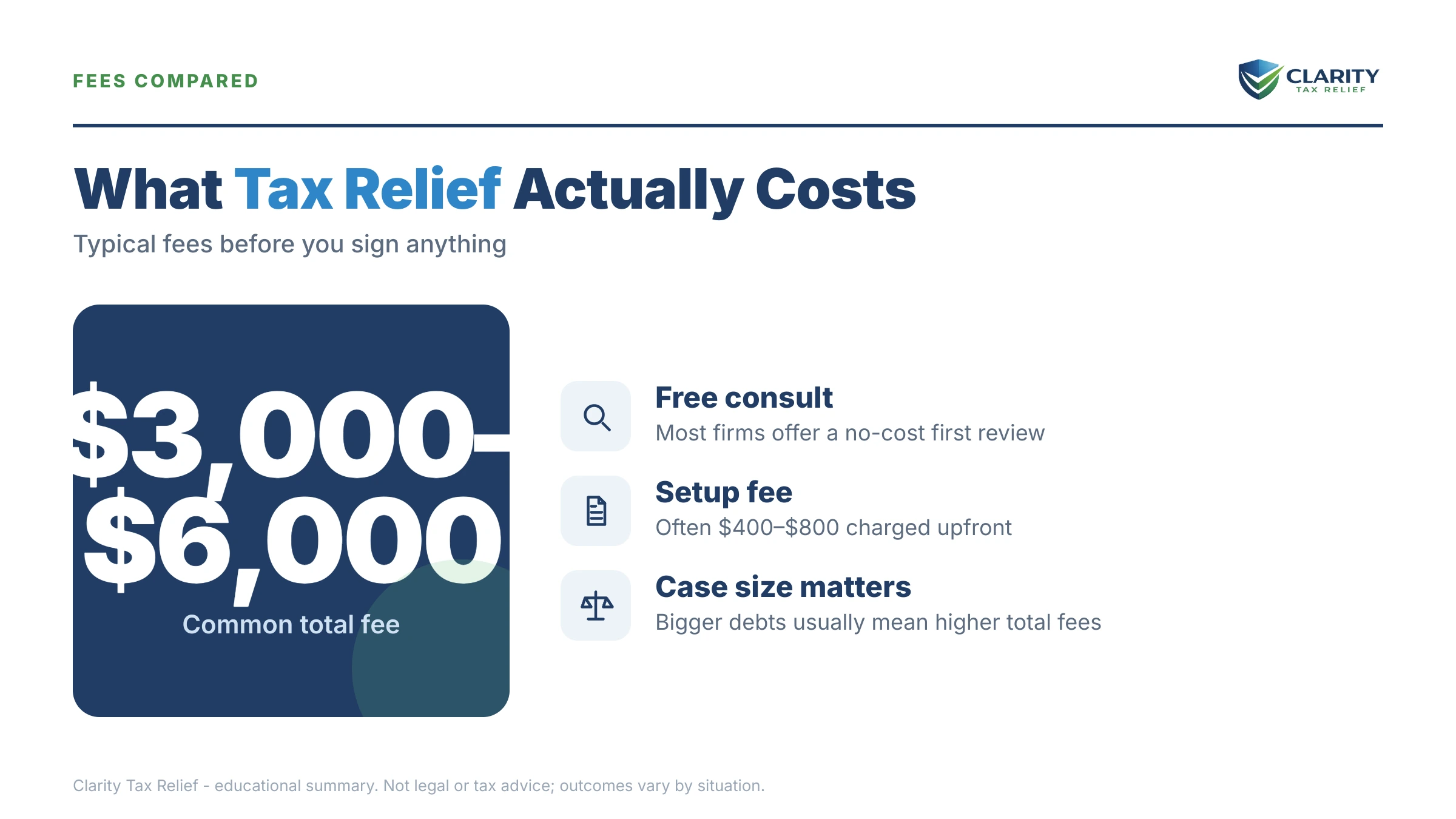
The short answer: when tax relief company fees are compared, most full-service cases run roughly $2,500 to $7,500 in professional fees, usually a $400–$750 investigation fee plus a resolution fee. Simple penalty requests cost a few hundred; payroll and multi-year cases cost more. The fee should track the work, never the size of your debt.
You have a quote in your inbox, or three of them, and the numbers are all over the map. One firm says $1,995, another says $6,000, and a third won't name a price until you "speak to a specialist." That spread is exactly why this page exists. The word "tax relief" describes dozens of different tasks, and the honest price depends entirely on which task your situation actually needs.
Here is the part the sales calls skip: the IRS programs themselves are free to apply for. You are never paying for access to an Offer in Compromise or a payment plan — you're paying for the labor and judgment of someone who does this every week. The table below lays out every pricing model side by side, so you can see exactly where a fair quote should land before you sign anything.
⏱ The clock that's really running: there's no deadline on comparing firms, but while you shop, a late-payment penalty of 0.5% per month plus daily interest keeps compounding on your balance. Take the time to choose well, but don't let a quote sit for months; the cost of waiting is real and it's automated.
Why tax relief company fees vary so much
Two firms can quote wildly different prices for the same taxpayer because they're pricing two different things. A fair fee reflects the hours a case will take; an inflated fee reflects the size of the debt and the firm's advertising budget.
The real drivers of cost are the number of tax years involved, whether returns still need to be filed, whether collection is already in motion, and how complex your finances are. A single-year balance with clean compliance is a light lift. Five unfiled years for a self-employed taxpayer with a bank levy pending is a heavy one, and it should cost more.
What should not drive the price is the dollar amount you owe. A $90,000 balance that resolves with one streamlined agreement can take less work than a $12,000 balance tangled up in unfiled returns and a disputed penalty. If a firm's quote climbs purely because your number is big, that's a pricing red flag, not a reflection of effort. For a deeper breakdown of the two main billing structures, see our guide to tax relief flat fee pricing versus hourly.
Tax relief pricing models compared
There are three ways firms structure fees, and each one shifts the risk of a "surprise total" between you and them.
| Model | How it works | Typical range | Watch out for |
|---|---|---|---|
| Flat fee | One quoted price for a defined scope of work | $2,500–$7,500 full case | Scope must be spelled out in writing, or "flat" means nothing |
| Hourly | Billed for time actually spent, often $200–$450/hr | Varies with case mess | Open-ended; ask for an estimate and a cap |
| Phased | Fixed investigation fee, then a fixed resolution fee | $400–$750 + resolution | Confirm the resolution fee is capped before you pay phase one |
Phased pricing is the most common structure at national firms, and it's reasonable — the investigation buys a clear picture of your account before anyone quotes the full job. The danger is agreeing to an unlimited resolution fee sight unseen. The safest arrangement is a written flat fee tied to specific deliverables: pull transcripts, file returns X and Y, negotiate agreement Z.
What the IRS charges you directly (the DIY cost)
Every resolution program has a government fee, and it's almost always a fraction of a firm's price, because you're supplying the labor yourself.
| Resolution | IRS fee (DIY) | Typical pro fee |
|---|---|---|
| Short-term payment plan (≤180 days) | $0 | $0–$500 |
| Long-term installment agreement (online, direct debit) | ~$29 (low-income waivable) | $500–$2,500 |
| First-time penalty abatement | $0 | $300–$1,000 |
| Currently Not Collectible status | $0 | $1,000–$3,000 |
| Offer in Compromise | $205 + 20% down (both waivable if low-income) | $3,500–$7,500+ |
The setup fee for an online long-term agreement is modest, and short-term plans cost nothing. Low-income applicants (AGI at or below 250% of the federal poverty level) can have the OIC $205 fee and the 20% down payment waived entirely. That's the whole point of comparing: you're deciding whether a firm's fee is worth it versus doing the same steps yourself, not paying for a secret program only insiders can reach. If your case is simple, our walkthrough on how to settle tax debt yourself covers the DIY route step by step.
What a bad hire actually costs you
Overpaying isn't the only risk — the wrong firm can cost you the resolution itself. Here's how a bad hire tends to unravel, in sequence:
- You pay a large fee upfront after a high-pressure call, often before anyone has pulled your transcripts.
- Weeks pass with little contact. Meanwhile a late-payment penalty and daily interest keep compounding on the untouched balance.
- A deadline slips by, a CP504 or LT11 window closes, because no one was watching your notices while you waited.
- The IRS escalates to a levy or lien that a timely response could have prevented, and now you're paying to unwind a problem that didn't exist when you signed.
- You're out the fee and deeper in debt, and refunds from an offshore "resolution mill" are notoriously hard to claw back.
This is exactly how the offer in compromise mill playbook works — sell an expensive offer to someone who was never going to qualify, then go quiet. Before you sign anywhere, it's worth reading our list of questions to ask a tax relief company and confirming the firm is a legitimate one. Here's how to tell whether tax relief is legit in the first place.
Got a tax relief quote in front of you?
Before you sign, get a free second opinion. An experienced tax professional will tell you honestly whether the fee matches the work your case actually needs — no pressure, no obligation, and no charge to find out.
Cost by case type: what you should expect to pay
The single biggest factor in your fee is what the case requires, not the balance owed. This table maps common situations to realistic professional-fee ranges.
| Case type | Typical pro fee | When the fee is worth it |
|---|---|---|
| Single-year balance, streamlined plan | $500–$1,500 | Rarely, usually a DIY job |
| Penalty abatement request | $300–$1,000 | When reasonable cause needs a written argument |
| Offer in Compromise (individual) | $3,500–$7,500+ | When the collection math genuinely supports it |
| Multiple unfiled years | $1,500–$5,000+ | Almost always — reconstruction is real work |
| Active levy or wage garnishment | $2,500–$6,000 | Almost always — timing is everything |
| Business / payroll (941) debt | $5,000–$15,000+ | Almost always — personal liability is on the line |
Audit defense is priced separately again — our breakdown of IRS audit representation cost covers that lane. The pattern across all of it: the more moving parts and the tighter the deadline, the more a professional earns their fee. A lone, low-balance installment agreement almost never justifies four figures.
A worked example: DIY cost vs. hiring a firm
Say you owe $32,000 across two tax years, both returns already filed, no levy yet, and you can afford a monthly payment. Here's the honest math both ways.
Doing it yourself: because you're under $50,000 with all returns filed, you likely qualify for a streamlined installment agreement online. Setup fee with direct debit is about $29. On a 72-month plan, that's roughly $444/month in principal before interest, and interest plus the 0.5% monthly penalty keep accruing until the balance is paid. Total out-of-pocket to set it up: about $29.
Hiring a firm: a phased quote might be a $500 investigation fee plus a $2,000 resolution fee — $2,500 total — to pull your transcripts, confirm you qualify, and file the agreement for you. For a clean case like this, you're paying $2,500 for convenience and peace of mind on work you could do yourself in an afternoon.
Now change one fact: add three unfiled years and a CP504 already in the mail. Suddenly the case needs returns reconstructed, a penalty-abatement argument. A response before the levy window closes. That same $2,500–$4,000 fee starts to look like money well spent, because a missed deadline could cost far more. You can estimate how fast the penalties and interest are stacking up with our IRS penalty and interest calculator before you decide.
How to evaluate a tax relief quote, step by step
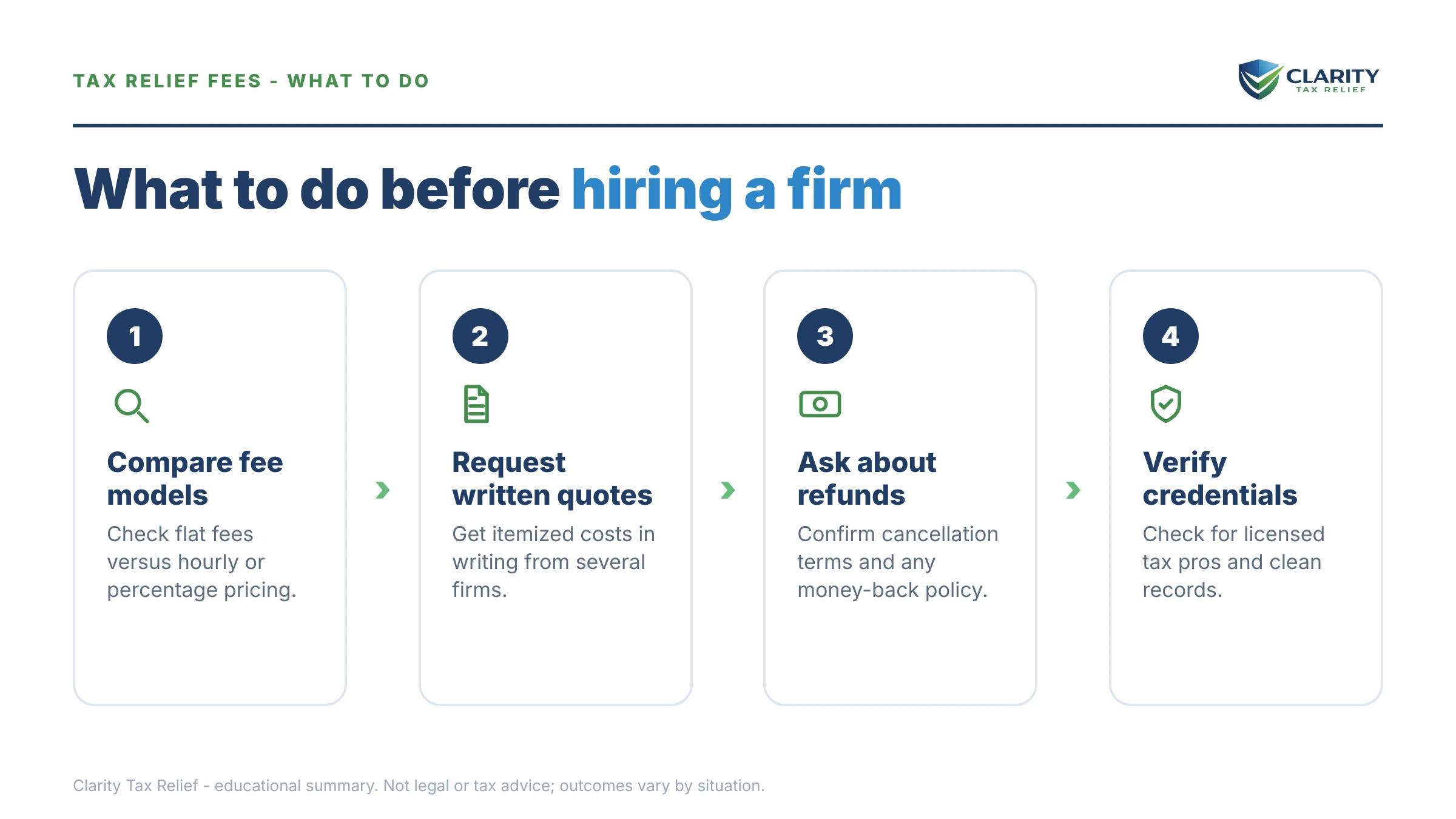
- Get the fee in writing — a verbal number on a sales call isn't a quote. Insist on a written scope and total.
- Ask what the fee covers — investigation only, or full resolution? Are amended or unfiled returns included, or billed extra?
- Confirm who does the work — you want an experienced tax professional (an enrolled agent, CPA, or tax attorney) handling your case, not a salesperson.
- Reject any guarantee of a specific result — no one can promise the IRS will accept an offer or a dollar figure. Walk away from anyone who does.
- Compare against the DIY cost — if the program is free to apply for and your case is simple, ask yourself what the fee is actually buying.
- Check the refund terms — know exactly what's refundable if you cancel before work begins, and get it in writing.
When you can handle this yourself, and when you shouldn't
You can almost certainly do this yourself if you owe a modest balance, agree with it, and can pay it within 180 days or set up a streamlined plan online. Those tools are free, and paying a firm for them rarely returns your money. First-time penalty abatement is another one you can request yourself with a phone call or a short letter, and note that beginning in summer 2026, the IRS is rolling out an Automatic Exemption from Penalty that removes qualifying first-time penalties with no request at all.
Experienced help changes outcomes when the stakes and complexity climb: a levy or garnishment already in motion, several unfiled years, business or payroll (941) debt where you could be held personally liable, an Offer in Compromise where the collection math has to be built and defended, or a disputed balance that needs an appeal. In those cases the fee isn't buying access — it's buying judgment, speed, and someone whose job is to catch the next deadline before it catches you. Still deciding who fits? Compare a tax attorney vs. CPA vs. enrolled agent before you choose.
Terms on your quote, decoded
Investigation fee: the upfront charge to pull your IRS transcripts and diagnose your account — normal, usually $400–$750.
Resolution fee: the charge for the actual negotiation and filing work; this is the number that varies most by case.
Retainer: money paid in advance that the firm draws against as it works — ask how unused funds are handled if you cancel.
Flat fee: a single fixed price for a defined scope; only meaningful if the scope is written down.
Power of attorney (Form 2848): the form that lets your representative speak to the IRS for you — signing it is part of the service, not an extra cost.
"Pennies on the dollar": a marketing phrase, not a program. The IRS accepted only about one in five offers in FY2024, and settlements are means-tested — treat any firm that leads with this claim as a red flag.
Want the full vetting playbook? See how to choose a tax relief company and what to expect at a free tax relief consultation before you commit a dollar.
Tax relief cost questions, answered
How much does a tax relief company charge?
Most full-service cases fall between roughly $2,500 and $7,500 in total professional fees, split between an investigation fee (commonly $400 to $750) and a resolution fee for the actual work. Simple penalty-abatement requests can cost a few hundred dollars; payroll, business, and multi-year cases can run well above $7,500. The number should track the complexity of the work, not the size of your debt.
Are tax relief companies worth the cost?
They are worth it when the work is genuinely complex — a levy in motion, multiple unfiled years, business or payroll debt, or an Offer in Compromise where the math has to be built and defended. For a small balance you agree with and can pay within 180 days, hiring a firm rarely pays off, because the IRS sets those plans up for free. Value depends on the case, not the marketing.
Why do tax relief companies charge so much?
A real case involves pulling transcripts, filing missing returns, building a financial statement on Form 433, and negotiating with the IRS over weeks or months. That labor is what you pay for. High fees can also come from advertising costs and, in the worst cases, from firms that price to the debt rather than the work. A fee quoted before anyone has looked at your transcripts is a warning sign.
Do tax relief companies charge upfront?
Many charge an investigation fee upfront and then bill the resolution fee before that work begins, which is normal. What is not normal is being asked to pay several thousand dollars in full before anyone reviews your account. Ask for the fee in stages tied to deliverables, and get every promise in writing before you pay anything.
Can I get tax relief for free?
Yes, in several situations. Short-term payment plans have no setup fee, first-time penalty abatement is free to request, and Currently Not Collectible status costs nothing to apply for. Low Income Taxpayer Clinics and the Taxpayer Advocate Service help qualifying taxpayers at no charge. You only pay a firm for the labor and judgment of handling it for you, not for access to the programs themselves.
What is the difference between flat-fee and hourly tax relief pricing?
A flat fee is a single quoted price for a defined scope of work, so you know your total before you sign. Hourly billing charges for time actually spent, which can be cheaper on a simple case but open-ended on a messy one. Phased pricing splits the difference: a fixed investigation fee first, then a fixed resolution fee once the scope is known. The safest arrangement is a written flat fee tied to specific deliverables.
How much does an Offer in Compromise cost with a company?
Professional fees to prepare and defend an Offer in Compromise commonly run $3,500 to $7,500 or more, on top of the IRS's $205 application fee and any required down payment. Low-income applicants (AGI at or below 250% of the poverty level) can have the $205 fee and the 20% down payment waived by the IRS. Because the IRS accepted only about one in five offers in FY2024, be wary of any firm that guarantees acceptance.
Is it cheaper to hire a CPA or a tax relief company?
A solo CPA or enrolled agent who does collection work often charges less than a national firm for the same case, because there is no heavy advertising overhead baked into the price. The trade-off is that resolution work is a specialty — a general-practice CPA who mostly prepares returns may not do it regularly. What matters is that whoever you hire is an experienced tax professional who handles IRS collections routinely and quotes a clear, written fee.
Your next 24 hours
- Find the total on every quote you have — separate the investigation fee from the resolution fee, and note anything left "to be determined."
- Gather your last filed return and any recent IRS notices so anyone reviewing your case can see the real scope in minutes, not guess at it.
- Get a free second opinion — send us your quote and your situation at the 2-minute form or call (888) 825-7779. We'll tell you honestly whether the fee fits the work, while penalties and interest are still small.
This guide is general information, not tax or legal advice for your specific situation. Eligibility for IRS programs depends on individual facts and circumstances; no outcome is guaranteed. Fee ranges shown are typical industry figures for illustration and will vary by firm and case.
Primary sources: IRS payment plans &. Installment agreements, IRS Offer in Compromise, and IRS: choosing a tax professional.