
Choosing Help
How to Verify a Tax Relief Company Before You Pay a Dime (2026)
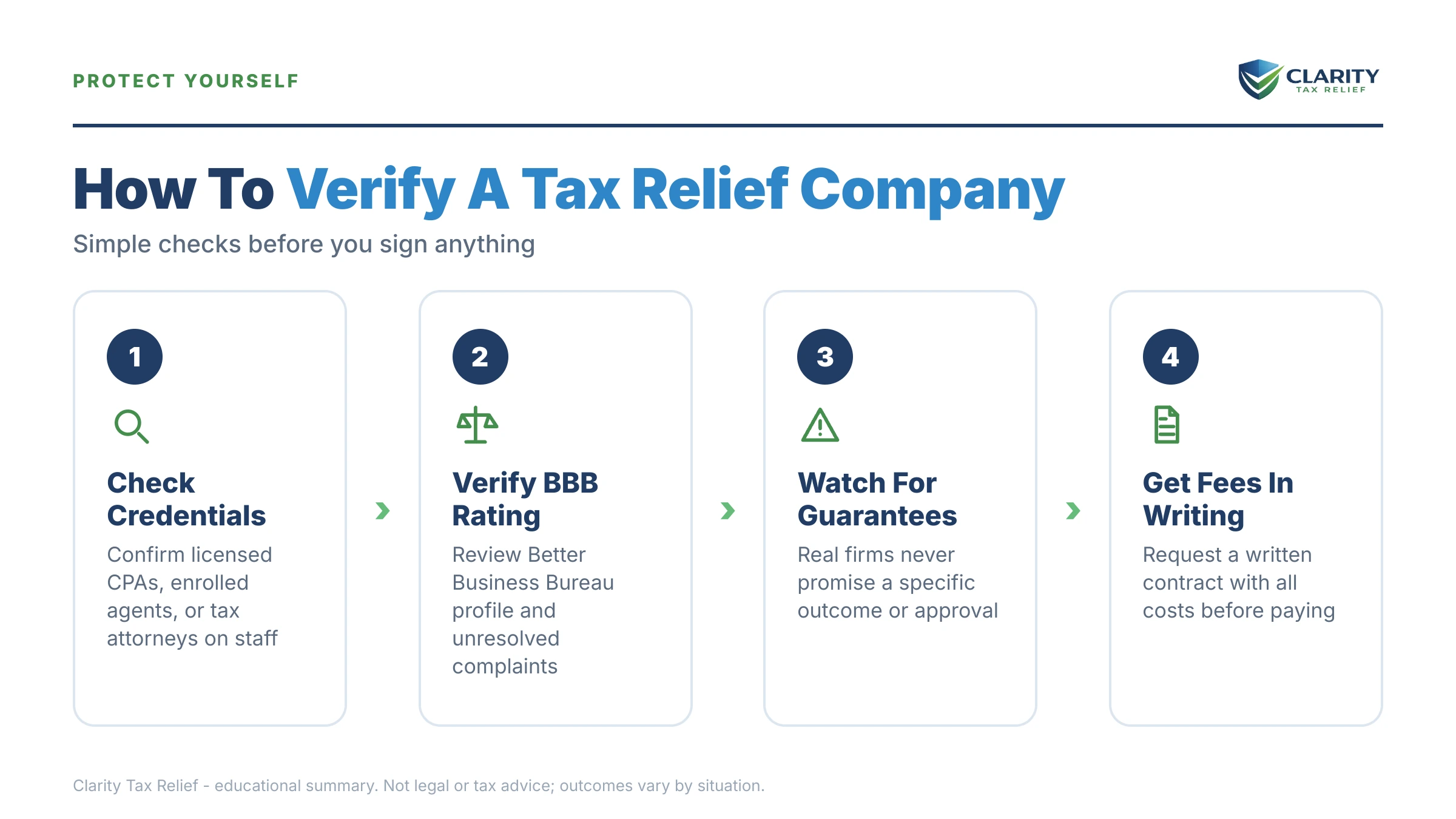
The short answer: to check a tax relief company, verify three things before you pay. First, confirm a named enrolled agent, CPA, or attorney will handle your case, and verify that credential yourself with the IRS or the state board. Second, search the FTC and your state attorney general for enforcement actions. Third, read the fee, scope, and refund terms in writing.
Maybe an ad promised to "slash" your IRS balance, or a caller said they'd already "reviewed your file." Now you're staring at a website full of five-star badges, wondering whether these people are real or just very good at marketing. Good instinct. The most important work you'll do isn't hiring a firm — it's checking one first.
Here's the encouraging part: a real credential can be verified by you, for free, in about five minutes, from a government website. Only enrolled agents, CPAs, and attorneys have unlimited rights to represent you before the IRS, and each of the three is looked up in a public database. The image below shows exactly where to look up a preparer's credential so you can confirm a company's claims yourself.
This matters more in 2026 than it used to. In June 2026 the Federal Trade Commission permanently banned a major tax-relief operation for exactly the pitches you should be screening out — promised savings and settling for a tiny fraction of what is owed. Knowing how to run that screen protects both your money and your case.
⏱ The clock that's actually running: there's no deadline to vet a company, but while an unverified firm sits on your file, your IRS debt does not pause. Penalties and interest keep accruing every month, and automated collection notices keep escalating. Vet fast; then act.
Why verifying a tax relief company matters
Verifying a tax relief company protects two things at once: the fee you pay them and the tax case they're supposed to fix. The tax-resolution field is legitimate and full of skilled professionals, but it also attracts marketers who sell hope, collect the fee upfront, and then do little or nothing while your collection notices march forward.
The damage from hiring the wrong firm isn't just the lost fee. It's the months of silence while a CP504 notice or an LT11 notice ticks toward a levy, and the deadlines that quietly expire because nobody filed the appeal. A company that never verified its own promises rarely files your Form 2848 or answers your calls, either.
The good news is that the same signals that make a firm trustworthy — a named credentialed representative, transparent fees, clean enforcement history — are all things you can check independently. You don't have to take anyone's word for it.
What happens if you skip the check
Skipping verification is how most "a tax relief company took my money" stories begin. The pattern is consistent, and knowing it helps you spot it early:
- The pitch. A cold call, robocall, or ad promises certain savings or a settlement for a fraction of what you owe, before anyone has seen a single transcript.
- The upfront fee. You pay a large retainer, often the full amount, before any work is defined or a power of attorney is filed.
- The silence. Weeks pass with no transcripts pulled, no Form 2848 on file, and calls that go unreturned.
- The escalation. Meanwhile the IRS keeps moving — reminder notices, then intent-to-levy, then a final notice — because collection is automated and never stopped.
- The realization. By the time you ask for a refund, the money is spent, deadlines have passed, and you're worse off than when you started.
None of this requires bad luck — only a skipped five-minute check. If you've already lived some of this, read "a tax relief company took my money" for your recovery options.
Not sure the firm you found is the real thing?
Before you pay anyone, get a second opinion from a credentialed professional. We'll tell you honestly where your case stands and what a fair scope and fee look like — free, confidential, no pressure — while penalties are still adding up.
How to check a tax relief company: what to verify and where
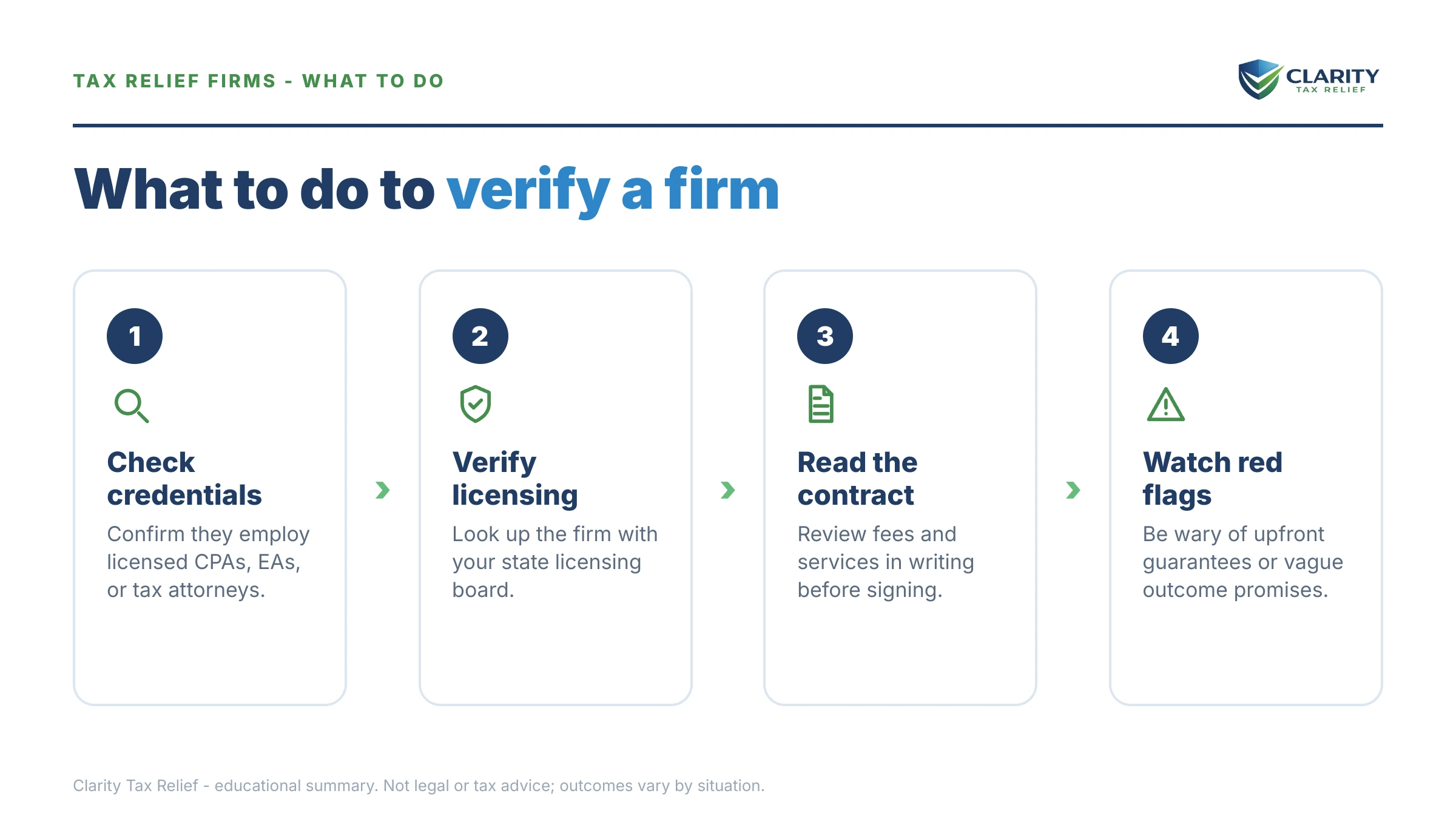
The core of checking a tax relief company is confirming that a real, credentialed person stands behind the marketing. Work through this list before you sign anything.
| What to verify | Where to check it | Green light vs. red flag |
|---|---|---|
| A named EA, CPA, or attorney will do the work | Ask directly; get the person's full name | Green: a specific name and credential. Red: "our team" with no name |
| The credential is real | IRS Directory of Federal Tax Return Preparers; state CPA board; state bar | Green: a matching public listing. Red: no listing found |
| Enforcement history | FTC press releases; state attorney general; BBB complaint pattern | Green: no actions, few complaints. Red: FTC/AG action or a wall of unresolved complaints |
| Fee, scope, and refunds | The written engagement agreement | Green: defined scope and refund policy. Red: full fee upfront, vague scope |
| They'll file a power of attorney | Ask if they file Form 2848 in the named rep's name | Green: yes, promptly. Red: evasive or "later" |
The single most powerful check is the credential lookup, because IRS representation rights are strictly defined. Not everyone who works at a tax relief company can actually stand in front of the IRS on your behalf.
Which tax relief credentials can actually represent you
Only three credentials carry unlimited rights to represent you before the IRS on collections, appeals, and audits: the enrolled agent, the CPA. The attorney. Each is verifiable in a public database, and each is issued by a different authority — which is exactly why you can check them.
| Credential | Representation rights | How to verify |
|---|---|---|
| Enrolled Agent (EA) | Unlimited — all IRS matters, all states | IRS Directory of Federal Tax Return Preparers |
| CPA | Unlimited before the IRS | Your state's Board of Accountancy license lookup |
| Attorney | Unlimited before the IRS | The state bar's attorney directory |
| Uncredentialed preparer / "case manager" | Very limited or none for collections | PTIN exists, but no representation credential to confirm |
Every paid preparer must hold a valid PTIN, and credentialed ones appear in the IRS Directory of Federal Tax Return Preparers with Credentials and Select Qualifications. If the person who will handle your case isn't an enrolled agent, CPA, or attorney, ask who is, because that's the person who will sign your Form 2848. For a deeper breakdown of the three, see tax attorney vs. CPA vs. enrolled agent.
Tax relief red flags vs. what a legitimate firm does
The fastest way to check a tax relief company is to hold its pitch up against how a legitimate firm behaves. The banned marketing phrases are not just tacky — under FTC scrutiny they're the exact language that gets companies shut down.
| Red flag | What a legitimate firm does instead |
|---|---|
| "Settle for pennies on the dollar" / guaranteed savings | Reviews your finances first; no outcome promised before analysis |
| Demands the full fee upfront, before any work | Defines a scope and stages fees, with a written refund policy |
| Won't name the credentialed person doing the work | Names the EA, CPA, or attorney and files a POA in that name |
| Cold call / robocall claiming to know your IRS balance | You initiate contact; they verify your balance with your authorization |
| Pressure to sign "today only" for a discount | Gives you time to read the contract and get a second opinion |
The "pennies on the dollar" line deserves special attention, because it is the most abused phrase in this industry. An Offer in Compromise is a real IRS program. But the IRS accepted only about 1 in 5 offers in FY2024, and acceptance is means-tested on your assets and income, not on a firm's sales talent. Any company that promises a specific settlement is selling something it cannot deliver. For the full list, see our tax relief red flags checklist and the anatomy of the offer in compromise mill.
How to verify a tax relief company, step by step
- Get the credentialed person's name. Ask who specifically will represent you and what their credential is — enrolled agent, CPA, or attorney. Don't accept "our team."
- Verify that credential yourself. Confirm the person in the IRS directory, the state CPA board, or the state bar. A missing listing is a stop sign.
- Screen for enforcement actions. Search the FTC and your state attorney general for actions against the company, and read the BBB complaint pattern, not just the rating.
- Read the contract before paying. Check the fee, the exact scope of work, the refund policy, and whether the firm will file a Form 2848 power of attorney in the named representative's name.
- Get the fee and scope in writing. Confirm the total cost and what it covers in a written engagement before any money changes hands, and keep a copy.
Two documents make the fee real: the engagement agreement and the Form 2848 power of attorney. If a firm will file the POA in a named EA's or attorney's name, that person is genuinely on your case. For the exact questions to walk through on the call, use our list of questions to ask before hiring a tax relief firm.
What a fair fee looks like: a worked example
Say a firm quotes you a $5,500 flat fee to pursue an Offer in Compromise on a $42,000 balance. Here's how to sanity-check that quote instead of just reacting to the number.
First, the math the firm cannot skip: an OIC carries a $205 application fee and, for lump-sum offers, a 20% down payment (both waived if you certify as low-income, with AGI at or below 250% of the federal poverty level). If the firm never mentions those figures or never asks about your income, it isn't doing the analysis — it's selling a package.
Second, the fee should attach to work, not to a promised result. A defensible $5,500 might cover pulling transcripts, preparing Form 656 and Form 433-A(OIC), and representing you through the review. A red-flag $5,500 is a firm assuring you it will resolve the debt, collected upfront, with no scope written down.
Third, run the alternative. If your finances don't support an OIC, a 72-month streamlined installment agreement on $42,000 is roughly $583 a month before interest — something you can often set up yourself for a small or zero fee. A firm worth its fee will tell you that honestly rather than steer you to the most expensive product. Compare pricing models in tax relief flat fee vs. hourly.
When you can verify and act on your own
You don't always need a firm, and an honest article should say so. If you owe a small balance you can pay within 180 days, agree with a first notice, or just need a straightforward payment plan, you can often handle it directly with the IRS and skip the fee entirely. Start with free help with IRS tax debt before paying anyone.
Experienced help changes outcomes when the stakes and complexity climb: a levy already in motion, multiple unfiled years, business or payroll tax debt, or OIC math that has to be built carefully to survive review. In those cases the question isn't whether to hire help — it's how to verify the help is real. Our guide to how to choose a tax relief company and the honest take in is tax relief legit walk through both.
Wondering what a legitimate first meeting even sounds like? Here's what happens at a free tax relief consultation — a real one asks about your situation before it quotes anything.
Terms to know when vetting a firm, decoded
- PTIN: the Preparer Tax Identification Number every paid preparer must hold — necessary, but not a representation credential by itself.
- Enrolled Agent (EA): a federally authorized tax practitioner with unlimited rights to represent taxpayers before the IRS.
- Form 2848: the IRS power of attorney that authorizes a specific named person to speak and act for you with the IRS.
- Form 8821: tax information authorization — lets a firm view your records but, unlike Form 2848, does not grant representation.
- Contingency vs. flat fee: a flat fee buys defined work; be wary of pricing tied to a promised dollar result you were guaranteed.
- Reasonable Collection Potential (RCP): the IRS's math for what it could collect — the real basis for any Offer in Compromise, no matter what a firm promises.
Verifying a tax relief company: questions answered
How do I check if a tax relief company is legitimate?
Confirm a named enrolled agent, CPA, or tax attorney will handle your case, then verify that credential yourself — through the IRS Directory of Federal Tax Return Preparers, the state CPA board, or the state bar. Next, search the Federal Trade Commission and your state attorney general for enforcement actions, and read the contract's fee and refund terms before paying anything.
How can I verify a tax preparer's credentials with the IRS?
Every paid preparer must have a valid PTIN, and credentialed ones appear in the IRS Directory of Federal Tax Return Preparers with Credentials and Select Qualifications. Search by name and state to confirm an enrolled agent, CPA, or attorney is listed. Only those three credentials carry unlimited rights to represent you before the IRS on collections and appeals.
What are the biggest red flags with tax relief companies?
The clearest red flags are promised results, assurances of settling your debt for a tiny fraction of what you owe, demands for the full fee upfront before any work, and refusal to name the credentialed person doing the work. Cold calls and robocalls that claim to have reviewed your account are another warning sign — the IRS does not sell your file to marketers.
Should a tax relief company charge upfront?
A reasonable firm charges a defined fee for defined work, often in stages, with a written refund policy. Be cautious of any company that demands the entire fee before it has even pulled your transcripts or filed a power of attorney. Ask whether the quote is a flat fee for a specific scope or an open-ended retainer, and get the answer in writing.
How do I know a tax relief "IRS" call is not a scam?
The IRS does not robocall taxpayers to offer settlement programs, and it does not sell your account to sales teams. A caller claiming to already know your balance and offering to "reduce" it is a marketer or a scammer, not the government. Verify any balance yourself by logging into your account at IRS.gov before you speak to any company about it.
Is the BBB rating enough to trust a tax relief company?
A Better Business Bureau profile is a useful data point but not proof of quality — read the complaint pattern, not just the letter grade. Look for repeated complaints about non-communication, no refunds after fees, or work never performed. Pair the BBB check with an IRS credential lookup and an FTC and state attorney general search for enforcement actions.
What questions should I ask before hiring a tax relief firm?
Ask who specifically will handle your case and what their credential is, whether they will file a Form 2848 power of attorney in that person's name, what the total fee covers, and what happens to your money if the IRS rejects the strategy. A firm that answers all four clearly and in writing is behaving the way a legitimate one should.
Your next 24 hours
- Find the name. Pull up the firm's site or your call notes and locate the specific person, with a credential, who would handle your case. If there isn't one, that's your answer.
- Gather your basics. Have your latest IRS notice, the tax years involved, and any written quote in front of you so you can compare the pitch to your real situation.
- Get a free second opinion. Before you sign or pay, let a credentialed professional confirm what a fair scope and fee look like — use the form or call (888) 825-7779. Your penalties and interest keep adding up until someone actually acts.
This guide is general information, not tax or legal advice for your specific situation. Eligibility for IRS programs depends on individual facts and circumstances; no outcome is guaranteed.
Primary sources: the IRS Tax Professionals directory and credential lookup, and the FTC consumer protection resources on tax-relief scams. Cross-check any firm against your state attorney general and the Better Business Bureau complaint history.