
Choosing Help
Is TaxRise Legit? What to Check Before You Hire Them in 2026
The short answer: yes — TaxRise is a legitimate, registered tax-resolution company, not a scam. But "legit" isn't the same as "right for you." Like any tax-relief firm, its value depends on its fee, the credentials of who actually works your case, and whether the outcome it pitches matches your real eligibility.
You saw a TaxRise ad — maybe on TV, maybe after Googling your IRS notice — and now you're doing the smart thing: checking before you hand over a credit card. Good instinct. The honest news is that TaxRise is a real company in an industry that also contains genuine scams, so the question worth asking isn't only "is it real?" but "is it worth the fee for my exact situation?"
This guide answers both. Below you'll find how to confirm any tax-relief firm is legitimate in minutes, the checklist we use to separate a fair firm from an overpriced one, and a comparison chart that shows exactly where a national firm makes sense, and where you'd be paying four figures for something you could do yourself for under $130.
⏱ The clock that's actually running: there's no deadline on choosing a firm, but if you owe the IRS, penalties and interest accrue every month while you shop. The failure-to-pay penalty and interest don't pause for vetting. Take the days you need to pick well, but don't let "researching companies" become a year of doing nothing.
Why you're asking if TaxRise is legit
Almost everyone researching "is TaxRise legit" is in one of three spots: you owe the IRS and feel out of your depth, you already spoke to a salesperson and want a gut-check before signing, or a firm quoted a fee that made you pause. All three are reasonable — the tax-relief industry earned its trust problem.
The reason the whole category feels risky is real history. In June 2026 the Federal Trade Commission permanently banned a large tax-relief operator for lying about results and pocketing fees without doing the work. That's the shadow every firm now sits under — including the honest ones. So the goal isn't to find a company with a clean marketing page; it's to verify the substance behind it.
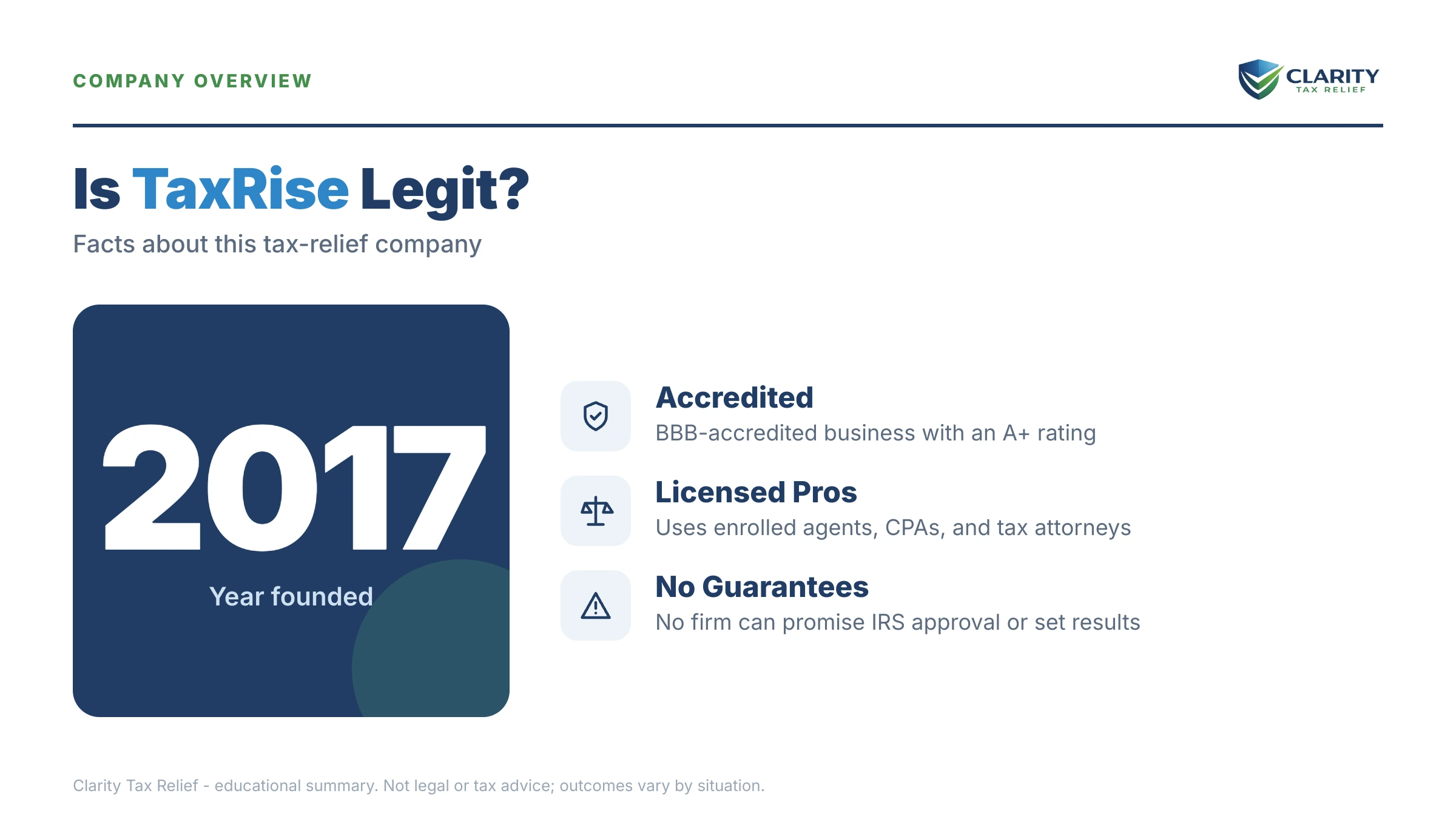
TaxRise, based in Irvine, California, is a genuine operating business that employs enrolled agents and tax professionals and represents taxpayers before the IRS. That clears the "is it a scam" bar. The rest of this article is about the bar that actually protects your money.
Is TaxRise a scam, or just a company you should vet?
TaxRise is not a scam. It is a real firm that delivers real services, which is a different thing from being the best or cheapest option for you. A scam vanishes with your deposit or harvests your identity. A legitimate-but-imperfect firm does the work but may charge more than your case warrants or oversell what the IRS will actually approve.
Here's the distinction in plain terms, because it decides how carefully you read the contract versus whether you walk away entirely.
| Signal | Outright scam | Legitimate firm (vet the contract) |
|---|---|---|
| Who works your case | No named credentialed preparer | Enrolled agents, CPAs, or attorneys you can verify |
| Payment method | Gift cards, wire, crypto, cash apps | Standard card/ACH with a written contract |
| Promises | "Guaranteed" settlement before seeing your finances | Outcomes framed as possible, pending IRS review |
| Paper trail | No engagement letter, no refund terms | Written scope, fee, and refund window |
| IRS contact claim | Claims special IRS access or "insider" deals | Uses normal IRS programs open to everyone |
TaxRise lands squarely in the right-hand column — which means your job is contract-reading, not scam-dodging. If a firm ever lands in the left column, stop; see our guide on tax relief scams to avoid and the full tax relief red flags checklist.
What happens if you pick wrong, or keep waiting
The real risk isn't that TaxRise is fake — it's that the IRS collection machine keeps moving while you deliberate. In 2026 the IRS workforce is down roughly 27% from prior years, but the automated notice-and-levy system never slowed. Whether or not a human touches your file, the sequence advances on its own timeline:
- CP14 — first balance-due bill. Penalties and interest start compounding.
- CP501 / CP503 — reminder notices. Still just bills, but the balance climbs monthly.
- CP504 — Notice of Intent to Levy your state refund. A federal lien becomes a real possibility.
- LT11 / Letter 1058 — Final Notice. After 30 days the IRS can garnish wages and levy bank accounts, and your Collection Due Process appeal window opens.
Two bad outcomes to avoid: paying a firm a big fee for a case you could have handled cheaply, and paying no one while the notices escalate past the point where the cheapest fixes were available. The middle path — pick the right level of help for your actual situation — is what this page is built to help you do. If you're getting these letters now, read the order of IRS collection letters so you know where you stand.
Want a second opinion before you sign anything?
Send us a photo of your IRS notice and any quote you've received. An experienced tax professional will tell you honestly what your case actually needs, and whether a big fee is warranted — free, confidential, no pressure.
Your options for tax-debt help, compared
A national firm like TaxRise is one of four realistic ways to handle IRS debt, and it's not the cheapest for a simple case. The right choice depends on how much you owe, whether returns are filed, and whether enforcement has already started. The comparison below is the same math we'd walk a caller through.
| Option | Typical cost | Best for |
|---|---|---|
| Do it yourself | $0–$69 (IRS setup fee) | Under $50k, returns filed, you agree with the balance |
| Local EA or CPA | Hourly or flat, often lower | One-off returns, a single-year balance, penalty relief |
| National firm (TaxRise, etc.) | ~$2,000–$7,500+ | Multiple years, levy in motion, complex OIC, hands-off |
| Free help (LITC / TAS) | $0 (income limits apply) | Low income, hardship, disputes you can't get resolved |
Two of those cost nothing or almost nothing. Before you pay any firm a four-figure fee, it's worth knowing whether you're a candidate for free help with IRS tax debt or a Low Income Taxpayer Clinic. If your case is genuinely complex, though, a good firm's fee can be money well spent — the trick is matching the fee to the work.
A worked example: is the fee worth it?
Say you owe $28,000 across two filed years, you work a W-2 job. A national firm quotes a $4,200 fee to pursue an Offer in Compromise. Here's the arithmetic that should drive your decision.
An OIC has its own hard costs: a $205 application fee plus 20% down on a lump-sum offer (both waived if you meet low-income certification). But approval isn't a given — the IRS accepted roughly 1 in 5 offers in FY2024. If your income and assets can cover the debt, the offer gets rejected and you've spent $4,200 in firm fees on a "no."
Now the alternative: a $28,000 balance is under the streamlined threshold, so you could set up a 72-month installment agreement yourself for about $29–$69. Roughly $28,000 ÷ 72 ≈ $389/month plus accruing interest — no four-figure fee at all. The firm is worth it if your finances genuinely support an OIC or a partial-pay plan and you want a professional to build and defend the financials. It is not worth it to set up a payment plan you qualify for automatically. Run your own numbers first with our Offer in Compromise Calculator.
How to vet TaxRise before you sign, step by step
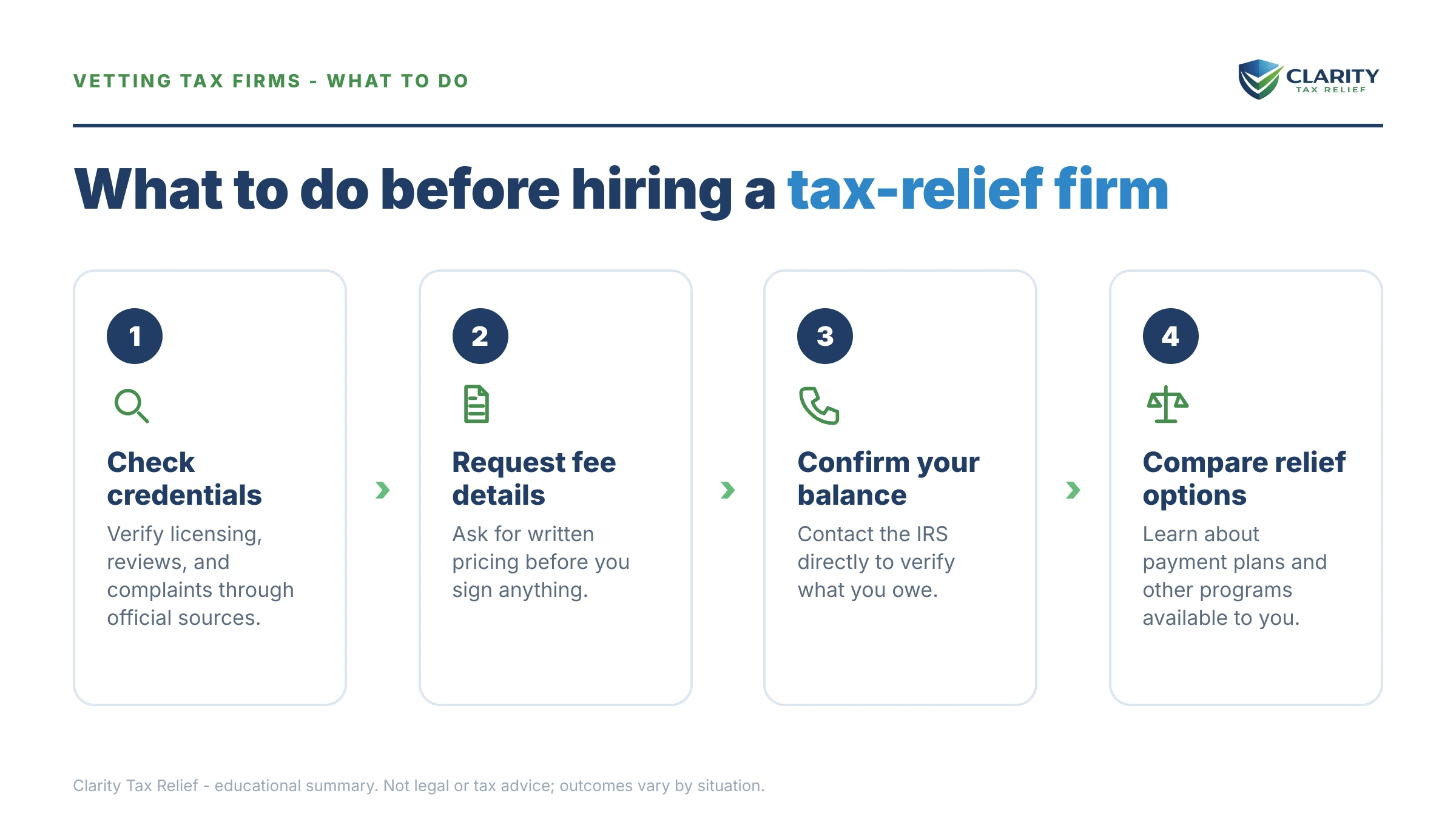
Verifying any tax-relief firm, TaxRise included, takes about 20 minutes and can save you thousands. Do these five things in order before you pay a dollar.
- Confirm the company and its professionals are real — check that the person assigned to your case is an enrolled agent, CPA, or attorney in the IRS directory of credentialed preparers, not just a "case advisor."
- Get the full fee and scope in writing — the total, exactly what it covers, whether it's flat or billed in phases. The written refund terms.
- Match the promise to your real eligibility — any settlement pitch should reflect your actual income and assets. Ask them to put promised outcomes in writing, and treat any promise of a specific result as a red flag.
- Check independent complaint records — read the Better Business Bureau file, your state attorney general's consumer complaints, and the one-star reviews for patterns.
- Compare against doing it yourself or a free option — price out a self-set-up payment plan or an LITC before committing to a big fee.
For a deeper script, see the exact questions to ask before hiring a tax relief firm and our buyer's checklist on how to choose a tax relief company.
When you can handle the IRS yourself, and when help pays off
You do not need TaxRise, or any firm, for a simple, agreed balance. If you owe under $50,000, your returns are filed. You agree with the number, you can set up a streamlined installment agreement online yourself, or a short-term plan of up to 180 days with no setup fee. A first-time first-time penalty abatement request is a phone call. Paying a firm four figures to do that is overpaying.
Experienced help genuinely changes outcomes in a narrower set of situations: a wage or bank levy already in motion, several years of unfiled returns, business or payroll (941) tax debt where you may be personally liable, or an Offer in Compromise where the financial analysis decides everything. In those cases the fee buys skill that changes the dollar result, not just convenience. The honest test: if the work is "fill out one form I qualify for," do it yourself. If it's "build a case the IRS could reject," get a pro.
If you'd rather never touch it, that's a legitimate reason to hire out — just pay for the case you have. A good firm will tell you when your situation is simple enough to DIY; a mill will sell you the biggest package regardless. Comparing options? See our take on Optima Tax Relief alternatives and Wiztax alternatives for how the same case looks across firms.
Terms on the sales call, decoded
- Offer in Compromise (OIC): a settlement for less than you owe — real, but means-tested and approved only about 1 in 5 times. This is what ads promising to slash your debt to a tiny fraction distort.
- Installment agreement: a monthly IRS payment plan. Most balances under $50,000 qualify for a streamlined version with no financial disclosure.
- Currently Not Collectible (CNC): a hardship status that pauses collection when you can't pay anything; the debt and interest remain.
- Enrolled agent (EA): a federally credentialed tax professional who can represent you before the IRS — the same authority a CPA or attorney has for tax matters. See what an enrolled agent is.
- "Investigation phase" fee: the first charge some firms bill to pull your transcripts. Know whether it's separate from the resolution fee before you agree.
If a salesperson leads with any banned promise — vowing to slash your debt to a tiny fraction, assuring a specific result, or claiming everyone qualifies — that's your cue to slow down. Those exact phrasings are what got a major competitor permanently banned by the FTC. Legitimate firms describe possibilities, not promised results.
Is TaxRise legit? Your questions, answered
Is TaxRise a legitimate company?
Yes, TaxRise is a real, registered tax-resolution company based in California, not a fly-by-night scam. It employs enrolled agents and other tax professionals and represents clients before the IRS. "Legitimate" means it's a genuine business. It does not mean every outcome it advertises will apply to your case, or that its fee is the best value for your situation.
Is TaxRise a scam?
No. A scam takes your money and disappears or steals your identity; TaxRise is an operating firm that provides real services. The fair criticism of national tax-relief firms is different: high upfront fees, aggressive sales, and settlement promises that don't match IRS reality. Judge it on its contract and credentials, not on whether it's "a scam."
How much does TaxRise charge?
National tax-relief firms typically charge between about $2,000 and $7,500 or more depending on how complex your case is, and TaxRise's fees fall in that general range. Always get the total fee, what it covers, and refund terms in writing before you pay. A simple installment agreement rarely justifies a four-figure fee — you can often set one up yourself for under $69.
Can TaxRise really settle my tax debt for less?
Sometimes — through an Offer in Compromise, but only if your income and assets genuinely can't cover the debt. The IRS accepted roughly 1 in 5 offers in FY2024, so no firm can promise it. Be wary of anyone advertising that they can slash your debt to a tiny fraction. The IRS runs the math. You can estimate your own odds before paying anyone.
Does TaxRise offer a money-back guarantee?
Many national firms advertise a limited refund window, often a set number of days after signing, but terms vary and shrink once work begins. Read the exact refund language in your agreement before paying — what triggers a refund, how much, and by when. A guarantee of a specific tax outcome is a red flag; no honest firm can guarantee an IRS result.
Is it better to hire TaxRise or handle the IRS myself?
It depends on your case. If you owe under $50,000 and agree with the balance, you can often set up a payment plan yourself online for free or a small fee. Experienced help pays off when a levy is in motion, you have multiple unfiled years, payroll or business tax is involved, or an Offer in Compromise needs real financial analysis.
How do I check TaxRise's reviews and complaints?
Look at independent sources: the Better Business Bureau, your state attorney general's consumer complaints. The IRS directory of credentialed preparers to confirm the professional assigned to you. Read the one-star reviews specifically — patterns of billing disputes or unmet promises tell you more than the marketing on the company's own site.
What's the difference between TaxRise and a tax attorney or CPA?
TaxRise is a resolution company that assigns enrolled agents and tax professionals to your case. A tax attorney or CPA is an individual credential you hire directly. All three can represent you before the IRS. The difference is model and price — a national firm bundles sales, case management, and representation, while a solo EA or CPA is often cheaper for a straightforward case.
Your next 24 hours
Turn the research into a decision with three concrete steps:
- Find your real number. Log into your IRS online account and note the exact balance and which years it covers — that's what decides whether you even need a firm.
- Gather your quote and your notice. Put any written fee estimate next to your most recent IRS letter so you can compare the work to the price.
- Get a free, no-pressure second opinion. Call (888) 825-7779 or use the 2-minute form. We'll tell you honestly whether your case is a DIY fix, a job for a local EA, or worth a firm, before interest and penalties climb any higher.
This guide is general information, not tax or legal advice for your specific situation. TaxRise is an independent company not affiliated with Clarity Tax Relief; names are used for identification and comparison only. Eligibility for IRS programs depends on individual facts and circumstances; no outcome is guaranteed.
Primary sources: IRS payment plans & installment agreements, Taxpayer Advocate Service, and FTC consumer advice.