
Choosing Tax Relief Help
Wall & Associates Alternatives in 2026: What to Compare Before You Hire
The short answer: a good Wall & Associates alternative is any experienced tax-resolution firm that charges a defined flat fee for a defined scope, not an open-ended monthly retainer. Before you hire anyone, compare the fee model, the credential of the person who actually works your case, and whether an Offer in Compromise is even realistic for your numbers.
The single biggest reason people search for a Wall & Associates alternative is the billing: Wall & Associates is a real, long-operating firm, but it charges a recurring monthly retainer rather than one defined fee, so your total cost keeps climbing the longer your case stays open. If you're weighing that against a flat-fee firm, you're asking the right question.
This page is not a hit piece. It's a buyer's guide: how the monthly-retainer model actually works, when it can cost far more than a flat fee, how to price two firms on the same terms, and when you don't need to hire anyone at all. The comparison below shows exactly how the two fee models stack up side by side.
The reason speed matters isn't the firm you pick — it's the IRS clock that runs no matter who you hire. While you shop, penalties and interest keep compounding on the balance itself.
⏱ The clock that never pauses: there's no deadline to hire a firm, but the IRS failure-to-pay penalty of 0.5% per month plus daily-compounding interest keeps growing on your balance every month your case sits unresolved. Comparison shopping is smart; letting the underlying debt drift for months while you decide is what costs you.
Why people look for a Wall & Associates alternative
Most searches for an alternative come down to one word: cost. Wall & Associates is legitimate and has operated for decades, but it uses a monthly-fee (retainer) model. You pay a set amount every month while your case is open, instead of one fixed price to reach a specific outcome.
That model isn't automatically bad. It's a problem when your case is straightforward but stretches across many billing months, because the total you pay is tied to time, not to the work required. A payment plan that a credentialed representative could set up in a few weeks can quietly generate many months of retainer charges.
The other common reasons people shop:
- No clear total. A monthly number feels small; the multi-month total often isn't. Readers want the full figure up front.
- Who's on the case? The person who sells the engagement isn't always the credentialed person who represents you at the IRS.
- Realism. Some clients sign up hoping for a settlement they were never going to qualify for. A good alternative tells you the truth about your numbers before you pay.
If any of those drove your search, you're not looking for a "cheaper Wall" — you're looking for a firm whose incentives line up with getting you done, not with keeping the meter running. Compare that directly against other national options like Optima Tax Relief alternatives, Community Tax alternatives, and Larson Tax Relief alternatives.
What happens if you do nothing while you shop
The firm you choose doesn't change the IRS timeline — only acting does. If you let the underlying balance drift, the automated collection sequence keeps escalating regardless of which company you're interviewing:
- CP14 — the first balance-due bill. Penalties and interest are already accruing.
- CP501 / CP503 — reminder notices. Still just bills, but the balance grows monthly.
- CP504 — Notice of Intent to Levy. The IRS can seize your state tax refund and a federal lien becomes a real possibility. (See our CP504 notice guide.)
- LT11 / Letter 1058 — the Final Notice of Intent to Levy. After 30 days the IRS can garnish wages and levy bank accounts, and your Collection Due Process appeal window opens. (See our LT11 notice guide.)
In 2026 this matters more than it used to. IRS staffing was cut roughly 27% in 2025, so a human is harder to reach. But the notices, liens, and levies are generated by automated systems that never stopped. The machine escalates whether or not anyone at the IRS has looked at your file. The point of hiring help is to get a representative in front of that process before it hits a levy, not months after.
Not sure which fee model fits your case?
Send us a photo of your latest IRS notice. An experienced tax professional will tell you what you actually owe, which resolution is realistic, and what it would cost as a defined flat fee — free, confidential, and with no monthly-retainer pressure.
Your options: alternatives compared
"Alternative to Wall & Associates" doesn't only mean another national firm. It means matching the level of help to the difficulty of your case. Here's the honest landscape.
| Option | Best fit | How you pay |
|---|---|---|
| Flat-fee national resolution firm | Multiple years, levy risk, OIC or CNC candidate, wants it handled end to end | Defined fee for a defined scope. You know the total before starting |
| Local enrolled agent or CPA | Straightforward balance, wants a face-to-face pro, moderate complexity | Flat or hourly; ask which up front |
| Tax attorney | Criminal exposure, large business/payroll debt, litigation or Tax Court | Usually hourly, higher rate; worth it for the right problem |
| Do it yourself (IRS online) | Small balance you agree with, one clean year, simple payment plan | $0–$69 IRS setup fee; no professional fee |
| Low-income clinic / free help | Qualifying low income, hardship, or a dispute you can't afford to fight | Free or nominal |
Whichever you choose, the deciding factor is usually the fee model, not the firm's logo. That's where the monthly retainer and the flat fee genuinely diverge — read tax relief flat fee vs. hourly for the full breakdown, and use the questions to ask before hiring a tax relief firm before you sign anything.
Monthly retainer vs. flat fee: how the money actually works
A monthly-retainer firm bills you every month your case is open; a flat-fee firm quotes one number for a defined result. The difference isn't the rate — it's who carries the risk if the case takes longer than expected.
| Question | Monthly-retainer model | Flat-fee model |
|---|---|---|
| Do you know the total up front? | No — depends on months open | Yes — stated in the engagement letter |
| Who benefits if the case drags? | The firm (more billed months) | You (same price) |
| What does canceling do? | Stops future months; billed months rarely refunded | Refund per the written scope terms |
| Easy to compare firms? | Hard — you must project the total yourself | Easy — one number vs. one number |
Neither model is a scam. But the monthly model shifts the incentive: the firm earns more the longer your file stays open, while a flat fee rewards a firm for finishing. When you interview any alternative, insist on seeing the projected total, not just the monthly figure.
A worked example: what the two models can cost on the same debt
Say you owe the IRS $38,000 across two tax years, you're behind but not yet at a levy, and you're a borderline candidate for an installment agreement. Here's how the two models can land — figures are hypothetical illustrations, not any firm's actual rates.
Monthly-retainer path. Suppose the retainer is $500/month and the case realistically stays open 14 months while returns are confirmed and the agreement is negotiated:
- Fees: $500 × 14 = $7,000
- Meanwhile the balance keeps accruing: roughly 0.5%/month failure-to-pay on $38,000 ≈ $190/month, plus interest, so the debt grows while you're billed monthly.
Flat-fee path. Suppose a flat-fee firm quotes $3,500 for the same defined scope (confirm both years, set up the agreement, request penalty relief). You know that number on day one, and it doesn't change if the IRS takes longer to respond.
Same debt, same outcome — the difference is roughly $3,500 in professional fees and, more importantly, certainty. The lesson isn't "monthly is always worse"; it's that you can't compare firms until you convert every monthly quote into a projected total.
When an Offer in Compromise is (and isn't) realistic
An Offer in Compromise settles a debt for less than the full balance, and it's the outcome most people picture when they call a tax relief firm. It's real. But the IRS accepted only about 1 in 5 offers in fiscal year 2024. It approves one only when your income and assets genuinely can't cover the debt.
The IRS decides using a formula called Reasonable Collection Potential — essentially your equity in assets plus your future income after allowable living expenses. If that number is higher than your balance, no firm can settle it, no matter the model. You can estimate your own figure with our Offer in Compromise Calculator before you pay anyone to pursue one, and read how an offer in compromise actually works for the full mechanics.
Here's the trap a monthly model can create: signing up hoping for a settlement, then paying month after month while the firm eventually concludes you don't qualify. A trustworthy alternative runs that math first and tells you honestly, even if the answer is a payment plan or Currently Not Collectible status instead. Beware any firm promising to slash your debt to a tiny fraction of what you owe. That pitch is marketing, not a legal outcome, and the FTC has acted against firms that used it.
How to choose a Wall & Associates alternative, step by step
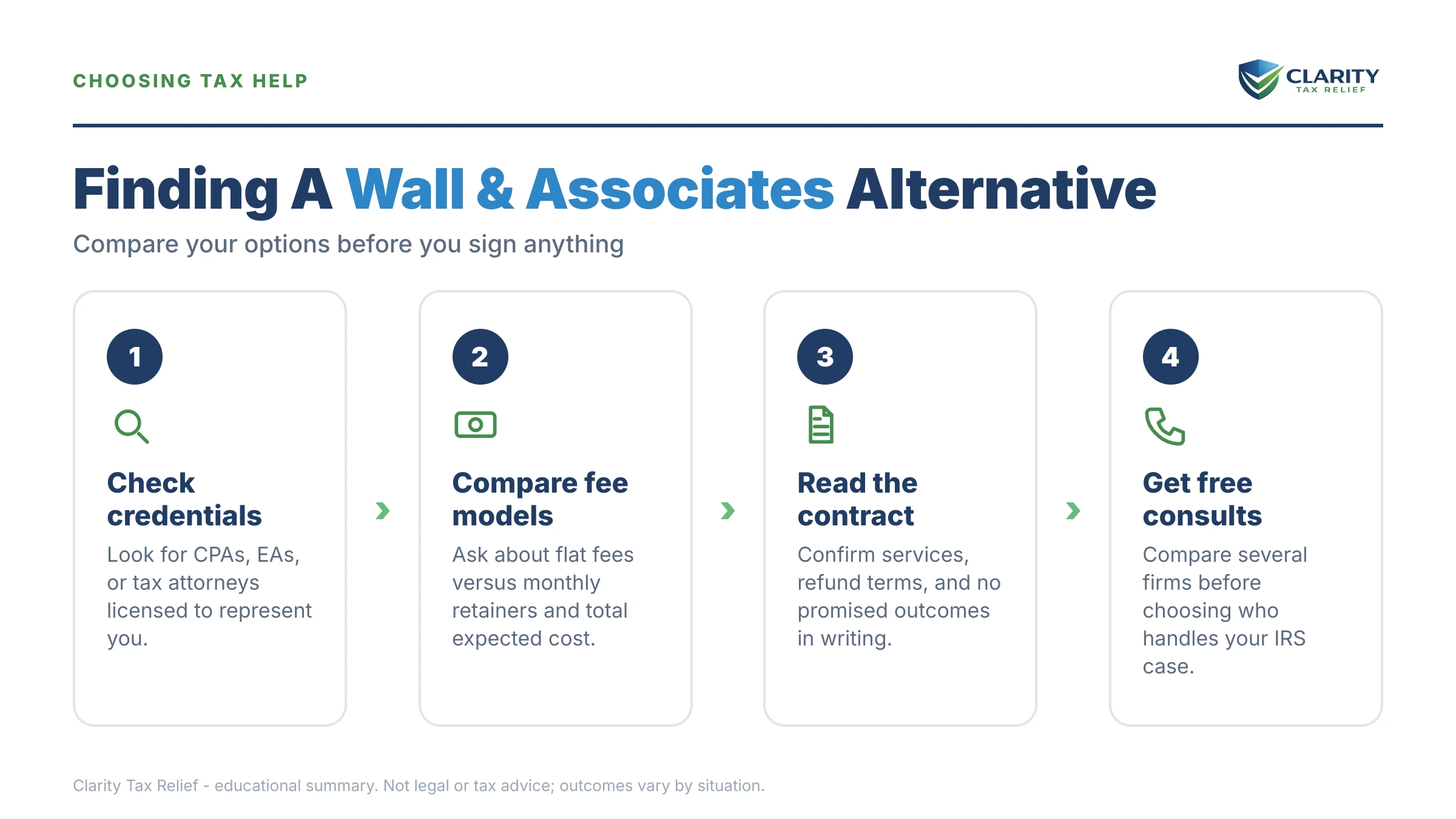
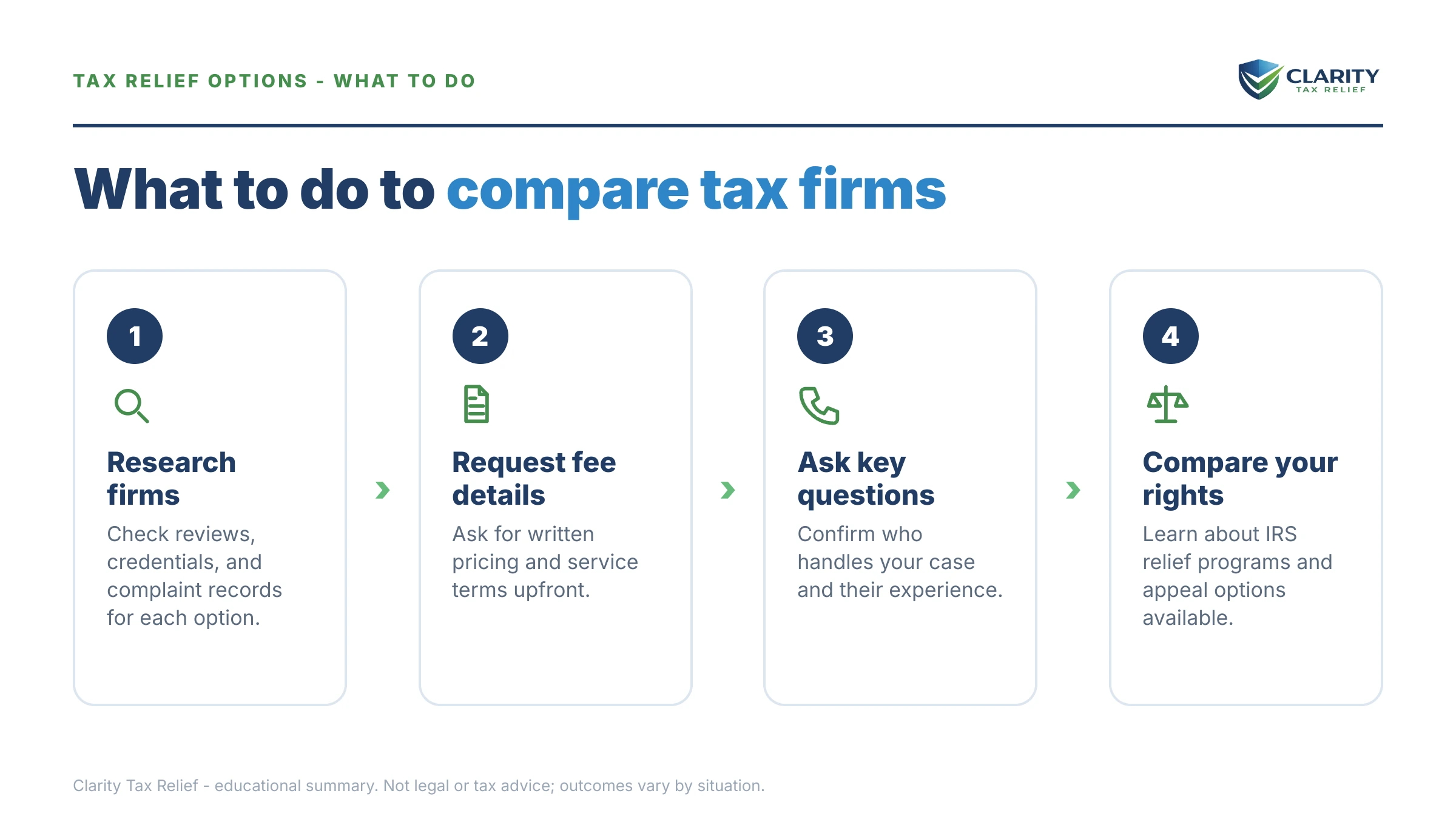
- Pull your own IRS account first. Log into your IRS online account and get your transcripts so you know what you owe and where you are before any firm quotes you.
- Ask for the total fee and the fee model in writing. Flat or monthly? Get the full projected number in a signed engagement letter before you pay.
- Confirm who actually works your case. Get the name and credential — enrolled agent, CPA, or tax attorney — of the person who'll represent you on Form 2848, not just the salesperson.
- Make them show the math before promising a result. A credible firm reviews your income, assets, and allowable expenses, then tells you what's realistic. Walk away from anyone who promises a settlement amount on the first call.
- Compare at least two firms and read the cancellation terms. Get a second free review, line up total cost and scope, and read what's refundable before you commit.
When you can handle this yourself, and when help changes the outcome
You don't always need a firm at all. If you owe under about $50,000, you agree with the balance. You just need time, you can set up a long-term payment plan yourself online — up to 72 months, with no professional fee. A single clean year with a small balance is a genuine do-it-yourself situation, and paying anyone a monthly retainer for it is overpaying.
Experienced help earns its cost when the case gets harder, and here's where the difference is real:
- A wage garnishment or bank levy is already in motion and you need it released fast.
- You have multiple unfiled years that must be reconstructed and filed before anything else.
- Business or payroll (trust fund) tax debt, where personal liability is on the table.
- You're a genuine Offer in Compromise candidate and the math has to be built and defended precisely.
In those cases, the value isn't "dealing with the IRS for you" — it's sequencing the fixes in the right order (returns, then penalties, then the balance) so you pay the least legally possible. If your situation is simple, don't overpay; if it's one of the above, don't go it alone.
Terms on the sales call, decoded
- Retainer (monthly fee): a recurring charge billed every month your case is open — total cost rises with time, not just work.
- Flat fee: one defined price for a defined scope, stated before you start.
- Reasonable Collection Potential (RCP): the IRS's formula for the least it could collect from you; it decides whether an OIC is possible.
- Power of Attorney (Form 2848): the form that lets a credentialed representative speak to the IRS for you — ask who will actually be named on it.
- Engagement letter: the written contract stating scope, price, and cancellation terms. Never pay before you've read one.
Still deciding how to vet a firm? Our checklist on how to choose a tax relief company and the tax relief red flags guide walk through the exact warning signs, and if you've ever felt burned, first-time penalty abatement may recover money on the tax side too.
Wall & Associates alternative: questions, answered
Is Wall & Associates a scam?
No — Wall & Associates is a real, long-established tax resolution firm, not a scam. The common criticism is about its fee model, not its legitimacy: it bills a recurring monthly retainer rather than a single defined fee, so your total cost depends on how many months your case stays open. That is exactly what a good alternative lets you compare against a flat fee.
How much does Wall & Associates cost compared to alternatives?
Wall & Associates uses a monthly-retainer billing model, so there is no single sticker price. You pay a set amount every month your case is open, and the total grows the longer resolution takes. Many alternative firms instead quote a defined flat fee for a defined scope. Before hiring anyone, ask for the full projected cost in writing so you can compare a monthly model against a flat fee on the same page.
What is the best alternative to Wall & Associates?
The best alternative is whichever experienced firm gives you a defined scope, a defined price. A named credentialed representative who reviews your actual numbers before promising anything. That could be a flat-fee national firm, a local enrolled agent or tax attorney, or — for small, clean balances — doing it yourself through your IRS online account. Compare total cost, not just the monthly number.
Can I cancel a tax relief company like Wall & Associates?
Usually yes, but the terms matter. With a monthly-retainer model, canceling stops future monthly charges but rarely refunds months already billed. Before you sign with any firm, read the cancellation and refund language in the engagement letter, and confirm whether unused work is refundable. If a firm won't put its cancellation terms in writing, treat that as a red flag.
Do I even need a tax relief company, or can I handle the IRS myself?
If you owe under about $50,000, agree with the balance, and just need a payment plan, you can usually set that up yourself online for little or no fee. Experienced help earns its cost on the harder cases: a levy already in motion, multiple unfiled years, business or payroll tax debt, or an Offer in Compromise where the math decides everything. Match the help to the difficulty.
Are Offer in Compromise settlements guaranteed by any firm?
No — no firm can guarantee an Offer in Compromise, and any that does is breaking the rules. The IRS accepted roughly 1 in 5 offers in fiscal year 2024. It approves an offer only when your income and assets genuinely cannot cover the debt. A trustworthy alternative tells you whether you're a realistic candidate before you spend a dollar chasing it.
What questions should I ask before hiring a Wall & Associates alternative?
Ask five things: what is the total fee and is it flat or monthly. Who is the credentialed person representing me. What outcome is realistic given my numbers. How do I cancel and what is refundable. And can I see the engagement letter before I pay. A firm that answers all five in writing is a safer bet than one that only quotes a low monthly figure.
Your next 24 hours
- Find your balance and years. Log into your IRS online account (or grab your latest notice) and write down what you owe and for which tax years — that's the number every firm will quote against.
- Gather three things. Your most recent notice, last filed return, and a rough monthly income-and-expense picture. With those, any credible reviewer can tell you what's realistic.
- Get a free, no-retainer case review. Use the 2-minute form or call (888) 825-7779. We'll tell you what you owe, which resolution fits. The defined flat-fee cost, while penalties and interest are still smaller than they'll be next month.
This guide is general information, not tax or legal advice for your specific situation. Eligibility for IRS programs depends on individual facts and circumstances; no outcome is guaranteed. Clarity Tax Relief is not affiliated with, and does not disparage, Wall & Associates, Inc.. The comparison above describes fee models generally so you can make an informed choice.