
Choosing a Tax Relief Company
Is Larson Tax Relief Legit? What to Check Before You Hire (2026)
The short answer: yes — Larson Tax Relief is a legitimate, established tax-resolution firm with credentialed staff and a long operating history. It is not a scam. But "legit" only means the company is real and does the work; it does not mean the firm is the cheapest option for you or that any specific outcome is assured. Verify the credential, the flat fee, and the promises before you sign.
You are staring at a tax notice, you searched a firm's name to see if it's safe, and you want a straight answer before you hand over money to a stranger. Good instinct. The image below shows you the paperwork trail an honest tax-resolution engagement actually leaves, and where to look to confirm a company is real.
Here's the honest framing this whole article turns on: the question most people mean when they type "is Larson Tax Relief legit" is not "does this company exist" — it's "will I get my money's worth, or am I about to get burned?" Those are two different questions, and both have concrete answers you can check yourself in about fifteen minutes.
⏱ While you shop, the meter runs: there's no deadline to pick a firm, but the IRS keeps adding a 0.5%-per-month failure-to-pay penalty plus daily interest to your balance the entire time you compare. Verifying a company is smart; letting the decision drift for months is what actually costs you money.
Is Larson Tax Relief a legitimate company?
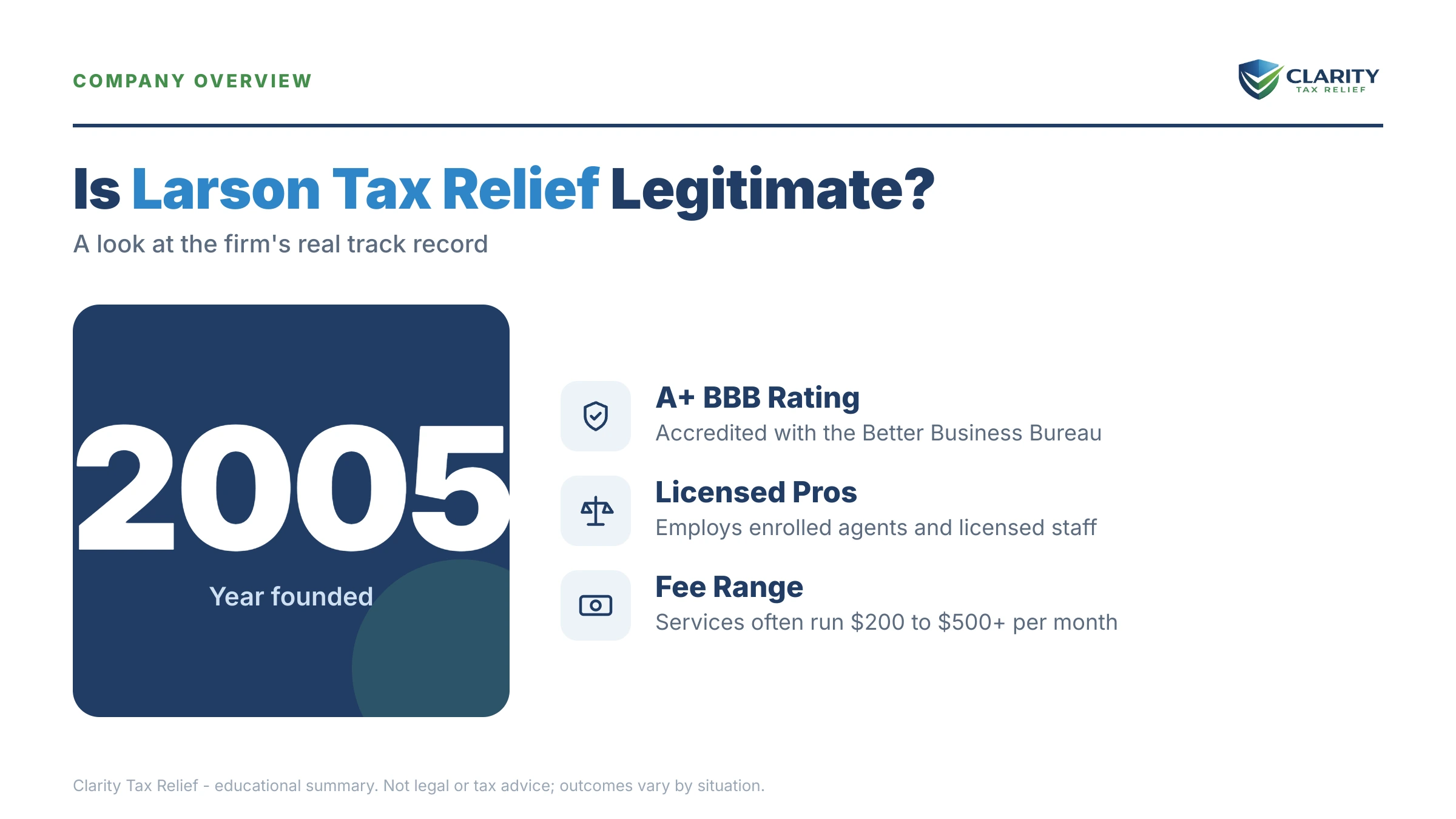
Yes — Larson Tax Relief is a real, registered tax-resolution firm, not a fraudulent operation. It has a genuine business history, physical operations, and professionals who hold recognized credentials such as enrolled agent. That already separates it from the impersonation scams that spoof the IRS by phone and email.
But you shouldn't take any single article's word for that — including this one. Legitimacy is something you confirm with primary sources, not reviews. Three checks settle it:
- Better Business Bureau: look up the firm's profile, its rating, and, more importantly, how it responds to complaints. A pattern of unanswered complaints matters more than the letter grade.
- State business registry: a legitimate firm is registered as a business entity in its home state. You can search most secretaries of state for free.
- The credential: ask the name and designation of the person who will actually represent you, then verify it. Enrolled agents appear in the IRS's own directory; CPAs and attorneys are listed with their state boards.
If a company passes all three, it's legit in the only sense that matters. Whether it's the right choice for your balance is a separate question, and the more useful one.
What "legit" does and doesn't mean
A legitimate firm can still be the wrong fit, or an overpay — for your specific situation. "Legit" answers the fraud question. It does not answer the value question. Here's the distinction that saves people money:
- Legit means: the company exists, employs credentialed people, does real IRS negotiation, and won't vanish with your retainer.
- Legit does NOT mean: your debt will be reduced, that you couldn't get the same result cheaper, or that you personally qualify for the programs the ads highlight.
The FTC permanently banned a large tax-relief company in June 2026 over exactly the claims to distrust — promises to slash your debt to a fraction, to erase what you owe, and to lock in savings. No honest firm, Larson or anyone else, promises a dollar result before seeing your finances. If you hear that language anywhere, that's your red flag, regardless of how well-known the name is. Our tax relief scams to avoid guide breaks down the exact scripts.
What happens if you hire the wrong firm, or hire nobody
The risk with a legitimate firm isn't fraud — it's paying for help you didn't need, while the IRS clock keeps ticking either way. Here's the sequence that quietly costs people money:
- You overpay for a simple case. You pay several thousand dollars for a firm to set up a payment plan you could have arranged yourself online in twenty minutes for a $29 fee.
- You pay before anyone reviews your file. Some firms charge a fee, then tell you weeks later you never qualified for what you were sold. If a firm took your money and disappeared, that's a different problem — see "a tax relief company took my money".
- You wait too long to decide. While you compare firms for months, the IRS notices keep escalating — from a balance-due bill toward a CP504 intent to levy and eventually a final LT11 notice that starts a 30-day clock to a wage or bank levy.
- You hire nobody and ignore it. The debt doesn't pause. Penalties and interest compound, and the automated collection machine keeps issuing liens and levies whether or not a human ever touches your case.
In 2026 that last point is sharper than ever: IRS staffing dropped roughly 27% during 2025. But the automated levy and lien systems never slowed down. Slow to act is the one mistake that reliably costs money — hiring the right help fast or handling a simple case yourself both beat drifting.
Comparing firms while penalties add up?
Send us a photo of your IRS notice. An experienced tax professional will tell you, free and with no pressure, whether your case even needs a paid firm, and exactly what your options cost. Then you can compare Larson, us, or anyone else with real numbers in hand.
How to vet Larson, or any tax relief company
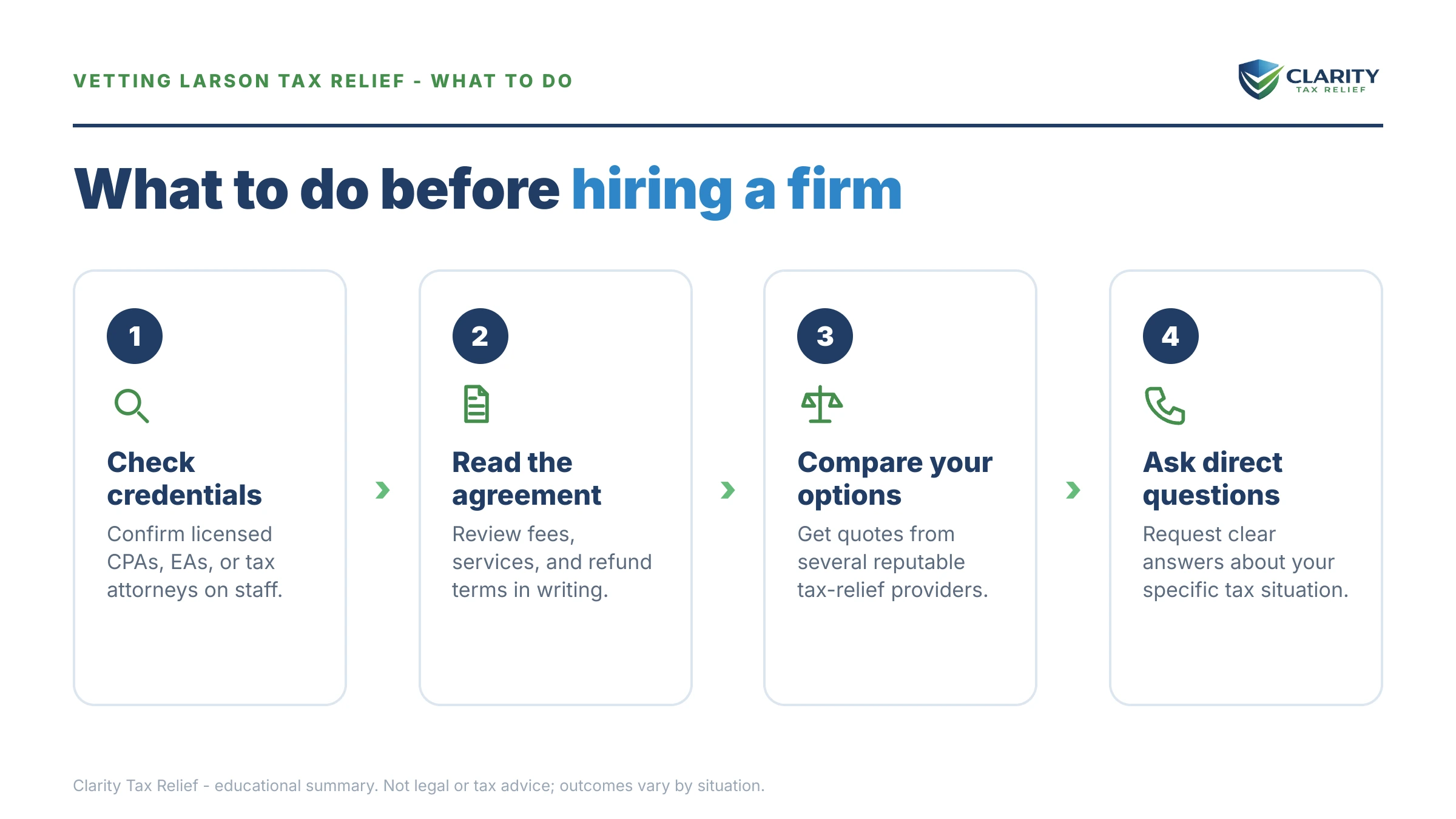
Every legitimate firm should pass the same five checks. The ones that dodge a check are telling you something. Use this before you sign anything, with any company.
| What to verify | Where to check it | What a good answer looks like |
|---|---|---|
| Company is real & registered | State business registry, BBB profile | Active entity, years of history, complaints answered |
| Who actually does the work | IRS enrolled-agent directory; state CPA/bar boards | A named enrolled agent, CPA, or attorney you can look up |
| The total price | The written engagement letter | A flat fee, in writing, with what it covers spelled out |
| The promises made | Sales call & contract language | No guaranteed dollar result before your finances are reviewed |
| Refund & cancellation terms | The contract's fine print | A clear refund policy if you cancel before work begins |
Here's the green-flag / red-flag version to keep in your head on the sales call:
| Green flags (honest firm) | Red flags (walk away) |
|---|---|
| Reviews your notices & transcripts before quoting | Quotes a "settlement" before seeing your finances |
| Flat fee in writing | Vague "phases" that keep adding charges |
| Explains you may qualify only for a payment plan | "Pennies on the dollar" / "we'll wipe out your debt" |
| Names the credentialed person on your case | Won't say who negotiates, or uses only salespeople |
| Tells you when you can do it yourself for free | Pressures you to sign today or "lose" a program |
Want the full interview list? Our guides on the questions to ask before hiring a tax relief firm and the tax relief red flags checklist give you a printable version. And because pricing is where most confusion lives, compare flat-fee vs. hourly billing before you commit.
What does Larson Tax Relief cost, and is it worth it?
Larson, like most national firms, charges a flat fee that scales with your case, not a single published price. A short investigation phase (pulling your transcripts, seeing what the IRS has on file) is relatively inexpensive. A full resolution across multiple years or with business taxes runs into the low-to-mid thousands. That's normal for the category. The question isn't whether the fee is real — it's whether the work behind it is worth more than what you'd pay to do it yourself.
The value depends almost entirely on complexity. A single-year balance you agree with and can pay over time is a do-it-yourself job. Several unfiled years, a levy in motion, payroll taxes, or an Offer in Compromise where the math is genuinely close — that's where an experienced firm earns its fee by not getting the strategy wrong.
A worked example: is the fee worth it on a $38,000 balance?
Say you owe $38,000 across two tax years and you're weighing hiring a firm versus doing it yourself.
- The clock, either way: the failure-to-pay penalty runs 0.5% of the unpaid balance per month — about $190/month on $38,000 — plus daily interest, until the balance is paid or in a formal plan.
- DIY path: because $38,000 is under $50,000, you likely qualify for a streamlined installment agreement — roughly $528/month over 72 months, set up online yourself for a small fee, no financial disclosure required.
- Firm path: a flat fee of, say, $3,000–$5,000 buys the firm doing that setup for you, plus checking whether you actually qualify for penalty abatement or an offer that could save more than the fee.
The honest math: if all you need is that streamlined plan, paying a firm $4,000 to arrange it is poor value. If the firm can knock a first-time penalty off or show the IRS your Reasonable Collection Potential supports an offer, the fee can pay for itself. That's exactly the calculation to run before you hire anyone. You can estimate your own offer math with our Offer in Compromise Calculator first.
How to check a tax relief company is legit, step by step
- Search the exact company name plus "BBB" and "complaints" — read how they respond, not just the star rating.
- Confirm it's a registered business in its home state's entity search.
- Ask who will represent you by name and credential, then verify that person in the IRS enrolled-agent directory or the relevant state board.
- Get the total fee in writing before paying — a flat number, with the scope and any refund terms spelled out.
- Test the promises: if anyone guarantees a settlement or a dollar amount before reviewing your finances, stop — that's the banned claim, not a plan.
- Compare against a free review so you know whether you even need to pay. Getting a second opinion costs nothing and often changes the decision.
When you can handle the IRS yourself: no firm needed
You do not need to pay any firm — Larson, us, or anyone — for a straightforward balance you agree with and can manage. Skip the fee when:
- You owe under $10,000 — you likely qualify for a guaranteed installment agreement the IRS must grant, set up free online.
- Your balance is one year, you agree with it, and you can pay within 180 days.
- You just got a first notice like a CP14 and simply need to pay or set up a plan.
- You want a first-time penalty removed and have a clean prior three years. You can request that yourself with one call or letter.
Experienced help genuinely changes the outcome when: a wage garnishment or bank levy is already in motion, you have several unfiled years, you owe business or payroll taxes, you're weighing an Offer in Compromise where the numbers are close, or you simply can't face dealing with the IRS and want it handled correctly the first time. There's no shame in either choice — the point is matching the cost to the complexity. If you'd rather DIY, start with how to settle tax debt yourself and the free options in free help with IRS tax debt. Not sure whether you're comparing apples to apples? Our Larson Tax Relief alternatives breakdown puts the choices side by side.
Terms you'll hear, decoded
Enrolled agent (EA): a federally credentialed tax professional licensed to represent taxpayers before the IRS in all 50 states — the credential that actually matters on a resolution case. See what an enrolled agent is.
Offer in Compromise (OIC): a program to settle for less than the full balance when your income and assets genuinely can't cover it — the IRS accepted roughly 1 in 5 offers in FY2024, so it's real but not routine.
Reasonable Collection Potential (RCP): the IRS's own formula for the most it thinks it could collect from you — the number that determines whether an offer flies, no matter who files it.
Flat fee vs. retainer: a flat fee is a fixed total for defined work. A retainer is money paid up front that a firm draws against — know which you're signing.
Investigation phase: the first paid step where a firm pulls your transcripts to see what the IRS has — cheap, but make sure it's not sold as the whole resolution.
Is Larson Tax Relief legit? Your questions, answered
Is Larson Tax Relief a legitimate company?
Yes. Larson Tax Relief is a real, established tax-resolution firm, not a fly-by-night operation. It's a registered business with a long operating history and staff who hold professional credentials such as enrolled agent. "Legitimate" means the company exists, is licensed, and does the work it advertises; it does not mean any specific result is promised. Confirm current standing yourself through the Better Business Bureau and the IRS's directory of credentialed preparers before signing.
How much does Larson Tax Relief cost?
Most national tax-relief firms, including this category, charge a flat fee that typically runs from a few hundred dollars for a short investigation phase to several thousand dollars for a full resolution, depending on how many years and how complex your case is. Larson does not publish a fixed price online because the fee scales with the work. Always get the total fee, and what it covers — in writing before you pay anything.
Does Larson Tax Relief have a minimum tax debt requirement?
Many national firms set an informal minimum — often somewhere around $10,000 to $20,000 in debt — because below that, their fee can eat up most of what you'd save. Ask directly whether your balance meets their threshold. If you owe under about $10,000, you can usually set up a guaranteed installment agreement yourself for free and skip the fee entirely.
Is Larson Tax Relief a scam?
No — a scam is an operation that takes your money and does nothing, or one that impersonates the IRS. Larson is a real firm that performs tax-resolution work. The genuine risk with any legitimate firm is paying for help you could have gotten free or cheaper, not fraud. The scams to fear are the ones promising to slash your debt to a fraction or erase what you owe — no honest firm assures a result.
Can Larson Tax Relief really reduce my tax debt?
Sometimes, but only when your finances independently qualify. A firm can prepare an Offer in Compromise, request penalty abatement, or negotiate an affordable payment plan. But the IRS decides based on your income, assets, and expenses, not on who represents you. The IRS accepted only about 1 in 5 offers in FY2024. Any firm that says it can guarantee a reduction before reviewing your finances is not being honest.
What's the difference between Larson Tax Relief and hiring a CPA or enrolled agent directly?
A national firm packages the work — intake, financial analysis, and IRS negotiation — under one flat fee, while a solo CPA, enrolled agent, or tax attorney you hire directly may bill hourly and cost less on a simple case. The credential doing the actual IRS work is the same either way. For a single-year balance you agree with, a local enrolled agent or even doing it yourself is often cheaper. For multiple years, payroll debt, or a levy in motion, a firm's bench can help.
How do I know if any tax relief company is legit?
Verify three things: the credential (the person handling your case should be an enrolled agent, CPA, or attorney you can look up), the price (a flat fee in writing, no vague "phases" that keep adding charges). The promises (an honest firm never assures a specific dollar result before reviewing your finances). Check the Better Business Bureau, your state's business registry, and the IRS preparer directory. If they ask for gift cards or claim to be "with the IRS," walk away.
Is it better to hire Larson or handle the IRS myself?
Handle it yourself when the balance is small, you agree with it. You can pay within 180 days or set up a simple online plan — that's free. Hire experienced help when a levy or wage garnishment is already in motion, you have several unfiled years, you owe business or payroll taxes, or an Offer in Compromise is on the table. Those situations have deadlines and math where a mistake costs more than the fee.
Your next 24 hours
- Find the balance and tax year on your most recent IRS notice — the amount box tells you how urgent this is and which programs you fit.
- Run the three legit-checks on any firm you're considering: BBB profile, state registry, and the named credential of whoever will represent you.
- Get a free second opinion before you pay anyone — use the form or call (888) 825-7779. You'll learn whether your case even needs a paid firm, so you can compare real numbers instead of sales pitches. Every month you wait, penalties and interest keep adding to the balance.
This guide is general information, not tax or legal advice for your specific situation. Eligibility for IRS programs depends on individual facts and circumstances; no outcome is guaranteed. Clarity Tax Relief is not affiliated with, and does not speak for, Larson Tax Relief. Verify any company's current standing through primary sources before hiring.
Primary sources worth checking yourself: the IRS's tax professionals and credential directory, the IRS payment plans page. The independent Taxpayer Advocate Service.