
Choosing a Tax Relief Firm
Tax Defense Partners Alternative: How to Choose the Right Tax Relief Firm in 2026
The short answer: the best Tax Defense Partners alternative is whichever firm puts a credentialed enrolled agent, CPA, or tax attorney on your case, charges a clear flat fee, and reviews your IRS transcripts before promising any outcome. Score each option on credentials, pricing, and honesty — not brand name.
You're comparing firms because your tax debt is real and you want to hand it to someone who will actually fix it — not just close a sale. Good instinct. The single biggest factor in whether a tax relief firm helps you isn't its name in a radio ad; it's who does the work and how they price it.
Here's the trap most people fall into: they sign with the first firm that sounds confident, pay a few thousand dollars, and later learn the "specialist" who called was a commissioned salesperson. The comparison table below shows exactly what to check before that happens.
⏱ The clock that matters isn't the sales deadline — it's the IRS's. While you shop, the failure-to-pay penalty accrues at 0.5% of the balance per month plus daily interest, and the automated collection sequence keeps moving. Take a few days to choose well, but don't let a firm's "sign today" pressure or your own delay run past a levy notice.
Why you're looking for a Tax Defense Partners alternative
Most people searching this exact phrase share one of a few reasons, and all of them are legitimate. Naming yours helps you pick the right comparison criteria below.
- You got a quote and it felt high or vague. A large fee split into unnamed "phases," with no written scope, is worth a second opinion.
- You want to compare before you commit. Smart. Getting two or three quotes on the same facts is the only way to see who's honest.
- You confused two similarly named firms. Tax Defense Partners and Tax Defense Network are different companies — an easy mix-up that muddies the reviews you read.
- You had a bad first call. A salesperson who promised a settlement before seeing your numbers told you something important about how that firm operates.
Whatever your reason, the goal is the same: match your actual tax problem to a firm that can genuinely solve it, at a price you can see in advance.
What goes wrong when you pick the wrong firm
The worst outcome in tax relief isn't paying a fee — it's paying a fee and ending up worse off because the case stalled. When people rush the choice, this is the sequence that tends to unfold:
- You sign under pressure. A same-day discount or "the program is closing" line gets you to commit before you've compared anyone.
- The work slows down. The salesperson hands you off. Calls go unreturned, your power of attorney sits unfiled, and no one requests your transcripts.
- The IRS keeps escalating. Because nobody actually intervened, your notices march forward — reminder, then intent to levy, then a final notice — while penalties and interest grow.
- You've spent the fee and lost time. Now you're hiring a second firm to fix the first one's inaction. The collection clock is further along than when you started.
This is preventable. The fix is entirely front-loaded: vet carefully before you pay, and the rest of the process protects itself. In 2026 it matters even more — IRS staffing was cut roughly 27% in 2025, so reaching a human is harder. But the automated liens and levies never slowed down. A firm that drags its feet is dangerous precisely because the machine doesn't wait.
Want a second opinion before you sign anything?
Send us your notice and balance. An experienced tax professional at Clarity will review your transcripts and tell you honestly what's realistic and what it should cost — free, confidential, and with no obligation to hire anyone.
Your options: how to compare any Tax Defense Partners alternative
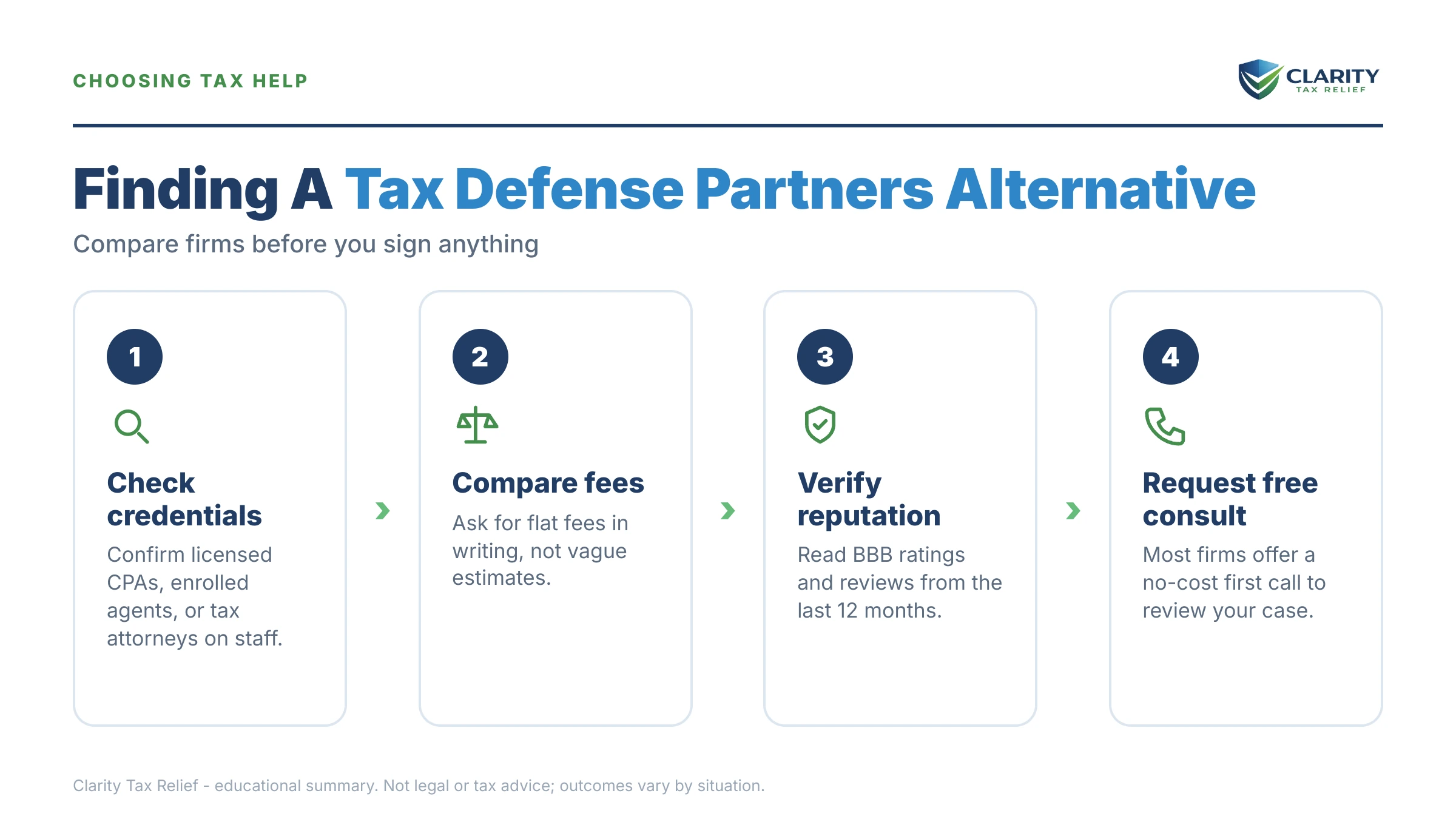
Every legitimate tax relief firm, Clarity included, should pass the same six checks. Use this as a scorecard and run it against every firm you talk to, including the one you started with.
| What to check | Why it matters | Green flag vs. red flag |
|---|---|---|
| Who does the work | Only an enrolled agent, CPA, or tax attorney can represent you before the IRS | Green: a named credential on your Form 2848 · Red: a "senior specialist" with no credential |
| Pricing structure | Hidden phases are how surprise bills happen | Green: one written flat fee · Red: "phase one" with more to come |
| Scope in writing | You should know exactly which years and notices are covered | Green: your specific years listed · Red: vague "we'll handle the IRS" |
| Transcript review first | No one can scope your case without seeing IRS records | Green: they pull transcripts before quoting · Red: a settlement number on call one |
| Refund / stall policy | You need to know what happens if the case can't resolve as described | Green: a written refund policy · Red: "all sales final," no answer |
| Sales pressure | Legitimate relief programs don't expire this afternoon | Green: time to think and compare · Red: "sign today or lose the discount" |
Notice what's not on that list: number of TV ads, a celebrity endorsement, or a promised dollar amount. Those sell; they don't resolve. For a deeper walkthrough of the vetting process, see how to choose a tax relief company and the full questions to ask a tax relief company before you pay.
What a tax relief firm should actually cost
Legitimate tax resolution is priced by the complexity of the work, not the size of your debt. A firm quoting a huge fee simply because you owe a lot, before reviewing anything, is pricing off your fear. Here's the realistic range, and note these are the firm's fees; the IRS charges its own separate fees on top.
| Case type | Typical flat-fee range | Separate IRS fee |
|---|---|---|
| Simple installment agreement (under $50k) | $0 (DIY) to ~$1,000 | $0–$69 setup, waived for direct debit / low income |
| Penalty abatement request | $500–$1,500 | $0 |
| Currently Not Collectible / hardship | $1,000–$3,000 | $0 |
| Offer in Compromise | $3,500–$7,500+ | $205 application fee (waived if low-income certified) |
| Multi-year unfiled returns + resolution | $2,500–$10,000+ | Varies by chosen program |
The fee model matters as much as the number. A single, all-in flat fee is easiest to hold a firm to. Hourly can work for a tax attorney on a complex case but should come with an estimate. Steer clear of anything sold as a percentage of "savings" — that's the language of an Offer in Compromise mill. Compare fee models in detail in our guide to tax relief flat fee vs. hourly.
A worked example: is the fee worth it?
Say you owe $34,000 across your 2023 and 2024 returns, both filed but unpaid, and you have steady W-2 income. One firm quotes you $6,000 to "pursue a settlement." Here's the math a straight-talking alternative would show you instead.
Because your balance is under $50,000, you likely qualify for a streamlined installment agreement spread over 72 months. That's roughly $472/month before interest, set up online for little or no fee. With steady income and no unusual hardship, an Offer in Compromise probably isn't realistic — the IRS would look at your income and assets and conclude it can collect the full amount over time.
So the honest advice here might cost a few hundred dollars to set up correctly and confirm no penalty relief was left on the table, not $6,000 to chase a settlement you don't qualify for. That gap is exactly why you compare. Use the Offer in Compromise Calculator to sanity-check whether a settlement is even plausible for your numbers before any firm quotes you for one.
How to vet a Tax Defense Partners alternative, step by step
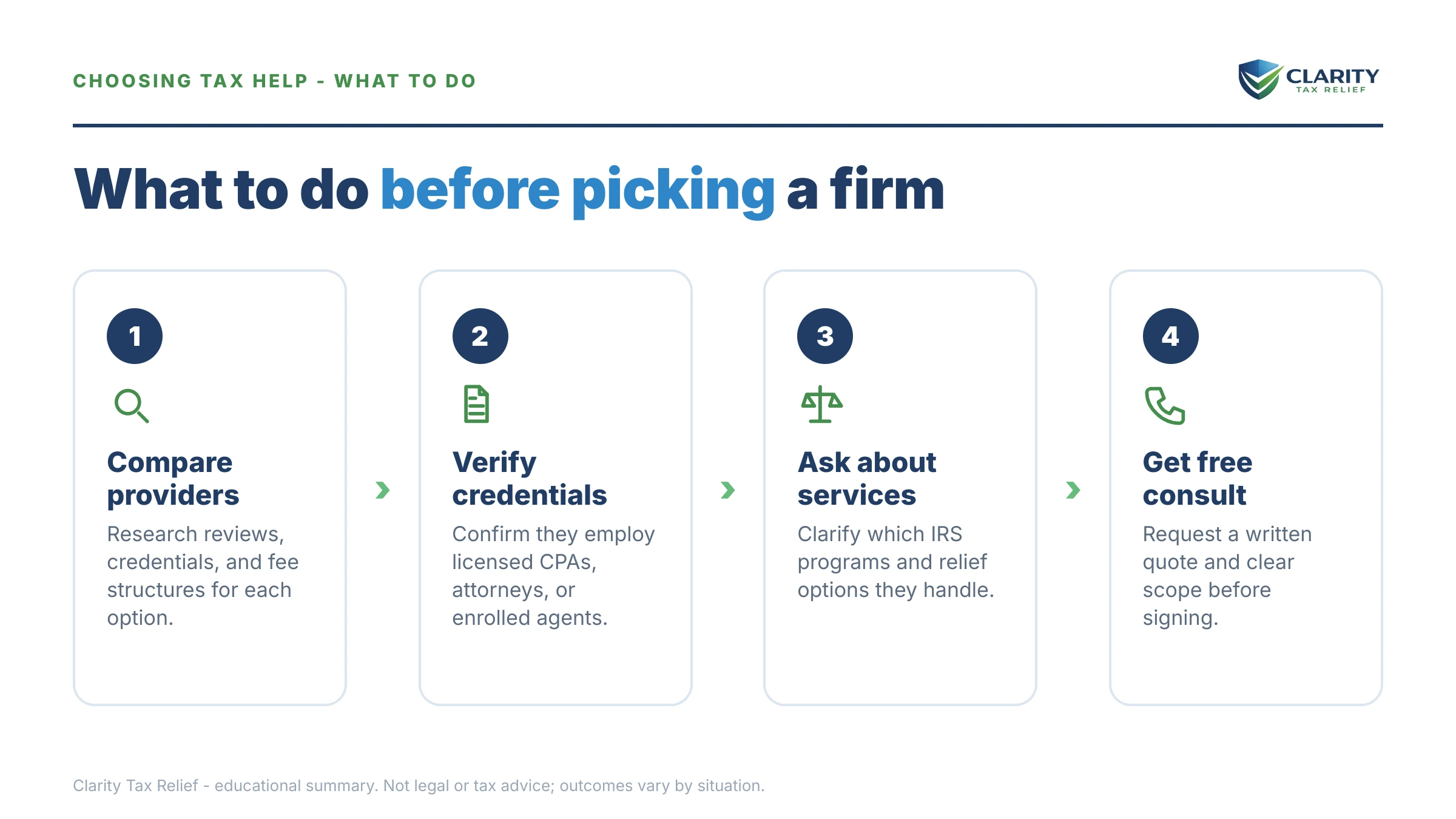
- Get a written scope, not a sales pitch. Ask exactly which returns, notices, and years the firm will handle, and get it in writing before you pay.
- Confirm who actually does the work. Ask for the credential — enrolled agent, CPA, or tax attorney — of the person who will sign your Form 2848 and speak to the IRS.
- Pin down the total flat fee and refund policy. Get the all-in price, what it covers, what triggers extra charges, and what happens to your money if the case stalls.
- Make them show the math before promising a result. A trustworthy firm reviews your transcripts and finances first, then tells you which outcomes are realistic.
- Compare two or three firms on the same facts. Give each the same balance and notices, then compare scope, price, and honesty side by side before signing.
Run this same scorecard against the bigger names too — it's exactly how we'd suggest evaluating an Optima Tax Relief alternative or a Community Tax alternative. The brand changes; the checklist shouldn't.
When you can handle this yourself, and when you shouldn't
Not every tax debt needs a firm at all, and an honest alternative will tell you so. You can very likely do this yourself if:
- You owe under $50,000, agree with the balance, and just need a payment plan — that's a few minutes online.
- You got a single notice you understand and can pay or set up in installments.
- You qualify for straightforward first-time penalty abatement and can make one phone call or send one letter.
Experienced help genuinely changes the outcome when the stakes and complexity climb:
- A wage or bank levy is already in motion and you need it released fast.
- You have multiple unfiled years — the order you file and resolve in changes what you ultimately owe.
- You have business or payroll (941) debt, where personal liability and larger dollars come into play.
- You're a real Offer in Compromise candidate and the math needs to be built and defended correctly.
The honest test: if the wrong move would cost you far more than a fee, hire experience. If it wouldn't, keep your money. Curious what a good consultation feels like? Here's what to expect at a free tax relief consultation.
Terms decoded: what firms actually mean
Enrolled agent (EA): a federally authorized tax practitioner who can represent you before the IRS in any state — a real credential, unlike "tax specialist." See what an enrolled agent is.
Flat fee: one agreed price for a defined scope of work, paid up front or on a schedule — the opposite of open-ended hourly billing.
Power of attorney (Form 2848): the form that lets a firm legally talk to the IRS for you. Whoever signs it as your representative is who's actually doing the work.
"Pennies on the dollar": advertising slang, not an IRS program. It refers loosely to an Offer in Compromise, which is means-tested and accepted only about 1 in 5 times — never a certainty.
Reasonable Collection Potential (RCP): the IRS's formula for the least it thinks it can collect from you. It, not a firm, decides whether a settlement offer flies.
If a firm can't explain these in plain English, that tells you something. And if you've already paid one that went quiet, read what to do when a tax relief company took your money.
Tax Defense Partners alternative: questions, answered
Is Tax Defense Partners a legitimate company?
Tax Defense Partners is an established tax resolution firm, so this isn't a question of legitimacy — it's a question of fit and value. Whether any firm is the right choice for you depends on the credential of the person handling your case, the total flat fee, and whether the scope matches your actual problem. Compare it against two other firms on the same facts before you decide.
What is a good alternative to Tax Defense Partners?
A good alternative is any firm that puts a credentialed enrolled agent, CPA, or tax attorney on your case, charges a clear flat fee, and reviews your transcripts before quoting an outcome. Don't pick on brand name alone — score each option on credentials, transparent pricing, and honest scoping. Getting two or three quotes on identical facts is the fastest way to see who is telling you the truth.
How much should a tax relief company cost?
Most legitimate tax resolution work runs from roughly $750 for a simple installment agreement to $3,500–$7,500+ for an Offer in Compromise or multi-year unfiled-return case. Beware any firm that quotes a large fee before seeing your transcripts, or that splits the fee into vague phases. The IRS charges its own separate fees — a $205 OIC application fee and setup fees for some payment plans.
Can I do what a tax relief firm does myself?
Yes, for straightforward cases. If you owe under $50,000 and agree with the balance, you can set up a payment plan online in minutes with no professional at all. Where experienced help changes the outcome is with multiple unfiled years, an active levy, business or payroll debt, or Offer in Compromise math — situations where one wrong move costs far more than a fee.
Is Tax Defense Partners the same as Tax Defense Network?
No. They are two different companies with similar names, which is a common source of confusion when people search for reviews. Make sure any review, complaint, or fee you read about actually matches the firm you're considering. Confirm the legal business name and address in your engagement letter before you sign or pay anything.
What questions should I ask before switching tax relief firms?
Ask who will personally handle your case and their credential, the total flat fee and what triggers extra charges, and what realistic outcomes they see after reviewing your transcripts. Also ask for the refund policy if the case stalls. If a firm dodges any of these or pressures you to sign the same day, treat that as your answer.
Will an alternative firm settle my tax debt for pennies on the dollar?
That kind of deep-discount slogan is marketing language, not a program — no honest firm can promise a settlement amount before reviewing your finances. The IRS accepted roughly 1 in 5 Offers in Compromise in fiscal year 2024. It decides the number based on your income and assets, not a firm's pitch. A reputable alternative tells you whether you're even a candidate before you spend a dollar chasing it.
Your next 24 hours
- Find your real numbers. Pull the exact balance and tax years from your latest IRS notice or your IRS online account — that's what any firm must scope against.
- Gather three things. Your most recent notice, your last filed return, and a rough monthly income-and-expense picture. That's enough for a real firm to tell you what's realistic.
- Get a no-obligation second opinion. Use our 2-minute form at /#consult or call (888) 825-7779. We'll tell you honestly what your case needs and what it should cost, even if the answer is that you don't need us. Penalties and interest keep accruing while you decide, so don't sit on it.
This guide is general information, not tax or legal advice for your specific situation. Eligibility for IRS programs depends on individual facts and circumstances; no outcome is guaranteed. Clarity Tax Relief is not affiliated with Tax Defense Partners or any other firm named for comparison. Company names are used only to help you evaluate your options.