
Hiring Tax Help
Tax Relief Consultation: What to Expect in 2026
The short answer: a tax relief consultation is a free 20–30 minute phone call where a tax professional asks about your balance, unfiled years, and income, then names the IRS programs that realistically fit you. Expect clear options and a written fee quote — never pressure to pay or sign on the first call.
You're self-employed, the IRS says you owe more than you could write a check for, and every company you've researched wants you to "call now for a free consultation." You're not sure whether that call is help or a sales script. Fair — it can be either. This guide to a tax relief consultation — what to expect stage by stage, what the work costs afterward, and the exact red flags that mean hang up — puts you in control before you dial.
⏱ The real clock: there's no application deadline for getting help, but your balance grows while you decide. The IRS failure-to-pay penalty adds 0.5% per month, interest compounds daily on top of it, and the automated notice sequence keeps advancing whether or not you've made a call.
Why the consultation is free, and what that means for you
Free tax relief consultations exist because they are the industry's sales call: the firm is screening you as a potential client at the same time you're screening them. That's not a scandal, it's the business model. But it means you should treat the call as a two-way interview, not a diagnosis you passively receive.
The useful consequence: you hold all the leverage on a first call. You haven't paid, you haven't signed, and any quote worth taking will still be valid tomorrow. A firm that tries to collapse that leverage, "this price is only good today", is telling you how it treats clients after the check clears.
The other consequence: quality varies wildly. Some consultations are run by credentialed tax professionals; others are run by commissioned salespeople reading a script. The stage-by-stage breakdown below shows you how to tell which one you got, usually within the first five minutes.
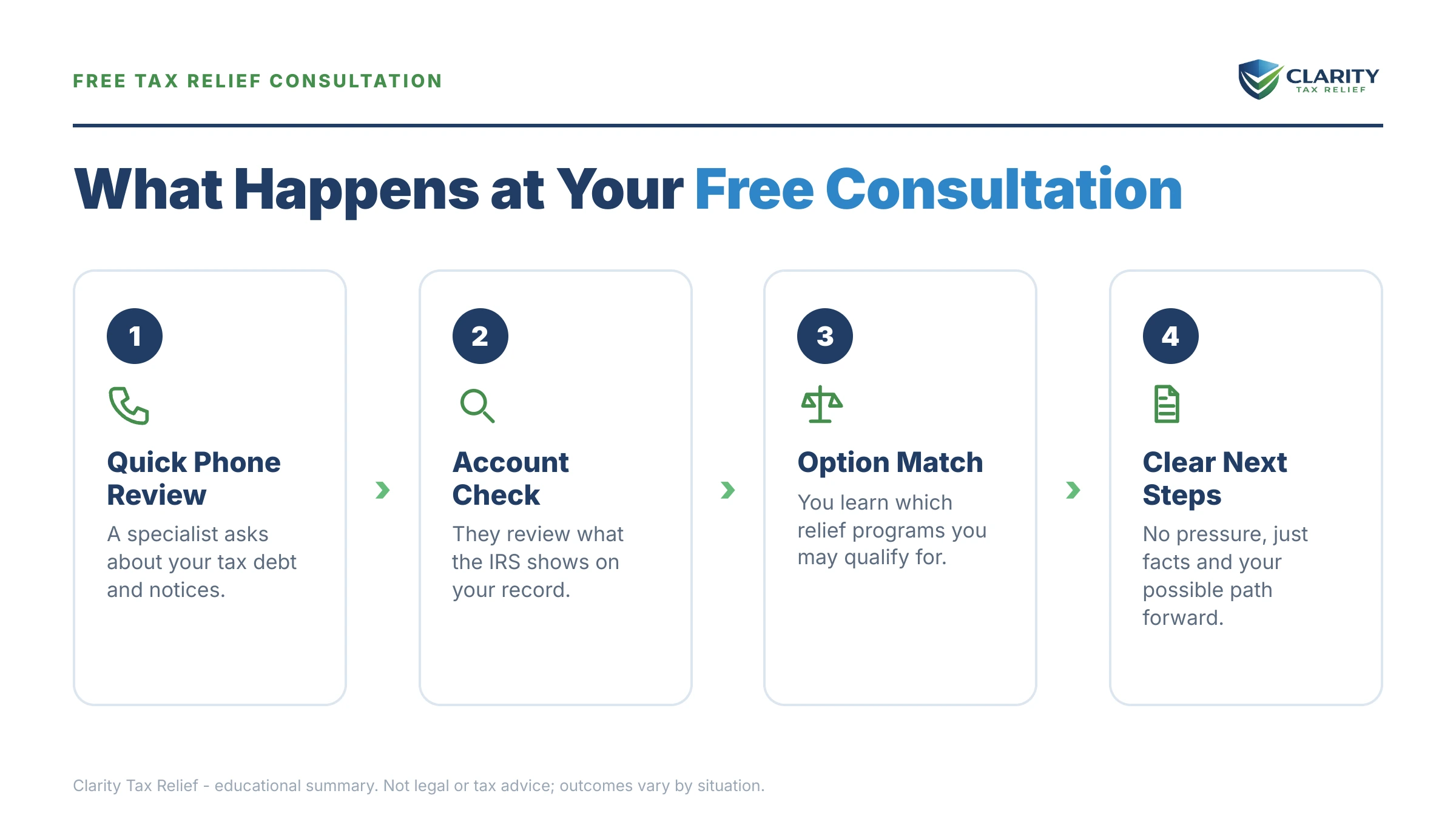
Tax relief consultation: what to expect on the call, stage by stage
A legitimate tax relief consultation runs about 20 to 30 minutes and moves through four stages: intake, a compliance check, an options triage. A fee quote. If the call skips straight from "hello" to "here's what you'll pay us," you learned everything you needed to know.
Stage 1: The intake (roughly the first five minutes)
Expect specific questions: how much the IRS says you owe, which tax years, whether it's income tax or something else (payroll, a state balance), what notices you've received, and how you earn — W-2, 1099, or a business. As a sole proprietor, expect follow-ups about estimated tax payments and whether you have employees, because those change the whole playbook.
Notice the direction of information. In a real consultation, the questions flow toward you before any promises flow back. A scripted sales call inverts that — big claims first, details never.
Stage 2: The compliance check
The first substantive question should be about unfiled returns, because the IRS won't approve an installment agreement or an Offer in Compromise while required returns are missing. If you have unfiled years, a competent consultation reorders everything: returns first, then penalties, then the balance, because the sequence changes what you ultimately pay.
Stage 3: The options triage
Based on your numbers, the professional should name which programs are realistic and, just as important, which are not. The phrasing matters: "you may qualify for an offer if your equity and disposable income come in low enough" is honest; "you qualify for the Fresh Start Program" before any financial screening is a sales line. The full options grid is in the table below.
Stage 4: The quote, and the pause
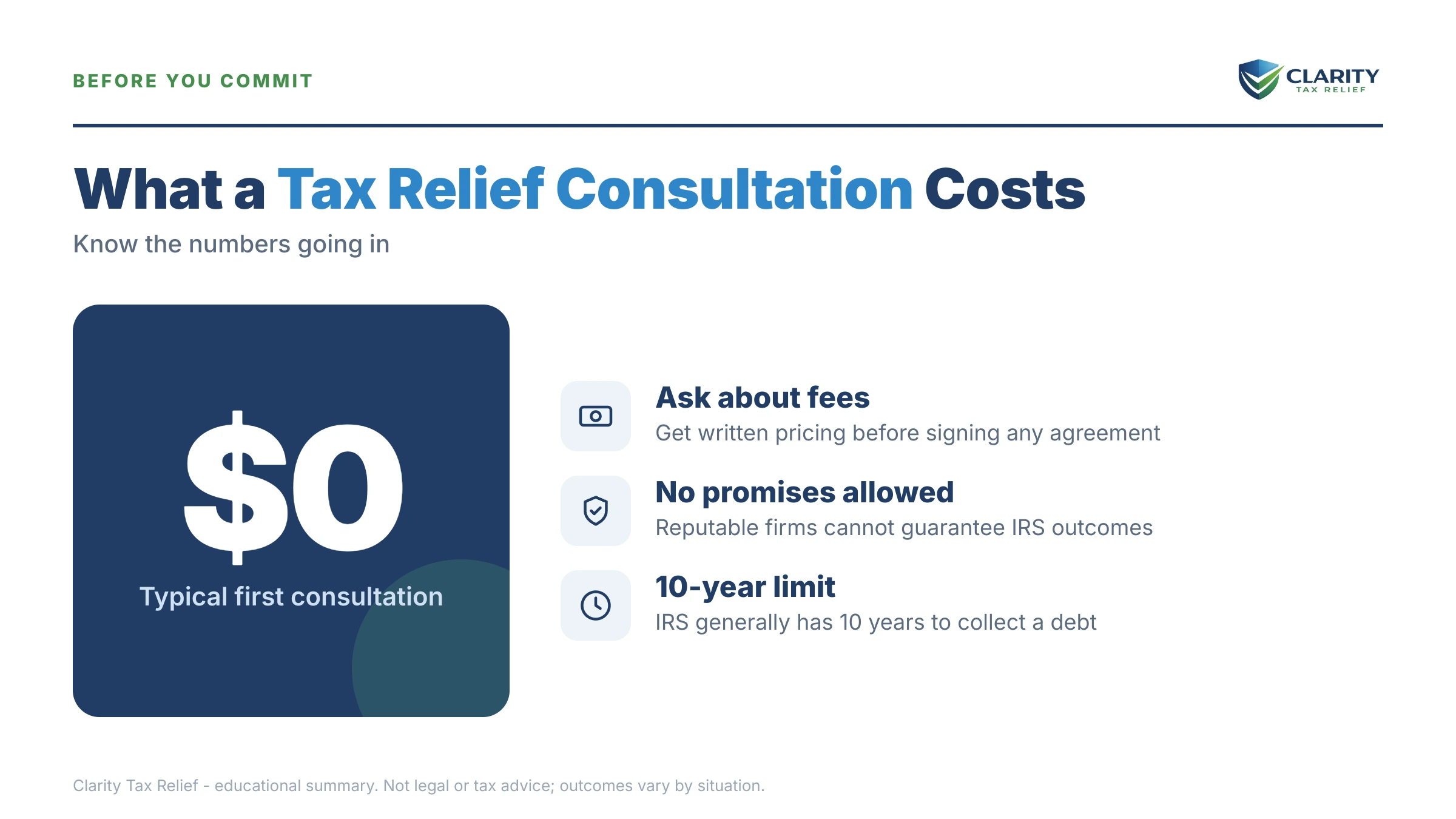
The call should end with a specific next step (usually a paid investigation phase, where the firm pulls your IRS transcripts with your authorization) and a written fee quote. What it should never end with: a payment. Compare flat-fee vs. hourly pricing models before you commit, and take the quote overnight. Any firm that objects to a 24-hour pause has answered your real question.
One thing no consultation can honestly do: quote your final settlement figure on a first call. Nobody knows what the IRS will accept until your transcripts and financials are on the table.
What happens if you keep putting the call off
Every month spent "still deciding" adds roughly 0.5% in failure-to-pay penalty plus daily-compounding interest, and moves the IRS's automated collection sequence one step forward. The sequence doesn't wait for you to finish comparison shopping:
- Bills and reminders — CP14, then CP501/CP503. No enforcement yet, but the balance grows monthly.
- CP504, Notice of Intent to Levy — the IRS can seize your state tax refund, and a federal tax lien becomes a live possibility.
- LT11 / Letter 1058, Final Notice — a 30-day clock starts. After it runs, the IRS can levy bank accounts. A levy served on one of your clients can capture the entire payment they owe you. Your Collection Due Process appeal rights attach here, and expire here.
- Ongoing enforcement — bank levies (with a 21-day hold before funds leave), continuous levies, lien filings, and refund offsets, all issued by automated systems that IRS staffing cuts did not slow down.
One threshold worth naming for a mid-five-figure balance: passport certification kicks in at $66,000 of seriously delinquent tax debt in 2026. A $48,300 balance accruing penalties and interest, plus one more unfiled year of self-employment tax, can cross that line faster than you'd expect.
Want a consultation that works the way this article says it should?
Hold us to this exact checklist. An experienced tax professional will review your balance, your filings. Your realistic options — free, confidential. You will not be asked to pay or sign anything on the call.
The resolution options a good consultation screens you for
A competent consultation tests your numbers against six IRS resolution paths, each with a hard eligibility threshold. If the person on the phone recommends a program without asking the questions that determine eligibility for it, they're selling, not screening.
| Option | Who typically qualifies | The key numbers |
|---|---|---|
| Short-term payment plan | You can pay in full within 180 days | $0 setup fee; interest and the 0.5%/month penalty continue until paid |
| Streamlined installment agreement | Balances up to $50,000 (direct debit generally required above $25,000) | Up to 72 months; can be set up online without full financial disclosure |
| Guaranteed installment agreement | You owe $10,000 or less in tax and are filing-compliant | Approval is essentially assured by statute if you meet the conditions |
| Currently Not Collectible (CNC) | Income at or below IRS allowable living expenses | Collection pauses; the debt remains and interest keeps accruing |
| Offer in Compromise (OIC) | Your assets plus future income total less than the balance | $205 fee; 20% down on lump-sum offers (both waived with low-income certification); roughly 1 in 5 offers accepted in FY2024 |
| Penalty abatement | Clean compliance in the prior 3 years (First-Time Abate), or reasonable cause | $0 to request; automatic AEP relief begins replacing FTA in summer 2026 |
The shared background on how each program works lives in our guide to how to settle tax debt yourself. On the consultation itself, what matters is that the recommendation matches the thresholds above — in front of you, using your numbers.
What the math looks like on a $48,300 balance
On a hypothetical $48,300 balance, a streamlined installment agreement with direct debit runs roughly $671 a month over 72 months, before the interest and penalties that keep accruing on the declining balance. That's the arithmetic a real consultation should do out loud.
Say you're a sole-proprietor electrician who under-paid quarterlies for two years and now owes $48,300, all returns filed. The consultation should walk you through at least two paths:
Path 1 — the payment plan. $48,300 ÷ 72 months ≈ $671/month. Because you're under the $50,000 line, no full financial statement is required, and setup can happen online. Paying faster than 72 months cuts the total interest meaningfully, so the real question is the largest payment your cash flow survives.
Path 2 — the offer screen. An Offer in Compromise turns on your Reasonable Collection Potential (RCP): net asset equity plus a multiple of monthly disposable income. Say your work truck has $5,000 in equity after the loan, tools add $2,000, and after IRS allowable expenses your disposable income is $650/month. A lump-sum offer values future income at 12 months: $7,000 + ($650 × 12 = $7,800) = $14,800 RCP — well below $48,300, so an offer is worth investigating. But change one input — disposable income of $3,500/month — and RCP jumps to $49,000, and the offer is dead on arrival. You can run your own rough numbers with our Offer in Compromise Calculator; it estimates, and the IRS's documented review decides.
This is exactly why the intake questions in Stage 1 matter. As a self-employed filer, your income is lumpy and your allowable business expenses are contested territory — the specifics of an OIC as a self-employed business owner are where experienced preparation most changes the result. And remember the honest baseline: the IRS accepted roughly 1 in 5 offers in FY2024. Anyone who treats acceptance as a formality is not doing math.
How much does tax relief cost after the free consultation?
The consultation is free; the work after it is not, and the fee should be a flat, written number before you pay anything. Here's how the costs and timelines actually break down, separating the IRS's own charges from professional fees:
| Stage or option | What it costs | Typical timeline |
|---|---|---|
| Free consultation | $0 — no obligation | 20–30 minutes |
| Investigation phase (transcript pull & analysis) | Flat fee, varies by firm — get it in writing | Days to a few weeks |
| IRS payment plan setup | IRS setup fee varies by application method — lowest online with direct debit, reduced for low-income taxpayers | Under $50,000, online approval is often same-day |
| Offer in Compromise (IRS side) | $205 application fee + 20% down on lump-sum offers; both waived with low-income certification (AGI ≤ 250% of the poverty level) | Months of review; auto-accepted if the IRS doesn't decide within 2 years, with narrow exceptions: a returned or rejected offer stops the clock, and time during court disputes does not count |
| Currently Not Collectible | $0 IRS fee | Granted after financial review; the IRS revisits it periodically |
| Penalty relief (FTA / AEP) | $0 IRS fee | FTA by phone or letter; AEP applies automatically starting summer 2026 |
Professional fees scale with complexity: a single-year payment-plan case sits at the bottom of any firm's range, while multiple unfiled years plus an OIC sits near the top. Our full breakdown of how much tax relief costs covers what drives the quote. But the rule on the consultation is simple: no total, no deal.
How to prepare for your tax relief consultation, step by step
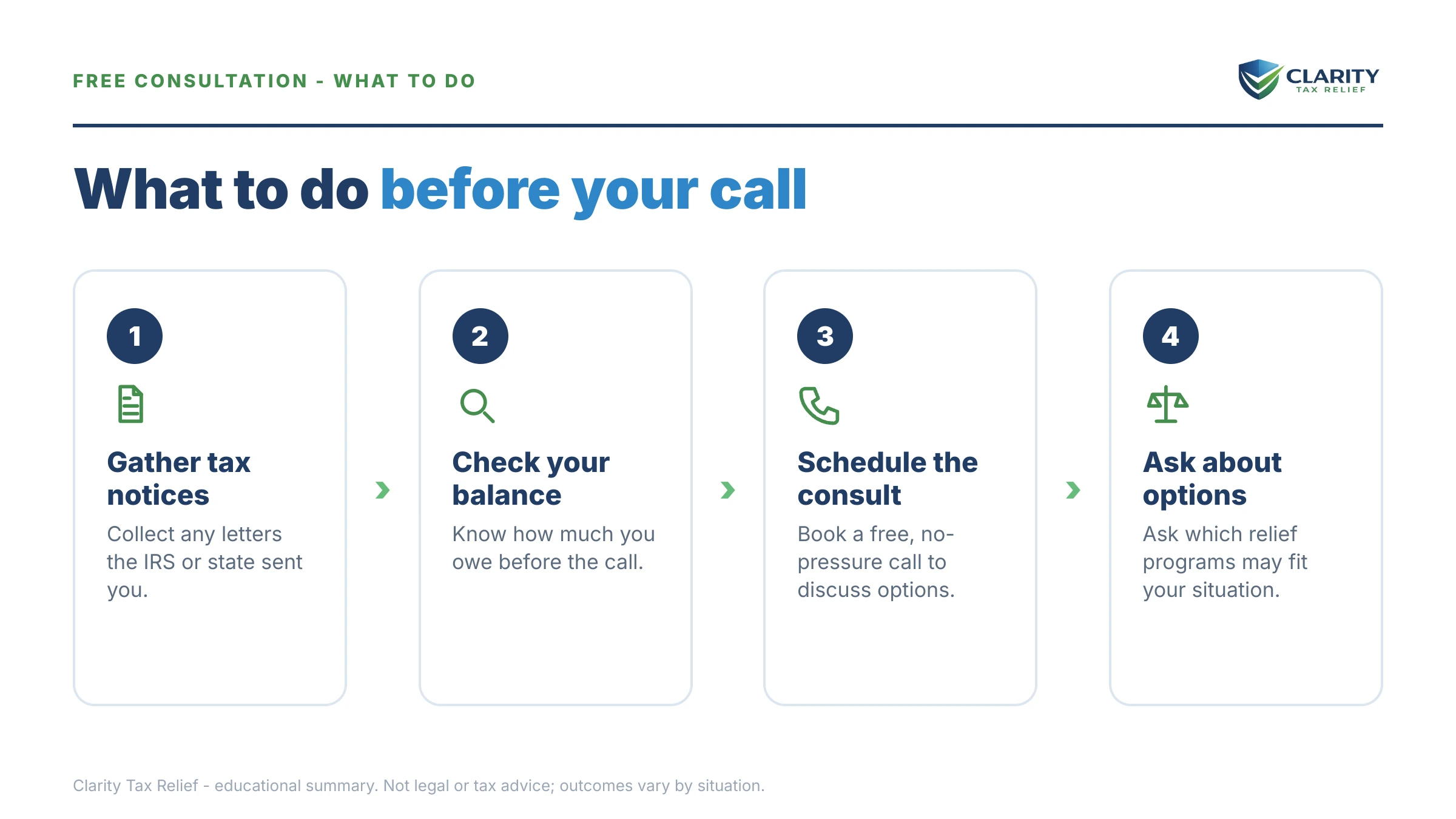
- Pull your IRS records. Log into your IRS online account or gather every notice you've received. The exact balance and tax years turn a vague call into a specific plan.
- List your unfiled years and income sources. Write down any year you didn't file and every 1099 client or platform you earned from — compliance is the first thing a real consultation checks.
- Sketch your monthly budget. Note your average monthly income and essential expenses; those two numbers decide which IRS programs you can realistically qualify for.
- Write down three questions. Ask who will work your case, what the total flat fee is, and how long resolution typically takes, and expect direct answers to all three.
- Book the call and pay nothing on it. Schedule the free review, take notes, and end the call before signing or paying anything. A legitimate quote will still be valid tomorrow.
Want a longer script? Our list of questions to ask a tax relief company covers all of them, with the answers a good firm should give.
Red flags vs. green flags on the consultation call
The fastest scam tell is an outcome promised before a single financial question is asked. Eligibility for every IRS program is means-tested, so a promise made blind is, by definition, made up.
| Red flag on the call | What a legitimate consultation sounds like |
|---|---|
| "You qualify for the Fresh Start Program" before any financial questions | "You may qualify for X if your income and equity come in under Y — we'd verify against your transcripts first" |
| Promises to settle for "pennies on the dollar" — the classic mill pitch | The honest number: the IRS accepted roughly 1 in 5 offers in FY2024, and acceptance is a math test, not a negotiation trick |
| Pressure to pay the full fee before the call ends, or a "today only" price | A written flat-fee quote you're explicitly invited to sleep on |
| Asks for your SSN or bank login in the first minutes | Identity details collected only when you sign a Form 8821 or Form 2848 authorization |
| Vague about who actually works your case | A named enrolled agent, CPA, or tax attorney assigned to your file |
If you're comparing multiple firms, our buyer's checklist on how to choose a tax relief company and the full list of tax relief company red flags go deeper. And if you've already had a consultation with one of the big national brands and something felt off, our Optima Tax Relief alternatives comparison shows what to weigh instead. Business owners carrying payroll or entity-level debt should start with our guide to tax relief for small business — the questions and the fee ranges both run differently.
When you can skip the consultation and handle it yourself
If you owe $10,000 or less, agree with the balance. Your returns are filed, you can usually resolve this online in under an hour without hiring anyone. The same is true if you can pay in full within 180 days — the short-term plan at IRS.gov/payments costs nothing to set up. Our how to settle tax debt yourself pillar walks the whole DIY path.
Experienced help changes outcomes in specific situations: multiple unfiled years (order of filing matters), OIC math built on self-employment income (documentation makes or breaks it), business or payroll tax debt (personal liability is on the table), a levy already served on a bank or client, or a balance you dispute. If money is the barrier, the Taxpayer Advocate Service and Low Income Taxpayer Clinics offer free help for those who qualify.
A consultation that tells you "honestly, you can do this yourself online" is the strongest possible signal you found a firm worth remembering when a bigger problem comes.
Terms you'll hear on the call, decoded
- Form 8821 vs. Form 2848: 8821 lets a firm see your IRS records; Form 2848 power of attorney lets a professional speak and act for you. Know which one you're signing.
- Investigation phase: the first paid step at most firms — pulling and analyzing your IRS transcripts to confirm exactly what you owe and which programs fit.
- Form 433-A / 433-F: the IRS financial statements that document your income, expenses, and assets for hardship status, larger payment plans, and offers.
- Reasonable Collection Potential (RCP): the IRS's formula, asset equity plus future income, that decides whether an Offer in Compromise can be accepted.
- Currently Not Collectible (CNC): a hardship status that pauses collection when you genuinely can't pay; the debt and interest remain.
- CSED: the Collection Statute Expiration Date — generally 10 years from assessment, though appeals, offers, and bankruptcy pause the clock.
Tax relief consultation questions, answered
Is a free tax relief consultation really free?
Yes — at a legitimate firm, the first consultation costs nothing and creates no obligation. The firm's business model is that some callers become paying clients, so the call doubles as their sales pitch and your interview of them. The line to watch is what comes next: you should get a written fee quote before paying a dollar, and no reputable firm charges for the first call itself.
What should I have ready for a tax relief consultation?
Have your most recent IRS notice, your last filed return, a list of any unfiled years, and a rough monthly budget. Perfect records aren't required — the balance from your IRS online account and your approximate 1099 income are enough for a useful first call. The more specific your numbers, the more specific the options you'll hear back.
Should I give my Social Security number during the consultation?
Not in the first minutes of a call you made from an ad. A firm only needs your SSN when it actually pulls your IRS transcripts, which requires your signature on Form 8821 or Form 2848 — something that happens after you've decided to hire them. Confirm the firm's identity and get the fee quote first; a legitimate company won't push back on that order.
How much does tax relief cost after the free consultation?
Professional fees vary with case complexity — a simple payment-plan setup costs far less than a multi-year case with unfiled returns and an Offer in Compromise. The IRS's own charges are modest by comparison: a $205 OIC application fee and payment-plan setup fees that are lowest online. Insist on a flat, all-in quote in writing before you pay anything.
Can the company talk to the IRS during my consultation?
No. Nobody can speak to the IRS on your behalf until you sign Form 2848 (power of attorney) or Form 8821 (information authorization), which doesn't happen on a first call. Any salesperson who claims they already checked your IRS file before you signed anything is describing something that didn't happen — treat it as a reason to hang up.
Can a tax relief company really settle my debt for less than I owe?
Sometimes, through an Offer in Compromise, but only when your income and assets show the IRS genuinely can't collect the full balance. The IRS accepted roughly 1 in 5 offers in FY2024, and acceptance is a math test, not a negotiation. A good consultation runs that math with you before recommending an offer; a bad one promises a settlement before asking a single financial question.
How do I know if a tax relief consultation is a scam?
Scam calls promise outcomes; legitimate ones ask questions. Watch for guarantees of a specific settlement, "you qualify" declarations before any financial screening, pressure to pay before the call ends, and requests for bank logins. A real consultation ends with conditional options, "you may qualify for X if Y", and a written quote you're free to sleep on.
Do I need a consultation if I owe the IRS less than $10,000?
Usually not. At $10,000 or below you likely fit the IRS's guaranteed installment agreement, which you can set up online in minutes if your returns are filed. A consultation earns its place at larger balances, multiple unfiled years, business or payroll debt, or when a levy is already in motion — situations where sequencing mistakes get expensive.
Your next 24 hours
- Find your real number. Log into your IRS online account or pull your most recent notice, and write down the total balance and each tax year it covers.
- Gather your three documents. Your last filed return, any IRS notices. A rough list of monthly income and essential expenses — that's everything a first call needs.
- Book the free review. Use the 2-minute form at claritytaxrelief.com/#consult or call (888) 825-7779. There's no deadline to hire anyone, but interest and the failure-to-pay penalty accrue every month you carry the balance, so the review that costs nothing is worth doing this week.
This guide is general information, not tax or legal advice for your specific situation. Eligibility for IRS programs depends on individual facts and circumstances; no outcome is guaranteed.