
Choosing Tax Help
Optima Tax Relief Reviews: Is It Legit in 2026?
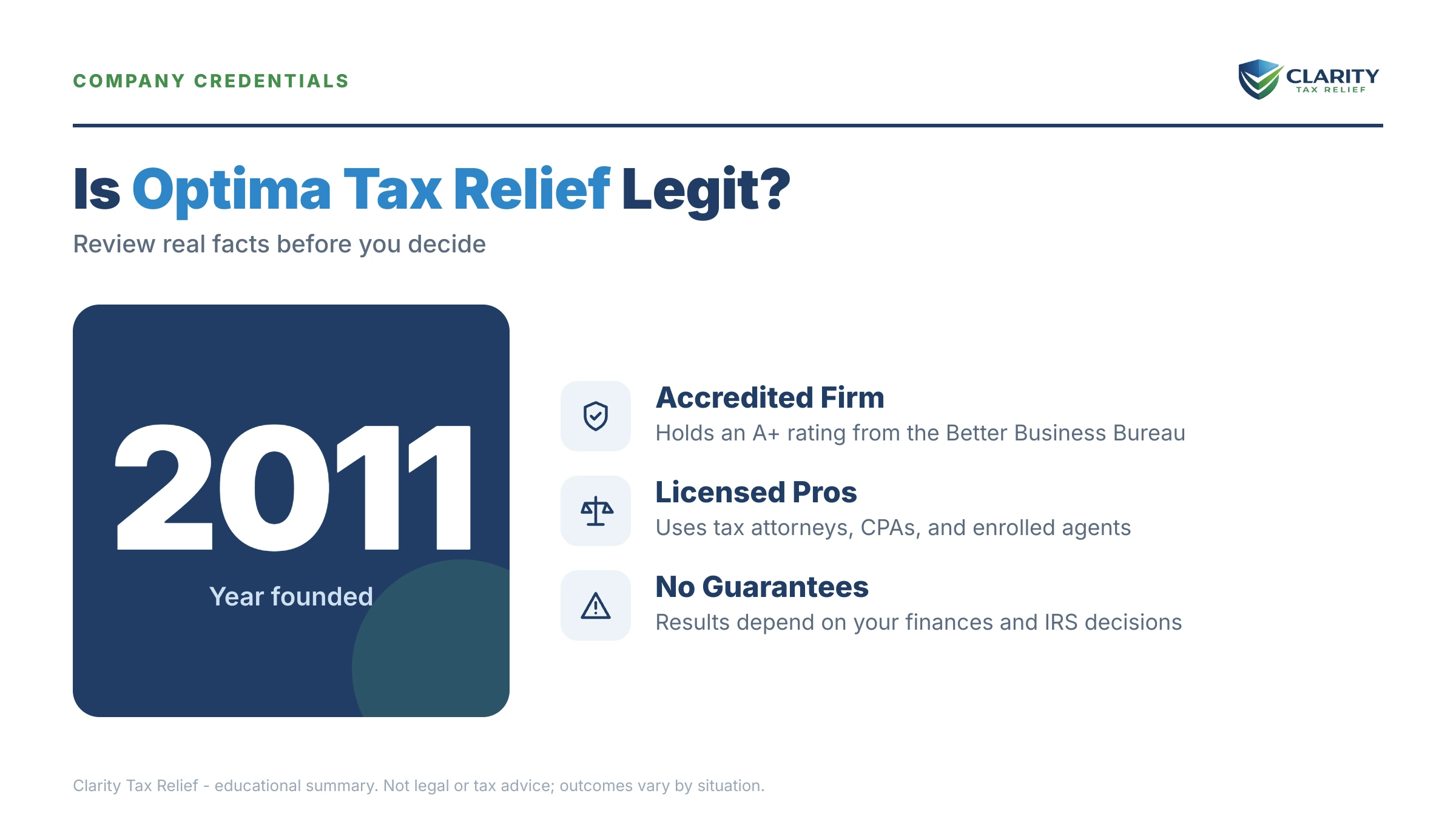
The short answer: yes — Optima Tax Relief is a legitimate, operating tax-resolution company, not a scam. Founded in 2011 and based in Santa Ana, California, it employs enrolled agents, CPAs, and tax attorneys. "Legit" and "worth the fee," though, are two different questions, and the answer to the second depends entirely on your case.
You saw the TV ad, or a rep called back fast after you filled out a form, and now you're staring at a contract with a four-figure fee on it. Before you hand over money to fix an IRS balance, you want to know one thing: is this a real firm that will actually help, or are you about to get burned? That instinct to check first is exactly right.
Here's the honest frame most reviews skip: whether Optima is real is easy to answer, and the answer is yes. Whether it's the right use of your money for your tax problem is the question worth your ten minutes. The breakdown below shows exactly where your money goes when you hire a firm like this, and where you can look before you sign.
⏱ The clock that actually matters: Optima's sales timeline isn't your deadline — the IRS's is. While you compare firms, the failure-to-pay penalty keeps adding 0.5% a month and interest compounds daily on the balance. The company you choose matters far less than not letting weeks pass while automated collection keeps escalating.
Is Optima Tax Relief legit? What "legit" actually means here
Optima Tax Relief meets every objective test of a legitimate business. It is registered, insured, publicly reviewed, and staffed by credentialed professionals. That is very different from a fly-by-night scam. A scam demands gift cards, spoofs the IRS by phone, and disappears with your money. Optima signs a written engagement, files an IRS power of attorney (Form 2848) to represent you, and answers complaints publicly.
So the word "legit" is doing two jobs in that search box. One is "is this a fraud?" — no. The other is "will paying them get me a result I couldn't get cheaper myself?", and that answer is it depends on how complex your case is. Keep those two questions separate and this whole decision gets clearer.
If your bigger worry is whether tax-relief firms as a category are trustworthy, start with our plain-English take on whether tax relief is legit, then come back here for the Optima-specific details.
| What to check | Legitimate firm (Optima included) | Scam or fee mill |
|---|---|---|
| How you pay the IRS | Payments go to the U.S. Treasury or IRS.gov | Asks you to pay the "IRS" via gift cards, wire, or apps |
| Promises made | "You may qualify, pending IRS review" | "Guaranteed" settlement or "pennies on the dollar" |
| Credentials | Named enrolled agents, CPAs, tax attorneys | Vague "tax experts," no license you can verify |
| Fees | Flat fee in a written contract, quoted after review | Large upfront cash before anyone reads your file |
| Contract & refunds | Written scope, written refund terms | Verbal promises only; no paperwork |
Why so many people search "is Optima Tax Relief legit"
The volume of this exact search is a byproduct of heavy advertising, not a sign of fraud. Optima is one of the most visible tax-relief brands in the country, so millions of people hear the name and, sensibly, Google it before spending money. High ad spend plus high fees plus an emotional situation (owing the IRS) reliably produces a lot of "is this real?" searches.
Second, the industry has a genuine reputation problem, and it colors every brand in it. The FTC has taken enforcement action against several tax-relief companies over the years for deceptive "settle for a fraction" claims. That's why our library also covers tax relief scams and a full tax relief red flags checklist, so you can tell the difference between a real firm and a mill on sight.
Third, people confuse "I didn't get the result I wanted" with "I got scammed." Those aren't the same. The Offer in Compromise a salesperson mentioned is real, but the IRS accepted only roughly 1 in 5 offers in FY2024, so a firm can do everything right and still have your offer rejected because the numbers don't support it.
Where to read real Optima Tax Relief reviews
Most pages that rank for this query are written by firms that would like your business instead, including this one. So the useful thing is not another opinion, it is knowing where the primary sources sit and how to read them.
The places worth your time are the ones a company cannot curate: the Better Business Bureau profile, Google Business reviews, Trustpilot, and your state attorney general's consumer complaint records. The Federal Trade Commission publishes enforcement actions against tax relief companies, and those are worth a search on any firm's name before you sign anything.
Read them for content rather than for the star average. A large company collects more complaints than a small one simply by volume, so the count on its own tells you very little. What tells you something is the shape: are people describing a fee they did not expect, a refund they could not get, a case that went quiet for months, or an outcome that was suggested on the sales call and never materialised? Those are different problems and they point at different things.
Two questions cut through most of it, and they work on any firm. What exactly does the first fee buy, in writing? And what happens to that money if the honest answer turns out to be that you qualify for nothing more than a payment plan you could have set up yourself in twenty minutes?
What happens while you shop around
The most expensive mistake here isn't picking the wrong firm — it's letting the decision drag while IRS collection keeps moving. The notice sequence is automated, and in 2026 that machine is running even though IRS staffing was cut about 27% in 2025. Nobody has to look at your file for the next letter to print.
- CP14 — the first balance-due bill. Penalties and interest are already accruing.
- CP501 / CP503 — reminder notices. Still just bills, but the balance grows every month.
- CP504 — Notice of Intent to Levy. The IRS can seize your state tax refund; a federal lien becomes a real possibility. (See our CP504 notice guide.)
- LT11 / Letter 1058 — the Final Notice. After 30 days, the IRS can garnish wages and levy bank accounts, and your appeal rights are on a clock. (See the LT11 notice guide.)
Point being: whether you hire Optima, a smaller firm, or handle it yourself, do something before the next notice arrives. A firm can pause much of this by getting into your file and requesting a hold, but only after you've signed and they've filed the power of attorney, which takes time.
Not sure whether to hire Optima, or handle it yourself?
Get a free, no-pressure case review from an experienced tax professional. We'll tell you honestly whether your situation needs paid representation or whether you can fix it yourself for free, while penalties and interest keep accruing on the balance.
What Optima Tax Relief actually costs
Optima uses the standard two-phase pricing model of large tax-resolution firms: a smaller investigation fee first, then a larger resolution fee. The free consultation you booked from the ad is a sales call, not the service — the real work starts at the investigation phase.
Exact numbers are quoted after they review your situation. They vary widely with the number of tax years, the size of the debt, and whether you have unfiled returns. The ranges below are typical of the industry. Treat them as a frame, not a promise, and always get your specific flat fee in writing.
| Phase | What it covers | Typical range |
|---|---|---|
| Consultation | Sales call; reviews your situation, quotes a fee | Free |
| Investigation / discovery | Pulls IRS transcripts, confirms balances and filing gaps | ~$295–$695 |
| Resolution | Files POA, negotiates the plan, prepares forms/returns | ~$2,000–$7,500+ |
Compare that to what the IRS charges for the underlying programs, because the firm fee is on top: a long-term payment plan can be $0 to set up online, an Offer in Compromise application fee is $205 (waived for low-income filers), and first-time penalty abatement is free to request. You're paying a firm for expertise and handling, not for access to the programs themselves. For how those two pricing worlds compare, see tax relief flat fee vs. hourly.
A worked example: does the fee make sense on $38,000?
Say you owe the IRS $38,000 across two filed tax years, you agree with the balance, and you're current on your filings. Here's the math both ways.
Hire a firm: an investigation fee of about $495 plus a resolution fee of, say, $4,000 = $4,495 in fees. The likely outcome for a case this clean is a streamlined installment agreement — a monthly plan over up to 72 months. On $38,000 that's roughly $530/month before interest, and interest and the 0.5%/month penalty keep running until it's paid.
Do it yourself: a balance under $50,000 with all returns filed usually qualifies for a streamlined installment agreement you can set up in your IRS online account in about twenty minutes, for a small setup fee — no $4,000 resolution charge. Same monthly payment, same accruing interest, minus the fee.
For that fact pattern, the fee mostly buys convenience. Now change one fact — add three unfiled years, or a wage levy already in motion, or a genuine Offer in Compromise where your Reasonable Collection Potential has to be calculated and defended, and paid expertise can change the actual dollar outcome, not just save you time. That's the line to watch. You can even estimate your own offer with our Offer in Compromise Calculator before deciding whether an OIC is realistic at all.
Your options: Optima, another firm, or yourself
Optima is one legitimate choice among many, and "the biggest advertiser" isn't the same as "the best fit for your case." Here's the honest comparison.
| Option | Typical cost | Best when |
|---|---|---|
| Large firm (e.g., Optima) | ~$2,500–$7,500+ in fees | You want a known brand and full hand-off; case is moderately complex |
| Smaller / boutique firm | Often lower flat fee, direct pro access | You want a named professional handling your file start to finish |
| Do it yourself | $0–$205 in IRS fees | Simple balance you agree with, returns filed, under ~$25k |
If you're weighing brands, our head-to-head on Optima Tax Relief alternatives lays out what to compare. And if you'd rather not pay any firm, our guide to how to settle tax debt yourself walks through every IRS program you can access directly.
How to check if a tax relief firm is legit, step by step
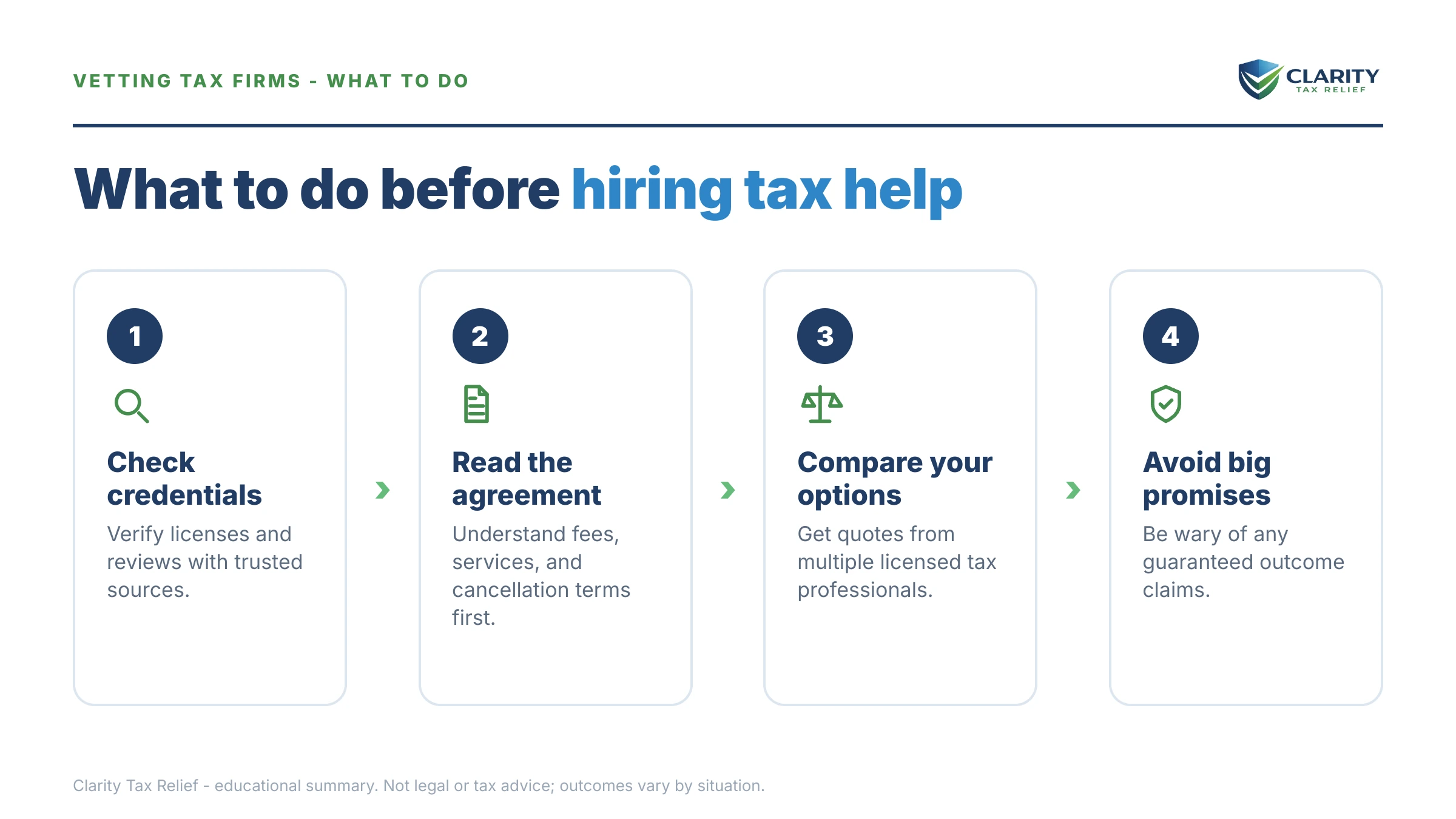
- Verify the company exists and is reviewed. Confirm the business address, and read the actual complaint text, not just the star rating, on the BBB and state records.
- Verify the person, not just the brand. Ask for the name and credential (enrolled agent, CPA, or attorney) of whoever will represent you, and confirm it.
- Get the fee and scope in writing. Insist on a flat fee, what's included, what triggers extra charges. The refund terms, before you pay.
- Screen the promises. Walk away from any "guaranteed settlement" or "pennies on the dollar" language. Eligibility is means-tested by the IRS, never by the firm.
- Confirm nothing routes payment away from the Treasury. Your tax payments go to the IRS. The firm's fee is separate and never disguised as a "tax payment."
- Get a second opinion. A free review from another professional costs you nothing and tells you fast whether the quoted plan is the right one.
For a deeper buyer's script, use our list of questions to ask a tax relief company and our full guide on how to choose a tax relief company before you sign anything.
When to handle this yourself, and when help changes the outcome
Be honest about which case you have, because it decides whether any fee is worth paying.
You can likely do this yourself if you owe a manageable balance you agree with, all your returns are filed. You just need a payment plan. A balance under $50,000 with returns filed usually sets up online in minutes, and a first notice you agree with rarely needs paid help. Paying $4,000 to arrange a plan you could arrange free is the single most common regret in this space.
Experienced help genuinely changes the outcome when the case is a negotiation, not a form: a wage or bank levy already in motion, several years of unfiled returns, business or payroll (trust-fund) debt, a rejected Offer in Compromise, or a debt large enough that the IRS assigns a revenue officer. In those situations the difference between a good and a bad strategy is real dollars, and that's what a fee should buy.
If a firm has already taken your money and you feel misled, you're not stuck — read "a tax relief company took my money" for your options. And if the pitch centered on a too-good OIC, understand how the Offer in Compromise mill scam works so you can spot it.
Terms on your contract, decoded
Investigation (discovery) fee — the first, smaller charge to pull your IRS transcripts and confirm what you actually owe and which years are unfiled.
Resolution fee — the larger charge for the actual negotiation, form preparation, and any back returns; this is where most of your money goes.
Power of Attorney (Form 2848) — the IRS authorization that lets the firm speak to the IRS on your behalf and request holds. Nothing real happens until it's filed.
Enrolled agent — a federally licensed tax practitioner with unlimited rights to represent taxpayers before the IRS. What an enrolled agent is, in full.
Reasonable Collection Potential (RCP) — the IRS's own math for the most it could collect from you. It determines whether an Offer in Compromise is even possible, no matter what a firm promises.
Still deciding who to trust? Our free case review will tell you honestly whether your case needs paid representation at all — start here or call (888) 825-7779.
Optima Tax Relief: your questions, answered
Is Optima Tax Relief a scam?
No — Optima Tax Relief is a real, operating company, not a scam. It has been in business since 2011, is headquartered in Santa Ana, California, holds Better Business Bureau accreditation, and staffs licensed tax professionals such as enrolled agents, CPAs, and tax attorneys. The complaints you'll read online are almost always about price, communication, or unmet expectations, not fraud. A scam takes gift cards and vanishes; Optima signs a written contract and files a power of attorney with the IRS.
How much does Optima Tax Relief cost?
Like most large tax-resolution firms, Optima charges in two phases: a smaller investigation or discovery fee (commonly a few hundred dollars) followed by a resolution fee that typically runs from roughly $2,000 to $7,500 or more, depending on how many years and how much debt are involved. The exact number is quoted after your free consultation, so get the full flat fee, and what's included — in writing before you sign anything.
Can Optima Tax Relief really reduce my tax debt?
Sometimes, but no firm, Optima included, can reduce a debt the IRS wouldn't reduce on its own. Programs like the Offer in Compromise are means-tested by the IRS, which accepted only about 1 in 5 offers in FY2024. A legitimate firm files the paperwork and argues your numbers; it cannot make you eligible. Be very skeptical of anyone who promises you'll pay only a tiny fraction of what you owe before reviewing your finances.
Is Optima Tax Relief BBB accredited?
Yes, Optima Tax Relief has held Better Business Bureau accreditation for years and generally carries a high letter rating. But accreditation and ratings can change, so check the current rating and read the actual complaint text yourself at bbb.org before you decide. A high rating tells you a company answers complaints; it does not guarantee your specific case will succeed.
What are common complaints about Optima Tax Relief?
The recurring themes in public reviews are the cost relative to the result, slow or inconsistent communication, and clients feeling the outcome didn't match what a salesperson implied at signup. These are industry-wide patterns, not unique to Optima. You can protect yourself by getting the scope and fee in writing, asking who your assigned preparer is, and confirming the refund terms before you pay.
Is Optima Tax Relief worth the money?
It depends on your case. If you owe under about $25,000, agree with the balance, and have all your returns filed, you can usually set up a payment plan yourself for a small fee and skip the resolution cost entirely. Where a fee earns its keep is a complex case — a levy in motion, multiple unfiled years, business or payroll debt, or a genuine Offer in Compromise where the math has to be built correctly.
Does Optima Tax Relief offer refunds?
Refund policies vary by contract and by how far your case has progressed, so read the money-back terms in your engagement agreement before signing. Many firms offer a short cancellation window on the investigation fee but treat resolution fees as earned once work begins. If a refund promise is only spoken and not written into the contract, treat it as if it doesn't exist.
Is it better to hire Optima or handle the IRS myself?
For a simple, single-year balance you agree with, handling it yourself through your IRS online account is faster and free of any firm fee. Experienced representation changes the outcome when the case is complicated: an active wage or bank levy, several years unfiled, a rejected Offer in Compromise, or business and trust-fund payroll debt. The honest test is whether the problem is a paperwork task or a negotiation.
Your next 24 hours
- Find your real numbers. Pull your balance and filing status from your IRS online account so you know exactly what you owe before anyone quotes you a fee.
- Gather your file. Grab your most recent IRS notice, your last filed return. A rough list of your monthly income and expenses — that's everything a professional needs to tell you the right path.
- Get one honest second opinion. Before you sign with any firm, take our free case review — the 2-minute form or (888) 825-7779. We'll tell you whether you need paid help at all, while penalties and interest keep growing on the balance.
This guide is general information, not tax or legal advice for your specific situation. Clarity Tax Relief is independent and not affiliated with Optima Tax Relief. Company details such as fees, ratings, and refund terms can change — verify current information directly with the company before deciding. Eligibility for IRS programs depends on individual facts and circumstances; no outcome is guaranteed.
Primary sources: IRS payment plans &. Installment agreements, IRS Offer in Compromise, and the Taxpayer Advocate Service.