
IRS Data Studies
Federal Tax Liens in Southern California: 10 Years of County Data
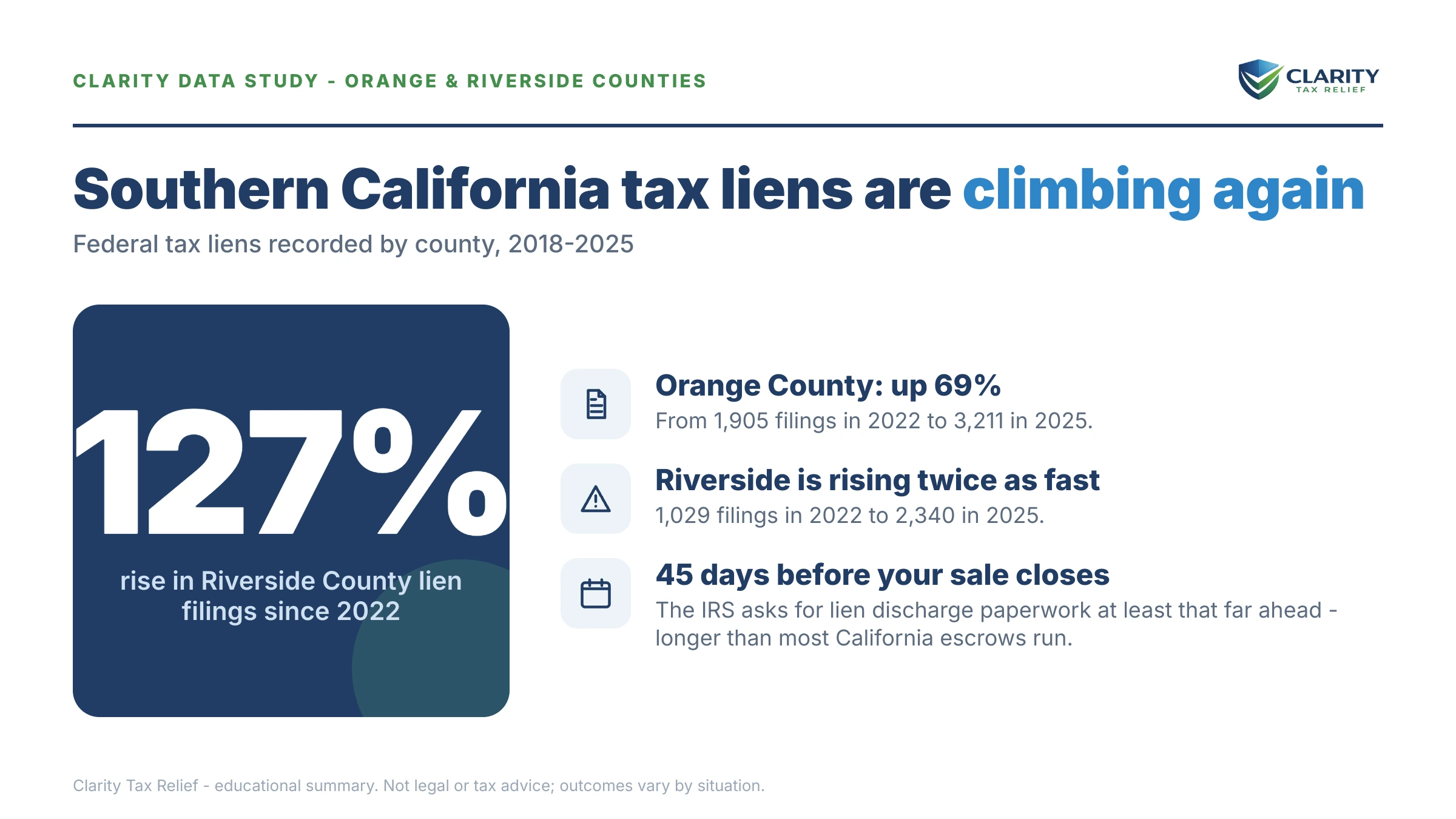
The short answer: federal tax lien filings in Orange, Riverside and San Diego counties fell by roughly three quarters after 2019, and have been climbing since. All three are still recording liens at roughly 42% to 46% of their 2019 volume. If a lien is filed against your property, the IRS asks for discharge paperwork at least 45 days before a sale closes, which is longer than most California escrows run.
Lien already filed against your property?
Send us the notice. An experienced tax professional will tell you which of the four remedies you actually qualify for and how long it takes — free, confidential, no pressure.
The IRS publishes how many liens it files nationally. It does not publish where they land. That gap is why nobody can tell you whether tax liens in Orange County are rising or falling, even though the answer sits in a public database anyone can search.
So we counted them. Every federal tax lien recorded in Orange County since January 2016, month by month, every one recorded in Riverside County since 2018, and every one recorded in San Diego County since 2016, quarter by quarter. The three counties were counted separately, on three different systems, without reference to each other. They agree.
What the counts show
| Year | Orange County | Riverside County | San Diego County |
|---|---|---|---|
| 2018 | 5,710 | 4,355 | 5,633 |
| 2019 | 6,920 | 5,051 | 6,209 |
| 2020 | 2,383 | 1,938 | 2,235 |
| 2021 | 2,228 | 1,658 | 2,288 |
| 2022 | 1,905 | 1,029 | 1,621 |
| 2023 | 2,282 | 1,075 | 1,583 |
| 2024 | 2,520 | 1,635 | 2,191 |
| 2025 | 3,211 | 2,340 | 2,597 |
Orange County recorded 6,920 lien filings in 2019. Three years later it recorded 1,905, a fall of 72%. Riverside fell further, 80%, from 5,051 to 1,029. San Diego went from 6,209 to 1,583, a fall of 75%, though it kept sliding a year longer than the other two.
That difference in timing is worth a moment. Orange and Riverside both bottomed out in 2022 and have been climbing since. San Diego fell again in 2023, and only turned the year after. Whatever drove the pause, it did not reach every county on the same schedule.
All three have turned now. Orange is up 69% from its floor, San Diego 64%, and Riverside 127%, climbing roughly twice as fast as either neighbour. If you own property in Riverside County that is the number to watch.
Here is the part that gets lost when a rebound gets reported as a surge. All three counties are still recording liens at roughly 42% to 46% of their 2019 volume. The trend is up. The level is not back. Both things are true, and a chart that starts in 2022 will only show you one of them.
The data proves itself
Two moments in the monthly Orange County series were not something we went looking for.
January 2019 records zero lien filings. February records 73. The federal government was shut down for 35 days ending 25 January 2019, and the recording data shows it as a flat line.
Then the spring of 2020, when the IRS suspended new lien filings under its People First Initiative:
| Month, 2020 | Orange County lien filings |
|---|---|
| January | 623 |
| February | 543 |
| March | 506 |
| April | 0 |
| May | 5 |
| June | 4 |
| July | 8 |
| August | 10 |
| September | 5 |
| October | 140 |
| November | 218 |
| December | 321 |
Six months, 32 liens, in a county that had been averaging over 500 a month. Neither the shutdown nor the pause was part of our search. Both appear exactly where they should. When a dataset reproduces events you can verify from other sources, it earns some trust.
Why this matters in a housing market
A recorded lien attaches to property. For most people that stays theoretical until they try to sell or refinance, and then it becomes the only thing anyone at the closing table wants to discuss.
The IRS has a process. A seller applies for a certificate of discharge to remove the lien from one specific property, or a subordination to let a new lender take priority. Both are routine. Neither is fast.
Publication 783 asks applicants to submit at least 45 days before the transaction date. A Southern California escrow commonly runs 30. The federal clock is longer than the deal, and sellers usually learn this from the title company rather than from the IRS.
That is the practical consequence of the table above. Just over 8,100 liens were filed across the three counties in 2025. Most of those taxpayers were not selling that year. Some will sell in 2027, and the 45 days will start mattering on a Tuesday afternoon when escrow has already opened.
The four ways a lien comes off, and what each one costs you
People use "remove the lien" to mean four different things. They have different forms, different eligibility, and very different consequences.
| What it does | Form | Who qualifies |
|---|---|---|
| Release — ends the lien entirely | Automatic | The debt is paid or otherwise satisfied. The IRS releases the lien within 30 days of payment. |
| Discharge — removes the lien from one property so a sale can close | Form 14135 (see Publication 783) | A specific property is being sold. Apply at least 45 days before the transaction date. |
| Subordination — lets a new lender take priority ahead of the IRS | Form 14134 (see Publication 784) | Usually a refinance. The lien stays; it just moves down the queue. |
| Withdrawal — removes the public notice as though it were never filed | Form 12277 | Two routes, both with conditions. See below. |
Withdrawal is the one most people actually want and the one least often asked for. It removes the Notice of Federal Tax Lien from the public record rather than marking it satisfied. There are two routes to it.
The first is after the fact. Your liability has been satisfied and the lien released, you have filed for the past three years, and you are current on estimated tax payments and federal tax deposits.
The second matters more, because it happens while you still owe money. You owe $25,000 or less, and if you owe more you may pay the balance down to $25,000 before requesting it. You enter into or convert to a Direct Debit installment agreement, make three consecutive direct debit payments, and the arrangement pays the balance in full within 60 months or before the collection statute expires.
That threshold is the reason a taxpayer sitting at $31,000 sometimes finds a way to pay down $6,000. It is not about the six thousand. It is about getting the public notice off the record while the rest is still being paid.
A worked example, with the arithmetic
The following is hypothetical and the numbers are round for clarity. Your own figures will differ.
A homeowner in Santa Ana sells for $850,000. There is a first mortgage of $520,000 and a federal tax lien of $95,000. Closing costs and commission come to $60,000.
The mortgage was recorded in 2016. The lien was filed in 2024. Priority runs by date, so the mortgage is paid first:
- Sale price: $850,000
- Less closing costs and commission: −$60,000
- Less first mortgage: −$520,000
- Remaining before the lien: $270,000
- Less federal tax lien: −$95,000
- Seller receives: $175,000
Here the equity covers the lien, so the IRS is paid in full from proceeds and the discharge is straightforward. Change one number and it stops being straightforward. If the first mortgage were $740,000 instead, the money left after costs would be $50,000 against a $95,000 lien. The IRS is not obliged to accept $50,000 and release its claim on the rest, and the sale can die at that point.
That is the situation where the 45 days matters most, because the application is where you make the case that the IRS is better off taking the proceeds than keeping a lien on a house you can no longer sell.
The credit report gap that catches people out
Ask most homeowners whether they have a tax lien and they will check their credit report. It will not be there.
Under the National Consumer Assistance Plan, the three nationwide credit bureaus removed civil judgments and roughly half of tax liens from consumer reports in July 2017. By April 2018, according to the Consumer Financial Protection Bureau, none remained. Bankruptcies are now the only public record type on consumer credit reports.
The lien did not go anywhere. It is still recorded at the county, still attached to the property, and still found by any title search. What changed is that the early warning most people rely on stopped working. A filed lien is now invisible on the document consumers actually check, and fully visible on the one their buyer's title company checks.
That mismatch is a large part of why the 45-day requirement surprises people. They had no reason to think anything was wrong until escrow opened.
Southern California is rising faster than the country
The IRS reports lien filings nationally in its Data Book. Comparing that series to what we counted locally is the most useful thing in this data, with one caveat stated up front: the national figures are fiscal years and ours are calendar years, so the comparison is directional rather than exact.
| Period | National lien filings | Orange County | Riverside County | San Diego County |
|---|---|---|---|---|
| 2023 | 179,019 | 2,282 | 1,075 | 1,583 |
| 2024 | 196,996 | 2,520 | 1,635 | 2,191 |
| 2025 | 214,099 | 3,211 | 2,340 | 2,597 |
| Two-year change | +19.6% | +40.7% | +117.7% | +64.1% |
The country added about a fifth more lien filings over two years. Orange County roughly doubled that rate, San Diego tripled it, and Riverside more than doubled its own volume outright.
We cannot tell you why from recording data alone, and we are not going to guess at a cause we cannot see. What the numbers support is narrower and still worth knowing: whatever is driving the national increase is landing harder in these three counties than the national average would lead a homeowner here to expect.
If you think the lien is wrong
Everything above assumes the debt is real. Sometimes it is not, or not in the amount claimed, and there is a specific window for saying so.
When the IRS files a Notice of Federal Tax Lien it sends Letter 3172, which notifies you of the filing and carries the right to request a Collection Due Process hearing under section 6320. The request window is 30 days. Publication 1660 and the IRS's CDP FAQs set out what the hearing covers and how to ask for one, and the request itself is made on Form 12153.
Two things about that window are worth being blunt about. It is short, and it is attached to a letter that arrives looking much like the several IRS letters that came before it and carried no deadline at all. Nationally, between 2003 and 2019, 1.44% of taxpayers who received a CDP notice requested a hearing — fewer than one in fifty, in the Taxpayer Advocate's own phrasing.
If the 30 days has already passed, the hearing right is generally gone, but the underlying disagreement is not necessarily finished. A lien filed in error, an amount that does not match your records, or a balance that belongs to a spouse rather than to you are all things worth raising even late, through a different route than CDP.
Three situations that change the answer
You are married and live in California. California is a community property state, and community property can be reachable for one spouse's separate federal tax debt. A lien filed against one spouse does not automatically stop at that spouse's half of the house. This is the single most common surprise for married sellers here, and it is worth getting a specific read on your facts before assuming the other spouse's interest is untouched.
You are self-employed or paid on a 1099. Two things follow. The balance often spans several tax years, and each year can carry its own filing, so what feels like "a lien" can be several. Compliance also matters more: both withdrawal routes require you to be current on estimated tax payments, which is exactly the obligation self-employed taxpayers most often let slide while they deal with the older debt.
The debt is payroll tax from a business. Unpaid employment taxes are treated differently from personal income tax, and the trust fund portion, the money withheld from employees' wages, can be assessed personally against the people responsible for paying it. A lien in that situation may reach personal property even though the debt began at the company. If your balance includes withheld payroll taxes, treat it as a different problem from a personal 1040 balance.
What happens if you do nothing
A lien is a claim, not a seizure. Nothing is taken on the day it is filed. What it does is establish the government's position against your property and start a sequence:
- The lien is recorded at the county. It attaches to property you own now and property you acquire later while it stands.
- Interest and penalties continue to accrue on the underlying balance.
- Any sale or refinance of the property stalls until the lien is released, discharged, or subordinated.
- The IRS may move from lien to levy, which is the actual taking of money or property. A levy is preceded by its own notice carrying appeal rights, and that notice is a separate document from the lien filing.
We have deliberately not put day counts on those stages. Timelines vary with the case and with IRS workload, and inventing durations would be worse than leaving them out. What is fixed is the order.
How to respond to a filed lien
- Confirm it exists and read the document. Search the county recorder's index for your own name, or ask your title company. Do not rely on your credit report, which no longer shows tax liens.
- Establish what you owe and for which years. Request your account transcripts so you are working from the IRS's figures rather than your own recollection.
- Get into filing compliance first. Every remedy except a straight payoff requires returns to be filed. Unfiled years block the rest of the process.
- Pick the remedy that matches your goal. Selling a specific property points to discharge. Refinancing points to subordination. Getting the public notice off the record points to withdrawal.
- Apply at least 45 days before you need it. If a sale is involved, start before you list, not after you have an offer.
When you can handle this yourself
Plenty of people should do this without paying anyone. If you owe under $25,000, your returns are filed, and you can afford a direct debit installment agreement, the withdrawal path is a form and some patience. If you are selling with clear equity that covers the lien in full, the discharge application is paperwork your escrow officer has seen before.
Experienced help changes the outcome in narrower circumstances: when the sale will not cover the lien and someone has to make the case for a discharge anyway, when the debt includes payroll taxes, when several years and several liens are involved, when a spouse's interest is at stake, or when you are close to a deadline and a mistake costs you the transaction. If your situation is none of those, the forms are on irs.gov and the process is designed to be used directly.
How we counted, and what these numbers are not
County recorders index documents by type. Orange County files these under NOTICE FED LIEN, Riverside under FEDERAL TAX LIEN, San Diego under NOTICE OF FEDERAL TAX LIEN. We queried each county's public index by document type and recording date, month by month for Orange, year by year for Riverside, quarter by quarter for San Diego.
Three things nearly went wrong, and they are worth stating because they affect how much weight this deserves.
Orange County also carries a type called FED TAX LIEN. It returns zero for every year we tested. It appears to be a retired code, and taking it at face value would have produced an article claiming Orange County records no federal tax liens at all.
Orange County search results silently cap at 767 while reporting success. An annual query looks like it worked and undercounts badly. May 2019 came back capped; split into weeks and re-summed, it was 1,119. Every capped month was recollected that way.
San Diego carries a second federal lien type, FEDERAL TAX LIEN, that returns nothing for any period we tested, including months where the type we used returns hundreds. It is the same shape of trap as the Orange County retired code, and choosing the first plausible match would have produced a decade of zeros.
San Diego's index also answers a valid query with an empty result set roughly half the time, and it renders as a legitimate count of zero rather than an error. One month returned 0, 0, 150 and 150 on four consecutive identical queries. Every San Diego figure here was read until the same value came back twice, and each one is checked against the date range the system echoes back, so no count can be filed against the wrong period.
Riverside accumulates document types between searches. A query we believed was liens only had quietly included partial releases and non-attachment certificates. Every Riverside figure here was re-run with a check that exactly one document type was in play.
What these counts are not:
- A count of taxpayers. One person with several tax periods can generate several filings.
- A count of net liens outstanding. Releases are recorded as separate document types and are not subtracted here.
- A count by residence. A lien follows the property and the address of record, so a Riverside resident who owns in Orange County appears in Orange County.
San Diego's 2018 total carries one caveat we would rather state than bury. January 2018 returns zero filings, and we cannot explain it. January 2017 and January 2020 read normally, so the month is not systematically empty in that index. If it is a gap in the county's records rather than a real absence, 2018 is understated by roughly a month.
Los Angeles is missing, and that is not an oversight. The county publishes no online index of official records, citing Government Code section 6254.21. We asked for the monthly counts directly and the county declined, on the ground that the Public Records Act does not require it to create a record that does not already exist. Worth noting it did not rely on the address exemption above. Ventura has not been requested, and Riverside 2016 and 2017 are not yet collected.
San Bernardino is missing for a different reason. We asked the county for its own figures and the request was closed, on the grounds that the office does not hold a report in that format, with a recommendation that we use the public index instead. That index counts differently from the others: it returns one row per named party rather than one per document, so a quarter that reports 1,311 results contains 666 filings. Anyone reading the headline number off that screen would publish a figure nearly twice the truth. We are counting it properly rather than quickly, and it will be added when it is done. Ventura is not in this study and is not being counted.
We asked all six counties to confirm these figures from their own systems. Four declined. Los Angeles and San Bernardino said they hold no report in that format, San Diego said the same and added that its system groups every release and withdrawal under generic document types regardless of whether a federal tax lien is involved, and Riverside closed the request pointing at bulk data sold by the file. None of that is obstruction. It is what recording systems are built to do, and it is the reason this series had to be counted by hand at all.
Orange County produced it. The Clerk-Recorder supplied a document-level export covering January 2016 to July 2026, one row per recorded document with its recording date and type. Counted against what we published, every year agrees to within 0.2%: 5,705 against our 5,710 in 2018, 6,914 against 6,920 in 2019, 1,902 against 1,905 in 2022, 3,208 against 3,211 in 2025. Across the eight published years the county counts 27,132 and we count 27,159, a difference of 27 filings in about twenty-seven thousand. Ours run a few high in every single year rather than scattering either way, which reads as a boundary difference at the edge of each export rather than an error in either count. We are not adjusting our figures to match, because a consistent 0.1% is inside what either method can resolve, and saying so is more useful than quietly reconciling to the more official-looking number.
That export also answers something San Diego could not. Orange separates the document types, so alongside 39,235 lien notices from January 2016 to July 2026 it records 26,422 releases and 793 withdrawals. A release is not a withdrawal: one says the debt is resolved, the other says the filing should not have been made. Withdrawals are about 2% of the volume of releases in that county over ten years.
The longer national arc is in our IRS levy and lien statistics, and the underlying figures sit with our other IRS data studies.
Tax lien questions, answered
Does a federal tax lien show up on my credit report?
No. The three nationwide credit bureaus removed tax liens from consumer credit reports, and by April 2018 none remained. Bankruptcies are now the only public record type shown. The lien is still recorded at the county and will still be found by a title search, so a clean credit report is not evidence that no lien exists.
How long does the IRS take to release a lien after I pay?
The IRS states that it releases a lien within 30 days after the tax debt is paid. Release is different from withdrawal: a release ends the lien, while a withdrawal removes the public notice as though it had never been filed.
Can I sell my house with a tax lien on it?
Often yes, but not on the buyer's timeline unless you plan for it. You apply for a certificate of discharge using Form 14135, and Publication 783 asks for the application at least 45 days before the transaction date. Most California escrows run about 30 days, so the application should start before you list rather than after you accept an offer.
What is the difference between a lien and a levy?
A lien is a legal claim against your property that secures the government's interest in a debt. A levy is the actual taking of property or funds. A lien being filed does not mean anything has been seized, and a levy is preceded by its own separate notice.
Can I get the lien withdrawn while I still owe money?
Yes, under specific conditions. You must owe $25,000 or less, and if you owe more you may pay the balance down to $25,000 before requesting withdrawal. You must enter into or convert to a Direct Debit installment agreement, make three consecutive direct debit payments, and the agreement must full pay the balance within 60 months or before the collection statute expires. The request is made on Form 12277.
Are tax lien filings in Southern California going up?
Yes, from a low base. Orange County filings rose from 1,905 in 2022 to 3,211 in 2025, Riverside from 1,029 to 2,340 over the same period, and San Diego from its own 2023 floor of 1,583 to 2,597. Orange and Riverside remain at about 46% of their 2019 volume and San Diego at about 42%, so the increase is a recovery toward earlier levels rather than a new peak.
This guide is general information, not tax or legal advice for your specific situation. Eligibility for IRS programs depends on individual facts and circumstances; no outcome is guaranteed.