
Tipped & Service Workers
Bartender Tip Taxes in 2026: What to Do When You Owe the IRS on Tips
The short answer: bartender tip taxes cover both income tax and Social Security and Medicare on every tip you earn — cash, credit card, and your share of a pool. If you owe the IRS on tips you never reported, you file or amend the affected years (using Form 4137 for cash tips), then set up a payment plan. Penalties and interest grow monthly until you act.
You poured drinks all year, took your cash tips home each night, and now a balance is staring back at you — from the return you just filed, or a letter that says you left tip income off. The number feels huge next to a bartender's paycheck. Here's the calming truth: this is one of the most common and most fixable tax problems there is, and you have more paths out than the bill suggests.
The reason bartenders get hit is baked into how tips are taxed. Two separate taxes ride on every tip, and one of them, Social Security and Medicare, is easy to forget on cash. The image below shows exactly how the different kinds of tips flow to the IRS and where the gap that creates a debt usually hides.
⏱ Your real clock: there's no single "tip tax" deadline, but the meter is always running. A late-payment penalty of 0.5% per month plus interest accrues on any unpaid balance, and if you haven't filed at all, the failure-to-file penalty is 10 times larger at 5% per month. If you got a CP2000, that notice sets its own 30-day response window printed at the top.
Why you owe taxes on your tips
A bartender owes on tips because tips are fully taxable income, and the tax on cash tips usually never got withheld. When a tip runs through a credit card, your employer sees it, adds it to your W-2, and withholds tax from your paycheck. When a tip goes straight into your hand as cash, none of that happens — the tax quietly stacks up until you file.
There are really three ways the debt shows up:
- Cash tips you never reported to your employer. These skip withholding entirely, so the full income tax plus the 7.65% employee share of Social Security and Medicare comes due at tax time on Form 4137.
- Allocated tips in box 8 of your W-2. When the tips a bar's staff report fall below 8% of food-and-drink sales, the employer allocates the shortfall to employees. That allocated amount is taxable and shows up years later in an IRS match.
- Under-withholding across the year. Even fully reported tips can leave you short if your regular paycheck wasn't big enough to cover the tax on both wages and tips.
This is not an audit and it is not a criminal matter. It's a balance-due problem — the same family of issue behind a CP14 notice or a CP2000 notice when the IRS's records show more tip income than your return did.
How each type of tip is taxed and reported
| Tip type | Taxable? | How the IRS sees it | What you file |
|---|---|---|---|
| Credit/debit card tips | Yes — income + FICA | Already on your W-2; tax withheld from pay | Nothing extra |
| Cash tips reported to employer (Form 4070) | Yes — income + FICA | Included in W-2 wages | Nothing extra |
| Cash tips NOT reported to employer | Yes — income + FICA | Only if you report or the IRS reconstructs it | Form 4137 |
| Allocated tips (W-2 box 8) | Yes, unless you prove a lower figure | Reported by employer; matched to your return | Form 4137 |
| Tip-pool / shared tips (your net share) | Yes — income + FICA | Depends on whether it ran through payroll | Form 4137 if not on W-2 |
Does the "no tax on tips" law wipe out what I owe?
No — the 2025 "no tax on tips" deduction does not erase a tip-tax debt, and it never touches Social Security and Medicare. Under the law passed in 2025, eligible tipped workers can deduct qualified tips from their federal income tax, within income limits, for tax years 2025 through 2028. That's a real break going forward, but three limits matter for anyone who already owes.
- It's income tax only. Your tips are still subject to the 7.65% employee Social Security and Medicare tax, which is often the larger surprise on cash tips.
- It doesn't apply to old years. Tips from 2024 or earlier, the ones that usually create back-tax debt, are unaffected. That balance stands.
- It phases out at higher income and requires proper reporting. You still have to report the tips to claim the deduction. It disappears above the income thresholds.
If you want the details of how the 2025 changes flow into a debt situation, see our breakdown of the One Big Beautiful Bill tax changes. For back years, the deduction is not a rescue — resolving the balance is.
What happens if you ignore it
An unpaid tip-tax balance doesn't sit still. It enters the same automated IRS collection sequence as any other debt, and each stage carries more force than the last. Doing nothing is the one choice that removes options:
- Balance due / CP14 — the first bill. Penalties and interest are accruing, but no enforcement yet.
- CP501 / CP503 — reminder notices. Still bills, but the number keeps climbing each month.
- CP504 — Notice of Intent to Levy. The IRS can seize your state tax refund and a federal tax lien becomes a real possibility.
- LT11 / Letter 1058 — Final Notice. After 30 days, the IRS can garnish your wages and levy your bank account. Because a bartender's income is a mix of steady paycheck and tips, a wage levy takes a bite out of the reported portion first. But it still hurts.
In 2026 the IRS is stretched thin after 2025 staffing cuts. But the levies and liens are issued by automated systems that never went on furlough. If you owe on multiple years, the older ones can quietly march toward levy while you're focused on the newest bill.
Owe the IRS on tips and not sure where to start?
Send us your notice or your latest W-2. An experienced tax professional will pin down what you actually owe — income tax versus Social Security and Medicare — and lay out your options before penalties and interest grow another month. Free, confidential, no pressure.
Your options if you can't pay the tip-tax bill
The bill implies you have two choices, pay it all or face collection. But the IRS runs several programs. The right one depends on your finances. Here's how they stack up for a tipped worker.
| Option | Best when | Cost / key threshold |
|---|---|---|
| Pay in full | Small balance, cash on hand | $0; stops penalties fastest |
| Short-term plan (≤180 days) | You'll catch up in a season | $0 setup; interest keeps running |
| Streamlined installment agreement | You owe ≤ $50,000 | Up to 72 months; small setup fee |
| Currently Not Collectible | Paying anything causes hardship | $0; collection paused, interest accrues |
| Offer in Compromise | Assets + income can't cover the debt | $205 fee (waived if low-income); ~1 in 5 accepted |
| First-time penalty abatement | Clean prior 3 years | Free; removes the failure-to-file/pay penalty |
For most bartenders, the balance lands under $50,000, which means a streamlined plan can usually be set up online without handing over detailed financials — see our walkthrough on how to set up an IRS payment plan online. An Offer in Compromise is real but means-tested. The IRS accepted roughly 1 in 5 offers in FY2024, and only when the math shows it truly can't collect more. Beware anyone promising to settle your tax debt for a tiny fraction of what you owe. That pitch is exactly what got a national firm permanently banned in 2026.
A worked example (hypothetical)
Say you tended bar last year and took home $14,000 in cash tips you never reported to your employer, on top of your regular paycheck. Here's roughly how the tax builds:
- Federal income tax at a 12% bracket: $14,000 × 12% = $1,680.
- Social Security + Medicare (employee share) on Form 4137: $14,000 × 7.65% = $1,071.
- Subtotal tax due: about $2,751.
If you filed on time but couldn't pay, the failure-to-pay penalty runs 0.5% a month plus interest — roughly $165 in penalty over a year, plus interest, so around $3,050 total. If you didn't file at all, the failure-to-file penalty is 5% a month and caps at 25% — up to about $688 on that same balance — which is why filing always beats not filing, even when you can't pay. Estimate your own penalty and interest with our IRS penalty & interest calculator. On a small balance like this, a short-term plan or a streamlined agreement of well under $100 a month usually clears it.
How to respond, step by step
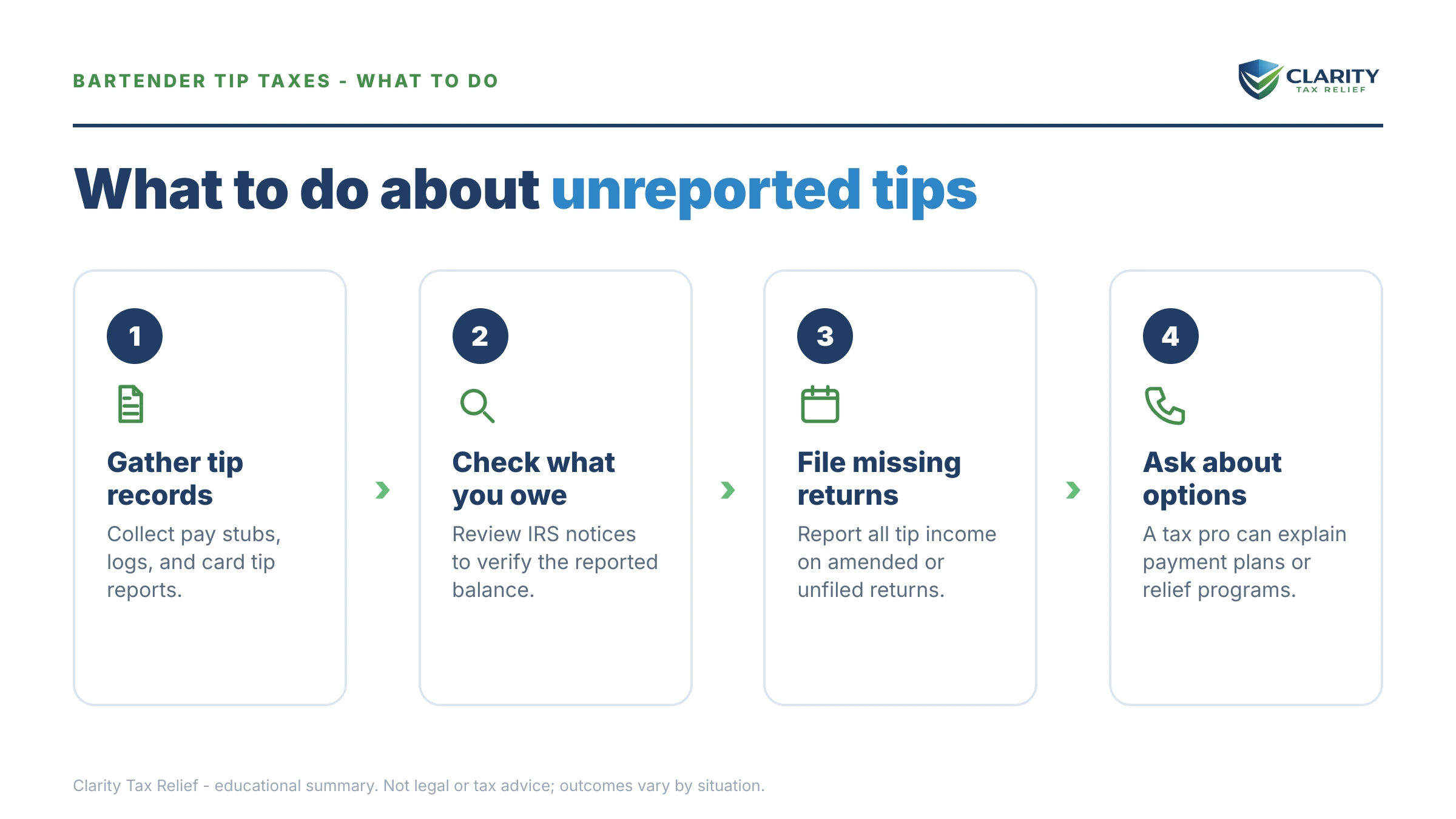
- Pull your wage and income transcript — order it so you can see every W-2 and allocated-tip figure the IRS already has on you.
- File or amend the affected years — file the missing returns or amend the wrong ones, reporting unreported cash and allocated tips on Form 4137.
- Total your real balance — add the income tax plus the Social Security and Medicare tax from Form 4137, then the penalties and interest, so you know the true number.
- Pick a payment path — choose to pay in full, set up a payment plan, request Currently Not Collectible status, or explore an Offer in Compromise based on your finances.
- Request penalty relief — ask for first-time penalty abatement if your prior three years are clean, or reasonable-cause relief if illness or another hardship caused the miss.
- Get a professional review if it's complex, if you have multiple unfiled years, a CP2000, or a large balance, have an experienced tax professional review the order of operations before you pay.
W-2 bartender vs. 1099 event work: the answer changes
Whether you were a W-2 employee or a 1099 contractor decides which tax you owe on tips. Most bar and restaurant bartenders are W-2 employees, so you pay only the 7.65% employee share of Social Security and Medicare through Form 4137. Your employer paid the matching half.
If you worked freelance banquet or event gigs paid on a 1099, that tip and fee income is self-employment income. You owe the full 15.3% self-employment tax plus income tax, the same shock covered in our guide to the self-employment tax you owe the IRS. And if a venue put you on a 1099 while treating you like a regular employee — set schedule, their bar, their rules — you may be misclassified and can challenge it. The playbook is in paid on a 1099 but should be a W-2 (Form SS-8). Married and filing jointly? A tip-tax debt from before your marriage stays with the spouse who earned it. But a joint refund can be pulled toward it unless you file separately.
When you can handle this yourself, and when to get help
Plenty of bartender tip-tax situations are genuinely DIY. If you have one year, you agree the tips were unreported. The balance is a few thousand dollars, you can file with Form 4137, set up a plan at IRS.gov, and be done — no professional needed. A first-time abatement request is a short letter you can send yourself.
Experienced help changes the outcome when the picture gets tangled: you have several unfiled years, a CP2000 proposing a big allocated-tip figure you don't recognize, a balance large enough to threaten a lien or levy, or a genuine hardship that points toward Currently Not Collectible or an Offer in Compromise. In those cases the order you fix things in — returns first, then penalty relief, then the balance — directly changes what you pay. If a levy is already in motion or the IRS assigned a revenue officer, don't wait; that's the moment a review pays for itself.
Terms on your notice, decoded
- Form 4137 — the form that reports Social Security and Medicare tax on tips you didn't report to your employer, including box 8 allocated tips.
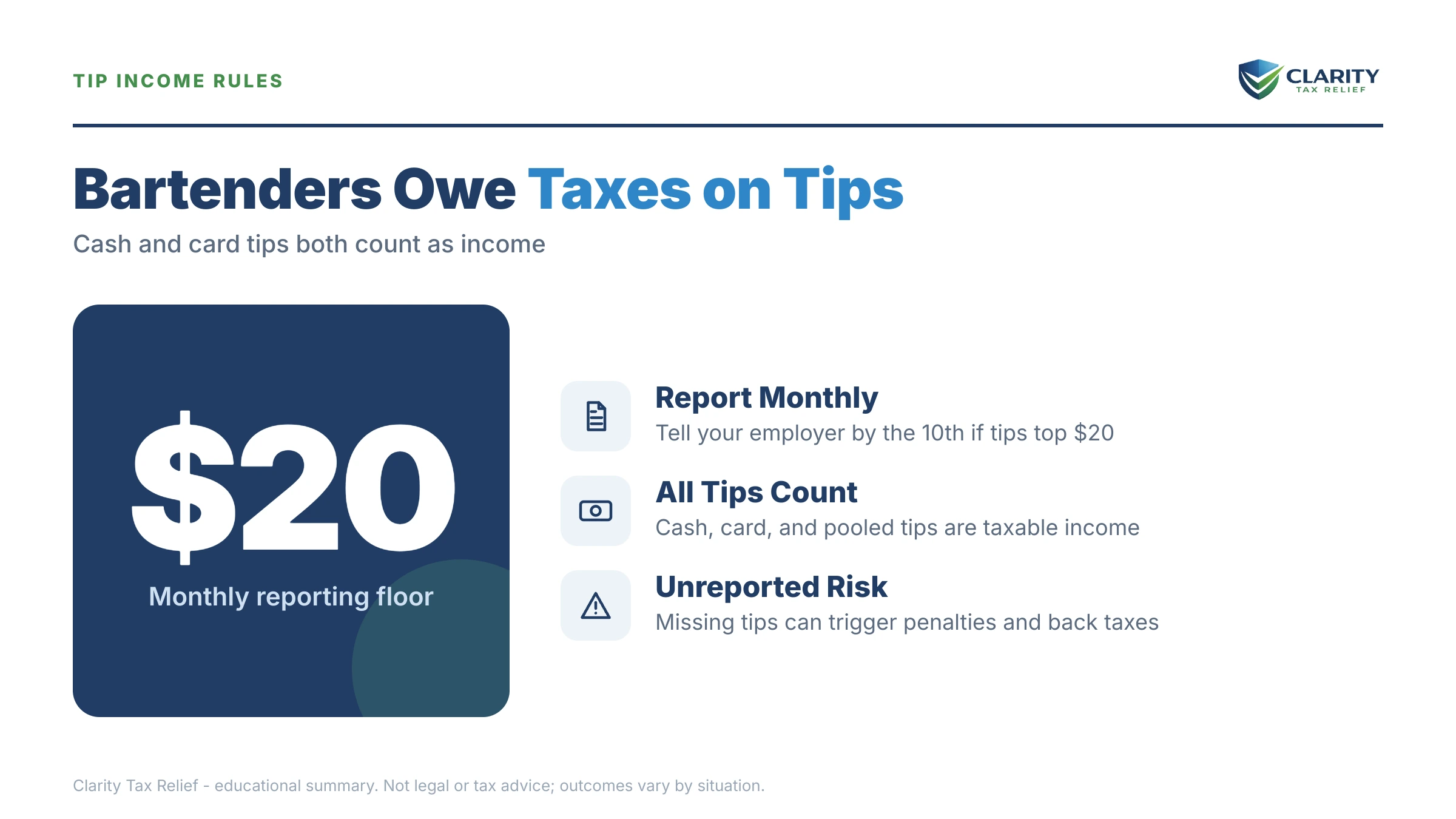
- Form 4070 — the monthly report an employee gives the employer of cash tips of $20 or more.
- Allocated tips (box 8) — tips your employer assigned to you when staff-reported tips fell below 8% of sales. Taxable unless you can show a lower actual figure.
- FICA — Social Security and Medicare tax; the employee share on tips is 7.65%.
- CP2000 — an underreporter notice the IRS sends when its income records (including tips) exceed what your return showed.
- Failure-to-file vs. failure-to-pay — the penalty for not filing (5%/month) is ten times the penalty for not paying (0.5%/month).
Bartender tip tax questions, answered
Do bartenders have to report cash tips to the IRS?
Yes. Every dollar of tips is taxable income — cash, credit card, and your share of a tip pool. You're supposed to report cash tips of $20 or more in a month to your employer by the 10th of the next month, usually on Form 4070. Any cash tips you never reported to your employer get reported directly on Form 4137 with your tax return, which also charges the Social Security and Medicare tax on them.
How much of my tips should I set aside for taxes?
A safe rule for most bartenders is roughly 25% to 30% of unreported cash tips. That covers federal income tax at a typical bracket plus the 7.65% employee share of Social Security and Medicare. If your card tips already have tax withheld through your paycheck, you mainly need to set aside for the cash tips your employer never saw.
What happens if I didn't report my tips for years?
You file the missing or corrected returns, report the tips on Form 4137. The tax plus penalties and interest becomes a balance you can resolve. The IRS generally wants the last six years of returns to be considered compliant. Filing voluntarily before the IRS contacts you keeps this civil and is almost always cheaper than waiting for a CP2000 or a substitute return.
Does the new "no tax on tips" law mean I don't owe anything?
No. The 2025 "no tax on tips" deduction only reduces federal income tax on qualified tips, within income limits, for tax years 2025 through 2028. Tips are still fully subject to Social Security and Medicare tax, and the deduction does nothing for prior-year debt. If you owe on tips from 2024 or earlier, that balance stands.
Can the IRS find out about my cash tips?
Often, yes. Bars report total credit-card tips, and when the tips employees report fall below 8% of food-and-drink sales, the employer allocates the difference. It shows in box 8 of your W-2. The IRS matches that allocated-tip figure against your return, and a gap can trigger a CP2000 underreporter notice years later.
What is Form 4137 and do I need it?
Form 4137 reports Social Security and Medicare tax on tips you didn't report to your employer, including allocated tips in box 8 of your W-2. You need it any time cash or pooled tips never ran through your paycheck. It's how you pay the 7.65% employee FICA share on those tips and get proper credit toward your future Social Security benefits.
Will I owe self-employment tax on my tips?
Not if you're a W-2 employee. You owe the 7.65% employee FICA share through Form 4137, not the full 15.3% self-employment tax. Self-employment tax only applies if you were paid as a 1099 contractor, such as a freelance banquet or event bartender. Misclassified employees can challenge a wrongful 1099 using Form SS-8.
Your next 24 hours
- Find the number. Grab your latest W-2 (check box 8 for allocated tips) or the notice, and note the tax year and the balance the IRS says you owe.
- Gather your records. Pull last year's return, any tip logs or POS printouts you kept. Your bank deposits — enough to confirm or dispute the tip figure.
- Get a free case review. Use the 2-minute form or call (888) 825-7779. The sooner you act, the less the monthly penalty and interest add — there's no upside to waiting.
This guide is general information, not tax or legal advice for your specific situation. Eligibility for IRS programs depends on individual facts and circumstances; no outcome is guaranteed.