
IRS Transcript Codes
Code 768 on Your IRS Transcript: The Earned Income Credit Line, Explained (2026)
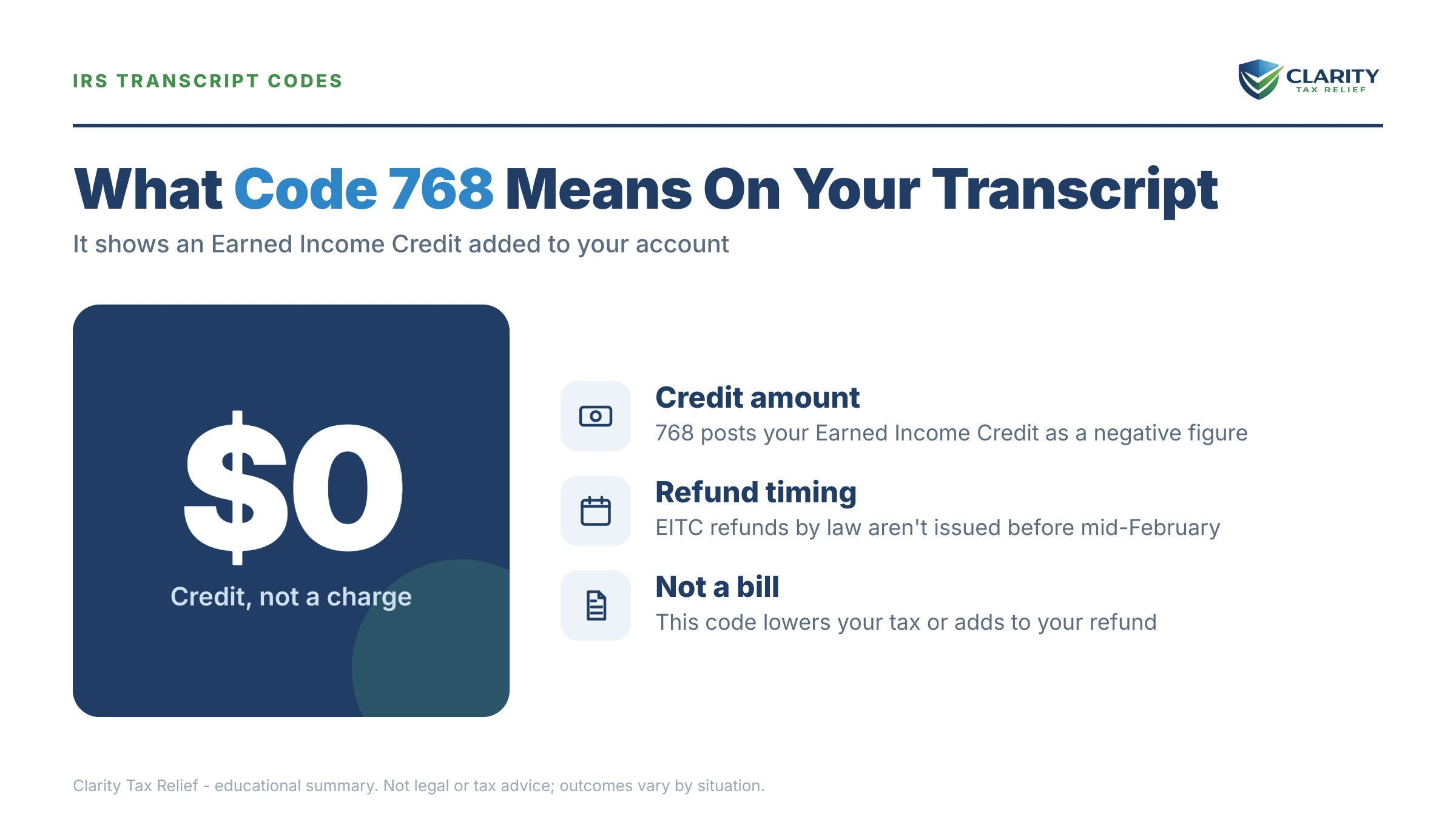
The short answer: code 768 on your IRS transcript is your Earned Income Credit being posted to your account — money in your favor, shown as a negative amount. It is not a bill and not a problem. But 768 alone does not mean your refund is on the way; the code that confirms that is Code 846, "Refund issued."
You pulled your account transcript, scanned the transaction list, and stopped on a line reading 768 — Earned Income Credit with a dollar figure and a date that hasn't happened yet. That combination looks strange, but it is completely routine. Code 768 is the IRS confirming it accepted the EIC you claimed and added it to your account.
The two facts that trip people up are the negative-looking number and the future date. Neither is a red flag — the sign means "credit," and the date is a bookkeeping convention, not a payout date. The image below shows you exactly what this section of a transcript looks like and where these lines sit relative to each other.
What you actually want to know is when the money moves. That answer lives a few lines down in a different code, and whether anything is holding it up lives in the codes sitting right next to 768.
⏱ The one timing rule that matters: by law (the PATH Act), the IRS cannot release any refund that includes the Earned Income Credit before mid-February, even if Code 768 posted to your transcript in January. Most EIC refunds arrive in late February once the hold lifts and Code 846 appears.
What code 768 means on your IRS transcript
Code 768 is the transaction the IRS uses to record your Earned Income Credit on your account. When the IRS finished processing your return and confirmed the EIC amount, it stamped this line onto your transcript for that tax year.
The Earned Income Credit is refundable, which is why 768 shows as a credit. A refundable credit can do more than zero out your tax. It can pay you the difference in cash. So the EIC amount gets added on top of your withholding to build your refund.
Two details cause almost all the confusion, so take them one at a time:
- The negative or bracketed amount is standard transcript accounting. Charges (your tax) are positive; credits and payments (your EIC, your withholding) are shown with the opposite sign because they reduce your balance. A negative number here is good news.
- The date — usually April 15 — is the statutory return due date the IRS uses for interest and accounting math, not the day your money moves. Nearly every credit line on a transcript carries that same date. It tells you nothing about refund timing.
If you want the full walkthrough of every line, see our guide on how to read an IRS account transcript. Code 768 is one of several credit lines that stack together.
How code 768 fits with the codes around it
Code 768 never stands alone. It sits inside a small cluster of codes that together build your refund. Reading them as a group is how you actually understand your transcript.
| Code | What it means | Sign on transcript |
|---|---|---|
| 150 | Tax return filed; your total tax | Charge (positive) |
| 806 | W-2 / 1099 federal withholding | Credit (negative) |
| 766 | Other refundable credit (e.g., Additional Child Tax Credit) | Credit (negative) |
| 768 | Earned Income Credit | Credit (negative) |
| 570 | Additional account action / refund hold | Hold |
| 846 | Refund issued — the real payout date | Refund out |
Want the neighbors decoded individually? We have dedicated guides on code 806 (withholding), code 150 (return filed), and codes 766 and 768 (credits). The one you're hunting for is code 846 and its refund-issued date.
What happens next, and when 768 signals a problem
On its own, code 768 is a milestone, not a finish line. Your refund still has to clear processing before Code 846 appears. Here is the sequence most EIC transcripts follow, and where it can stall:
- Codes 150, 806, 766, 768 post — your return and all credits are recorded. This is the normal, healthy state.
- PATH Act hold (if you claimed EIC) — even a fully processed return waits until mid-February before any refund can release. Nothing is wrong; it is the law.
- Code 846 appears — "Refund issued," with a real date. This is the outcome you're waiting for.
- Or Code 570 appears instead — an account hold. Your EIC is calculated, but the refund is frozen while the IRS reviews something. Watch for a paired Code 971 notice.
- Or Code 810 appears — a full refund freeze, often tied to identity or credit verification. This is the most serious stall and frequently needs a response from you.
So the honest read on 768: seeing it is good. What determines your refund is whether the next update brings an 846 (paid) or a 570/810 (held). In 2026, with IRS staffing down sharply, an automated hold can sit untouched for weeks unless you act — the systems that freeze refunds never slowed down even as the workforce shrank.
Refund stuck behind a 570 or 810 next to your 768?
A frozen Earned Income Credit refund rarely un-sticks on its own. Send us a photo of your transcript and an experienced tax professional will tell you exactly which code is holding your money and what to do about it — free and confidential.
Your options depending on what else is on the transcript
What you should do about code 768 depends entirely on the codes surrounding it. Match your situation to the row below.
| What your transcript shows | What it means | Your move |
|---|---|---|
| 768 + 846 | EIC accepted; refund issued | Nothing — check the 846 date for your payout |
| 768, no 846, before mid-Feb | PATH Act hold in effect | Wait; refund typically releases late February |
| 768 + 570 | Refund on hold for review | Watch for 571/572 (released) or a 971 notice |
| 768 + 570 + 971 | IRS is mailing an explanation or request | Read the notice; respond by its date |
| 768 + 810 | Refund frozen | Verify identity/credits; often needs a response |
| 768 smaller than you claimed | IRS reduced your EIC | Compare to your return; a notice will explain |
If you also see a Tax Topic 152 or "still processing" message on Where's My Refund, that's normal for EIC filers and usually just reflects the PATH Act wait, not a separate problem. And remember: your PATH Act refund delay is set by statute, not by anything you did.
A worked example: how code 768 builds your refund
Say your transcript for the year reads like this — clearly a hypothetical, but typical of a working parent with two kids:
- Code 150 (total tax): $1,200
- Code 806 (withholding): –$2,400
- Code 766 (Additional Child Tax Credit): –$1,700
- Code 768 (Earned Income Credit): –$4,213
Add the three credits: $2,400 + $1,700 + $4,213 = $8,313 in your favor. Subtract the $1,200 of tax, and the account nets to a refund of $7,113. That $7,113 is what you should eventually see on a Code 846 line.
Notice how the Earned Income Credit alone ($4,213) is bigger than the entire tax bill. That's the power of a refundable credit, and exactly why the IRS reviews EIC returns more carefully, and why the PATH Act holds these refunds until mid-February to guard against fraud.
How to respond, step by step
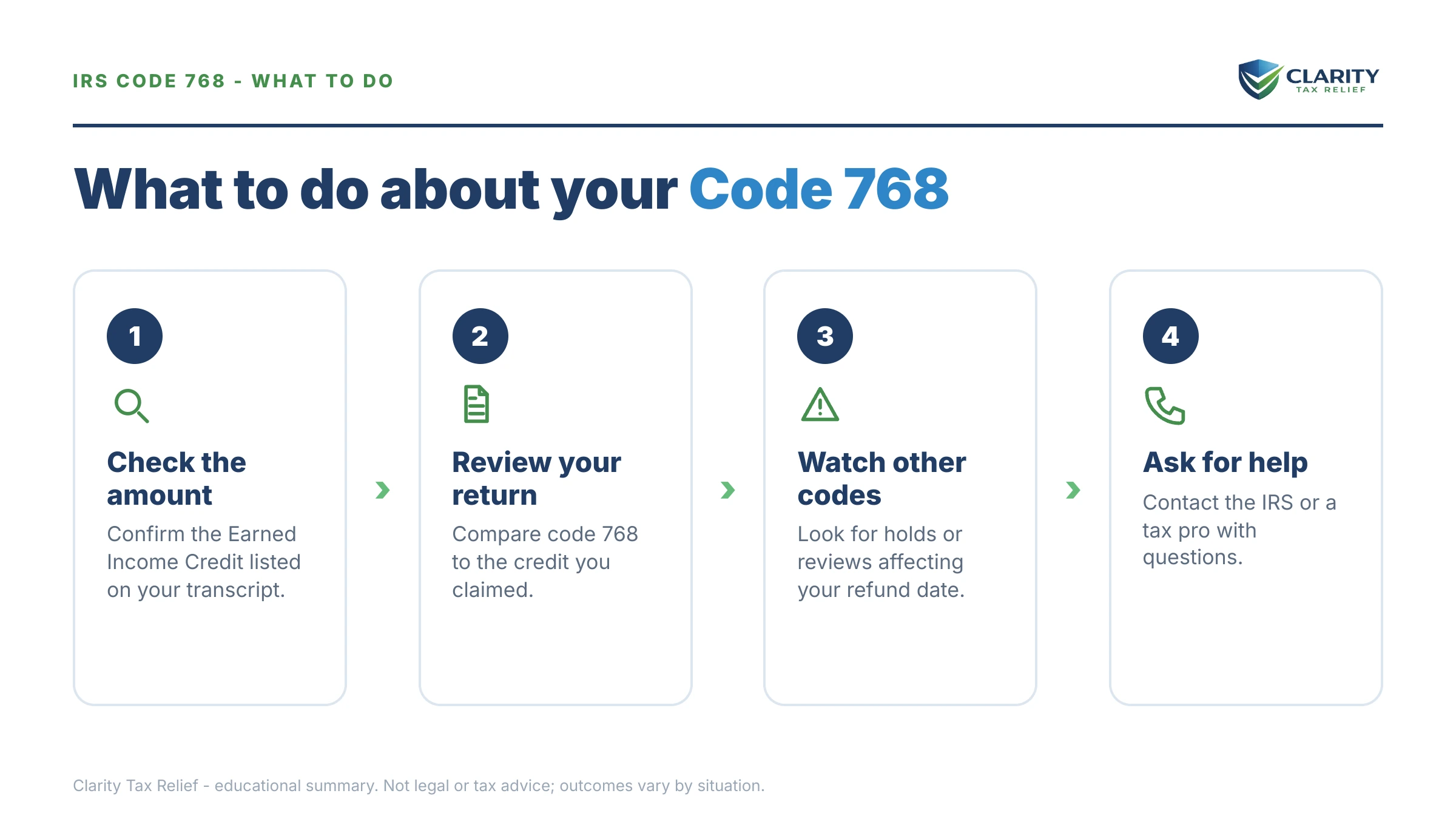
- Confirm the amount — compare the number next to Code 768 with the Earned Income Credit you claimed on your return. If they match, the IRS accepted your EIC as filed.
- Add up the credits — total Code 768, any Code 766 credits, and Code 806 withholding, then subtract the tax on Code 150 to see the refund you should receive.
- Look for Code 846 — scan for Code 846, "Refund issued." Its date is your real refund date. No 846 yet means the return is still processing.
- Check for holds — look for Code 570, Code 810, or a Code 971 notice. Any of these can delay or freeze the refund and tells you what to do next.
- Respond to any notice — if a CP75 or other letter arrives asking you to prove your qualifying child or residency, gather your documents and answer by the date on the notice.
- Get help if the credit is at risk, if your EIC is frozen, being audited, or tied to a balance from a prior year, have an experienced tax professional review your transcript before you respond.
When you can handle this yourself, and when to get help
Most code 768 situations need nothing from you at all. If you see 768 followed by 846, your EIC was accepted and your refund is on the way — no action, no phone call. If you see 768 with no hold codes before mid-February, you're simply in the PATH Act window and waiting is the correct move.
You can also handle a straightforward EIC document request yourself. A CP75 EIC audit that asks you to prove where your child lived is answered with school, medical, or lease records — see our guide on proving residency and relationship in an EIC audit.
Experienced help changes the outcome when: your refund is frozen under a Code 810 and you can't get it released. Your EIC was disallowed and you're facing a CP79 requiring Form 8862. The IRS is holding this year's refund to cover a balance from a prior year. Or the credit reduction pushed you into owing tax you can't pay. In those cases the order you fix things in matters, and a review before you respond protects the money.
Terms on your transcript, decoded
- Earned Income Credit (EIC/EITC): a refundable credit for lower-to-moderate-income workers that can pay out in cash beyond zeroing your tax.
- Refundable credit: a credit that can generate a refund even if you owed no tax — unlike a nonrefundable credit, which only reduces tax to zero.
- Transaction code (TC): the three-digit code the IRS uses to record each action on your account, like 768 for EIC or 846 for a refund.
- PATH Act hold: the law requiring the IRS to delay EIC and Additional Child Tax Credit refunds until mid-February each year.
- Code 846: "Refund issued" — the only code whose date reflects when your money actually leaves the IRS.
- Form 8862: the form you must file to reclaim the EIC in future years after it was disallowed.
Code 768 questions, answered
Does code 768 mean my refund is coming?
Not by itself. Code 768 only means your Earned Income Credit has been calculated and posted to your account. The code that confirms money is on the way is Code 846, "Refund issued," which carries the actual date the IRS sends it. If you see 768 but no 846 yet, your return is still processing.
Why does code 768 show a future date like April 15?
The date next to Code 768 is not the date your refund pays — it's the statutory tax-return due date the IRS uses for accounting, which is April 15 for most filers. Nearly every credit and payment code on a transcript is dated to that day. To find your real refund timing, look for Code 846.
Why is the amount next to code 768 negative?
A negative or bracketed number on a transcript is money in your favor — a credit to your account. Code 768 lowers what you owe or increases your refund by the amount of your Earned Income Credit. Tax charges (like Code 150 or Code 806's withholding) and credits carry opposite signs so the account nets to a balance or a refund.
What is the difference between code 766 and code 768?
Both are credits, but Code 768 is specifically the Earned Income Credit, while Code 766 is a generic credit line used for other refundable credits such as the Additional Child Tax Credit or the Recovery Rebate Credit. You can have both on the same transcript. They add together, along with your withholding, to produce your total refund.
I have code 768 and code 570 — what does that mean?
Code 570 is an account hold that freezes your refund while the IRS reviews something. Your Earned Income Credit (768) is calculated, but the 570 stops it from releasing. Watch for Code 571 or 572 (hold released) or Code 846 (refund issued). If a Code 971 notice appears, the IRS is mailing you an explanation or a request for documents.
Can the IRS take back the earned income credit shown on code 768?
Yes, if the IRS later decides you were not entitled to it. An EIC audit usually arrives as a CP75 notice asking you to prove your qualifying child, residency, or income. If the credit is disallowed, you may receive a CP79 and be required to file Form 8862 to claim EIC in future years. Keep your proof of relationship and residency.
Why is my earned income credit refund delayed even with code 768?
By law (the PATH Act), the IRS cannot release any refund that includes the Earned Income Credit before mid-February, even if 768 posted in January. Most affected refunds arrive in late February. Beyond PATH, delays come from identity verification, a Code 570 hold, or a Code 810 refund freeze — check your transcript for those codes.
How do I know if my earned income credit was denied on the transcript?
A denial or reduction usually shows as a later Code 768 with a smaller amount, a Code 767 reversing the credit, or additional tax posted under Code 290. You'll also get a paper notice explaining the change. If the EIC was reduced during processing, compare the transcript amount to the EIC you claimed on your return to see the difference.
Your next 24 hours
- Find the number. On your transcript, read the amount next to Code 768 and compare it to the Earned Income Credit you claimed on your return — do they match?
- Gather the picture. Note whether you also see Code 846 (refund on the way), or Code 570 / 810 (a hold), and pull up any IRS letter you've received. Don't have your transcript yet? Here's how to get your IRS transcript online.
- Get a free review. If a hold or freeze is sitting on your EIC refund, or the credit was reduced and now you owe, use the 2-minute form or call (888) 825-7779. An experienced tax professional will read the codes with you and map the fastest path to your money.
This guide is general information, not tax or legal advice for your specific situation. Eligibility for IRS programs depends on individual facts and circumstances; no outcome is guaranteed.
Primary sources: IRS — Get Transcript · IRS — Earned Income Tax Credit · IRS — Refunds & PATH Act timing.