
California Payroll Tax
EDD Payroll Tax Assessment: Your Deadline and Options in 2026
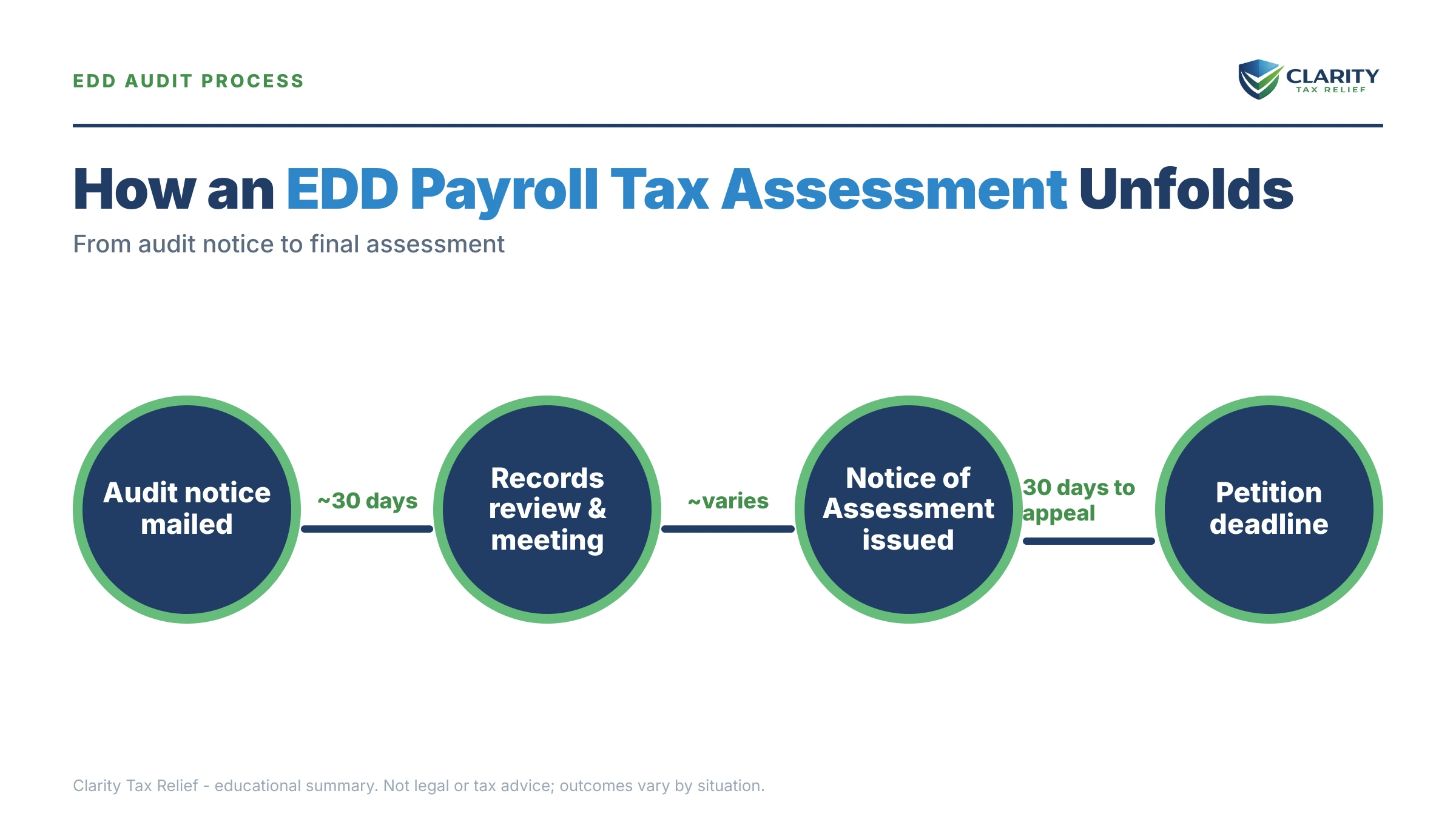
The short answer: an EDD payroll tax assessment is a bill from California's Employment Development Department saying your business underpaid state payroll taxes, usually after a worker-classification audit. You have 30 days from the Notice of Assessment date to file a Petition for Reassessment before the amount becomes final and collectible.
You opened a thick envelope from the EDD, and inside is a Notice of Assessment with a number on it that dwarfs what you thought you owed, because it isn't one quarter, it's every worker you paid on a 1099, recalculated as an employee, going back years. That number can land on you personally, not just the business. But the clock on your appeal is short, and this is fixable if you move now.
Two things on that notice decide everything: the assessment amount and the date your petition is due. The image below shows exactly what an EDD Notice of Assessment looks like and where those two figures appear.
⏱ Your deadline: you generally have 30 days from the date the Notice of Assessment was served to file a Petition for Reassessment with the California Unemployment Insurance Appeals Board. Miss it and the assessment becomes final — EDD can then lien, levy, and pursue you personally. Interest and penalties keep accruing the entire time.
Why you got an EDD payroll tax assessment
An EDD assessment means the Employment Development Department believes your business owes California payroll taxes it did not report or pay. Unlike the California FTB back taxes you'd get for income tax, EDD handles the four payroll taxes an employer touches: Unemployment Insurance (UI), Employment Training Tax (ETT), State Disability Insurance (SDI), and the state Personal Income Tax (PIT) that should have been withheld from wages.
By far the most common trigger is worker misclassification — paying people on a 1099 whom EDD decides should have been W-2 employees. California uses the ABC test (from AB5) to make that call, and it is strict: a worker is presumed an employee unless the business proves all three prongs. If you've been paid on a 1099 but treated like an employee — or you're the business owner who did the paying — this is the fight behind most assessments.
Other paths to an assessment: a former "contractor" filing for unemployment benefits (which alerts EDD instantly), late or missing DE 9 and DE 9C quarterly returns, or an audit that estimates wages when your records are incomplete. Whatever the trigger, the assessment isn't an accusation of fraud by itself — it's a bill, and the sooner you engage the cheaper it stays.
| Tax | Who pays it | What it funds |
|---|---|---|
| UI (Unemployment Insurance) | Employer | Unemployment benefits |
| ETT (Employment Training Tax) | Employer | Workforce training programs |
| SDI (State Disability Insurance) | Withheld from employee wages | Disability & paid family leave |
| PIT (Personal Income Tax) | Withheld from employee wages | California income tax |
The reason a misclassification assessment gets big fast: when EDD reclassifies contractors as employees, it assesses the employer for the UI and ETT that were never paid and the SDI and PIT that were never withheld from those workers, often across three years of quarters at once, plus penalties and interest.
What happens if you ignore an EDD assessment
An EDD assessment becomes final and fully collectible once the 30-day petition window closes. From that point the collection machine runs on its own, and California's Employment Development Department has enforcement tools that mirror the harshest state collectors:
- Notice of Assessment — the bill. You are here. The 30-day petition clock is running.
- Assessment becomes final — no petition filed, so the amount is locked in with interest and penalties added.
- State tax lien — EDD records a lien that becomes public record and can block financing or the sale of business assets.
- Levy & garnishment — EDD can seize business bank accounts, garnish accounts receivable, and levy wages to collect the balance.
- Section 1735 personal assessment — EDD assesses a responsible owner, officer, or check-signer personally, so the debt no longer stops at the business.
That last stage is the one that surprises people. Even if the business closes, a Section 1735 assessment follows the individual — EDD can then levy your personal bank account and intercept your personal California refund. That's why the response you make in the first 30 days matters far more than anything you can do after the assessment goes final.
Have an EDD Notice of Assessment in hand?
Get it reviewed free before your 30-day petition window closes. An experienced tax professional will read the classification findings, flag any personal-liability exposure, and lay out your options — confidential, no pressure.
Your options for resolving an EDD payroll tax assessment
You have more paths than the notice suggests. The right one depends on whether you dispute the assessment, can pay it, or need EDD to take less. Here's how the realistic options compare.
| Option | Best when | What it does |
|---|---|---|
| Petition for Reassessment | You dispute the classification or the wage estimate | Preserves appeal rights before CUIAB; pauses the amount going final |
| Pay in full | Assessment is correct and affordable | Stops interest and penalties; avoids lien/levy |
| Installment agreement | Balance is correct but you can't pay at once | Monthly payments; interest continues; lien may still file |
| Penalty abatement (good cause) | Late/failure penalties from reasonable circumstances | Can remove penalties, not the underlying tax |
| EDD Offer in Compromise | Closed business or responsible person who can't pay in full | Settles for less than owed — discretionary, means-tested |
| Section 1735 defense | You're assessed personally as a "responsible person" | Challenges willfulness and your authority over payments |
The Petition for Reassessment is your first move if anything about the assessment is wrong. Filing it within 30 days sends the dispute to the California Unemployment Insurance Appeals Board and stops the amount from becoming final while you argue the ABC test or the wage figures. You can file to preserve your rights even before your records are fully assembled.
If the balance is right and you simply can't pay it, an EDD installment agreement spreads it over monthly payments. This is separate from any business IRS installment agreement you may also need. For a closed or non-operating business, or a former responsible individual, EDD runs its own Offer in Compromise program. Like every legitimate settlement, it's means-tested and discretionary, never a fixed fractional payoff any promoter can promise you.
A worked example: how an assessment snowballs
Say you ran a small contractor crew and paid four workers a combined $180,000 over three years, all on 1099s. EDD audits, applies the ABC test, and reclassifies all four as employees. The Notice of Assessment shows $42,000: roughly $30,000 in back UI, ETT, SDI, and PIT that should have been withheld, plus about $12,000 in penalties and interest layered across twelve quarters.
If you let the 30 days pass without a petition, that $42,000 becomes final. EDD records a lien, and because you signed the checks, it issues a Section 1735 assessment against you personally — putting the full $42,000 on you as an individual even if the business folds. File the petition on time instead, prove even two of the four workers ran genuine independent businesses. The assessed base can drop sharply before you ever discuss a payment plan. (Figures are hypothetical and illustrative; your numbers depend entirely on your wages, quarters, and records.)
How to respond, step by step
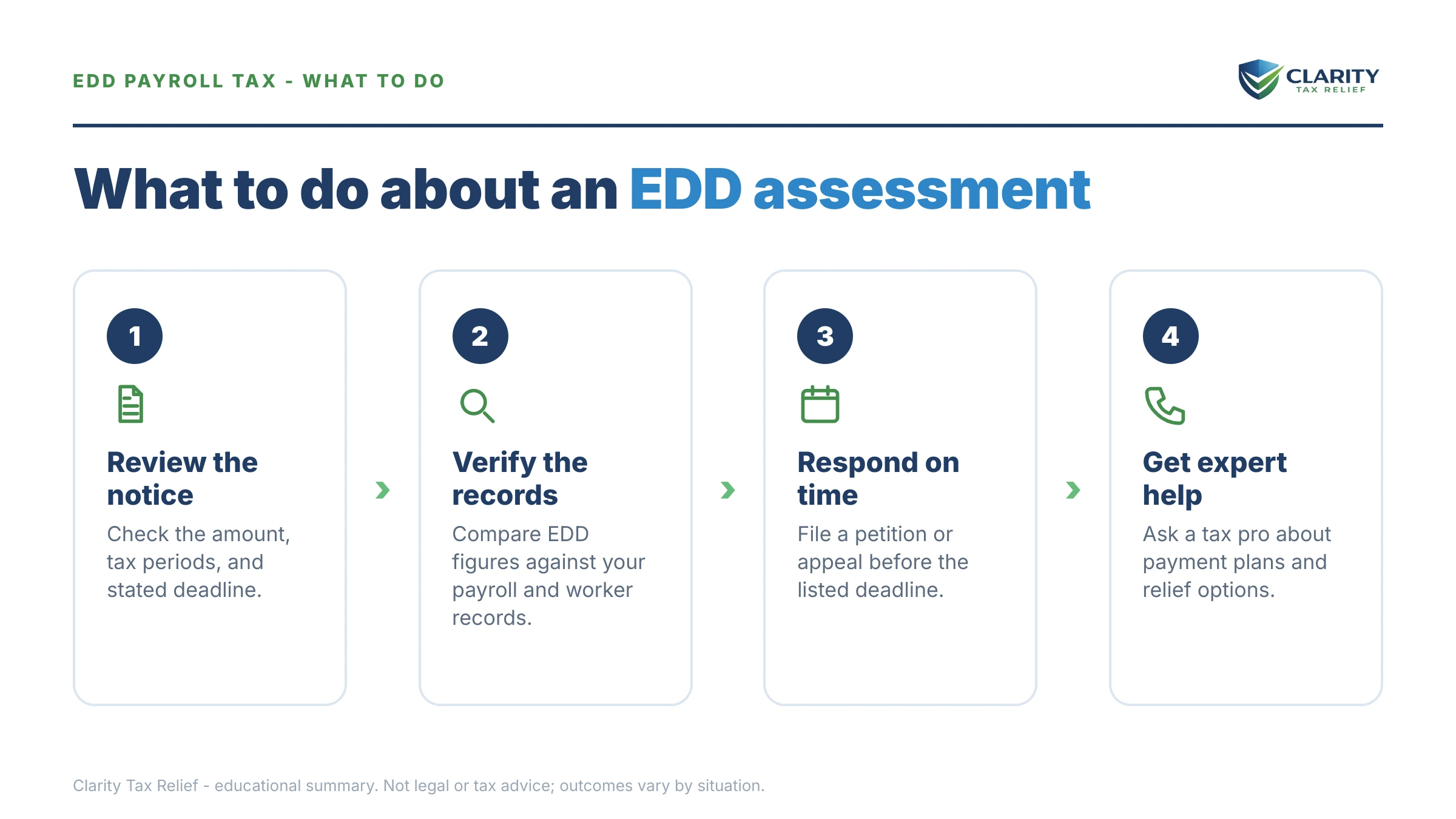
- Read the assessment date and the petition deadline — find the issue date and count 30 days forward; that's your window to petition.
- Decide whether you dispute the assessment — if the classification or wage estimate looks wrong, file the Petition for Reassessment to preserve your CUIAB appeal rights, even while you gather records.
- Pull your worker and payroll records — 1099s, contracts, DE 9 and DE 9C filings, bank records, and proof each worker ran their own business. The ABC test decides classification.
- Address personal liability early, if you're an owner, officer, or check-signer, assume a Section 1735 assessment may follow and start your responsible-person defense now.
- Choose a resolution path if the balance is correct — set up an installment agreement, request good-cause penalty abatement, or explore an EDD Offer in Compromise if you can't pay in full.
- Get an experienced review before the 30 days run out — misclassification and personal-liability defenses are technical and time-limited. Have a professional read the notice before the window closes.
When you can handle this yourself, and when you shouldn't
Not every EDD notice needs a professional. If the assessment is small, clearly correct (you filed a DE 9 late and owe a modest penalty). You can pay it, you can log in to EDD's system, pay, and request good-cause penalty relief on your own. A single-quarter balance you agree with is a DIY fix.
Where experienced help changes the outcome is misclassification and personal liability. Winning an ABC-test argument before the appeals board is document-driven and technical, and a Section 1735 personal assessment works much like the federal Trust Fund Recovery Penalty — the defense turns on whether you had authority over payments and whether the failure was "willful." Those cases, along with a multi-year assessment or a business winding down, are where getting it wrong is expensive. If you're also facing a federal side to the same problem, our guide on being personally liable for payroll taxes maps how the two agencies overlap. When your case involves personal exposure, get it reviewed before you file anything — start a free case review or call (888) 825-7779.
Terms on your EDD notice, decoded
Notice of Assessment (NOA): the formal bill stating the payroll tax, penalties, and interest EDD says you owe. The date your petition is due.
Petition for Reassessment: your written appeal, filed within 30 days, that sends the dispute to the California Unemployment Insurance Appeals Board and stops the amount from going final.
ABC test: California's standard (from AB5) for deciding if a worker is an employee. You must satisfy all three prongs to keep a 1099 classification.
Section 1735: the Unemployment Insurance Code provision letting EDD assess a responsible individual personally for amounts the business willfully failed to pay.
CUIAB: the California Unemployment Insurance Appeals Board — the independent body that hears your petition, separate from EDD itself.
DE 9 / DE 9C: the quarterly returns employers file with EDD reporting wages and payroll taxes; missing ones are a common audit trigger.
EDD payroll tax assessment questions, answered
Is an EDD payroll tax assessment the same as an IRS payroll tax bill?
No. EDD is a California state agency that collects UI, ETT, SDI, and state income-tax withholding, while the IRS collects federal 941 taxes. The two are separate debts with separate deadlines and separate personal-liability rules. A worker-classification problem often triggers assessments from both agencies at once, so resolving one does not resolve the other.
How long do I have to appeal an EDD assessment?
You generally have 30 days from the date the Notice of Assessment was served to file a Petition for Reassessment with the California Unemployment Insurance Appeals Board. Miss that window and the assessment becomes final and collectible. EDD may allow a late petition up to 60 days if you can show good cause for the delay, but do not count on it.
Can EDD hold me personally liable for the assessment?
Yes. Under California Unemployment Insurance Code Section 1735, EDD can assess a responsible individual — an owner, officer, or anyone with authority over paying the taxes — personally for amounts the business willfully failed to pay, including the income tax that should have been withheld from workers. This is California's version of the federal Trust Fund Recovery Penalty and it survives the business closing.
What triggers an EDD payroll tax audit?
The most common trigger is worker misclassification — paying people on a 1099 who EDD believes should be W-2 employees under California's ABC test. A former worker filing for unemployment benefits after being paid as a contractor is the single fastest way to open an audit. Late or unfiled DE 9 and DE 9C returns and large 1099 totals with no reported wages also draw scrutiny.
Can I set up a payment plan with EDD?
Yes. EDD offers installment agreements for employers who cannot pay a final assessment in full, and you can request one online or by phone. Interest and penalties continue to accrue while you pay, and EDD may still file a state tax lien to secure the debt. For larger balances, EDD will usually want financial information before approving terms.
Does EDD offer an Offer in Compromise?
Yes, EDD has its own Offer in Compromise program, separate from the IRS and the FTB. It is generally aimed at closed or non-operating businesses and former responsible individuals who cannot pay the full liability and where EDD decides accepting less is in the state's best interest. Approval is discretionary and means-tested — it is not a guaranteed or automatic discount.
What happens if my business closed — do I still owe the EDD assessment?
Closing or dissolving the business does not erase an EDD payroll tax debt. If EDD has assessed you personally under Section 1735 as a responsible person, that liability follows you individually and EDD can lien your property, levy your bank accounts, and intercept your personal state income-tax refund until it is paid or resolved.
Can EDD levy my bank account or file a lien?
Yes, once an assessment is final EDD can record a state tax lien, issue a bank levy, and garnish accounts receivable or wages to collect. A recorded EDD lien becomes public record and can block financing or the sale of business assets. Setting up an installment agreement or petitioning on time is what keeps enforcement from starting.
Your next 24 hours
- Find two things on the notice: the assessment amount and the petition deadline. Count 30 days from the issue date — write that date down.
- Gather your proof: the 1099s, worker contracts, your DE 9 and DE 9C filings, and anything showing each worker ran an independent business.
- Get a free case review before the petition window closes — use the 2-minute form or call (888) 825-7779. Filing on time is what protects your appeal rights and limits personal exposure.
This guide is general information, not tax or legal advice for your specific situation. Eligibility for IRS and California EDD programs depends on individual facts and circumstances; no outcome is guaranteed. For official EDD information see edd.ca.gov and, for appeals, the California Unemployment Insurance Appeals Board.