
Self-Employed & Gig Tax Debt
Personal Trainer Owes Back Taxes: What to Do in 2026
The short answer: personal trainer taxes owed come from the tax nobody withheld — income tax plus 15.3% self-employment tax on every 1099 and cash dollar you kept. The fastest fix is to file each missing year with real deductions (which usually shrinks the balance), then set up a payment plan, hardship status, or an Offer in Compromise for what's left.
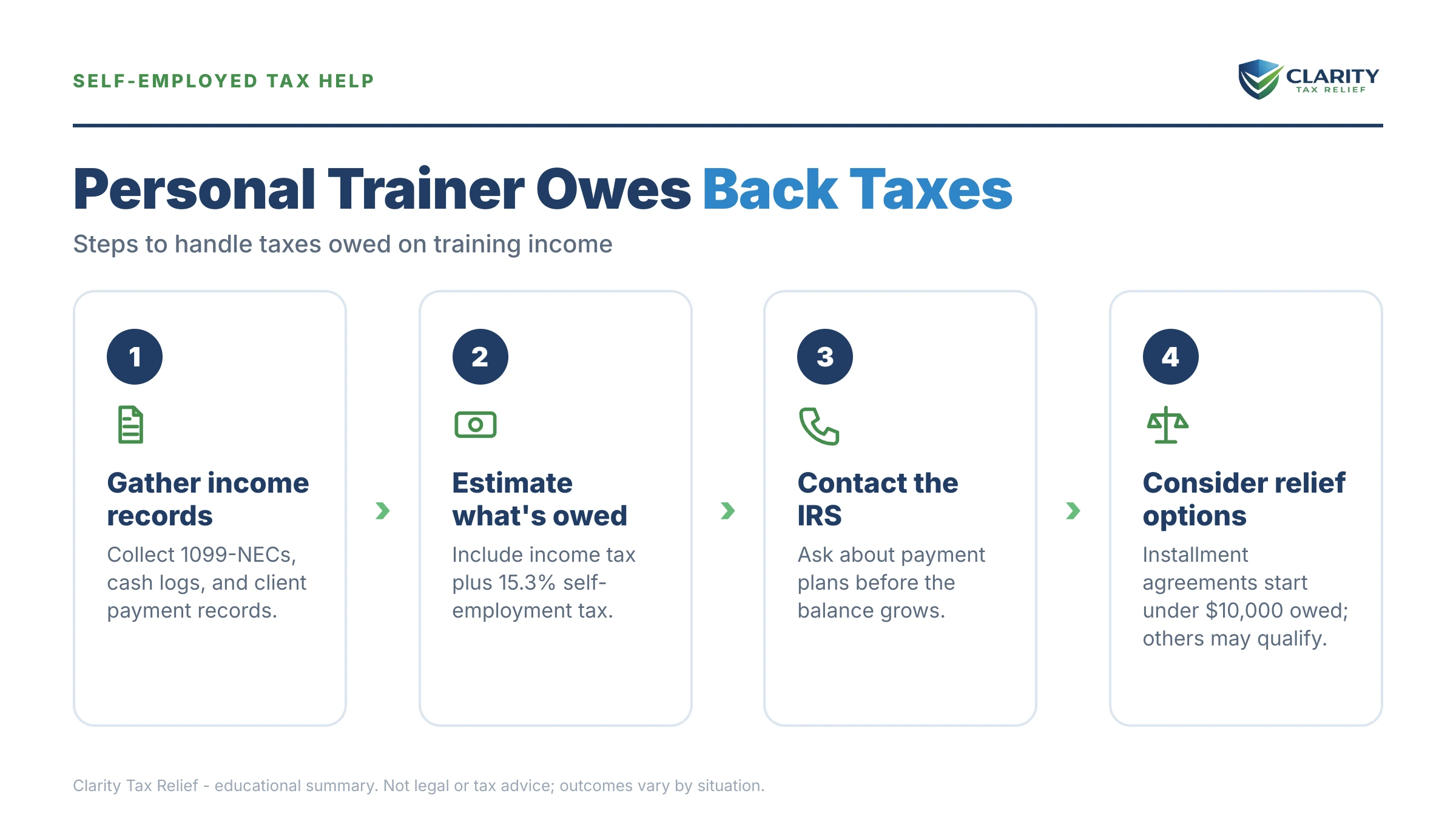
You closed out a good month, checked your bank account, and then remembered the IRS letter, or the balance that just appeared in your online account. Nothing was ever taken out of your training income, so the bill has been building quietly across one, two, maybe three years. This is fixable, and the map below shows exactly where to start.
Most of what makes this feel huge is the self-employment tax stacked on top of income tax — a piece W-2 employees never see. The image below shows what that stack actually looks like on a return, and where filing correctly can pull the number back down.
⏱ Your ongoing clock: there's no single deadline on back taxes — the cost grows every month you wait. The failure-to-file penalty runs 5% per month (up to 25%), ten times the 0.5% failure-to-pay penalty, and interest compounds on top. That's why filing the missing returns comes before everything else, even if you can't pay a cent yet.
Why personal trainers owe back taxes
A personal trainer owes back taxes because no employer withholds tax from the money — the entire bill is yours to set aside, and most trainers don't. When a gym pays you on a 1099-NEC or a client Venmos you for a session, you're an independent contractor, and the IRS expects you to pay as you earn through quarterly estimates.
Here's the part that shocks people: you owe two taxes on your profit, not one. Regular income tax at your bracket, plus 15.3% self-employment tax for Social Security and Medicare — the combined amount a W-2 job splits with your employer. On a trainer netting $40,000, self-employment tax alone runs roughly $5,650 before income tax even starts.
The three most common triggers we see:
- You never paid quarterly estimates. The first year self-employed, most trainers don't know quarterlies exist until the bill arrives. See how quarterly estimated taxes work and the penalty for not paying quarterlies.
- You mixed W-2 and 1099 work. Trainers who left a salaried gym job for independent clients, or run both at once, get blindsided when only the W-2 side had withholding. The self-employment tax shock guide breaks this down.
- Cash and app income never got tracked. Sessions paid in cash, Zelle, or Venmo feel invisible, but they're fully taxable. The year-end reckoning is brutal.
This is the classic first-year self-employed tax shock. It looks almost identical for a hair stylist with 1099 income or any booth-rent professional. What's different for trainers is how heavily deductions can move the number — covered next.
What happens if you ignore it
Ignoring a training tax debt doesn't freeze it — the IRS collection machine escalates on its own, notice by notice, whether or not a human ever looks at your file. The sequence is automated, and in 2026 that matters more than ever: IRS staffing dropped roughly 27% in 2025. But the systems that mail notices and issue levies never stopped.
- CP14 — the first bill for a filed year with a balance due. Read the CP14 notice guide for what it means.
- CP501 / CP503 — reminder notices. Still just bills, but penalties and interest keep stacking.
- CP504 — Notice of Intent to Levy. The IRS can seize your state tax refund and a federal tax lien becomes a real risk.
- LT11 / Letter 1058 — Final Notice of Intent to Levy. After 30 days the IRS can levy your bank account and issue a levy on money a gym owes you. This is where your Collection Due Process appeal rights kick in.
For unfiled years, a separate track runs in parallel: the IRS may file a substitute return for you, using the gym's 1099 with zero deductions and single filing status — the worst possible math. That inflated balance then feeds the same collection sequence. If you have several missing years, start with haven't filed taxes in 3 years and the IRS filed a substitute return for me.
The IRS can also issue a levy on your 1099 income — a one-time grab of whatever a gym or client owes you at that moment. It's less powerful than a wage garnishment on a W-2, but it can still empty a payout you were counting on.
Behind on training taxes and worried about a levy?
Send us a photo of any IRS notice you've received. An experienced tax professional will map exactly where you stand across every year and what your real options are — free, confidential, and before penalties and interest grow any further.
The deductions that shrink a trainer's tax debt
Filing the real return with your legitimate business expenses is usually the single biggest reduction available. It lowers both income tax and the 15.3% self-employment tax on each year. If the IRS built your balance from a substitute return, those deductions were never counted, so amending or filing correctly can slash the number.
These are ordinary and necessary expenses trainers routinely miss. You must have actually incurred them and be able to substantiate them, but if you did, claim them:
| Deduction | What it covers |
|---|---|
| Vehicle mileage | Driving between clients, gyms, and in-home sessions (standard mileage rate — track it) |
| Certifications & CEUs | NASM, ACE, NSCA renewals, specialty certs, continuing-education courses |
| Equipment & gear | Bands, kettlebells, mats, straps, TRX, heart-rate monitors, sound systems |
| Liability insurance | Professional liability / general liability premiums |
| Gym rent or booth fees | Space you rent to train clients, or a percentage a gym charges independent trainers |
| Home office | A dedicated space for programming, video coaching, and admin (regular & exclusive use) |
| Phone, apps & software | Business-use share of your phone, booking apps, coaching platforms, music subscriptions |
| Half of SE tax | An automatic above-the-line deduction for one-half of your self-employment tax |
If your miles went untracked, don't skip the deduction. You can often reconstruct them. See rescuing mileage deductions when you didn't track miles for the reconstruction method, which works the same for trainers.
Your options if you owe and can't pay in full
The IRS has several programs beyond "pay it all now," and which one fits depends on your balance and your cash flow. Here's the honest comparison, with what each one costs and what disqualifies you.
| Option | Best when | Cost / catch |
|---|---|---|
| Short-term plan (≤180 days) | You can pay in full within six months | $0 setup; interest & penalty still accrue |
| Streamlined installment agreement | Balance ≤ $50,000; want monthly payments, no financial disclosure | Small setup fee; up to 72 months; accrual continues |
| Currently Not Collectible | Paying anything would create genuine hardship | Collection pauses; debt & interest remain; periodic review |
| Offer in Compromise | Your income & assets genuinely can't cover the debt | $205 fee (waivable if low-income); ~1 in 5 accepted |
| First-Time Penalty Abatement | Clean compliance the prior 3 years | Removes penalties, not tax or interest |
One note for 2026: First-Time Abatement is being replaced by Automatic Exemption from Penalty (AEP), starting summer 2026 — the IRS is moving toward applying it automatically without a request. Reasonable-cause relief (illness, disaster, a documented hardship) is a separate path that can stack. And if you're weighing a plan against a settlement, the payment plan vs. Offer in Compromise comparison walks through which fits which situation.
A worked example: what a trainer really owes
Say you're a trainer who netted about $45,000 a year for two years and never paid quarterlies. Here's roughly how that becomes a back-tax balance — numbers are hypothetical and simplified to show the shape.
- Self-employment tax: ~15.3% on ~92.35% of profit ≈ $6,360 per year.
- Income tax: after the standard deduction and half-of-SE-tax deduction, roughly $2,600 per year for a single filer at these numbers.
- Combined: about $8,960 per year, or roughly $18,000 across two years before penalties.
- Penalties & interest: failure-to-file at 5%/month (capped at 25%) plus failure-to-pay and interest can add several thousand more if the returns sit unfiled.
Now watch what deductions do. Suppose you can substantiate $9,000/year in mileage, certifications, gear, insurance, and booth fees. That drops profit to ~$36,000, cutting self-employment tax to about $5,090 and income tax further — potentially lowering each year's tax by well over $1,500. Across two years, filing correctly could shave several thousand dollars off the balance the IRS is chasing.
On the roughly $18,000 that remains, a 72-month streamlined installment agreement runs about $250/month before accrual, while interest and the 0.5% monthly failure-to-pay penalty continue until it's paid. Want to see the penalty-and-interest math on your own numbers? Estimate it with our IRS penalty & interest calculator. If your balance lands closer to five figures, the I owe the IRS $15,000 and I owe the IRS $20,000 guides map the option bands.
How to respond, step by step
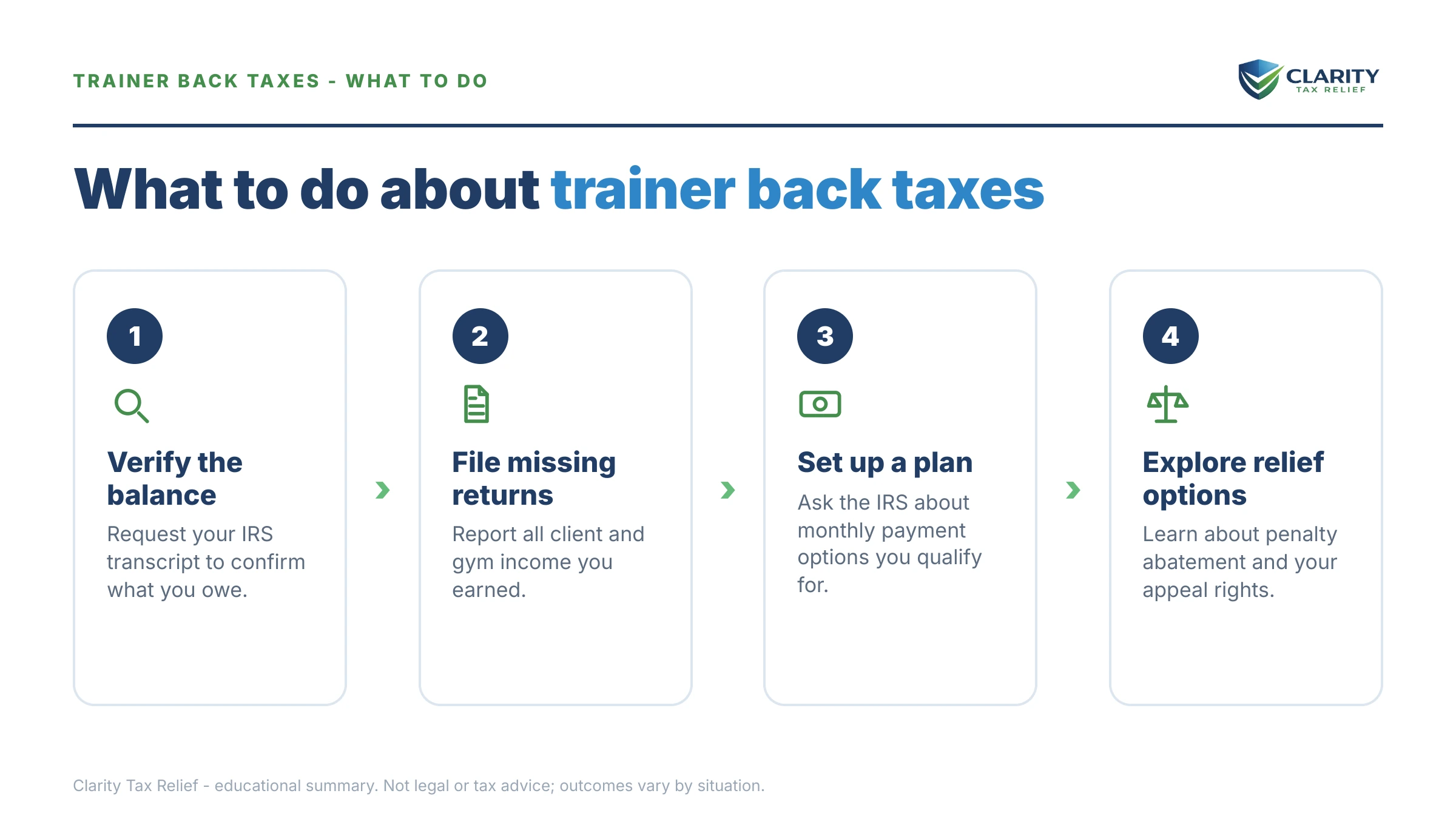
- Pull your income records. Order your IRS wage and income transcript to see every 1099-NEC and 1099-K filed under your name, and add your cash sessions from your booking app or calendar.
- File the missing years with real deductions. Prepare a Schedule C for each unfiled year and claim your mileage, certifications, equipment, and insurance. This almost always lowers the balance.
- Add up the real total. Combine tax, self-employment tax, both penalties, and interest across every year so you know the true number before you pick a plan.
- Choose the resolution that fits. Match your balance and cash flow to a payment plan, Currently Not Collectible, an Offer in Compromise, or penalty abatement.
- Get current on this year's quarterlies. Start paying estimated taxes now so you don't add a fresh balance — the IRS treats a new debt as a defaulted plan.
- Get a professional review for multiple years or large balances. If you have several unfiled years, a five-figure balance, or a levy in motion, have an experienced tax professional sequence the filings and negotiation.
When you can handle this yourself, and when to get help
If you have one filed year with a balance you can pay within 180 days, or a balance under $50,000 you can cover on a streamlined monthly plan, you can likely handle this yourself. Set up the plan directly at IRS.gov, keep paying your quarterlies, and you're done — no firm needed. The payment plan online walkthrough shows every screen.
Experienced help changes the outcome when the situation is layered: multiple unfiled years, a substitute return the IRS already filed against you, a levy or final notice in motion, or an Offer in Compromise where the math has to be built carefully. The order you fix things in — file the returns, abate the penalties, then negotiate the balance — determines what you ultimately pay. Getting that sequence wrong is the most expensive mistake trainers make.
One more scenario worth a professional look: if a gym paid you on a 1099 but controlled your schedule and methods, you may have been misclassified. Filing Form SS-8 to challenge 1099 treatment can shift the employer's half of payroll tax off your bill entirely.
Worried a levy is close? Get your situation reviewed free before a final notice of intent to levy runs its 30-day clock.
Terms on your notice, decoded
- Self-employment (SE) tax — the 15.3% Social Security and Medicare tax on your net profit; the piece an employer would normally split with you.
- Schedule C — the form where you report training income and deduct business expenses; it's what turns gross income into taxable profit.
- Substitute for Return (SFR) — a return the IRS files for you when you don't, using reported income and no deductions — almost always inflating what you owe.
- Installment agreement — a monthly IRS payment plan; "streamlined" versions skip financial disclosure for balances up to $50,000.
- Currently Not Collectible (CNC) — a hardship status that pauses collection when paying would leave you unable to cover basic living expenses.
- Offer in Compromise (OIC) — a settlement for less than the full balance, granted only when the IRS agrees it can't collect the full amount.
Personal trainer tax questions, answered
Why do personal trainers owe so much in back taxes?
Because nobody withholds tax from a trainer's pay. When a gym pays you on a 1099-NEC or a client pays cash, you owe both income tax and 15.3% self-employment tax on the profit, and none of it is taken out during the year. Skip your quarterly estimates and the whole bill lands at once, plus penalties and interest.
Do I have to report cash payments from training clients?
Yes. All income from training is taxable whether it arrives by 1099, Venmo, Zelle, or cash, and whether or not anyone reports it to the IRS. The 1099-K threshold reverted to $20,000 and 200 transactions for 2026, so many app payments won't generate a form. But the income is still legally reportable, and unreported cash is exactly what a Schedule C audit looks for.
Can deductions lower the back taxes I already owe?
Often, yes, especially if the IRS built the balance from a substitute return that gave you zero deductions. Filing a proper Schedule C with your mileage, certifications, equipment, liability insurance, and home-office costs can cut both the income tax and the self-employment tax on each year. Amending or filing the real return is frequently the single biggest reduction available.
What if the gym paid me on a 1099 but treated me like an employee?
You may have been misclassified, which matters because employees don't pay the employer half of payroll tax. If the gym set your schedule, required their methods, and controlled your work, you can file Form SS-8 to ask the IRS to rule on your status and Form 8919 to pay only your share of Social Security and Medicare tax. That can meaningfully reduce a back-tax balance.
I haven't filed in years — how many returns do I actually have to file?
The IRS generally wants the last six years filed to be considered in good standing, though you may need older years if the IRS filed substitute returns or you want to claim a refund. File the most recent years first. A refund is only payable if you file within three years of the original due date — older refunds are lost. But the filing still stops the failure-to-file penalty from growing.
Can I settle my personal trainer tax debt for less than I owe?
Sometimes, through an Offer in Compromise, but only when the IRS's own math shows it can't collect the full amount from your income and assets. The IRS accepted roughly 1 in 5 offers in FY2024, so it is not automatic. Ignore any company promising to settle for 'pennies on the dollar'. That phrase is a marketing red flag, not a program.
Will the IRS take my training income or my bank account?
It can, but only after a sequence of notices ending with a final notice of intent to levy that gives you 30 days and appeal rights. The IRS can issue a one-time levy on money a gym owes you, or levy your bank account after a 21-day hold. Setting up a payment plan or hardship status before that final notice stops the levy from ever happening.
Your next 24 hours
- Find the numbers. Locate any IRS notice and note the tax year and balance, or log into your IRS online account to see what's actually owed and for which years.
- Gather your records. Pull last year's return (if you have one), your 1099s, your booking/payment app history. A rough list of business expenses — mileage, certs, gear, insurance.
- Get a free case review. Call (888) 825-7779 or use the 2-minute form. An experienced tax professional will tell you what filing correctly does to your balance and which option fits, before penalties and interest climb another month.
This guide is general information, not tax or legal advice for your specific situation. Eligibility for IRS programs depends on individual facts and circumstances; no outcome is guaranteed.
Primary sources: IRS Self-Employed Individuals Tax Center, IRS payment plans, Taxpayer Advocate Service