
Tipped & Cash-Income Workers
Restaurant Server Owes Tax on Tips: What You Owe and How to Fix It (2026)
The short answer: server tip income taxes owed come in two parts — regular income tax plus Social Security and Medicare tax (about 7.65%) on any tips your employer didn't withhold on. You report unreported tips on Form 4137, and the balance is fixable with a payment plan, hardship status, or penalty relief.
The bill hit harder than you expected, and it's the tips that did it. You reported some of your credit-card tips, kept your cash tips in your pocket, and now the IRS says you owe — either as a balance on the return you just filed or as a CP2000 saying your numbers don't match the restaurant's. That sinking feeling is real, but this is one of the most fixable tax problems there is.
Here's the piece almost no one explains: unreported tips get taxed twice over — the income tax you'd expect, and a second Social Security and Medicare charge on Form 4137 that your employer never took out of your paychecks. The worked example below shows exactly how those two numbers stack.
⏱ Your clock: if a notice arrived, your deadline is the date printed on it — typically 21 days on a CP14, or the response date on a CP2000. If no notice has come yet, the clock still runs: the failure-to-pay penalty adds 0.5% a month and interest compounds daily until the balance is paid.
Why you owe server tip income taxes
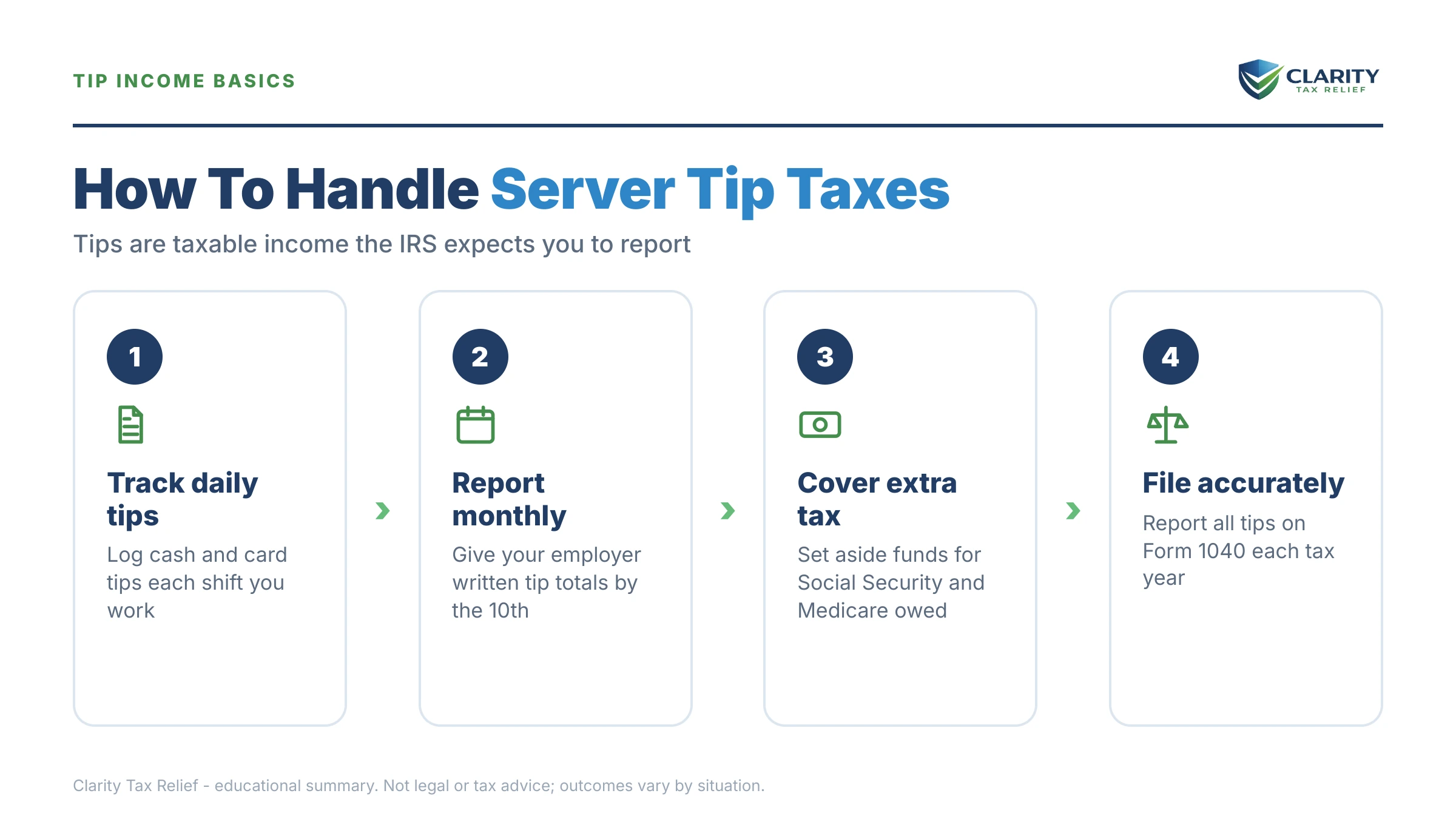
You owe because tips are taxable wages, and no one withheld enough tax on them during the year. When you're paid a small hourly tipped wage plus tips, your paycheck withholding is calculated on the small wage — the tips you took home in cash were never run through payroll. At tax time the full tax on those tips lands at once.
All tips count: cash left on the table, tips added to a card, and your share of a tip pool. You're required to report tips of $20 or more in a month to your employer, usually on a tip statement (the IRS version is Form 4070). What you report gets taxed through payroll. What you don't report doesn't, until you file, or until the IRS matches records and sends a notice.
This is not an audit. It's a balance-due situation, and like the first CP14 notice, it's cheapest to handle early, before penalties and interest keep compounding.
Which tips are taxable, and how the IRS sees them
Every category of tip is taxable, but the IRS learns about each one differently. Card tips leave a paper trail; cash tips mostly don't — which is why cash tips are where nearly every surprise balance comes from.
| Type of tip | Taxable? | How the IRS sees it |
|---|---|---|
| Credit / debit card tips | Yes | Runs through the POS and payroll; usually already in W-2 box 7 (Social Security tips) |
| Cash tips you kept | Yes | Invisible unless you report them — the #1 source of a balance due |
| Your share of a tip pool / tip-out you received | Yes | Reportable like any tip; card portions often show on your W-2 |
| Tips you paid out to bussers/bartenders | Subtracted | Reduces your reportable tips, but only if you keep records |
| Allocated tips (W-2 box 8) | Yes | Added by the restaurant when reported tips fall below ~8% of sales |
| Non-cash tips (event tickets, gifts) | Yes (income tax) | Reported at fair value on your return; not subject to FICA |
That box 8 line matters. If the restaurant's total reported tips come in under roughly 8% of its food-and-drink sales, it can allocate extra tips to you, and those show up on your W-2 whether or not you actually earned them that way. When the tips on your return don't match your W-2 or the restaurant's filings, the IRS can send a CP2000 notice proposing more tax.
The two-part tax: a worked example
Unreported tips are taxed twice — once as income and once for Social Security and Medicare. Here's the arithmetic on a clearly hypothetical server.
Say you earned $18,000 in W-2 wages and $24,000 in tips last year, but only reported $12,000 of those tips to your manager. The other $12,000 in cash tips never had a dime withheld.
- Income tax on the $12,000 unreported tips, at a 12% bracket: $1,440.
- Social Security + Medicare on Form 4137, at 7.65%: $918.
- Balance created: about $2,358 added to what you owe on your return.
Leave it unpaid and the failure-to-pay penalty adds 0.5% a month while interest compounds daily — over a year that's roughly another $140 in penalty plus interest, pushing the balance past $2,600. You can estimate your own accruals with our IRS penalty & interest calculator.
Now stretch it across three years of the same habit and you're looking at a balance north of $7,000 — the range where getting it structured correctly matters. That's the same math whether you owe as a single filer or married. If your spouse also works, filing jointly can change your bracket but not the 7.65% FICA piece.
What happens if you ignore it
A tip-tax balance follows the same automated collection path as any other individual tax debt, and for a tipped worker, the wage-levy stage is especially painful because it hits your steady paycheck, not your unpredictable tips.
- Balance due / CP14 — the first bill. No enforcement yet, but penalties and interest start.
- CP501 / CP503 — reminder notices. Still just bills, but the balance grows monthly.
- CP504 — Notice of Intent to Levy. The IRS can seize your state tax refund and a federal tax lien becomes possible.
- LT11 / Letter 1058 — Final Notice of Intent to Levy. After 30 days the IRS can garnish your wages and levy your bank account. A wage levy is continuous — it stays on every paycheck until released.
In 2026 the sequence runs on autopilot. IRS staffing was cut sharply in 2025. But the notices, liens, and levies are issued by automated systems that never slowed down — the machine escalates whether or not a human ever opens your file.
Owe tax on your tips and not sure which notice you're holding?
Send us a photo of the notice or your W-2. An experienced tax professional will decode exactly what you owe and lay out your options, free and confidential, before penalties and interest climb any higher.
Your options if you can't pay the tip taxes owed
A tip-tax balance qualifies for every standard IRS resolution program — the right one depends on how much you owe and what your finances look like.
| Option | Best if | Cost / setup |
|---|---|---|
| Pay in full | You can cover it now | Stops penalties immediately; pay at IRS.gov/payments |
| Short-term plan (≤180 days) | You can clear it within about 6 months | $0 setup; interest & penalty still accrue |
| Streamlined installment agreement | You owe $50,000 or less | Up to 72 months; low setup fee; no financial disclosure |
| Currently Not Collectible | Paying anything creates hardship | Collection pauses; debt remains; needs financials |
| Offer in Compromise | Assets + income can't cover the debt | $205 fee (waivable if low-income); ~1 in 5 accepted |
| First-Time Abatement | Prior 3 years are clean | Removes the failure-to-pay penalty; free to request |
For most servers the balance lands under $10,000, which means a guaranteed installment agreement is on the table, and setup can be done yourself. If you're between $10,000 and $50,000, a streamlined installment agreement spreads it over up to 72 months. If money is genuinely too tight for any payment, Currently Not Collectible status pauses collection. And if your finances truly can't cover the debt, an Offer in Compromise settles for less. But the IRS runs the math, and roughly 1 in 5 offers were accepted in FY2024, so it's real but never a sure thing. (Read how the process actually works in how an offer in compromise actually works.)
"No tax on tips": what it does and doesn't change
The 2025 tax law created a temporary federal income-tax deduction for qualified tips for tax years 2025 through 2028. But it will not erase a tip-tax debt you already owe. Four limits matter for anyone with a balance:
- It's a deduction, not an exemption — it reduces the income-tax portion, not the whole bill.
- It does not touch Social Security and Medicare tax — the Form 4137 piece still applies.
- It applies going forward; it does not wipe out prior-year balances already assessed.
- Many states still tax tips in full, and the deduction has income-based phase-outs at higher earnings.
Verify how it applies to your specific return before assuming it changes what you owe, and if a prior year is the problem, the deduction won't help that year at all.
How to respond, step by step
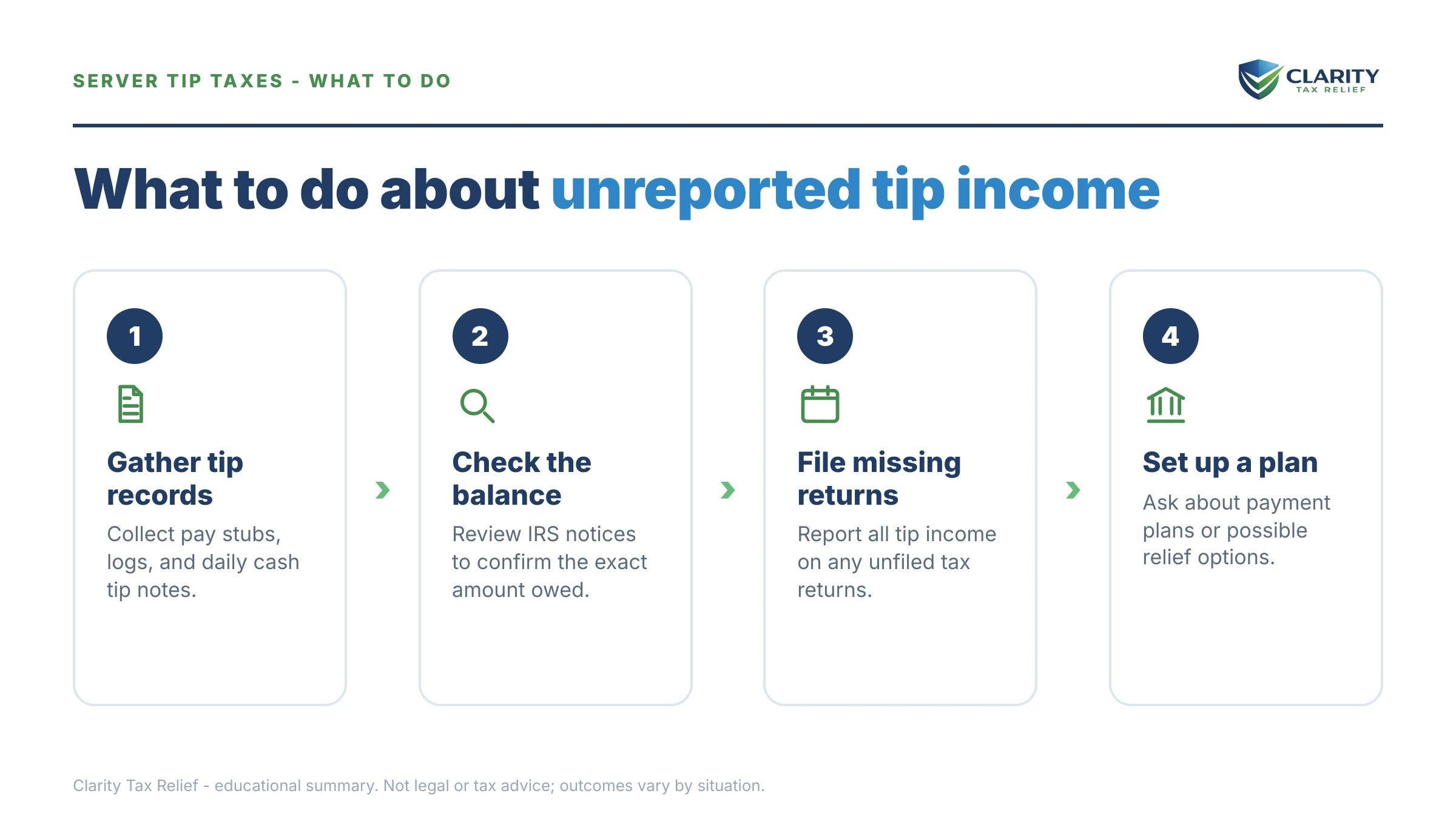
- Pull your W-2 and check box 7 (Social Security tips) and box 8 (allocated tips) so you know what was already reported.
- Compare against your own records — tip log, credit-card tip reports, or POS printouts — to find what went unreported.
- Figure the two-part tax on the unreported tips: income tax plus Social Security and Medicare on Form 4137.
- If it's correct and you can pay: pay by the notice date at IRS.gov/payments to stop penalties and the notice sequence.
- If you can't pay in full: set up a short-term plan or installment agreement before the deadline, even a plan started today prevents everything that follows.
- If you owe for multiple years or got a CP2000: get a professional review first, so the years are fixed in the right order.
When you can handle this yourself, and when to get help
Plenty of tip-tax situations are DIY. If you agree with the balance, it's a single year, and it's small enough to pay within 180 days or through a simple plan, you can set it up in minutes — our walkthrough on how to set up an IRS payment plan online covers it. A first, correct CP14 you agree with rarely needs anyone.
Experienced help changes the outcome when the picture gets tangled: multiple unfiled years, a CP2000 proposing tips you don't think you earned (often from allocated tips), a wage levy already in motion, or an Offer in Compromise where the math has to be built correctly the first time. If you're staring at a balance over $10,000 or wondering whether you're even a candidate for settlement, a review costs nothing and can save you from paying a penalty you could have removed. See our plain guide to what to do when you owe the IRS $5,000 for a sense of the smaller-balance playbook.
Terms on your notice, decoded
- Form 4137 — the form where you report Social Security and Medicare tax on tips you didn't report to your employer. It adds about 7.65% of those tips to your bill.
- Allocated tips (W-2 box 8) — extra tips the restaurant assigns to you when total reported tips fall below roughly 8% of sales.
- Social Security tips (W-2 box 7) — the tips your employer already ran through payroll and withheld on.
- Tip-out / tip pooling — tips shared among staff. Your share is taxable, and tips you pay out can reduce your reportable total if you keep records.
- Uncollected Social Security & Medicare tax — the FICA that wasn't withheld on unreported tips and comes due on your return.
Server tip taxes, answered
Do I have to pay taxes on cash tips?
Yes. All tips are taxable income — cash, credit-card, and tips shared through a pool — and you're required to report tips of $20 or more in a month to your employer. Cash tips are where most balances come from because no tax is withheld from them. If you didn't report them, you owe both income tax and Social Security and Medicare tax on that money.
Isn't there "no tax on tips" now?
The 2025 tax law created a temporary federal income-tax deduction for qualified tips for tax years 2025 through 2028, with an income-based phase-out. It is a deduction, not a full exemption, and it does not remove Social Security and Medicare tax on your tips. It also does not erase tip taxes you already owe from earlier years, and many states still tax tips in full, so verify how it applies to your return before assuming a balance disappears.
What is Form 4137 and do I need it?
Form 4137 is where you report Social Security and Medicare tax on tips you didn't report to your employer. If you had unreported cash tips, you attach it to your return and it adds roughly 7.65% of those tips to your bill on top of income tax. It's also how those earnings get credited toward your future Social Security benefits, so filing it isn't only a cost. It protects your record.
Will the IRS know about my cash tips?
Often, yes. Credit-card and debit-card tips flow through the restaurant's records and onto your W-2, and if the restaurant's total reported tips fall below about 8% of food-and-drink sales, it may allocate additional tips to you in box 8. When the tips on your return don't match those records, the IRS can send a CP2000 proposing extra tax. Cash tips paid directly to you are harder for the IRS to see, but reporting them is still required.
Can I set up a payment plan for taxes owed on tips?
Yes. Tip-tax balances qualify for the same payment options as any other individual income tax. If you owe $50,000 or less, you can usually set up a streamlined installment agreement online for up to 72 months without detailed financial disclosure, and balances of $10,000 or less generally qualify for a Guaranteed Installment Agreement. A short-term plan gives you up to 180 days with no setup fee — interest and penalties keep running until it's paid.
What if I owe tip taxes for multiple years or haven't filed?
File the missing years first, because the failure-to-file penalty is 5% a month — ten times the 0.5% failure-to-pay penalty. Once every year is filed, the IRS treats the balances as one account you can resolve together through a single payment plan, hardship status, or an Offer in Compromise if your finances qualify. The order matters: fixing returns and penalties before attacking the balance usually lowers the total.
Does owing tax on tips affect my Social Security?
It works both ways. Paying the Social Security and Medicare portion on Form 4137 credits those tips toward your future benefit, so reporting them builds your record. But if the IRS moves to collection and you're already receiving Social Security, up to 15% of your benefit can be levied through the Federal Payment Levy Program. Resolving the balance with a plan or hardship status prevents that.
What happens if I didn't report my tips to my employer?
You're still responsible for the tax, and you report the unreported tips directly on your own return using Form 4137. Because your employer never withheld on those tips, the full income tax plus about 7.65% Social Security and Medicare comes due at filing. If the shortfall is large or spans several years, expect penalties and interest on top, but penalty relief may remove part of it if your prior three years are clean.
Your next 24 hours
- Find the number. On your W-2, read box 7 (Social Security tips) and box 8 (allocated tips). On any IRS notice, find the tax year and the amount due.
- Gather your proof. Pull last year's return, your W-2s, and anything showing your actual tips — a tip log, card-tip reports, or POS printouts.
- Get a free case review. Call (888) 825-7779 or use the 2-minute form — the sooner you act, the less penalty and interest stack up on the balance.
This guide is general information, not tax or legal advice for your specific situation. Eligibility for IRS programs depends on individual facts and circumstances; no outcome is guaranteed.
Primary sources: IRS Topic 761, Tips – withholding and reporting, About Form 4137, IRS payment plans